Wardrobes · 14 min read · 21 August 2026
Tall wardrobe doors: how tall, how heavy and when to split them
How tall can a wardrobe door be? What makes tall doors heavy and warp-prone, the hinge counts the maker publishes, when to split a door or add a top box, sliding doors for tall openings, handle position and what to ask in a quotation.

By Ali Haider Basra, Founder, Al Tareeq Decor · Contact our workshop
Key takeaways
- No single height limit exists: a tall door is limited by its hinges, its board or glass and its width together, and we found no UAE standard.
- Weight grows with area: our arithmetic from published tables puts a 600 by 2,400 mm slab of MDF at roughly 16 to 20 kg and 6 to 8 mm glass alone at 21 to 28 kg, above the two hinge bands Blum lists up to 12 kg.
- Blum says 2 hinges for 4 to 6 kg and 3 for 6 to 12 kg, valid for doors up to 600 mm wide with one more up to 650 mm, and that height also counts; we do not state the heavier bands because we could not verify them.
- A split into upper and lower leaves or a top box gives lighter, shorter doors at the cost of a visible joint; sliding doors move the weight limit to the system's own rating.
- Ask in writing for each leaf's size and weight, hinges per door and their rating, where the door is split, how it is kept flat and where the handle sits.
On this page
- Key takeaways
- How tall can a wardrobe door be?
- Why a tall door gets heavy: board, glass and mirror
- What a 600 mm by 2,400 mm door could weigh (illustration only)
- Why tall doors warp, and why width matters
- Hinge counts for height and weight: what the maker says
- Hinge counts from the maker (only the bands we could verify)
- Split the door, or add a top box
- One tall door, a split, a top box or sliding: what changes
- Sliding doors for a tall opening
- Handle position on a tall door
- Flatness and alignment: how to judge a tall door
- What to ask for in a quotation
- Questions for a tall-door quotation
- What we do about tall doors
- Common questions
How tall can a wardrobe door be?
There is no single number. The honest answer is that a door can be as tall as three things allow together: the hardware that carries it, the board or glass it is made of, and the width of the opening. A door that is fine at 2 metres in one board and one width can be a problem at the same height in a heavier material, or wider. This guide explains the three limits so that you can judge a quotation, and shows where to split a door when a single leaf is no longer the sensible choice.
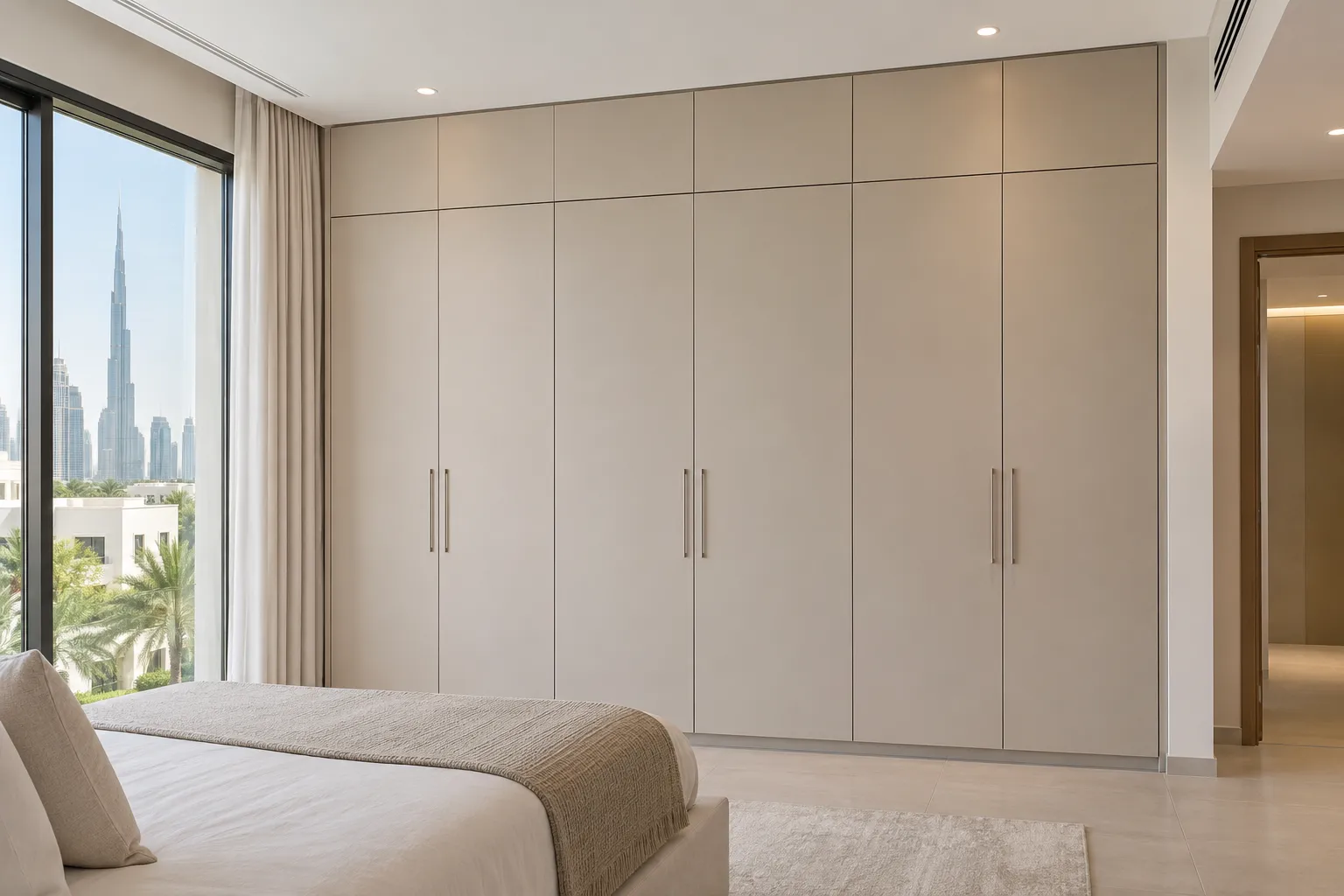
Two warnings first. We found no UAE standard for the height of a wardrobe door, and we do not publish a maximum of our own, so every number below is a maker's figure or our own arithmetic, labelled as such. And a tall door is a different question from a tall wardrobe: how the carcass reaches the ceiling, the gap at the top and the filler panels are covered in our floor-to-ceiling wardrobe guide, while this page only deals with the door leaf.
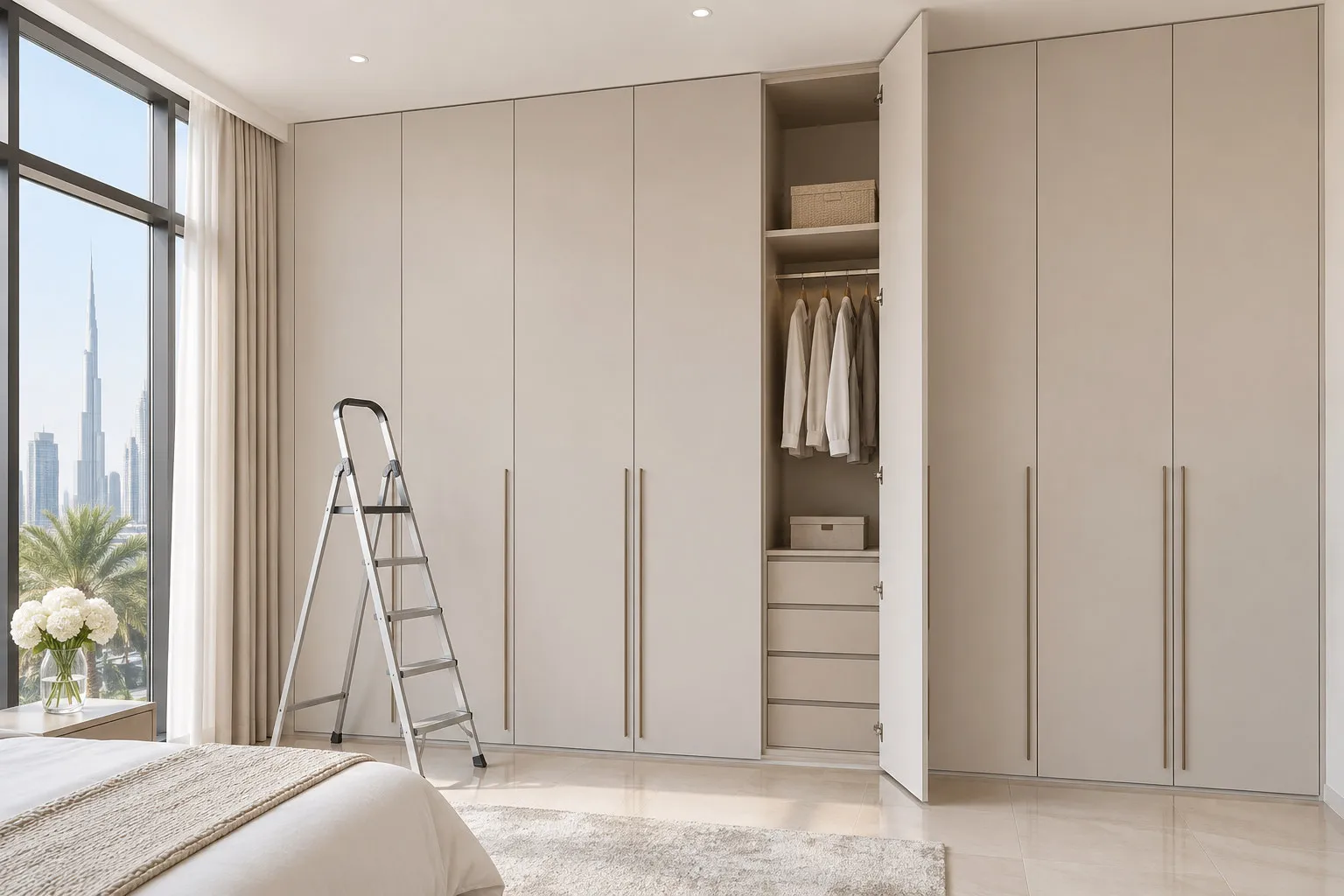
The drawing shows one tall door in the order the problem arrives: its width and height, the two weight bands we could confirm from the hinge maker, the hinges that go with them, and one way out, a split into an upper and a lower leaf.
- 1. The door: up to 600 mm wide in Blum's table, and its height counts too
- 2. 4 to 6 kg: Blum says 2 hinges are optimal
- 3. 6 to 12 kg: Blum says 3 hinges are optimal
- 4. The split option: an upper and a lower door, each shorter and lighter
- 5. What to ask: door weight, hinges per door and whether the door is split
Why a tall door gets heavy: board, glass and mirror
A hinge carries the weight of the whole door, and weight grows with area. A door twice as tall is twice as heavy at the same width and thickness, and the hinge maker is clear about what counts: "the door weight including additional weights such as handles". The handle is part of the load, and so is any glass, mirror or metal frame.
To put a size on it we used two published tables and one illustrative door, 600 mm wide and 2,400 mm high, which is 1.44 square metres. A MDF trade page lists standard MDF (average density 750 kg per cubic metre) at 11 kg per square metre in 16 mm and 14 kg in 19 mm, and says the weight is not strictly proportional to thickness between brands; 18 mm is not on its list, so the figure for 18 mm sits between the two. A single slab of that board of that size would therefore weigh roughly 16 to 20 kg. That is our own arithmetic, for one imagined door, not a weight we claim for any door we make.
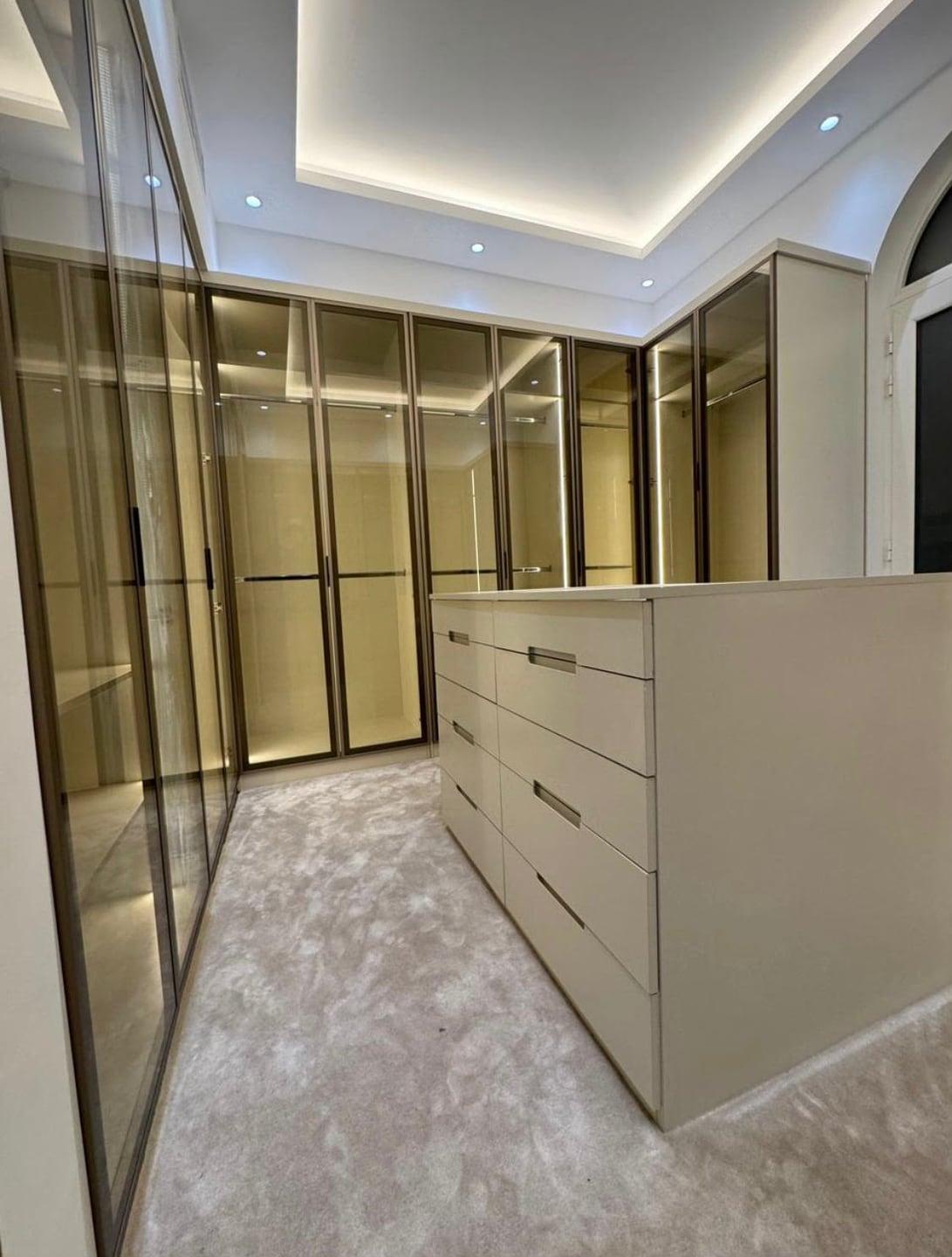
Glass is heavier for its thickness. A glass maker's table gives 14.5 kg per square metre for 6 mm and 19.5 kg for 8 mm, so the same 1.44 square metres of glass alone would weigh about 21 kg at 6 mm and 28 kg at 8 mm, before any frame. A mirror is glass with a coating, so the same logic applies, and our mirror wardrobe doors guide explains the fixing side. Compare those figures with the two weight bands we could confirm from the hinge maker, 4 to 6 kg and 6 to 12 kg: a full-height door of ordinary board or glass sits above the bands we can quote. That is exactly why the weight has to be estimated for the actual door and the hinge count and the hinge rating confirmed for it, not assumed.
What a 600 mm by 2,400 mm door could weigh (illustration only)
One slab of MDF, 16 mm
- Published weight per sqm
- 11 kg/sqm (mdf-info.eu, standard 750 kg/m3)
- Weight of 1.44 sqm
- about 15.8 kg
One slab of MDF, 19 mm
- Published weight per sqm
- 14 kg/sqm (mdf-info.eu)
- Weight of 1.44 sqm
- about 20.2 kg
Glass only, 6 mm
- Published weight per sqm
- 14.5 kg/sqm (Bendheim)
- Weight of 1.44 sqm
- about 20.9 kg
Glass only, 8 mm
- Published weight per sqm
- 19.5 kg/sqm (Bendheim)
- Weight of 1.44 sqm
- about 28.1 kg
Our arithmetic from two published tables for an imagined door; a real door has a frame, edge bands, a handle and a different board or glass, so its weight is something to ask for in the quotation. Every row sits above the 12 kg top of the two Blum weight bands we verified.
Why tall doors warp, and why width matters
A tall door is a long, thin plank standing on edge, and a small bow along its length shows as a gap at the middle of one edge or a corner that stands proud. Boards and finished doors can bow when the two faces do not behave the same, for example when one side is exposed to a damp wall or the sun and the other is not. Our moisture-resistant boards guide covers the board side. A wardrobe against a bathroom wall is the case where this shows first.
We did not find a neutral test that sets a safe height for a door in a given board, so we do not give one. What the sources we opened do say is consistent. Cabinetmakers in a trade forum say that "the wider panels are much more likely to warp or split", that "the narrower, the better", and that a wider door can be split with a centre rail. A retailer's page for a tall-door straightening kit describes the product as designed "to preserve the integrity of tall cabinet doors" by preventing bowing or correcting a curve; that is one product on one retailer's page, and it shows only that makers know the problem and sell answers to it.
Width also changes the hinges. Blum's table is for doors up to 600 mm wide and adds one hinge for doors up to 650 mm, and its catalogue says its load and height data relate to fronts 600 mm wide. A wide, tall door is therefore both the heaviest leaf and the one outside the table, so it is the first place to think about two narrower doors, as the next section explains.
Hinge counts for height and weight: what the maker says
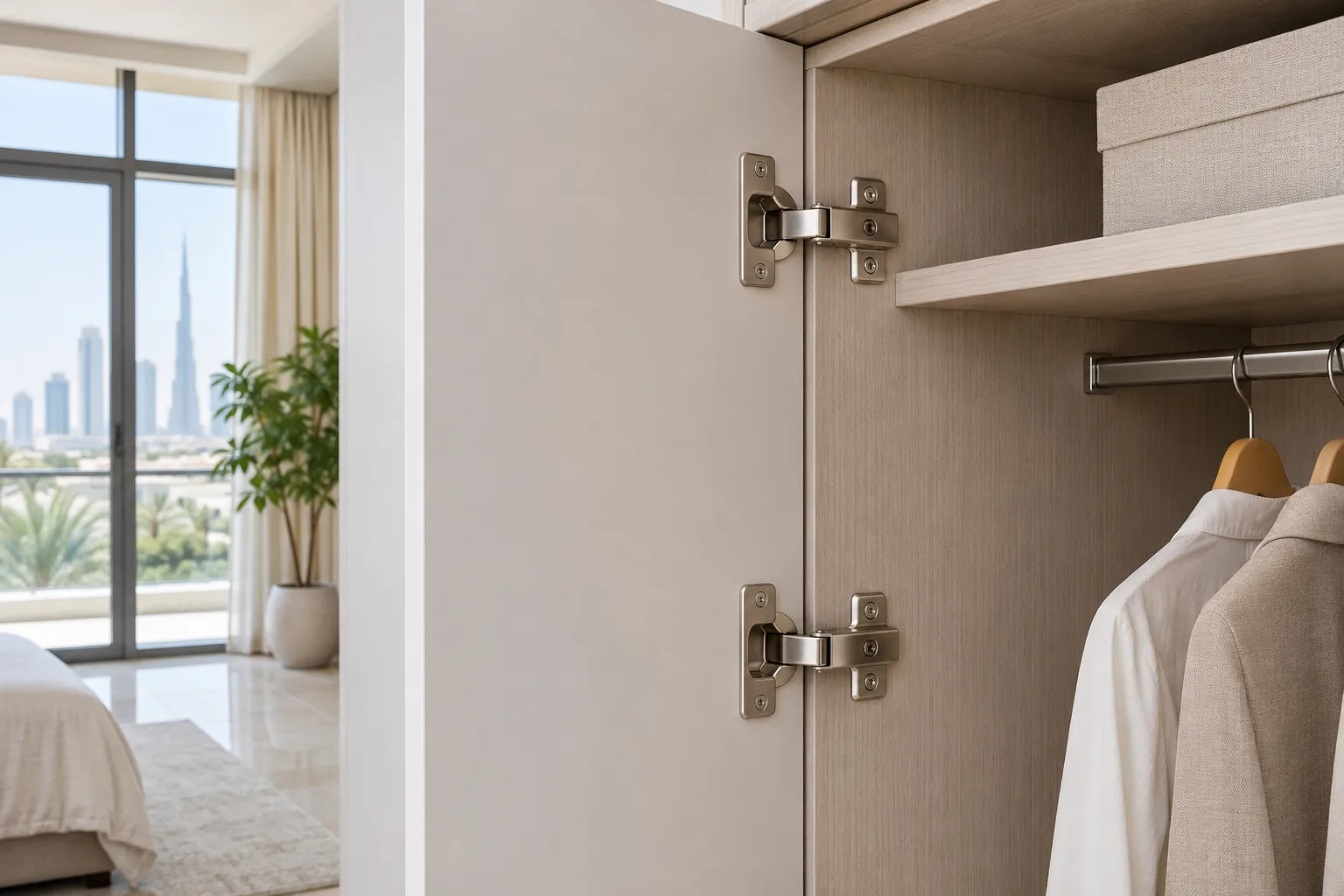
We keep the hinge explanation in one place, our wardrobe hinges guide, and only the tall-door points follow here. Blum's page says 2 hinges are optimal for door weights of 4 to 6 kg and 3 hinges for 6 to 12 kg, valid for doors up to 600 mm wide, with one additional hinge for doors up to 650 mm. It also says the door height affects the number of hinges, that for "high and narrow doors" three hinges may be wise "for extra stability", and that the further apart the hinges are, the more securely the door hangs.
Blum's catalogue also shows weight bands above 12 kg, but we could not read the hinge counts for them on any Blum page we opened, so we do not state them, and we do not say that every tall door needs four or five hinges. The catalogue does say the count depends on the front weight and the front height. For a tall door that is the point: the number on a quotation should come from the weight and the height of that door, for that hinge, from the maker's table.
Hinge counts from the maker (only the bands we could verify)
4 to 6 kg
- Hinges (Blum, doors up to 600 mm wide)
- 2 hinges optimal
- What else the maker says
- Weight includes the handle; height also affects the count
6 to 12 kg
- Hinges (Blum, doors up to 600 mm wide)
- 3 hinges optimal
- What else the maker says
- High, narrow doors: three may be wise for stability
Door up to 650 mm wide
- Hinges (Blum, doors up to 600 mm wide)
- One more hinge
- What else the maker says
- Applies to the values above
Above 12 kg
- Hinges (Blum, doors up to 600 mm wide)
- Not stated here
- What else the maker says
- Ask for the maker's table for the actual hinge and door
Blum EA page 'Number of hinges' and Blum catalogue 2022 p.73, opened 4 Nov 2026. These are Blum's figures for its own hinges, not a rule for all hardware and not the count we use on any door.
Split the door, or add a top box
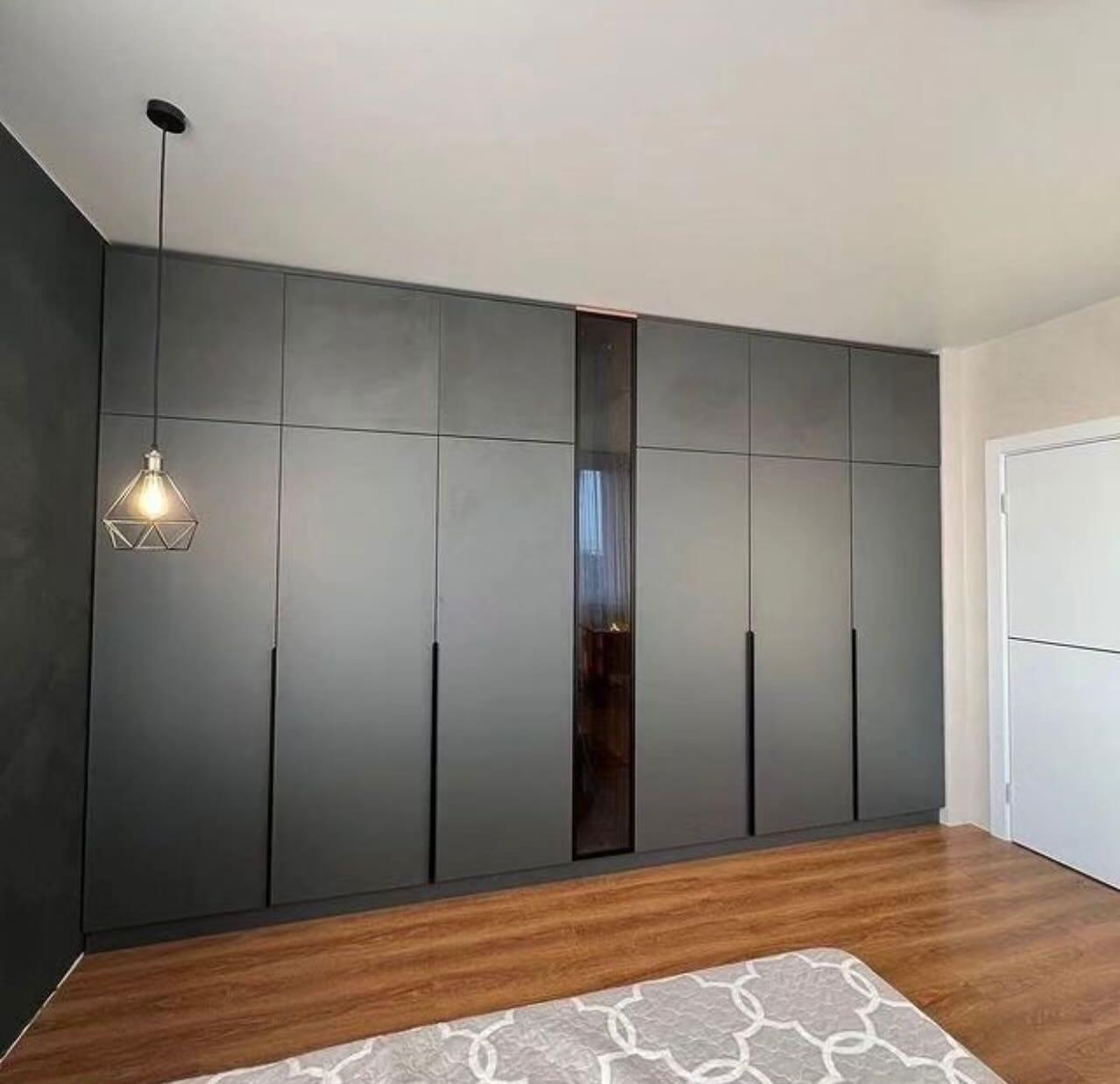
When one leaf becomes too tall, too heavy or too wide, the usual answers are to divide the door or to stop it short. Splitting into an upper and a lower leaf gives two shorter doors; each one is lighter, each carries its own hinges, and each is easier to keep flat. The price is a horizontal joint across the front and two handles or two grips. A top box is a row of smaller doors above the main tall doors, so the main door stops at a reachable height and the box carries the overhead storage; the doors on the box are small, light and usually need only two hinges each.
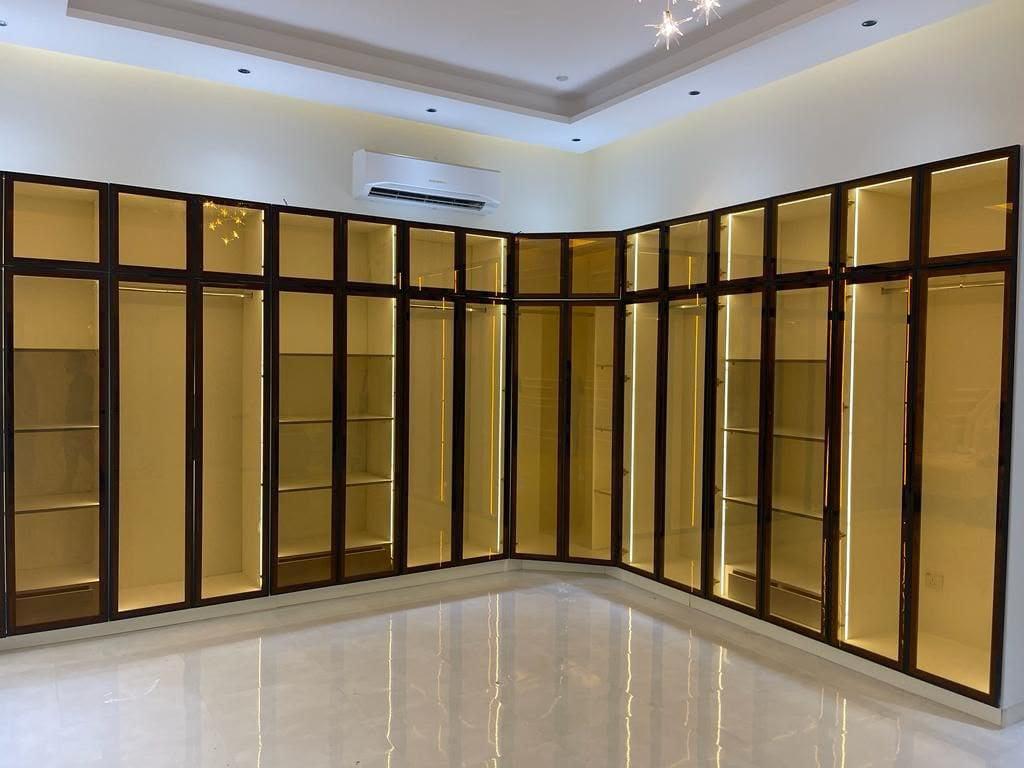
A split suits a door that is tall and narrow enough that the upper half would otherwise be out of reach, or a glass or mirror door where the weight is the limit. A top box suits a wardrobe whose upper third is for the seldom-used things in luggage and seasonal storage and which needs a step to reach, and it also fixes the ceiling gap, and our guide to the height of the hanging rail explains the inside. Neither is automatically better: a split line crossing a mirror, for example, is visible and has to be placed on purpose, which is the kind of choice worth agreeing on the drawing.
One tall door, a split, a top box or sliding: what changes
One tall door
- What it helps
- Clean unbroken front
- What it costs you
- Heaviest leaf; hinge count and flatness depend on the maker's table
Split into upper and lower
- What it helps
- Two lighter, shorter leaves; each easier to hold flat
- What it costs you
- A horizontal joint; a handle or grip on each leaf
Main door plus top box
- What it helps
- Door stops at a reachable height; overhead storage behind small doors
- What it costs you
- A visible line; the box needs a step to use
Sliding doors
- What it helps
- No swing; no hinge count to meet
- What it costs you
- Leaf weight, rail and track limits come from the maker of that system
A comparison of ideas, not a recommendation: how a door is divided is agreed on the drawing before production.
Sliding doors for a tall opening
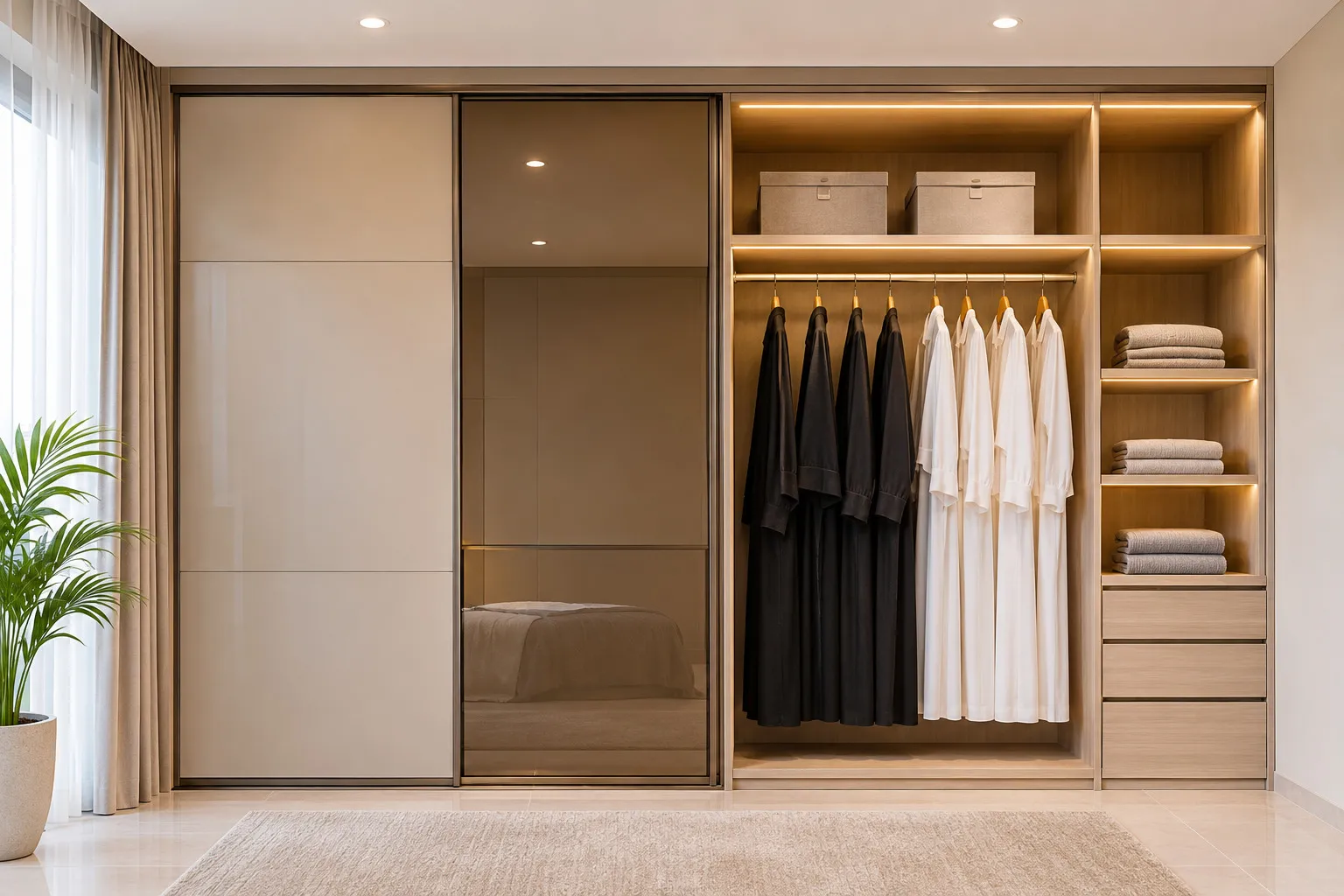
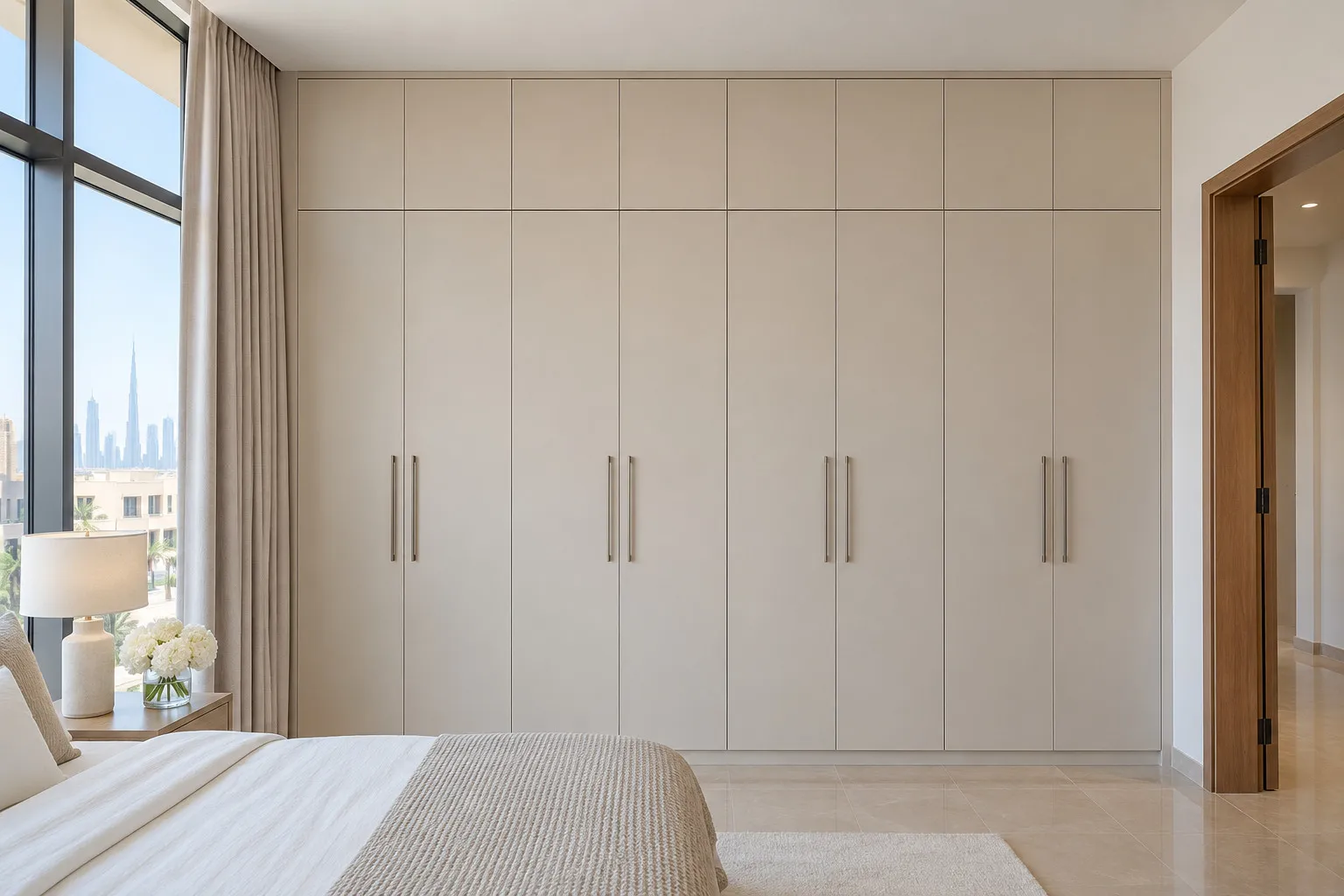
Sliding leaves remove the swing and the hinge count, and for a wide, tall opening they are often the practical answer; the choice between the two is in hinged against sliding wardrobe doors. The hardware itself is in our sliding door systems guide. They do not remove the weight problem, they move it: a leaf hangs from a track or runs on one, and each system is rated by its maker for a leaf weight, a height and a width. We do not give any weight limit here, because the limits belong to the system and the kit, and a figure from one system must not be applied to another.
What you can ask is which system is quoted, what leaf weight and height it is rated for, and whether your leaf, with its glass or mirror, sits inside that rating. Our guide to top-hung and bottom-running tracks explains what each type asks of the ceiling, the floor and the carcass. If a leaf later comes off its track, the off-track guide has the first checks. For the full range of finishes on a leaf, see our guide to wardrobe door finishes.
Handle position on a tall door
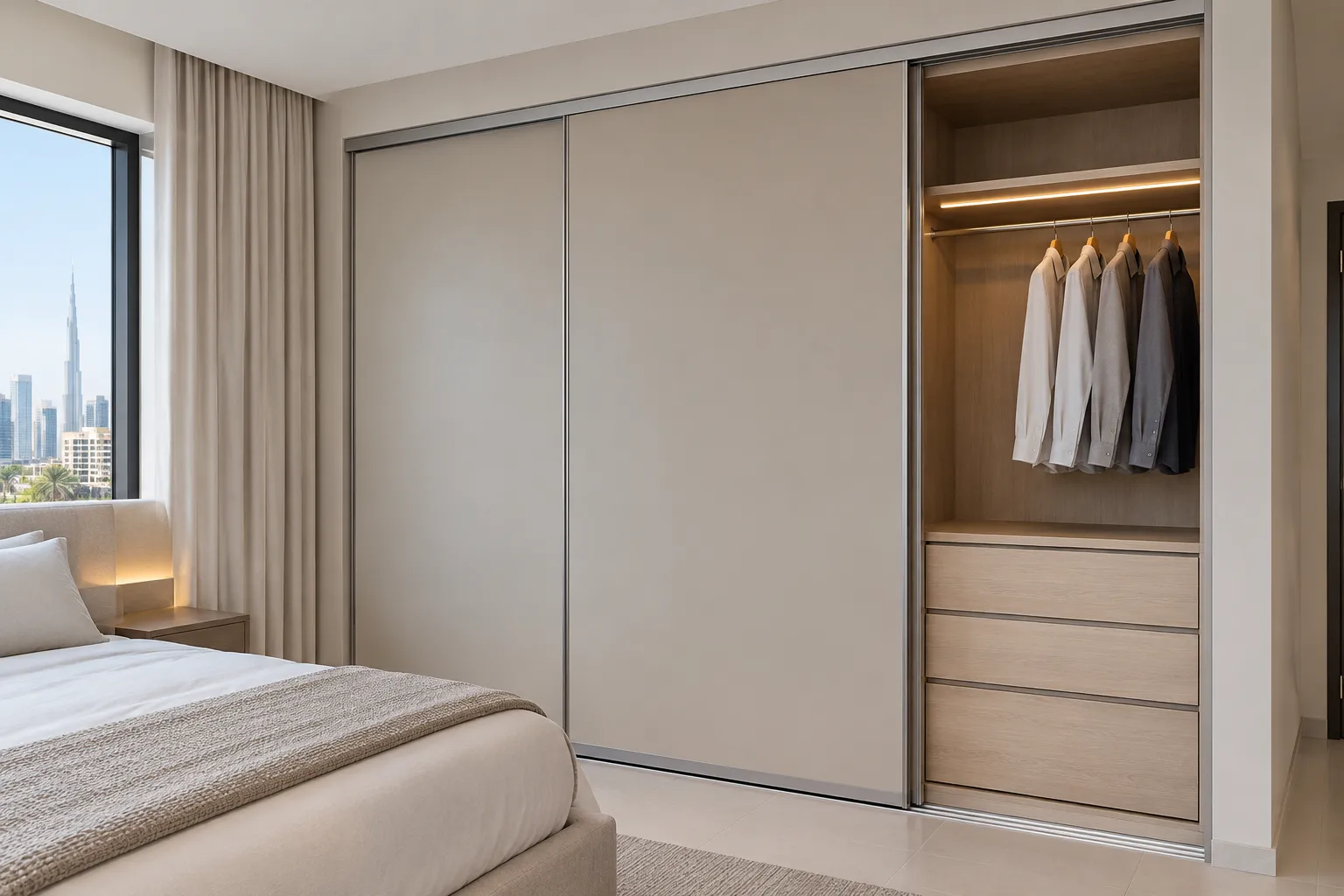
On a tall door the handle belongs where a hand naturally reaches, not at the middle of the leaf, and that point rarely falls at the geometric centre. A hinged tall door is held at one edge, so a handle low on the free edge pulls the leaf with the most leverage. The handle is part of the weight, as the hinge maker notes, and a long bar handle on a tall door weighs more than a small knob. Our wardrobe handles guide covers heights and styles, and we give no single height here because we found no standard we can cite.
A handleless door has no handle to carry, but it needs a grip edge or recess the hand can reach, and on a tall door that edge is also where the leaf is most likely to flex, which is worth checking on a sample; our handleless against handles guide explains the trade. On a split door each leaf needs its own grip, and on a mirror door the grip should not cut into the glass. Mark the handle position on the drawing, and test it on the sample leaf at the measuring visit.
Flatness and alignment: how to judge a tall door
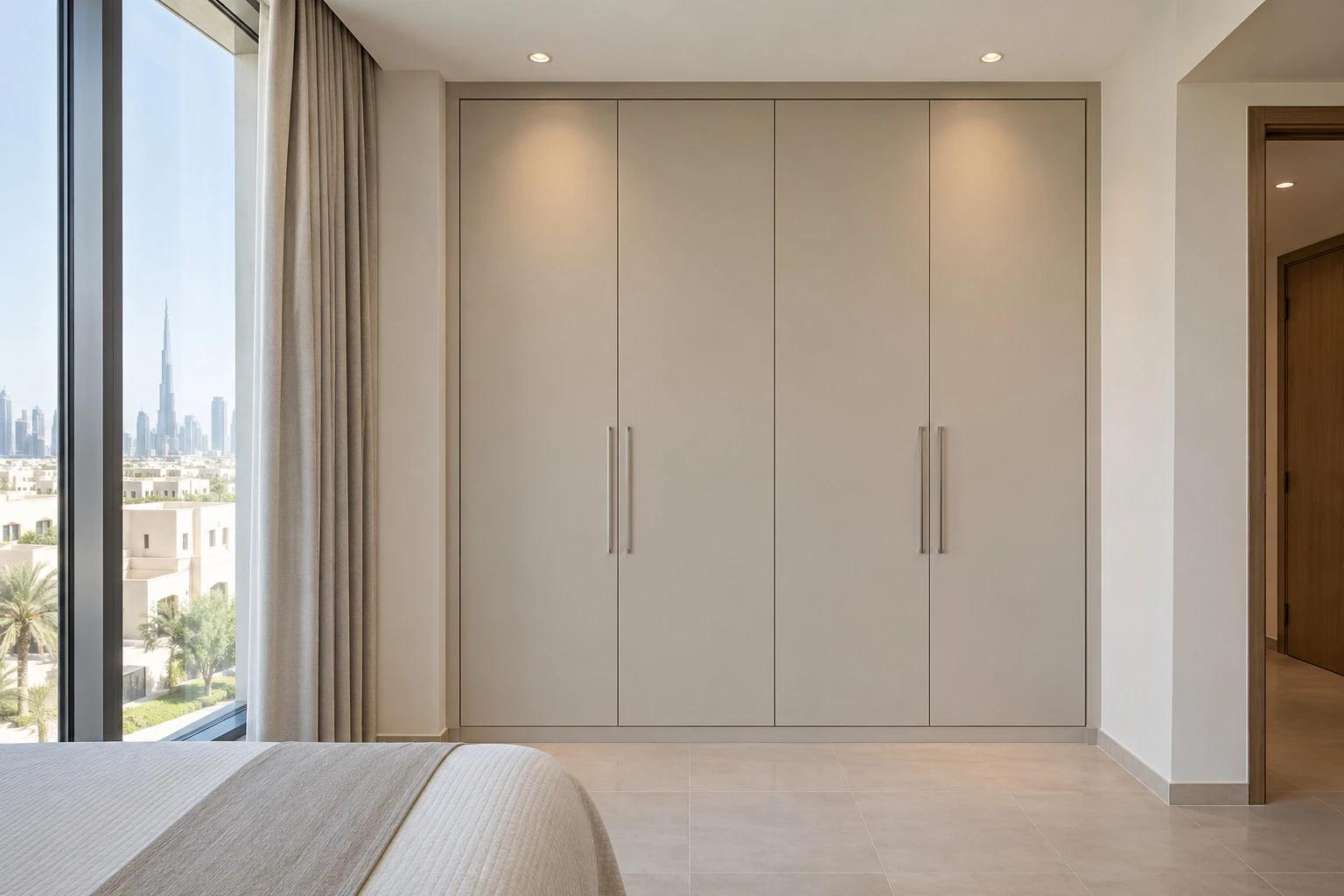
A tall door is judged by its lines. Look along the closed door from each end: the edge should be straight, the gap to the next door even from top to bottom, and the face flat to the eye with no wave in the reflection of a window across it. The gap at the top and at the bottom should match; a wider gap at one end is the first sign of twist. Hinge adjustment can usually correct a small alignment error, and it is worth asking whether the hinges quoted can be adjusted, but adjusting cannot straighten a door that is itself curved.
If a door already rubs, catches or sags, our guide to a sticking wardrobe door explains the first checks. Wardrobe door clearance shows how much room the leaf needs to swing past a wall or a neighbour. Some makers also sell stiffening or straightening kits for tall doors, and we do not say that any particular one is fitted to ours: if you want to know how a quoted door is kept flat, that belongs in the quotation. Mounting it level is part of installation, and a door that is flat but hung out of plumb will still look wrong.
What to ask for in a quotation
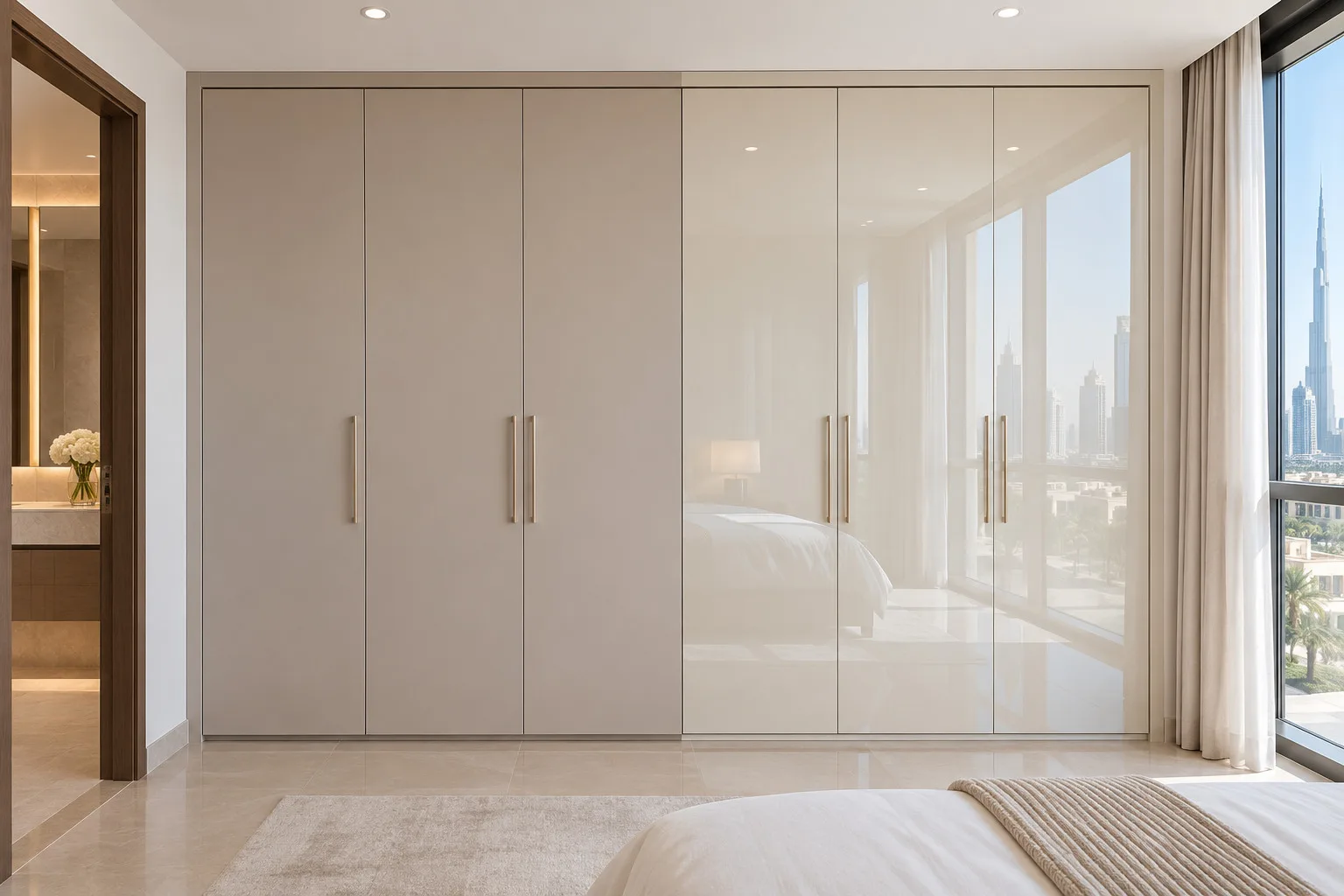
Most of the risk in a tall door is a number nobody wrote down. The questions below turn the points above into lines you can compare. They sit beside the general wardrobe quotation checklist; if you are replacing doors only, the door replacement guide shows the extra lines for that.
Questions for a tall-door quotation
Door height and width, leaf by leaf
- Why it matters
- Height and width decide the load and the hinge count
- A clear answer looks like
- Every leaf listed with its own size on the drawing
Estimated weight of each leaf, with handle, glass or mirror
- Why it matters
- The hinge maker counts the handle and any added weight
- A clear answer looks like
- A weight in kg per leaf, and how it was worked out
Hinges per door, and their load rating
- Why it matters
- The count comes from weight and height
- A clear answer looks like
- A number per leaf and the maker's table it comes from
Is the door split, and where?
- Why it matters
- A split changes weight, hinges and handles
- A clear answer looks like
- The split line marked on the drawing, a grip on each leaf
How the door is kept flat
- Why it matters
- A tall door can bow, and it is cheaper to plan than to repair
- A clear answer looks like
- A named method, or the honest answer that none is added
For sliding: system, leaf rating and the track
- Why it matters
- The limit belongs to the system and the kit
- A clear answer looks like
- System named, leaf weight and height rating in writing
Handle or grip position
- Why it matters
- It changes reach and weight
- A clear answer looks like
- Position on the drawing, shown on the sample
Our entry price of AED 550 per sqm is for MDF laminate with hinged doors, installed; glass, mirror and other options raise it and no figure is published for them. Ask for it in the quotation.
What we do about tall doors
We make wardrobes to your dimensions, hinged or sliding, with glass and mirror options, and the feasibility of a tall door is agreed with you before production: the door height, the board or glass, whether it is split and how it opens are all settled on the drawing. We do not publish a maximum door height or weight, and we do not state the hinge brand or count, so ask for them in the quotation and we will write them down.
At the free measuring visit we bring samples of boards and finishes, measure the wall with a laser, then send a drawing and an itemised price; nothing is made until you approve them. Our wardrobe measuring visit guide lists what is checked. After the measurements and details are agreed, a 60% advance is paid and production starts once it is received; the remaining stage is agreed with you. Our Sharjah workshop builds the wardrobe and our own team installs it, up to about 10 days from confirmation depending on size and design. The wood-based boards carry a 5-year limited warranty, subject to terms; hinges, tracks, runners, rollers and other moving hardware are not covered, and the terms are in the written warranty, explained in our warranty guide. A separate 24-month written workmanship warranty covers our installation.
To start, book a free measuring visit through the consultation form or read about our custom wardrobes service. The built-in wardrobes page shows finished runs, and the sliding door wardrobes page covers the other door type; the lit glass front wardrobes page shows glass-front designs. Our wardrobe materials guide compares boards. A custom or ready-made wardrobe comparison shows what changes in what you are given. The wardrobe price guide and the pricing guide tool show how a quotation is built.
Special cases have their own pages: a wardrobe that works around a column is covered in wardrobes around beams and columns, and one that runs under a pitched roof in the sloping ceiling wardrobe guide. Installation covers the whole UAE, and the Sharjah page gives the workshop address.
Door height depends on the room and layout; the wardrobe guide that sets the planning order shows how they connect.
Common questions
How tall can a wardrobe door be?
There is no single limit. It depends on the hinges, the weight of the board or glass and the door width, and we found no UAE standard. We agree the feasibility with you on the drawing before production. See our floor-to-ceiling wardrobe guide.
How many hinges does a tall wardrobe door need?
Blum says 2 hinges for 4 to 6 kg and 3 for 6 to 12 kg for doors up to 600 mm wide, one more up to 650 mm, and that height also counts. We could not verify heavier bands, so ask for the maker's table. See our wardrobe hinges guide.
Why do tall wardrobe doors warp?
A tall door is a long thin panel, and a small bow along its length shows as an uneven gap. Trade sources say wider panels warp more and that a centre rail or a stiffener can help. See our moisture-resistant boards guide.
Is it better to split a tall door into two?
A split gives two shorter, lighter leaves, each with its own hinges, at the cost of a horizontal joint and a handle on each. A top box is another way to stop the door at a reachable height. See our wardrobe hanging heights guide.
Are sliding doors better for a tall wardrobe?
They remove the swing and the hinge count, but each system has its own leaf weight and height rating from its maker, and we give no figure here. Ask which system is quoted and its rating. See our sliding door systems guide.
Where should the handle go on a tall door?
At the point a hand reaches naturally, and mark it on the drawing; the handle is part of the weight the hinges carry. A handleless door needs a reachable grip edge. See our wardrobe handles guide.
What should a quotation say about tall doors?
Each leaf's size, an estimated weight including handle, glass or mirror, the hinges per door and their rating, any split, and how the door is kept flat. See our wardrobe quotation checklist.

Sources & specifications
Manufacturer information applies to the named products and systems. Sources reviewed on 4 November 2026.
- Blum, number of hinges (EA): 2 hinges for 4 to 6 kg, 3 for 6 to 12 kg, values for doors up to 600 mm wide, one more hinge up to 650 mm, height also affects the count, handles count in the weightea.blum.com(opens in a new tab)
- Blum catalogue and technical manual 2022, page 73: the number of hinges depends on front weight and front height; load and height data relate to front widths of 600 mmpublications.blum.com(opens in a new tab)
- Bendheim, how heavy is glass in relation to its thickness: 6 mm 14.5 kg/sqm, 8 mm 19.5 kg/sqmbendheim.com(opens in a new tab)
- mdf-info.eu, manufacturing of MDF: typical weights at 750 kg/m3, 16 mm 11 kg/sqm and 19 mm 14 kg/sqm; weight is not strictly proportional to thicknessmdf-info.eu(opens in a new tab)
- WOODWEB cabinetmaking Q&A, maximum cabinet door width: wider panels more likely to warp, a centre rail can split a wide door (trade forum contributors)woodweb.com(opens in a new tab)
- Kitchen Library, tall door straightening kit: designed to preserve the integrity of tall cabinet doors and prevent bowing (one retailer's product)kitchenlibrary.au(opens in a new tab)
Want this planned for your home?
Consultation and measurement are free. Tell us the rooms, location and what you need; we arrange a sample visit and define the measured quotation.