Upholstery · 15 min read · 5 June 2026
Majlis seating and upholstery in the UAE: sizes, foam, fabric and layout
How to specify majlis seating in the UAE: floor or raised, seat height, depth and back angle, guests per wall, foam grades, fabric, and re-covering or new.

By Ali Haider Basra, Founder, Al Tareeq Decor · Contact our workshop
Key takeaways
- Choose floor or raised by your oldest regular guest: a low seat is relaxed but harder to rise from, and a seat of about 45 cm is kinder.
- Specify numbers, not 'standard': our starting points are a seat about 45 cm high and 62 cm deep for a raised majlis, and about 30 cm and 70 cm for a floor one.
- Plan about 60 cm for each guest and count each corner once; a U of 10.8 m seats roughly 16.
- Put the money in the foam: D45 for seats in daily use, with the anti-sagging guarantee of about five years.
- Re-cover a sound majlis (about eight days from your go-ahead, with a free inspection first) and order new only when the room has changed.
On this page
- Key takeaways
- What a majlis seat is made of, and what you are really ordering
- Floor majlis or raised majlis: decide by who will sit in it
- Floor majlis and raised majlis side by side
- Seat height, depth and back angle: the numbers behind a comfortable majlis
- How many guests fit: seat width and run length
- Guests per run at 60 cm each
- Modular runs, corners and end arms
- Foam for a majlis: where the money goes
- Fabric for guests, occasions and daily use
- Backs, tufting, buttons and bolsters
- A new majlis, or re-covering the one you have
- The rest of the room: curtains, ceiling and light
- Before you order a majlis: a checklist
- Common questions
What a majlis seat is made of, and what you are really ordering
A majlis is the room a household keeps for welcoming visitors, and its seating is the room's one big piece of furniture. Wikipedia's account of the tradition describes cushions set along the walls, with guests sitting either on the floor itself or on a raised shelf. Everything in this guide grows from that: the seating follows the walls, so it is ordered as a run of modules cut to your room, not as a sofa picked from a showroom floor.
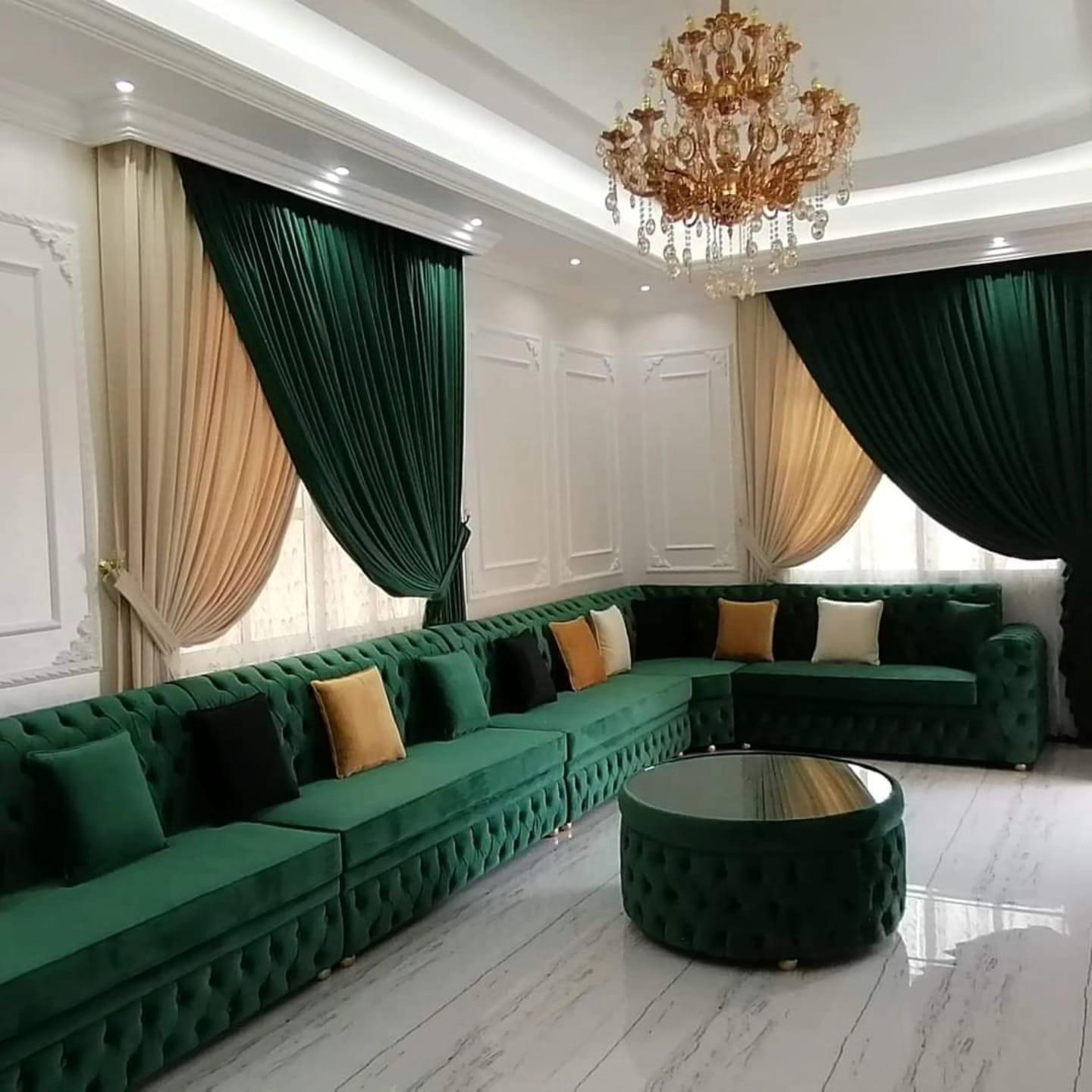
Strip any majlis to its bones and you find the same three layers, whatever the height. Underneath sits the base, which is a plain low platform in a floor majlis and a framed, legged or fretwork-skirted body in a raised one. Over it lies a deep foam slab wrapped in its own cover. Behind that, leaning on the wall, come the back cushions or an upholstered back fixed in place, and the bolsters and scatter cushions are laid along the front edge. Our majlis upholstery page shows how each layer is renewed, and our custom majlis seating page shows sets made new for a room.
This guide is about specifying the seat: how high, how deep, how it leans, how many guests it holds, what goes inside and what goes over it. The curtains and ceiling of the room have their own guides, linked where they come up.
Floor majlis or raised majlis: decide by who will sit in it
A floor majlis is the traditional choice and the most relaxed one. The slab sits low, about 30 cm off the carpet, guests lean on the wall cushions, and nobody perches. It suits a majlis that is used for long evenings among people who are comfortable on low seats. A raised majlis puts the same slab on a frame, so guests sit more like they would on a sofa, with their feet on the floor.
The deciding question is who needs to get up from it. A study of 55 older adults, average age 70, had each of them do a 30-second chair-stand test from a 43 cm seat and again from five heights set to 80 to 120% of their own lower leg length. Scores at 43 cm were significantly lower than at heights equal to or above leg length. A separate audit of seating in Australian aged-care homes found that residents, staff and experts preferred higher seats because they make standing up easier. A seat that is too low makes the person rising work harder.
The same audit warns about the opposite mistake: many seats were too high for shorter people to rest their feet flat, which costs comfort and stability. So the answer is a middle height, not the tallest one. If your guests include grandparents or elderly visitors, choose a raised majlis. If the room is mainly for younger family and the evening is the point, a floor majlis gives the classic look and the lowest profile under a picture window.
Floor majlis and raised majlis side by side
Seat top
- Floor majlis
- About 30 cm: low platform plus a thick foam slab
- Raised majlis
- About 45 cm: frame, legs or skirt plus a slab
How it feels
- Floor majlis
- Relaxed, you sink in and lean back
- Raised majlis
- Upright and formal, closer to a sofa
Rising
- Floor majlis
- Needs more effort, hard for older guests
- Raised majlis
- Easier, kinder to older guests
Under the seat
- Floor majlis
- Platform only, little to see
- Raised majlis
- Fretwork, carved or upholstered base is part of the look
Where the comfort comes from
- Floor majlis
- Almost entirely the foam slab
- Raised majlis
- Foam plus what the frame and support carry
Best for
- Floor majlis
- Younger households, long evenings, low windows
- Raised majlis
- Mixed ages, daily use, formal receiving
Heights are our own starting points. No published standard exists for majlis seating, so the final figures come from your room and the people who use it.
Seat height, depth and back angle: the numbers behind a comfortable majlis
Sofas, at least, have published sizes. Studio C, a furniture-design reference, gives an 18 in (about 46 cm) seat height, a seat depth of 22 to 24 in (56 to 61 cm), a back that rises 22 in (56 cm) above the seat and a back lean of 5° for a formal sofa, 10° for an everyday one and 15° for the most relaxed. An ergonomics reference adds that a seat which is too deep cuts off circulation to the legs, while one that is too shallow makes you feel you will slide off.
A majlis has to bend those numbers, because guests do not all sit the way a sofa assumes. On a raised majlis we start from the sofa figures: a seat top of about 45 cm, a depth of about 62 cm and a lean of about 10°. On a floor majlis people fold a leg or stretch out, so the seat is lower and deeper: about 30 cm high, about 70 cm deep, leaning back about 15°. Because a deep seat is hard on the legs of someone sitting with their feet down, the loose back cushions take up the extra: lean on them and the effective depth is shorter.
These are starting points, not a standard. The 79-second video below walks through the same sofa dimensions in plain terms, seat height, seat depth and cushion height, and why each one decides how comfortable you are. Watch it with your own room in mind, then compare it with the sizes in the drawing.
- 1. Floor majlis: a low base, a thick foam slab and a back cushion that leans about 15°
- 2. Raised majlis: the slab on a frame with legs, leaning about 10°
- 3. Sizes count up beside each drawing: seat height, depth, back angle and back height
- 4. Dashed line: the 43 cm seat of a standard chair, drawn across both
- 5. The floor seat sits about 13 cm below that chair; the raised seat about 2 cm above
- 6. Verdict: the floor seat is relaxed but harder to rise from; the raised one is kinder to older guests
How many guests fit: seat width and run length
Guests on a majlis sit closer than on a sofa with fixed seats, which means the useful figure is a width per person, not a count of cushions. Rules of thumb for sofas allow roughly 50 to 60 cm per person; for a majlis, where people sit with bolsters and a drink beside them, we plan on about 60 cm for each guest on an ordinary evening and fewer for an occasion when everyone wants room to move.
The sums are simple. Measure every wall the seating will run along, subtract doorways and any window you want left free, and divide by 60 cm. A corner counts once: the square where two runs meet is a seat shared by both, so leave it out of the second wall's length. A modest room with seating on two walls of 4 m and 3.5 m gives you about 7.5 metres of run; take off 60 cm for the one corner and about 11 guests fit.
Size the run for your busiest evening rather than a quiet one. Write down how many people sit on a normal day and how many on Eid, then see whether an L, a U or seating on every wall reaches that number. A U lets every guest see every other, which is why larger majlis favour it, and it frees the fourth wall for the door, a coffee corner or, where the room doubles as a family lounge, a media wall.
Guests per run at 60 cm each
3 m (one wall)
- Guests at 60 cm
- About 5
- Typical use
- A small sitting room or the end of an L
4.2 m (one long wall)
- Guests at 60 cm
- About 7
- Typical use
- An L-shaped majlis in an apartment
7.2 m (two walls, one corner)
- Guests at 60 cm
- About 11
- Typical use
- A medium villa majlis
10.8 m (three walls, two corners)
- Guests at 60 cm
- About 16
- Typical use
- A U-shaped family majlis
14.4 m (four walls)
- Guests at 60 cm
- About 20
- Typical use
- A large hosting room
Our own planning arithmetic at about 60 cm per guest, with each corner counted once. Your own room is drawn after we measure it.
Modular runs, corners and end arms
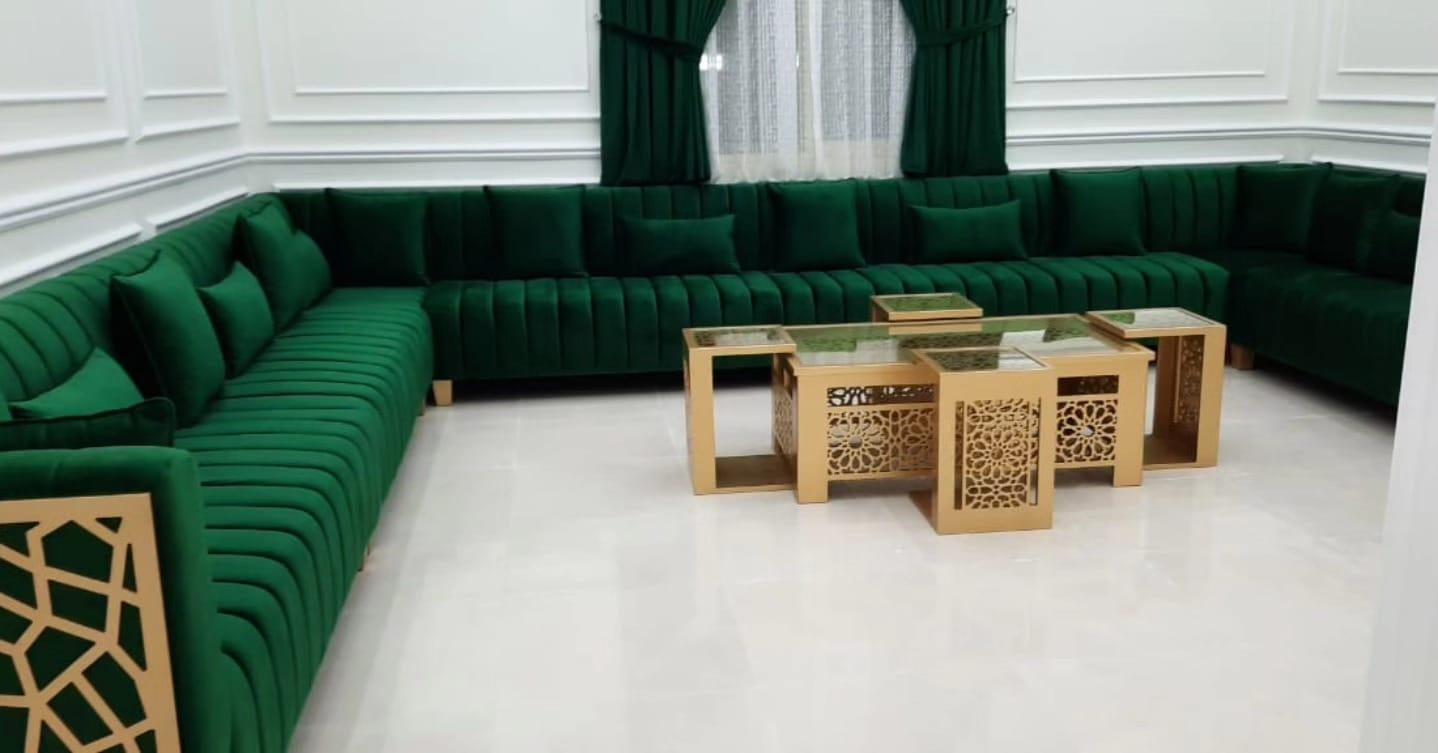
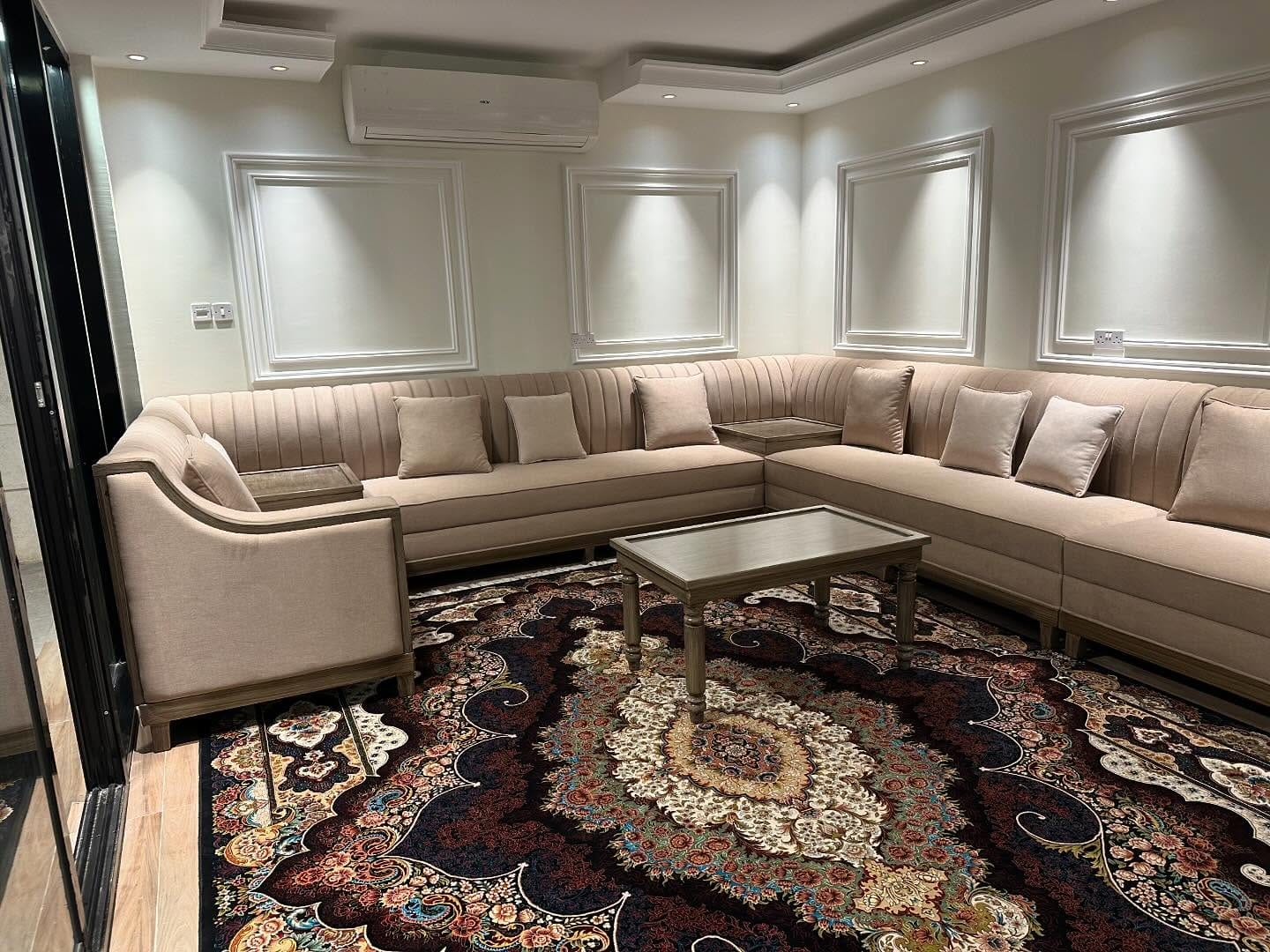
Seating that runs around the walls is made in separate modules that butt up against each other: straight lengths, a corner square, and end pieces that finish with an arm or a side panel. Because each module has its own frame and its own foam, the whole run can be carried through a door, pushed to a different wall later, and mended piece by piece if one part is damaged.
Choose the modules so that the seams land at sensible places. Put a joint at each corner and at a point where a long wall changes use, for example where the sitting part ends and the side table begins. Avoid a seam directly in front of a window or a door, where a guest steps on and off. The corner square is the best place for a small table built into the seating, as in the set pictured below.
Think about the route into the house. A module is long, and a tight turn, a narrow lift or an awkward staircase decides how long each piece can be. Tell us about the route at the visit so the modules are cut to get in rather than to a figure that looks tidy on paper.
Foam for a majlis: where the money goes
In a floor majlis the foam slab is the whole seat. No spring or webbing sits under it to carry part of the weight, just a platform, so the slab must be thick enough that a guest never feels the base after an hour, and dense enough to resist hollowing in the spots the same people take every evening. If you are going to spend more anywhere in a majlis, spend it here.
We work with three foam grades, D35, D40 and D45, where the number is the density: more material per cubic metre, and a longer fight against flattening. Put D45 under the seats that see daily use; D35 can be enough in the back cushions and bolsters, which mostly have to hold their shape. For how the grades are made, why density and firmness are different questions, and how long each should last, read our guide to sofa foam density D35, D40 and D45.
A raised majlis adds a second question: what carries the slab. On a frame the foam rests on webbing, springs or a board, so a seat that has gone soft may be a tired base rather than tired foam. New foam from us comes with an anti-sagging guarantee of about five years, and when foam is the only thing that has failed, foam and cushion replacement leaves your existing cover alone.
Fabric for guests, occasions and daily use
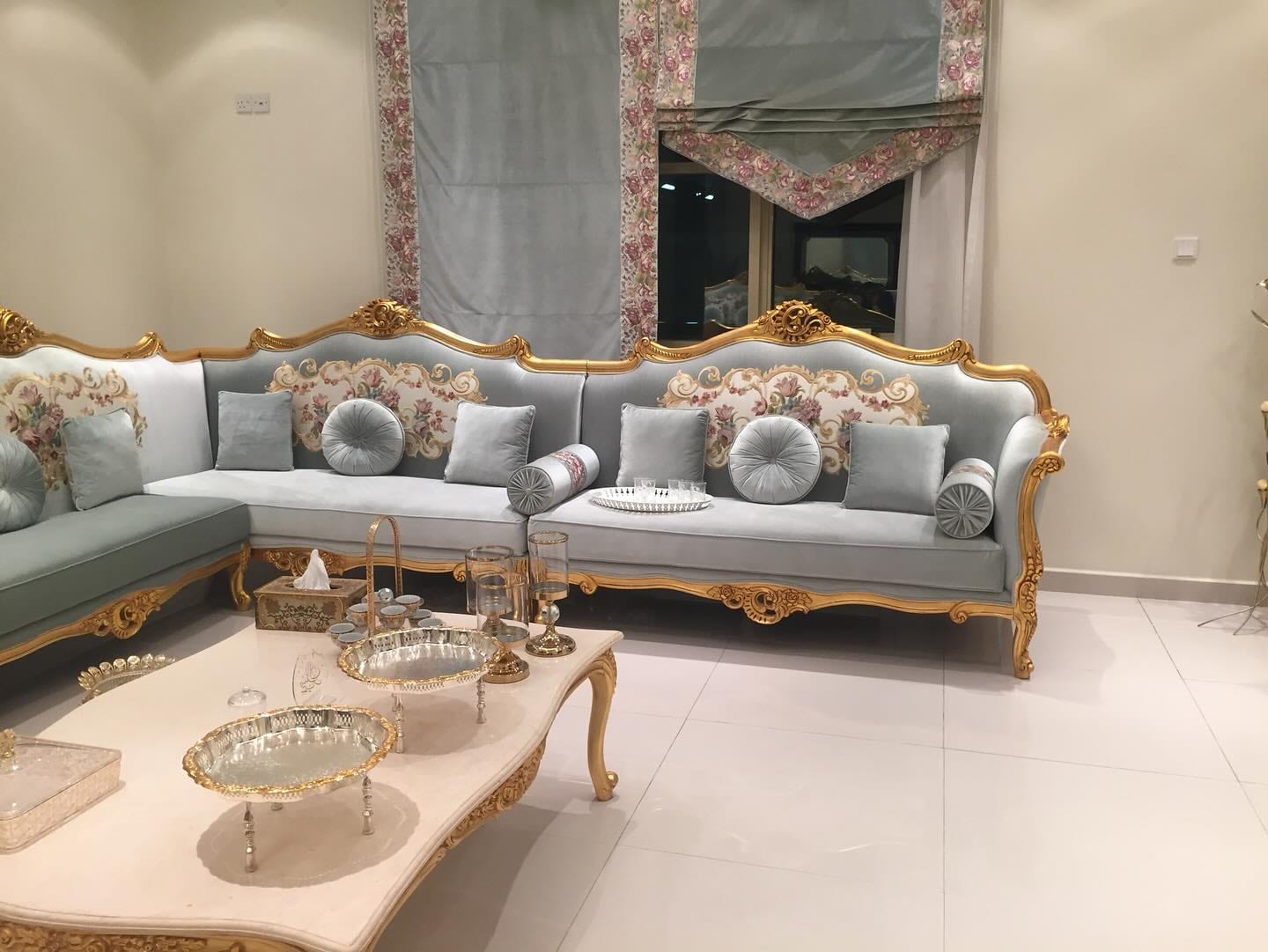
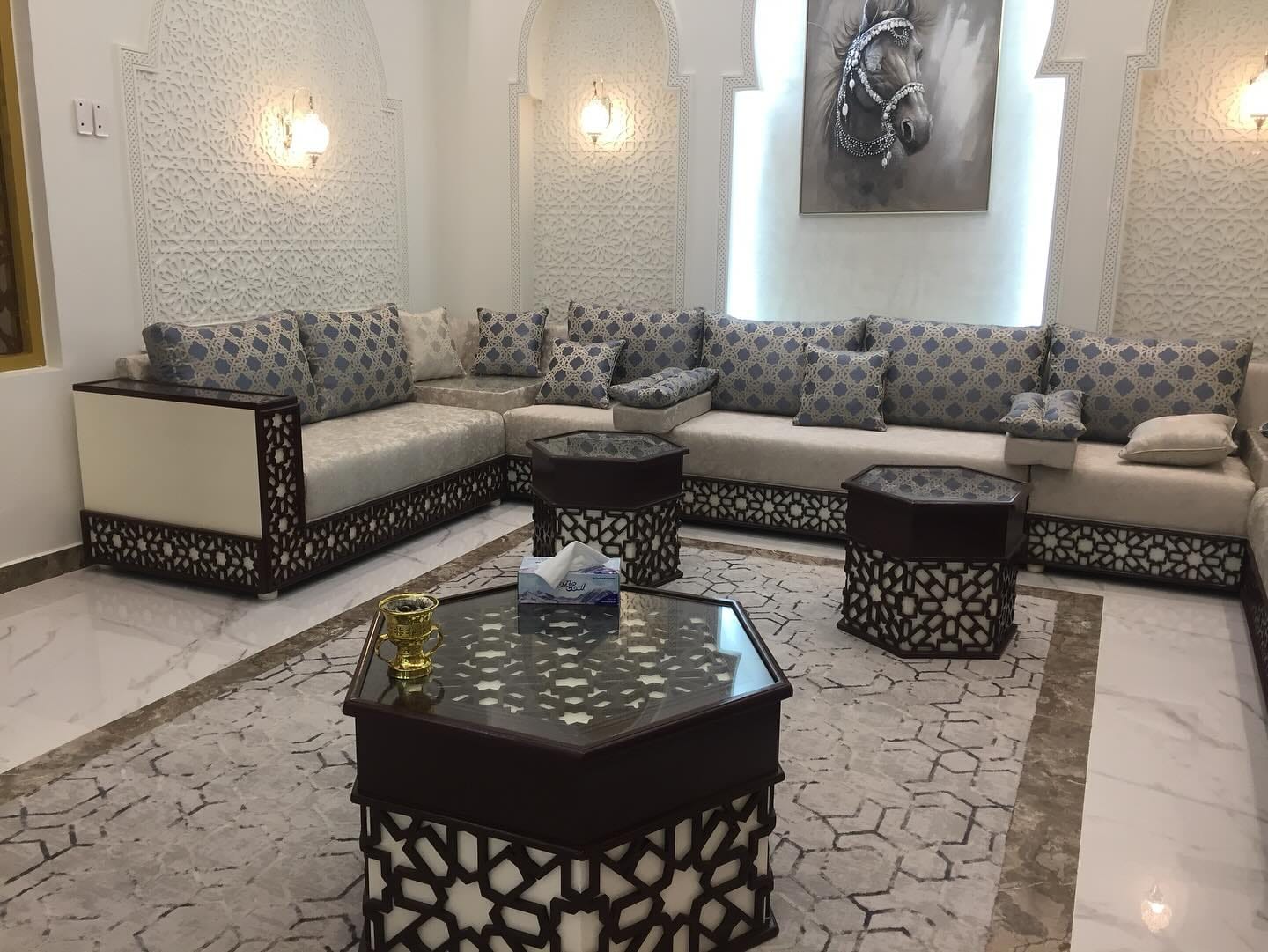
Ask first how the room is really used. A majlis opened only for visitors and festivals can wear a richer cloth than any family sofa could survive, for instance a thick-pile velvet, hand embroidery or a crest set in the middle of every cushion. One the household lounges in daily needs a closer weave, since a deep pile flattens where people sit most and the marks show. Our library holds more than 2,000 fabrics, among them stain-resistant, water-repellent and pet-friendly ones.
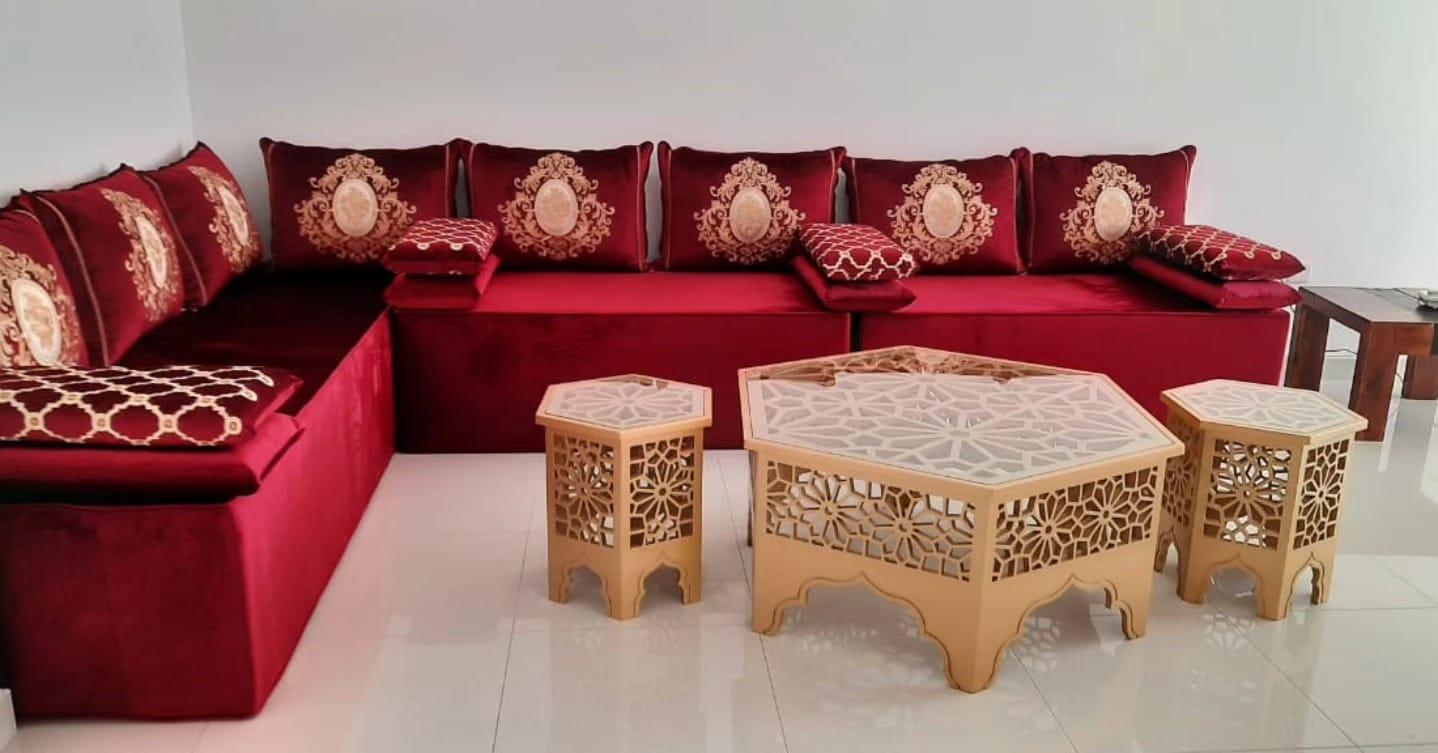
The usual answer is a split. Put a plain, tough cloth on the seats, where the wear happens, and save the pattern or embroidery for the backs and bolsters, as in the photograph above. The design then stays where eyes land, and a plain seat hides scuffs. A pattern also has to be matched along a long seat, which eats fabric and cutting time, so a patterned seat costs more than it looks.
Daylight is part of the specification in the UAE, because the long seating wall often faces a big window. Choose a cloth that holds its colour and let the curtains take the brightest hours. Rub counts, cleaning codes, claws against weave and a sample test at home are covered in choosing sofa fabric for children, pets and daily use, and our fabric replacement job changes only the cover.
Backs, tufting, buttons and bolsters
Guests look at the back before they sit, so the back sets the style. Vertical channels read clean and modern, deep buttons read traditional and a little jewelled, and plain loose cushions are the simplest to swap in later. A fixed back with buttons belongs to its module and has every button redone when it is re-covered, which takes longer than refilling loose cushions, so settle your preference at the start.
Bolsters and scatter cushions are the cheapest lever for changing the room's look years from now, and they largely decide how it looks in photographs. Decide early whether they should echo the seat colour or stand apart from it, since that alters how much cloth is ordered. Either way, have them sewn from the same dye lot as the seats, so every piece reads as one set along a long wall.
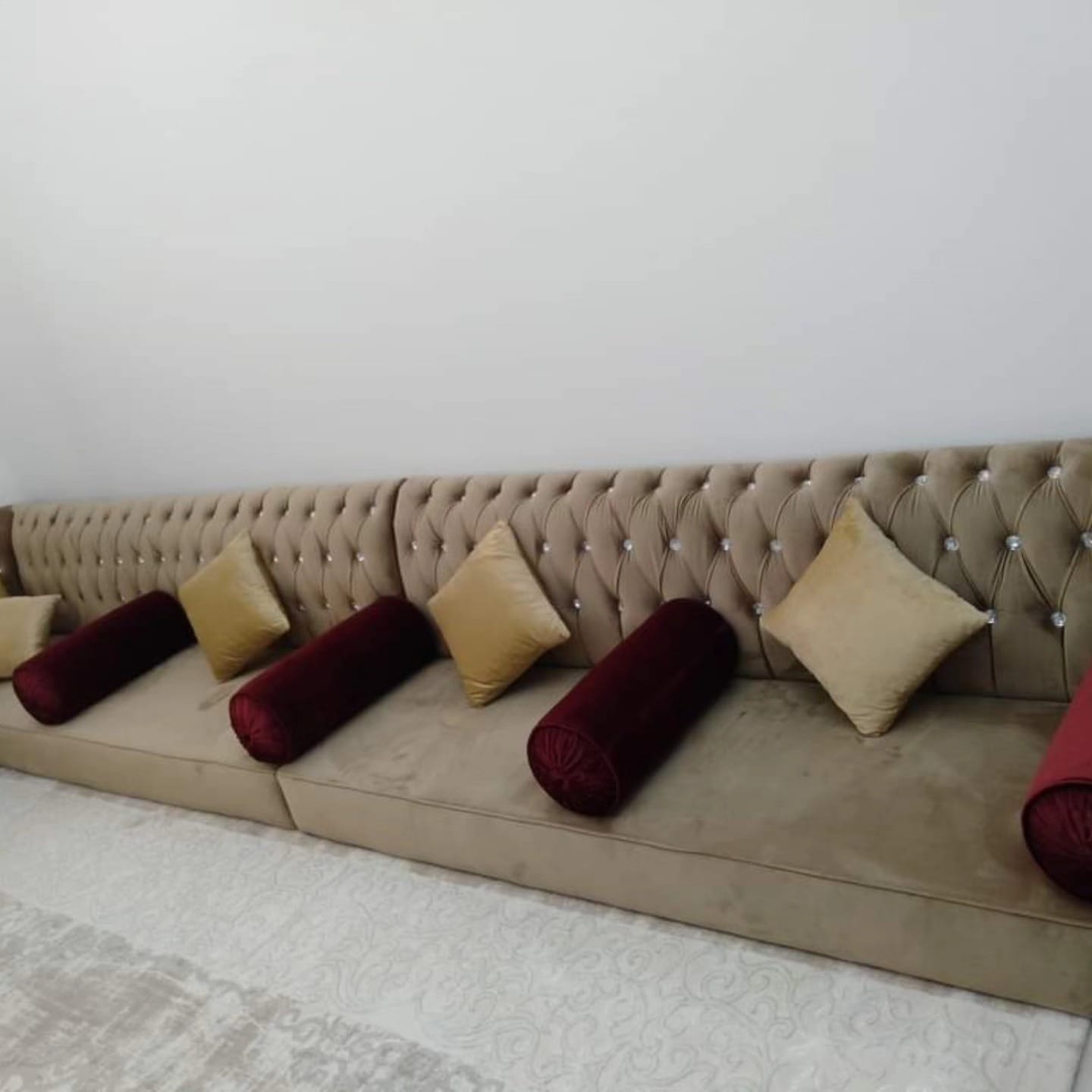
The photograph below shows a floor majlis with a deep-buttoned back and bolsters across the front: the slab provides the comfort and the back is there for style. After it comes a workshop's own film of a corner majlis being made, which shows roughly how modules are assembled, although the details of our own work differ.
A new majlis, or re-covering the one you have
Keep what you have when its layout still works and its base is sound. Re-covering leaves the modules, corners and base where they are and renews the seat foam and cloth, which suits a majlis whose arrangement is right but whose comfort and fabric have given out. Order new when the room has moved on: another wall, a larger household, a changed doorway. Reupholster or replace a sofa sets out five checks that hold for a majlis too, and sofa upholstery costs shows what each part of a quotation covers.
Everything starts with a free inspection at your home. We measure and number each module, count the cushions and work out the cloth for the entire run in one calculation, so it can be bought as one order and the shade does not drift along the wall. An itemised quotation follows. We publish no price for majlis work, because the length of the runs, the foam and the cloth differ on every set.
When you give the go-ahead, our own team picks up the modules and cushions, the work happens in our Sharjah workshop, and the set is brought back and set out in your room. A typical re-cover comes back about eight days after your go-ahead, and a very long majlis may need longer. The pick-up and the return are part of the job and carry a charge, which is shown on the quotation. We accept a whole set or a large part of one, never a lone cushion. The workmanship carries our 24-month written warranty. Local details are on our Sharjah sofa upholstery page, and the full service sits under sofa upholstery and repair. The same foam and fabric choices apply in the bedroom, where upholstered beds and headboards are specified the same way.
The rest of the room: curtains, ceiling and light
A majlis is read as one room, so the seating, the windows and the ceiling should be decided together. The long wall of seating is usually opposite the windows, which means the curtains frame the guests as much as the glass. Our majlis curtains guide covers heading, fullness and fabric for these windows; the cloth can be held beside the seat fabric before either is cut, and the majlis curtains with tiebacks page shows the style most majlis choose.
Overhead, the layers of a gypsum ceiling set the mood: a cove around the edge for soft light, downlights over the seating and a centre feature that matches the room's character. False ceiling designs for a living room or majlis compares the options, gypsum ceiling lighting basics explains how to light them, and curtain pockets in gypsum ceilings shows how to plan the ceiling and the tracks together so neither is torn open later. If the curtains need measuring first, our window measuring guide shows how.
Our majlis collection gathers curtains and seating for these rooms on one page. If both orders go to one workshop, you can lay the two cloths together on a table and judge them before a single metre is cut.
Before you order a majlis: a checklist
A good majlis order is a drawing you can read, not a set of words. Before you sign, check it against this list:
- Floor or raised is chosen with the oldest regular guest in mind.
- Seat height, depth and back lean are written on the drawing, not left as 'standard'.
- The run length is divided into guests at about 60 cm each, with each corner counted once.
- Seat foam and back foam are named on the quote, grade by grade, with the anti-sagging guarantee.
- Seats are a hard-wearing cloth; patterned cloth is kept for the backs and bolsters.
- Seams fall at corners, not in front of a door or a window.
- The delivery route is checked, so each module fits through the door and the lift.
- The curtains and the ceiling are decided in the same visit.
Common questions
What size should majlis seating be?
There is no published standard, so size it to the people. We start a raised majlis at about 45 cm seat height and 62 cm depth, and a floor majlis at about 30 cm and 70 cm. Custom majlis seating.
How many people fit on a majlis?
Plan on about 60 cm per guest and count each corner once. A U-shaped run of about 10.8 m seats roughly 16 people. Custom majlis seating.
Is a floor majlis or a raised majlis better?
A floor majlis is more relaxed; a raised one at about 45 cm is easier to rise from, so it suits older guests. Choose by your oldest regular visitor. Majlis upholstery.
What foam is best for majlis seating?
D45 for seat slabs used every day, and D35 for backs and bolsters; the grade is the density. New foam carries a guarantee of about five years against sagging. Sofa foam density explained.
What fabric is best for a majlis?
A tight, hard-wearing cloth on the seats and a richer or patterned one on the backs and bolsters. Deep pile crushes where people sit most. Sofa fabric for daily use.
How much does a majlis cost in the UAE?
We quote after a free inspection, because runs, foam and fabric differ on every set, and no fixed price is published. The quotation itemises each wall of seating. What sofa and majlis upholstery costs.
How long does majlis re-covering take?
About eight days after you confirm for a typical set, and longer for a very long majlis. Pick-up and return are part of the job and carry a charge shown on the quotation. Majlis upholstery.

Sources & specifications
Manufacturer information applies to the named products and systems. Sources reviewed on 28 October 2026.
- Studio C: standard sizes for custom furniture, seating (sofa seat height, depth, back height and 5°, 10° and 15° lean)designsbystudioc.com(opens in a new tab)
- PubMed: the influence of chair seat height on older adults' 30-second chair stand test (43 cm against 80–120% of lower leg length)pubmed.ncbi.nlm.nih.gov(opens in a new tab)
- Blackler et al., SAGE Open Medicine: seating in aged care, physical fit, independence and comfortpmc.ncbi.nlm.nih.gov(opens in a new tab)
- Wikipedia: Majlis (cushions along the walls, on the floor or a raised shelf)en.wikipedia.org(opens in a new tab)
- City University of Hong Kong online anthropometry: seat height, depth and backrest designpersonal.cityu.edu.hk(opens in a new tab)
Want this planned for your home?
Consultation and measurement are free. Tell us the rooms, location and what you need; we arrange a sample visit and define the measured quotation.