Upholstery · 15 min read · 6 June 2026
Upholstered beds and headboards in the UAE: size, style, fabric and fixing
How to specify an upholstered bed or headboard in the UAE: width and height against the bed, channel or tufted style, fabric, foam, fixing, sockets and cleaning.

By Ali Haider Basra, Founder, Al Tareeq Decor · Contact our workshop
Key takeaways
- Start the width from the bed frame, not the mattress: about 10 cm over the mattress for a plain headboard, plus any bedside units.
- Measure height above the mattress: 60 cm showing is a sound standard, 50 cm is the lowest worth leaning on, and above about 70 cm the headboard must be fixed to the wall.
- Choose the style for the cleaning it brings: vertical channels are clean and easy, diamond buttons collect dust and plain panels show creases.
- Settle sockets, lights and bedside tables before the headboard is made, and agree the fixing for your wall.
- Re-cover a sound headboard (about eight days after your go-ahead, with a free inspection first) and order new only when the bed, wall or room changes.
On this page
- Key takeaways
- Upholstered bed, headboard only, or a whole headboard wall?
- Headboard width: start from the frame, not the mattress
- Headboard width for common mattress sizes
- Headboard height: how much should show above the mattress
- Channel, tufted or plain panel: the styles and what each costs you
- Headboard styles at a glance
- Fabric for a bedroom headboard
- What is inside a headboard: the board, the foam and the edges
- Wall-mounted, fixed to the bed, or free-standing
- Bedside tables, shelves and sockets around the headboard
- Beds for children and for guests
- Cleaning an upholstered headboard
- A new bed, a new headboard, or re-covering the old one
- Before you order a bed or headboard: a checklist
- Common questions
Upholstered bed, headboard only, or a whole headboard wall?
Three different things hide behind the search for an upholstered headboard, and mixing them up is the commonest reason an order disappoints. A headboard on its own is a padded panel behind the pillows. An upholstered bed adds the base, and sometimes a bench or a footboard, in the same cloth. A headboard wall carries the padding past the bed's edges, up the wall and often to the ceiling, which turns it into a feature of the room instead of a part of the bed.
This guide covers the first two: the bed and its own headboard, how big to make them, what style and fabric to choose, how to fix it, and what to plan around it. If you want the padding to run wide and tall, our guide to the upholstered headboard wall takes over from where this one stops. The beds we have made are on the upholstered beds and headboards product page, and the wider version is on upholstered headboard walls.
Why bother with an upholstered one at all? It is softer to lean on than timber, it can be cut to nearly any height and shape, and it can match the curtains and the rest of the room exactly. The price of that softness is care: fabric collects dust and marks from heads and hands, so the fabric and cleaning sections below matter as much as the dimensions.
Headboard width: start from the frame, not the mattress
A mattress sits inside a frame, and the frame is a few centimetres wider than the mattress. The headboard should be at least as wide as that frame, otherwise it looks undersized and the corners of the base show. Hunker's measuring guide notes that many standard headboards run 0 to 3 in (up to about 8 cm) wider than the mattress or frame. For a bed with an upholstered base we plan on about 10 cm over the mattress width, and we confirm it from the real frame at the measuring visit.
The mattress width itself is the first thing to pin down in the UAE, because the two common patterns differ. Wikipedia's bed-size table lists a European king at 180 × 200 cm and a US king at 193 × 202 cm, a UK king at 152 × 198 cm and a European double at 160 × 200 cm. A headboard cut for one of them will not suit another, so measure the mattress you own, or tell us the size you are buying before anything is cut.
From there you choose how much wider to go. A narrow, plain headboard keeps the bed small and calm in a small room. A wide one, which carries a bedside shelf or a niche on each side, turns into a piece of furniture: add the width of each side unit to the 10 cm. Past that, when the padding should reach the corners of the room, you are into headboard-wall territory.
Headboard width for common mattress sizes
90 cm (single)
- Plain headboard (about +10 cm)
- About 100 cm
- With a 40 cm shelf each side (+90 cm)
- About 180 cm
160 cm (European double)
- Plain headboard (about +10 cm)
- About 170 cm
- With a 40 cm shelf each side (+90 cm)
- About 250 cm
180 cm (European king)
- Plain headboard (about +10 cm)
- About 190 cm
- With a 40 cm shelf each side (+90 cm)
- About 270 cm
193 cm (US king)
- Plain headboard (about +10 cm)
- About 203 cm
- With a 40 cm shelf each side (+90 cm)
- About 283 cm
200 cm (super king)
- Plain headboard (about +10 cm)
- About 210 cm
- With a 40 cm shelf each side (+90 cm)
- About 290 cm
Mattress widths from Wikipedia's bed-size table. The 10 cm and the 40 cm shelf are our planning figures; the final width follows the frame and the room as we measure them.
Headboard height: how much should show above the mattress
Height is measured from the top of the mattress, because that is the part you see and lean on. The floor-to-top figure also depends on how tall the base and mattress are, so it changes from one bed to the next. A worked example from Furl, a British headboard maker: a 38 cm bed base plus a 25 cm mattress puts the mattress top at 63 cm, and a headboard with 60 cm showing, fixed 2 cm below the mattress top, reaches 121 cm from the floor.
Sixty centimetres showing is a sound standard height. It carries your back and shoulders when you sit up with a pillow behind you, and it leaves a clear stretch of wall above for a picture, a light or a niche. Hunker describes a low modern look as roughly 20 to 24 in (about 50 to 60 cm) above the mattress top, so 50 cm is where a low profile starts. Go lower than that and the headboard stops being something to lean on.
Go taller for drama, and plan the fixing at the same time. Furl adds a limit: once the visible part passes roughly 70 cm, the headboard has to hang on the wall instead of hanging off the bed. A tall one in a high-ceilinged villa bedroom looks right; in a low flat it can feel heavy. The 3-minute video below runs through headboard sizes for each bed size in one go, which is a useful cross-check against the table above.
- 1. The bed builds up: a 38 cm base and a 25 cm mattress, so the mattress top is at 63 cm
- 2. A standard headboard grows up from 2 cm under the mattress top, showing 60 cm
- 3. Overall height counts up to 121 cm from the floor
- 4. A figure sits up: the lime band is the part that carries your back and shoulders
- 5. A low 50 cm and a tall 75 cm outline are drawn over it for comparison
- 6. Wall fixing: above about 70 cm showing, the headboard must be fixed to the wall
Channel, tufted or plain panel: the styles and what each costs you
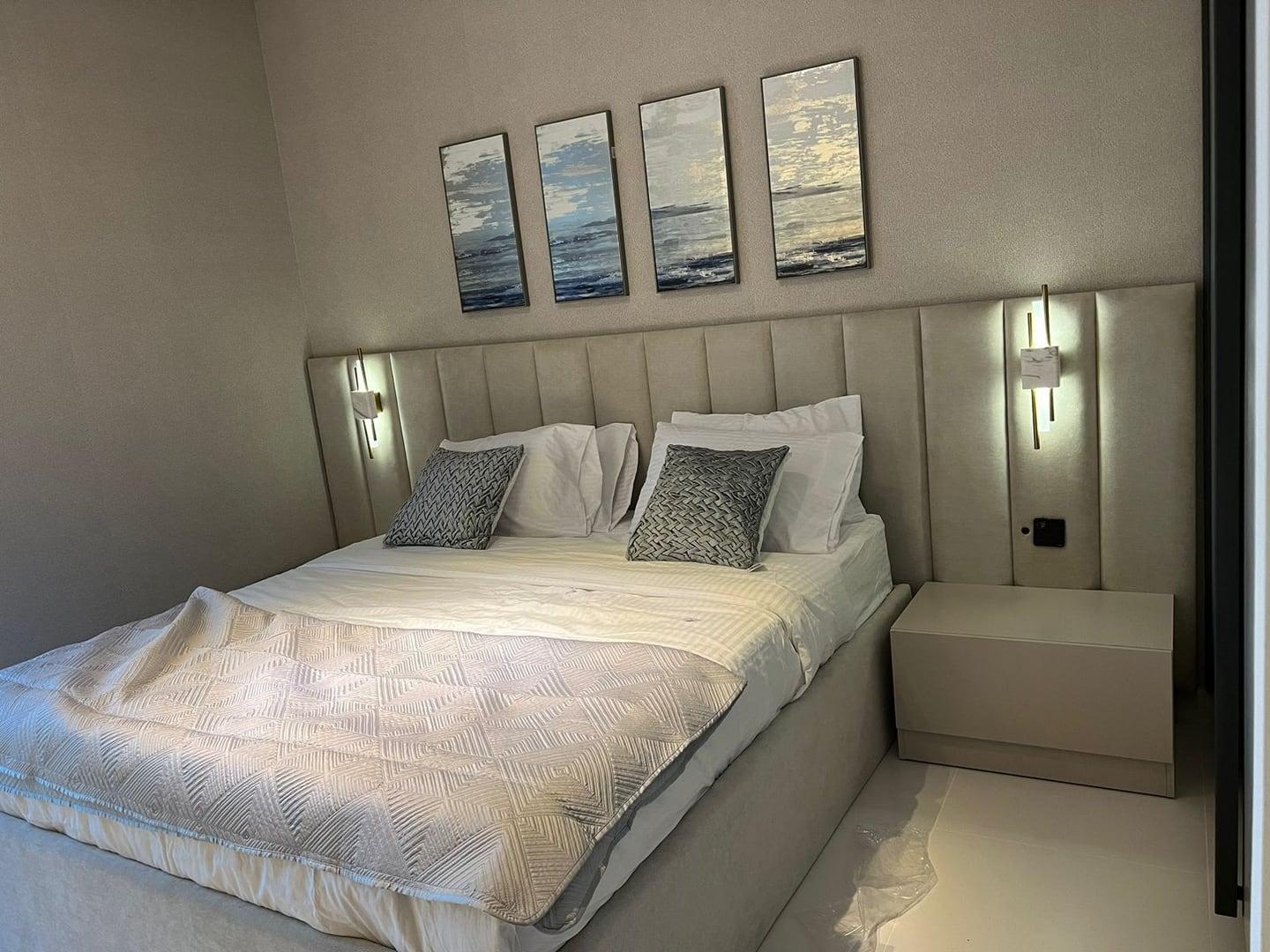
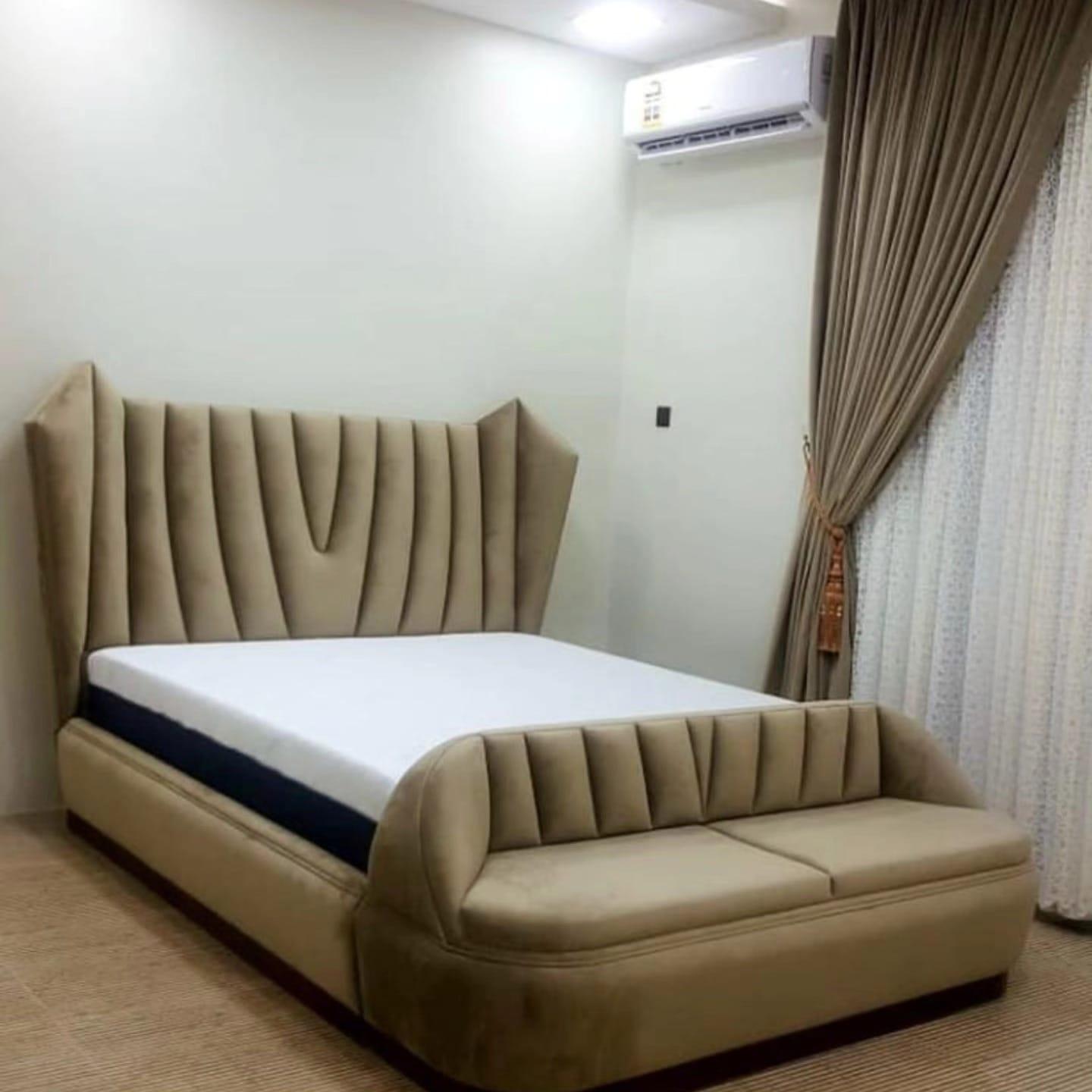
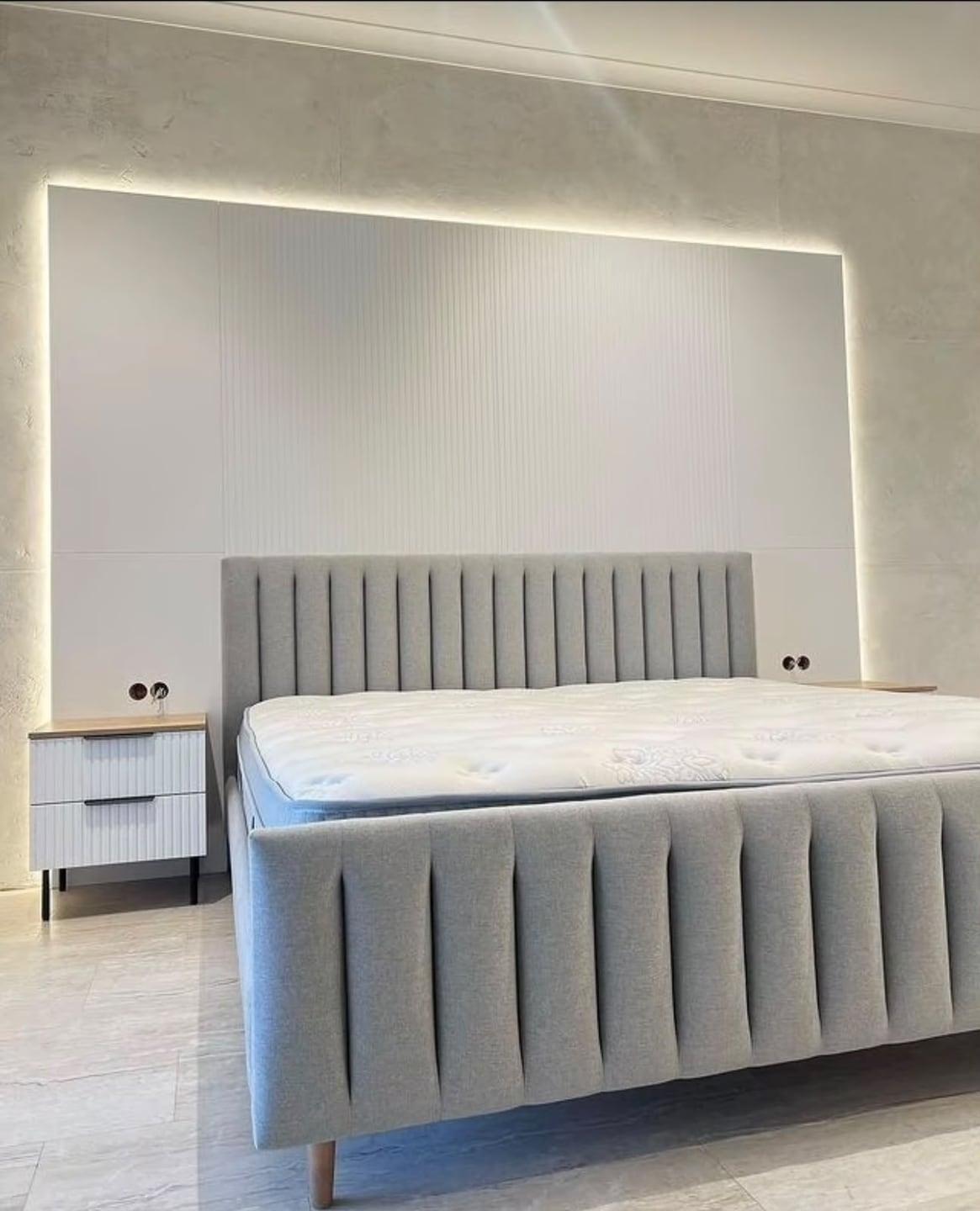
Style decides two things beyond looks: how much sewing the headboard needs and how much dust it holds. Channel tufting, which stitches the padding into vertical tubes, is the style of every bed on our product page. It reads clean and tall, it hides the join between panels, and it is simple to keep straight on a wide headboard.
Diamond tufting, where buttons pull the fabric into the padding at set points, is the traditional style. It looks rich in velvet and every button is a small dust trap, so it takes more cleaning. A plain panel, with a smooth face and a piped or wrapped edge, suits a modern room and is the easiest to wipe, but it shows every crease in a cheap fabric. A winged headboard, whose side panels step forward to frame the pillows, adds sew time and floor depth but gives a hotel look.
The bed pictured here, with wings at the head and a small sofa-like bench at the foot, shows how far the outline can go. A bench is a good use of a long bedroom: it gives you somewhere to sit while dressing and stops the foot of the bed looking bare. In a room under about 3.5 m long it will crowd the walkway, and a plain footboard is the better choice.
Headboard styles at a glance
Vertical channel
- Look
- Clean, tall, modern
- Best for
- Wide beds and most rooms
- Watch for
- Channels should be even and straight across the width
Diamond or button tufted
- Look
- Traditional, rich in velvet
- Best for
- Classic and formal bedrooms
- Watch for
- Dust collects in every button
Plain panel
- Look
- Smooth and quiet
- Best for
- Small and modern rooms
- Watch for
- Shows creases in a thin fabric
Winged
- Look
- Hotel-like, enclosing
- Best for
- Large master bedrooms
- Watch for
- Needs floor depth and more sewing
Headboard with bench foot
- Look
- Complete, furnished
- Best for
- Rooms 3.5 m or more long
- Watch for
- A short room loses its walkway
Our own comparison of the styles we make. Sew time and cost follow the drawing and the fabric, and are quoted after a free inspection.
Fabric for a bedroom headboard
A headboard is touched by heads and hands every night, so the fabric picks up hair oil, skin oil and cream sooner than a sofa does, and you will first see it as a darkening at the middle of the top edge. Pale velvet shows this soonest, which is why we suggest a mid-tone or a tighter weave for a bed that gets daily use, and keep the very pale shades for a guest room.
Choose by touch as well as by colour. A velvet-look pile feels warm and rich, a woven or linen-look cloth feels cooler and hides marks better, and a boucle adds texture but catches on jewellery and watch straps. In a room with a bright window, a cloth with good colour hold keeps the headboard from fading faster than the bed linen. Rub counts, cleaning codes and a home sample test are covered in choosing sofa fabric for children, pets and daily use, and every principle in it applies to a headboard too.
Match the fabric to the rest of the room before you decide. Hold the sample beside the curtains and the bedding, in daylight and again under the bedroom lights; our curtain colour guide shows how a cloth reads against sunlight. A headboard in a cloth that matches the curtains looks planned, while one that only nearly matches looks like a mistake.
What is inside a headboard: the board, the foam and the edges
Under the cloth, a headboard is a rigid board, a layer of foam, and often a wrap of wadding that smooths the edges. The board does the structural work and carries the fixings, so it has to be flat, strong and cut square. The foam is what you lean against, and the wadding stops the foam's edge from showing as a ridge through the cloth.
How much padding goes in depends on the style. A plain panel needs only a thin layer for a tailored, flat face. Channels and buttons need more, because the stitching has to pull the fabric into the padding to make the shape. Ask for the padding to be named on the quotation, as you would for any seat, and see sofa foam density explained for what the grades mean. A headboard is leaned on, not sat on, so it wears more slowly than a seat, but a thin, soft foam still flattens where the same shoulders rest every night.
Look at the edges and the back too. Straight, even corners and a back covered in a neat lining are signs of careful work, and the back is where the fixings sit, so it is worth knowing what the headboard hangs on before it is made.
Wall-mounted, fixed to the bed, or free-standing
There are three ways a headboard meets the room. A wall-mounted headboard hangs on the wall with brackets or a cleat and sits just below the top of the mattress, so the bed's length is not increased by the headboard's depth. A headboard fixed to the bed base uses struts or bolts to the frame and moves with the bed. A free-standing one rests on the floor, and is the simplest where drilling is not allowed.
Choose by height and by the wall. Anything tall, as Furl notes above about 70 cm showing, should be on the wall, because a tall panel on struts rocks every time someone leans on it. A headboard that is wall-mounted also leaves the floor behind the bed clear, which makes cleaning easier. For a rented flat where you cannot drill, free-standing or fixed to the bed is the practical answer.
UAE walls ask for care. Villa and apartment walls are usually masonry, behind which electrical conduit runs; an anchor that finds a conduit is a repair job, so locate hidden cables before drilling. A partition wall of plasterboard needs timber or board backing where the headboard hangs, because a bracket in bare plasterboard will not carry a person leaning on it. Tell us at the visit how the headboard will be fixed, so the back is made with the right brackets or cleat from the start.
Bedside tables, shelves and sockets around the headboard
The headboard is the best moment to organise everything beside the bed. Decide where the lamps, the phone chargers and the bedside tables go before the headboard is made, because a socket found after the fact will be hidden behind the padding or sit in the wrong place. Sockets should be within reach of the pillow on each side, and the cut-outs, if any, are made in the board, not in the finished cloth.
Our own team can move a socket or fit LED wiring where the layout needs it, so raise it early. For lights, a reading light on each side, switched from the bed, is worth more than a bright ceiling; the lighting side of a wide panel is covered in the upholstered headboard wall guide.
Bedside storage can come as a table beside the bed, a floating drawer under a wide headboard or a run of shelves behind it. Our guide to bedside tables and sideboards goes through the sizes, and small bedroom wardrobe ideas shows how a headboard sits between wardrobe towers. If the bedroom also holds a TV, read bedroom wardrobe with a built-in TV unit so the screen and the headboard are planned together.
Beds for children and for guests
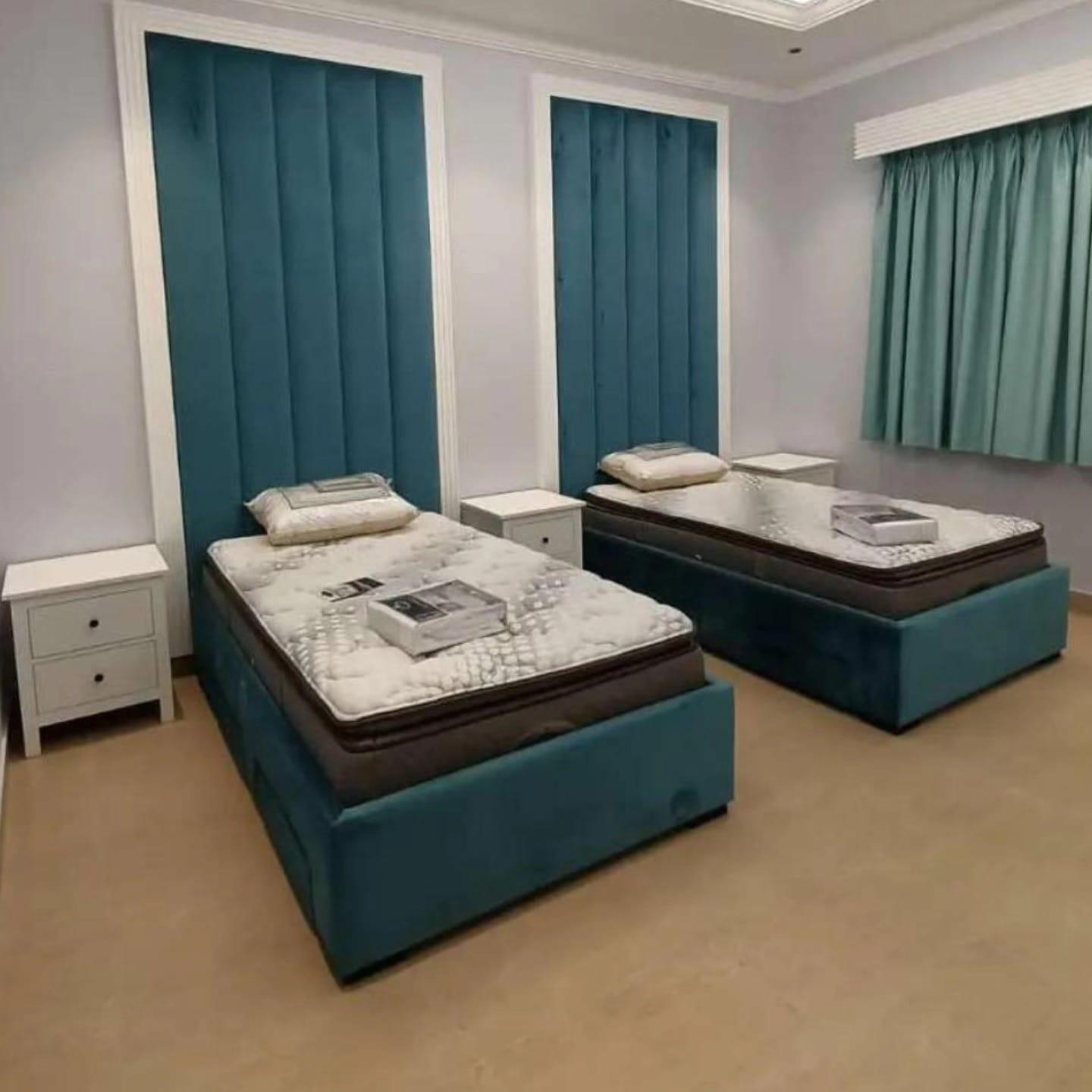
A child's bed asks for a lower, softer outline: round the corners, keep the headboard around the low end of the range, and choose a cloth that wipes clean. The twin beds below each pair a tall channelled panel, framed in wall moulding, with a deep padded base. If two children share a room, matching beds cost less to sew in one fabric order, and the fabric is bought once.
A guest room can take a paler cloth and a simpler panel, because it is used rarely and kept tidy. Think about growth: a child's headboard that is too low at eight will look small at fourteen. Our kids wardrobe design guide shows how to plan a child's room that grows with them.
Cleaning an upholstered headboard
Vacuum it regularly, which is the single biggest thing you can do. Use the upholstery brush on low suction and work from top to bottom, with extra attention to the top edge, the seams and the gap behind the pillows. Hunker's cleaning guide adds a first rule that applies to everything else: check the fabric's cleaning code, and follow it. W means water-based cleaners, S means solvent only, W/S allows either and X means neither, only vacuuming.
For a fresh spill, blot, never rub, from the edge of the stain inwards, then let the fabric dry fully. Hunker also warns against scrubbing, which can cause pilling, and recommends testing any cleaner on a hidden spot first. For oil from hair, sprinkling baking soda, waiting an hour and vacuuming it is the standard first step. If you are unsure, or the stain has set, a professional is cheaper than a ruined headboard.
The video below shows a quick method with household ingredients; treat it as one approach and check it against your own fabric's cleaning code before trying it. For the bedroom, a washable or removable throw over the top of the headboard, or a rule to keep pillows from leaning directly against it, extends the life of the cloth considerably.
A new bed, a new headboard, or re-covering the old one
If the headboard's frame is sound and the shape still suits the room, re-covering is the better value: the cloth is renewed, the padding is renewed where it has gone flat, and the bed keeps its place. If you are changing the bed size, the wall or the whole room, a new one made to measure is the other route. Reupholster or replace a sofa gives the five-check logic, which carries over to a headboard, and sofa upholstery costs covers headboards as part of a set.
Headboards are part of our upholstery service. We start with a free inspection at your home, quote after looking, and publish no fixed price, because size, style and fabric change every one. Once you agree, our team collects the headboard, the work is done at our Sharjah workshop and it is returned; a typical re-cover is back about eight days after your go-ahead. Collection and return carry a charge shown on the quotation, and the workmanship has our 24-month written warranty. If you are deciding between a refresh and a replacement, see our pricing guide for how we quote.
Local details are on our Sharjah sofa upholstery page, the service is under sofa upholstery and repair, and the cover-only job is the fabric replacement page. If the same household is furnishing a majlis, our guide to majlis seating and upholstery covers the same foam and fabric choices on a larger scale.
Before you order a bed or headboard: a checklist
Check your order against this list before the first cut:
- The mattress's real width and length are written on the drawing.
- Headboard width is at least the frame width, with any bedside units added.
- Visible height above the mattress is stated, and a tall one is marked as wall-fixed.
- The style is chosen for the cleaning it will need: buttons collect dust, plain panels show creases.
- The fabric is a mid-tone or tight weave where the bed is used daily.
- Sockets, lights and bedside tables are placed before the headboard is made.
- The fixing method is agreed for the wall: masonry, plasterboard or free-standing.
- The cleaning code is kept with the fabric sample.
Common questions
How high should a headboard be above the mattress?
Sixty centimetres showing is a sound standard; 50 cm is a low profile, and above about 70 cm it should be fixed to the wall. Measure from the mattress top. Upholstered beds and headboards.
How wide should a headboard be?
At least as wide as the bed frame: about 10 cm over the mattress for a plain headboard, plus the width of any bedside shelves. Wider than that becomes a wall feature. Upholstered headboard wall.
What is the best fabric for a headboard?
A mid-tone or tight weave for daily use; a pale velvet shows hair and skin oil soonest. Always check the cleaning code. Sofa fabric for daily use.
Is a wall-mounted or free-standing headboard better?
Wall-mounted for anything tall, because a tall panel on struts rocks when leaned on; free-standing or bed-fixed where you cannot drill. Upholstered beds and headboards.
How do you clean an upholstered headboard?
Vacuum on low suction, check the cleaning code (W, S, W/S or X), blot spills and never scrub. Test any cleaner on a hidden spot first. Sofa fabric care and codes.
Can an old headboard be re-covered?
Yes, when the frame is sound. We inspect free, quote after looking, and a typical re-cover is back about eight days after your go-ahead. Sofa upholstery costs.
How much does a custom headboard cost in the UAE?
We publish no fixed price, because size, style and fabric change each one; the quotation follows a free inspection. How we quote.

Sources & specifications
Manufacturer information applies to the named products and systems. Sources reviewed on 28 October 2026.
- Furl: upholstered headboards explained (usable height, wall-mounting, over about 70 cm must be wall-mounted)furl.co.uk(opens in a new tab)
- Hunker: headboard measurements (height above the mattress, width against the mattress, low modern look)hunker.com(opens in a new tab)
- Hunker: how to clean an upholstered headboard (vacuuming, cleaning codes, spot cleaning)hunker.com(opens in a new tab)
- Wikipedia: bed size (European, UK and US mattress sizes)en.wikipedia.org(opens in a new tab)
Want this planned for your home?
Consultation and measurement are free. Tell us the rooms, location and what you need; we arrange a sample visit and define the measured quotation.