Curtains · 15 min read · 12 June 2026
Choosing curtain colours: sofa, walls and UAE sunlight
Which curtain colour for a grey sofa, cream walls or a bedroom? Match, tone or contrast, sun fading, lining and sheer colours, patterns and testing samples in your own light.

By Ali Haider Basra, Founder, Al Tareeq Decor · Contact our workshop
Key takeaways
- Choose from the room's quiet colour: a curtain one or two shades deeper than the walls, in the same family, is the safe, finished answer.
- A grey sofa suits cream, taupe or greige curtains; check the undertone against the sofa's arm before anything else.
- Sun fades bright and very deep colours first; a lined, mid-tone, muted or patterned curtain on a west window ages best, and a sheer protects nothing.
- Pair the sheer and the drape by undertone, and remember the lining is the colour the street sees.
- Test two samples at the window in the morning, midday, late afternoon and under the lamps; we bring samples to the free visit.
On this page
- Key takeaways
- Which curtain colour? Start from four rules
- Colour changes with the light in your room
- Sun fading: which colours go first, and why the lining matters
- Match the walls, tone with the sofa, or contrast?
- Curtain colour for a grey sofa
- Curtain colour by sofa colour
- Cream, beige and white walls: the UAE default
- Bedroom curtain colour: calm first, dark second
- Sheer and drape: choosing the colour of both layers
- Pattern or plain, and what a majlis asks for
- Lining colour, and what the street sees
- Try samples at your own window before you order
- A sample check before you order
- What colour does to price and timing
- Common questions
Which curtain colour? Start from four rules
People search this question by object: curtain colour for a grey sofa, for cream walls, for a bedroom. The answers differ in detail and agree on a method. First, read the room's quiet colour, usually the walls and the biggest piece of furniture, and choose a curtain from the same family before you consider contrast. Second, keep the curtain one to two shades away from the wall, not an exact match, so it reads as a deliberate layer. Third, decide the lining and the sheer, because the colour on the back and the colour behind the curtain are seen as much as the front. Fourth, never choose from a swatch under a showroom light.
In the UAE one more rule sits on top of those four: the sun. It fades strong colours, it turns cream to gold at four in the afternoon, and it pours through glass onto a white floor that bounces it back into the room. The sections below go through each rule, then through the usual combinations: grey sofa, cream or beige walls, white walls, bedrooms and majlis. The video below is a designer's quick run through the same ground, from what the room is for to light, size and fading.
Colour changes with the light in your room
A curtain colour is not one colour. It is a fabric seen in a particular light, and the light in a Gulf living room changes a good deal in a day. Sherwin-Williams, a US paint maker, makes the point for walls and it applies to cloth: north-facing rooms get cool, even light, south-facing rooms warm, steady light, and east and west rooms swing, with the east warm in the morning and cool by evening and the west the other way round. Its advice is to choose by when you use the room most.
The drawing below puts one room through morning, midday and late afternoon, with four curtain colours swapped in. Look at how ivory, sage and taupe change between the three rooms, and at how heavy charcoal looks against cream walls in the low golden light. A beige that is soft at nine can look orange by five, and the same beige reads grey in a bedroom whose window never gets direct sun. That is why we bring fabric samples to your windows and not a catalogue to a sofa.
Add the evening. Warm lamps and recessed LEDs change a colour again after dark, as Sherwin-Williams also notes for rooms with little daylight, and a living room is used more after dark than before it. A colour you like only at noon is half a choice.
- 1. Morning: light is cool and soft, and pale curtains turn slightly cool
- 2. Late afternoon: low, golden light warms every colour in the room
- 3. The same curtain is drawn in all three lights, so you see what a swatch cannot say
- 4. Charcoal is the heaviest against cream walls and shows the largest change between rooms
- 5. Shortlist two colours, then check both at all three times before you order
Sun fading: which colours go first, and why the lining matters
Ultraviolet light breaks down dye in cloth, and Asian Paints, an Indian paint company, sets out what that means for curtains. Bright, saturated tones and very deep shades show fading most clearly, mid-tone neutrals and muted earthy shades age more gracefully, and pale fabrics can yellow or grey. Printed patterns hide uneven fading better than a plain colour does. South- and west-facing windows fade cloth fastest.
The cloth itself matters as much as the colour. The same source puts silk at the bottom for fade resistance, cotton, linen and velvet in the low to moderate range, polyester high, and acrylic very high, with solution-dyed synthetics, where the colour is part of the fibre, holding tone best. Ask for a fabric's lightfastness rating, which is a separate figure from its rub count, and treat a missing one as an answer. The velvet and silk-look drapes people love in a majlis are the fabrics that pay for a lining.
The lining is the cheap defence. An unlined curtain fades much faster than a lined one, and a sheer, which fades quickly itself, protects nothing behind it. In practice that means a lined curtain on any window that gets direct sun, drawn during the strongest hours, with the sheer as the daytime layer. How a lining also holds heat back is in thermal curtains in UAE heat, and how it behaves at the edges is in light gaps around blackout curtains; this guide stays with colour.
Our recommendation for a west window: a mid-tone, muted colour with a pattern or texture, lined, over a sheer. It is the combination most forgiving of eight summers.
Match the walls, tone with the sofa, or contrast?
Three strategies cover nearly every living room, and picking one on purpose beats drifting into a fourth. Matching means a curtain close to the wall colour, which makes the window quiet and the ceiling feel taller. Toning means a curtain a step or two lighter or deeper than the wall in the same family, which frames the window softly. Contrasting means a curtain that stands apart, which makes the window the feature. Houzz, discussing cream walls, offers the same split: tonal curtains in white or grey, two-tone ideas, and contrasts such as espresso brown or wine red.
On the question people type, lighter or darker than the walls, we say darker, by one or two steps, for a room you want to feel calm and finished, and lighter only where the room is dark and you need the window to open it up. A curtain lighter than the wall seems to float; one slightly deeper anchors the window. A strong contrast belongs in a room with a reason for it, such as a feature wall or a large pattern, and with one colour only.
When the room is large and the windows tall, tone beats contrast. The heading and fullness matter as much as the colour in how a curtain falls, and pinch pleat, wave and eyelet headings are covered in their own guide.
Curtain colour for a grey sofa
Grey is the easiest sofa to dress and the easiest to get flat. For a mid or light grey, the dependable choices are cream, ivory, warm taupe and a greige, which warm a cool sofa without fighting it, and a deeper grey of the same family for a monochrome room. For a charcoal or dark grey sofa, go lighter than the sofa so the window does not turn into a second dark mass: ivory, sand, a pale sage. Contrast with a muted sage, olive, dusty blue or a soft terracotta works when the walls are neutral; with a vivid colour, use cushions first and curtains second.
Check the undertone, not the name. A grey sofa leans cool or warm, and a curtain that leans the opposite way looks dirty beside it, so put your sample on the sofa's arm before anything else. If the sofa is yours to change, the same workshop can match the two: our workshop's sofa reupholstery can use a fabric chosen with the curtains, and sofa fabrics that hide wear shows how colour and weave help.
Curtain colour by sofa colour
Light or mid grey
- Curtain colours that work
- Cream, ivory, warm taupe, greige
- Colours to test twice
- Dusty blue, sage
- Sheer behind
- White or ivory
Charcoal or dark grey
- Curtain colours that work
- Ivory, sand, soft grey
- Colours to test twice
- Pale sage; olive only in a big room
- Sheer behind
- White
Cream or beige
- Curtain colours that work
- Taupe, sand, warm grey, a deeper cream
- Colours to test twice
- Soft gold, sage
- Sheer behind
- Ivory or champagne
Brown or tan
- Curtain colours that work
- Cream, ivory, mushroom, bronze-gold
- Colours to test twice
- Deep green, burgundy
- Sheer behind
- Ivory
Navy or blue
- Curtain colours that work
- Ivory, light grey, sand
- Colours to test twice
- Soft gold, light blue
- Sheer behind
- White
Green
- Curtain colours that work
- Cream, taupe, a lighter green
- Colours to test twice
- Gold, brown
- Sheer behind
- Ivory
Black
- Curtain colours that work
- Warm grey, ivory, charcoal-taupe
- Colours to test twice
- Muted gold
- Sheer behind
- White or ivory
Our recommendations for rooms we measure, and a starting point: bring a sample to the sofa's arm and to the window in your own light.
Cream, beige and white walls: the UAE default
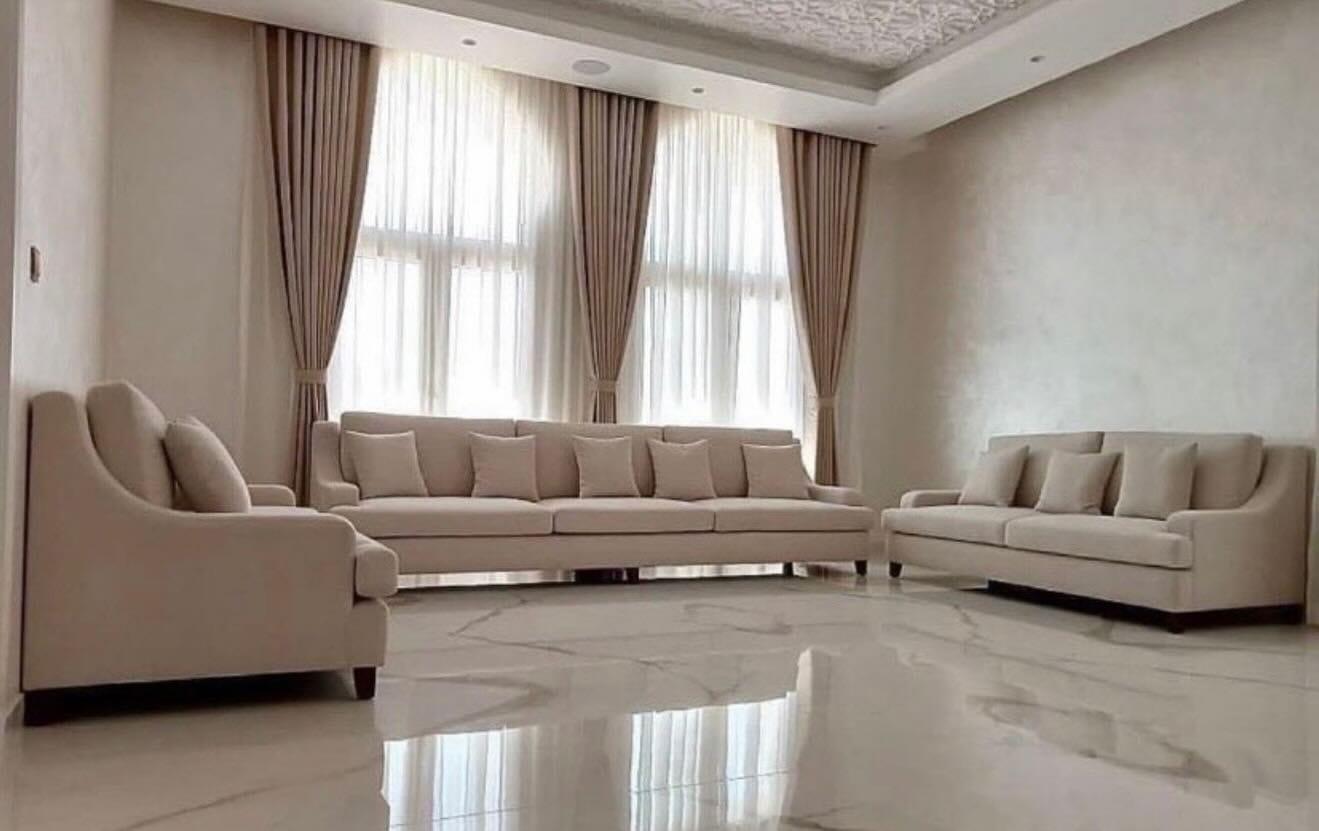
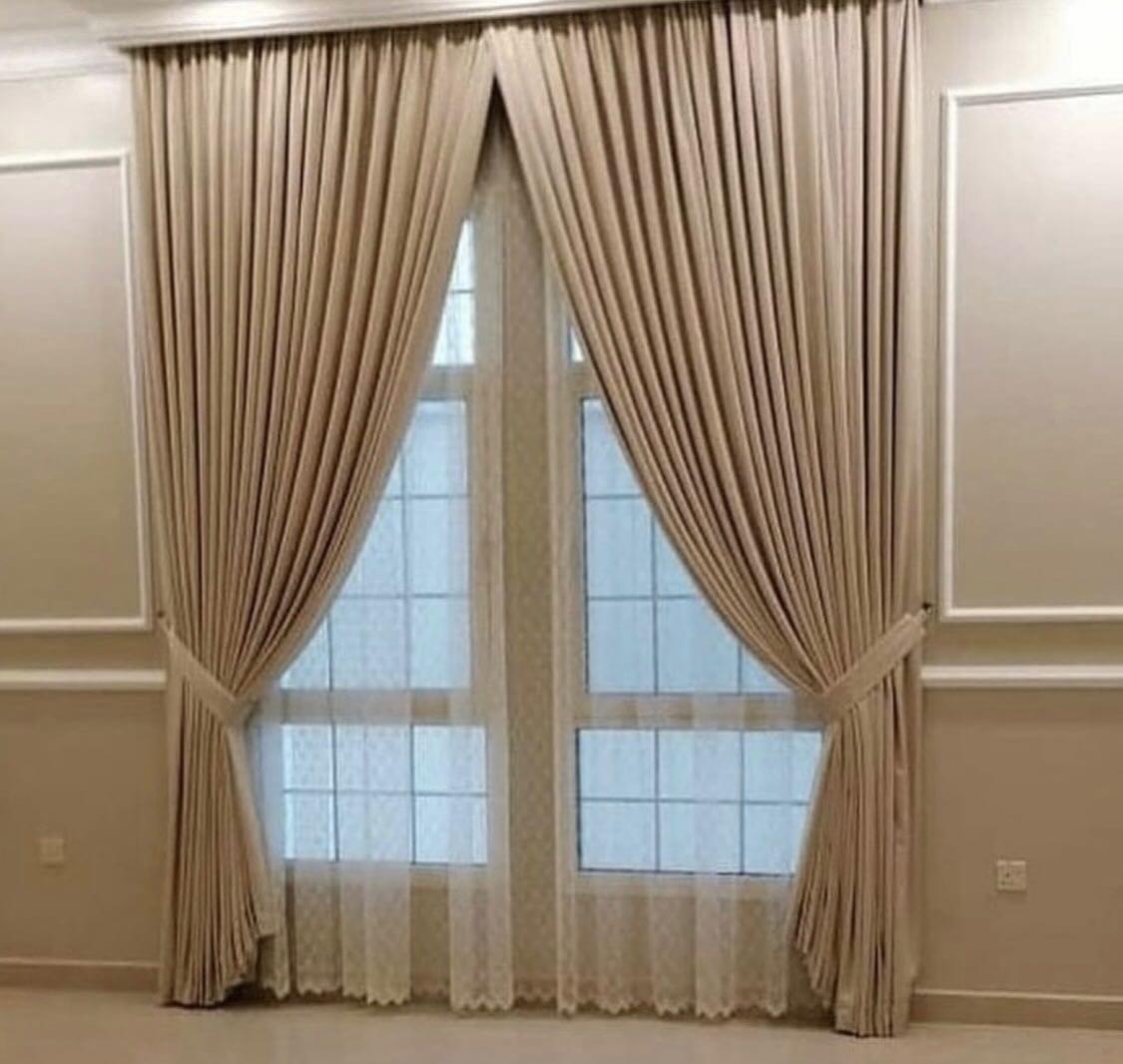
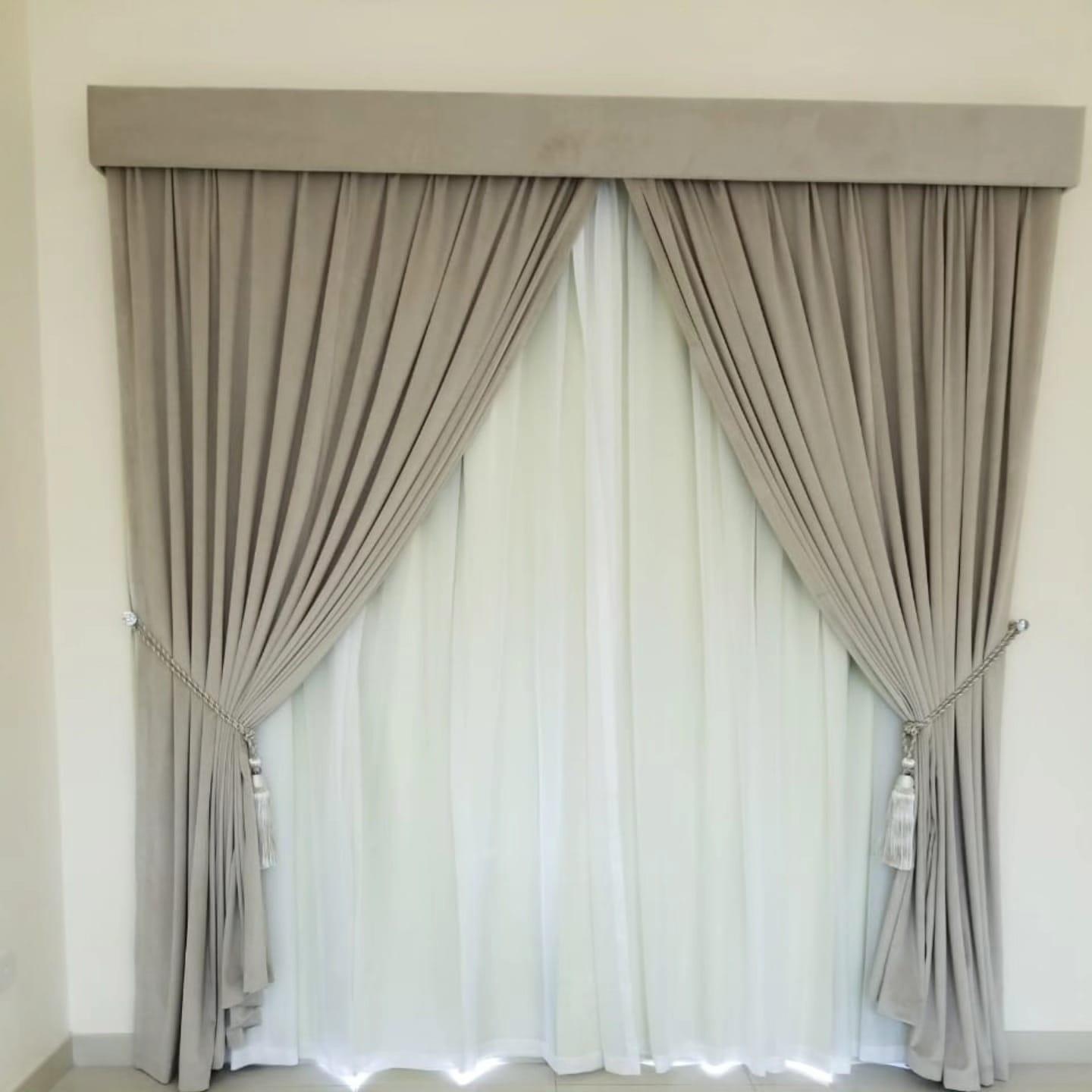
Cream and beige walls on a white or marble floor are the commonest room we measure, and the colour search that follows them is usually the same: what goes with cream walls and a grey or brown sofa. The safe answer is tonal, a curtain one or two steps deeper than the wall in sand, taupe, mushroom or warm grey, with a white or ivory sheer. White works on cream, as Houzz notes, because the two neutrals layer, and a grey curtain adds depth to it.
Take care with yellow. Cream walls under warm lamps lean yellow in the evening, and a curtain with a gold or yellow cast joins them and turns the whole room golden. Where that is the mood you want, as in a formal majlis, fine; in a bright modern living room, pick a cooler taupe or a greige, and let the light bring the warmth.
White walls are a different problem: they show every colour in the room, so the curtain tends to be the biggest colour on show. Mid-tone or muted colours such as sage, dusty blue or a warm grey look intentional, where a stark white curtain on a white wall simply looks like a bare window. If you are choosing wall colour or wallpaper at the same time, start with the walls: our guide to wallpaper for each room shows how a wall's pattern changes the curtain you should pick.
Bedroom curtain colour: calm first, dark second
For a bedroom, choose the colour you want to wake up to, then the darkness you need to sleep. The two are separate. The darkness of a room comes from the fabric, its lining and how the curtain closes at the edges, not from how deep the colour is: a pale blackout curtain with a good lining stops the light as well as a charcoal one does. So treat the colour as a mood choice and the blackout as a spec; the blackout light gaps guide is about gaps, not shades.
Pick calm colours: warm greige, taupe, sage, olive, dusty blue or soft stone, in a muted tone and in a family with the bedding or the headboard. Dark colours make a bedroom feel cosier and smaller, light ones airier, and the room's size and your own taste decide which you want. Avoid a very saturated colour facing the bed; at night under a lamp it dominates the room.
Bedrooms also take a sheer and a drape, and which colour goes in front is a layering question. The reasons for the order are in sheer-plus-blackout layering. For the colour, put the heavier, deeper tone on the drape and the lightest on the sheer.
Sheer and drape: choosing the colour of both layers
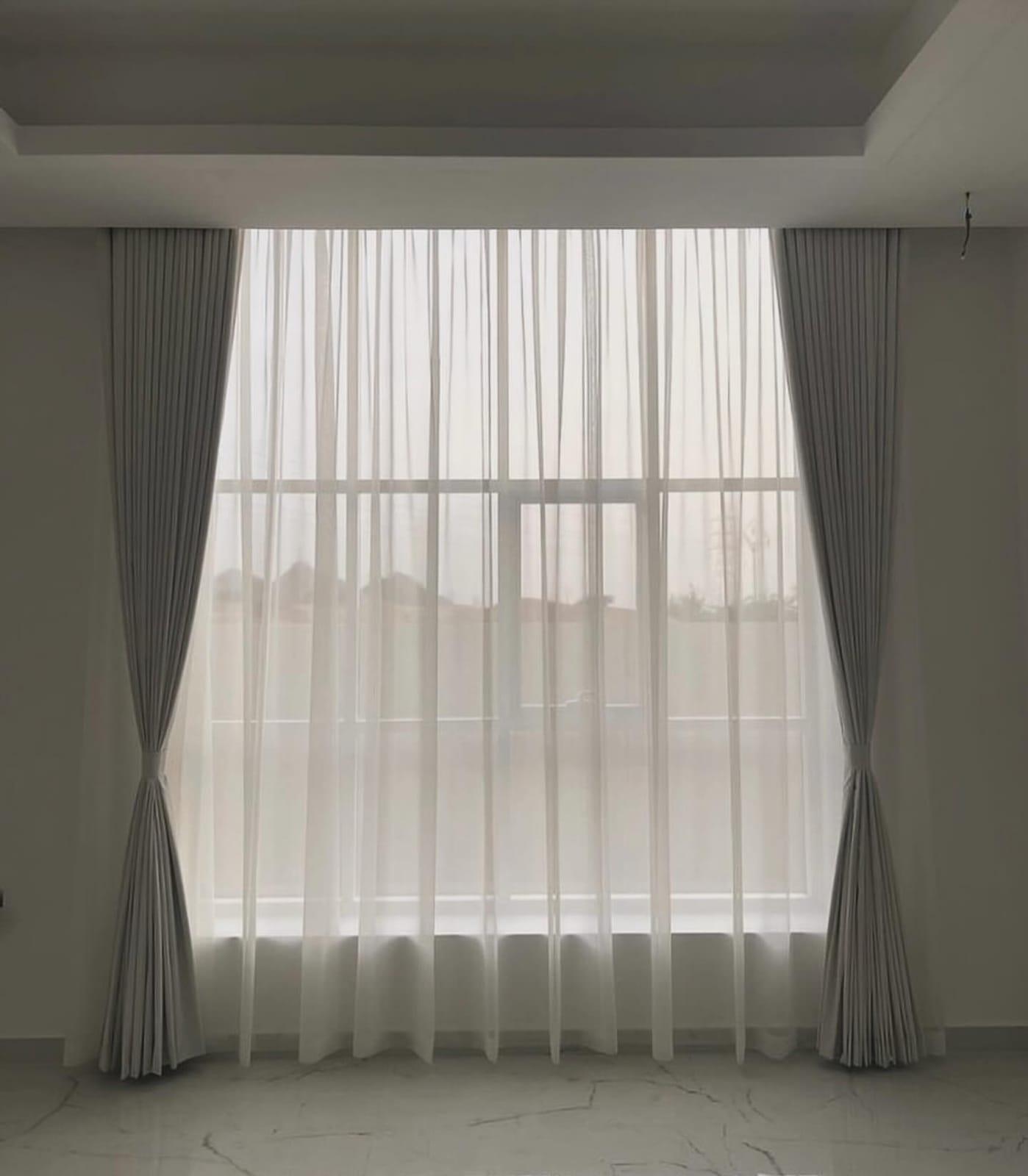
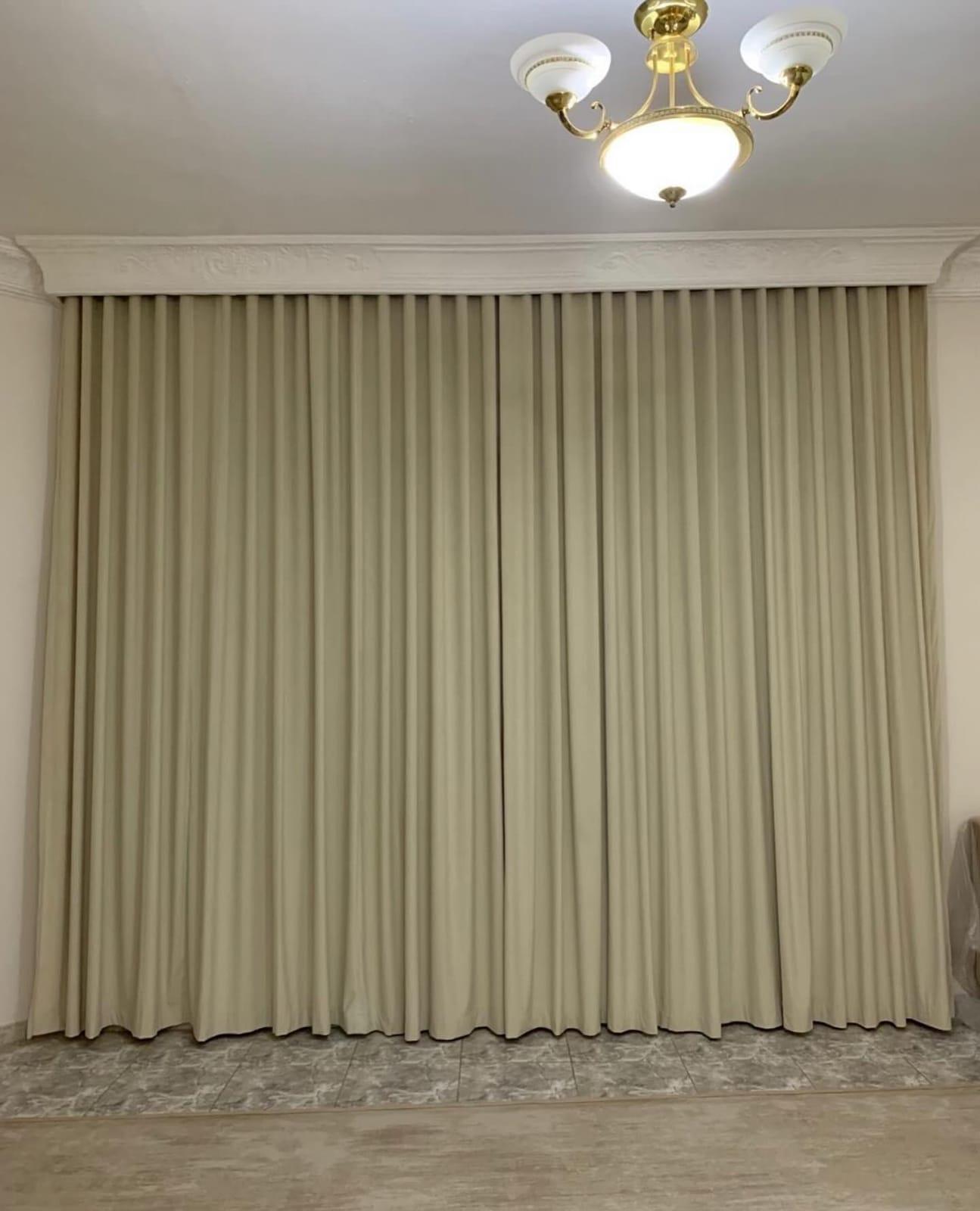
A sheer is the colour that daylight picks up first, because the sun passes through it. A white or ivory sheer keeps daylight neutral; a champagne or oatmeal sheer warms it, which suits a cream room; a grey sheer cools and dims it. Embroidered sheers carry a little pattern, so the drape in front can stay plain. The sheer fades fast and shields nothing, so choose its colour for looks and expect to replace it before the drape.
Pair them by undertone. Warm drape, warm sheer; cool drape, cool sheer. A grey drape over an ivory sheer is the mismatch we see most: the sheer then looks yellow beside it. Use white with a cool drape, ivory or champagne with a warm one. The two together are also two layers of light control, covered in the sheer-or-blackout choice, with our sheer curtains as the product behind it.
If the drape is a blackout, give it the deeper tone and keep the sheer pale. That way daytime, with the drape drawn back, still gives a bright window.
Pattern or plain, and what a majlis asks for
Plain curtains suit most rooms and show off the heading and the fall. A pattern earns its place in two cases: when the room is plain and needs interest, and when the window gets strong sun, because, as Asian Paints notes, printed patterns hide uneven fading better than a solid colour. Where the sofa or rug already carries a pattern, keep the curtain plain, and pick up one colour from the pattern rather than the pattern.
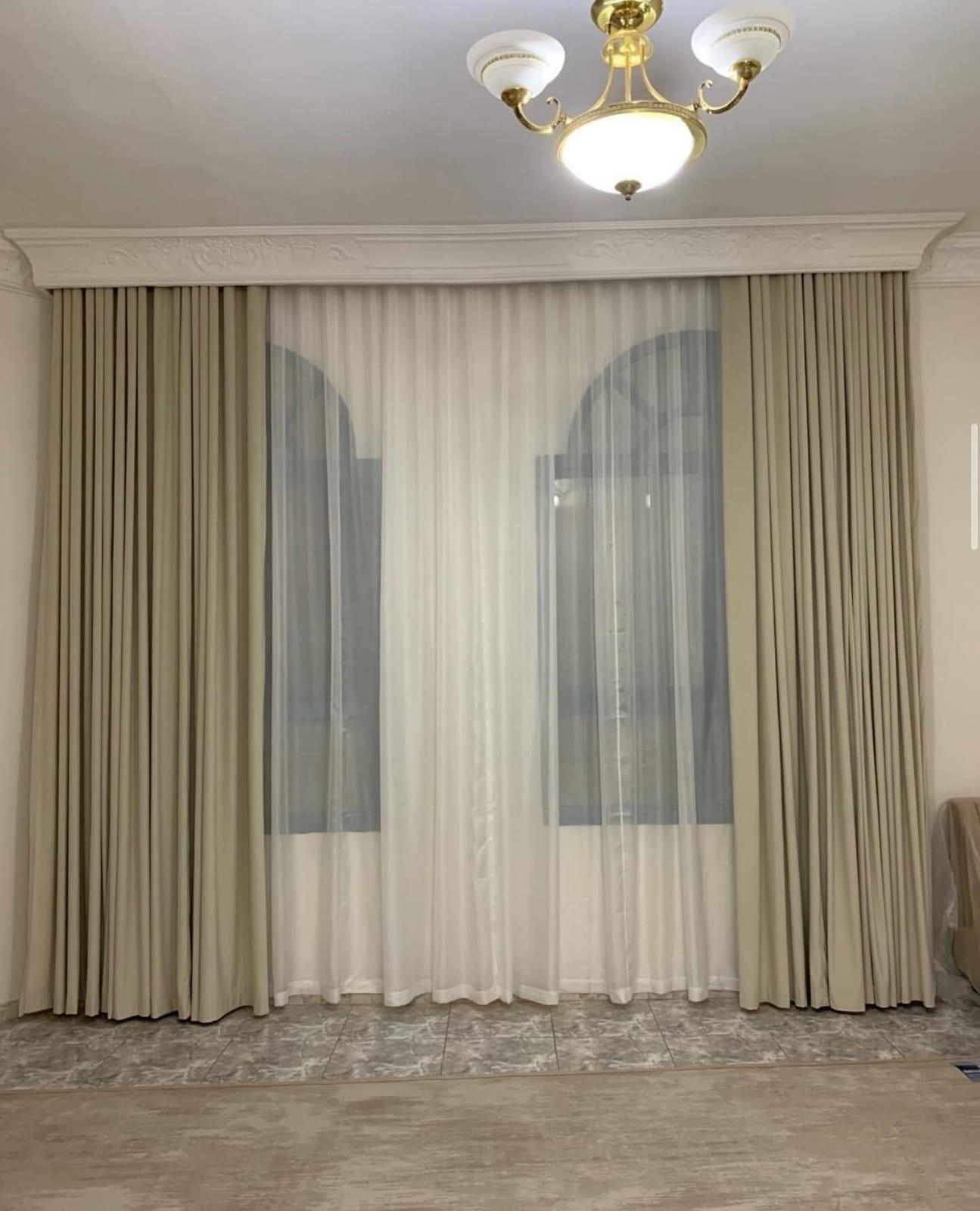
A majlis follows a different logic. Velvet soaks up light and makes colours look deep, and the seating, curtains and rug are usually one family, often with gold or embroidery. The sheer carries the pattern and the drape the main colour. The fabrics are in our majlis curtains guide, and since the same workshop makes the seating and the curtains, majlis curtains with tiebacks can be chosen together with the cushions and sofa fabric.
In a small room, light and mid-tone curtains that sit close to the wall colour make the window less of a feature and the room seem larger. Dark curtains work in a small room if the room has good light and you want it cosy.
Lining colour, and what the street sees
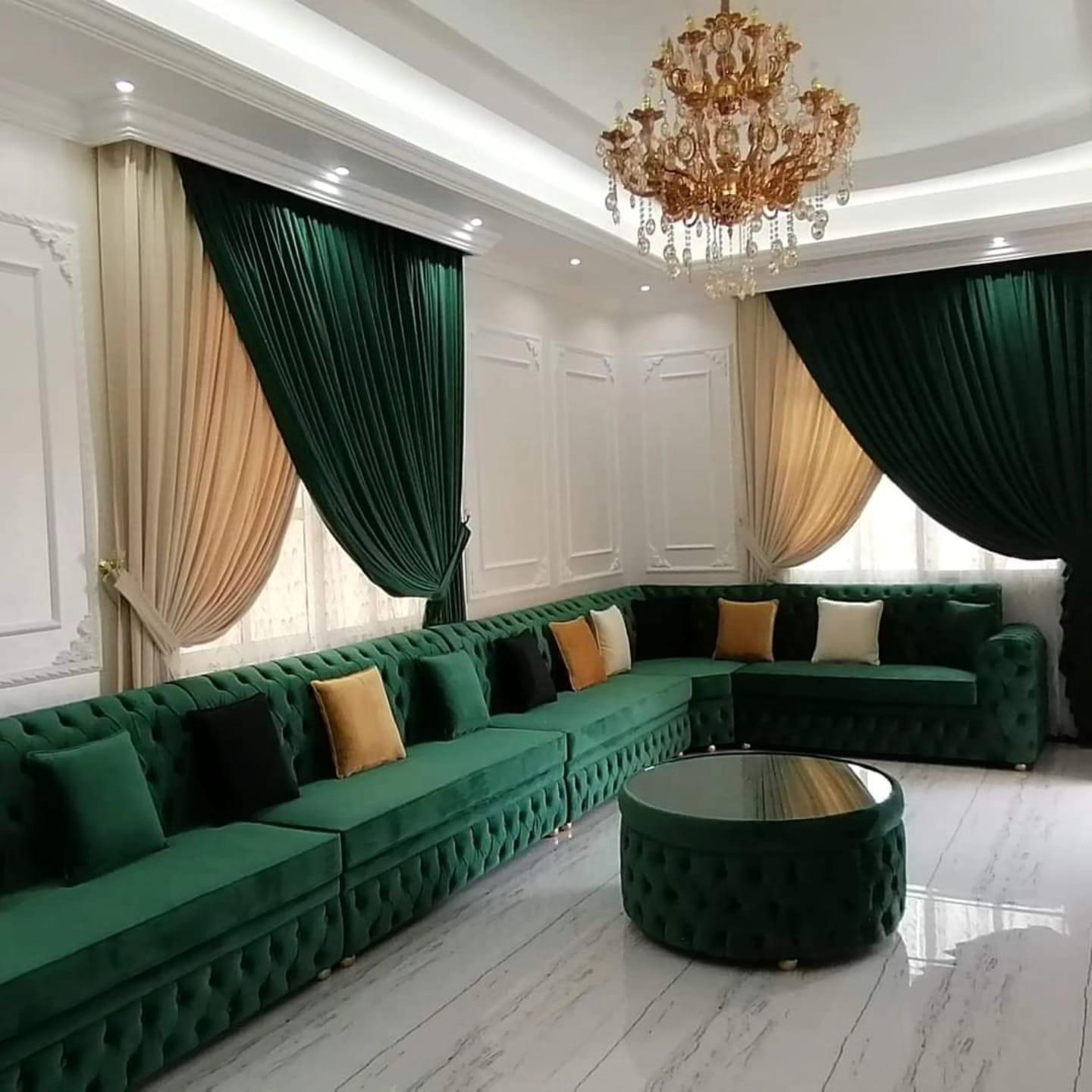
Every curtain has two faces. The one inside is the colour you chose; the one facing the glass is the lining, and from the street, the walkway or the tower opposite, the lining is the colour of your window. Most linings come in ivory or white, and a pale lining is also what the side facing the glass usually is for a reason: it holds less of the sun's heat against the room, as the thermal curtains guide explains. Some buildings and communities prefer a uniform look from outside, so ask your management if there is a rule before you choose a coloured lining.
Name the lining on the quotation. Two curtains in the same face fabric can have different linings, and a coated blackout lining is a different product from a plain cotton one. Ask for the outer fabric, the lining and the colour code in writing, so a replacement panel can be matched later. The same advice, with the price breakdown, is in curtain prices in the UAE.
Dark colours also show dust and lint more, and light ones show marks. Know what you are signing up for, and read the care label before you order; caring for blinds and curtains explains what each fabric can take.
Try samples at your own window before you order
Paint makers all say it and it is true of cloth: judge a large sample, not a small chip, and look at it at several times of day. Sherwin-Williams suggests samples in the room for the same reason. For curtains, hold or hang a metre of the fabric at the window, against the sofa and against the floor, and look at it at about nine, one and five, and again at night under the lamps you use.
Do it with two colours, not six. Six samples turn into a blur; two make a decision. If you have a sheer in mind, hold it in front of the drape, because the pair is what you will live with. The short video that follows argues for trying colours out first.
At the free measuring visit we bring fabric samples to your windows, check the light in the room and the wall behind the curtain, and measure for the track. To prepare, read how to measure windows; curtain measuring and fitting describes what the visit covers, and picking a curtain maker in Sharjah helps if you are comparing quotes. Colour is only part of the job: how the track, the heading and the fabric work together is part of our curtains and blinds service.
A sample check before you order
Morning
- What to look at
- Sample at the window, then on the sofa arm
- What you are checking
- Does it turn cool or grey in cool light?
Midday
- What to look at
- Sample against the wall and floor
- What you are checking
- Does it look flat or washed out in bright light?
Late afternoon
- What to look at
- Sample in the low, golden light
- What you are checking
- Does it turn orange, yellow or muddy?
Night
- What to look at
- Sample under the room's own lamps
- What you are checking
- Does it still look like your colour?
With the sheer
- What to look at
- Sheer held in front of the drape
- What you are checking
- Do the two undertones agree?
Our checklist for the visit; most rooms settle on a colour after the afternoon look.
What colour does to price and timing
Colour itself does not change the price of our curtains. The fabric you pick, the fullness, the lining and the track do. Curtains start from AED 550 per window, fabric, manual track and fitting included, and the collection and lining you pick move the figure; what goes into a curtain price breaks it down. For a number across several rooms, use the pricing guide.
Our Sharjah workshop sews the curtains and our own fitters hang them anywhere in the UAE, with the 24-month written warranty on workmanship. The sooner you settle the colour with a sample on site, the sooner the order starts; if you are still undecided, take two samples home. And if blinds are also on the list, zebra, vertical and wooden blinds are compared in our other guide.
Common questions
What colour curtains go with a grey sofa?
Cream, ivory, warm taupe or greige for most greys, and a lighter ivory or sand for a charcoal sofa. Check the undertone against the sofa's arm first. Custom curtains made to measure.
What colour curtains go with cream or beige walls?
Tonal ones: sand, taupe, mushroom or warm grey, a step or two deeper than the wall, with a white or ivory sheer. Avoid a gold cast in a bright room. A sheer and a blackout curtain together.
Should curtains be lighter or darker than the walls?
Slightly darker for a calm, finished room; lighter only in a dark room that needs opening up. Matching exactly makes the window disappear. Curtain headings and how the fabric falls.
Do dark curtains fade faster in the sun?
Bright, saturated colours and very deep shades show fading most, and unlined curtains fade much faster than lined ones. Mid-tone, muted or patterned fabrics hold best. Thermal curtains and UV.
What is the best curtain colour for a bedroom?
A calm, muted colour such as greige, taupe, sage or dusty blue; darkness comes from the lining and the fit, not the shade. Blackout curtains.
Should sheer curtains be white?
White or ivory keeps daylight neutral; champagne or oatmeal warms it. Match the sheer's undertone to the drape, warm with warm and cool with cool. Sheer curtains.
Plain or patterned curtains?
Plain for most rooms; a pattern for plain rooms and sunny windows, where it hides uneven fading. If the sofa is patterned, keep the curtain plain. Majlis curtains and their fabrics.

Sources & specifications
Manufacturer information applies to the named products and systems. Sources reviewed on 28 October 2026.
- Asian Paints: how sunlight affects curtain and upholstery fabrics (UV, colour, fibre, lining, window direction)beautifulhomes.asianpaints.com(opens in a new tab)
- Sherwin-Williams: choosing colour by room orientation (north, south, east and west light; testing samples)sherwin-williams.com(opens in a new tab)
- Houzz: what colour curtains go with cream walls (tonal, contrast and accent colours)houzz.in(opens in a new tab)
Want this planned for your home?
Consultation and measurement are free. Tell us the rooms, location and what you need; we arrange a sample visit and define the measured quotation.