Curtains · 15 min read · 11 June 2026
Zebra, vertical and wooden blinds: which suits which window?
Zebra, vertical or wooden blinds: how each handles light, night privacy, heat, damp and sliding doors, what Dubai prices run to, and which window each suits.

By Ali Haider Basra, Founder, Al Tareeq Decor · Contact our workshop
Key takeaways
- Zebra blinds give soft daylight and night privacy; vertical blinds cover wide glass and sliding doors; wooden blinds give a warm, adjustable slat line.
- At dusk every open blind shows the lit room from outside; each one closes differently: zebra bands overlap, vanes turn face-on, slats tilt shut.
- None of the three is a heat shield or a blackout; for a dark bedroom a lined curtain on a long track is still the first choice.
- Real wood belongs in dry, air-conditioned rooms; in kitchens and bathrooms choose faux wood, aluminium slats or a washable roller fabric.
- Our blinds are roller, Roman and Venetian, quoted after the free measuring visit; zebra, vertical and wooden types are compared here and are not on our published list.
On this page
- Key takeaways
- Zebra, vertical or wooden blinds: the short answer
- What each of the three blinds actually is
- What we make and install, and what we do not list
- Daylight by day, and privacy once the lamps are on
- Heat and glare in a UAE window
- How dark each one gets
- Sliding doors, wide glass and the draught problem
- Kitchens, bathrooms and humid rooms: real wood or faux wood
- Cleaning, cords and children
- What each costs in Dubai
- Dubai blind prices per m² of window, as published by Curtains Express
- Window by window: which blind where
- Which blind suits which window
- How we plan it with you
- Common questions
Zebra, vertical or wooden blinds: the short answer
Pick by the window, not by the style. A zebra blind suits a living-room or bedroom window where you want soft daylight and a way to dial privacy up at night. Vertical blinds suit wide glass and sliding doors, where the blind has to slide aside to let people through. Wooden blinds suit a window where you want a warm, solid line and fine control of the angle of the light, in a room that stays dry.
Almost every disagreement between the three comes down to four things: how the blind moves, how it behaves after dark when the room outshines the street, how dark it gets, and what the room does to it, which in the Gulf means sun, air-conditioning draughts and, near the coast, steam and damp air. The sections below go through them in that order. For the wider question of a blind against a curtain we keep a separate guide, roller blinds or curtains, and the fabric blind that folds is covered in our Roman blinds guide, so neither is repeated here.
What each of the three blinds actually is
A zebra blind, also sold as a day-and-night or dual-layer blind, is a roller blind with a trick. Its fabric runs in two layers, each striped with alternating bands of solid and sheer cloth. Raise or lower it and one layer slides past the other. When the solid bands sit over the sheer ones the blind is closed; when solid lines up with solid, the sheer bands are left for light and a blurred view. Blindster, a US blinds retailer, describes exactly this: aligning the sheer bands filters light, aligning the opaque bands gives privacy.
A vertical blind hangs a row of tall, narrow slats, called vanes, from a track above the window. The vanes turn through a half circle: edge-on to the glass for a clear view, angled to redirect sunlight, or face-on for privacy. The whole row then slides to one side or splits down the middle. SelectBlinds says the vanes rotate 180 degrees. They are made in vinyl, fabric and faux wood.
A wooden blind is a horizontal-slat blind, a Venetian blind in the wider sense, whose slats are wood or a wood-look material. Slats tilt up and down to admit or shut out light, and the whole stack lifts to the top on cords. The slat material is the real choice: real wood is the warm one; faux wood, made from polymer or composite, is the one made for damp rooms. We come back to that in the humidity section.
What we make and install, and what we do not list
Our published blind range is roller blinds, including sunscreen and blackout fabrics, Roman blinds and Venetian blinds, supplied and installed by our own team across the UAE. Zebra, vertical-vane and real-wood blinds are not on that list, and we would rather say so here than let a comparison page suggest otherwise. If you have set your heart on one of the three, send us the window and tell us on WhatsApp; we will say plainly whether we can supply it, and which slat or fabric.
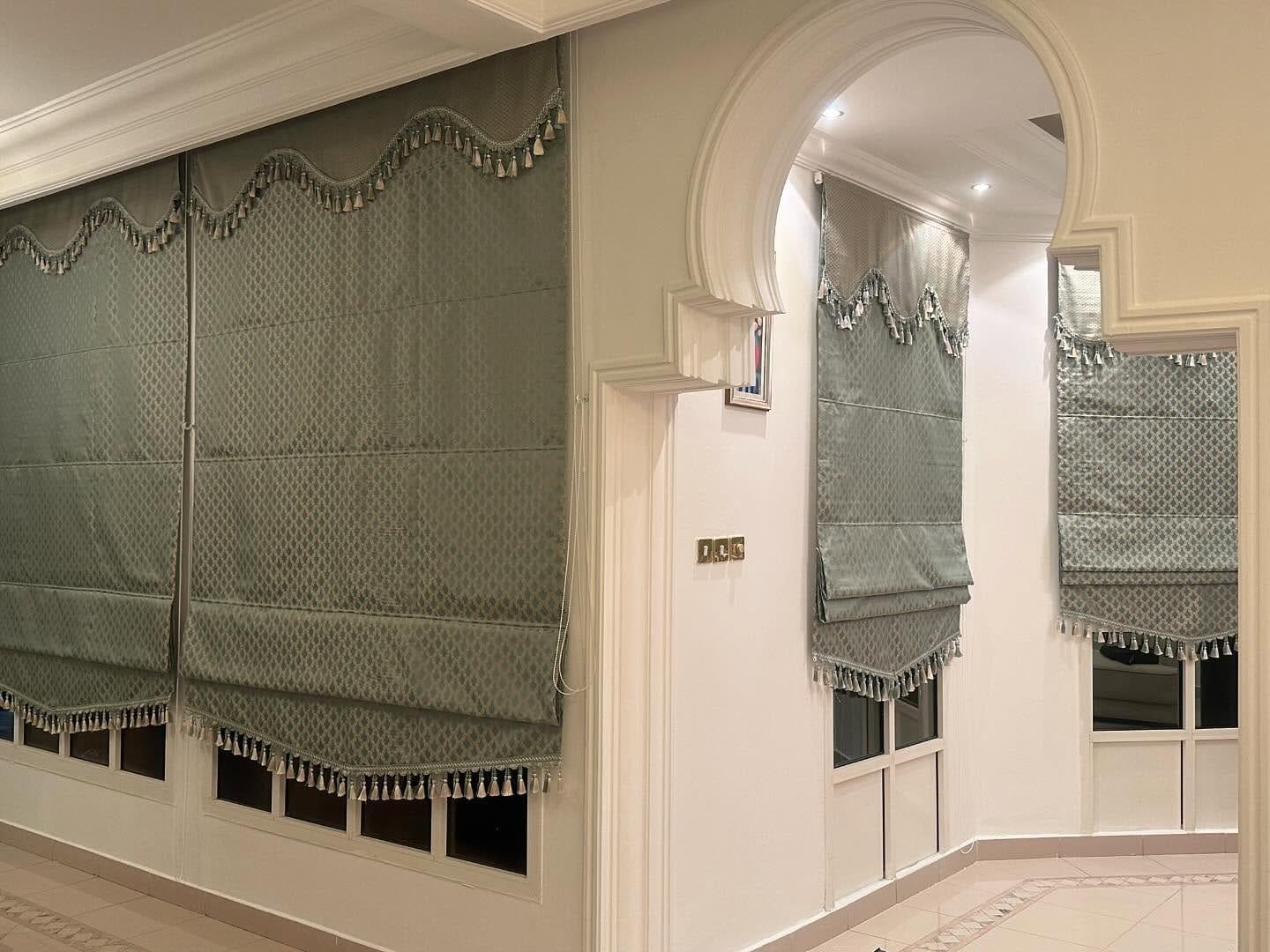
What the comparison still does is help you choose, because each type solves a problem we also solve another way. If it is a zebra's daytime softness and night privacy you want, the nearest thing in our range is a sunscreen roller blind with a sheer curtain, or a roller blind behind a curtain. If it is a vertical blind's reach across a sliding door, a curtain hung wider than the opening does the same job in softer cloth. If it is a wooden blind's slatted line, a Venetian blind gives it. Start from the product page for Roman and roller blinds and our curtains and blinds service, or see what the Sharjah workshop does on the curtains and blinds in Sharjah page.
Daylight by day, and privacy once the lamps are on
A window behaves in two opposite ways. By day it is brighter outside than in, so a thin or open blind lets you see out while passers-by see little in. After dark the lights inside make the room the bright side, and the same open gaps show the room to anyone outside. That reversal is explained for sheer curtains in why a sheer curtain shows the room at night, and every blind here has to be judged against it.
The drawing below runs all three through one day. Open, each leaves a different share of the window see-through: about half for a zebra blind, whose sheer bands are only a veil, and most of it for vanes turned edge-on or slats tilted flat. When the lamps come on, all three show the room. Closing them changes that, and it closes in three different ways: the zebra's solid bands slide over its sheer ones, the vanes turn face-on, and the slats tilt shut.
This is where a zebra blind earns its popularity. Because it never fully lifts out of the window, the sheer bands keep daylight soft all day, and one pull gives privacy in the evening. Vertical vanes and wooden slats need a deliberate turn of the wand, and a window with gaps between slats is never quite private from a floor above. For a window overlooked by a neighbouring tower, add sheer curtains in front of a blind so there is a soft layer by day and the blind's own darkness at night.
- 1. By day all three are open: zebra bands aligned, vanes edge-on, slats tilted, and the view and light come in
- 2. At dusk the lamps make the room the bright side, and it shows through the same gaps from outside
- 3. Zebra: slide the solid bands over the sheer ones to close it
- 4. Vertical: turn the vanes face-on so they overlap across the whole width
- 5. Wooden: tilt the slats shut; the cord holes and the edges still let a little light by
Heat and glare in a UAE window
None of the three is a heat shield, and any page that says so is selling. A blind sits inside the glass, so the sun's heat has already reached the room when it stops the light. What a blind does is cut glare and the direct beam, which lets the AC cope. The ranking that follows from that is modest: a closed blind with solid material in it, whether solid zebra bands, closed vanes or closed slats, keeps more sun out than an open one, and an open zebra, vanes or slats let most of it in.
Of the three, a real-wood slat is a better insulator than plastic or metal, and Budget Blinds credits real wood with blocking UV and reducing solar heat gain, though it gives no figures, so we treat it as a small bonus and not a reason to buy. The fabric on a zebra blind or a fabric vertical blind matters more: light-filtering fabrics let heat and light through, room-darkening ones less. For the serious fight against afternoon sun on a west window, the answer is still a lined layer or a reflective one, as laid out in thermal curtains in UAE heat, with the blind doing glare control.
Glare on screens is the one place all three do well. Tilting slats or turning vanes lets you cut the beam on a TV or a desk without losing the view, which is hard to do with a plain roller. If glare is the whole problem, a sunscreen roller blind does the same job in a flatter way and is in our range.
How dark each one gets
Ask how dark before you ask how pretty. A zebra blind is not a blackout blind by default. Solid bands overlap to block most of the light, yet some gets through at the joins between bands and along the edges, and a true blackout version exists only where the maker specifies one, so check the fabric's rating on the product in front of you. Vertical blinds leave a narrow gap where one vane meets the next and a gap at each end of the track. Wooden slats overlap well, yet light slips through the cord holes and along the headrail and sill.
These are the same four gaps that light finds around any curtain, top, sides, middle and bottom, so the way to judge a blind is the way we judge a curtain, in why a blackout curtain is not dark. If a bedroom has to be properly dark, none of the three comes first. A blackout curtain hung from the ceiling on a track wider than the window does, and our blackout curtains are planned to close those gaps. A blind then becomes the daytime layer, in front of it or behind.
In a room that only needs to be dim for a TV or a nap, a closed zebra or a closed wooden blind is plenty. Be honest about which room you are dressing.
Sliding doors, wide glass and the draught problem
Vertical blinds exist for wide openings, and this is where they beat the other two. A zebra blind or a wooden blind on a three-metre door is one huge, heavy panel that has to be lifted every time someone steps out, while a vertical blind draws aside along its track like a curtain and can be left half open. Several of the guides we read call vertical blinds the usual choice for sliding and patio doors for that reason. The full case for each option on a sliding balcony door, including where the stack should go, is in curtains and blinds for sliding doors.
The weak point is air. Vanes are light and free-swinging, so an open door and an AC draught make them clatter, and SelectBlinds names noise as a main complaint, along with slats snapping or bending after repeated use. A heavier fabric vane quietens them, and SelectBlinds points to panel tracks as a calmer alternative. If the door is opened many times a day and the vanes are vinyl, expect to replace one now and then; vanes are sold singly.
On a sliding door we often suggest a curtain on a ceiling or wall track beyond the frame instead, because it stacks clear of the opening and carries no moving slats. A vertical blind is the right answer where you want a clean, office-like look, a cheap fix, or a rented flat where you will take the blind with you.
Kitchens, bathrooms and humid rooms: real wood or faux wood
Wooden blinds are where the material decides everything. Real wood takes in moisture and over time it warps and fades, so Budget Blinds, a US retailer, steers it to bedrooms and living rooms and faux wood to bathrooms, kitchens and laundry rooms, where steam and splashes are routine. The same retailer describes faux wood as polymer with UV inhibitors that resists warping, cracking and yellowing, and says it can be wiped clean. It is heavier than real wood, and a retailer that sells both is not a neutral judge, so ask for the maker's maximum width and weight for the exact blind.
In our climate that rule needs one more line. A kitchen on the coast in August has steam inside and sticky air outside, and a bathroom window is wet every day, so put real wood only in a bedroom or a majlis that is air-conditioned and dry. In a wet room, choose faux wood, aluminium Venetian slats or a washable roller fabric, and keep slats out of the splash zone of a sink or shower.
Zebra blinds in fabric or vinyl are easy to wipe, which is another reason they do well in rented flats. The video below sets wood against faux wood in a few minutes, which is quicker than reading both brochures.
Cleaning, cords and children
Dust is the everyday difference. Vertical vanes collect less of it than horizontal slats, according to SelectBlinds, and a damp cloth or a vacuum's brush attachment is enough. Wooden slats take a dry or slightly damp microfibre cloth, one slat at a time, with the tilt reversed halfway through so both faces get done. Zebra bands, with fewer parts, wipe with a damp cloth. The routine for each fabric is in caring for blinds and curtains.
Cords are the safety question. The US product-safety regulator, the CPSC, is blunt that cordless products are the only way to remove the strangulation risk to young children, that cord stops and tension devices reduce it without removing it, and that continuous loops should be anchored taut to the floor or wall. Zebra blinds come with a chain, a cordless lift or a motor; vertical blinds use a wand to turn and a cord or chain to draw; wooden blinds have lift and tilt cords. For a child's room, choose cordless or motorised, as explained in motors and cordless controls, and tell us which rooms the children use before we plan the controls.
What each costs in Dubai
Our blinds are quoted after we measure each window, since fabric, control and fitting all move the figure, so we publish no rate card for them. To give a sense of the spread between the types, here is one published Dubai price list, Curtains Express, read on 28 October 2026. Every blind there is priced per square metre of window, with a minimum charge, and a small window is billed as the minimum.
Work it through for a 2.4 m wide by 2.4 m tall sliding door, which is 5.76 m². At those rates a vertical blind in sunscreen fabric comes to about AED 461 and in blackout fabric about AED 634; a roller blind about AED 518; a zebra blind about AED 922; and a 50 mm faux wood blind about AED 1,210. A 1.5 × 1.2 m window is only 1.8 m², but the minimums make it AED 240 for a vertical blind, AED 180 for a roller or an aluminium Venetian, AED 320 for a zebra and AED 420 for faux wood. Vertical blinds are the cheapest way to cover a wide opening; faux wood is the dearest of the three.
Our curtains start from AED 550 per window with fabric, a manual track and installation, itemised in the curtain price guide. For a ballpark across a whole home, use the pricing guide, then ask us for the blind quotation.
Dubai blind prices per m² of window, as published by Curtains Express
Vertical, sunscreen
- Rate per m²
- AED 80
- Minimum charge
- 3 m² (AED 240)
- A 2.4 × 2.4 m door (5.76 m²)
- About AED 461
Vertical, blackout
- Rate per m²
- AED 110
- Minimum charge
- 3 m² (AED 330)
- A 2.4 × 2.4 m door (5.76 m²)
- About AED 634
Roller, sunscreen or blackout
- Rate per m²
- AED 90
- Minimum charge
- 2 m² (AED 180)
- A 2.4 × 2.4 m door (5.76 m²)
- About AED 518
Aluminium Venetian
- Rate per m²
- AED 90
- Minimum charge
- 2 m² (AED 180)
- A 2.4 × 2.4 m door (5.76 m²)
- About AED 518
Zebra, solid and sheer stripes
- Rate per m²
- AED 160
- Minimum charge
- 2 m² (AED 320)
- A 2.4 × 2.4 m door (5.76 m²)
- About AED 922
Faux wood, 50 mm slats
- Rate per m²
- AED 210
- Minimum charge
- 2 m² (AED 420)
- A 2.4 × 2.4 m door (5.76 m²)
- About AED 1,210
Rates and minimums are from the Curtains Express price page, read 28 October 2026, for comparison only; the last column is our own multiplication. Al Tareeq Decor blinds are quoted after measurement.
Window by window: which blind where
Use the table as a starting point and bring the exceptions to the visit. The right-hand column gives the option from our own range that comes closest, so a real alternative can be priced whichever way you lean.
Two rules cover most homes. Put the blind that is easy to wipe where the room is wet or greasy, and put the one that adjusts light finely where the glare is. Where one window has to do both jobs, give it a blind and a curtain, as set out in a sheer and a blackout curtain on one window.
Which blind suits which window
Living-room window facing the street
- Best of the three
- Zebra
- Why
- Soft daylight, privacy at night with one pull
- Closest in our range
- Sunscreen roller with a sheer curtain
Sliding balcony door
- Best of the three
- Vertical
- Why
- Draws aside, covers the full width cheaply
- Closest in our range
- Curtain hung wider than the opening
Bedroom
- Best of the three
- Zebra with blackout fabric
- Why
- Dim by day, private at night
- Closest in our range
- Blackout roller behind a curtain
Home office or desk window
- Best of the three
- Wooden or vertical
- Why
- Tilt or turn to cut screen glare
- Closest in our range
- Venetian or sunscreen roller
Kitchen window over a sink
- Best of the three
- Faux wood or a wipeable zebra
- Why
- Steam, splashes and grease
- Closest in our range
- Roller in a wipeable fabric
Bathroom
- Best of the three
- Faux wood (never real wood)
- Why
- Moisture resistant, wipes clean
- Closest in our range
- Roller in a moisture-tolerant fabric
Majlis or formal room
- Best of the three
- Wooden (real wood, dry room)
- Why
- Warm, solid, formal line
- Closest in our range
- Roman blinds or curtains
Rented flat
- Best of the three
- Vertical or zebra
- Why
- Cheap, easy to take down
- Closest in our range
- Roller blinds
Our own recommendations from the windows we measure. Real wood belongs only in a dry, air-conditioned room.
How we plan it with you
On the free measuring visit our fitter laser-measures every window, checks whether the recess is deep enough for a blind inside it, looks at the wall beside the window for a curtain to stack on, and asks which rooms the children and the afternoon sun use. We bring fabric and blind samples so you can hold a swatch to your own glass before you decide; a swatch looks quite different at nine in the morning and at four in the afternoon.
Blinds and curtains are measured, made and fitted by our own team, with the workshop in Sharjah and fitting across the UAE, and our 24-month written warranty covers the workmanship. If you have a particular zebra, vertical or wooden blind in mind, say so at the start and we will answer honestly about what we can supply. See how to measure your windows to prepare, measuring and installation for what the visit involves, or choosing a curtain maker in Sharjah if you are comparing us with others.
Common questions
Do zebra blinds give privacy at night?
Yes, once the solid bands cover the sheer ones. With the sheer bands aligned and the lamps on, the room shows from outside. Sheer or blackout, layer by layer.
Are zebra blinds blackout?
Not by default: the solid bands overlap, but some light gets through at the joins and edges, and only certain versions are made as blackout. Where blackout light gets in.
Are vertical blinds or curtains better for a sliding door?
Vertical blinds are the cheap, usual choice; a curtain on a track wider than the opening is quieter and parks clear of the opening. Sliding doors: curtains or blinds.
Are wooden blinds good for a kitchen or bathroom?
Real wood is not: damp makes it warp and fade. Use faux wood, aluminium slats or a washable roller fabric. Roller blinds or curtains by room.
Which blind keeps the most heat out?
A closed blind helps with glare and the direct beam, but none of the three replaces a lined or reflective layer on a hot window. Thermal curtains for UAE homes.
Which blinds do you make and fit?
We supply and install roller, Roman and Venetian blinds, quoted after a free measuring visit; zebra, vertical and wooden types are not on our list, so ask us first. Roman and roller blinds.
How much do blinds cost in Dubai?
One published Dubai price list runs from AED 80 per m² for a sunscreen vertical blind to AED 210 for faux wood, each with a minimum. Curtain prices in the UAE.

Sources & specifications
Manufacturer information applies to the named products and systems. Sources reviewed on 28 October 2026.
- Blindster: how zebra shades work (alternating sheer and opaque bands, light control and privacy)blindster.com(opens in a new tab)
- SelectBlinds: the pros and cons of vertical blinds (180-degree vanes, sliding doors, noise, cleaning)blog.selectblinds.com(opens in a new tab)
- Budget Blinds: faux wood against real wood blinds (humidity, warping, heat, best rooms)budgetblinds.com(opens in a new tab)
- Curtains Express: blind prices per square metre in Dubai, with minimum chargescurtainsexpress.ae(opens in a new tab)
- US Consumer Product Safety Commission: go cordless with window coveringscpsc.gov(opens in a new tab)
Want this planned for your home?
Consultation and measurement are free. Tell us the rooms, location and what you need; we arrange a sample visit and define the measured quotation.