Upholstery · 15 min read · 7 June 2026
Upholstered headboard wall: sizes, fabric, lights and cost in the UAE
What an upholstered headboard wall is, how far to run it, panel layouts, fabric, wall lights and sockets, fixing, cleaning and what sets the price in the UAE.

By Ali Haider Basra, Founder, Al Tareeq Decor · Contact our workshop
Key takeaways
- A headboard wall is padding fixed to the wall itself: it can run wall to wall and to the ceiling, and the lights, sockets and bedside tables are planned with it.
- Pick the shape from the room: a band to about 1.2–1.4 m behind most beds, or floor to ceiling when the bed wall faces the door.
- Padding takes echo out of a tiled bedroom but does not stop noise passing through the wall behind it.
- Fix wall light and socket positions before the panels are made: set a light 76–91 cm above the mattress top and about 30 cm out from the bed.
- The price comes from the drawing: wall size, layout, fabric, trims and lights set the figure, and no price per metre is published.
On this page
- Key takeaways
- Upholstered headboard wall: a wall, not a bigger headboard
- Three ways to run the panel: headboard, wall to wall, floor to ceiling
- Headboard, band or full wall at a glance
- Panel sizes, channels and where the joints fall
- Velvet, satin or leather-look: choose by who touches the wall
- Does a padded wall make the room quieter?
- Fixing the panels and preparing the wall
- Bedside tables, wall lights and sockets
- Keeping an upholstered wall clean
- How much does an upholstered headboard wall cost?
- What sets the price of a headboard wall
- Headboard wall or just a headboard?
- Headboard wall against headboard
- From the first visit to a fitted bed wall
- Common questions
Upholstered headboard wall: a wall, not a bigger headboard
A headboard belongs to the bed: it is the padded board at the head end, and it moves with the bed when you do. An upholstered headboard wall belongs to the room. The padding is fixed to the wall itself, so it can be as wide as the room and as tall as the ceiling, and everything on that wall (lights, sockets, bedside tables) can be planned as one surface instead of as separate pieces of furniture.
Because it is built for the wall, the decisions are different from buying a headboard. Instead of a size chart you have a drawing, and the questions are how far the padding runs, what fabric faces your pillows, where the wall lights and sockets pass through it, and what has to be true of the wall behind. This guide takes them in the order the drawing does. Our own made-to-measure version is shown on the upholstered headboard walls page.
Three ways to run the panel: headboard, wall to wall, floor to ceiling
Nearly every padded bed wall is one of three shapes, and the drawing below builds them in turn on the same wall: a 3.6 m wall with a 1.8 m bed. First comes a headboard-sized panel, about 2.0 m wide and 1.2 m high. Next the band widens to the whole wall and rises to 1.4 m. Last it climbs to the ceiling. The number on the right is the padded area, and it is the quickest way to feel what each step adds: about 2.4 m², then 5.0 m², then 9.7 m².
For most bedrooms we suggest the middle shape or the last one. A band that runs wall to wall stops the bed looking stuck onto a bare wall, gives the bedside tables something to stand against, and leaves a clear strip above for pictures. Run it to the ceiling when the bed wall is the one you see from the door: it makes the room read as one calm surface and takes light from wall lights well. Keep the headboard-sized panel for a small room, or for a rented flat where the bigger job would not be worth it; for that case, our guide to upholstered bed headboards goes into sizes and bed frames.
Height deserves a rule of its own. A headboard that rises about 60 cm above the mattress is a common size, and Furl, a UK maker of upholstered headboards, mounts anything higher than about 70 cm to the wall so it does not rock when you lean on it. Count from the mattress top rather than the floor, because bed bases differ. On a wall panel you are not limited by what a bed frame can carry, so choose the height from the room: low enough to leave your pictures visible, or all the way up.
Headboard, band or full wall at a glance
Headboard-sized panel
- Size in our example
- 2.0 m wide, up to 1.2 m
- Padded area
- About 2.4 m²
- Choose it when
- The room is small or rented, and the bed wall is not the focus
Wall-to-wall band
- Size in our example
- 3.6 m wide, up to 1.4 m
- Padded area
- About 5.0 m²
- Choose it when
- You want pictures above and a finished look behind the bedside tables
Floor to ceiling
- Size in our example
- 3.6 m wide, up to 2.7 m
- Padded area
- About 9.7 m²
- Choose it when
- The bed wall faces the door and carries the room's lighting
Our own sums for a 3.6 × 2.7 m wall: width × height. Fabric and fitting time follow the area, so the full wall is about four times the headboard-sized panel.
- 1. Wall light fixed through the finished fabric, its wire run behind the panel before the padding goes on
- 2. Socket cut out of the panel, with the fabric edged neatly around it
- 3. Bedside table standing against the panel, which runs behind it so no bare strip shows
- 4. Top edge: in the full-height wall the panel meets the ceiling, so that joint is drawn and agreed first
Panel sizes, channels and where the joints fall
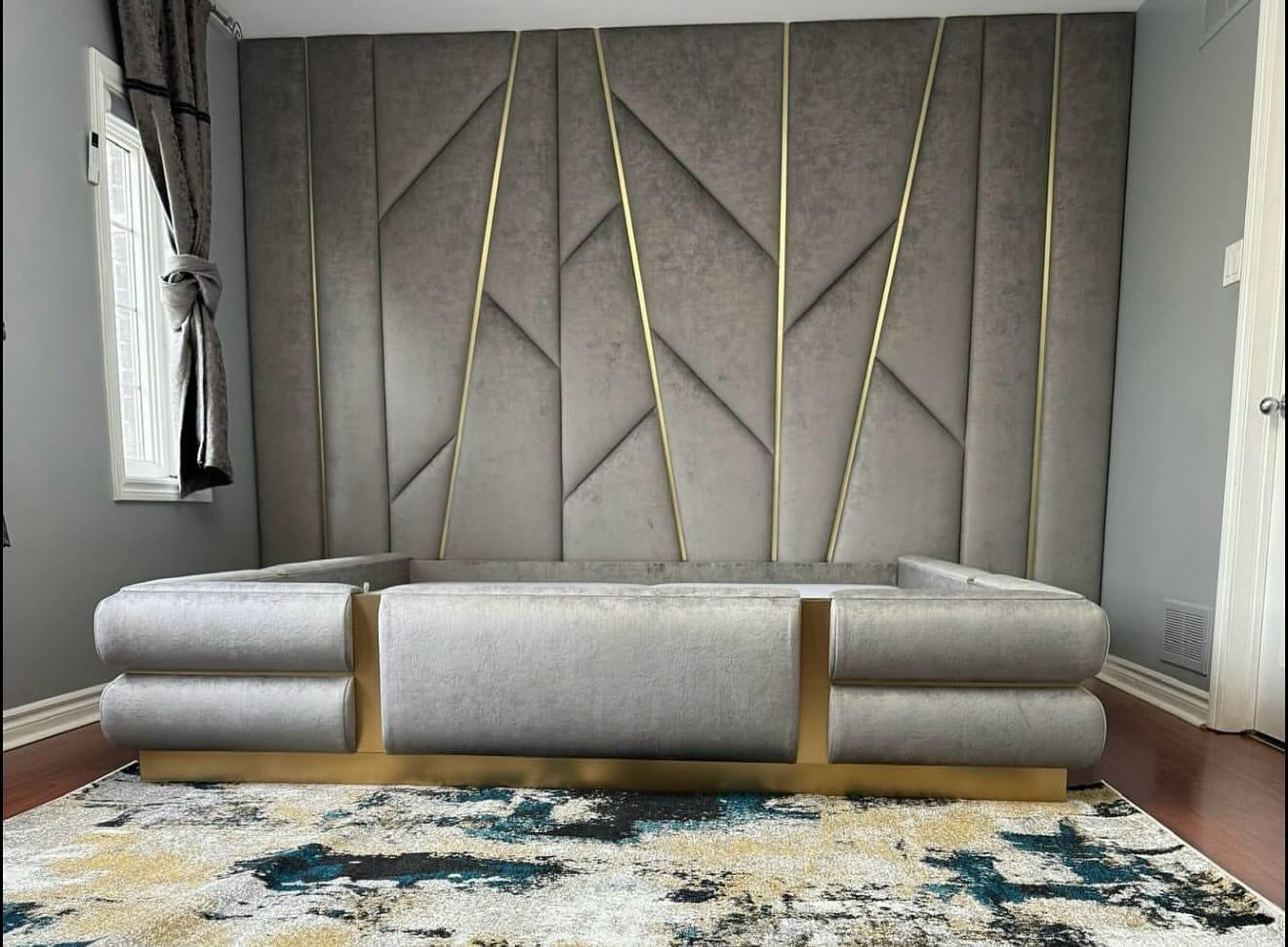
A padded wall is not one sheet. It is a set of panels, each a board with foam and fabric over it, fitted edge to edge. The panel's size is partly practical, because a board has to be carried up the stairs and turned in a bedroom, and partly a matter of looks: the line between two panels is part of the design. Boards commonly come in sheets around 2.4 m long, so a 2.7 m ceiling means either panels stacked in tiers or a pattern drawn so that the join becomes a line; your drawing shows which.
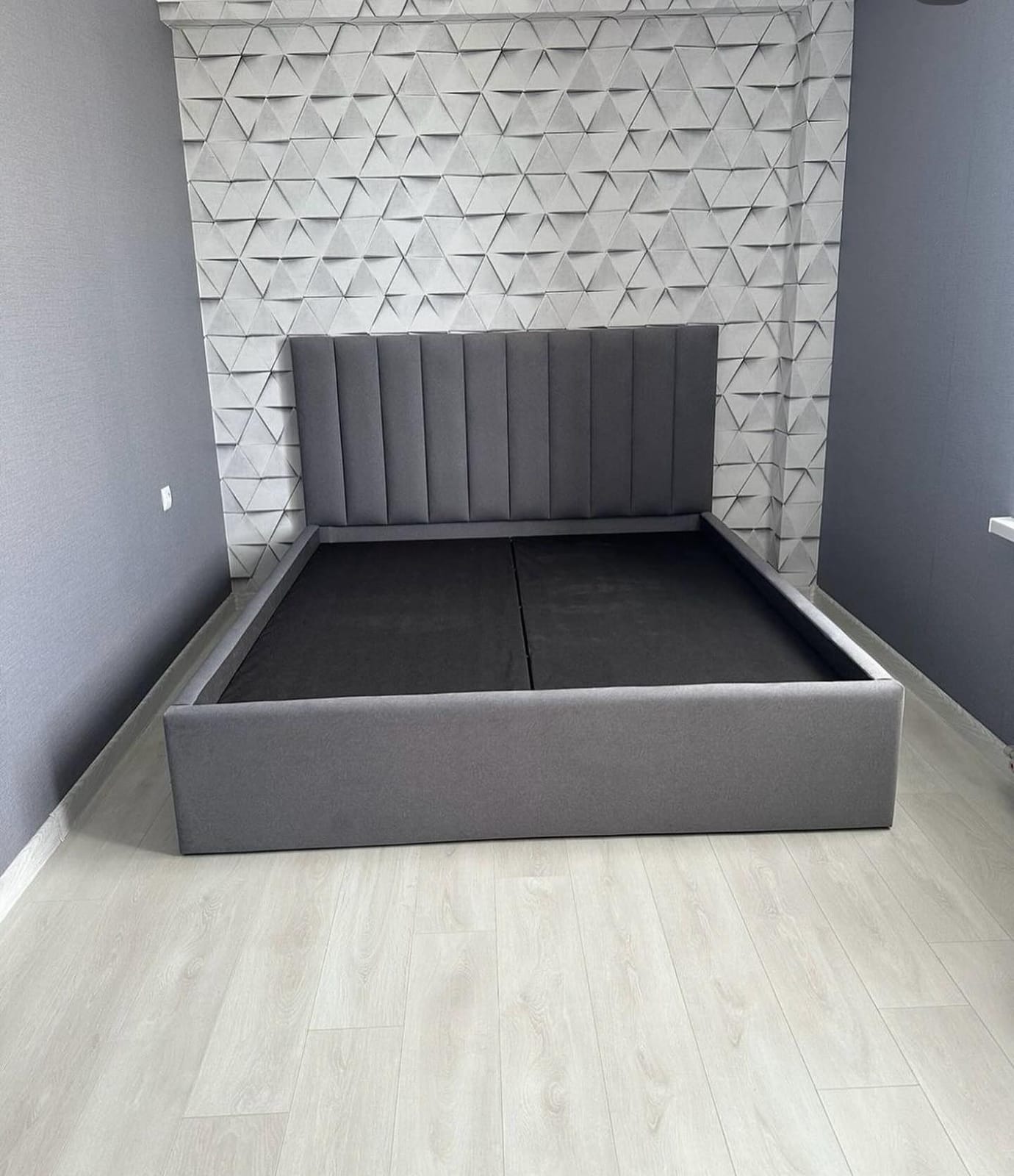
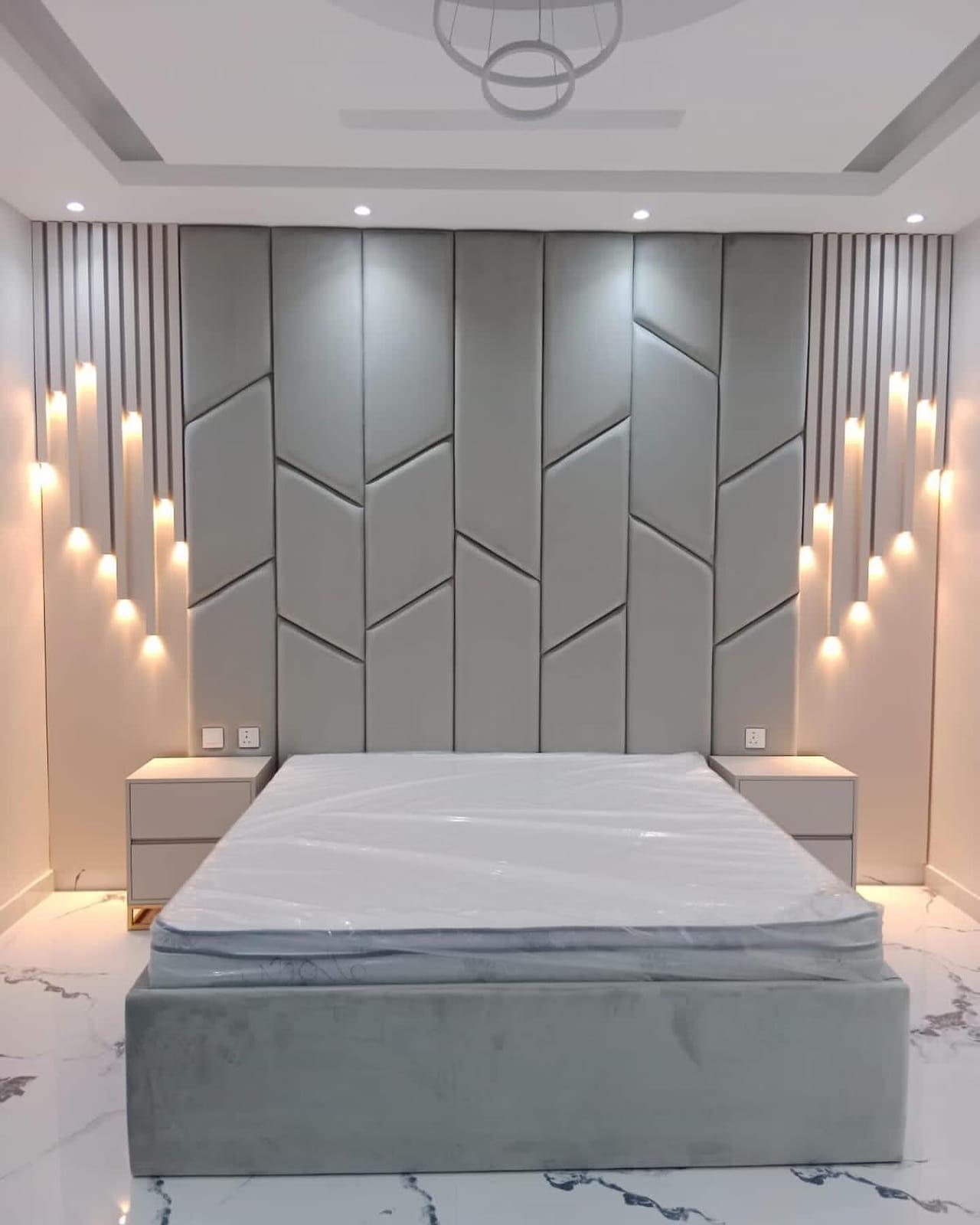
That is why the layouts in the bedrooms we have fitted use the join as the pattern. Vertical channels, a few inches wide, make every seam a deliberate line and let the wall be cut to any width. Angled blocks and chevrons, as in the photograph below, place the horizontal joins where the diagonals cross. A thin gold or brass strip between panels, which several of our bedrooms use, turns the seam into trim.
Decide the layout with the width of the bed in mind. A seam that lands on the bed's centreline looks tidy and is easy to set out, but only when the bed itself sits centrally. If a door or window crowds one end of the wall, request that the pattern be centred on the bed rather than on the wall, and let the end panels absorb the difference. The wallpaper guide to centring a feature wall uses the same logic for a pattern repeat.
Velvet, satin or leather-look: choose by who touches the wall
Fabric is the one choice you will see and feel every day, so choose it by how the wall will be used. Velvet-look fabrics give the deepest colour and the softest surface, and they are the usual pick for a master bedroom where the wall is leaned against, not scrubbed. Satin-look and leather-look fabrics wipe clean more easily, so they suit a children's room, or the side of the bed where a hand rests after oiled hair or sun cream.
Think about colour in daylight and by lamp. A mid-tone grey or beige hides the faint marks a bed wall collects, while a pale cream shows them within months, and a deep green or navy changes noticeably under warm light. Hold the sample against the wall in the evening, with the bedside lights on, because that is when this wall is seen most. What makes a fabric tough, or easy to clean, is explained in our sofa fabrics guide for children and pets; the same ideas apply to a wall, with far less rubbing.
Sunlight is the other limit. A bed wall seldom sits in a direct beam, but a wall that faces a west window will fade a dyed fabric over a few summers, so put the headboard wall on a wall without direct sun when you have the choice, and pair it with blackout or sheer curtains so the afternoon light is controlled. For a wider look at wall finishes, choosing wallpaper for each room compares paper, paint and panels.
Does a padded wall make the room quieter?
Partly, and the distinction matters. Two different ratings are in play. NRC, the noise reduction coefficient, rates how much sound a surface keeps from bouncing back into the room, on a scale from 0 to 1. STC, sound transmission class, describes how much sound a wall construction stops from passing through. Wikipedia's explainer keeps the two apart for good reason: a padded surface scores on the first, not the second.
In practice that means a padded wall takes the echo out of a bedroom with a tiled floor and bare walls, so voices and a television sound softer and the room feels hushed. It will not stop a neighbour's music coming through the wall behind it. If sound from next door is the problem, the fix is in the wall's construction, not in the fabric on its face.
How well a panel absorbs also depends on how it is mounted. NRC is tested with the material fixed straight onto a wall unless the test says otherwise, and the same panel behaves differently on a spacer or with an air gap. We do not publish an NRC figure for our panels, so treat the comfort as the benefit and do not count on a measured sound reduction. For the same reason, a wall of padded panels near the bed is far more about softness to lean against than about acoustics.
Fixing the panels and preparing the wall
Each of our panels is a padded board, fitted to the wall after the drawing is signed off. The fixing is where UAE bedrooms differ from the guides written for other countries. Amerisleep's installation guide, written for a US bedroom, has you find the timber studs behind the wall and hang the headboard on brackets or French cleats. Most bedroom walls here are plastered block or concrete, so fixings go into masonry, and the wall is checked on site before anything is made.
Check three things before the panels arrive. First, the wall must be dry. The US EPA's moisture guide wants indoor humidity held under 60%, with 30% to 50% as the target, and says walls behind furniture are a typical spot for hidden mould, because condensation forms where the air stays still. Panels fixed flat to a damp wall hide the fault without curing it, so repair a leak or a sweating AC line first. How to test a wall, and what the readings mean, is covered in our humid-climate wallpaper guide.
Second, the wall should be reasonably flat and sound. Padding forgives small bumps but not a crumbling surface; our wall preparation guide lists what to repair before any covering goes on. Third, decide where the wall lights and sockets sit, because wiring behind the finished wall is hard to add later. If the room is lived in during the work, plan the day with our guide to occupied-home installation.
Bedside tables, wall lights and sockets
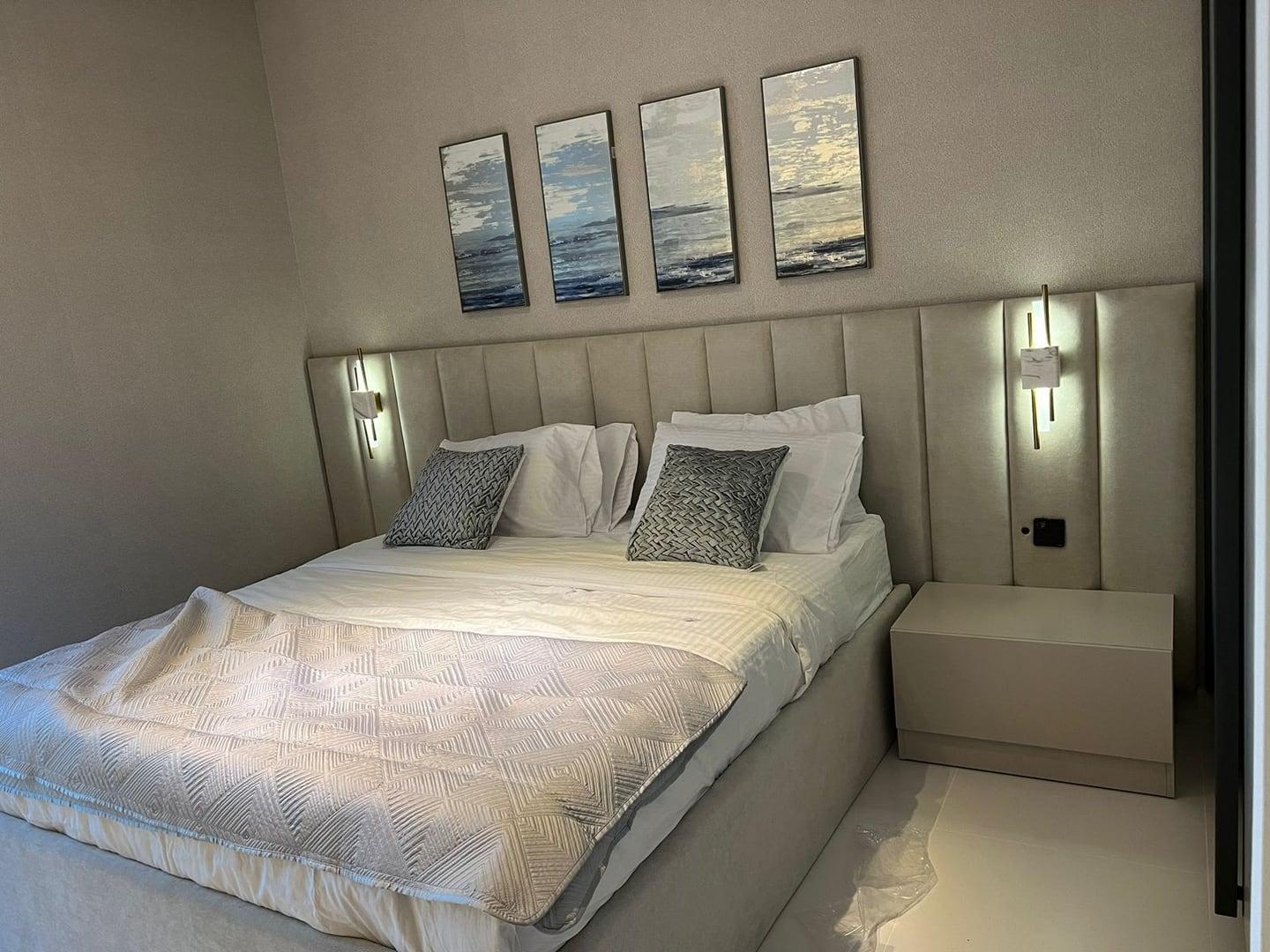
The padded wall is the best chance you will have to plan the bed's side of the room as one design. A floating bedside table fixed to the wall keeps the floor clear and lets the panel run behind it. A socket cut into the panel puts the charger exactly where it is wanted, with the fabric edged around it. And a wall light fixed through the fabric frees the bedside table from a lamp, as in the lead photograph of this guide, where two slim lights stand on the panel and a socket sits in it beside the bedside chest.
Position the lights from the person in bed, not from the wall. Guides for bedside lighting put a wall light 76 to 91 cm above the mattress top, and about 30 cm out from the bed's edge if you read at night; another way is to sit up in bed and set the light a few inches above your shoulder. On a bed with a mattress top at about 60 cm from the floor, that puts the light near 1.45 m from the floor, which is the height drawn in the animation above. Because the lights pass through the fabric, their wires are run before the padding goes on, which is why the drawing fixes their positions first.
Put the socket where a hand reaches it from the pillow, not where the old socket happened to be, and keep the cable behind the panel. If you want a lit edge or a hidden strip around the wall, our media wall lighting guide shows how layers of light work on a feature wall, and gypsum ceiling lighting basics covers the ceiling above it. Matching bedside storage is built in our joinery workshop, as on the sideboards and bedside storage page.
Keeping an upholstered wall clean
A bed wall is out of the way of most of the household's dirt, so it needs little: a soft brush attachment on low suction, run over it now and then, lifts the dust, and the top edge, where a panel meets the ceiling, is the place it settles. In a bedroom that is air-conditioned all year, the fine dust that comes in on the air is the main enemy, not spills.
For marks, press a clean white cloth wetted with water onto the spot rather than scrubbing, and try any cleaner on an offcut or a hidden corner first. Velvet-look fabrics mark most easily and show the direction of the pile, so brush gently in one direction afterwards. Satin-look and leather-look fabrics take a damp cloth. Keep steam and strong solvents away from all of them.
When the work is done, ask for a small offcut of the fabric. It lets you test a cleaning method before trying it on the wall, and it is the match if a panel is ever repaired. Because the wall is made of separate panels, ask at the drawing stage how a marked one would be repaired; panel-by-panel repair is a real advantage over a single large piece of fabric.
How much does an upholstered headboard wall cost?
No per-metre price is published for padded walls, and the reason is in the work: each one is drawn to its wall. The figure comes from the wall's size, how the panels are laid out, the fabric chosen, and any trims or wall lights, and it is confirmed from the drawing. Production starts when you approve the drawing, and your quotation states the timing.
What you can do is judge the direction. Fabric and fitting time follow the padded area, so in the worked example above a full-height wall is about four times the headboard-sized panel. A layout with many angled pieces takes more cutting than vertical channels; gold strips and lights are lines of their own. For scale, our wallpaper service begins at AED 45 per m², supplied and fitted, a much lighter wall treatment; a padded wall is a made-to-order upholstery job and sits in a different range.
Ask for the quotation in lines you can compare: the wall area, the layout, the fabric by name, the trims, each light and socket, and the fitting. Our pricing guide and the fit-out budget guide show how to read those lines.
What sets the price of a headboard wall
Height
- Pushes it up
- Floor to ceiling
- Keeps it down
- A band to 1.2–1.4 m
Width
- Pushes it up
- Wall to wall
- Keeps it down
- A headboard-sized panel
Layout
- Pushes it up
- Angled blocks, chevrons, many small pieces
- Keeps it down
- Plain vertical channels
Trim
- Pushes it up
- Gold or brass strips between panels
- Keeps it down
- Plain joints
Lights and sockets
- Pushes it up
- Wall lights, extra sockets, a lit edge
- Keeps it down
- Sockets only
Set from the drawing: wall size, layout, fabric, trims and lights. No per-metre price is published.
Headboard wall or just a headboard?
Choose a headboard wall when you own the home or the lease is long, the bed wall is the focus of the room, and you want lights, sockets and bedside tables designed in. It is also the better answer in a wardrobe-lined room: a panel the width of the wall lines up with the towers, as in the small-bedroom wardrobe ideas and in the way wardrobe, TV and bed share one wall. Choose just a headboard when you may move, the room is small, or you want to change the bed in a few years; it travels with you and costs less.
The two are not exclusive. Many of our bedrooms pair a padded wall with a matching upholstered bed, so the fabric continues from the wall down the bed's side. Our upholstered beds and headboards page shows the matching pieces.
Headboard wall against headboard
Fixed to
- Headboard wall
- The wall
- Headboard
- The bed or the wall
Covers
- Headboard wall
- A band or the full wall
- Headboard
- About the bed's width
Moves with you
- Headboard wall
- No
- Headboard
- Yes
Lights, sockets, bedside tables
- Headboard wall
- Built into one drawing
- Headboard
- Separate pieces
Best for
- Headboard wall
- Owned homes, master suites
- Headboard
- Rented flats, small rooms
From the first visit to a fitted bed wall
Our free home consultation comes first. We take laser measurements of the wall, record the doors, windows, sockets and any AC unit, and bring fabric samples to hold against it. Then we draw the layout, the trims and the exact spot of each light and socket, and the workshop waits for your approval. Panels are padded at our Sharjah workshop and fitted by our own installers anywhere in the UAE, with the 24-month written warranty covering workmanship.
You can start by sending a photo of the wall and bed through the wallpaper and feature wall service, and the Sharjah feature walls page shows what we fit locally. The same service covers 3D textured feature walls, if you want relief rather than padding. For upholstery on its own, see our sofa and upholstery service; for a whole bedroom, the stages of the work are set out in planning a fit-out. Check the drawing against these points before you sign:
- The panel runs as far as you chose (headboard, band or full height), measured from the mattress top as well as the floor.
- The layout is centred on the bed, with seams or channels where you want them.
- The fabric is named, and you have seen it in evening light.
- Each light and socket is placed from the person in bed, and the route of its wire is agreed.
- The wall is level, sound and dry, with any AC or leak fault already repaired.
- The quotation lists area, layout, fabric, trims, lights and fitting as separate lines.
Common questions
How high should an upholstered headboard wall be?
Behind most beds, a band up to about 1.2–1.4 m from the floor leaves room for pictures above it; floor to ceiling suits the wall you see first. Measure from the mattress top as well as the floor. Upholstered headboard walls from our workshop.
Can you attach a headboard to the wall?
Yes, and any headboard rising more than about 70 cm above the mattress is better fixed to the wall than to the bed. On a masonry wall the fixings go into the block or concrete, so the wall is checked first. Upholstered bed headboards.
Is a padded wall behind the bed soundproof?
No. Padding soaks up echo inside the room, which helps in a tiled bedroom, but it does not stop sound travelling through the wall. Sound from next door is solved in the wall, not the fabric. Our padded wall panels.
How do you clean upholstered wall panels?
Brush it lightly with a soft attachment now and then, press a damp white cloth on any mark instead of scrubbing, and try a cleaner on an offcut first. Satin-look and leather-look fabrics clean easiest. Which fabrics last with children and pets.
How much does an upholstered headboard wall cost?
Each wall is priced from its drawing, where the size, panel layout, fabric, trims and lights set the figure; there is no published per-metre rate. Fabric and fitting time grow with the area. Our pricing guide.
Can I have wall lights and sockets in the padded wall?
Yes, and they should be decided before the panels are made, because they pass through the fabric and the wiring is built in first. A light sits about 76–91 cm above the mattress top. Wall lighting ideas.
Should I choose a headboard wall or fabric wallpaper behind the bed?
Wallpaper is lighter and cheaper; a padded wall gives softness, depth and a place for lights and sockets. Choose the padded wall in a home you own and the paper when you want a quick change. Choosing wallpaper room by room.

Sources & specifications
Manufacturer information applies to the named products and systems. Sources reviewed on 28 October 2026.
- Furl: upholstered headboards explained (heights above the mattress; wall mounting above about 70 cm)furl.co.uk(opens in a new tab)
- Wikipedia: noise reduction coefficient (NRC against STC, and how mounting changes the rating)en.wikipedia.org(opens in a new tab)
- US EPA: mold and moisture guide for the home (humidity under 60%, walls behind furniture)epa.gov(opens in a new tab)
- Amerisleep: how to install a headboard (wall-mounted headboards, studs and cleats)amerisleep.com(opens in a new tab)
- Tidbits & Twine: the right wall sconce height for every room (30–36 in above the mattress)tidbitsandtwine.com(opens in a new tab)
Want this planned for your home?
Consultation and measurement are free. Tell us the rooms, location and what you need; we arrange a sample visit and define the measured quotation.