Media Walls · 24 min read · 14 September 2026
Marble TV wall UAE: real stone, porcelain slab and marble-effect panel compared
Compare three routes to a marble TV wall in the UAE: real stone, large-format porcelain slab and engineered marble-effect panel — weight, pattern, maintenance and cost implications.

By Ali Haider Basra, Founder, Al Tareeq Decor · Contact our workshop
Key takeaways
- Real marble is heavy — a full-height slab behind a 3 m wall can exceed the load tolerance of some UAE apartment ceilings without specialist fixing.
- Large-format porcelain is lighter than real stone, nearly as visually similar and significantly more durable against staining and etching.
- Engineered marble-effect panels (MDF with a print finish or a resin surface) are the lightest option and the easiest to integrate with standard joinery.
- Pattern matching across joins is the main practical differentiator — porcelain and real stone require a skilled tiler; a panel is factory-cut to match.
On this page
- Key takeaways
- Three different routes to the same visual result
- Real marble: weight, variation and care
- Large-format porcelain: lighter, harder, more consistent
- Three marble-effect options compared
- Engineered panels: integration, weight and variety
- Pattern, veining and the join question
- Colour, polish and long-term appearance
- Long-term performance — illustrative
- LED lighting behind a marble or stone-effect panel
- Combining marble-effect panels with fluted sections
- Structural considerations for upper-floor UAE apartments
- UAE climate and care for each material
- Choosing a stone pattern: a practical guide
- Marble TV walls in different rooms: living room, bedroom, office
- What to agree before the stone or panel is ordered
- Weight, fixing and what the wall behind must carry
- Book-matching, vein direction and where joins fall
- Slabs, lots and the cut plan
- Edges, corners and the shadow gap
- Cutting for sockets, the bracket and the ventilation slot
- Soundbars, speakers and resonance against a hard face
- Reading a marble-wall quotation line by line
- Al Tareeq Decor and marble TV walls
- Common questions
Three different routes to the same visual result
When a client asks for 'a marble TV wall', the brief may be answered by three different materials: real quarried marble, large-format porcelain with a printed stone pattern, or an engineered panel with a marble-effect surface. All three can produce a similar visual effect in a finished photograph. The practical and cost differences between them are substantial.
This article explains the three options and helps identify which suits a given brief. It does not make a universal recommendation — the right choice depends on the building structure, the design intent, the budget and the room's use. Each section gives the information needed to have a useful conversation with the design team.
Real marble: weight, variation and care
Quarried marble is a natural stone that varies from slab to slab. No two pieces are identical, which is a feature in high-end residential design and a complication in a room where visual consistency matters. Bookmatched marble — where two adjacent slabs are opened like a book to create a symmetrical pattern — is the technique used in premium hotel lobbies and is increasingly requested for UAE residential walls.
The weight of a full-height marble installation behind a television is significant. A standard 2 cm marble slab weighs approximately 55–60 kg per square metre. A 3 m × 3.5 m feature wall using 2 cm marble weighs over 500 kg. UAE apartments above the ground floor vary considerably in their slab-to-slab structural capacity. This should be assessed by a structural engineer for any installation larger than a small section behind the screen.
Marble is porous and reactive to acid. Lemon juice, red wine and common cleaning products can etch the surface and leave marks that cannot be removed without repolishing. In a UAE living room where drinks are placed on a console surface and food is served nearby, the risk of etching is real. Sealed marble is more resistant but still not stain-proof. Consider this before choosing real stone over a more durable alternative.
Large-format porcelain: lighter, harder, more consistent
Large-format porcelain tiles and slabs (sometimes called 'sintered stone') are manufactured with a printed surface that reproduces natural marble patterns. At thicknesses of 6–12 mm, they weigh approximately 15–25 kg per square metre — less than half the weight of real marble at comparable sizes. A 3 m × 3.5 m porcelain feature wall is structurally manageable in most UAE apartment buildings without specialist structural assessment.
Porcelain is non-porous. It does not absorb liquids or react to acid cleaners. Its surface hardness (usually 7–8 on the Mohs scale) is higher than real marble (3–4). In practical terms: a porcelain slab will not etch from citrus juice, is easy to wipe clean and will not develop the patina that real marble acquires over years. For high-use residential settings or commercial receptions, porcelain is often the more practical choice.
The main trade-off is that the printed pattern has a repeat. On a large-format slab (600 × 1200 mm or 1600 × 3200 mm), the repeat is usually not visible in normal use. On a smaller tile format, the repeat can become apparent where cuts produce an identically placed vein corner. Ask to see a full-layout plan before the material is ordered.
Three marble-effect options compared
Real marble (2 cm)
- Weight (approx.)
- 55–60 kg/m²
- Maintenance
- Seal annually; acid-sensitive
- Pattern matching
- Natural variation — no two slabs identical
Porcelain slab (6–12 mm)
- Weight (approx.)
- 15–25 kg/m²
- Maintenance
- Wipe clean; acid-resistant
- Pattern matching
- Printed repeat — plan the layout
Engineered panel
- Weight (approx.)
- 5–12 kg/m²
- Maintenance
- Wipe clean; check product spec
- Pattern matching
- Factory-matched across joins
Weights are illustrative — confirm the actual product's weight per m² with the supplier before ordering.
Engineered panels: integration, weight and variety
An engineered marble-effect panel combines a substrate (usually MDF or a moisture-resistant board) with a surface finish that replicates marble. The finish may be a high-resolution print bonded to the substrate, an acrylic or resin layer with pigment and veining, or a PVC membrane. These panels are significantly lighter than stone (typically 5–12 kg/m²) and are designed to be cut and joined using standard woodworking tools.
The advantage for a media wall context is integration. An MDF panel can be cut to any dimension, routed for LED channels, mitre-joined at corners and combined with fluted sections, lacquer panels and a floating console in a single designed assembly. Real marble and porcelain require a skilled stone setter and cannot be integrated directly into standard joinery without intermediate fixing methods.
The trade-off is that engineered panels are more susceptible to moisture damage than stone at the substrate level. A scratch that penetrates through the surface layer to the MDF will swell if moisture reaches it. Use moisture-resistant boards in areas with high humidity variability and confirm with the team whether the specific product supplied suits the application.
Pattern, veining and the join question
The most visible difference between the three options in a finished wall is how the pattern is managed across joins. Real marble joins are usually handled by bookmatching the adjacent slabs or by planning the vein direction so that cuts fall in visually quiet areas. Porcelain slabs need a layout plan that places the printed repeat so that the identical corner does not appear twice at viewing distance. An engineered panel is factory-cut by the joinery team, so the join can be agreed and shown on the drawing.
For a media wall with a central television, the most common join positions are at the screen edges. The vein or pattern direction running through these positions will either terminate cleanly or appear interrupted. For real stone and porcelain, this needs a tile-setter's planning; for an engineered panel, the team can produce a matched pair that continues across the join in production.
If a continuous vein running from floor to ceiling across the full wall is important to the design intent, real bookmatched marble or a large-format single slab of porcelain is the right material choice. An engineered panel is usually available in a maximum height of 2.4–2.8 m, requiring a horizontal join for a full-height wall above 2.8 m.
Colour, polish and long-term appearance
Real marble develops a patina over years. Some clients value this as evidence of natural material ageing; others find the dulling and occasional staining unattractive. Repolishing is possible but requires specialist equipment. In a UAE climate where air conditioning produces condensation on cold surfaces and dust settles quickly, unsealed marble can mark more rapidly than in a temperate environment.
Porcelain maintains its surface indefinitely under normal use. The printed pattern does not fade, and the surface is unaffected by cleaning. After five years, a porcelain slab looks the same as the day it was installed. This predictability is an advantage in a commercial setting but may be less appealing to clients who value natural material change.
Engineered panels vary by product. A high-quality acrylic-surface panel holds its look well in domestic conditions. A PVC-membrane panel may show fine cracks or shrinkage at joins after several years in UAE temperatures, particularly at south-facing walls with significant thermal cycling. Ask the team for the product's temperature tolerance rating before specifying it for a wall with significant sun exposure.
Long-term performance — illustrative
Real marble
- After 5 years (indoor, climate-controlled)
- Possible surface patina; etching if unsealed
- Risk to watch
- Acid damage, condensation marks
Porcelain
- After 5 years (indoor, climate-controlled)
- Unchanged — same appearance
- Risk to watch
- Grout or adhesive at joins
Engineered panel
- After 5 years (indoor, climate-controlled)
- Depends on product quality
- Risk to watch
- Substrate moisture; edge lifting at joins
Performance in a UAE climate depends significantly on the specific product and room conditions — confirm with the supplier.
LED lighting behind a marble or stone-effect panel
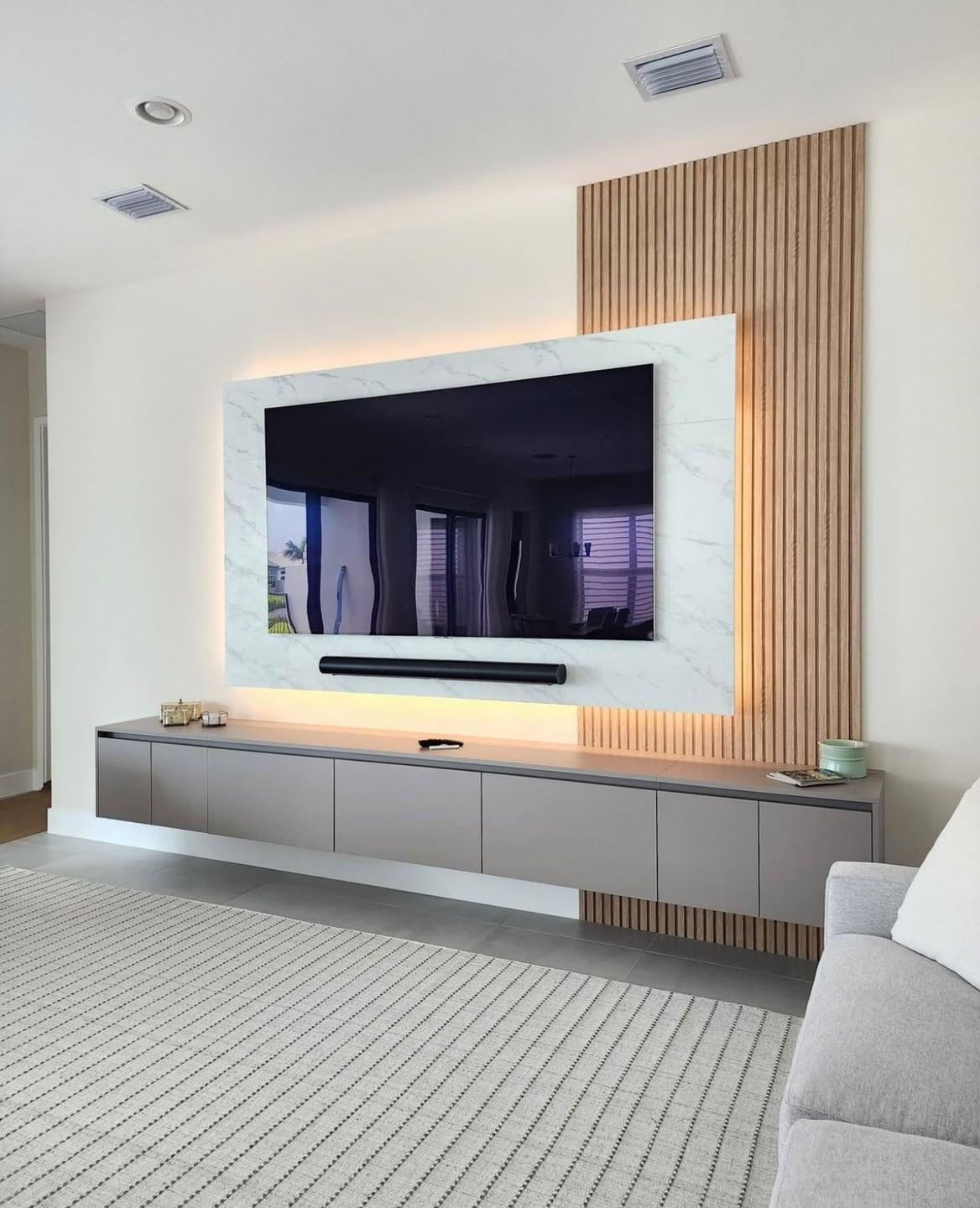
LED lighting transforms how a marble-effect or stone-effect panel reads in a room. A warm-white LED strip (2700–3000 K) brings out the warmth in beige, cream and gold-toned marble patterns. A neutral or cool-white strip (3500–4500 K) works with grey and charcoal stone-effect panels, keeping the cooler tone of the stone consistent rather than warming it artificially. The choice of LED colour temperature should be agreed at the same time as the panel material, not after the wall is installed.
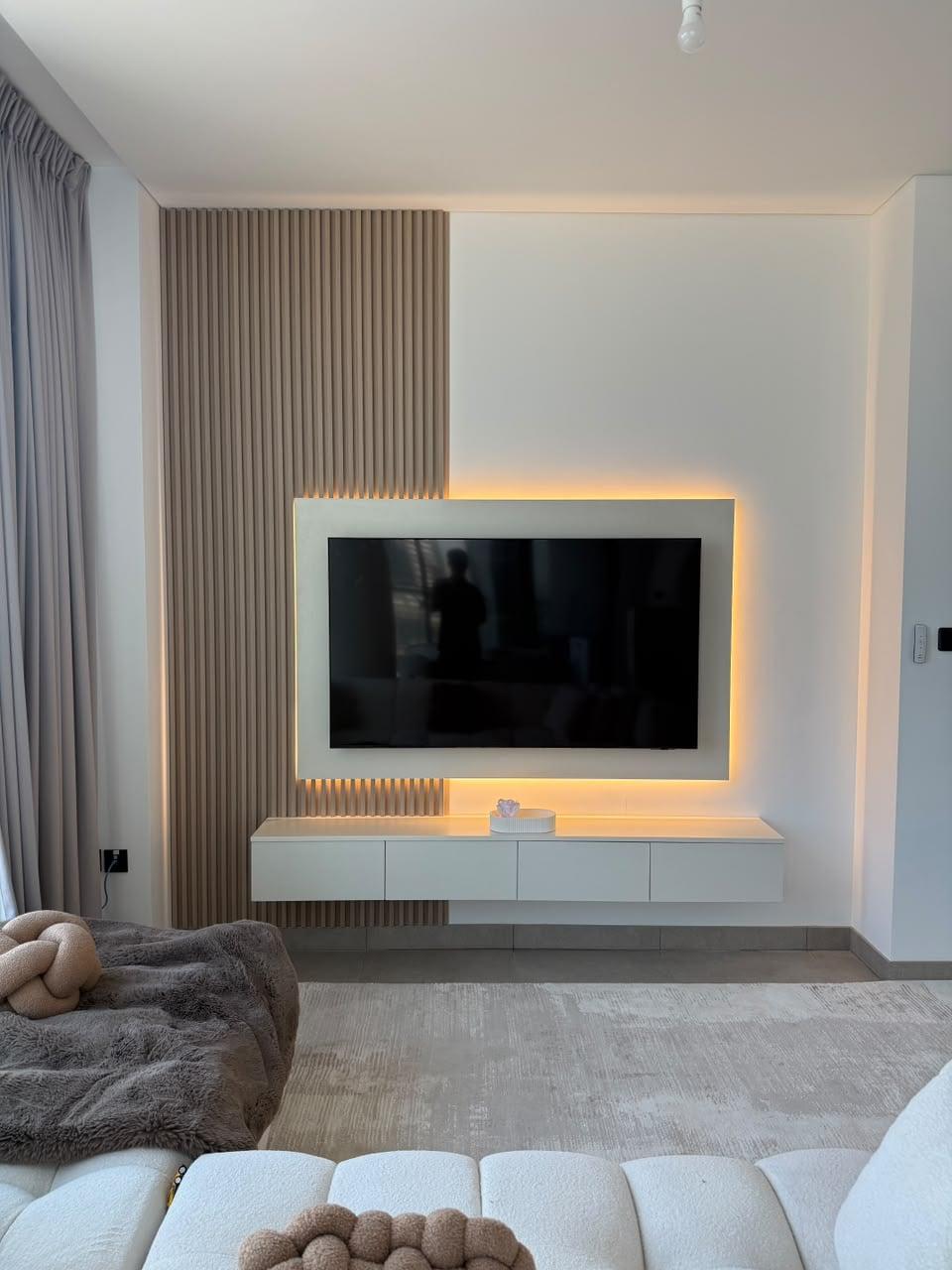
Two approaches are used in UAE media walls. The first is a backlight: a strip behind the panel creates a halo effect that is popular in hotel-style interiors and seen in many UAE living rooms on social media. The second is an edge light: a strip at the top of the panel bounces light down the face, emphasising the veining direction and creating a soft gradient. Backlighting is more dramatic; edge lighting is more architectural. Both require a planned recess in the joinery — they cannot be added neatly after the panel is installed.
Dimmable LED drivers are worth including. A marble-effect feature panel with an undimmed LED behind it in a small apartment is very bright for evening television viewing. A dimmer allows the ambient light level to be matched to the television brightness, reducing eye strain. The driver and strip should be accessible behind the panel for bulb replacement. Note the LED driver position on the approved drawing.
Combining marble-effect panels with fluted sections
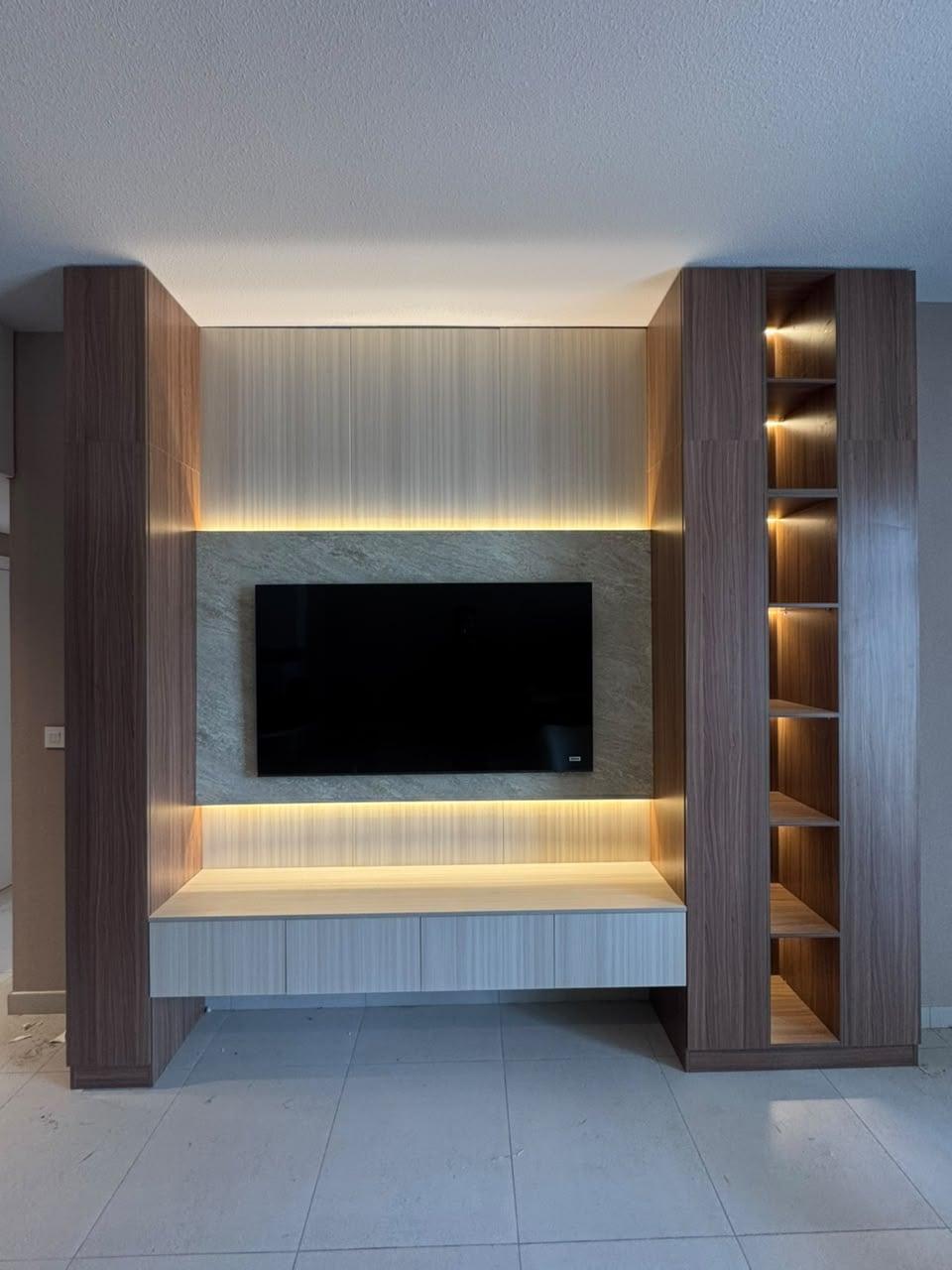
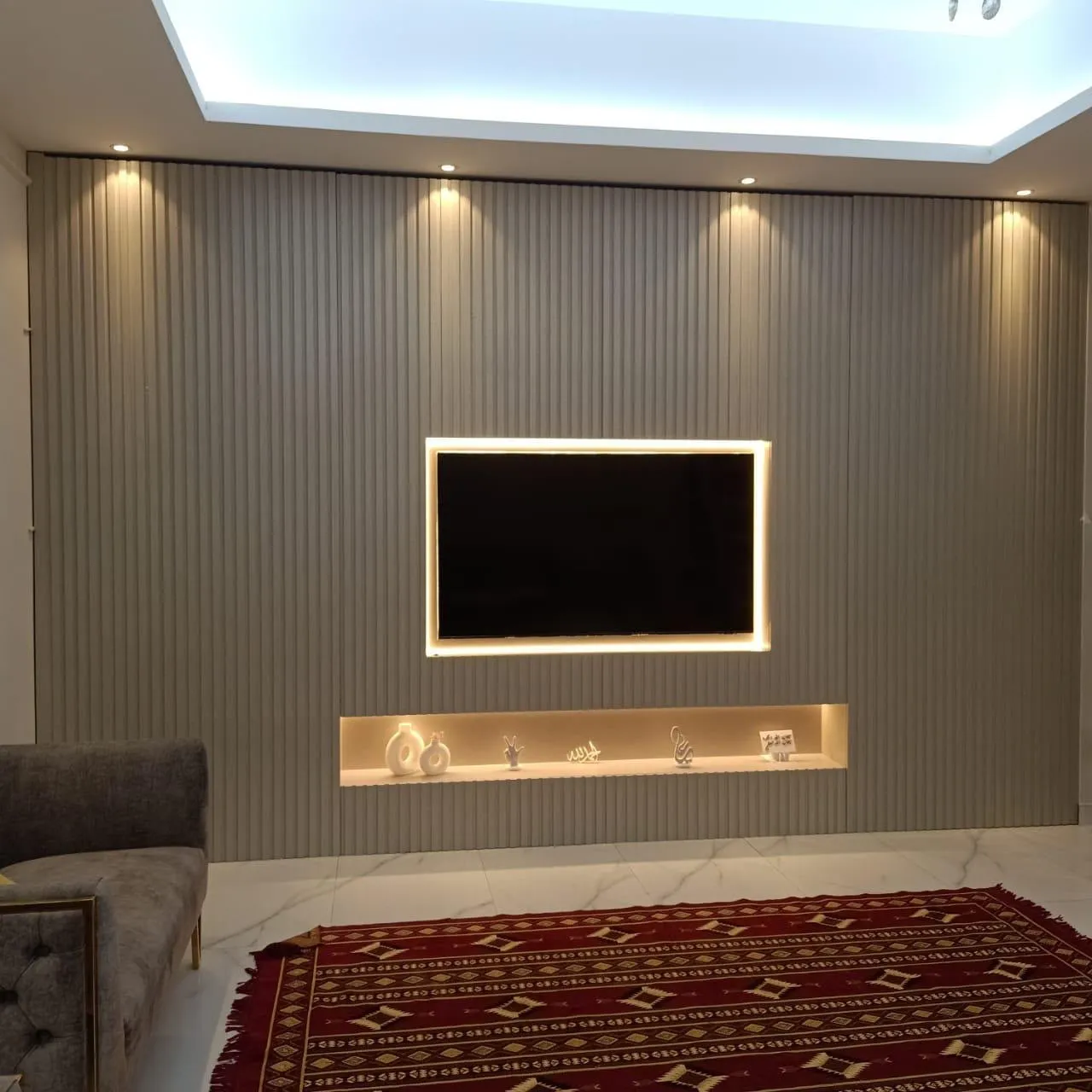
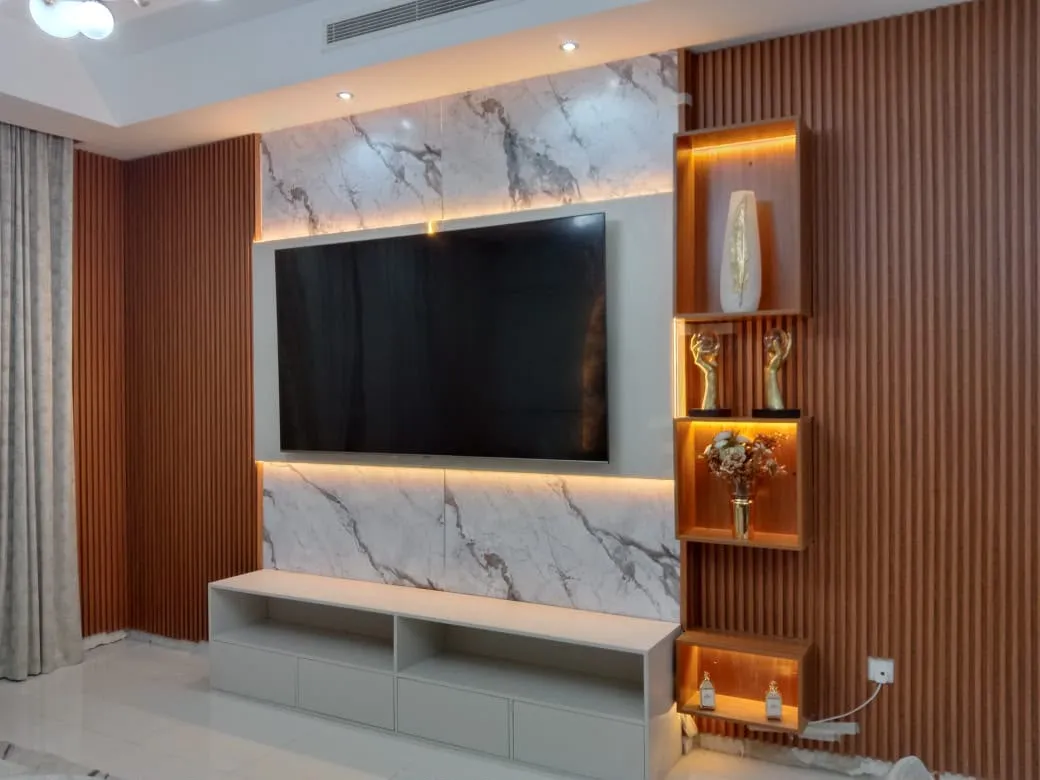
The marble-effect backdrop behind the television combined with fluted panels on each side is the most requested media wall composition in UAE homes. The two textures work together because they operate at different scales: the stone veining is a large-format surface pattern and the fluted groove is a fine linear texture. Each emphasises the other without competing.
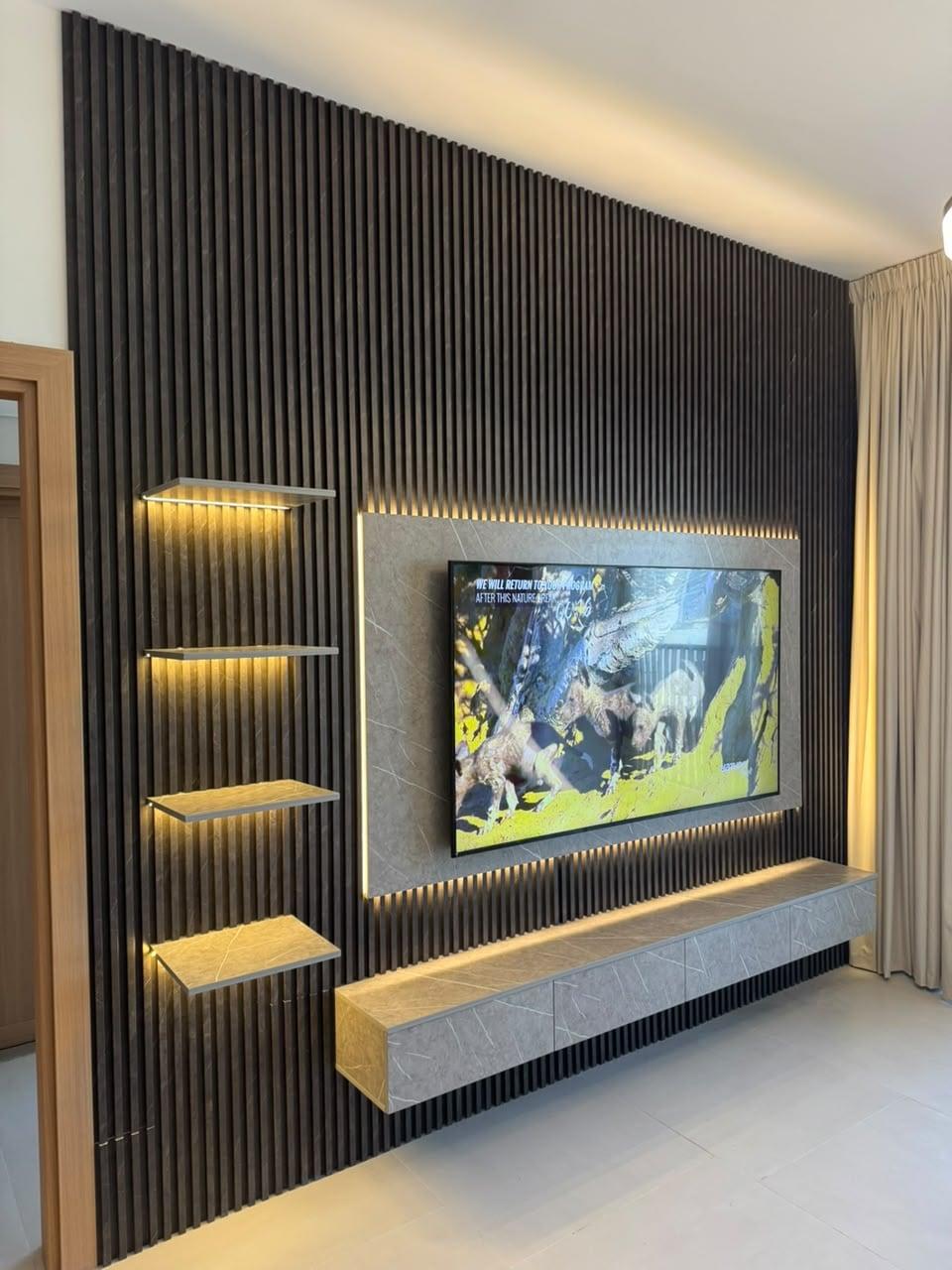
The critical decision is the colour relationship. A warm cream marble-effect panel behind the screen works with a natural oak or warm-toned MDF flute. A grey or charcoal stone-effect panel works with a dark lacquered or charcoal flute. Avoid matching the flute colour too closely to the marble tone — the two should be distinct enough to read as separate materials while remaining within the same palette.
Joining the two materials at the screen edge is the most detailed point in this composition. The join can be a mitred edge where the two panels meet flush, a shadow gap, or a small vertical column element that separates them. Agree the join detail on the drawing before manufacture — it is a construction decision, not a finishing touch. For the fluted panel design, the fluted TV wall article covers the profile and groove decisions in detail.
Structural considerations for upper-floor UAE apartments
Most UAE apartments above the ground floor have partition walls built from lightweight block or gypsum board on a metal frame. These walls are not structural — they carry no floor load — and their capacity to support heavy wall fixings is limited. For a large engineered panel or a standard porcelain slab, the fixing is usually into the stud or block material, which is adequate for panel weights. For full-height real marble above the third floor, a structural engineer assessment is advisable.
A marble-effect engineered panel (5–12 kg/m²) or a standard large-format porcelain slab (15–25 kg/m²) on a 3 m × 3.5 m wall weighs 53–262 kg respectively. This is within the range that standard wall fixings handle in most UAE partition wall constructions. A full-height 2 cm real marble installation on the same wall weighs over 500 kg. The installer will assess the wall construction at the survey visit and advise on fixing method.
In addition to the wall fixing, a heavy marble or stone-effect panel installation typically uses a steel substrate frame or a heavy-duty adhesive system rather than standard tile adhesive. Confirm the fixing method with the team and ensure it is specified in the written quotation. The fixing method affects the installation programme: a bonded system cures before it can carry load, and the TV mount cannot go up until the stone is set.
UAE climate and care for each material
Real marble in UAE apartments requires sealing at installation and periodic re-sealing — annually is a common recommendation in a room with air conditioning, where humidity variability can be significant. An unsealed marble surface etches more rapidly from common liquids: lemon juice, coffee, fizzy drinks and commercial cleaning products all contain acids that react with the calcite in marble. A sealed surface is more resistant but still not stain-proof.
Large-format porcelain requires no sealing and is unaffected by the cleaning products that damage marble. The grout or adhesive line at joins is the maintenance point for porcelain: in UAE conditions, grout can discolour or crack at movement joints if the wrong type is used. Ask for the grout specification and inspect the join lines annually. A movement crack in a grout line is better repaired early than left to widen.
Engineered panels perform well in climate-controlled rooms. For panels on walls with significant sun exposure — a south-facing wall in a room with glazing — confirm the product's temperature tolerance. Some PVC-membrane surfaces show fine surface crazing after several years of thermal cycling in UAE conditions. A high-quality acrylic-surface or laminate-surface panel is more stable. The team can advise on the right product for the specific wall.
Choosing a stone pattern: a practical guide
The range of marble-effect and stone-effect patterns available in UAE is wider than in most other markets. Local suppliers stock Italian, Spanish, Turkish and Chinese marble-effect products alongside engineered panels from European and Southeast Asian manufacturers. Navigating the range is easier with a few working principles.
Start with the room's colour palette rather than the stone. A living room with warm beige walls, an oak floor and cream upholstery suits a warm-toned stone — Calacatta, Crema Marfil, Volakas. A room with grey or white walls and darker joinery elements suits a cooler stone — Carrara, Nero Marquina, grey concrete-effect. A strong veined pattern (Calacatta Gold, Black Gold) works as a full backdrop behind the screen. A quieter stone (Statuario, plain grey) works as a wider surface that extends to the console.
In a UAE living room seen from 3–4 m, the vein scale matters more than the material. A large vein pattern at viewing distance reads dramatically; a fine grain pattern reads as a plain tone. Request to see the pattern at scale — at least a 600 × 600 mm sample, or a digital layout rendering — before confirming. A pattern that reads well on a 100 × 100 mm sample can look very different on a 3 m wall.
Marble TV walls in different rooms: living room, bedroom, office
In a living room, a marble-effect backdrop behind the television is typically the focal point of the wall. The panel extends from console height to ceiling, or from floor to ceiling on a full statement wall. The television sits in front of or into the panel, and the console below carries equipment. This is the classic composition seen across UAE interiors in Dubai, Abu Dhabi and Sharjah.
In a bedroom, a marble-effect panel behind the television is usually smaller in scale — the wall is shared with wardrobe panels and the TV section is one element among several. A large-format vein pattern that suits a 4 m living-room wall can appear very dominant in a 1.5 m bedroom TV section. For bedrooms, a quieter stone pattern or a smaller format is usually more appropriate. The bedroom TV wall guide covers the integration of the TV and wardrobe in detail.
In a commercial setting — a reception, a boardroom or an executive office — a marble-effect backdrop carries additional meaning. It signals material quality to visitors and clients. The practical requirements of a commercial setting (finish durability, easier maintenance, faster cleaning) tend to favour engineered panels or porcelain over real marble. The composition principles are the same; the material choice follows the use.
What to agree before the stone or panel is ordered
The decisions that must be agreed before the stone or panel material is ordered are: the material type (real marble, porcelain slab or engineered panel), the product reference or supplier code, the slab or panel format, the layout plan showing all join positions and the pattern direction, the fixing or adhesive method and substrate preparation required, and — for real marble — the sealing product and schedule.
For porcelain and real marble, a full layout plan placed on a drawing showing the wall dimensions is essential. This confirms the number of pieces, the cut positions and where the printed repeat falls (for porcelain) or how the vein is managed across each join (for real marble). Do not accept a quotation that names a material without a layout plan — the layout is part of the scope, not an optional detail.
LED integration, fluted section joins, the console support method and the TV mount type should all appear on the same drawing as the stone layout. These elements affect each other: a stone join at the screen edge needs to coordinate with the joinery frame, and a heavy stone panel fixed to a lightweight partition wall may need a different console support than a panel fixed to a solid block wall. Agree all of these together before confirming the order.
Weight, fixing and what the wall behind must carry
Marble is heavy in a way that finish samples hide. Natural marble weighs roughly 2.7 tonnes per cubic metre, so a 20 mm face comes to about 54 kg for every square metre. A feature zone 1.2 m wide and 2.0 m tall is already around 130 kg of stone before the TV, the bracket or the console are counted. Porcelain slabs at 6 mm are far lighter, and engineered panels vary by build, so the supplier's data sheet is the number to use, not a guess from how the sample feels in your hand.
The load never rests on the finish. It travels through the fixing into whatever sits behind: block, concrete or a gypsum partition. A block or concrete wall takes the fixing directly. A gypsum partition does not, which is why a heavy face on a partition needs a backing frame built into the zone before the board is closed. Plan this during the drawing stage, because adding a frame afterwards means opening a finished wall.
Ask for the face weight in kilograms per square metre on the drawing, next to the fixing method. If the answer is vague, the wall has not really been designed yet. Our measuring visit checks the wall type first for exactly this reason: the material choice should follow from what the wall can carry, not the other way round.
Book-matching, vein direction and where joins fall
Every marble wall has joins, because no slab covers a full living-room wall. What matters is where the joins fall and what the veining does when it meets them. There are three honest ways to lay a pattern. Random order puts panels side by side as they come, and the veins stop and restart at each join. Sequential order cuts panels one after another from the same slab, so the vein carries across. Book-matched order mirrors the second panel against the first, which makes a symmetrical, deliberate pattern.
Each reads differently on the wall. Random reads as tiles, which suits a quiet backdrop but not a statement wall. Sequential reads as one continuous stone and is the usual choice behind a TV. Book-matched is dramatic and suits a centre panel where the symmetry can frame the screen, but it only works if the vein has a strong, clear direction.
The cost of matching is material. A matched layout uses more slab, because panels must come from adjacent positions rather than wherever they fit. Ask which layout the quotation assumes before comparing prices. Two quotes for the same wall can differ simply because one assumes random order and the other assumes the vein carries across.
Slabs, lots and the cut plan
Stone and large-format panels are produced in lots, and shade can drift from one lot to the next. A wall assembled from two lots may show a visible change in tone across a join that looks perfect on the drawing. The safest approach is to specify that the whole wall comes from a single lot, and to confirm the slab count before the order is placed so the quantity is not split across deliveries.
The cut plan is the document that turns this into something checkable. It shows the slab as a rectangle and marks where each strip is cut, numbered in cutting order. Strips cut in sequence continue the vein from one to the next, so the numbers also become the installation order on the wall. Ask to see it before fabrication starts. If a fabricator cannot show one, the vein continuity you were promised is a hope rather than a plan.
Number each panel on its back before it leaves the workshop. On site, a stack of near-identical panels is easy to mix up, and a wrong order turns a continuous vein into a random one. Keep any offcuts too. They are useful for edge returns, shelf fronts and replacement pieces, and a later repair has a far better chance of matching if it comes from the original slab.
Edges, corners and the shadow gap
On a flat marble-effect wall the detail people notice is the edge. A raw panel edge shows the core, and a 20 mm stone edge catches light in a way that can look heavy. Decide how each edge finishes before the drawing is approved: a mitred return that wraps the thickness, a slim metal trim, or a recessed shadow gap that lets the panel float slightly off the neighbouring surface.
Outside corners are where stone and large panels are least forgiving. A mitre needs a precise 45-degree cut on both faces and a steady hand at installation, and a corner that is slightly open shows as a dark line the whole length of the wall. If a corner is not essential to the design, avoid it: ending a panel against a flanking cabinet or a fluted pillar is simpler and often looks more deliberate than turning the stone around a corner.
The shadow gap deserves a mention for its practical side. A 6 to 10 mm gap between a stone panel and the ceiling, floor or side cabinet hides small variations in the room, which is useful because UAE apartment walls and ceilings are rarely perfectly square. It also leaves room for the small movements that any assembly experiences through the year. Ask for the gap dimension on the drawing rather than leaving it to site judgement.
Cutting for sockets, the bracket and the ventilation slot
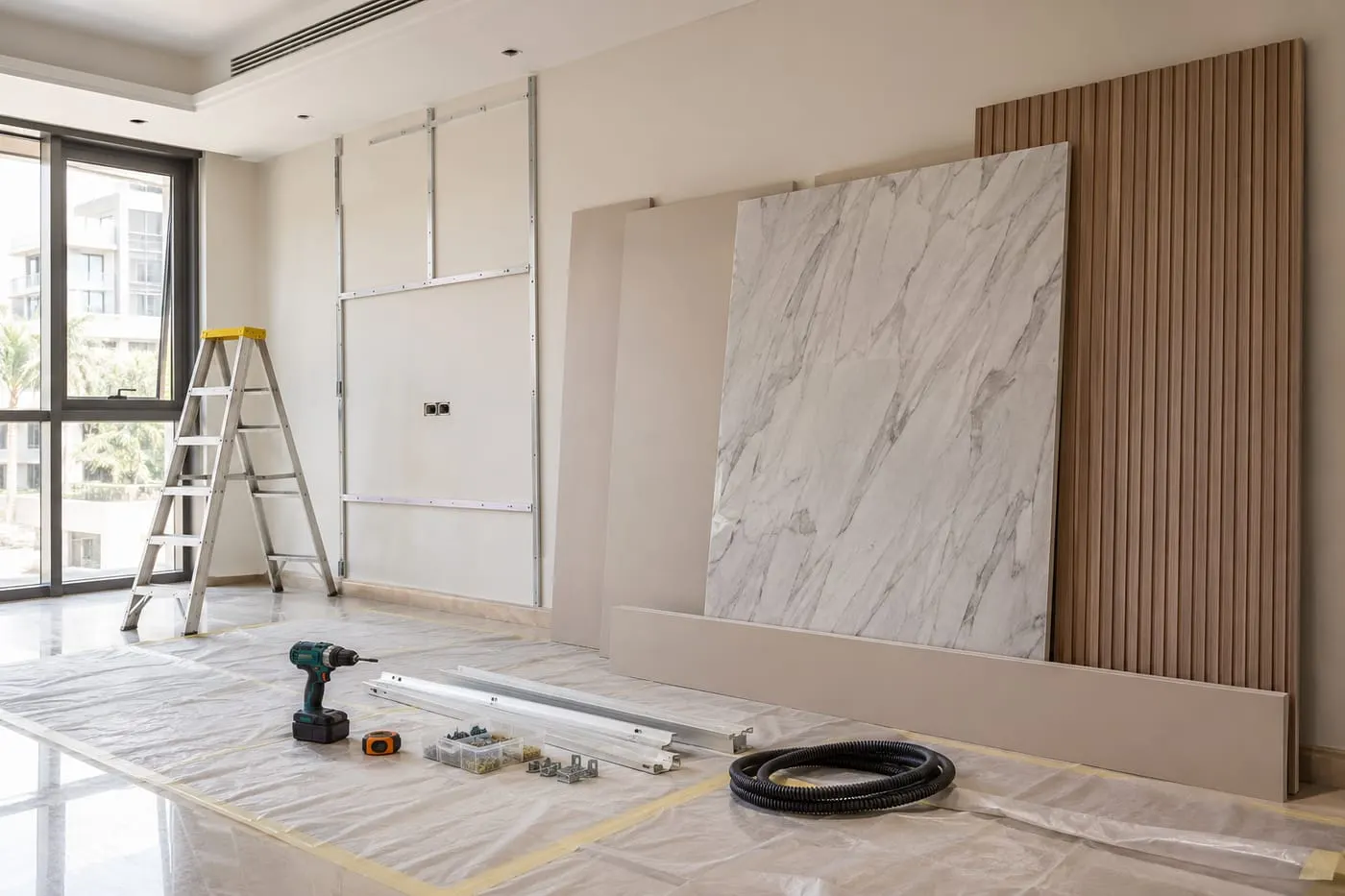
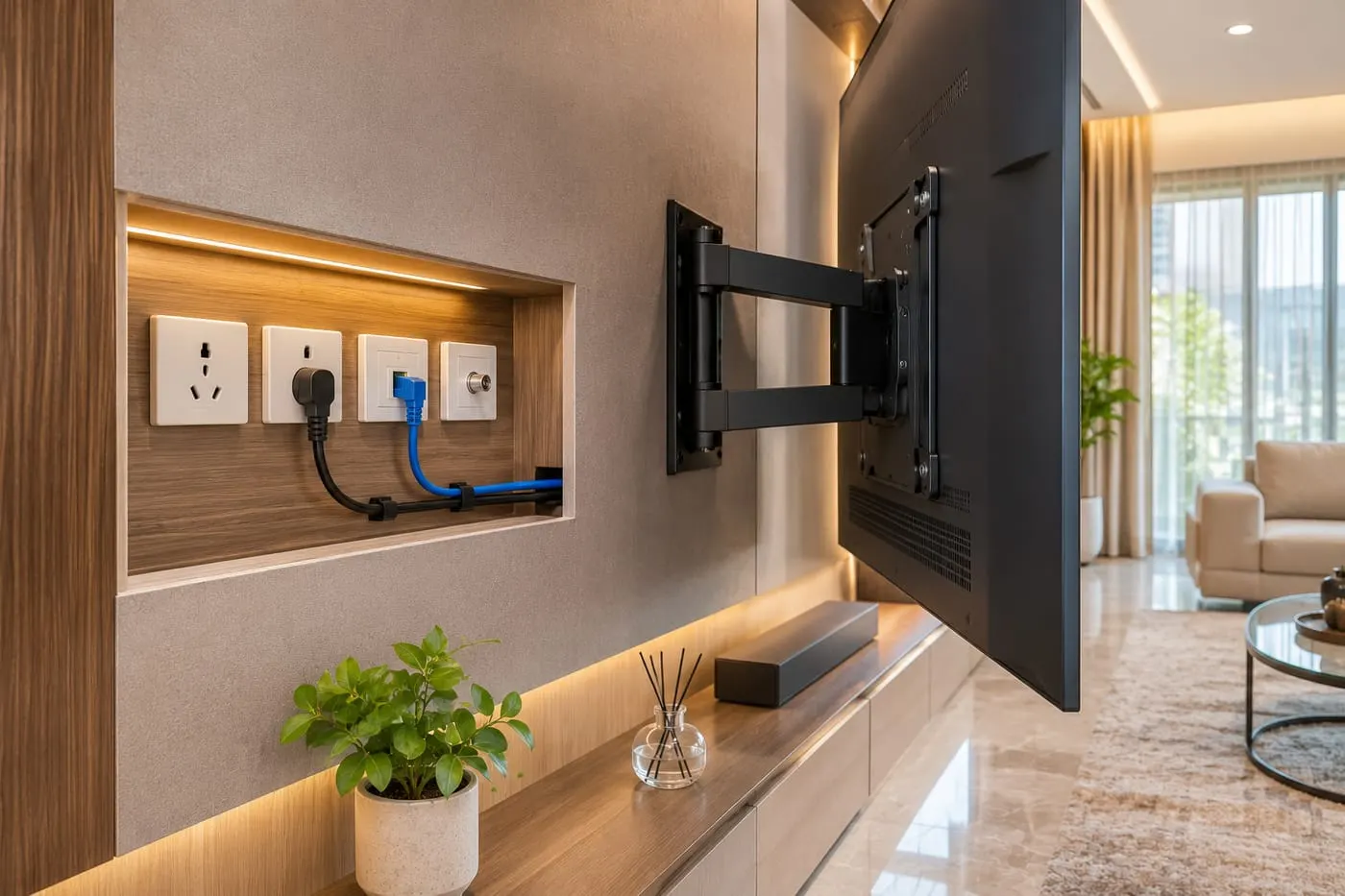
A marble panel behind a TV is cut for things, and each cut is a risk. Power and data points, the bracket plate, the cable path and any ventilation slot all need openings, and stone and porcelain do not forgive a cut in the wrong place. A hole drilled after installation is a gamble, and a hole drilled before is a measurement, so the order matters.
Mark every opening on the drawing from the confirmed TV model, not from a typical one. TV mounting patterns and connection panels differ between brands and between years of the same brand. A socket that sits three centimetres off the real connection panel becomes a visible cable run. Confirm the TV, and where it cannot be confirmed yet, ask for an oversized access opening that a trim can cover.
Ventilation matters as much as the cuts. A TV set into a closed stone-faced recess traps heat, and, as our TV ventilation guide explains, the recess needs clear air paths whatever the face material. Stone does not breathe the way painted board does, so the slot or gap that lets warm air escape should be designed into the panel layout, not added as an afterthought once the TV is running warm.
Soundbars, speakers and resonance against a hard face
A hard face behaves differently from a soft one. Marble, porcelain and engineered stone panels reflect sound rather than absorbing it, so a soundbar or speaker placed against or beside the panel can sound brighter and a little harsher than the same unit against painted board. Some setups also pick up a faint buzz if a speaker touches a hard surface that vibrates sympathetically.
None of this is a reason to avoid stone, but it is a reason to plan the audio. Decide where the soundbar sits and how it is isolated before the panel is cut. A small rubber or felt isolation pad, a shelf set slightly forward of the face, or a recess lined with a soft material can all calm a hard reflection. Speakers on stands in front of the wall often work better than speakers pressed against it.
If a surround or in-wall speaker system is planned, tell us at the brief stage. Cut openings for in-wall speakers need to be sized to the speaker, and the cabling route for each one has to be built into the structure behind the face. Our soundbar and speaker guide goes through the layouts, and the stone wall simply adds one more reason to decide before fabrication, not after.
Reading a marble-wall quotation line by line
A quotation for a marble-effect wall can look very different between suppliers, and the totals are rarely comparable until the lines are. Start with the face material: is it real marble, a porcelain slab or an engineered panel, and what thickness? Then the layout assumption: random, sequential or book-matched, and how many slabs are included. Then the structure: backing frame, fixings, and the wall type the quote assumes.
Next look for the things that tend to be missing. Edge treatment, the shadow gap, cut-outs for power and the bracket, and the finish of any return are all work, and a quote that leaves them out has simply moved them to a later conversation. Delivery and access matter too. Heavy panels need a lift, protection for the floor and enough people on site, and a building with restricted delivery hours should be flagged before the date is set.
Finally, check what stands behind the work. Our workmanship warranty is 24 months and the limited warranty on covered wood-based boards is 5 years, both in writing, and entry pricing starts from AED 3,500 for a compact wall. A marble-effect wall with matched layout and full-height stone moves well beyond that, which is why the written quotation is built from the approved drawing line by line. If two quotes cannot be reconciled at that level, ask both suppliers the same list of questions before deciding.
Al Tareeq Decor and marble TV walls
Al Tareeq Decor produces marble-effect media walls using engineered panel finishes integrated with custom joinery. Our workshop in Sharjah cuts panels to the approved drawing, matches joins and coordinates the finish with fluted sections, lacquer panels, shelving and floating consoles. For projects where real stone or large-format porcelain is specified, the stone-setting work is coordinated with the joinery installation.
To start the conversation, send a photograph of the wall, your television size and an indication of which material direction interests you. The free measuring visit allows the team to advise on structural suitability, material choice and join position for your specific wall. Marble TV walls are available in Dubai, Abu Dhabi, Sharjah and across the UAE.
Common questions
Is a marble TV wall structurally safe in a UAE apartment?
An engineered marble-effect panel is very light and suitable for all standard apartments. Large-format porcelain is typically manageable without structural assessment. Full-height real marble (2 cm) can exceed 500 kg for a 3 × 3.5 m wall and should be assessed by a structural engineer for upper-floor apartments.
What is the difference between porcelain slab and marble-effect panel?
Porcelain is a fired stone product, non-porous and very hard, installed by a tiler. A marble-effect panel is a manufactured board with a printed or resin surface, cut by the joinery team and integrated directly with the media wall structure. Both produce a similar visual result. Materials guide.
Can real marble be used behind a television?
Yes, though weight, structural suitability, the porous surface and join planning need to be addressed. For most UAE apartments, an engineered panel or porcelain slab gives a comparable result with fewer practical complications.
How is the vein or pattern matched across joins?
For real marble, the stone setter plans the cut to follow or mirror the vein. For porcelain, the layout plan positions the printed repeat. For an engineered panel, the joinery team produces a factory-matched pair. Agree the join strategy on the approved drawing before manufacture.
Does marble etching matter in a living room?
Yes. Citrus, wine, coffee and many cleaning products etch real marble and leave marks that cannot be wiped off. In a UAE living room, the risk is real. Sealed marble is more resistant but not stain-proof. Porcelain and engineered panels are unaffected by these substances.
What does a marble TV wall cost in the UAE?
Entry projects from AED 3,500 cover a compact laminate panel and console. A marble-effect or porcelain backdrop panel is a mid-range addition. Full real stone with bookmatching is a premium project. Confirm the material choice and price in the written quotation. Media wall prices.
What maintenance does a marble TV wall need?
An engineered panel or porcelain wall needs only routine wiping with a damp cloth and a neutral cleaner. Real marble needs annual sealing and acid-free cleaning products. Avoid steam cleaners on any of the three materials.

Sources & specifications
Manufacturer information applies to the named products and systems. Sources reviewed on 10 November 2026.
Want this planned for your home?
Consultation and measurement are free. Tell us the rooms, location and what you need; we arrange a sample visit and define the measured quotation.