Dressing Units · 13 min read · 4 June 2026
Built-in vanity niche, floating console or dressing table: which suits a small bedroom?
A vanity niche, a floating dressing console or a full dressing table: which one fits a small bedroom, what each needs from the wall and the floor, and what each costs.

By Ali Haider Basra, Founder, Al Tareeq Decor · Contact our workshop
Key takeaways
- Choose by the room: a wardrobe wall you own points to a vanity niche, a solid or backed wall to a floating console, and a rented room to a dressing table on legs.
- A floating console is the lightest form, but a plastic wall plug holds only about 5–10 kg and a toggle bolt up to about 50 kg, so loaded units need several fixings or backing.
- A niche belongs to the wardrobe run and stays put; the table on legs is the only form you can take to your next home.
- Check the floor under the unit: a robot vacuum needs about 12.5–15.5 cm of clearance, and closed drawers beat open shelves for dust.
- Dressing units start from AED 1,800 per unit and are normally made and fitted up to about 10 days after the order is confirmed; a niche is quoted with the wardrobe.
On this page
- Key takeaways
- Niche, console or table: three ways to get ready in a small bedroom
- Two questions about the room settle most cases
- The vanity niche: a getting-ready corner inside the wardrobe wall
- The floating console: the lightest form, but it hangs on your wall
- The full dressing table: the most storage, and the most floor
- Floor, cleaning and dust: the cost you meet every week
- The three forms compared
- Mirror, light and sockets: what changes with each form
- Three small bedrooms, three answers
- What each form costs, from our published figures
- From the first visit to a fitted corner
- Common questions
Niche, console or table: three ways to get ready in a small bedroom
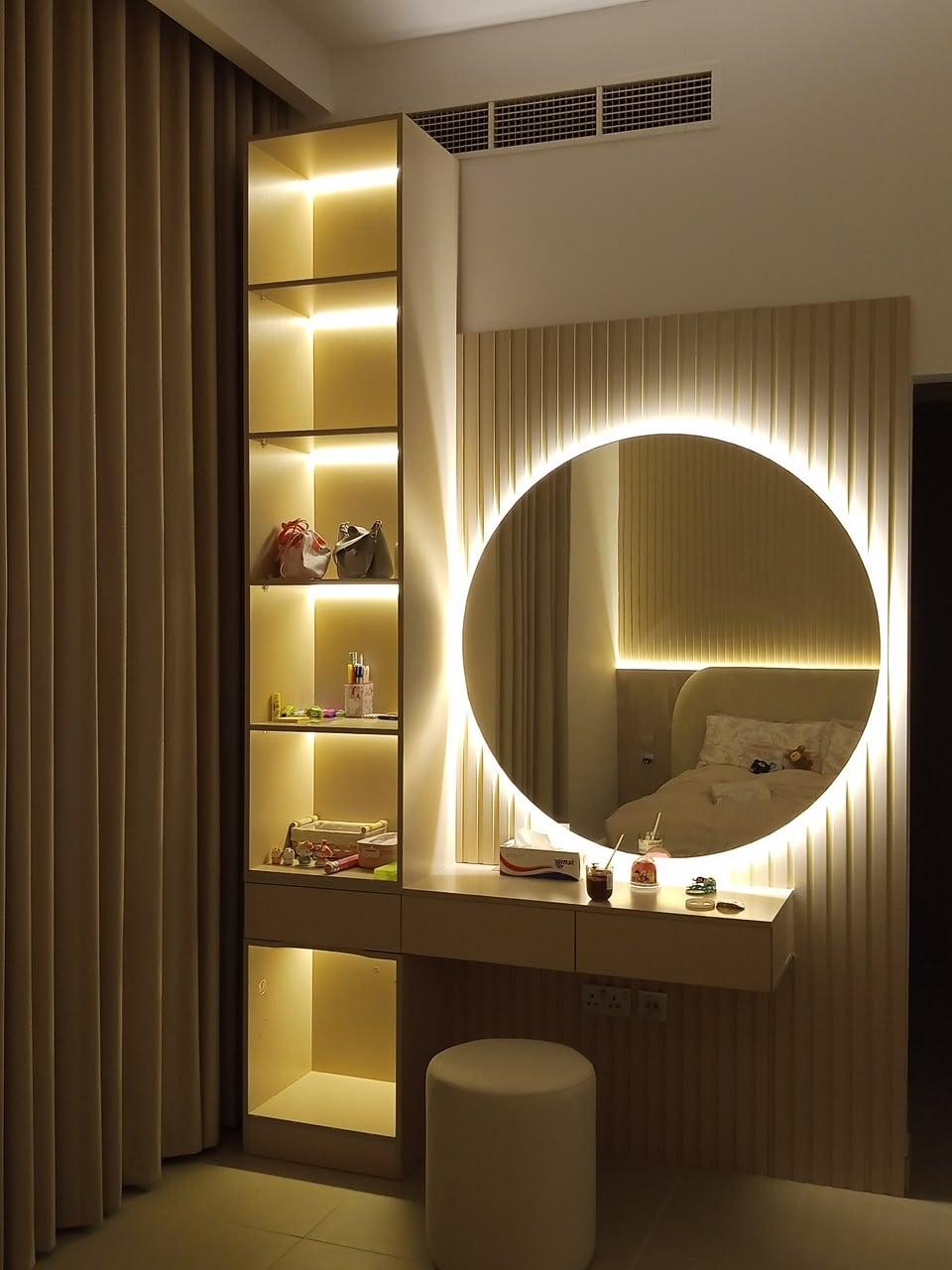
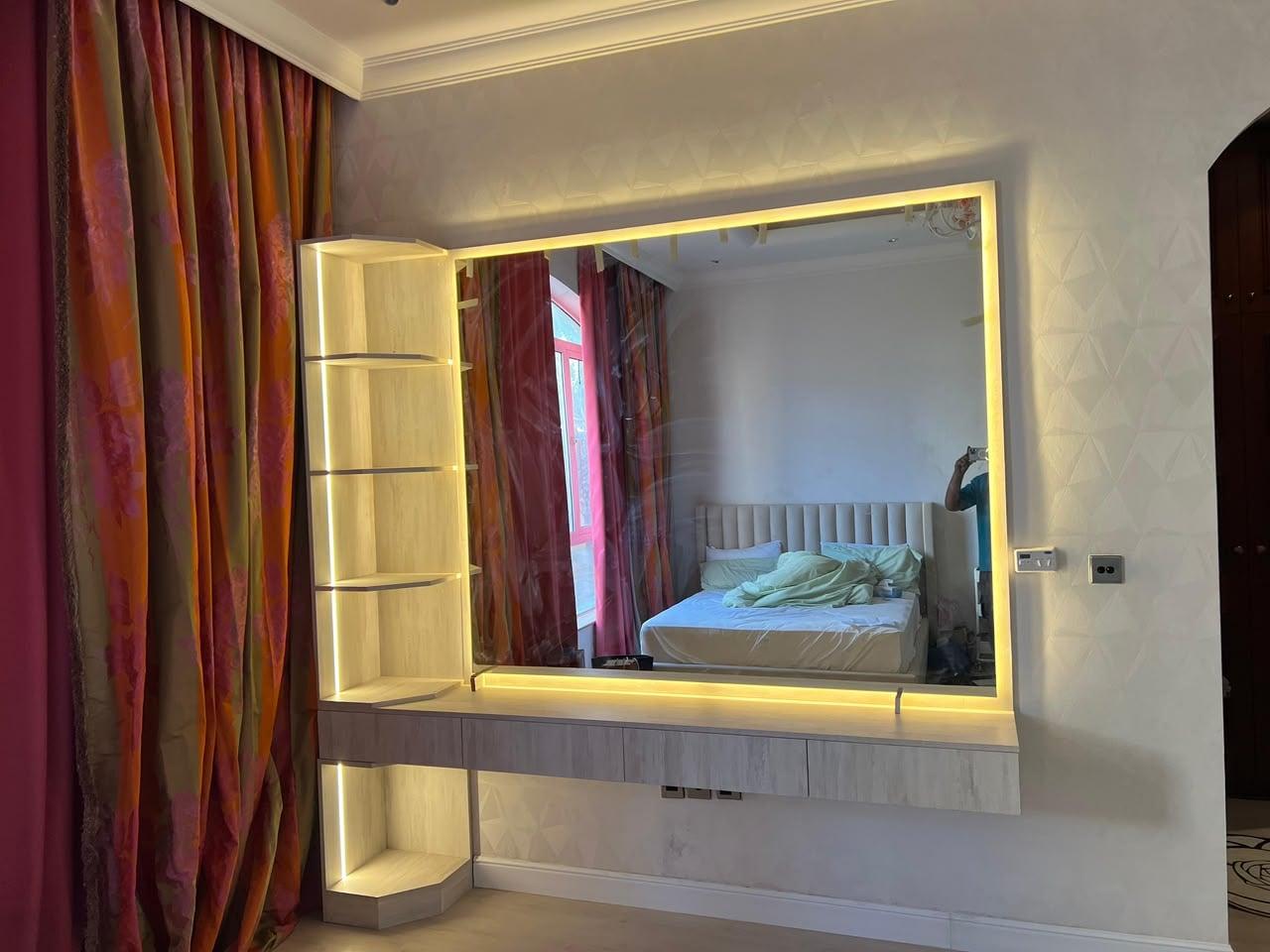
In a small bedroom the question is rarely which dressing table looks best. It is what the room can spare: a stretch of wall, some floor, perhaps a wardrobe run to build into. Our workshop makes three forms, and each spends those three things differently. A vanity niche turns a gap in the wardrobe wall into a seated counter with its own mirror and lighting, the hair-dryer socket hidden in the joinery. A floating dressing console hangs from the wall, with bare floor underneath, carrying a few drawers and an oval or round mirror above. A dressing table with drawers stands on legs or a drawer pedestal and holds the most.
This guide is the chooser. Heights, depths, knee space and the stool are already worked out in our dressing table design tips, the price build-up is in what a dressing unit costs and how it can be laid out, and everything about the mirror’s light is in make-up mirror lighting. Here we take the step before all of those: which of the three suits your room, your wall and your lease. If you are unsure whether you need a full table at all, makeup vanity vs dressing table compares the two.
Two questions about the room settle most cases
Start with the wardrobe wall. If you own the flat and a run of wardrobes is being fitted, or replaced, a niche is the natural answer: cupboards can carry on over the top of the recess, the door finish runs straight through, and the side gaps where dust usually settles are closed up. If you rent, or may move within a few years, a niche is the wrong answer, because it is part of the carcass and stays when you go.
Next, look at the wall. A floating console puts its whole load on the wall, so ask whether the wall is block or concrete, which takes fixings directly, or a gypsum partition, which needs timber or metal backing built in before it is boarded. If the wall is solid or can be backed, a console is the lightest form there is. If it is a hollow partition that cannot be opened, or you want the heaviest storage, choose the table on legs, which asks nothing of the wall.
The chart below puts those two questions in order, then shows what a single wall fixing can hold, the figure that decides whether a floating unit is realistic on a plasterboard wall. Its limits come from Rapid, a fixings maker, and they are for one fixing; a real console is hung on several.
- 1. Wardrobe wall to build into, and staying? Then a niche; the recess is part of the wardrobe run
- 2. No run to use? Ask whether the wall is solid or can be backed: yes, a floating console; no, a table on legs
- 3. One fixing holds about 10 kg as a plastic plug and up to about 50 kg as a toggle bolt, so loaded units go on several fixings or into backing
- 4. Renting or likely to move? Only a table on legs can be taken along; the niche and the console stay
The vanity niche: a getting-ready corner inside the wardrobe wall
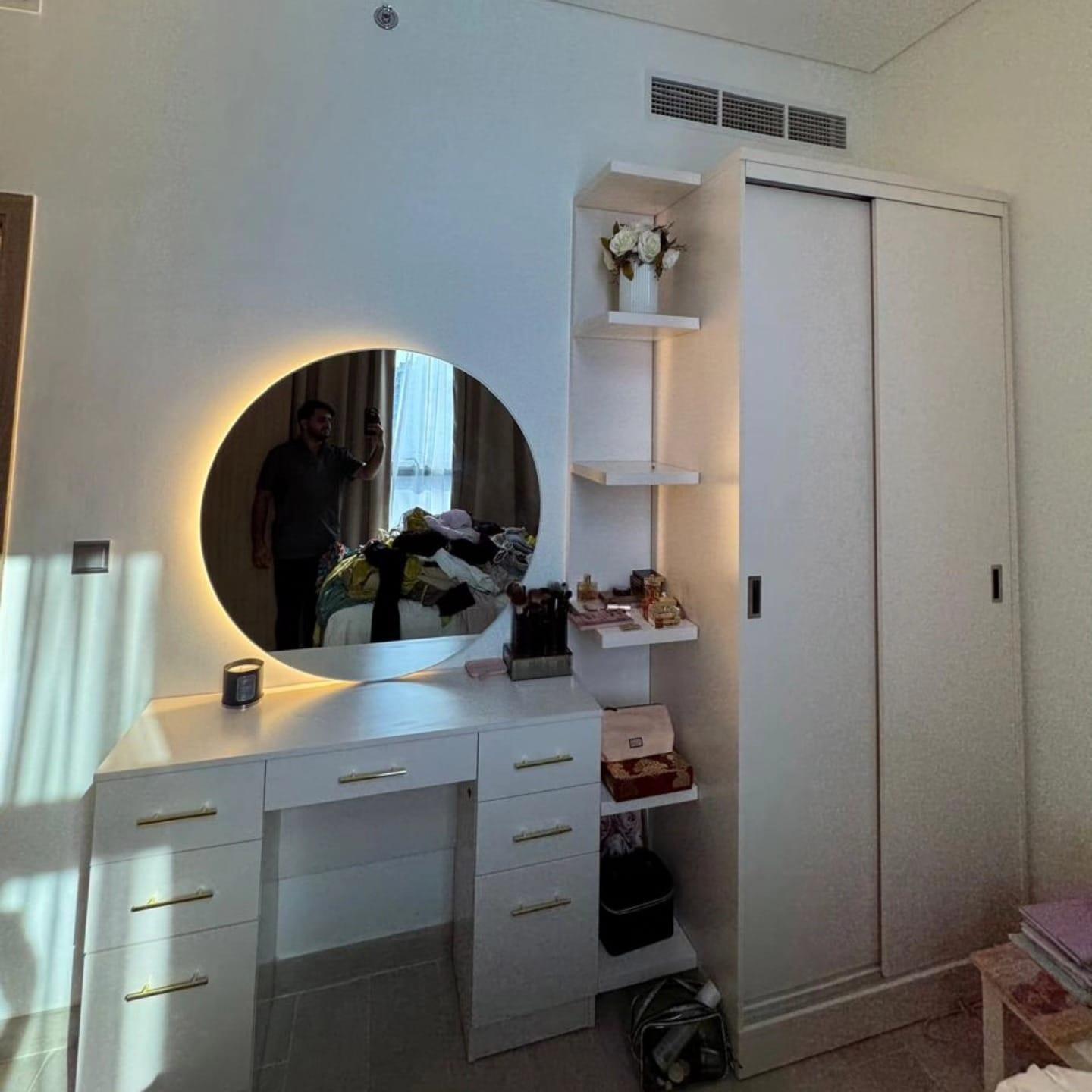
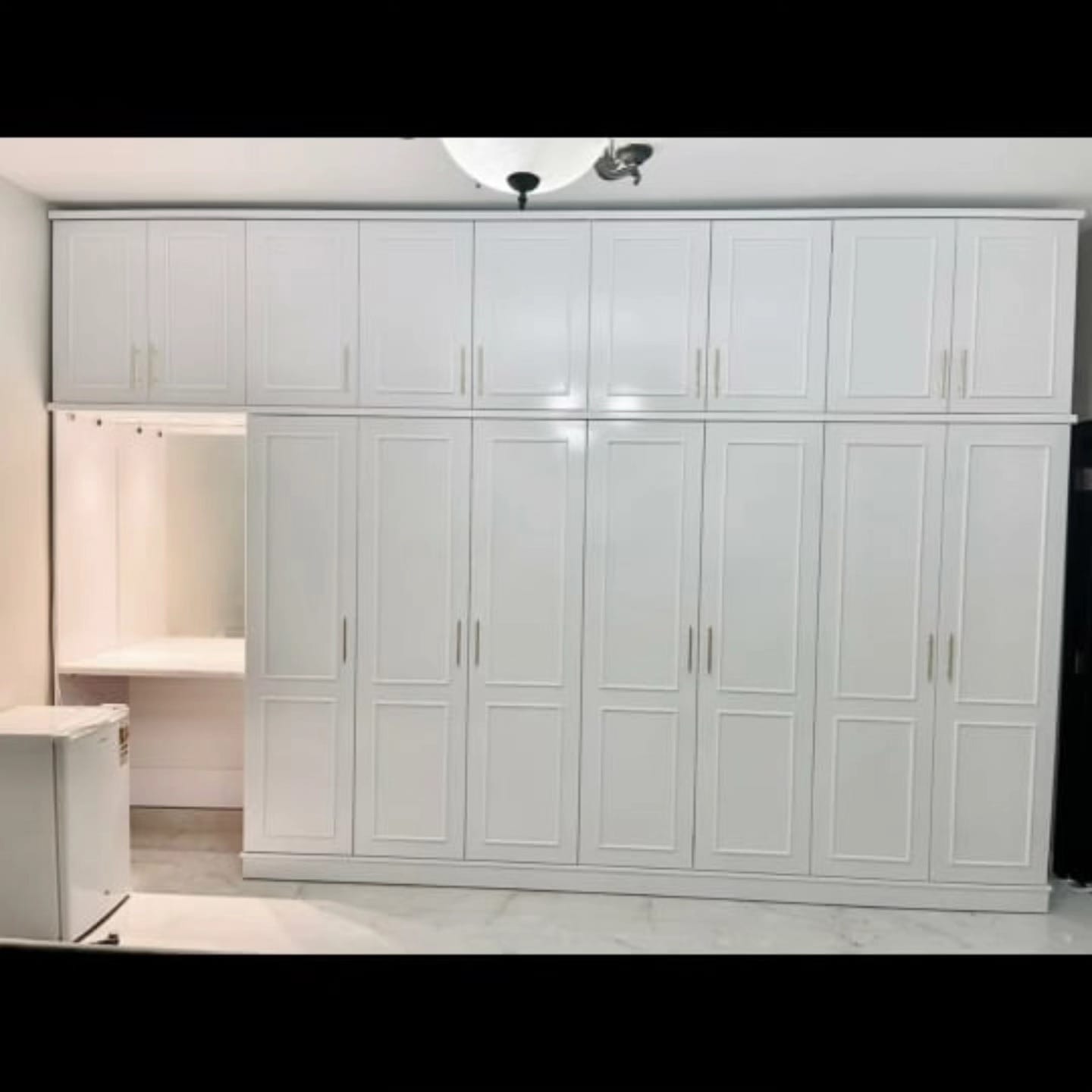
A niche earns its keep through the wardrobe wall around it. Cupboards sit over the recess, drawer stacks or a lit shelf column flank it, and the whole wall comes across as one tailored unit. Nothing hides behind or beside it for dust or loose cables. The photograph below is the plainest version: a niche at the end of a white wardrobe wall, beneath a row of short cupboards.
The costs are real too. A niche cannot be moved, so it is a decision for the home you intend to keep. Its width is the one number to get right. At the table you use now, spread your elbows, note the width they take, and add space for a lamp and a tray on either side; a recess squeezed into a single door width feels cramped within a week. The counter can stop short of the wardrobe’s front edge, which draws the mirror nearer your eyes, while the wardrobe run itself keeps its 60 cm depth.
With walls on three sides, the recess gets little spill from the room, so it needs lighting of its own; make-up mirror lighting sets out the options. It also traps warmth and steam. Give hair tools a mat to cool on, and where the niche backs onto a bathroom, ask for water-resistant boards in the carcass, which wardrobe materials and hardware compares. The short video that follows shows a vanity made inside a wardrobe frame: the same idea, built at home.
The floating console: the lightest form, but it hangs on your wall
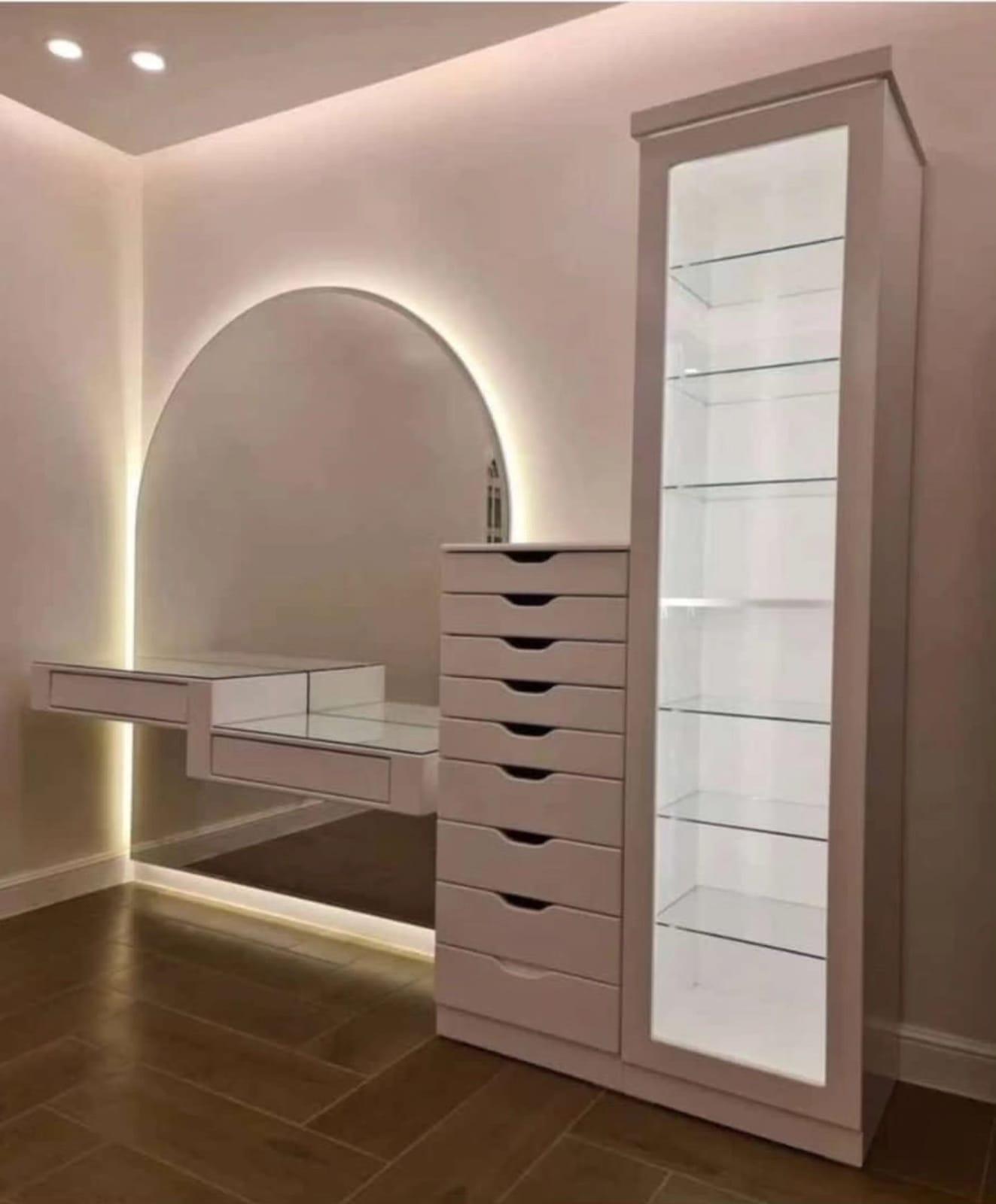
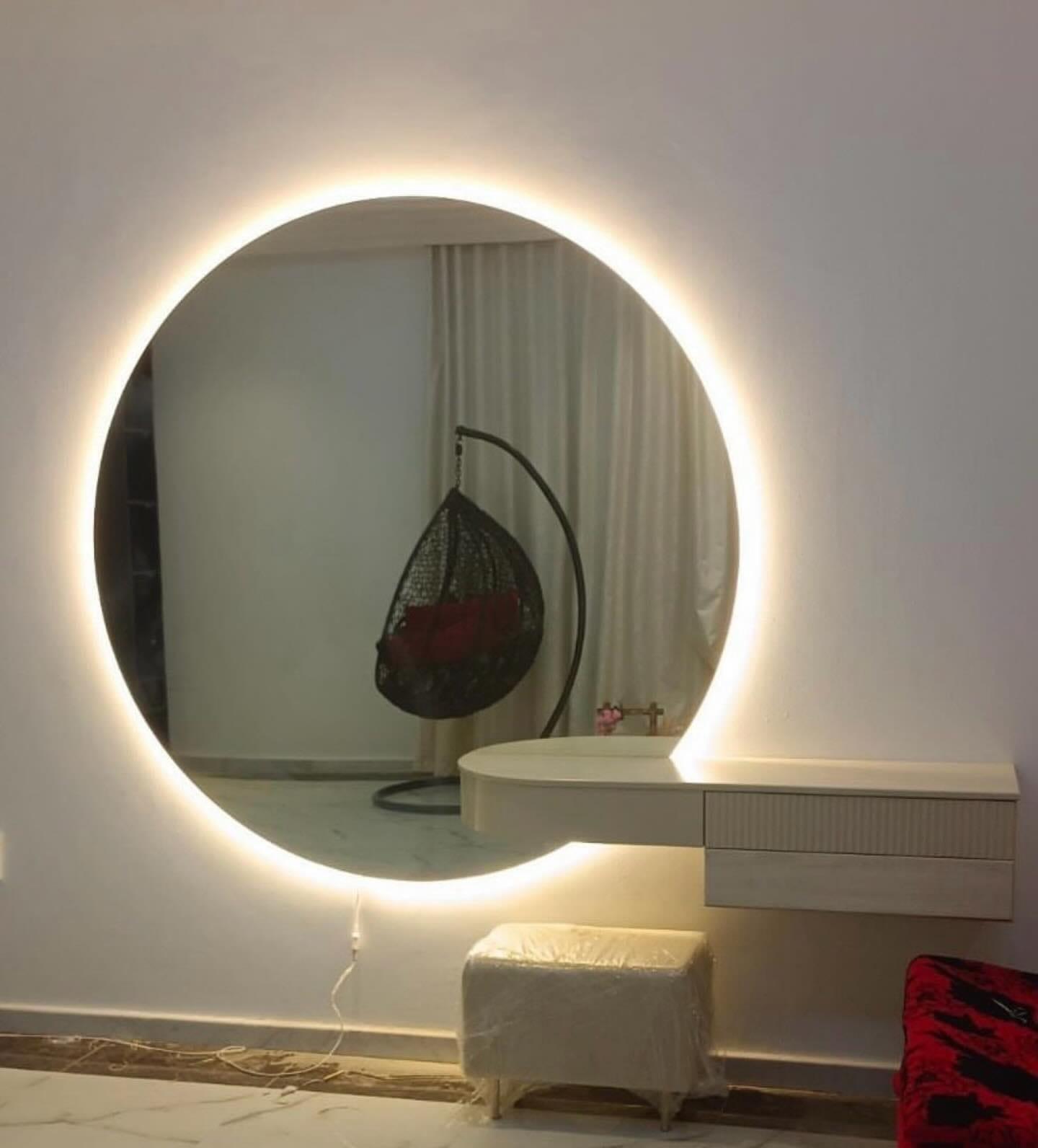
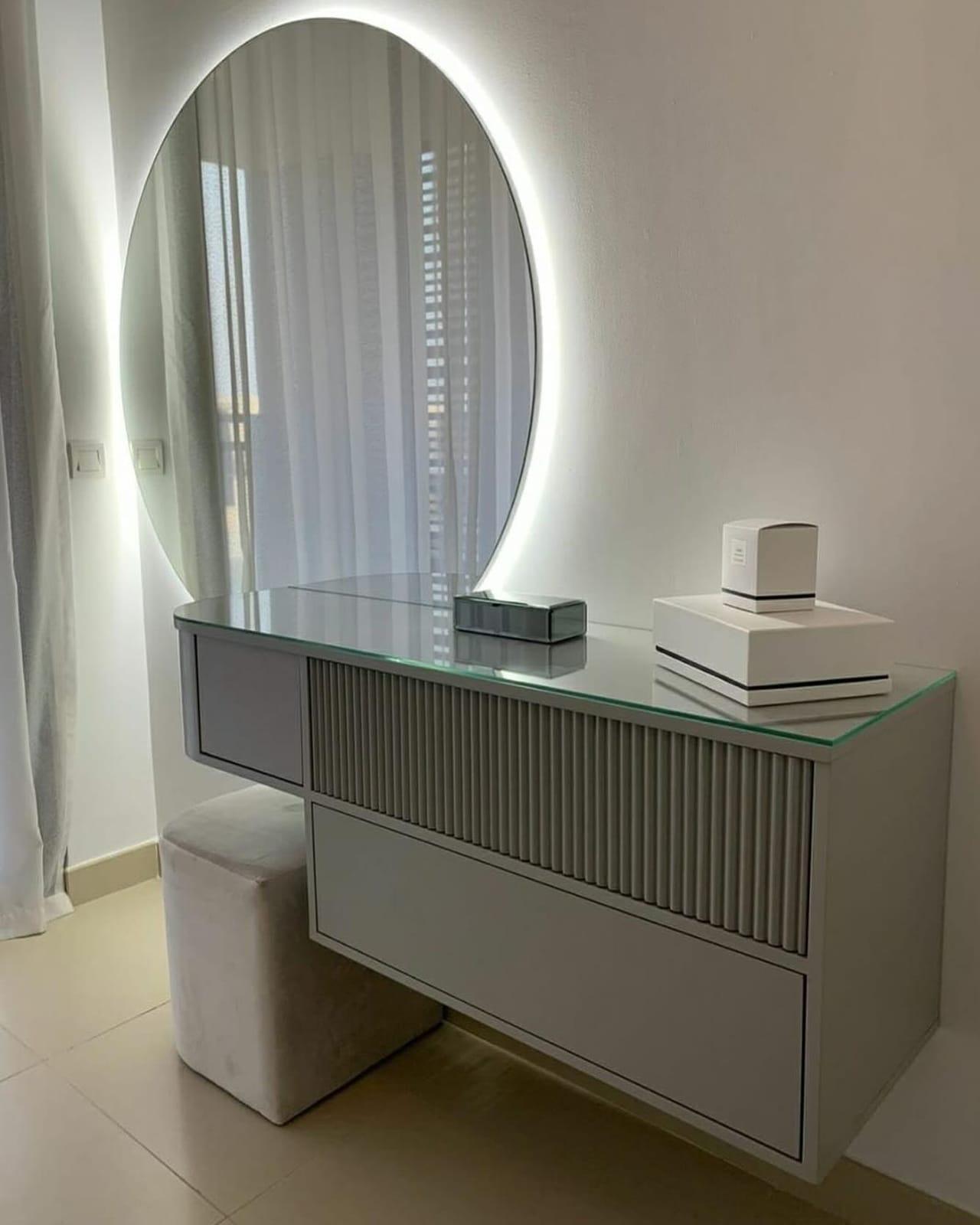
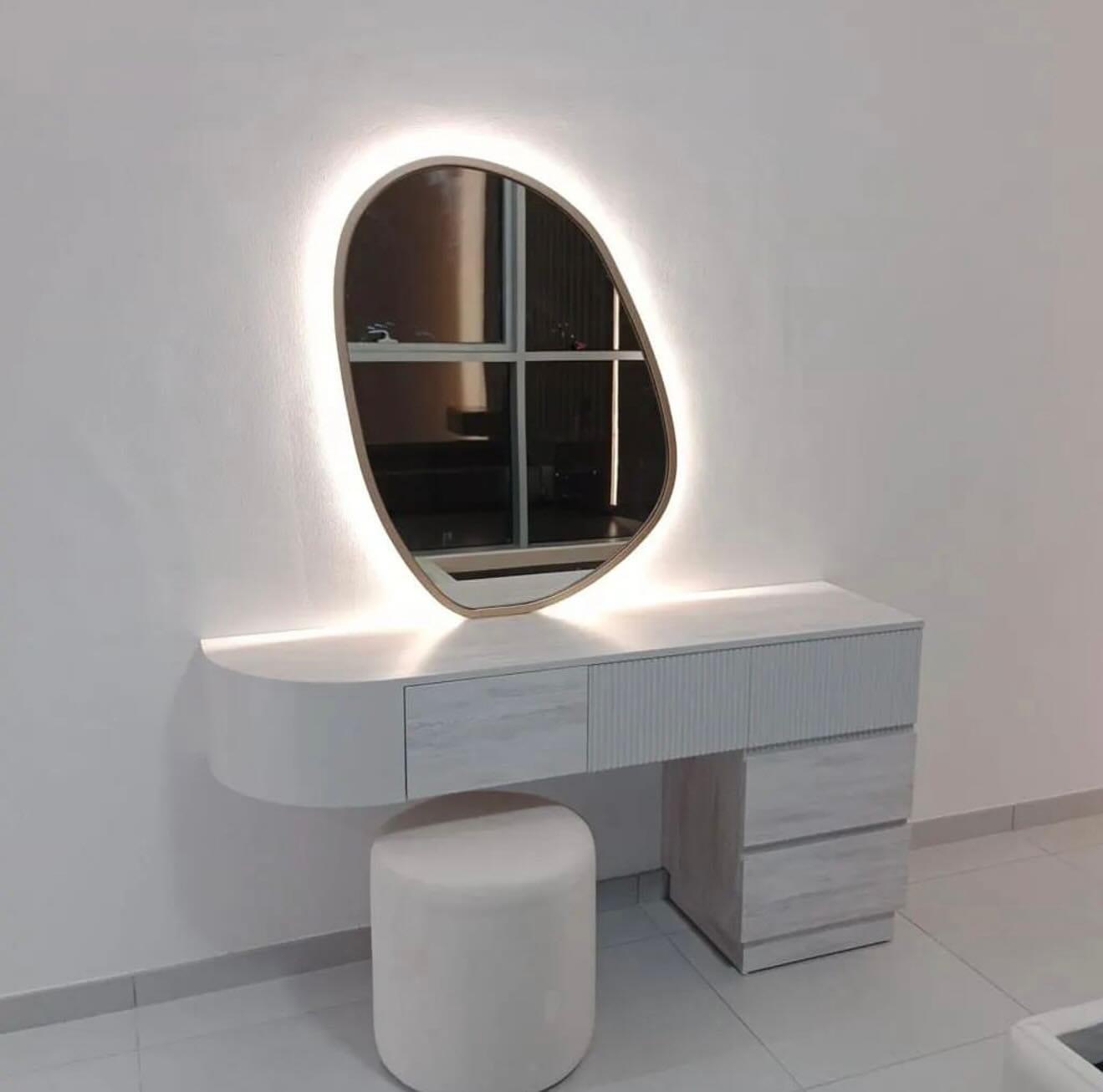
A floating console costs a small bedroom the least. Hung high off the floor, it lets the floor run uninterrupted, so the room feels wider and there are no legs to sweep around. Ours are compact, with between one and three drawers, an end that is curved or square, and often ribbed drawer fronts that add texture and need no handle, set under a round or organic-shaped mirror. A glass top, like the one on the grey console below, protects the surface from perfume and make-up, and a pouf that slides right underneath completes it.
The price of that lightness is the wall. Rapid’s guide to fixing heavy items to plasterboard puts the holding power of one fixing at roughly 5 to 10 kg for a plastic anchor, 10 to 20 kg for a self-drilling one, 20 to 40 kg for a hollow-wall anchor and up to about 50 kg for a toggle bolt, and advises spreading the load over several fixings, counting the bracket in the total and using a stud for the heaviest things. A console with a lit mirror, three drawers and a collection of perfume weighs far more than it looks, which is why we plan the fixings for the wall the console actually hangs on.
Our advice is simple. On a block or concrete wall, go floating. On a gypsum partition, go floating only if timber or metal backing can be built in at the right height, and keep the drawers shallow and the contents light. If neither is possible, choose the table on legs. The wall-hung-or-legs choice is argued out in our dressing unit price guide, and small bedrooms get more of the same thinking in small bedroom wardrobe ideas.
The full dressing table: the most storage, and the most floor
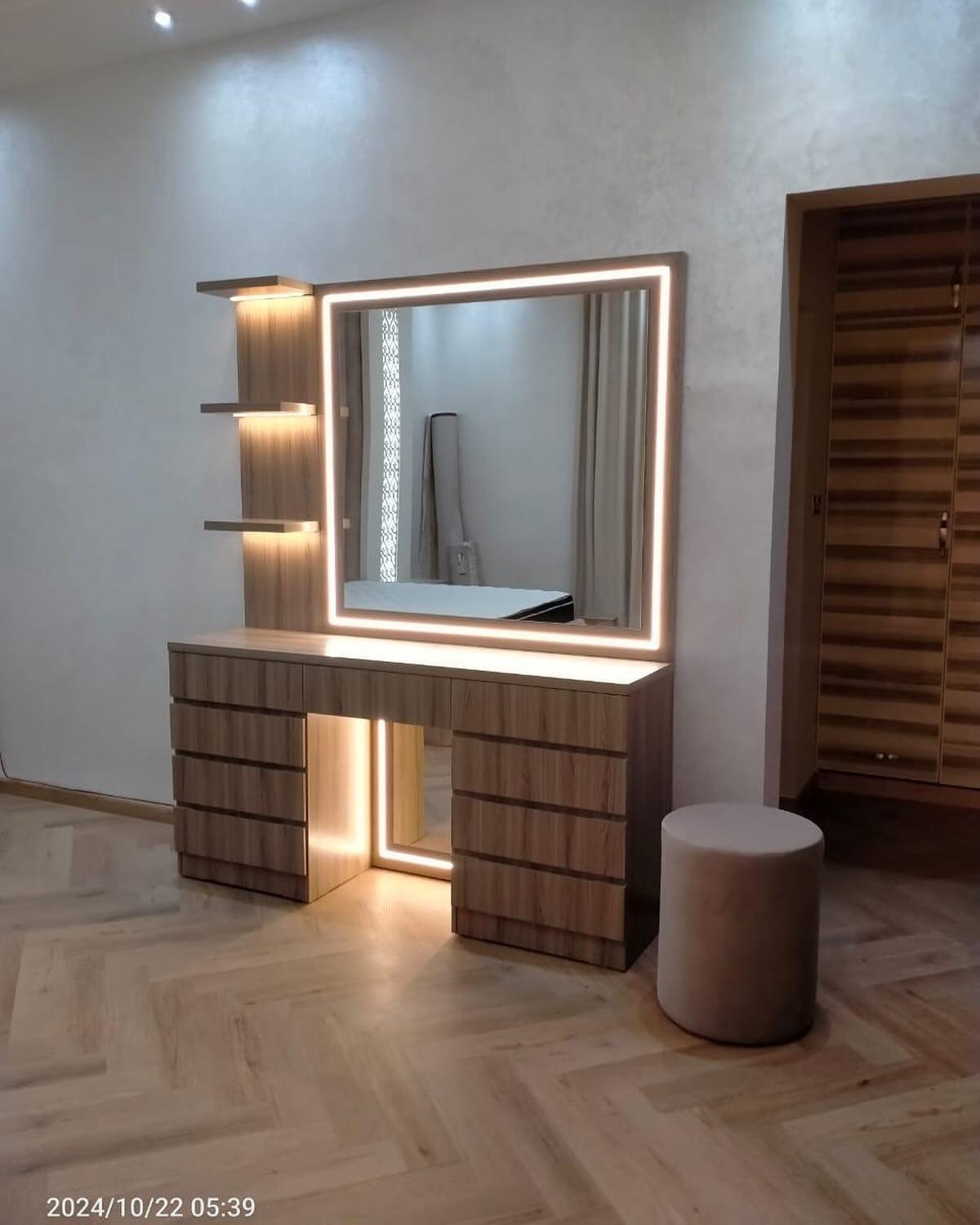
What sets the table apart is how much it stores, and none of the other two forms comes close. A drawer tower beside the top, or a pedestal at one end, keeps jewellery, palettes, perfume and hair tools at seated height, and a drawer can have a socket wired in. The unit in the photo below has a curved-ended top held by the wall and a pedestal of drawers resting on the floor, which takes part of the weight and so asks less of the wall.
That makes the table the most forgiving choice in a rented flat or against a hollow wall. A table on legs needs no structural fixing, can be carried to the next home, and leaves room for a stool to tuck all the way in. What it costs you is floor and feet: it takes the most of the room’s floor, and its legs or pedestal are one more thing to clean around. How tall to make it and how much knee space to leave are settled in dressing table design tips.
Choose the table when you have a large collection, when two people share, or when the room is rented. Choose it, too, when the best wall for the mirror is the one with the window, because a table can stand in front of daylight that no wardrobe niche could. Our dressing units page shows what we make in all three forms.
Floor, cleaning and dust: the cost you meet every week
Think about how each form is cleaned before you fall for its shape. Under a floating console the floor stays open from the wall to the front edge, so there is nothing to stop a mop or a robot cleaner. Ecovacs, a robot vacuum maker, says its 8.1 cm robot passes reliably under furniture only from about 12.5 to 15.5 cm, so a table on legs should be raised at least that high or it will need sweeping by hand. A niche sits on the wardrobe base, so there is no floor under it to clean, only the knee space.
Dust matters more than the floor in the UAE, where fine dust settles on every flat surface. Closed drawers keep jewellery and make-up clean; an open lit shelf column looks lovely and needs wiping. Ribbed fronts hold dust in their grooves; run a soft brush along them. Put perfume and nail polish on a tray, because acetone and some cosmetics mark painted and lacquered tops, and keep stone and matte surfaces to a damp cloth.
The table below compares the three on what you live with every day, not just how they look.
The three forms compared
Floor it takes
- Vanity niche
- None beyond the wardrobe run
- Floating console
- None under it; the stool tucks in
- Dressing table
- Legs or pedestal, plus the stool
Storage
- Vanity niche
- Drawers and cupboards around the recess
- Floating console
- One to three drawers
- Dressing table
- Most: drawer tower or pedestal
Moves with you
- Vanity niche
- No, it belongs to the wardrobe
- Floating console
- No, it is screwed to the wall
- Dressing table
- Yes, if on legs
Asks of the wall
- Vanity niche
- A wardrobe run to build into
- Floating console
- A solid wall, or backing built in
- Dressing table
- Little; a socket and a mirror fixing
Cleaning
- Vanity niche
- No gaps at the sides; wipe the counter
- Floating console
- Floor is open beneath
- Dressing table
- Legs to clean around
Best for
- Vanity niche
- Owned flat, wardrobe being fitted
- Floating console
- Small room, solid wall
- Dressing table
- Rented room, large collection, two users
Our summary from the product pages and our own fitting experience; robot clearance from Ecovacs.
Mirror, light and sockets: what changes with each form
The lighting rules are the same for all three, and they are set out in the guide to lighting a dressing mirror. What differs is where the wiring hides. In a niche, LED strips run beside the opening or round the mirror, and their cables are laid inside the wardrobe carcass before the back panel closes it. Above a floating console the mirror simply hangs on the wall, so its power lead needs a route through the wall or the unit before either is finished.
A table can take a socket inside its top drawer, so a dryer stays connected and hidden, and its mirror either hangs on the wall or stands on the top. Whichever form you pick, fix the socket positions while the drawing is still on paper. Our electricians do the lighting and relocate any socket or switch the layout displaces, and each is itemised on the quotation. If the room has reading lights or a wardrobe interior light too, keep their switches apart from the mirror’s, as in wardrobe lighting ideas.
Three small bedrooms, three answers
A narrow main bedroom in a flat you own, with a wardrobe wall about to be fitted, wants the niche. It costs no floor, puts the cupboards above to work and lets the finish run on from the doors. If a television is also planned for that wall, read about sharing one bedroom wall between wardrobe and TV first, so the two do not fight over the same run.
A rented studio wants the table on legs. It asks nothing of the walls, travels to the next place and holds the most. Pick a backless stool or pouf that slips right under, and a top shallow enough to leave a path beside it. A small flat you own, with a solid block wall beside the window and the wardrobes elsewhere, wants the floating console with a round mirror and a pouf, the form in our lead photograph, which keeps the floor clear for the bed.
In each room, think of the matching pieces too. A bedside chest in the same finish links the corner to the bed; custom sideboards and bedside storage shows how those are sized.
What each form costs, from our published figures
Dressing units begin at AED 1,800 per unit: the compact size, with a mirror and basic drawers. Anything beyond that, a wider top, more drawers or a tower, stone, velvet linings, a lit mirror or built-in power, is added and shown separately. That entry price covers the table and the console. A niche is drawn into the wardrobe run and quoted with it; wardrobe fronts begin at AED 550 per m², installed, in the entry specification, and the niche’s lit mirror, any stone top and its power are itemised beside them.
From the day the order is confirmed, a dressing unit normally takes about ten days to build and install, and our workmanship carries a written warranty of 24 months. A floating console or a niche has no list price of its own: the wall, the width and the finish move the figure more than the form does. Dressing unit prices and layouts goes through the figures, and our pricing guide shows how to set two quotations side by side. Once you have chosen a form, how a custom dressing unit is made follows the order from visit to fitting.
From the first visit to a fitted corner
We start with a free visit to your home. We look at the wall, find out what it is made of, note the sockets and the window, and sit where you would sit. A drawing follows, showing the form we recommend with its lighting and power, and the workshop starts only once you have approved it. For homes near the workshop, see our wardrobes in Sharjah; we fit across the UAE.
A niche is easiest to plan with the wardrobe, so mention it when we first meet, even if you are still unsure. Our built-in wardrobes and how fitted, built-in and freestanding wardrobes differ explain how the wardrobe run is drawn. Before you sign, check this list:
- The form matches your lease and your plans: niche only for a home you will keep.
- A floating unit has a wall that is solid, or backing drawn in, and the load is spread over several fixings.
- A table on legs is high enough underneath for a robot vacuum, if you use one.
- The niche is wide enough for your elbows plus a lamp or tray on each side.
- Light, mirror power and hair-tool socket positions are drawn before anything is built.
- Drawers are closed, and a tray is planned for perfume and nail polish.
Common questions
What is a built-in vanity niche?
A gap in the wardrobe wall made into a seated getting-ready spot, with its own counter, mirror, lighting and hidden sockets. Built-in vanity niches.
Is a floating console or a dressing table better for a small bedroom?
A floating console, if the wall is solid or can be backed, because the floor stays free. A table on legs, if the wall is hollow or the room is rented. Floating dressing consoles.
Can a floating dressing table hold drawers and a lit mirror?
Yes, if the fixings suit the wall: a plastic plug holds about 5–10 kg and a toggle bolt up to about 50 kg per fixing, so we spread the load or fix into backing. Dressing units we make.
Can I take a built-in vanity with me when I move?
No. A niche is built into the wardrobe carcass and stays with the flat, so choose a table on legs if you rent or may move soon. Which wardrobe type stays and which travels.
Where should the sockets go in a dressing corner?
One for hair tools, inside a drawer or along the counter’s rear edge, and a separate route for the mirror’s power; all of it is drawn before anything is built. Dressing table design tips.
How much does a vanity or dressing console cost in the UAE?
Dressing units begin at AED 1,800 per unit, and a niche is quoted with the wardrobe run. Width, stone tops, lit mirrors and power add to the figure. Dressing unit costs and layouts.
Which light suits a vanity niche?
LED strips down both edges of the opening, or a halo around the mirror, so your face is evenly lit from in front rather than overhead. Mirror lighting for dressing tables.

Sources & specifications
Manufacturer information applies to the named products and systems. Sources reviewed on 28 October 2026.
- Rapid: how to fasten heavy objects to plasterboard (studs, spreading the load, anchor ratings from about 5–10 kg for plastic plugs to about 50 kg for toggle bolts)rapid.com(opens in a new tab)
- Ecovacs: robot vacuum clearance under furniture (about 12.5–15.5 cm for an 8.1 cm robot)help.ecovacs.com(opens in a new tab)
- Interior Company: dressing table designs for small bedrooms (wall-mounted, cupboard-affixed nook, floating)interiorcompany.com(opens in a new tab)
Want this planned for your home?
Consultation and measurement are free. Tell us the rooms, location and what you need; we arrange a sample visit and define the measured quotation.