Curtains · 9 min read · 13 November 2026
Office curtains and blinds in the UAE: how to choose for glare, privacy and upkeep
Roller blinds, vertical blinds, sheers or curtains for an office? Compare glare control, privacy, safety, fire documents and upkeep before you order in the UAE.

By Ali Haider Basra, Founder, Al Tareeq Decor · Contact our workshop
Key takeaways
- Prioritize facade orientation and screen glare over decorative style; unshaded west glass requires 1% to 3% solar-screen openness.
- Woven roller blinds are the commercial default for easy maintenance; curtains add acoustic dampening in meeting rooms and boardrooms.
- Fabric openness and yarn colour govern visibility: darker screens provide clearer outdoor views, while lighter screens reflect more solar heat.
- Verify building-specific civil defense and landlord fire certification requirements (NFPA 701 / BS 5867) before ordering commercial fabrics.
- Specify child-safe cordless wand or motorized systems, and coordinate motor electrical wiring before ceiling framing closes.
On this page
- Key takeaways
- Start with the glare problem: how daylight hits workplace screens
- Workplace window performance priorities by room type
- Writing the workplace brief before requesting quotations
- Checklist for drafting a commercial window covering brief
- The main window covering options for UAE commercial interiors
- What a covering does to the sun on an office desk
- Fabric openness factor and colour: the technical trade-offs
- Solar-screen openness factor and colour selection matrix
- Fire safety standards and compliance documents in the UAE
- Child safety regulations, cordless hardware and automation
- Integrating window treatments into the fit-out sequence
- Commercial fit-out sequence for window treatments
- Commercial retail shopfronts and showrooms
- Office blind maintenance and cleaning schedule
- Recommended commercial blind maintenance frequency
- Commercial quotation checklist: what to verify before purchase
- Al Tareeq Decor commercial services across Dubai and Sharjah
- Common questions
Start with the glare problem: how daylight hits workplace screens
Office windows present very different design demands than residential glazing. Employees sit near glass facades for eight to ten hours a day, computer monitors reflect outdoor light, and meeting rooms must transition instantly to blackout conditions for digital screen presentations.
A landmark field study by the Lawrence Berkeley National Laboratory (conducted for IEA SHC Task 61) evaluated commercial shade systems in active office environments. The researchers found that continuous woven roller shades maintained visual discomfort glare below noticeable thresholds throughout the working day, whereas slatted Venetian blinds frequently exceeded glare limits due to specular light leaking between individual horizontal slats.
In modern UAE commercial towers across Business Bay, DIFC, Downtown Dubai and Sharjah, intense solar radiation makes covering selection critical. Beyond selecting window coverings, interior desk orientation matters: orient computer workstations perpendicular (side-on) to glazed perimeter walls rather than facing directly into or away from the glass.
Workplace window performance priorities by room type
Open-plan workstation bays
- Primary Functional Requirement
- Mitigate screen glare while preserving daylight & view
- Standard Commercial Specification
- 3% or 5% solar-screen light-filtering roller shades
Boardrooms & conference rooms
- Primary Functional Requirement
- Complete blackout for digital projection & video calls
- Standard Commercial Specification
- Dual-roller system (solar screen paired with blackout)
Executive suites & private offices
- Primary Functional Requirement
- Acoustic softening, visual warmth and daytime privacy
- Standard Commercial Specification
- Full-length sheer drapery paired with lined curtains
Client reception & lounge
- Primary Functional Requirement
- Refined brand impression and controlled glare
- Standard Commercial Specification
- Ceiling-recessed wave curtains or structured Roman blinds
Glazed partitions & demountable walls
- Primary Functional Requirement
- Intermittent meeting privacy at reasonable linear cost
- Standard Commercial Specification
- Vertical louvre blinds or slimline motorised rollers
Server rooms & records storage
- Primary Functional Requirement
- Total solar rejection to protect cooling equipment
- Standard Commercial Specification
- Heavy-duty 100% blackout PVC-free roller blinds
Writing the workplace brief before requesting quotations
A structured written specification prevents misunderstandings between corporate tenants, interior fit-out contractors and window treatment suppliers. Before requesting pricing, document four baseline criteria for every glazed elevation:
1. Façade orientation and floor elevation: west- and south-facing glazing receives intense afternoon desert sun at low incident angles, requiring tighter fabric openness, whereas north-facing elevations maintain consistent, indirect daylight.
2. Workstation layout: identify desk positions on architectural floor plans to verify line-of-sight angles between screens and exterior glazing.
3. AV presentation requirements: identify specific meeting spaces requiring complete opacity for high-lumen video conferencing.
4. Night-time privacy criteria: ground-floor retail shops, street-level showrooms and illuminated conference rooms require total night privacy when interior illumination exceeds exterior light levels.
Send us your CAD floor plan or window schedules, and our project team provides a free comprehensive site survey (see our commercial office fit-out guide for broader interior coordination).
Checklist for drafting a commercial window covering brief
Facade solar orientation
- Why It Matters Technically
- Dictates solar heat gain coefficient (SHGC) and glare intensity
- What to Document in Specification
- Compass direction, floor height, external shading
Personnel proximity to glass
- Why It Matters Technically
- Determines localized radiant heat discomfort and screen glare
- What to Document in Specification
- CAD floor plan showing desk orientation and distance to window
Presentation room blackout
- Why It Matters Technically
- Ensures projection screens achieve required contrast ratios
- What to Document in Specification
- Blackout requirement, side channel needs, automated control
Night-time external visibility
- Why It Matters Technically
- Preserves confidentiality when offices are lit after dark
- What to Document in Specification
- Double-layer requirement on ground-floor or public facing facades
The main window covering options for UAE commercial interiors
Commercial interiors utilize five primary window treatment formats, each serving distinct functional and maintenance requirements:
Roller blinds: the standard specification for modern workspaces. Flat woven fabrics roll neatly onto extruded aluminium barrels, wiping down effortlessly and resisting workplace dust accumulation. Dual-roller brackets combine a solar-screen mesh for daylight glare control with a separate blackout blind on the same window (see our comparison in roller blinds vs curtains).
Vertical louvre blinds: vertical fabric vanes rotate 180 degrees and draw along an aluminium track. They represent a cost-effective solution for exceptionally wide glass spans and internal glazed partition walls (detailed in our guide to zebra, vertical and wooden blinds). Verify that vanes are positioned clear of high-velocity AC supply diffusers to prevent distracting louvre flutter.
Zebra day-and-night blinds: alternating horizontal bands of sheer mesh and solid opaque fabric that align to modulate illumination without raising the blind barrel.
Roman blinds: structured fabric panels that raise in uniform tailored horizontal folds, ideal for executive suites, boardrooms and corporate dining areas (see Roman blinds in the UAE).
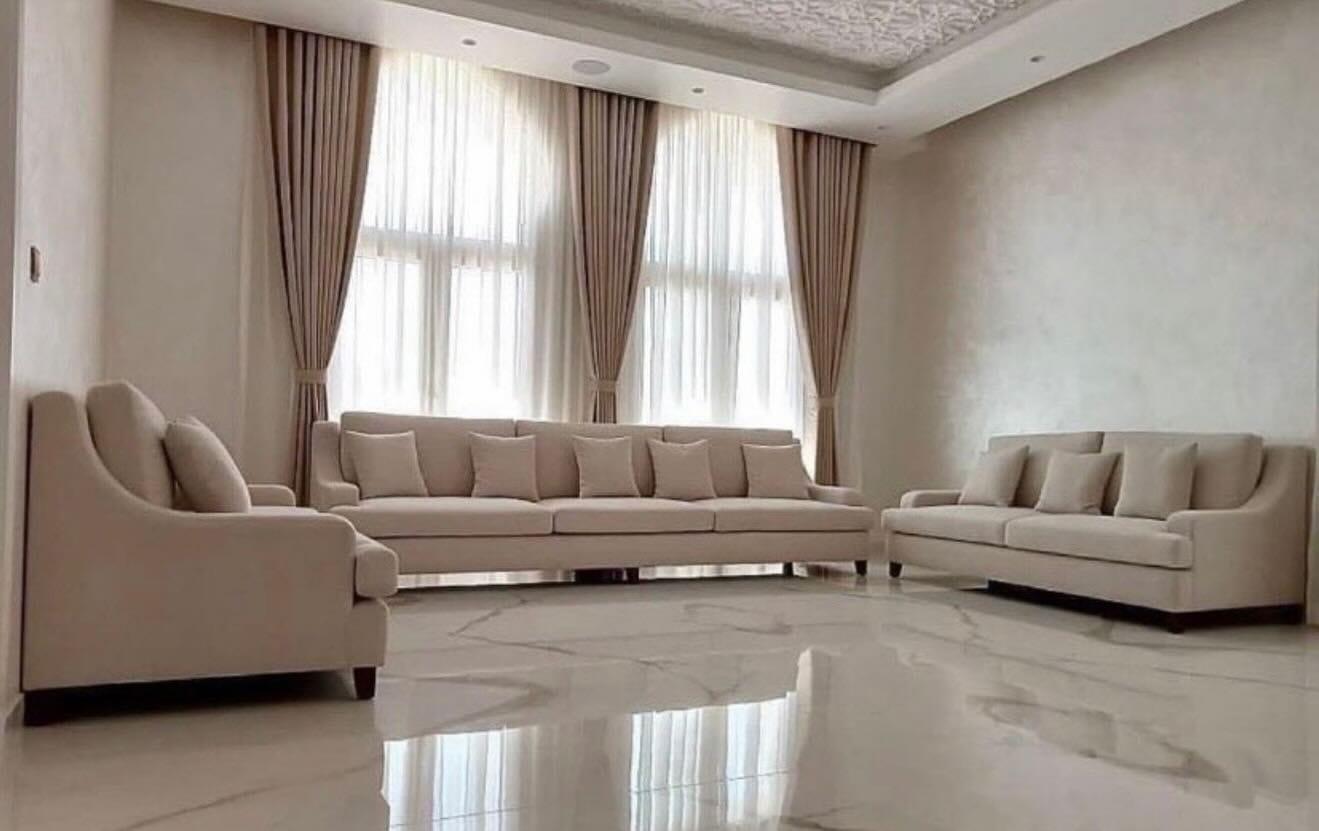
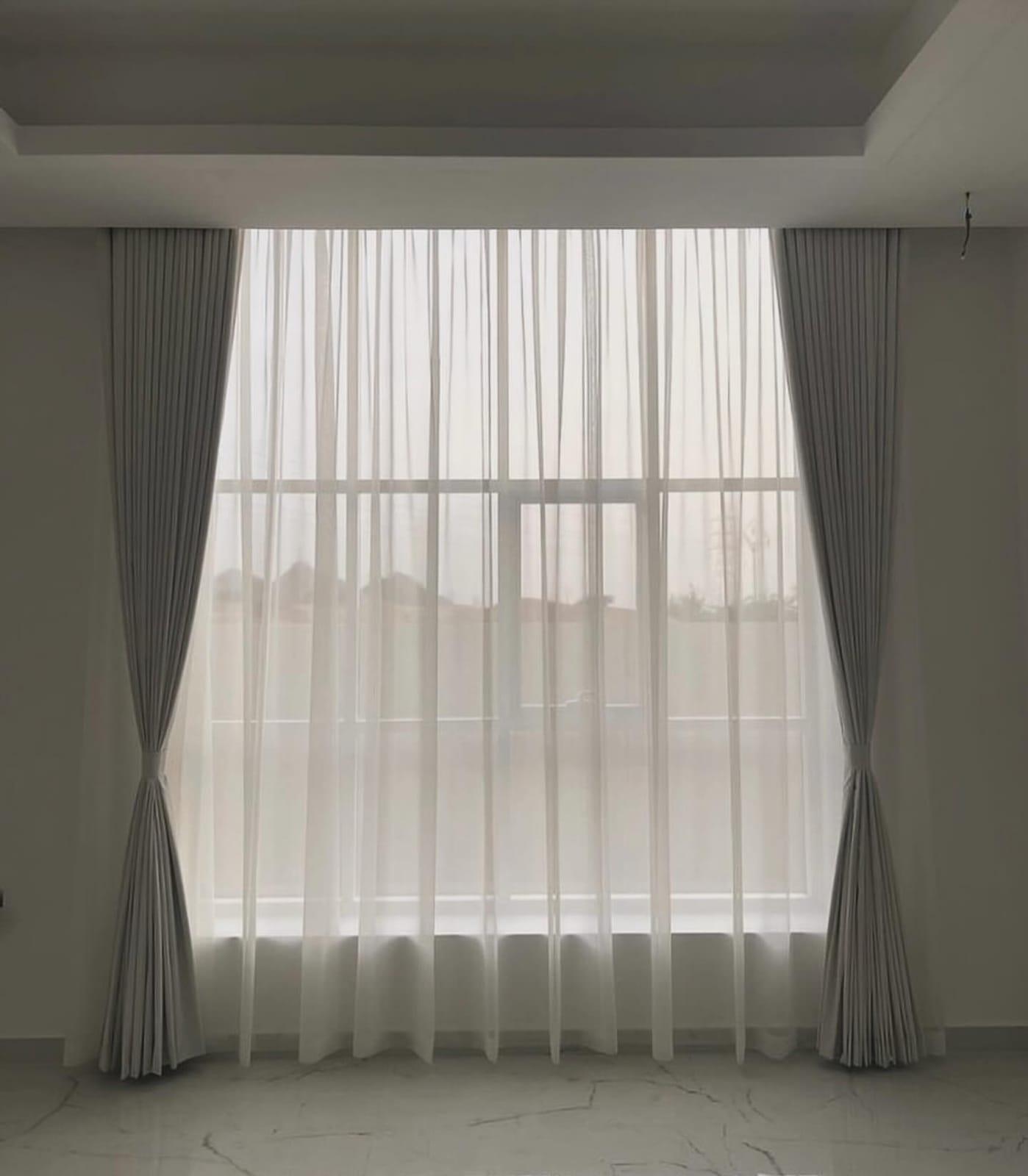
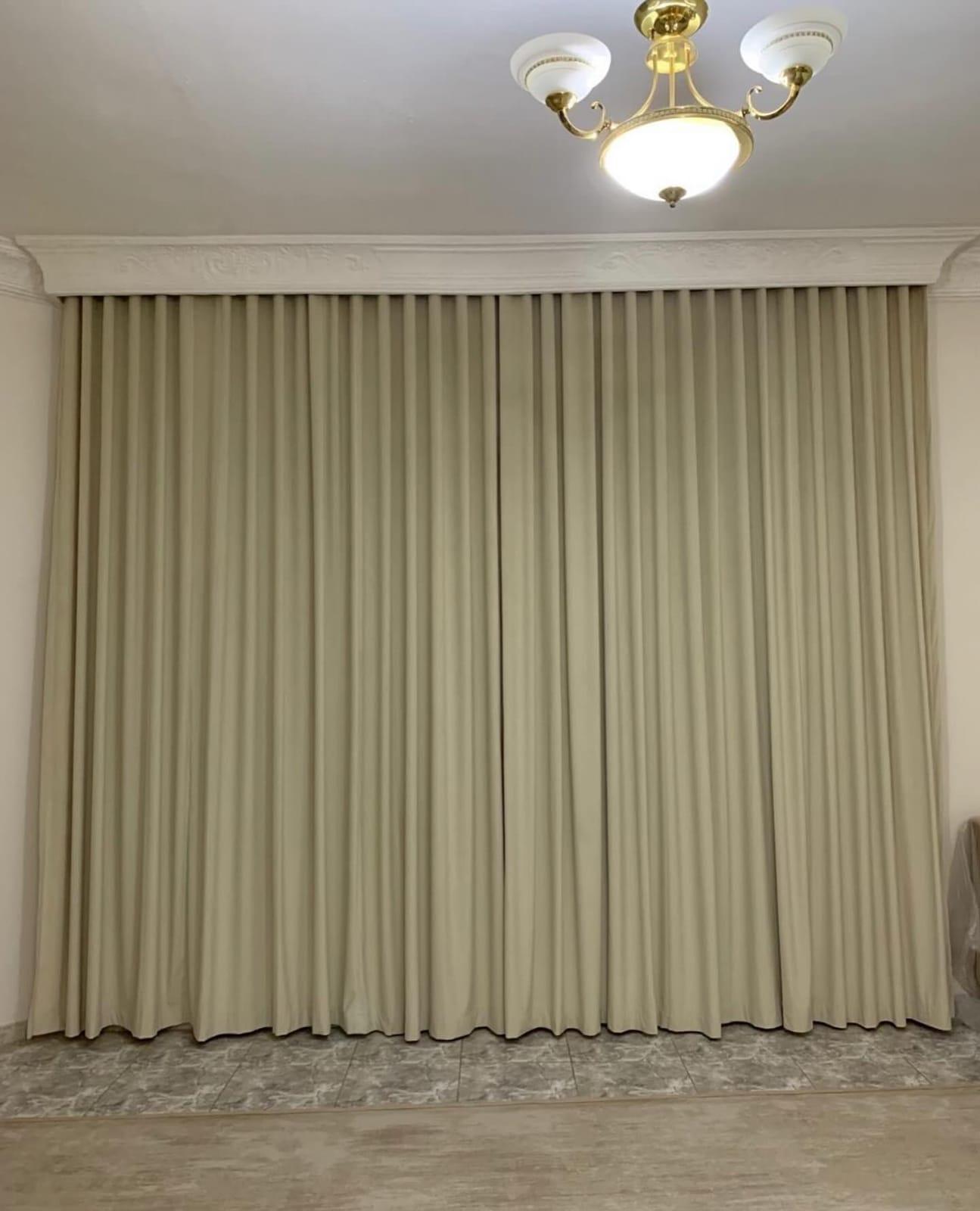
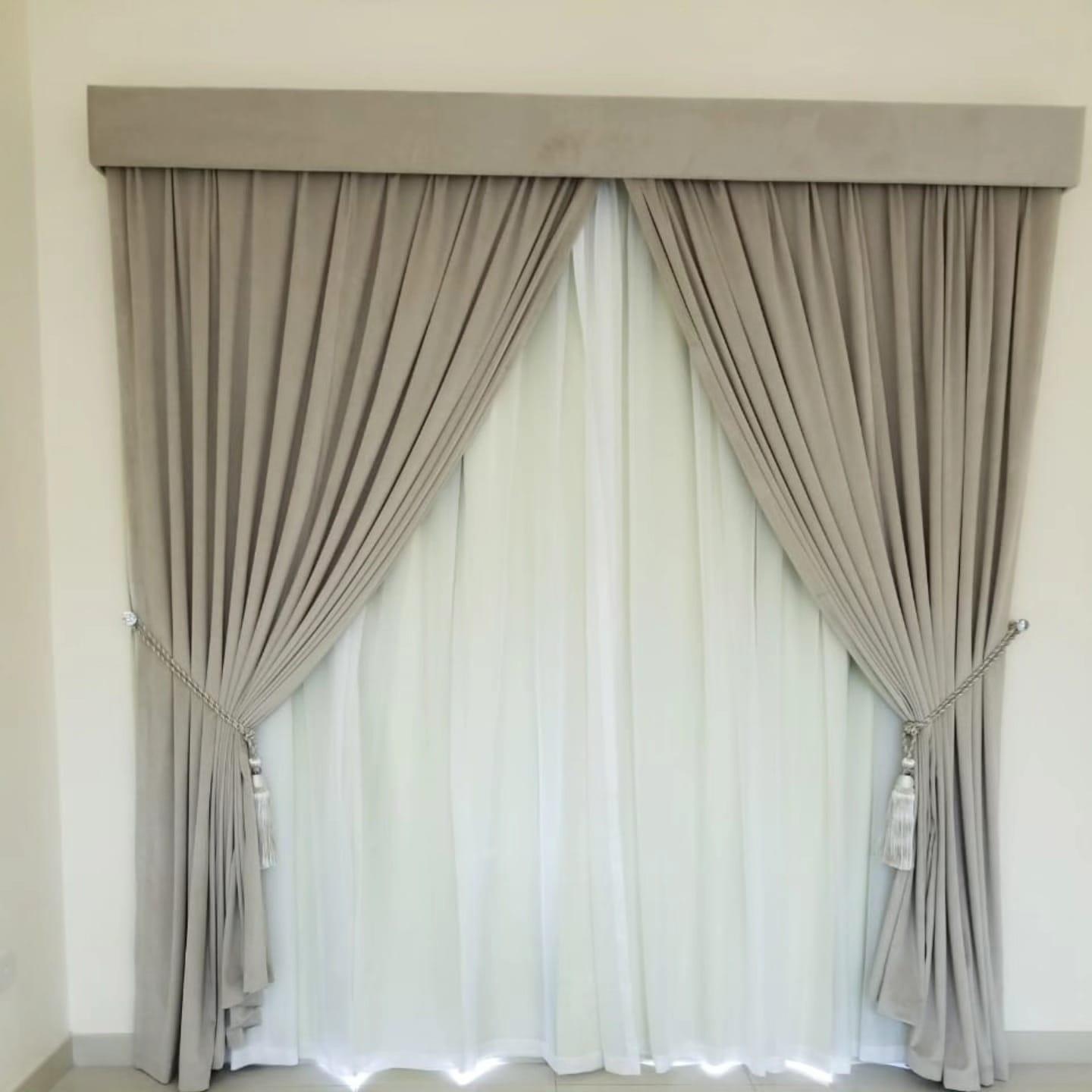
Custom curtains and sheers: floor-to-ceiling wave drapery adds architectural luxury, conceals structural columns and absorbs mid-frequency room reverberation. In executive spaces and meeting rooms, heavy curtains soften harsh flutter echo across glass walls (see do soundproof curtains work and curtain rod vs track).
What a covering does to the sun on an office desk
The architectural section below illustrates a perimeter office desk with an identical external sun angle under three covering scenarios: a light-filtering roller blind, a 100% blackout roller shade, and a layered sheer-plus-curtain installation.
Notice how each solution affects the monitor's glare footprint, outdoor visibility, natural daylighting and corporate privacy. Select light-filtering screens for general staff desks where outdoor views boost workplace productivity, blackout blinds where digital screens require contrast, and dual-layer drapery where corporate spaces require versatile luxury.
- 1. Direct solar radiation strikes the glazed facade at low incident angles
- 2. A light-filtering roller softens screen glare while preserving external views
- 3. A blackout roller eliminates all glare patches, ideal for video conferencing
- 4. A sheer paired with heavy curtains allows dynamic modulation of daylight and privacy
- 5. Indicator dots compare relative view preservation, natural daylight and visual privacy
Fabric openness factor and colour: the technical trade-offs
Solar-screen roller fabrics are precision-engineered textiles defined primarily by two metrics: openness factor (expressed as a percentage) and yarn colour.
The openness factor measures the percentage of open weave area relative to total fabric area. A 1% openness weave provides dense solar protection, filtering out approximately 99% of UV radiation and direct glare, which makes it ideal for critical workstation screens on unshaded western facades. A 3% openness fabric provides the standard corporate balance, blocking intense glare while retaining recognizable outdoor shapes. A 5% or 10% openness weave yields brighter workspaces with crisp exterior views, ideal for north-facing elevations or shaded courtyards.
Fabric colour influences visual physics counter-intuitively: darker yarns (charcoal, slate, bronze) absorb light scatter, allowing the human eye to see through the mesh to the outside world with superior contrast. Lighter fabrics (white, oyster, cream) reflect solar radiation more effectively, contributing to lower interior cooling loads, but create a softly illuminated hazy glow that obscures outdoor views.
Solar-screen openness factor and colour selection matrix
1% Openness weave
- Visual & Glare Impact
- Maximum glare suppression; exterior view heavily diffused
- Thermal & Privacy Behavior
- High thermal reflection; excellent daytime privacy
- Recommended Application
- Trading floors, west-facing glazing, high-altitude towers
3% Openness weave
- Visual & Glare Impact
- Balanced glare control; sharp view preservation
- Thermal & Privacy Behavior
- Moderate heat rejection; good daytime eye comfort
- Recommended Application
- General open-plan desks, corporate workstations
5% Openness weave
- Visual & Glare Impact
- Generous natural daylighting; clear outdoor landscape view
- Thermal & Privacy Behavior
- Lower glare suppression; mild afternoon reflections
- Recommended Application
- North facades, shaded urban streets, reception atriums
Dark charcoal / black yarn
- Visual & Glare Impact
- Superior glare absorption and high-contrast view through mesh
- Thermal & Privacy Behavior
- Absorbs solar heat; requires pairing with low-E facade glass
- Recommended Application
- Glazed meeting rooms, executive views, panoramic windows
Light white / beige yarn
- Visual & Glare Impact
- Reflects solar radiation to keep perimeter desks cooler
- Thermal & Privacy Behavior
- Creates interior ambient glow; partially obscures outdoor view
- Recommended Application
- Harsh western desert sun exposures, unshaded low-rise villas
Crucial rule: solar screens reverse privacy at night when interior office lights are on.
Fire safety standards and compliance documents in the UAE
Commercial fit-outs across the UAE are subject to statutory life safety regulations enforced by municipal civil defense authorities (such as Dubai Civil Defense - DCD, or Sharjah Civil Defence). When undertaking commercial tenant fit-outs, building management or authority inspectors frequently require certified test documentation for interior furnishings.
Work through compliance systematically: first, consult your project architect, fit-out consultant or building facilities team to verify the exact fire classification specified in the tenant fit-out manual. Commercial specifications commonly reference international testing standards such as NFPA 701 (Standard Methods of Fire Tests for Flame Propagation of Textiles and Films in the USA) or BS 5867 Part 2 Type B (Fabrics for curtains, drapes and window blinds in the UK).
Second, obtain the manufacturer's certified flammability test report before finalizing fabric procurement. Never assume an untagged fabric is flame retardant. Third, statutory approvals remain the responsibility of the client and designated engineering consultant; Al Tareeq Decor manufactures and installs window treatments strictly in accordance with approved consultant specifications.
Child safety regulations, cordless hardware and automation
Loose, looped operating cords and bead chains present severe strangulation hazards to young children. Comprehensive child safety guidelines published by the US Consumer Product Safety Commission (CPSC) emphasize that cordless window coverings represent the only definitive hazard elimination in commercial spaces frequented by children—including corporate crèches, pediatric clinics, educational facilities and retail shops.
Specify wand-operated, spring-assist or motorised roller blinds to eliminate looped chains entirely. The European standard EN 13120 mandates strict safety device integration (such as breakaway chain connectors and continuous tension cleats) where manual chains cannot be avoided.
Motorized blind systems offer superior commercial operational efficiency. Motorized banks allow facilities managers to synchronize entire building elevations with a single wall switch, wireless remote or centralized building management system (BMS). Automation prevents uneven half-drawn blinds, ensuring a uniform exterior facade. Motor electrical planning must be integrated before ceiling framing and wiring conduits close (see motorised curtains).
Integrating window treatments into the fit-out sequence
Window coverings must be scheduled into the wider fit-out programme at precise milestones to avoid costly rework and damaged fabrics.
Commercial fit-out sequence for window treatments
Initial space planning
- Window Treatment Coordination Action
- Determine desk orientations and presentation room blackout criteria
- Responsible Trade / Party
- Client & interior architect
Ceiling framing & MEP rough-in
- Window Treatment Coordination Action
- Frame recessed ceiling pelmet pockets; run 230V power to motor points
- Responsible Trade / Party
- Ceiling contractor & MEP electrical trade
Partition boarding & AC ducting
- Window Treatment Coordination Action
- Coordinate diffuser positions to prevent air jet blowing directly on blinds
- Responsible Trade / Party
- HVAC contractor & ceiling trade
Floor finishes & wall painting
- Window Treatment Coordination Action
- Conduct final precision laser site survey of finished window openings
- Responsible Trade / Party
- Al Tareeq Decor survey technician
Final fit-out handover
- Window Treatment Coordination Action
- Install blind mechanisms, program motor limits and commission controls
- Responsible Trade / Party
- Al Tareeq Decor installation team
Never install fabric window coverings before dusty MEP and drywall sanding is finished.
Commercial retail shopfronts and showrooms
Retail premises and showrooms present unique window treatment challenges: shopfront glazing must showcase merchandise while protecting display items and furniture fabrics from severe UV fading.
Motorized solar-screen roller blinds (1% to 3% openness) protect shop merchandise during peak midday sun without rendering the window display completely opaque from the street. For retail fitting rooms and customer changing suites, specify 100% blackout fabrics or lined acoustic curtains on heavy-duty ceiling tracks to guarantee complete customer privacy. Because solar screens become transparent when backlit at night, never specify solar-screen mesh for fitting room doors.
Office blind maintenance and cleaning schedule
Commercial blinds accumulate fine airborne dust and particulate matter from high-turnover central HVAC circulation. Establishing a routine maintenance protocol extends fabric life and preserves mechanical warranty coverage.
Recommended commercial blind maintenance frequency
Surface dust removal
- Recommended Schedule
- Monthly routine
- Standard Operating Procedure
- Use vacuum cleaner with soft brush attachment on low suction setting
Solar-screen mesh wipe-down
- Recommended Schedule
- Quarterly (every 3 months)
- Standard Operating Procedure
- Wipe with damp microfibre cloth and mild neutral detergent; avoid saturating
Mechanism & motor inspection
- Recommended Schedule
- Bi-annually (every 6 months)
- Standard Operating Procedure
- Test motor limit stops, verify chain tension clips and lubricate idler pins
Curtain & sheer laundering
- Recommended Schedule
- Annually (yearly shut-down)
- Standard Operating Procedure
- Dry clean or gentle wash according to manufacturer care label specifications
HVAC deflection review
- Recommended Schedule
- Annually
- Standard Operating Procedure
- Verify supply louvres do not discharge high-velocity conditioned air into blinds
Refer to our comprehensive [curtain and blind care guide](/inspiration/curtain-blind-care) for fabric-specific cleaning formulas.
Commercial quotation checklist: what to verify before purchase
To compare commercial window covering proposals accurately across competing suppliers, require itemised responses to the following six criteria:
- 1. Site-verified dimensions: ensure quotations reflect on-site laser measurements rather than unverified architectural CAD drawings
- 2. Fabric specification: confirm fabric manufacturer, composition, openness factor, colour code and solar optical properties (Ts, Rs, As)
- 3. Mechanical operation: detail manual chain, child-safe wand, or motorized tubular drive (including motor brand and warranty)
- 4. Compliance certification: obtain written copies of required fire test reports (NFPA 701, BS 5867) where mandated by building management
- 5. Installation terms: confirm whether installation includes out-of-hours weekend working, high-access equipment and building permit fees
- 6. Warranty terms: confirm written warranty coverage on mechanisms, motors and fabric colorfastness (Al Tareeq provides a 24-month workmanship policy)
Al Tareeq Decor commercial services across Dubai and Sharjah
Operating from our specialized manufacturing workshop in Industrial Area (Hay Al Gharb), Sharjah, Al Tareeq Decor delivers bespoke commercial window coverings, custom joinery and acoustic drapery for corporate offices, retail stores, healthcare clinics and executive boardrooms across the UAE.
Custom window treatments start from AED 550 per window for entry manual specifications, with commercial volume projects quoted via itemised bills of quantities following our complimentary on-site measurement visit. Standard curtains and roller blinds are manufactured and installed in 3 to 5 working days, with 48-hour express production available for time-sensitive commercial fit-outs (see our joinery and fit-out services and commercial pricing guide).
Common questions
What is best for office windows, curtains or blinds?
Solar-screen or light-filtering roller blinds suit open-plan desks near glass, while layered curtains excel in boardrooms and executive suites for warmth and echo absorption. See roller blinds vs curtains.
Are vertical blinds suitable for commercial offices?
Yes, they provide cost-effective coverage for wide glass partitions, but ensure louvres are clear of high-velocity AC supply vents to prevent flutter. See vertical and wooden blinds.
Do office curtains need to be fire-retardant in the UAE?
Requirements depend on your specific building management and local Civil Defense approvals. Confirm required standards (such as NFPA 701 or BS 5867) before ordering. See our office fit-out guide.
What stops glare on computer monitors near windows?
Specify 1% to 3% solar-screen roller shades and orient monitors perpendicular (side-on) to the glass to eliminate direct reflections. See roller blinds vs curtains.
Can commercial office blinds be motorized?
Yes. Motorized roller blinds can be linked to wall switches, multi-channel remotes or building management systems (BMS). Plan wiring before ceilings close; see motorised curtains in the UAE.
What is the turnaround time for commercial blinds?
Standard office orders are measured, fabricated and installed in 3 to 5 working days, with express 48-hour service available for fast-track tenant handovers. See our commercial fit-out guide.

Sources & specifications
Manufacturer information applies to the named products and systems. Sources reviewed on 13 November 2026.
- Lawrence Berkeley National Laboratory: Enhancing workplace quality with dual-zone automated shades (IEA SHC Task 61)iea-shc.org(opens in a new tab)
- US Consumer Product Safety Commission (CPSC): Window covering cord safety guidelinescpsc.gov(opens in a new tab)
- Silent Gliss: Commercial internal shading child safety (EN 13120 compliance specification)silentgliss.com(opens in a new tab)
- Dubai Development Authority (DDA): Commercial tenant fit-out guidelines and civil defense clearancedda.gov.ae(opens in a new tab)
Want this planned for your home?
Consultation and measurement are free. Tell us the rooms, location and what you need; we arrange a sample visit and define the measured quotation.