Media Walls · 22 min read · 17 October 2026
Veneer vs lacquer vs HPL for a TV wall: how each finish ages in a UAE home
Veneer, lacquer or HPL laminate for a TV wall: how each finish copes with scratches, heat, moisture, light, repairs and grain matching in UAE homes, plus a five-step sample test.

By Ali Haider Basra, Founder, Al Tareeq Decor · Contact our workshop
Key takeaways
- HPL laminate is the calm choice for daily scratches, wipes and heat, but a damaged laminate panel is replaced, not patched.
- Sprayed lacquer gives a continuous colour and can be re-sprayed, but its topcoat specification and sheen must be agreed in writing.
- Veneer is real wood: it marks more easily but can be sanded and resealed, and its layout (sequence-matched or mixed) changes the whole look.
- Under every finish is a board, and every edge, back and cut-out must be sealed whichever face you choose.
- Run five checks on a sample board over a week; veneer and lacquer raise the price from AED 3,500 per project, and the quotation states by how much.
On this page
- Key takeaways
- The question is not which looks best, but which ages best
- Three surfaces in plain words
- Five everyday events, three surfaces
- Scratches and knocks: the daily test
- Heat: screens, LED strips and electric fireplaces
- Moisture, edges and the board underneath
- Light and colour change over the years
- When something goes wrong: three repair paths
- Veneer needs a layout: grain, leaves and sequence
- Matt, satin or gloss: sheen changes how every finish behaves
- HPL's weak spot is the edge
- Lacquer: coats, curing and why a rushed job shows
- Living with veneer: the care that keeps it looking right
- Mixing finishes on one wall
- What the price does, in direction only
- Which finish for which wall and household
- Finish by household and room
- Five checks on a sample, before you approve
- Mistakes that spoil a good finish
- Choosing with us, and the WhatsApp message to send
- Common questions
The question is not which looks best, but which ages best
Every showroom sample looks perfect on the day. The useful question about a TV wall finish is what it looks like after three years of children, vacuum cleaners, summer sun through the window and a replacement TV that needed a new bracket. High-pressure laminate (HPL), sprayed lacquer and real-wood veneer answer that question in three different ways, and the differences matter more than the colour name on the sample.
Our guide to media wall colours and finishes already covers how white, wood and stone read in UAE light, and the materials guide lists the faces a wall can have. This article covers a different search: you are choosing between these three surfaces, and you want to know how each behaves when something happens to it. We go through scratches, heat, moisture, light, repairs and grain, then give you a five-step sample test you can run for free.
We build media walls in laminate, veneer and lacquer. Our entry price is from AED 3,500 per project for a compact panel with a floating console in standard laminate; veneer and lacquer change the figure, and the quotation states by how much for your wall. None of the three is the best finish for every household, and we will say plainly which one we would pick in each case.
Three surfaces in plain words
HPL laminate is a printed paper under a clear layer, pressed into a sheet. Wikipedia's entry on decorative laminate describes HPL as resin-impregnated cellulose layers consolidated under heat and high pressure, with a decorative paper that carries the colour or print, an overlay paper that improves abrasion, scratch and heat resistance, and kraft paper as the core. The sheet is then glued to a board. Because the pattern is printed, one decor code looks the same from batch to batch.
Sprayed lacquer is paint, applied in coats directly to the board face. The board is filled and sanded smooth, primed, then sprayed in colour and sealed with a topcoat in matt, satin or gloss. Because it is a paint, any colour is possible, and the surface is continuous: there are no printed repeats, and curved or grooved parts can be sprayed as easily as flat ones. MDF is the usual core, and the Wikipedia article on MDF notes that it takes paint well, which is why it is the board of choice for sprayed work.
Veneer is a slice cut from real timber and glued to a core panel. Wikipedia's entry on wood veneer says veneers are cut as thin as 0.64 mm, and notes that veneer is also used instead of the decorative paper in some HPL products, so a laminate can wear a wood face too. Veneer on a board is then sealed with oil or lacquer. Because it is real wood, no two leaves are the same, and the grain is the whole point.
None of the three changes what is underneath. In all cases the structure is a board, and the board decides how the wall behaves with moisture; the face decides how it behaves with hands, light and heat. Keep those two questions apart as you read on.
Five everyday events, three surfaces
The grid below sets the three finishes against five things that happen to a TV wall in a UAE home: a scratch, a hot object, moisture, light and a repair. Read it as a guide to temperament rather than a score. A cell that says 'take care' does not mean a finish fails; it means the finish needs a specific habit or a specific specification from the supplier.
Notice that HPL is strongest on the events that happen daily (scratches, hot cups, wipes) and weakest on repair, because a laminate sheet cannot be patched; the whole panel is replaced. Lacquer sits in the middle on almost everything, with a strong repair story if the workshop can respray. Veneer asks for the most care on everyday knocks and heat, and gives the best repair story, because real wood can be sanded and resealed in place.
- 1. Scratch: the HPL overlay layer is there to resist it; lacquer shows marks but can be re-sprayed; veneer marks and is sanded and resealed
- 2. Heat: the HPL overlay helps; lacquer needs its topcoat specification in writing; veneer is sealed and does not take hot objects
- 3. Moisture: all three sit on a board, so every face and edge must be sealed
- 4. Light: every finish should be judged on a sample; veneer tone can change over the years
- 5. Repair: HPL means a new panel, lacquer means re-spraying the panel, veneer can be re-sealed in place
Scratches and knocks: the daily test
Think about who touches the wall. In a family room with young children, the lowest hand-height band collects toy knocks, shoe scuffs and drawn-on marks. HPL is the calm choice there, because the overlay layer exists to resist abrasion and scratching, and a damp cloth removes most marks. We would put a laminate on the console fronts and the lower panels of a family wall even if the upper panels are veneer.
Lacquer is a coating, and coatings can chip at an edge or mark under a sharp corner. A matt topcoat hides small scuffs better than gloss, in the same way a matt car paint hides small scratches better than a mirror-gloss one; we cover that choice in more depth in the colour and finish guide. Lacquer is not a poor choice for a wall that adults mainly look at, such as a TV wall in a formal living room; it is simply a finish that rewards care.
Veneer is real wood, and real wood marks. A fingernail will leave a trace on a soft species, a sharp heel will dent it. In return, the marks can be sanded out and the finish renewed. For a wall that carries a premium look and is rarely bumped, such as a feature panel above hand height, veneer is a fair choice. For a console top that will be used as a shelf, we suggest something tougher.
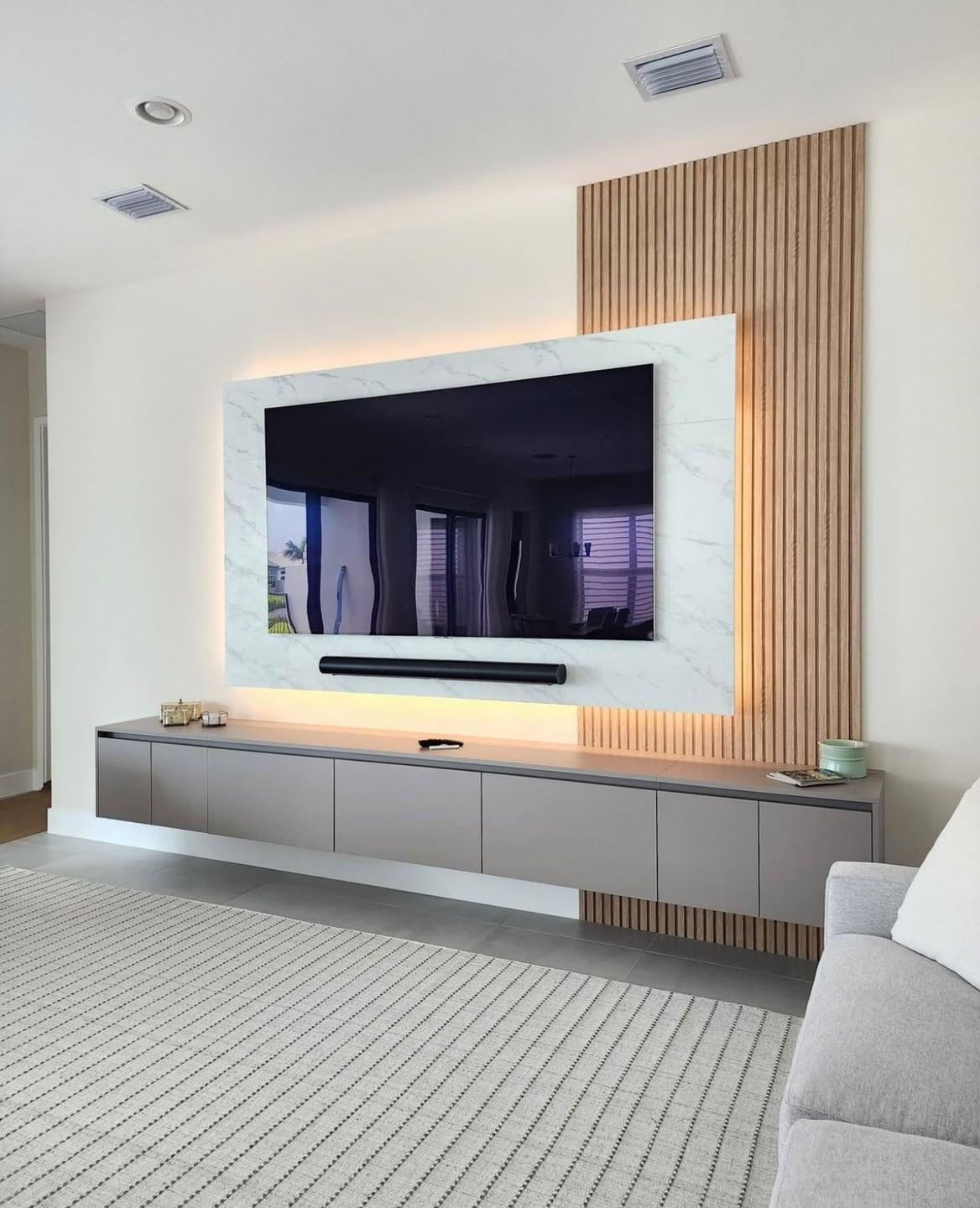
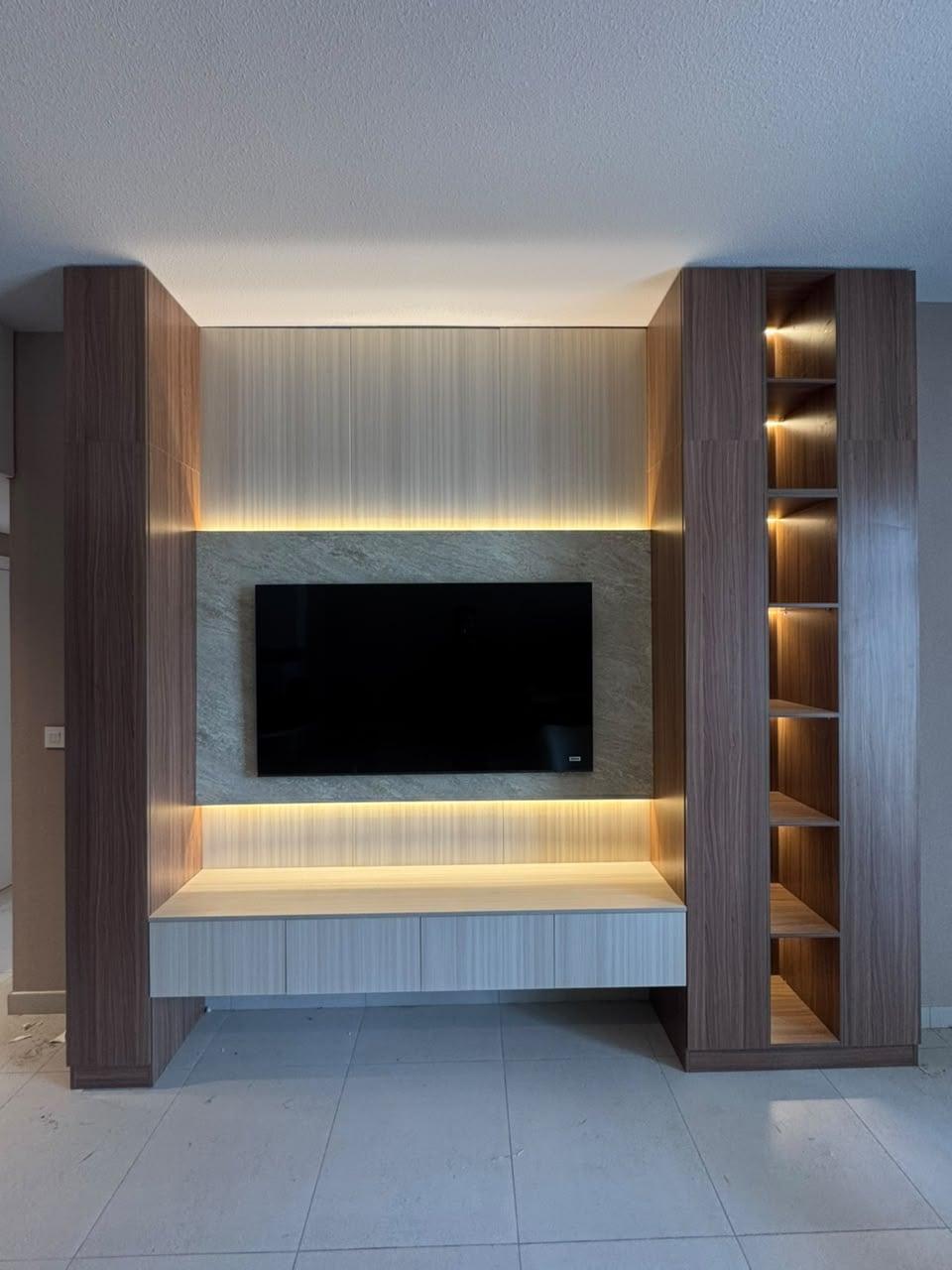
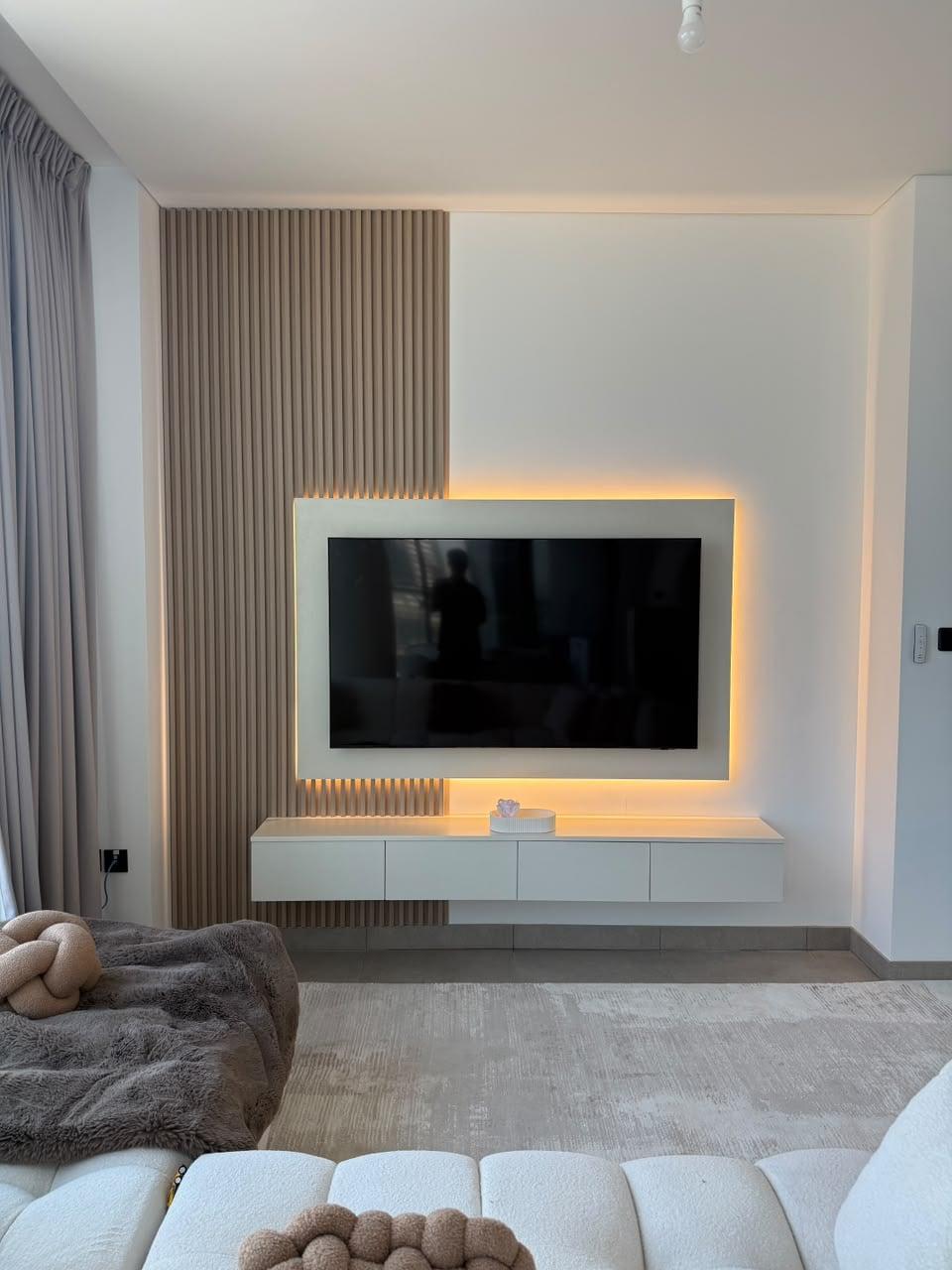
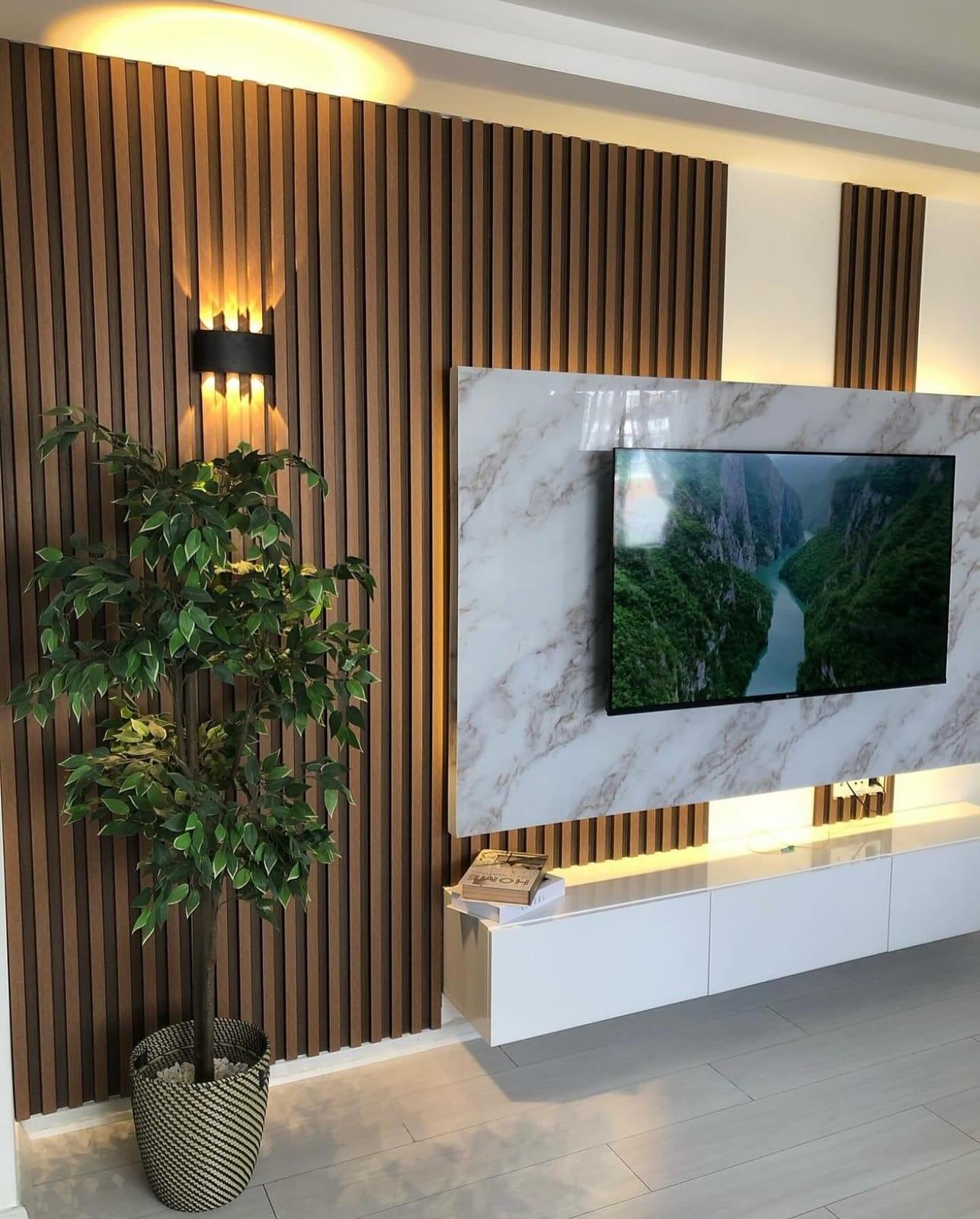
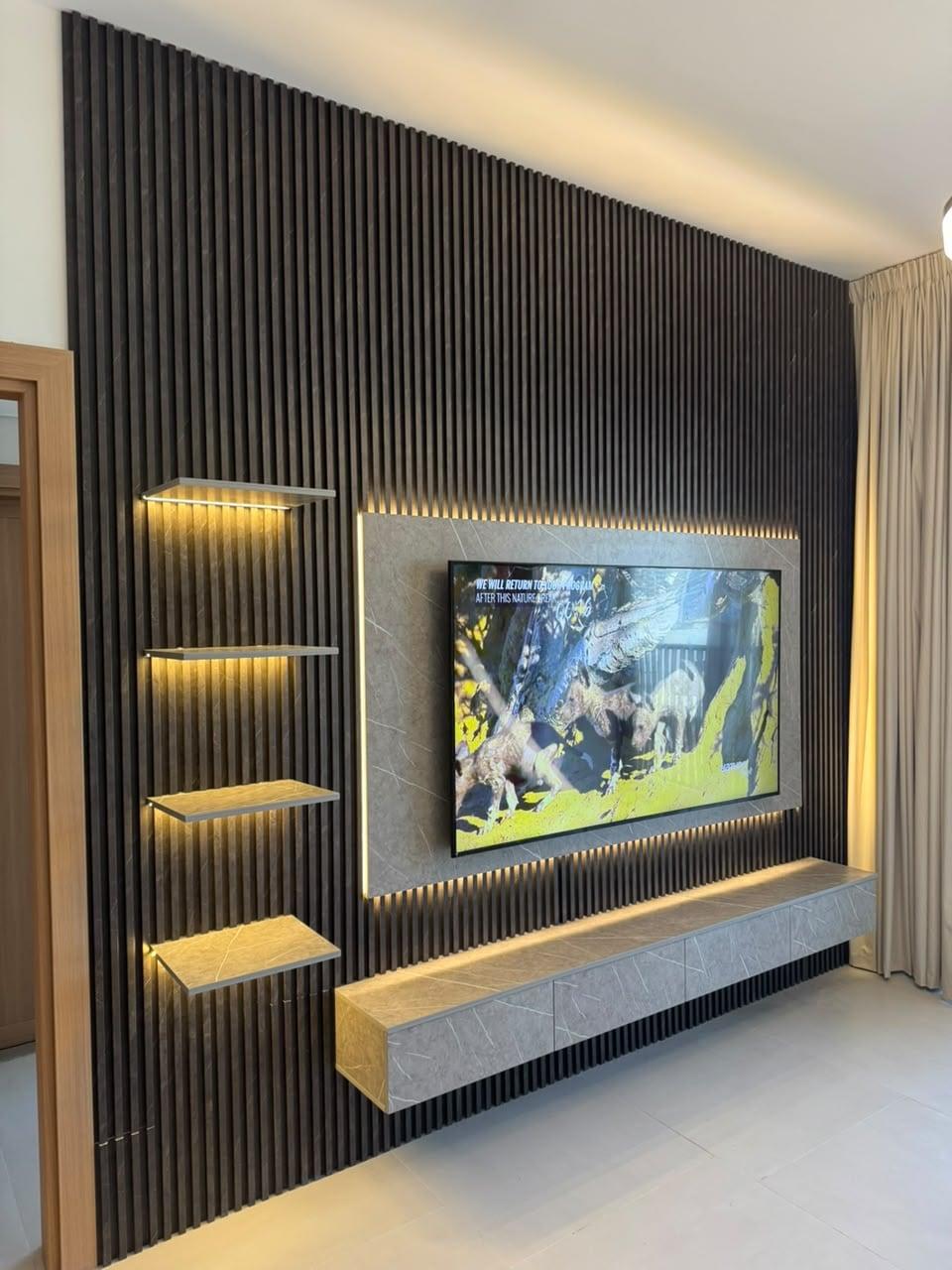
A useful split for a living room is: laminate at the hand and knock bands, lacquer or veneer on the feature panel behind and above the screen. That is the pattern in most of the walls we build, and the guide to living room TV walls shows several. It also keeps the price in check, since the premium finish covers a limited area.
Heat: screens, LED strips and electric fireplaces
A TV wall has more heat sources than most walls in a house. The TV itself warms the panel behind it. LED strips, drivers and dimmers produce some warmth. A set-top box or console in the cabinet below adds more. And if the wall carries an electric fireplace, the fireplace is a heater in its own right. Each finish handles that differently, and the board and ventilation do most of the work; our guide to TV ventilation in a media wall covers the air path and electric fireplaces in a media wall covers the heat.
For the finish itself, HPL's overlay layer is described as improving heat resistance, which suits the console top and the area next to the fireplace insert. Lacquer is a paint film, and how much heat the topcoat tolerates depends on the product; ask the supplier for the topcoat's specification, in writing, and keep it with your quotation. Veneer is sealed real wood, and a hot item left on it can leave a mark or lift the seal, so the console top is the wrong place for it.
None of this changes the wall's ventilation. A finish that tolerates heat does not make a closed cavity safe for electronics; the cavity still needs air. Treat the two as separate decisions: the finish for the surface, the vents for the equipment.
Moisture, edges and the board underneath
It is tempting to read a finish name as a promise about water. It is not. The Wikipedia article on MDF notes that it may warp or expand in humid environments if not sealed, and recommends coating all sides of a finished piece. That applies to the board under every one of our finishes: a laminate face does not protect an unsealed cut edge, a lacquer film does not protect an unsealed back, and a veneer face does not protect a cut-out for a socket.
In practice the weak points are the same on any surface: cut edges, the joints between panels, holes cut for sockets and cables, and the bottom edge near the floor. A well-built wall seals or bands every edge, treats the inside of cut-outs, and keeps the bottom panel off damp tiles. For the reasoning, our guide to humidity and MDF in a media wall goes through the places where moisture reaches boards in UAE homes, from air conditioning to mopped floors. For coastal homes where the air itself is salty and humid, the beachfront plywood guide explains why we ask about the board class.
The takeaway is simple. Choose the finish for looks and wear. Then ask separately: what is the board, how are its edges treated, and is the back sealed. If the quotation answers only the first question, ask again.
Light and colour change over the years
All three finishes look different in the room than in a showroom, and our finish sample guide explains why a sample should be approved in the room, in daylight and at night. Over the years, strong sunlight can shift colours, and the shift depends on the pigment or the wood, not on the type of finish. A printed laminate decor, a sprayed colour and a wood leaf each respond differently to a bright window.
Veneer is the one most often discussed, because real wood tone changes with time and light, usually slowly. That is part of its character, and some households like it. If you want a wall that looks identical in five years, a laminate or a lacquer in a neutral colour is the safer path. If you want a wall that develops a patina, veneer is the honest choice.
If the wall is opposite a large window, put the sample in that window for a few days. Look at it at noon, at sunset and at night under the wall's own LED. It costs nothing and answers more than any description.
When something goes wrong: three repair paths
The finish you pick today also picks the repair you will face later, and that is worth deciding now. The drawing shows the three routes. With HPL, a chip or a deep scratch means replacing the panel, because a laminate sheet is a single pressed surface. That is easy if the decor is still made and the batch is close; ask the quotation to record the decor code and whether a spare panel can be supplied with the order.
With lacquer, a mark or chip is repaired by respraying, usually the whole panel, because spot repairs of a flat colour tend to show. The result is a panel that looks new, with the same sheen across its surface. We tell customers that a sprayed finish may be refreshed in the workshop, which is one reason lacquer suits walls that people want to keep for a long time; ask at the visit whether the repair you need can be done on site or needs the panel to go back.
With veneer, a dull patch or a light scratch is sanded lightly and resealed or re-oiled in place, and the grain stays real. The repaired area may differ slightly in tone from the rest, which is a fact of real wood, not a defect in the work. This is the best repair story of the three, and the reason veneer ages gracefully when it is looked after.
- 1. HPL laminate: replace the panel; record the decor code and ask about a spare panel
- 2. Sprayed lacquer: re-spray the whole panel so the sheen stays even
- 3. Real-wood veneer: light sand, re-seal or re-oil; tone may differ slightly
Veneer needs a layout: grain, leaves and sequence
A veneer wall is made of leaves cut from a log, and the way they are laid out decides whether the wall looks calm or restless. If the leaves are taken in the order they were cut and laid side by side, the grain flows across the joints, and the wall reads as one piece of wood. If leaves from different logs or different places are mixed, the joints jump, and each panel looks like a separate board. The drawing shows the difference on one wall.
Ask the quotation which layout it assumes, and ask whether the grain runs vertically or horizontally. Vertical grain makes a wall look taller; horizontal grain makes it look wider. For a TV wall with doors and drawers, ask whether the grain continues across the door and the fixed panel beside it, because a continuous line across a door gap is a mark of careful work.
Lacquer has no grain, so for lacquer the match is in colour and sheen between parts. A small door sprayed in a different batch from a large panel can look slightly different in raking light. Spraying the pieces of one wall together in one session is the answer, and it is a question worth putting to any workshop that quotes a sprayed wall. HPL decor codes match by printing, but ask whether the pattern repeat is aligned across adjacent panels if the decor has a strong grain or veining.
- 1. Sequence matched: leaves laid in the order they were cut, so the grain flows
- 2. Mixed at random: leaves from anywhere, so the grain jumps at each joint
- 3. For lacquer the match is colour and sheen, not grain
Matt, satin or gloss: sheen changes how every finish behaves
Sheen is the quiet variable in every finish decision, and it changes behaviour more than most people expect. A gloss surface reflects the room: the window, the ceiling lights, the TV screen itself when it is switched off. On a TV wall that reflection competes with the picture, and a glossy wall beside a dark screen doubles every lamp in the room. A matt surface absorbs the light and lets the screen be the brightest thing on the wall. Satin sits between, and for a TV wall it is often the right compromise.
Sheen also decides which marks show. Fingerprints, dust and wipe streaks stand out on gloss and nearly vanish on matt. That is why the sheen of a console top is a practical decision, not a stylistic one. Our colour guide already explains why matt tends to be easier to live with in busy rooms; the point here is that the same rule applies to all three finishes, so compare them in the same sheen, not matt laminate against gloss lacquer.
Every finish can be had in more than one sheen, but not at the same price or with the same repair story. A gloss lacquer is the hardest to repair invisibly, because any patch shows in reflection. A matt laminate is the simplest to replace, because a new panel in the same decor and sheen looks like its neighbours. Ask for the sheen of every surface in writing, and approve it on a sample board under the lights the wall will actually have.
HPL's weak spot is the edge
The face of a laminate panel is tough; the edge is where the work is. A laminate sheet is glued to a board, so every cut edge shows the board unless it is covered. The usual cover is an edge strip, a narrow band of matching material that is glued and trimmed to the panel. Done well, the edge is almost invisible; done badly, it shows a line, a gap or a corner that catches on clothing.
Ask which edges are banded and what the band is made of, because the quotation may name it or may not. Look at the corner of the sample: is it square or slightly rounded, and does the band wrap the whole edge or stop short? The corners of console fronts and shelves are the parts that people touch and bump, so they are where edge quality is judged. Our colour and finish guide covers matching the colour of the edge to the face, and the humidity guide explains why a sealed edge matters for the board beneath.
A second weak spot is the join between two laminate panels. Because the pattern is printed, a wall of laminate looks seamless only if the panels are arranged so that the pattern repeats sensibly across the joints. For a plain colour there is nothing to match. For a stone or wood decor, ask whether the drawing places the joints where they will be least visible, for example behind the TV or at an architectural break.
Lacquer: coats, curing and why a rushed job shows
Sprayed lacquer looks simple because the result is smooth. The work behind it is a sequence: filling and sanding the board face, priming, spraying the colour in coats, letting each coat dry, and sealing with a topcoat. A shortcut at any stage shows later as a dull patch, an orange-peel texture, a run, or a coating that marks too easily. You cannot judge that from a finished photograph, only from a finished sample and from a workshop that is willing to explain its routine.
Questions that tell you a lot are simple. How many coats does the finish have? How are the pieces of one wall sprayed: together, so that colour and sheen match, or in separate sessions? How long is the finish left to cure before the pieces are handled and fitted? What is the topcoat, and does it have a written specification? A workshop that can answer these without hesitation is usually a workshop that does the work properly. Our guide on choosing a media wall contractor includes the wider set of questions to ask.
Lacquer is the finish for exact colour. If you have a colour code from a paint chart, a sofa fabric or a ceiling cove, a sprayed finish can follow it, and a printed laminate generally cannot. That is the strongest reason to choose lacquer, and the reason many designers specify it for a feature wall that must match another surface in the room.
Living with veneer: the care that keeps it looking right
Veneer rewards a few habits and punishes their absence. Wipe it with a soft, slightly damp cloth, then dry it; do not let water sit on it, particularly at the joints and edges. Do not put hot cups, plates or electronics directly on a veneer top, because the sealed surface can mark or lift, as noted above. Use a coaster, a tray or a runner where the surface is used as a shelf. Keep strong cleaning products away from it unless the supplier's care sheet says they are safe.
Sunlight is the other habit. Real wood tone changes slowly with light, and a console that stays in a strong sunbeam will change faster on that side. Curtains or blinds that soften direct sun help; our curtains and blinds service can plan them with the wall if the window is large. Rotating the objects on a shelf now and then prevents a pale outline appearing where a vase has stood for years.
Finally, treat re-oiling or resealing as a maintenance task, not a repair. If the surface looks dry or dull after a few years, a light renewal brings it back, and that is far cheaper than replacing a panel. Ask the quotation or the handover pack which product was used to seal the wall, because the same product should be used to renew it.
Mixing finishes on one wall
Most good walls use two or three finishes, and the junctions are where the work shows. A veneer shelf meeting a lacquer panel needs the two to agree on sheen as well as colour, because a satin wood beside a gloss paint looks mismatched even when the hues are close. A laminate console under a veneer panel needs a clean break line, with a shadow gap or a metal trim, rather than two surfaces glued face to face.
Our guide to the colour and finish junctions explains how to read a joint detail. Here the practical advice is to ask for the sheen of every finish in writing (matt, satin or gloss), because words like 'natural' and 'soft' mean different things to different suppliers. Then compare the sample boards side by side, not one at a time.
If the wall includes a stone-effect panel, the porcelain, sintered and marble-look guides describe how the large slab meets the other finishes; see porcelain and sintered-stone TV walls for the slab-specific points and marble TV walls for marble. The junction between a stone panel and a wood one is where thickness differences show, so ask the drawing to show it in section.
What the price does, in direction only
We do not publish per-metre prices for finishes, because the figure depends on the board, the wall size and the drawing, and a single number would mislead. The direction is simple. Standard laminate is the entry specification, and media walls start from AED 3,500 per project on that basis. Veneer and lacquer raise the figure, because veneer is a more labour-intensive surface and lacquer is sprayed in several steps; the quotation states by how much for your wall.
The cheapest way to get a premium look is to limit the premium finish to the area that carries the eye. A veneer feature panel behind the screen with laminate everywhere else is far kinder to the budget than a veneer wall from end to end, and it is easier to repair. Our guide to what a media wall costs shows how the lines add up, and the pricing tool explains how we build a quotation.
Whatever you choose, ask the quotation to name the finish line by line: the decor code or the lacquer colour code and sheen, or the veneer species and cut, plus the board and the edges. If two quotations differ, the difference is usually in those lines.
Which finish for which wall and household
Nobody lives in an average home, so the table sets the three finishes against common households and rooms. It is a starting point for a conversation, not a rule, and the best walls often mix two columns.
Finish by household and room
Family with young children
- Our first choice
- HPL laminate on the lower panels and console
- Why
- Daily scratches and wipes
- Watch for
- Sealed edges, a spare panel
Formal living room, few knocks
- Our first choice
- Lacquer or veneer on the feature panel
- Why
- Colour or grain, a wall to look at
- Watch for
- Sheen agreed in writing
Rented flat
- Our first choice
- HPL laminate
- Why
- Hard to damage, easy to wipe
- Watch for
- Landlord's permission in writing
Villa lounge or majlis
- Our first choice
- Veneer on large feature panels
- Why
- Real grain at scale, repairable
- Watch for
- Sequence-matched layout
Bedroom TV wall
- Our first choice
- Laminate or lacquer
- Why
- Quiet colour, little handling
- Watch for
- Sunlight on the sample
Home office
- Our first choice
- HPL laminate
- Why
- Constant use, desk, chairs
- Watch for
- Edge strips at desk height
Guest suite or short-stay unit
- Our first choice
- HPL laminate
- Why
- Strangers' hands and trolleys
- Watch for
- Finish code on file, see the suite guide
Our workshop guidance, not a test result. Every finish should be approved on a sample in the room.
Five checks on a sample, before you approve
You do not need a laboratory to learn a lot from a sample board. Ask us for a board at the free measuring visit, and then run these five checks over a week. The drawing lists them in order.
Scratch it lightly with a fingernail in a spot nobody will see: does it mark? Wipe it with a damp cloth: does the look change, does the sheen go patchy? Put it on a window ledge for several days: does the colour move? Turn it on edge and look at the banded or sealed edge: is it clean, does it show a line? And finally, look at it at night under the same warm LED that the wall will have, because that is when most TV walls are actually used.
Write down what you see. If two samples seem close, the five checks will separate them in a way no catalogue can. The full process of approving a sample, including what to record and what to sign, is in our sample approval guide.
- 1. Scratch it lightly with a fingernail in a hidden spot
- 2. Wipe it with a damp cloth and look for changes in sheen
- 3. Leave it in the window for several days and watch the colour
- 4. Turn it on edge and inspect the banded or sealed edge
- 5. Look at it at night under the wall's warm LED
Mistakes that spoil a good finish
Most finish regrets are not about the finish; they come from the decision around it.
- Choosing from a photograph or a phone screen instead of a physical sample in the room.
- Using a delicate surface on the console top, where cups and bags land.
- Asking for 'wood look' and not saying whether it is laminate or veneer.
- Leaving the sheen unspecified, so matt, satin and gloss are decided by the workshop.
- Forgetting that the board edges and cut-outs need sealing under every finish.
- Assuming a laminate can be spot-repaired; it is replaced as a panel.
- Mixing finishes with no drawing of the junction between them.
- Placing a hot object on a veneer or lacquer top because the sample 'felt hard'.
Choosing with us, and the WhatsApp message to send
We build media walls in laminate, veneer and lacquer in our Sharjah workshop and fit them with our own team. At the free measuring visit we bring sample boards so you can see the finishes in your own room, and the drawing and the itemised price are approved before production. After measurements and details are agreed, a 60% advance is paid and production starts once it is received; the remaining stage is agreed with you. A wall is finished in up to about 10 days, depending on size and design. The 5-year limited warranty covers the wood-based boards only, not hinges, runners, labour or misuse; our 24-month workmanship warranty is a separate line. We have been in the trade for ten years under founder Ali Haider Basra.
To start, send us a WhatsApp message with a photo of the wall, the TV size, the room and the finish you are leaning toward, plus a photo of the window that faces the wall if there is one. Our guide to what to send for a media wall consultation lists the photos that help most. If you want to see how a measuring visit goes first, read the measuring visit guide, and for the whole range of work visit our media walls page.
Common questions
Which is more durable, HPL or lacquer?
HPL's overlay layer is made for abrasion, scratch and heat resistance, so it is the calmer choice for daily knocks; lacquer rewards care but can be re-sprayed. Media wall colours and finishes.
Can a scratched laminate panel be repaired?
Not by patching: a laminate sheet is a single pressed surface, so the panel is replaced, which is why we record the decor code. The finish sample approval guide.
Does veneer suit a UAE apartment with air conditioning?
Yes, when the face and every edge are sealed, because the board underneath reacts to moisture whatever the face is. Humidity and MDF in a media wall.
Is a lacquered TV wall easy to repair?
Usually by re-spraying the whole panel so the sheen stays even; ask whether the repair is done on site or in the workshop. What a media wall costs.
Which finish for a rented flat?
HPL laminate is hard to damage and easy to wipe, and any fixing should be agreed with your landlord in writing. Media wall materials and what to specify.
Can I mix veneer and laminate on one wall?
Yes, and it is the usual way to get a premium look at a sensible price: veneer on the feature panel, laminate at hand height. Living room TV walls.
What should I send on WhatsApp to choose a finish?
A photo of the wall, the TV size, the room and the finish you like, plus a photo of the window facing the wall. What to send for a consultation.

Sources & specifications
Manufacturer information applies to the named products and systems. Sources reviewed on 10 November 2026.
- Wikipedia: Decorative laminate (HPL layers; overlay improves abrasion, scratch and heat resistance; used on furniture tops and cabinets)en.wikipedia.org(opens in a new tab)
- Wikipedia: Wood veneer (thin slice glued to a core panel; cut as thin as 0.64 mm; also used in HPL)en.wikipedia.org(opens in a new tab)
- Wikipedia: Medium-density fibreboard (takes paint well; may warp or expand in humid environments if not sealed; coat all sides)en.wikipedia.org(opens in a new tab)
Want this planned for your home?
Consultation and measurement are free. Tell us the rooms, location and what you need; we arrange a sample visit and define the measured quotation.