Media Walls · 20 min read · 2 September 2026
How to choose a media wall contractor in the UAE: seven checks
Choose the media wall maker whose answers you can check on paper: someone who measures your wall, a drawing you approve, and an itemised price. Seven checks, each with a good sign and a warning sign.

By Ali Haider Basra, Founder, Al Tareeq Decor · Contact our workshop
Key takeaways
- Choose the maker whose answers you can check on paper: an in-person measurement, a drawing, an itemised price.
- A custom wall is cut to your wall after you agree, so you can only judge the process and the paperwork in advance.
- Ask who makes it, who fits it and who mounts the TV, and ask for payment stages and exclusions in writing.
- A warranty described only in years tells you little; ask what it excludes. Ours covers the wood-based boards only.
- Look for photographs of built walls and physical samples, not renderings.
On this page
- Key takeaways
- The short answer
- Why a media wall is harder to judge than a ready-made unit
- Ask the same five questions, and listen for the kind of answer
- Check 1: has anyone measured your wall in person?
- Check 2: a drawing before anything is cut
- Check 3: a quotation that names things
- What a media wall quotation should name
- Check 4: who actually makes it and fits it
- Check 5: how approval and payment are written down
- Check 6: what the warranty covers, in plain words
- Check 7: real work and real samples
- A worked example: three makers, one wall, three kinds of reply
- Comparing two quotations for the same wall
- Two quotations for one wall: what to compare
- What a sensible timeline looks like
- Mistakes buyers make when choosing a maker
- Warning signs in the way a maker talks
- A handover checklist for the day the wall is finished
- If something is not right
- Seven checks on one page
- Seven checks: ask, good sign, warning sign
- What we do about it
- Send us the wall on WhatsApp
- Common questions
The short answer
Choose the maker whose answers you can check on paper. Before you pay anything, someone should have measured your wall in person, you should hold a drawing of what will be built, and the price should be itemised so you can see what is on the wall and what is not. A confident voice on the phone, a long gallery and a low number do not replace any of those three.
This guide gives you seven checks you can run yourself, in the order they come up: the measuring visit, the drawing, the quotation, who actually does the work, how payment and approval are written down, what the warranty covers, and what real work you can see. Each check has a good sign and a warning sign, and each can be done by message before you commit to anything.
Why a media wall is harder to judge than a ready-made unit
A ready-made TV unit can be inspected before you buy it. A custom media wall cannot: it is cut to your wall after you agree, and by the time you see it, the money is spent. So the only things you can judge in advance are the process and the paper, which is why this guide is about those rather than about taste.
There is also a lot you will never see. The conduit for the cables, the access panel, the fixings behind the panel and the place where the LED driver sits all disappear into the finished wall, and they decide whether you can service it in five years. A maker who talks about these on the first visit is thinking about the whole life of the wall; one who talks only about finishes is selling the photograph. Our guide to cable routes you can still service shows what to ask about. Still weighing a bespoke wall against a shelf and a stand? What a media wall is and custom versus compact walls set out the difference first.
Ask the same five questions, and listen for the kind of answer
You can learn most of what you need from five plain questions, put in writing so the answers stay in front of you. The drawing below sets the vague answers that sound reassuring next to the ones that can be checked. The vague lines are examples of how a sales answer sounds, not quotes from any company.
The pattern is simple: a checkable answer names a document, a person or a step. "A drawing and an itemised price" can be held up against the finished wall. "All included" cannot. If a reply to any of the five questions is vague, ask once more in writing and see whether it gets clearer or only more friendly.
- 1. Who fits it: a named team that makes, fits and mounts the TV, not an unnamed someone
- 2. What is on the price: an itemised price tied to a drawing, not one all-included figure
- 3. When work starts: after the drawing is approved and the advance is paid, not on the day you say yes
- 4. What the warranty covers: stated in terms of what it excludes, not in years alone
- 5. Has anyone measured: a visit with samples and a laser measure, not a size read down the phone
Check 1: has anyone measured your wall in person?
A media wall is built to the millimetre around one wall, and walls are rarely square. A figure given from a photograph or a size you read out is a guess, and the person guessing is usually the one who will absorb the error, so a careful maker wants to see the wall. Ours is a free visit: the team brings samples of the finishes and laser-measures the wall the design has to fit. Read what happens at a measuring visit for what is taken and why.
Warning signs are a firm price before anyone has seen the wall, a visit that is charged for and then lost in the order, and a visit that records only the width. A good sign is questions: what is the wall made of, where do the sockets sit, what is above it, where do you watch from. Send photos beforehand to make the visit shorter; what to send before the consultation lists them.
Check 2: a drawing before anything is cut
The drawing is where a maker's thinking becomes visible. It should show the wall as measured, the TV at a height and size you have discussed, the console, the panels, the lighting and the routes behind. A sketch with no dimensions does not count, and neither does a photograph from another project. You should approve it, and nothing should be cut until you have.
Use it to test the decisions that are hardest to change afterwards. Is the screen height right for where you sit? Is there room for a larger TV later? Where do the cables enter and leave? The guides on TV height and how big a TV the wall can take give you numbers to compare with, and changing the TV later shows what margin to look for. A maker who resists drawing, or who draws only after the deposit, has told you something. If you have not yet decided what the wall must do, planning a media wall is the place to start before you ask anyone to draw it.
Check 3: a quotation that names things
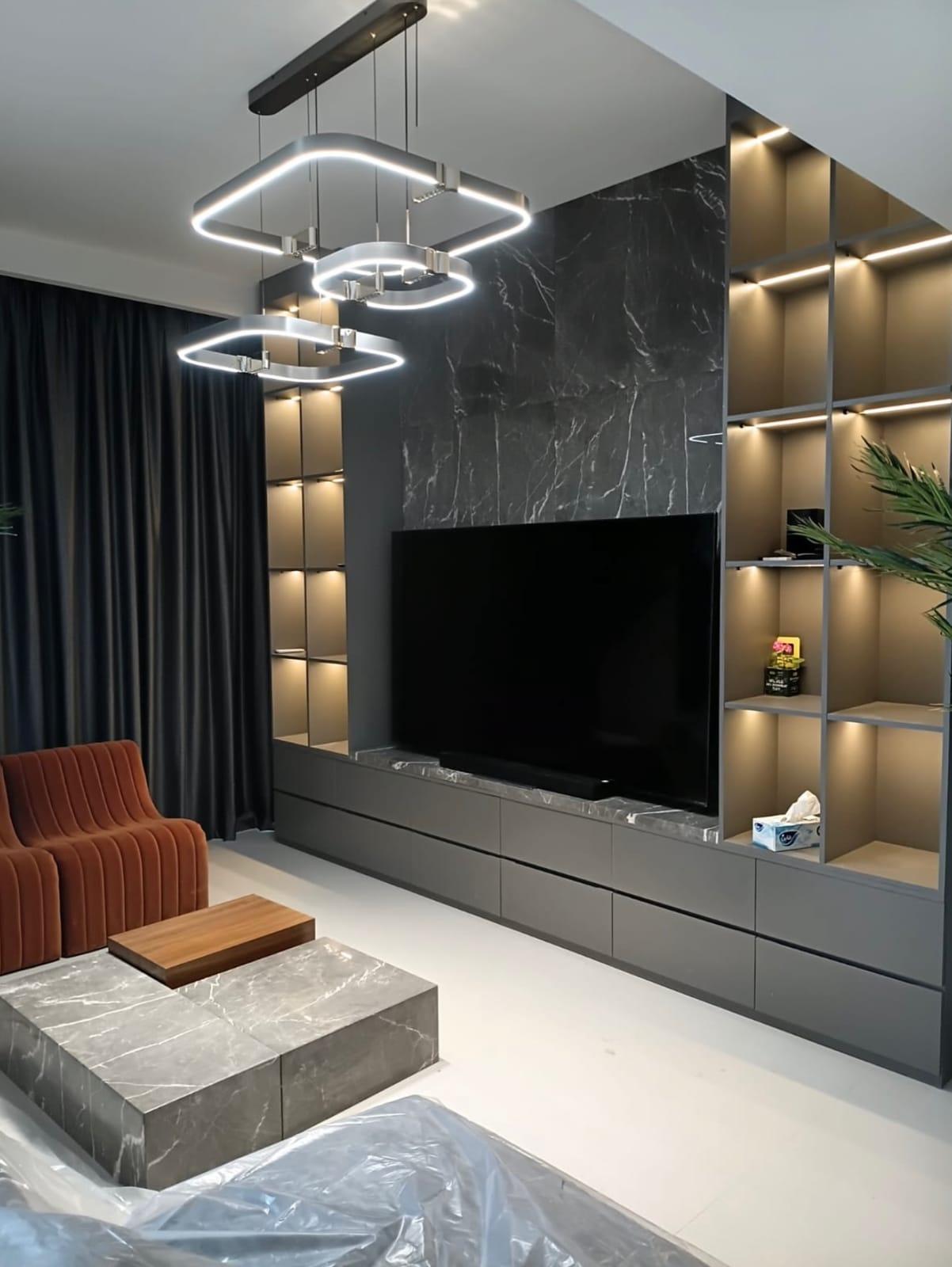
An itemised price is what lets you compare two makers honestly, and it is the check most buyers skip. The test is simple: can you point to each thing on the wall and find it on the quotation? A single total tells you nothing about what is in it, and a maker who cannot break the total down may not have counted the parts.
The UAE government portal, u.ae, lists what a supplier's dated invoice must carry: the trade name and address, the type of goods or service, its price and quantity, in Arabic (other languages may be added). A quotation is not an invoice, but it is the same document one step earlier, so a quote that cannot name the goods and the price line by line will not suddenly be able to later. That is our reading, not a rule from u.ae.
A related UK source, Citizens Advice, tells home owners to get written quotes from at least three contractors and compare them to decide if the price is fair. It is British advice, but the point travels: compare like with like, wall for wall. How the pieces add up is in what a media wall costs, and what the parts are made of explains the materials you will see named. The same logic applies to other joinery: the wardrobe quotation checklist shows it on a different job.
What a media wall quotation should name
Wall size and the drawing it refers to
- Why it matters
- The price follows the measured wall
- What to ask
- Which drawing is this price for?
Finish: laminate, veneer or lacquer
- Why it matters
- The finish changes the price and the care
- What to ask
- Which finish, and is a sample approved?
Panels: slats, porcelain or marble-effect
- Why it matters
- Feature panels are priced apart from the base
- What to ask
- Which panels, on which part of the wall?
Lighting
- Why it matters
- Channels, dimmers and the driver are separate items
- What to ask
- Where is the driver, and can I reach it?
Electric fireplace, if wanted
- Why it matters
- A built-in fire adds cost and needs its own socket
- What to ask
- Is it named, and is its power planned?
Sockets and electrical work
- Why it matters
- Moving or adding a socket is a line of its own
- What to ask
- Who does it, and is it on the quotation?
TV mounting and cables
- Why it matters
- Mounting is part of the job, not an extra visit
- What to ask
- Is mounting included, and who does it?
A guide to reading the lines, not a price list. Media walls start from AED 3,500 per project for a compact panel and floating console in standard laminate; the final figure comes from the quotation.
Check 4: who actually makes it and fits it
Ask who cuts the panels, who fits them, who mounts the TV and who does the electrical work, and ask whether any step is handed to someone else. There is nothing wrong with specialist trades, but you want to know in advance, because the person who fits your wall is the one who meets its problems. When a wall is made in one workshop and fitted by the same team, the drawing and the finished job stay with one set of people.
In our case the wall is made in our Sharjah workshop and fitted by our own team, who also mount the TV; if a socket must move or the LED lighting needs wiring, our own team handles it and the electrical work appears as its own line on the quotation. Which sockets can stay and where the light layers go are the two questions that most often change that line. The founder, Ali Haider Basra, has worked in the trade for 10 years. Ask any other maker the same plain question, and a plain answer is what you want.
The wall also has to be understood before anything is fixed to it. One TV-mount maker, Mantel Mount, advises its customers to understand what the home is built from, because this is critical to know so you use the right type of anchor. What the wall is made of changes how a heavy screen and a floating console are held on it, which is one more reason to want someone to see the wall in person.
Check 5: how approval and payment are written down
Whatever the maker's terms, ask for them in writing before you say yes. Citizens Advice makes two points that apply anywhere: once you accept a quote it is a binding agreement whether or not it is written down, and a written contract should cover timings, tidying up, materials, equipment, subcontractors and payment. That is UK consumer advice, not UAE law, but a written version protects both sides in any country.
In our process, once the measurements and details are agreed, a 60% advance is paid and production starts when it is received; the remaining stage is agreed with you. Whoever you choose, ask what is paid when, what the first payment is for, and that you get a receipt for each payment, which is the other thing Citizens Advice says to insist on.
Check 6: what the warranty covers, in plain words
A warranty described only in years tells you little; one described by what it excludes tells you a lot. Ask for the written terms and read the exclusions first. Ours is a 5-year limited warranty on the wood-based boards only. Hinges, runners, labour and misuse are excluded, and it is never a warranty on the whole wall.
That is a narrow promise, and it is meant to be: boards are the part you cannot replace cheaply, and the moving parts and lighting are the parts that wear. If a maker offers more, ask for it in writing, and if the answer is a number of years with no list, assume it covers less than it sounds. The wardrobe equivalent is spelled out in our wardrobe warranty guide, which uses the same board-only logic.
Check 7: real work and real samples
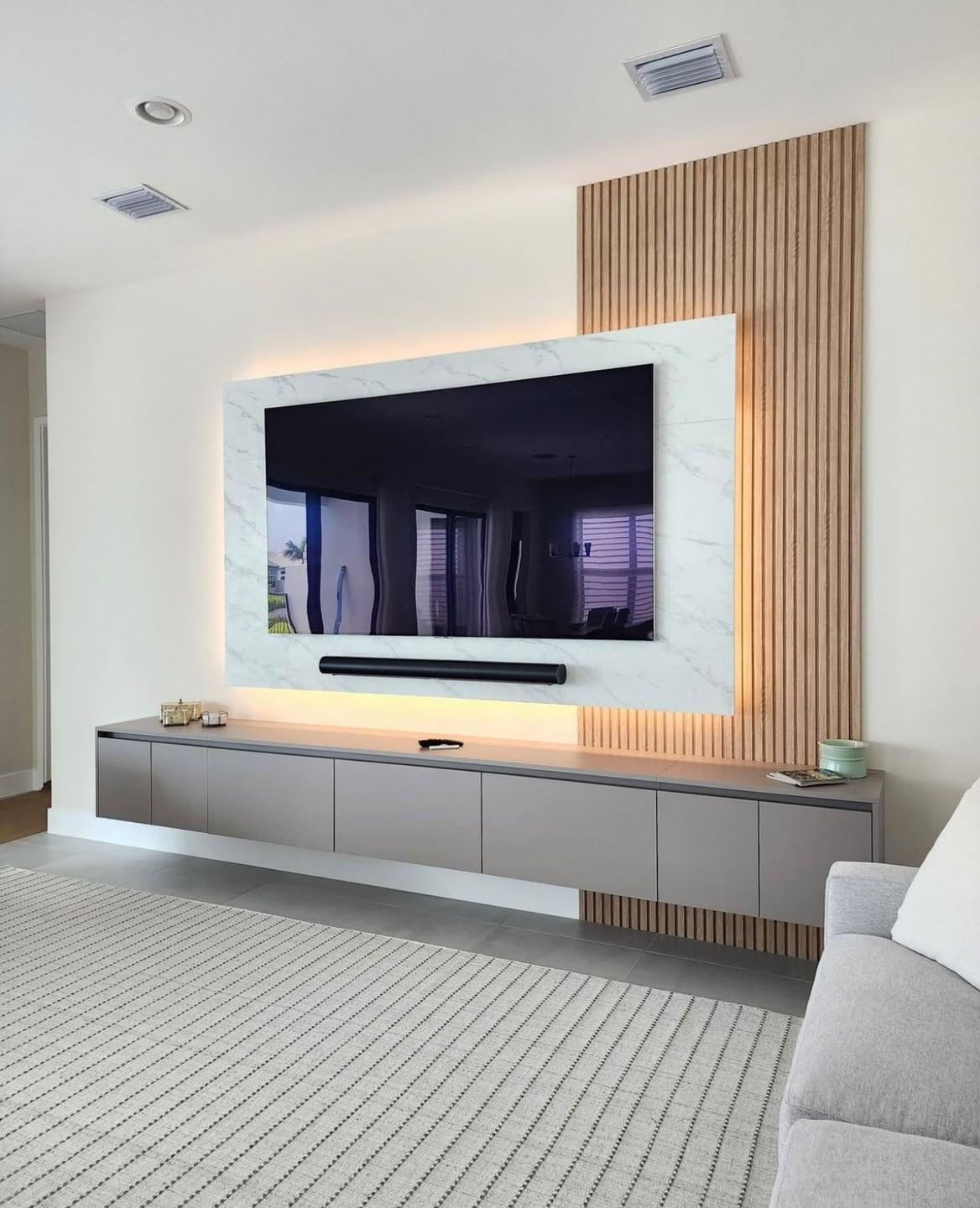
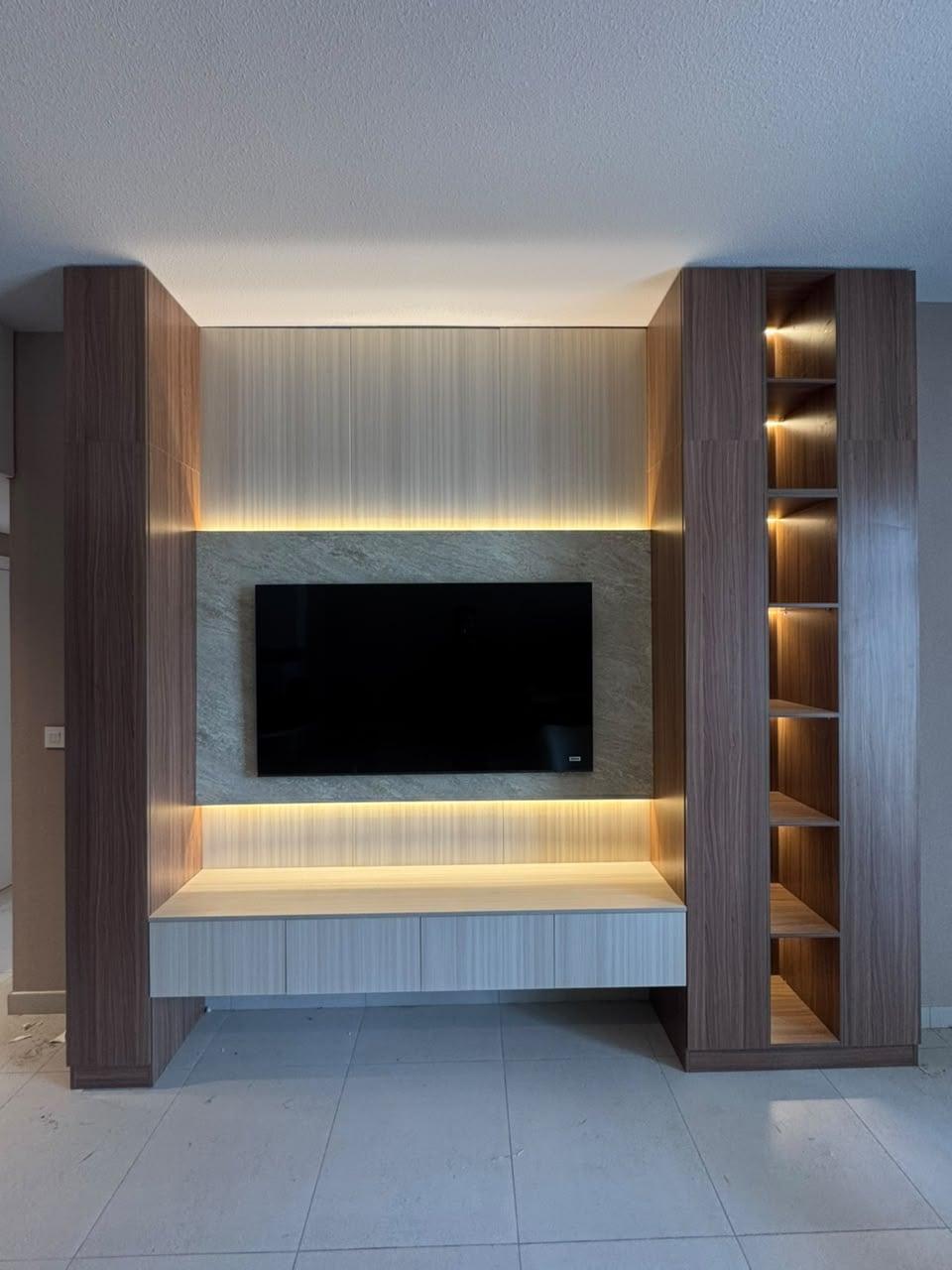
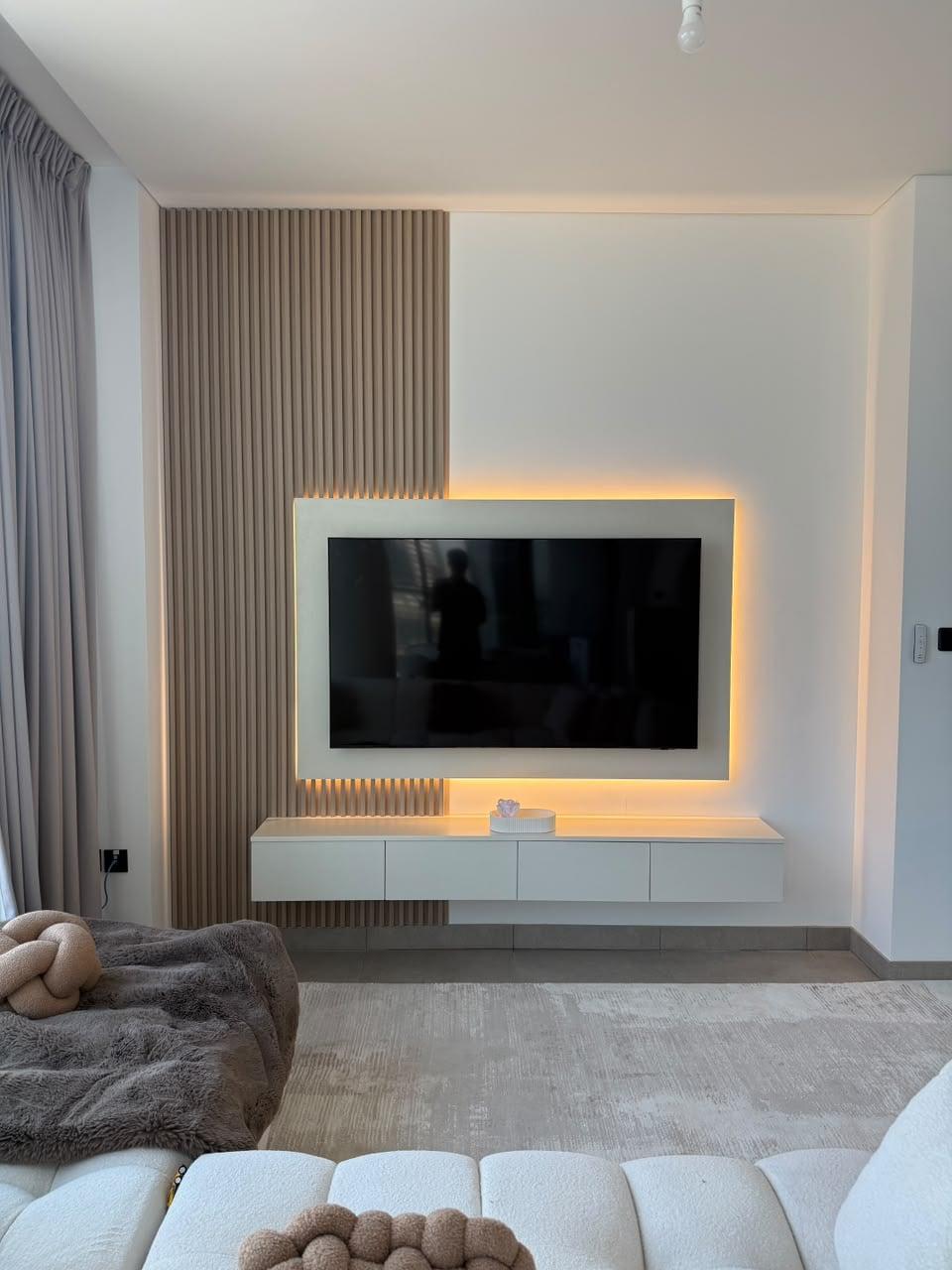
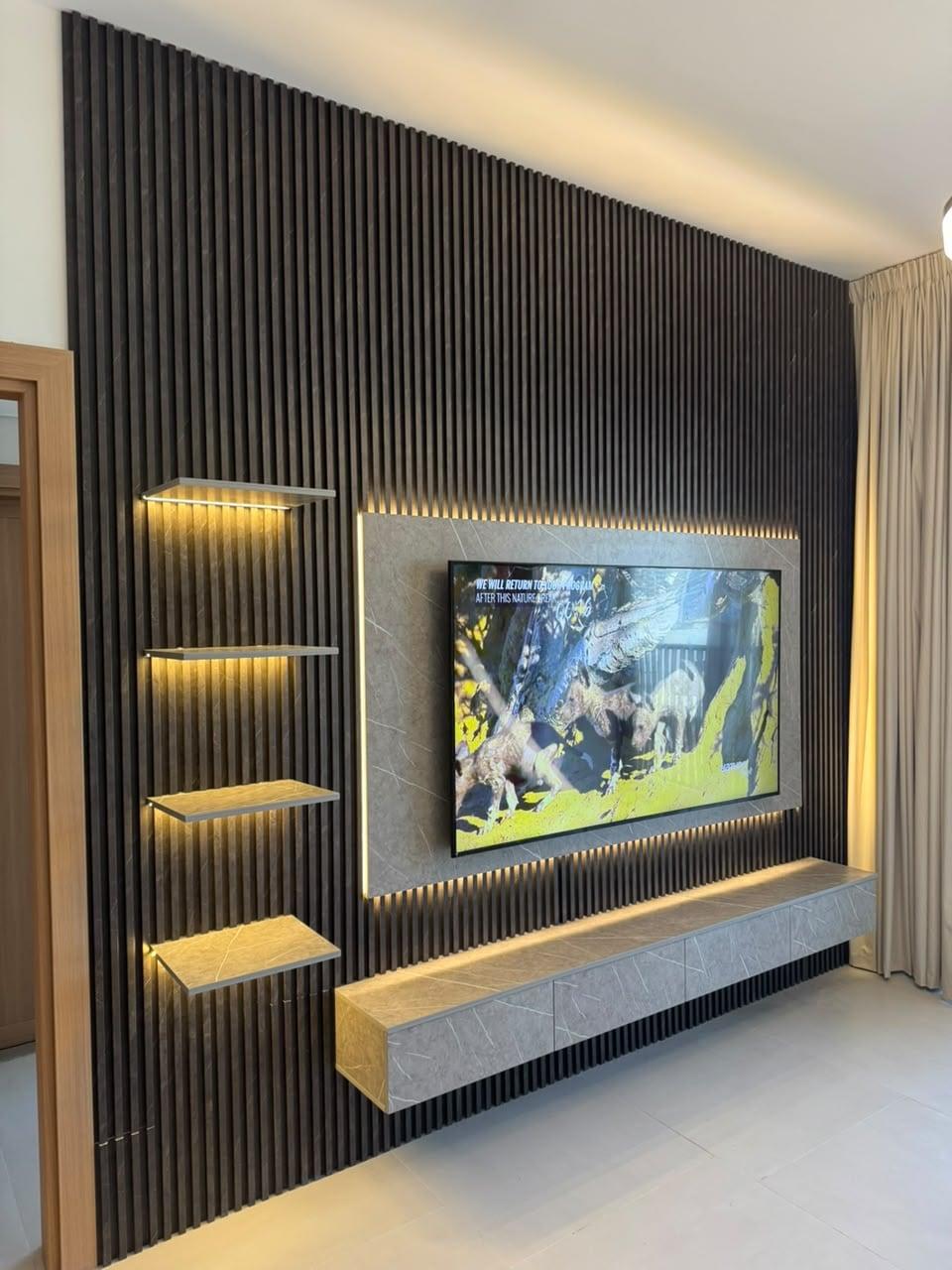
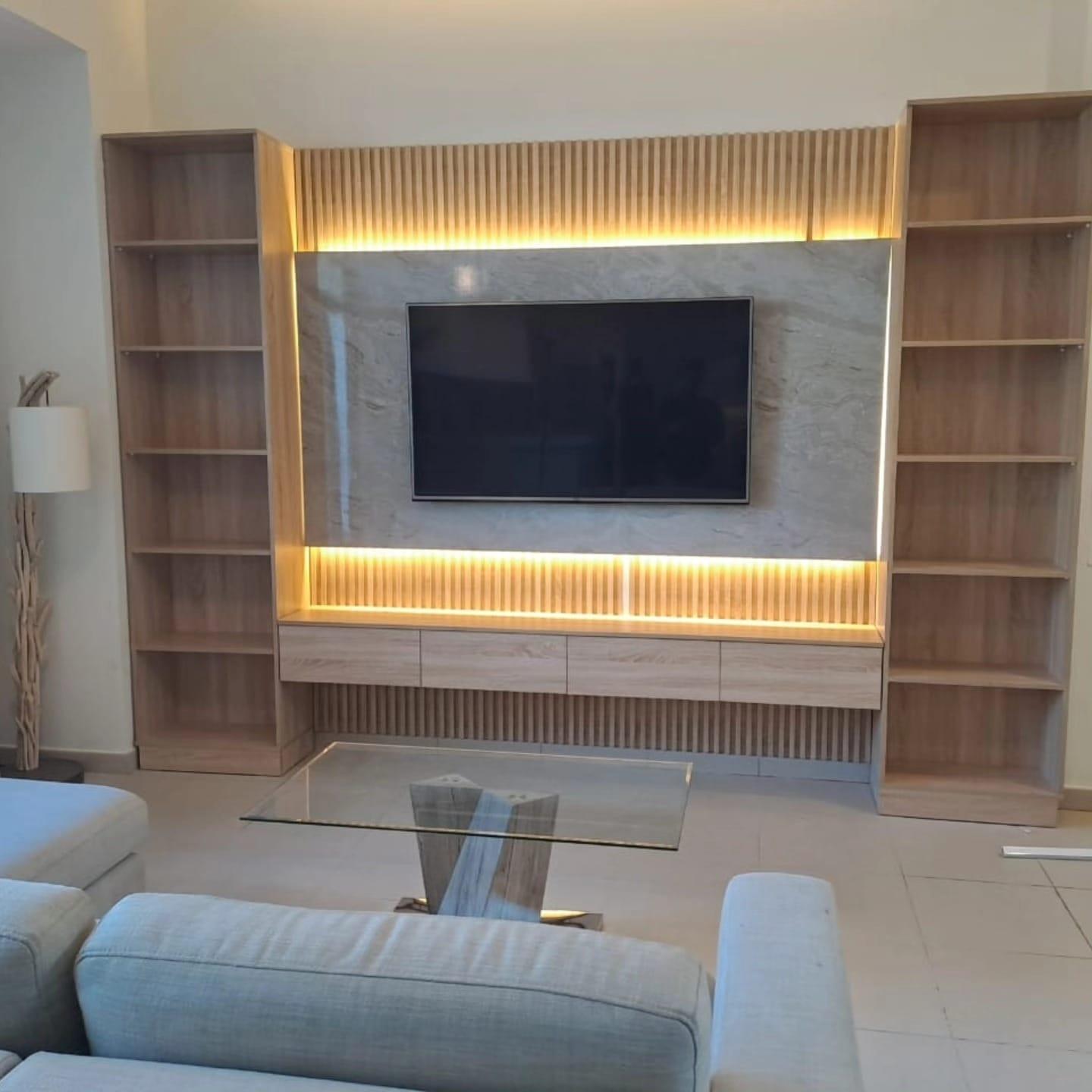
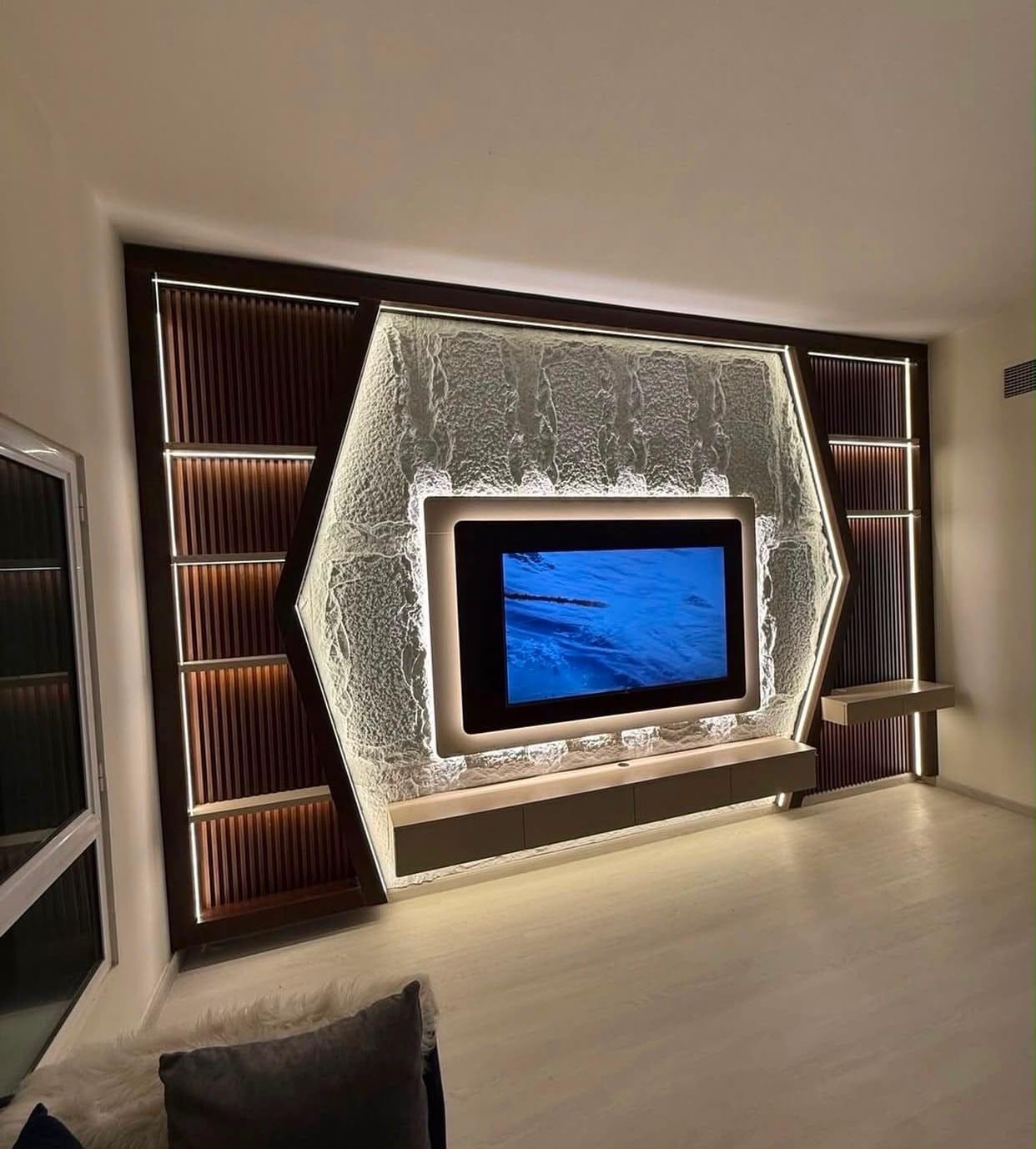
Ask to see finished walls, ideally in a finish like yours, photographed as built rather than rendered. A rendering shows what a designer hopes for; a photograph shows what a workshop delivered, including the join lines, the shadow gaps and how the lighting really looks. Our media wall design ideas and our guides to fluted slatted walls and marble-effect TV walls all use photographs of our own walls where we have them.
Samples matter more than photographs. A finish looks different in your own light, next to your own floor, and a printed picture cannot show the grain or the gloss. At our visit we bring physical samples for the finishes we make: acoustic fluted slats in oak, walnut and charcoal, and porcelain or Calacatta marble-effect panels. Hold them against the wall, in the light the room gets in the evening, before you choose. How the board types differ is in media wall panels compared.
A worked example: three makers, one wall, three kinds of reply
Imagine a living-room wall with a 65-inch TV, a floating console, one lit shelf column and a socket that sits right where the screen will hang. You message three makers with the same photo and the same two lines: the TV size and the wish for one shelf column. Everything below is an invented scenario, built to show how replies differ, not a report of any real company.
The first maker replies within minutes with a single figure and the words "all included, we start tomorrow". The second asks for a better photo, asks what the wall is made of, asks where you sit, and says a visit is needed before any price is firm. The third sends a catalogue, a discount that expires today and no questions at all. On price alone you cannot tell them apart yet. On the evidence of the replies you can: only the second has begun to measure, and only the second has noticed that the socket may have to move.
Notice what the second reply does not do. It does not promise a number, because a number from a photograph is a guess. It does not hurry you either. That slower start is the same trait that later shows up as a drawing with dimensions and a quotation that names the electrical work. Speed of reply is pleasant, but it is the least useful thing to judge. The kind of question a maker asks first tells you far more than how fast the answer arrives.
Comparing two quotations for the same wall
Suppose two quotations arrive for that same wall. One is a single line with one total. The other has seven lines: the wall and the drawing it refers to, the finish, the feature panels, the lighting, the electrical work, the TV mounting and the console. The single total may be lower, and that is exactly the trap: you cannot see what it leaves out. The table below shows the questions to put to each line so the two can be compared fairly, and the figures are deliberately left out because the point is the structure, not a price.
Go line by line and mark anything that appears in one quotation and not in the other. A missing electrical line often means the socket will be dealt with later, as an extra. A missing lighting line may mean the driver and channels are not counted. A missing mounting line may mean the TV is left for you to arrange. None of these is wrong by itself; each is a cost that has not been counted yet, and it is far easier to learn that before you pay than after the panels are cut. Our media wall quotation checklist is written for exactly this side-by-side job.
Two quotations for one wall: what to compare
Is the drawing named?
- Single-total quotation
- Usually not
- Itemised quotation
- Yes, the price points to a drawing
- What to do
- Ask the first maker which drawing the price is for
Is the electrical work counted?
- Single-total quotation
- Unclear
- Itemised quotation
- A separate line
- What to do
- Ask whether moving a socket is included
Is lighting counted?
- Single-total quotation
- Unclear
- Itemised quotation
- Channels, dimmers and driver named
- What to do
- Ask where the driver sits and whether you can reach it
Is mounting counted?
- Single-total quotation
- Often assumed
- Itemised quotation
- A line or a stated inclusion
- What to do
- Ask who lifts and fixes the TV
What is excluded?
- Single-total quotation
- Rarely stated
- Itemised quotation
- Stated, or can be asked
- What to do
- Get the exclusions in writing
Can you drop an item?
- Single-total quotation
- No way to see
- Itemised quotation
- Yes, line by line
- What to do
- Decide what to keep before you approve
A way of comparing two quotations, not a price list. The scenario is invented for illustration.
What a sensible timeline looks like
A media wall is a short job once it starts, but the weeks before it matter more than the days of fitting. The order that protects you is the same whoever you choose: first a visit, then a drawing, then an itemised price, then your approval, then the first payment, then production. If any step is skipped or reversed, ask why. In particular, be wary of a start date offered before the wall has been measured, because the date can only be real once the drawing is.
Once production starts, our own typical wall is finished in up to about 10 days, depending on its size and design. That is a typical figure, not a promise for every wall: a large wall with marble-effect panels and an electric fireplace takes longer than a compact panel and floating console. Ask any maker for the timeline in writing, and ask what could change it. A date with no conditions attached deserves a second question. Planning a media wall lists the decisions to settle first, because most delays come from decisions made late rather than from the workshop.
A useful habit is to keep the whole conversation in one thread. When the drawing, the quotation, the approval and the payment confirmation all sit in the same message history, there is never a question later about what was agreed. That is one reason orders with us are confirmed on WhatsApp.
Mistakes buyers make when choosing a maker
The first mistake is choosing on the photograph of the finished wall rather than the process behind it. A striking image tells you what a workshop can do on its best day; it does not tell you whether the wall will be measured, drawn and itemised for you. The second is accepting a firm price before anyone has seen the wall. The third is paying a large sum before there is a drawing, which leaves you with nothing to hold the maker to.
The fourth is comparing totals instead of lines, which rewards the quotation that counted the least. The fifth is skipping the question of who fits the wall, then discovering that the people who made it are not the people who arrive. The sixth is hearing "warranty" and not asking what it excludes. The last is not writing anything down: a verbal promise made on a site visit is easy to remember differently six weeks later.
None of these needs special knowledge to avoid. Each is avoided by asking one plain question in writing and keeping the answer. If you are still deciding between a custom wall and something simpler, the comparison of custom and compact walls earlier in this guide sets out the trade-off so that you choose the type of job before you choose the maker.
Warning signs in the way a maker talks
Some warning signs are not on paper at all. Pressure to decide the same day is one: a good wall does not become dearer overnight, and a genuine offer survives a night's sleep. Reluctance to put anything in writing is another. A refusal to say who will do the work, or a vague answer such as "our people", is a third. A fourth is a price that is far lower than the others with no explanation of what has been left out.
Be equally alert to the opposite: a maker who piles on technical words without ever showing you a drawing. Complexity is not quality. What you are listening for is the ability to say what happens next, who does it and what it will look like, in terms you can write down. If a maker can explain the cable route, the access panel and the driver in plain words, they probably have thought about them. If not, ask again, and note whether the second answer is clearer.
A handover checklist for the day the wall is finished
The check does not end when the wall is up. On the day it is finished, spend ten minutes before you sign off anything. The points below are what to look at, and they apply whoever built the wall. If something is wrong, say so on the day, in writing, with a photograph, because that is when it is simplest to put right.
- Does the wall match the approved drawing: size, shelf positions, console height and finish?
- Switch on the lighting and test every dimmer or switch; look at the glow from where you sit, not only from close by.
- Open every drawer and door; they should move freely and close flush with their neighbours.
- Check the gaps and join lines against the ceiling, the floor and the side walls; they should be even and neat.
- Turn on the TV, the soundbar and every other device and make sure the cables reach and nothing runs hot in a closed space.
- Ask where the access panel and the LED driver are, and make sure you can reach them.
- Ask for the warranty terms in writing, and for a receipt for every payment made.
- Take photographs of the finished wall while it is clean, for your own records.
If something is not right
Even a careful job can have a flaw: a door that rubs, a light that flickers, a join that is not neat. The simplest route is to describe it in one message with a photograph, say what you expected from the drawing and ask for a date to put it right. Keeping to writing makes it easy for both sides to see what was asked and what was done.
It also helps to know what a warranty will and will not cover before you need it. Ours is a limited warranty on the wood-based boards only, so hinges, runners, labour and misuse sit outside it. Knowing that in advance prevents disappointment: a loose hinge is a service matter, not a board failure. Ask any maker to explain the same line between what is covered and what is not, using one example from your own wall.
Seven checks on one page
Keep this table beside the messages you exchange. If a maker passes four or five of these by message alone, you have enough to arrange the visit. If they dodge more than two, ask again in writing and see whether the answers improve.
Seven checks: ask, good sign, warning sign
1 Measuring
- What to ask
- Will someone measure my wall in person?
- Good sign
- A free visit with samples and a laser measure
- Warning sign
- A firm price from a photo or a phone call
2 Drawing
- What to ask
- Will I get a drawing to approve?
- Good sign
- A dimensioned drawing before anything is cut
- Warning sign
- A sketch with no sizes, or a drawing only after the deposit
3 Quotation
- What to ask
- Is the price itemised?
- Good sign
- Wall, finish, panels, lighting and electrical named
- Warning sign
- One total with "all included"
4 Who works
- What to ask
- Who makes it, fits it and mounts the TV?
- Good sign
- A named team and a named workshop
- Warning sign
- "We will send someone"
5 Payment
- What to ask
- What is paid when, and is it written?
- Good sign
- Stages in writing and a receipt for each payment
- Warning sign
- Payment in full, or no receipt
6 Warranty
- What to ask
- What does it exclude?
- Good sign
- Written exclusions and the part covered named
- Warning sign
- "Everything, for years"
7 Real work
- What to ask
- Can I see finished walls and samples?
- Good sign
- Photographs of built walls and physical samples
- Warning sign
- Only renderings or stock pictures
What we do about it
We make custom media walls in our Sharjah workshop and install them across the UAE. The sequence is the one above: a free visit with samples and a laser measure, a drawing and an itemised price, your approval, then the 60% advance, then production. A typical wall is finished in up to about 10 days, depending on its size and design. Walls start from AED 3,500 per project for a compact panel and floating console in standard laminate; the final figure comes from the quotation and depends on the wall size, the finish, any marble-effect panels, the lighting and any electric fireplace.
You can look at the options on our media walls page, at custom media walls and at TV wall units and floating consoles, and read about media walls in Sharjah. The pricing guide gives a starting figure for planning. If you already have a quotation from another maker, our media wall quotation checklist is a quick way to check it against ours.
Send us the wall on WhatsApp
The simplest next step is a message. Send a photo of the wall, taken straight on from the middle of the room, the TV size you have or plan to buy, and a photo of the room, and we will tell you what a visit would look at. Orders are confirmed on WhatsApp, so you can keep the whole thread, the drawing and the quotation in one place. A checklist of what to include is in what to send before a consultation.
Common questions
How do I choose a good media wall contractor?
Pick the one who measures your wall in person, gives you a drawing to approve and an itemised price, and says in writing who makes it, who fits it and what the warranty excludes. Photographs and samples come after those. Our guide to what a visit covers shows what a proper measurement looks like.
Should I get more than one quotation for a media wall?
Yes. Citizens Advice, a UK charity, suggests at least three written quotes to judge whether a price is fair; compare them line by line, not by total. Our media wall quotation checklist lists what each should name.
Is a cheaper media wall quote a warning sign?
Not by itself. A lower figure can mean a smaller wall, a simpler finish or a missing item, so ask what each quote names before you compare totals. What a media wall costs explains the usual differences.
Do I need to pay before the contractor measures?
At Al Tareeq Decor the measuring visit is free. Payment comes later: once measurements and details are agreed, a 60% advance is paid and production starts when it is received. Our media walls page shows how we work.
What warranty should a media wall have?
Ask what it excludes, not only how many years it runs. Ours is a 5-year limited warranty on the wood-based boards only, excluding hinges, runners, labour and misuse. Our wardrobe warranty guide explains the same board-only logic.
Can I see a contractor's finished media walls?
Ask for photographs of built walls in a finish like yours, and for physical samples of the materials. We bring samples to the visit; media wall design ideas shows finished walls.
Do you build media walls outside Sharjah?
Yes: we make them in our Sharjah workshop and install across the UAE. Media walls in Sharjah shows where we work.

Sources & specifications
Manufacturer information applies to the named products and systems. Sources reviewed on 9 November 2026.
- Citizens Advice (Scotland): Before you get work done on your home (written quotes, binding quotes, what a contract covers)citizensadvice.org.uk(opens in a new tab)
- u.ae: Consumer protection (what a supplier's invoice must include)u.ae(opens in a new tab)
- Mantel Mount: Mounting a TV on drywall, stucco and plaster (know what the wall is made of)mantelmount.com(opens in a new tab)
Want this planned for your home?
Consultation and measurement are free. Tell us the rooms, location and what you need; we arrange a sample visit and define the measured quotation.