Media Walls · 20 min read · 11 September 2026
Media wall quotation checklist: the eight lines a written quote must list
The eight lines every written media wall quotation must list (scope, finishes, lighting, wiring, mounting, delivery, fitting, warranty), with what to ask on each.

By Ali Haider Basra, Founder, Al Tareeq Decor · Contact our workshop
Key takeaways
- A written media wall quotation must show eight lines: scope, finishes, lighting, wiring, mounting, delivery, fitting and warranty scope.
- A single total cannot be compared; ask every supplier for the same eight lines and compare the answers.
- Ask which drawing the price comes from and which sample reference each surface uses.
- Ask for the TV mounting and fixing in writing: the right fixings depend on what your wall is made of.
- To get a quotation with all eight lines, send us on WhatsApp a photo of the wall, the TV size and the room.
On this page
- Key takeaways
- What a written media wall quotation must show
- Why one total is not a quotation
- The eight lines, and what to ask on each
- Eight lines a written media wall quotation must list
- Lines 1 and 2: scope and finishes
- Lines 3 and 4: lighting and wiring
- Line 5: how the TV is mounted
- Lines 6 and 7: delivery and fitting
- Line 8: what the warranty covers
- Reading two quotes side by side
- Two quotes for the same wall, read line by line
- When a line stays blank
- A message you can copy to every supplier
- Three ways a quotation goes wrong, with no prices
- The order of events, from measuring visit to handover
- Checking the finished wall against the paper
- A handover check, line by line
- Questions beyond the eight lines
- Extras that deserve their own line
- Comparing three quotations without a spreadsheet
- A smaller job still needs the eight lines
- Reading the exclusions
- Spoken promises and what to do with them
- Keeping a paper trail
- What to send us on WhatsApp
- Common questions
What a written media wall quotation must show
A media wall quotation is ready to sign when eight lines are on the paper: what is being built, the finishes by name, the lighting, the wiring and sockets, how the TV is mounted, how the pieces get to your door, who fits them and how, and what the warranty covers. Anything missing is either not included or not yet decided, and you want to know which before you pay a deposit. A single total under the words "media wall, supply and install" cannot be compared with anything.
This guide gives the eight lines, the question to ask on each, and what to do when one is blank. It is deliberately not about money: the figures are in our media wall price guide. The layers of the wall itself (board, face, hardware) are in the materials guide, which we do not repeat. The map below shows where each line points on a typical wall.
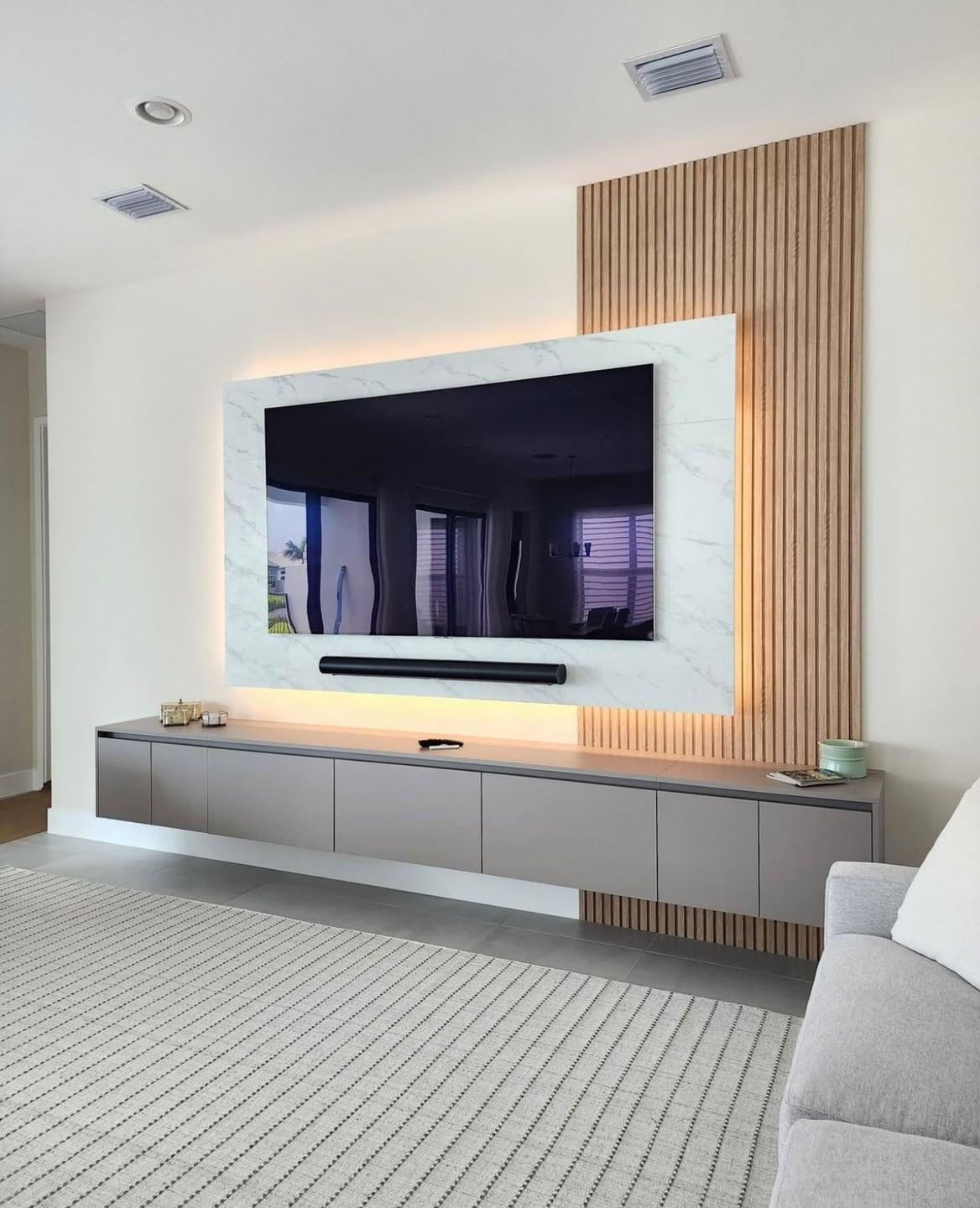
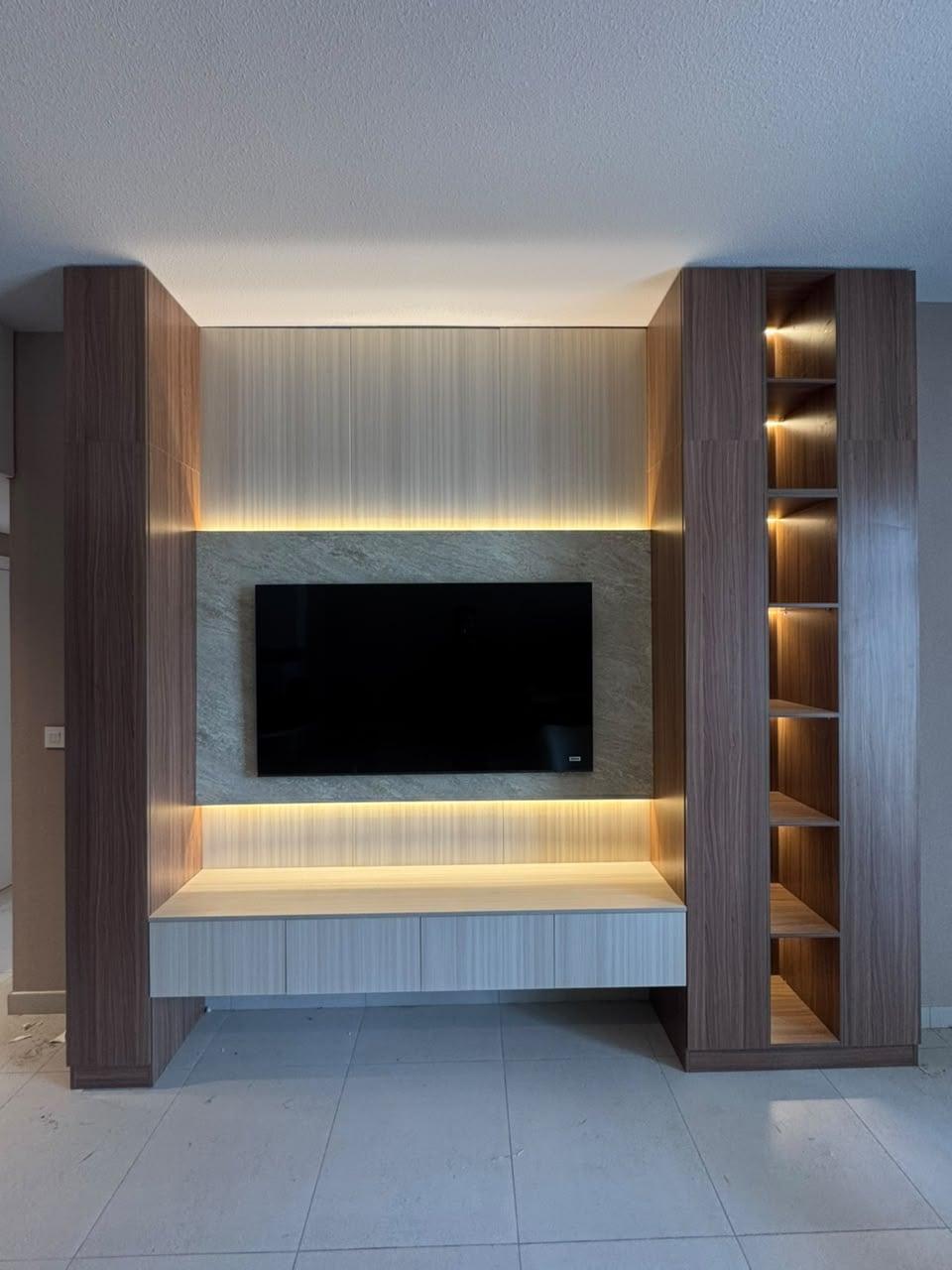
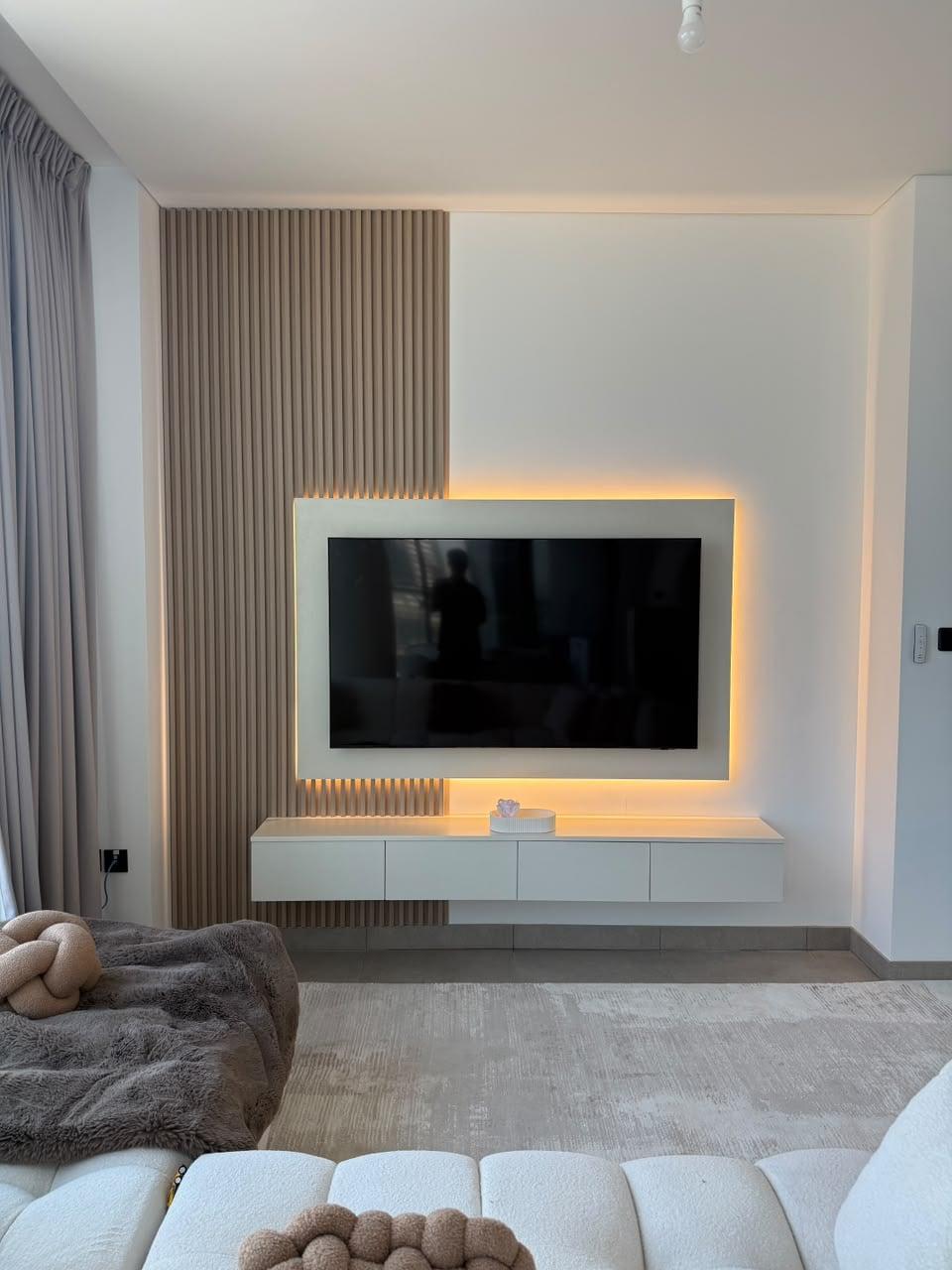
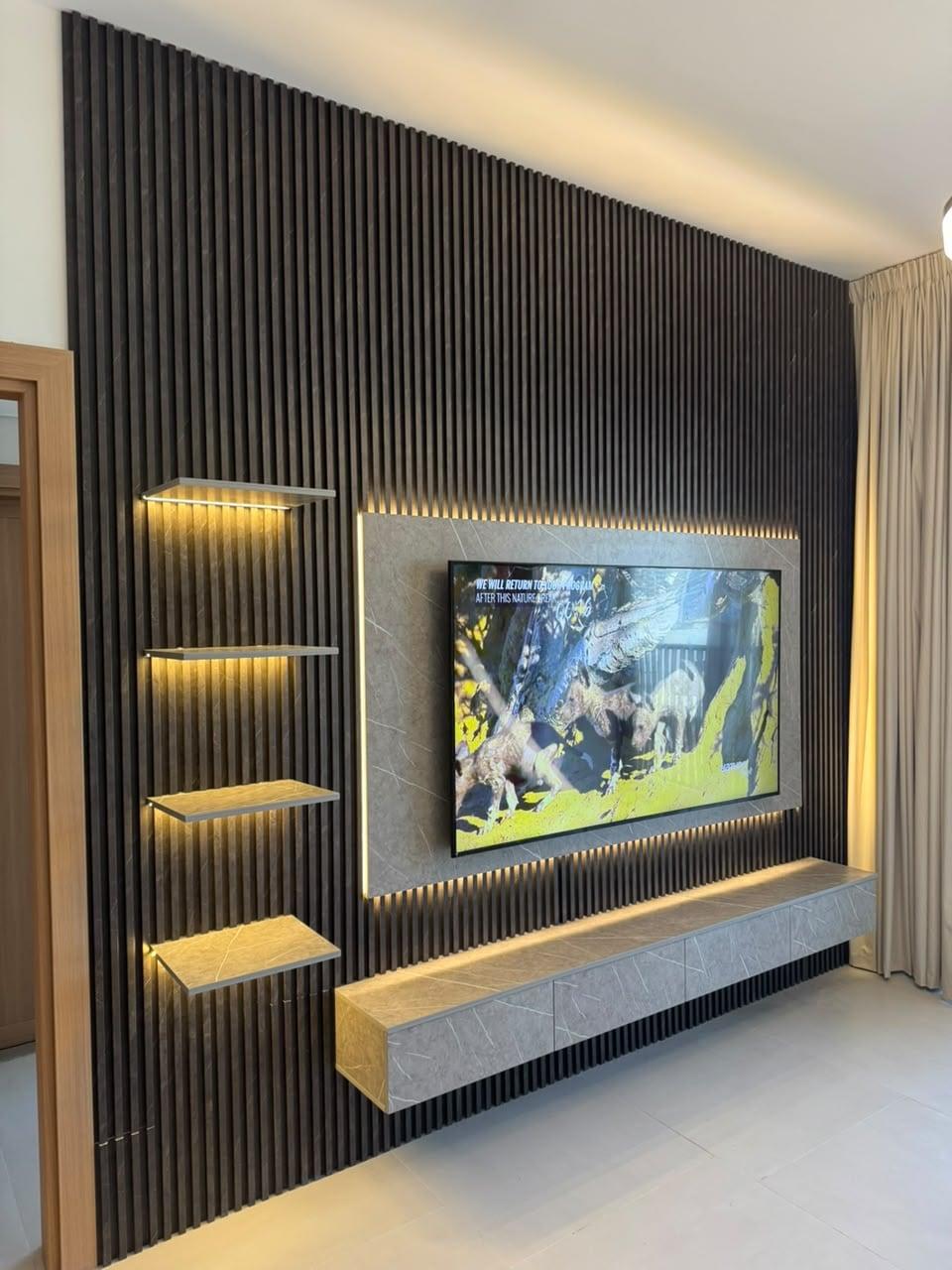
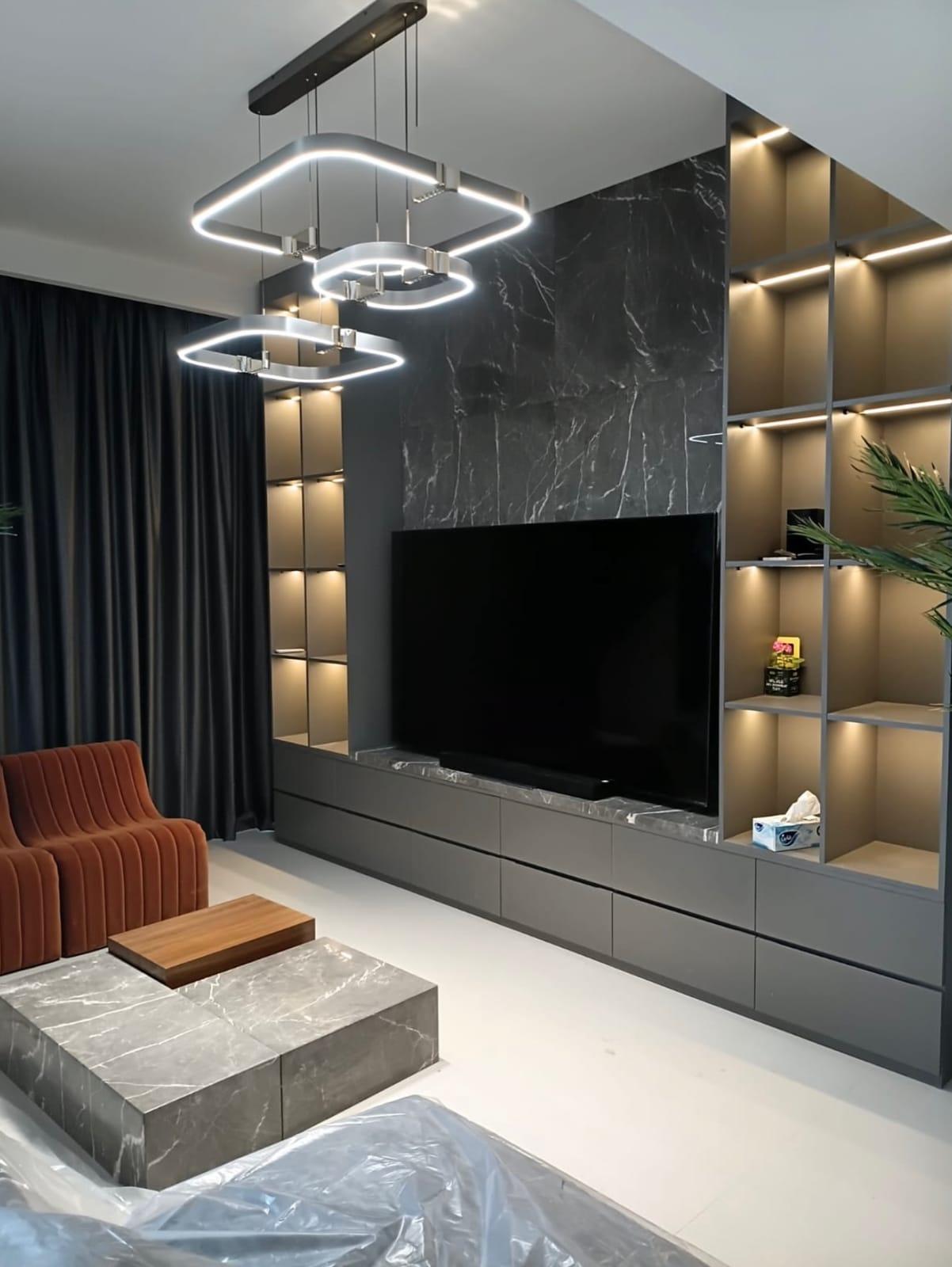
- 1. Lines 1 and 2: scope and finishes land on the panel, the slats and the console
- 2. Lines 3 and 4: the light line and the socket behind the screen
- 3. Lines 5 and 6: the TV bracket, and the floor where the pieces arrive
- 4. Lines 7 and 8: who fits the wall, and what the board warranty covers
Why one total is not a quotation
Building-industry guidance on comparing quotes says the same thing in plain words. Queensland's Building and Construction Commission advises asking every contractor to price the same scope of work, tasks and materials, and warns against choosing on the lowest price alone, since a low quote can come with exclusions or hidden costs. The principle carries over to a TV wall: two quotes only compare when they describe the same wall.
A TV wall is easy to describe loosely because it looks simple. The same photograph can hide a laminate panel and a stone-look one, a lit niche and a plain one, a cabinet that opens fully and one that does not. That is why we write our own quotation per project from a drawing; what a TV wall costs explains which choices change a figure, and each of the eight lines below keeps that choice visible.
The eight lines, and what to ask on each
Use the table as a list you hand to every supplier, including us. Where a cell on your quote is empty, ask for it in writing before you compare totals; a supplier who answers in a message has given you something you can keep.
Eight lines a written media wall quotation must list
1
- Line
- Scope
- What the quote should say
- Each part built (panel, console, slats, shelves, tall units) with its measured size and the drawing it comes from
- Ask if it is missing
- Which parts are in, which are out, and which drawing is this?
2
- Line
- Finishes
- What the quote should say
- The finish of every surface by name and sample reference: laminate, veneer, lacquer, marble-effect
- Ask if it is missing
- Which sample did you show me for each surface?
3
- Line
- Lighting
- What the quote should say
- Where the light runs, the colour temperature, whether it dims, the driver and where it is reached
- Ask if it is missing
- How do I reach the driver if it fails?
4
- Line
- Wiring and sockets
- What the quote should say
- Sockets moved or added, cable route behind the panel, who does the electrical work
- Ask if it is missing
- Is any electrical work shown as a separate line?
5
- Line
- TV mounting
- What the quote should say
- The bracket, the TV size and weight it was chosen for, and how it is fixed to your wall
- Ask if it is missing
- What is behind my wall, and what holds the bracket?
6
- Line
- Delivery
- What the quote should say
- Where and how the pieces arrive, access for the lift or stairs, and who carries them in
- Ask if it is missing
- Is delivery in the price, and what access do you need?
7
- Line
- Fitting
- What the quote should say
- Who fits, what is cut or fixed on site, what is made good, and who clears the packaging
- Ask if it is missing
- Is making good and clean-up included?
8
- Line
- Warranty
- What the quote should say
- What is covered, for how long, what is excluded, and whose promise each part is
- Ask if it is missing
- What exactly is covered, and where is it written?
Copy the eight lines into a message and send them to every supplier. The answers, not the totals, are what you compare.
Lines 1 and 2: scope and finishes
Scope is the sentence that says what you are buying, and it should read like a parts list: a screen panel, a console of a stated length, slats on stated sides, shelves, a tall unit, a niche. Each part carries a measured size taken at your wall, and the whole is tied to a drawing you have seen. Ask for the drawing before the price: a wall priced without one is a guess. Planning a media wall shows what the measuring visit takes. Compact or full wall helps you decide how much to include.
Finishes are the second line to pin down. "Marble finish" or "oak look" could be any of several surfaces. Ask for a sample reference per surface and look at it in your own light. The fluted and slatted wall guide shows the slat choices. The marble-effect guide covers stone-look surfaces.
Panel materials explains what the surfaces are made on. Our marble-effect TV backdrops page shows examples.
Lines 3 and 4: lighting and wiring
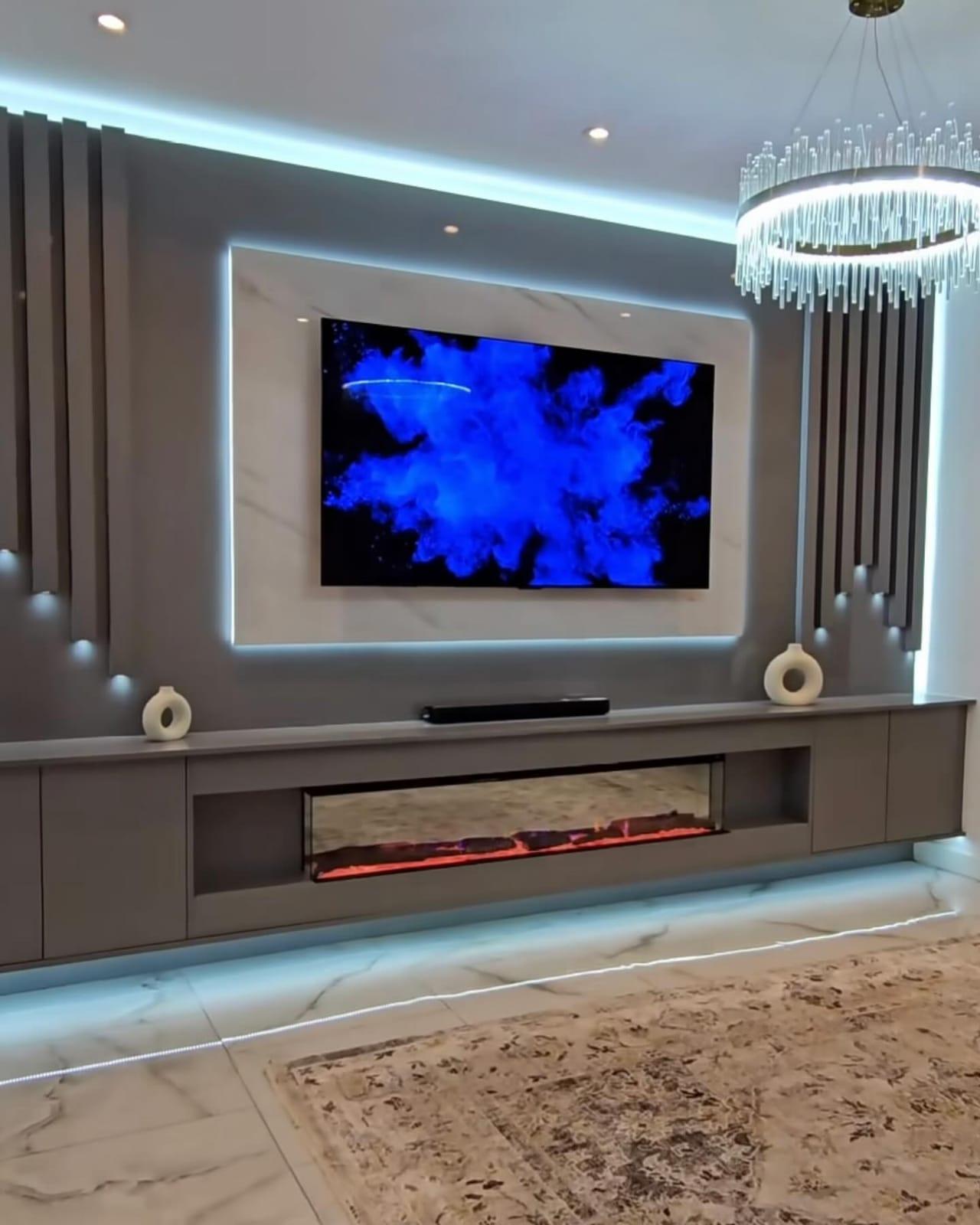
Lighting is where quotations are most often vague, because it hides several parts: the strip, the profile that holds it, the driver that powers it, the dimmer, and the wiring from the driver to a socket. Ask for the colour temperature (our channels are offered in warm 3000K and neutral 4000K), whether the light dims, and where the driver sits. A driver is often the first electrical part to fail, so it should be reachable without breaking the wall. Media wall lighting ideas explains the layers. An electric fireplace adds a bought-in appliance with its own power and its own maker's warranty.
Wiring is the line most often left to "the customer's electrician" or added later. The quotation should state which sockets stay, which move, how the signal and power routes run, and who does the electrical work. Which sockets can stay is explained in the sockets guide. Routing cables so they stay serviceable covers the rest. If the wall is to be wired for equipment you do not own yet, say so on the quote.
Line 5: how the TV is mounted
Mounting is a safety line, so it deserves a sentence. The quote should name the bracket, the TV size and weight it was chosen for, and how it fixes to your wall. The fixings depend on what the wall is made of: MantelMount's mounting guide lists different anchors for metal studs, brick, concrete and plaster. A supplier who has not looked at your wall cannot know them, which is one more reason the measuring visit comes before the price. The position of the bracket also sets where the picture sits; TV height on a media wall gives the rule.
Two practical points. First, the screen: if you have not bought it, the quote is written around a size, so see whether to buy the TV first. A screen you may upgrade is covered in planning for a bigger TV later. Second, safety: the US Consumer Product Safety Commission also advises anchoring TVs and furniture securely to the wall, which is relevant if a unit stands under a wall-mounted screen.
Lines 6 and 7: delivery and fitting
Delivery and fitting are the lines most often missing, and the ones that cause the most arguments afterwards. For delivery, the quote should say how the pieces reach you and what access they need: a lift, a stair, a parking arrangement. Many buildings have rules about working hours and lift use, so ask your building management in writing before the fitting date and tell the supplier what they say. We cannot answer for your building.
For fitting, ask who does it. Our own fitters install our walls, hang the TV once the wall is complete and route the cables. Whoever you ask, the quotation should say what is cut or fixed on site, what is made good afterwards, what happens to packaging and offcuts, and whether an old unit is removed. Ask also for the timeline in terms you can plan around: with us it is up to about 10 days from order confirmation, depending on size and design, and a date should be written against the order, not promised in conversation.
Line 8: what the warranty covers
A warranty is only as useful as its wording. Ask any supplier for it in writing and read three things: what is covered, for how long, and what is excluded. Ours is a 5-year limited warranty on the wood-based boards only. Hinges, runners, labour and misuse are outside it, and it is never a warranty on a whole wall. Parts that are bought in, such as LED drivers or a fireplace, follow their own makers' terms. The final terms are in the written warranty, and you should ask to see them before you order.
Use the same questions elsewhere. A supplier who says "warranty included" has said nothing; one who says what is covered and what is not has told you something you can hold them to. Our wardrobe warranty guide shows how to read the same wording on joinery.
Reading two quotes side by side
The table below shows two imagined quotes for the same wall, with no prices. What matters is the pattern of cells: A answers every line, B leaves three empty. Neither total tells you which is better; B's blanks only tell you what you have to ask before you can compare. The cheaper-looking one may simply be the one with more still to be added.
Two quotes for the same wall, read line by line
1 Scope
- Quote A
- Parts listed with sizes and a drawing
- Quote B
- "TV wall, supply and install"
- Next step
- Ask B for the parts list and the drawing
2 Finishes
- Quote A
- Sample references named
- Quote B
- Named by colour only
- Next step
- Ask B for sample references
3 Lighting
- Quote A
- Channels, colour temperature, dimmer and driver access stated
- Quote B
- "LED included"
- Next step
- Ask B where the driver goes
4 Wiring
- Quote A
- Sockets and route stated, electrical work listed
- Quote B
- Not mentioned
- Next step
- Ask B who does the electrical work
5 Mounting
- Quote A
- Bracket named for the TV size
- Quote B
- Not mentioned
- Next step
- Ask B which bracket and which fixing
6 Delivery
- Quote A
- Stated
- Quote B
- Stated
- Next step
- Both clear
7 Fitting
- Quote A
- Fitting and clean-up stated
- Quote B
- Fitting stated
- Next step
- Ask B about making good
8 Warranty
- Quote A
- Cover and exclusions in writing
- Quote B
- "Warranty included"
- Next step
- Ask B for the wording
An illustration of how to read quotes. The cells show what is stated or missing, not what any supplier writes.
When a line stays blank
If a supplier cannot fill a line, there are three honest outcomes: it is included and unwritten (ask them to write it), it is excluded (ask what it would add), or it has not been decided (ask when it will be). All three are normal; the problem is only finding out after the deposit. QBCC's advice also points at start and completion dates and at warranties as things to ask each contractor, so put both in the same message as the eight lines.
Do not let the quote drift after you sign. If you change the TV, add a shelf or move a socket, ask for the change in writing with its effect on the plan, so the paper still describes the wall that gets built. Our own process is simple: a free measuring visit, a drawing you approve, and once the details are agreed and a 60% advance is paid, production starts in our Sharjah workshop.
A message you can copy to every supplier
Comparing suppliers is easier when each one answers the same questions in the same order. The wording below is deliberately plain, so you can paste it into a chat or an email and change only the bracketed parts. Send it to every supplier you are considering, including us, and keep the replies together.
- "Hello, I am planning a TV wall in my [living room / bedroom] and would like a written quotation. I have attached a photo of the whole wall and the TV size is [size]."
- "Please list each part you would build (panel, console, slats, shelves, tall units) with its size, and say which drawing the quotation is based on."
- "Please name the finish of every surface with a sample reference, and say whether the lighting dims and where its driver is reached."
- "Please say which sockets move or are added, who does the electrical work, which bracket you would use for my TV, and how it is fixed to my wall."
- "Please say how the pieces are delivered, who fits them, what is made good and cleared afterwards, and how many days from confirmation to fitting."
- "Please send the written warranty: what is covered, for how long, and what is excluded."
Three ways a quotation goes wrong, with no prices
The three stories below are imagined, and they carry no figures because the lesson does not depend on any. Each shows a gap on the paper turning into an argument later, and the line that would have closed it.
In the first, a homeowner is quoted for a "TV wall with marble finish" and agrees by message. When the wall arrives, the panel is a different tone from the one they pictured, because "marble finish" named a family of surfaces and not a sample. The line that would have closed the gap is line 2: a sample reference per surface, looked at in the room's own light before ordering. Nobody acted badly here; the paper simply allowed two readings.
In the second, a tenant orders a wall for a TV they have not yet bought. After the wall is built, the television they choose is larger than the panel was drawn for. The line that would have closed it is line 1, with the TV size written into the scope, and line 5, with the bracket chosen for it. The sensible remedy is to know the screen first, or to draw margin into the panel, as the guide on changing the TV later explains.
In the third, a family agrees a fitting date, and on the day the building will not allow the lift to be used. The pieces cannot be carried up in time and the date slips. Line 6 would have prevented it: the quotation should state the access needed, and the customer asks their building management in writing about lift use and working hours before fixing the date, passing on the reply to the supplier. We cannot know every building's rules, which is exactly why the question belongs on the paper.
The order of events, from measuring visit to handover
A quotation does not stand alone: it sits in the middle of a process, and knowing the order lets you see when each of the eight lines matters. Our own sequence is the one below, and a supplier who follows another should be able to describe theirs just as plainly.
- Step 1, the message: you send a photo of the wall, the TV size and the room on WhatsApp, and we reply with what we need.
- Step 2, the free measuring visit: we measure your wall, look at what it is made of and note the sockets and the route for cables.
- Step 3, the drawing: it shows the panel, console, cable route, lighting and fixing, and you approve it before production.
- Step 4, the written quotation: it follows the drawing and lists the eight lines, and the final figure comes from it.
- Step 5, confirmation: once the details are agreed and a 60% advance is paid, production starts in our Sharjah workshop.
- Step 6, production, delivery and fitting: a wall is usually ready up to about 10 days after order confirmation, depending on its size and design, and our own fitters install it.
- Step 7, handover: you check the wall against the quotation, and the written warranty terms are in your hands.
Checking the finished wall against the paper
The quotation is not finished when you sign it; it is finished on the day of fitting, when you read the wall against it. A short walk-through, with the paper in your hand, is the moment to catch a gap while the people who can fix it are still in the room.
A handover check, line by line
1 Scope
- What to look at
- Every part on the list is present
- What good looks like
- Nothing on the list is missing and nothing extra was added without a note
2 Finishes
- What to look at
- Each surface against its sample
- What good looks like
- The finish matches what you approved
3 Lighting
- What to look at
- Switch it on, dim it, look for uneven spots
- What good looks like
- Even light, and you know where the driver is reached
4 Wiring
- What to look at
- Test every socket and the cable route
- What good looks like
- Sockets work, nothing is strained, the cable route is hidden
5 Mounting
- What to look at
- Push the screen gently, check it is level
- What good looks like
- Firm, level and at the height you agreed
6 Delivery
- What to look at
- Look for marks on parts and floors
- What good looks like
- No damage; packaging gone
7 Fitting
- What to look at
- Open every door and drawer
- What good looks like
- Smooth and square; the site left clean
8 Warranty
- What to look at
- Ask for the written terms
- What good looks like
- You hold what is covered, for how long and what is excluded
Do the walk-through on the day. A problem noticed on the day is the easiest kind to put right.
Questions beyond the eight lines
The eight lines cover the wall. A few more questions cover the relationship around it, and they cost nothing to ask. None is a trap, and a supplier who answers calmly is telling you something good about how the job will be run.
Ask how a change is handled. You may want to move a socket or add a shelf after the drawing is approved. A sound answer is that the change is written down with its effect on the plan before anyone builds it. Ask also who your contact is during the job, since a wall involves a drawing, a workshop and a fitter, and you want a single person who can say where things stand.
Ask to see earlier work of the same kind. Photographs help, though a photograph shows a wall, not the quotation behind it. Ask what happens if a part arrives damaged: it should be repaired or remade, and the answer should be on paper. Finally, ask what is not included. The honest ones list their exclusions without being pressed, and that list is often the most useful part of the quote.
Extras that deserve their own line
Some features do not fit neatly inside the eight lines, and they are the ones most likely to be waved through as "included". Give each its own sentence on the quotation: what it is, where it sits, how it is powered and who stands behind it.
An electric fireplace is the clearest case. It is an appliance with its own power, its own heat and its own maker's terms, built into a console that has to be drawn around it. A shaped or hexagonal panel is another: the shape adds cutting and fitting, so the quotation should name it. A niche for a soundbar or a speaker needs a size and a ventilation note. A tall unit with a lit interior needs its own light line and its own access for the driver. A hidden door or a TV that sits inside a closed cabinet needs the mechanism named, because it is a moving part with its own wear.
None of these is unusual, and none is a reason to hesitate. The reason to write each down is that a feature without a line has no owner: nobody can say who supplies it, who fits it and who answers for it if it fails.
Comparing three quotations without a spreadsheet
When more than two quotations arrive, a grid keeps the comparison honest. Take a sheet of paper, write the eight lines down the side and the suppliers across the top. In each cell write one of three things: what the quotation states, "missing" or "unclear". That is all.
Then read the sheet, not the totals. A supplier with several "missing" cells has not offered a lower price, only a less finished one, and the gap has to be filled in before the numbers mean anything. Send each supplier a single message listing only its missing cells. When the replies come back, update the sheet, and only then look at the totals side by side.
If two suppliers remain, ask each one the same final question: "What is not included in this quotation?" Their answers will often settle the matter. Also look at how each one answered: promptly, in writing, and in terms you could hold them to. That behaviour before you pay is the best preview of the behaviour afterwards. For the prices themselves, our price guide explains what moves a figure; it is not repeated here.
A smaller job still needs the eight lines
It is tempting to skip the discipline when the job is small: a single panel, a floating console, one strip of light. The opposite is true. A small job is where a vague sentence hides most easily, because there is so little text that nobody notices what it leaves out. The eight lines still apply, and on a compact wall each of them is simply shorter.
For a compact wall, scope is two or three parts and one drawing. Finishes are one or two references. Lighting is one line and its driver. Wiring is the socket behind the screen and the route to it. Mounting is the bracket and the fixing. Delivery and fitting are one visit each, and the warranty is the same wording as for a large job. Read in that way, the quotation fits on one page, and every line on it is a question you can ask in a sentence.
The same holds in a bedroom, where the TV may sit in a wardrobe bay or a short wall. The first question is still what is built; the last is still what is covered. Everything between them is what keeps a modest job from turning into a surprise.
Reading the exclusions
Exclusions are the sentences that begin "not included", "by others" or "at extra cost". They are not a bad sign; every quotation has some, and a quotation with none has probably not been thought through. Read them as carefully as the inclusions, because they mark where your own budget and your own arrangements begin.
Three exclusions deserve a second look. Electrical work by "the customer's electrician" means you must find and pay one, and that person has to be ready on the day. Making good of the wall around the piece means paint or plaster that you will have to arrange. Removal of an old unit means someone has to carry it out. Each can be fine; the point is to decide who does it before the fitting day, not on it.
Finally, notice what the quotation says about changes after approval. A sentence that any change is priced separately is reasonable, provided you are told the effect before the work starts. Together with the eight lines, these exclusions give you the full picture of what you are buying.
Spoken promises and what to do with them
In the showroom or on a call, a supplier may say something helpful: a date, a finish, a favour. If it matters to you, ask that it be written on the quotation or in a message. This is not a sign of distrust. People forget, staff change, and a sentence on paper is the only version everyone can read later.
The same applies to us. A date is written against the order, a warranty is written in its own terms, and a change is written with its effect on the plan. If you are told something that you cannot find on the paper, ask for it to be added, and treat the answer as part of the choice.
Keeping a paper trail
Most of what protects you in a job like this is a message you saved. Keep the drawing and every revision of it, the quotation, the samples you approved, the permissions you were given by your landlord or building management, and the written warranty. Put them in one folder with the date on each.
When something changes, say so in writing and ask for the change to be acknowledged in writing. A short message such as "please confirm the console is now longer, to the size we agreed, and what that changes on the plan" is enough. The aim is not to be difficult; it is that the paper and the wall stay the same thing.
What to send us on WhatsApp
Our media walls start from AED 3,500 per project (a compact panel and floating console in standard laminate); the final figure comes from the quotation and depends on the wall size, finish, lighting and any fireplace. To get a quotation that shows all eight lines, send us on WhatsApp a photo of the whole wall, the TV size and the room, and tell us if you already have a quote to compare. What to send before the visit lists the rest.
If you are still choosing the kind of piece, media wall or TV unit helps you decide first. Our media walls service page shows more work.
Custom media walls explains the made-to-measure option. In Sharjah, our local page has the details.
The pricing guide tool is a place to start a budget. To see a wall with lit shelving, look at media walls with display shelving.
For the bedroom, a wardrobe with a TV bay comes with its own quotation. The same line-by-line method works on our wardrobe quotation checklist.
Common questions
What should a media wall quotation include?
Eight lines: scope, finishes, lighting, wiring, mounting, delivery, fitting and warranty, each written rather than implied. What a media wall costs.
How do I compare two media wall quotes?
Ask each supplier to fill the same eight lines, then compare the answers and only then the totals. The materials checklist.
Should the quote name the TV bracket?
Yes, with the TV size it was chosen for and how it fixes to your wall. TV height on a media wall.
Is delivery included in a media wall price?
It depends on the supplier, so ask for it on the quote, with the access needed. Planning a media wall.
What does your media wall warranty cover?
A 5-year limited warranty on the wood-based boards only; hinges, runners, labour and misuse are excluded, and the final terms are in writing. Media walls service.
Do I need the drawing before I pay a deposit?
Ask for it: a wall priced without a drawing is a guess, and you approve our drawing before production. Media wall or TV unit.
What should I send you on WhatsApp for a quotation?
A photo of the whole wall, the TV size and the room, plus any quote you want to compare. What to send before the visit.

Sources & specifications
Manufacturer information applies to the named products and systems. Sources reviewed on 9 November 2026.
- Queensland Building and Construction Commission: seeking and comparing quotes (same scope, exclusions, not lowest price alone)qbcc.qld.gov.au(opens in a new tab)
- MantelMount, 10 Dec 2025: mounting a TV on metal studs, brick, concrete and plaster (anchors depend on the wall)mantelmount.com(opens in a new tab)
- US CPSC news release, 9 Feb 2023: anchor TVs and furniture securely to the wallcpsc.gov(opens in a new tab)
Want this planned for your home?
Consultation and measurement are free. Tell us the rooms, location and what you need; we arrange a sample visit and define the measured quotation.