Media Walls · 17 min read · 9 June 2026
Media wall with an electric fireplace: sizes, heat and TV height
How to plan a media wall with an electric fireplace for UAE homes: insert type, sizes and depths, fire width against the TV, why the fire goes low, heat, wiring and servicing.

By Ali Haider Basra, Founder, Al Tareeq Decor · Contact our workshop
Key takeaways
- In the UAE an electric fireplace is a feature first and a heater second: Dubai's January mean high is about 24 °C, and most fires run the flame without heat.
- Choose the fire model before the drawing, because its width, height, depth and vents decide the opening; one maker's published openings are about 23 to 30 cm deep.
- Make the fire wider than the TV: a 65-inch screen suits a fire of roughly 1.5 to 1.9 m.
- Set the fire low and let the TV hang at eye height: stacking a 63 cm firebox under the screen lifts its centre to about 158 cm, 48 cm above a seated viewer's eyes.
- Plan servicing now: a removable front or panel, a cable route that survives a swap, and the fire's own warranty on the quotation.
On this page
- Key takeaways
- Is an electric fireplace worth having on a UAE media wall?
- Flame effect, 3D flame or water vapour: pick the insert type
- Three insert families compared
- Choose the fire first: widths, heights and depths of real inserts
- What published rough openings look like
- How wide should the fire be beside your TV?
- Where the fire sits decides how high the TV goes
- Heat: what leaves the fire, and what the TV can take
- Niche depth, framing and how much floor the wall takes
- Power, remote and cables around the fire
- Light, finish and the materials near the fire
- Keep the fire serviceable
- From first visit to a finished wall
- Common questions
Is an electric fireplace worth having on a UAE media wall?
In a villa or flat here, an electric fireplace is a feature first and a heater a distant second. It gives the wall a glowing line below the screen, a reason to switch on a lamp-like light in the evening and something for the eye to settle on when the TV is off. It does not give you a chimney, a real flame or smoke, and it is not meant to. What we build is an electric insert set into the lower part of a media wall; we do not build gas or wood-burning fireplaces.
Dubai's long-term averages show why the heater matters less than it would in Manchester. In January, the coolest month, the mean daily high is about 24 °C and the mean low about 14 °C; in July they are about 41 °C and 30 °C (Wikipedia's climate table for Dubai, built from 1977 to 2015 normals). A heater has real work to do only on the coolest winter evenings, and the flame effect, which is just light, is the part you will use all year. Dimplex, a fire maker, says the same of its fires: most let you run the flame without heat, which it describes as suited to ambience in warmer seasons.
That reading changes what you plan and what you spend on. Choose the fire for how its flame looks in your room and how it sits in the wall, treat the heater as a bonus, and ignore the guides written for cold British houses that are all about warming the room. If you are still deciding what kind of wall you want at all, our media wall design ideas and explanation of what a media wall is come first; this guide starts where you have decided to add a fire.
Flame effect, 3D flame or water vapour: pick the insert type
Electric fires come in three families, and the wall is built differently for each. A standard flame-effect insert lights a bed of logs or crushed glass with LEDs. A 3D flame insert builds the flame in layers so it seems to have depth behind the glass. A water-vapour insert, sold under names such as Optimyst, is the most realistic and the most demanding: Dimplex explains that ultrasonic technology turns water into a fine mist that reflects LED light, so the tank has to be filled by hand or connected to a water line.
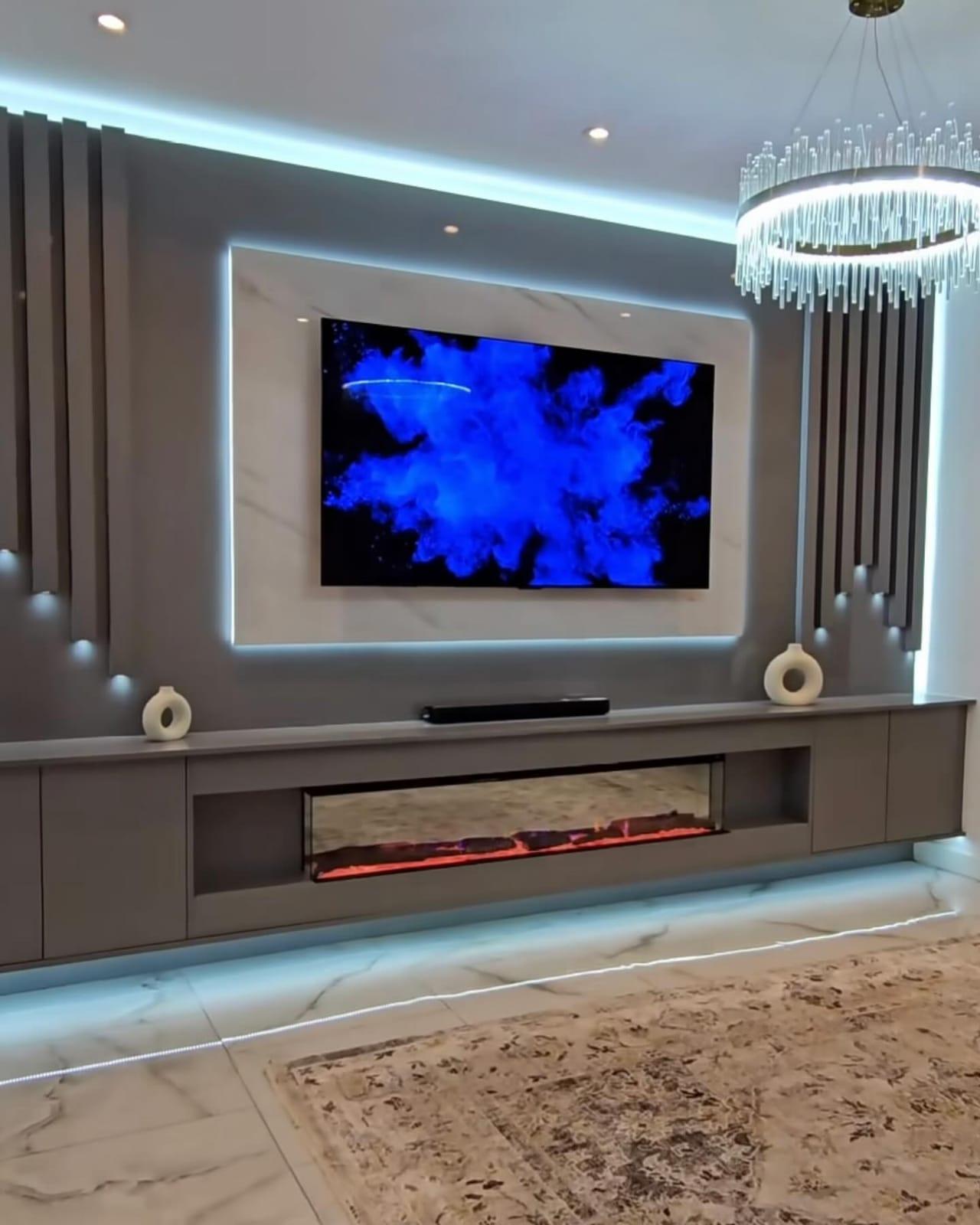
The wall also depends on whether the fire has a heater. Many do, and Dimplex says most let you switch the heat off and keep the flame, so a fire with a heater is not a fire that must be heated. Our own product page makes the same point from the carpenter's side: flame-effect inserts often let you change the flame colour, as the blue and orange versions of one of our walls show, and the heater is the reason the space around the fire is planned rather than improvised.
A few rules of thumb come out of that. For a family room used every evening, a 3D flame insert is the sensible middle path. A water-vapour fire suits the owner who is happy to refill and clean a tank and wants the most lifelike flame. A basic flame-effect insert is enough for a bedroom or an office, where you want the glow and not the theatre. Whichever you pick, the model decides the opening, so it is chosen before the wall is drawn.
Three insert families compared
Flame effect
- How the flame is made
- LEDs light a bed of logs or glass
- What it asks of you and the wall
- A rough opening, a power supply and a heat-vent clearance; very little upkeep
- Best for
- Bedrooms, offices, compact living rooms
3D flame
- How the flame is made
- Layered light gives the flames depth behind the glass
- What it asks of you and the wall
- An opening, power and a heat-vent clearance, all set by the model's manual
- Best for
- Family living rooms used every evening
Water vapour
- How the flame is made
- Ultrasonic mist reflects LED light (Dimplex)
- What it asks of you and the wall
- A water tank or a water line, occasional cleaning, and a service route to the tank
- Best for
- Owners who want the most lifelike flame and will look after it
With or without heater
- How the flame is made
- The heater is separate from the flame in most models
- What it asks of you and the wall
- A vent that must stay clear; the flame can run without it
- Best for
- A heater is a bonus in the UAE winter, not the purpose
Based on Dimplex's published descriptions and our own fireplace product page. Exact behaviour, depth and clearances come from the maker's manual for the model chosen.
Choose the fire first: widths, heights and depths of real inserts
Every fire has its own cut-out, and a wall drawn for one will not take another. Our fireplace page puts it plainly: pick the model before the drawing, because its width, depth and vents fix the size of the console. Published figures show how much the models differ. EcoSmart Fire's Motion range, for example, needs a rough opening 63 cm high and at least 23 cm deep, in widths from about 74 cm to 3.15 m; its Switch range needs about 64 cm in height and at least 30 cm in depth, from about 1.13 m to 3.06 m wide. Dimplex lists its linear Optimyst fires at 46, 66 and 86 inches, roughly 117, 168 and 218 cm, without giving a depth on that page.
Those are one maker's openings, and they will not be yours, but the pattern is useful. A built-in fire is a box about the height of a bedside table and as deep as a shelf unit, so it can take 23 to 30 cm of wall depth before the TV recess and the finish are counted. A slim linear model is a better match for a low console than a tall firebox, which is why the choice of model should come from your wall and your TV, not from a catalogue picture.
Bring the model name to our free home visit if you have one in mind, or three candidates if you do not. We take laser measurements, check the manufacturer's current dimensions rather than a remembered figure, and draw the opening to that model. Our guide to buying the TV before the media wall makes the same argument for the screen, and it applies in full to the fire.
What published rough openings look like
EcoSmart Fire Motion
- Widths
- About 74 cm to 3.15 m
- Opening height
- About 63 cm
- Minimum depth
- About 23 cm
EcoSmart Fire Switch
- Widths
- About 1.13 m to 3.06 m
- Opening height
- About 64 cm
- Minimum depth
- About 30 cm
Dimplex Optimyst Linear
- Widths
- About 117, 168 and 218 cm
- Opening height
- Not given on its page
- Minimum depth
- Not given on its page
Your fire
- Widths
- Set by the model you choose
- Opening height
- Set by the model
- Minimum depth
- Set by the model
Converted from the makers' inch sizes, rounded. EcoSmart Fire is a North American maker, so its wiring figures do not apply here; the openings show scale only. Use your model's own manual.
How wide should the fire be beside your TV?
A fire that is narrower than the screen looks like an afterthought. The rule most guides give is that the fire should be wider than the TV, and Stylish Fireplaces, a fireplace retailer, puts numbers on it: a 55-inch TV goes with a fire of 50 to 60 inches, a 65-inch with 60 to 74, a 75-inch with 74 to 88 and an 85-inch with 88 to 100. Those are fire widths measured straight across against TV sizes measured on the diagonal, so a 65-inch TV, about 144 cm wide, sits comfortably above a fire of roughly 1.5 to 1.9 m.
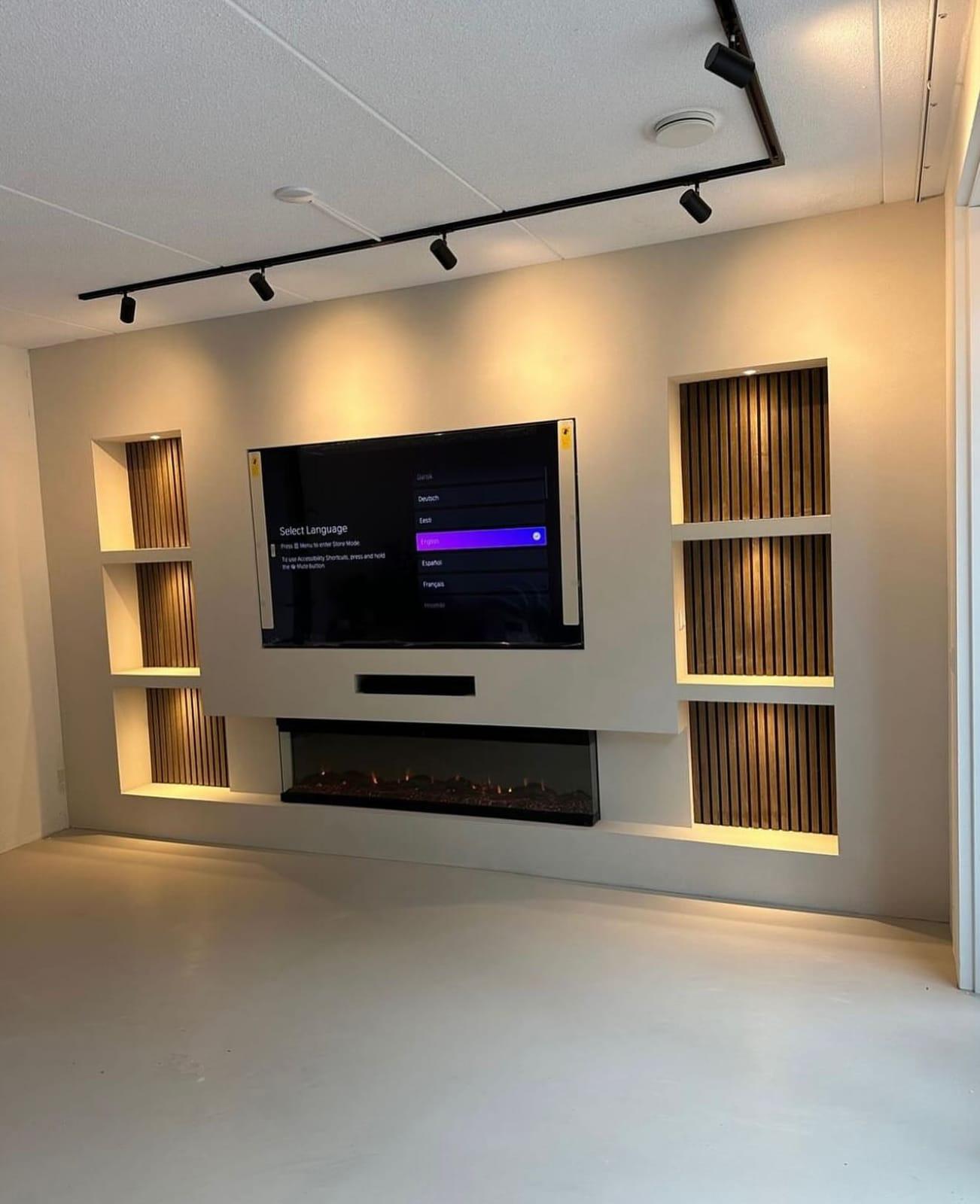
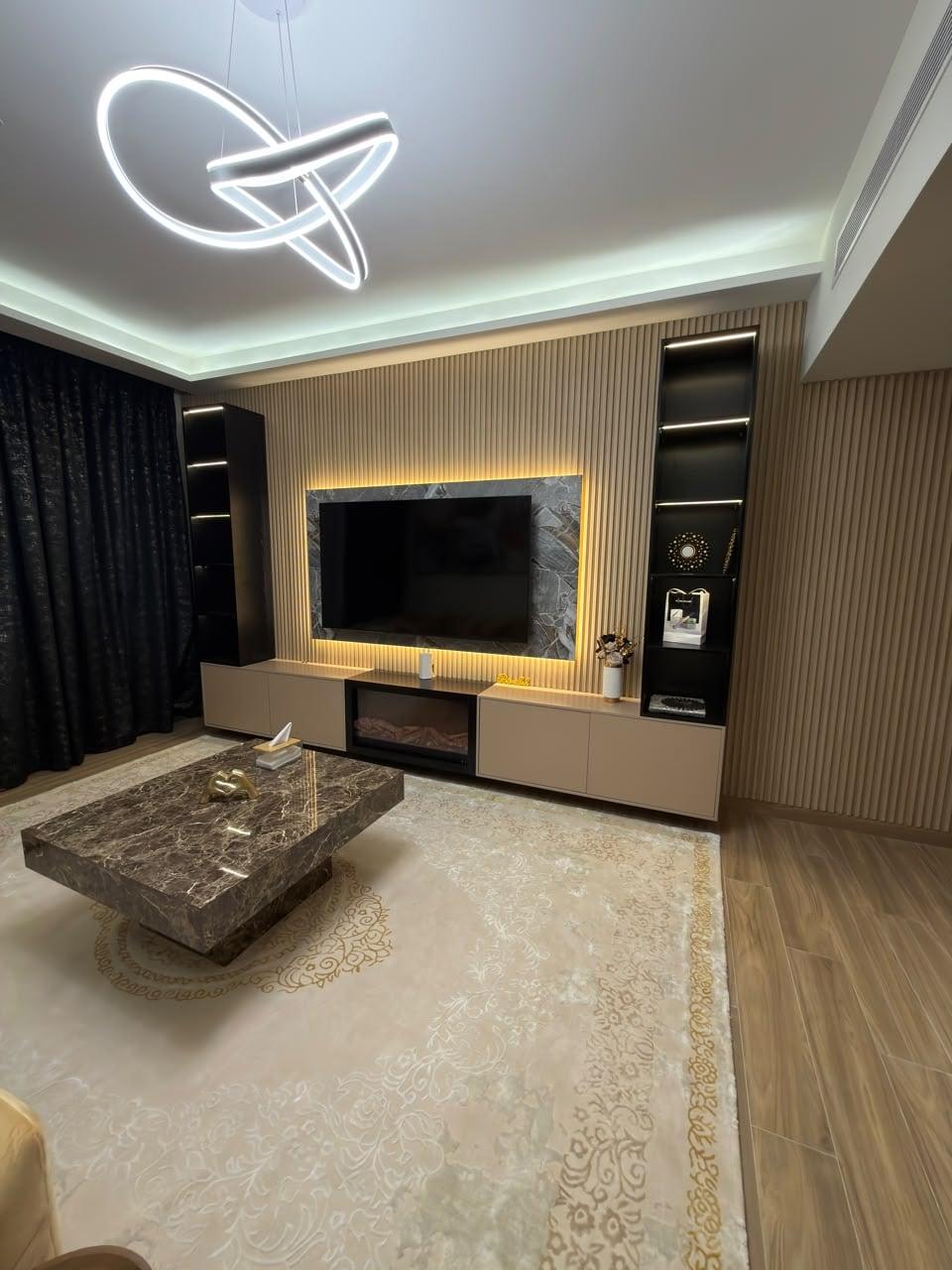
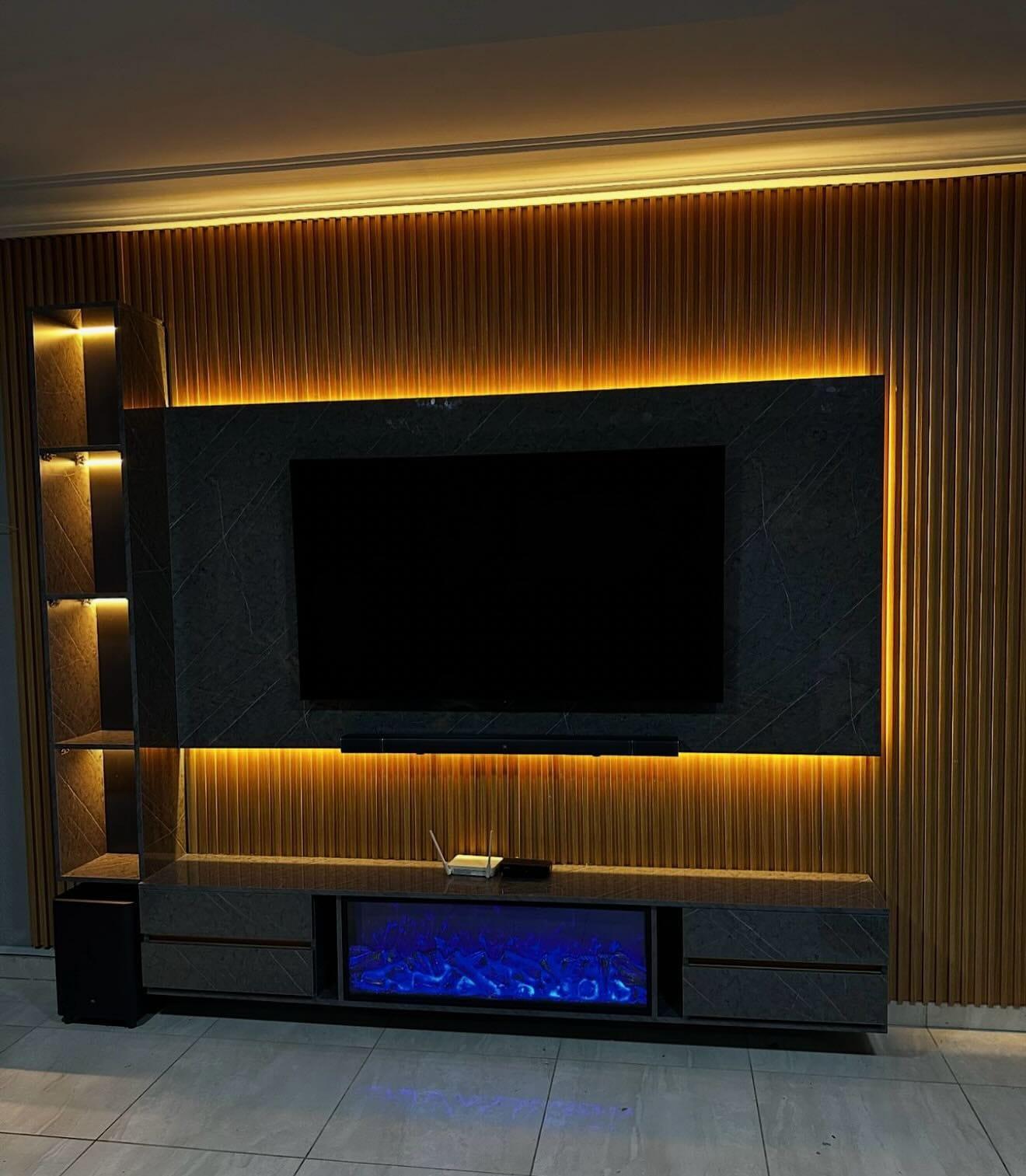
The same retailer leaves 6 to 10 inches, about 15 to 25 cm, of plain wall at each end of the fire. We would not argue with that for the dark, framed look it is describing, but in a wide UAE living room the sides are where lit niches, shelf towers or slats begin, so the end margin often becomes the first shelf. The photograph below shows the usual outcome: a fire that is wider than the screen, flanked by display units that run the whole height of the wall.
Choose the screen size first, from the distance to the sofa, using our TV size and viewing distance guide, then pick a fire wider than it, and let the console length follow. Going the other way, buying a short fire and a big screen, leaves the glow looking like a footnote. For a very long wall, our full wall or compact media wall guide shows when the whole wall earns the extra build.
Where the fire sits decides how high the TV goes
This is the one choice that changes how the room feels every day, and published guides get it wrong for our homes. EcoSmart Fire's guide suggests the top of the firebox at 36 to 48 inches off the floor and a gap of 3 to 6 inches above it for the TV's base. Its worked example puts the fire's top at 42 inches and the base of a 65-inch TV at 46 inches. A 65-inch screen is about 81 cm tall, so its centre lands near 158 cm, roughly 48 cm above the eyes of someone seated, who looks from about 110 cm.
Samsung's UAE page on wall mounting names the problem directly: mounting above a fireplace may lift the TV above eye level and cause neck strain. At a sofa 3 m from the wall, a screen centre 48 cm above the eyes means looking up by about 9 degrees for every film. The drawing below plays both versions, then swaps the tall firebox for a slim insert set low, which brings the screen back to eye level with about 15 cm to spare for a soundbar slot.
Our rule follows from the sums: put the fire down low and let the screen hang at eye height. Stylish Fireplaces gives the other end of the range, a linear fire no lower than 12 inches off the floor in a sitting area, so the insert has a little air beneath it. Our guide to TV height on a media wall works out the eye-level figure for your own sofa; this guide only has to make sure the fire does not push the screen out of reach. The short video below, from Stylish Fireplaces, covers choosing a fire's size under a TV and how high to mount both.
- 1. Dashed line: the eyes of a seated viewer, 110 cm from the floor
- 2. Stacked: a 63 cm firebox with its top at 107 cm pushes the screen centre to about 158 cm, 48 cm above the eye
- 3. Slim and low: a 25 cm opening set from 30 cm brings the screen down to eye level
- 4. About 15 cm is left between fire and screen, enough for a soundbar slot
Heat: what leaves the fire, and what the TV can take
Electric fires are called zero-clearance because nothing burns inside them, but they still move warm air. The reassuring facts, from makers and retailers alike, are these. Dimplex says the glass stays cool to the touch and that heat comes from a separate vent, usually on its top or its underside. Stylish Fireplaces notes the heat is not blown up onto a TV. In flame-only mode, EcoSmart Fire says its LED array makes no meaningful heat, and the smallest Switch model draws as little as 42 W.
The cautions come from the TV side. Samsung's UAE page asks owners to keep the temperature near the screen below 40 °C, to test how much heat a fireplace gives off before mounting, and suggests recessing the TV or adding a mantle to shield it. It gives no clearance figure, so we do not invent one: the fire's own manual gives the vent position and the clearance above it, and the TV's manual gives its limit. EcoSmart's own gap of 3 to 6 inches is described as a visual choice, not a thermal rule.
Our practice is to read both manuals before the drawing is finished. If the vent is at the top, the screen goes higher or a ledge goes between them; if it is at the front, a low fire under an eye-level screen is already the best layout. The cut-out and the surface around the opening are made for heat, and PVC or WPC cores are kept clear of the vent because they soften at modest temperatures, as set out in our MDF, WPC, PVC and wood panel guide. For stone-effect faces, see marble TV wall options. The video below explains how a fire's heat chart affects how high a TV can be mounted above it.
Niche depth, framing and how much floor the wall takes
A recessed fire is a box inside the wall, and the wall has to be deep enough to hold it. On the published figures above, that is about 23 to 30 cm before the finish, which is more than the thickness of a normal partition wall. On most walls that depth is found by building the media wall out in front of the existing one, and the room loses floor to it. A frame 30 cm deep along a 4 m wall takes 1.2 m² of the floor, so a smaller room may suit a slim wall-hung insert better than a deep built-in one.
Plan the access before the finish. EcoSmart Fire's installation guide suggests masking the viewing area before plastering or painting, because fine dust can get into the LED housing, and its installation steps include removing the front glass. It also suggests a 50 to 100 mm conduit run between the fire and the TV position with a pull string, so cables can be replaced later, and a structural check on the framing for its very widest models. We apply the same thinking to every wall: the frame is square, the opening is true, and the drawing shows how the insert is removed.
Power, remote and cables around the fire
The fire's power is its own subject, and our article on media wall sockets and power covers the rules: a socket of its own, never an extension lead and the plug within reach. What this guide adds is how the choice of fire changes the wiring. Some inserts plug into an ordinary socket, and others are hardwired and need a dedicated circuit; EcoSmart Fire's models are the second kind, with the wiring ending at the top of the opening. Dimplex's Canadian FAQ says most of its fires plug into a standard outlet but that built-in or high-wattage models may need a dedicated circuit; the voltages there are not ours, but the split between plug-in and hardwired models is the same.
That is why the maker's wiring page is read before the opening is drawn. A hardwired fire needs its supply behind the finished wall, and moving it later means opening that wall. A plug-in fire needs a socket close to it, reachable and not directly under the heat outlet. Stylish Fireplaces also advises against running a TV's power lead inside the wall to a socket below, and suggests a recessed outlet behind the TV instead. Our team does the small electrical work on our walls, such as moving a socket, and each item appears as its own line on the quotation.
Plan the cables the same way. The fire's remote or controller, the TV's HDMI and power, the soundbar and the router should each have a route, and the route should survive a replacement. Our cable and service access guide shows how to keep equipment reachable behind a finished wall.
Light, finish and the materials near the fire
A fire is already a light source, so the lighting around it should be quieter than it. EcoSmart Fire's guide suggests dimming niche lighting beside the fire to about a tenth of the firebox's brightness so the flame stays the brightest thing on the wall, and our media wall lighting guide explains the backlight and shelf layers that sit around it. A warm strip in the niches, a neutral weak glow behind the screen and the flame in the middle make three levels that do not fight.
The surface beside the fire matters as much as its light. Slats and fluting look good next to a fire and are covered in our guide to fluted and slatted TV walls. Stone-look panels and real marble suit the area around the fire, which our marble TV wall guide compares for weight and heat. The lit cabinets, niches and shelves beside the fire are shown on our display shelving walls.
Keep the list of ideas short. A wall that carries slats, marble, niches, cabinets and a fire gives the screen four rivals. Choose one surface to frame the TV, let the fire be the second event, and keep storage and lighting in the background. Our marble-effect TV backdrops and wooden feature walls show two surfaces that sit well around a fire.
Keep the fire serviceable
Electric fires need little care, and the little they need is easy to forget when the wall is finished. Dimplex's FAQ says they need very little maintenance: dust the outside, clean the glass and check the air intake and fan vents for build-up. For its water-vapour models, its troubleshooting advice is that if the mist still does not appear, the transducer is replaced and the fan checked. A water-vapour fire also needs its tank refilled and cleaned, and Dimplex names distilled water for the cleaning.
So the wall has to let someone reach the fire. That means a front that opens or comes off, a service panel or removable plinth beside the insert, and a cable route that survives a swap, not a fixed slat run glued over everything. The drawing should show it, and our cable and service access guide has the detail. It is far cheaper to draw an access panel than to cut a finished wall.
On warranty, our written 24-month cover is for our own workmanship on orders agreed from 10 October 2026, and a fireplace is a bought-in part with its maker's own warranty. The quotation names it, so you know whose promise is whose. Should you swap the screen in a few years, what changes on the wall is worth reading first; the fire's opening should be drawn with that in mind.
From first visit to a finished wall
Our free home visit comes first: we bring finish samples, laser-measure the wall, record every socket and AC grille, and take down your fire model or help you pick between a few. Then we draw the wall with the fire's exact cut-out, the TV at eye level, the soundbar slot and the service access, and price it. The workshop only begins once you approve the drawing, which means the fire's position can still change at no cost while it is on paper. For a shop, café or office rather than a home, start with our guide to office and shop fit-out, because the landlord's rules and approvals come before the wall.
Expect roughly 10 days between confirming the order and a finished wall; a very wide or detailed design can take longer. Our entry brief starts at AED 3,500 per project (a compact laminate panel with a floating console), and an electric fire, a wider wall, veneer, marble-effect panels and lighting each add to that, and the fire sits on its own line and keeps the maker's warranty. Read our media wall price guide to see how each choice moves the total, or use the pricing guide.
Our workshop is in Sharjah and we install across the UAE; our Sharjah media wall page has the local details. To see built fire walls, open our media walls with an electric fireplace, the custom media walls range or our wider media walls service.
Common questions
Can you put a TV above an electric fireplace?
Yes. Makers say the heat leaves through a separate vent and the glass stays cool, but check your model's manual for the vent position and the TV's own limit, which Samsung's UAE page puts at 40 °C. Keeping the fire low also keeps the screen at eye level. TV height on a media wall.
Do electric fireplaces give off heat, and can I use one without it?
Most have a heater and most let you run the flame on its own, which Dimplex describes as suited to warmer seasons. In the UAE you will use the flame all year and the heater on a few winter evenings. Media walls with an electric fireplace.
How deep does the recess for an electric fireplace need to be?
It depends on the model. One maker's published openings are at least 23 cm for its Motion range and 30 cm for its Switch range, so we draw the depth from the fire you choose. Planning a media wall.
Does an electric fireplace need a chimney or a vent?
No. Dimplex says electric fireplaces need no chimney, flue or vent, but their own air intake and fan vents must stay clear. Choose the model first and keep its sockets planned. Media wall sockets and power.
What separates a 3D flame fireplace from a water-vapour one?
A 3D flame insert layers LED light behind glass; a water-vapour insert makes a mist that reflects LED light, so it needs a water tank or a water line to look after. Either runs flame-only. Cable and service access.
How much does a media wall with an electric fireplace cost in the UAE?
The entry brief starts at AED 3,500 per project, a compact laminate panel and floating console. An electric fire, a wider wall, veneer or marble-effect panels and lighting add to that, and the fire gets its own line on the quotation. Media wall price guide.

Sources & specifications
Manufacturer information applies to the named products and systems. Sources reviewed on 28 October 2026.
- EcoSmart Fire: built-in entertainment wall with an electric fireplace insert (rough openings, depths, firebox and TV heights, wiring, dust and glass, conduit)ecosmartfire.com(opens in a new tab)
- Stylish Fireplaces: design tips for a modern fireplace wall with a TV above (fire width against TV size, heights, recess and cable advice)stylishfireplaces.ca(opens in a new tab)
- Dimplex: electric fireplace FAQ (flame without heat, vent position, cool glass, no chimney, maintenance)dimplex.com(opens in a new tab)
- Dimplex: Optimyst linear water vapor fireplaces (ultrasonic mist, water tank or water line, widths, flame without heat)dimplex.com(opens in a new tab)
- Samsung UAE: things to consider before wall mounting your TV (40 °C limit near a fireplace, neck strain above a fireplace)samsung.com(opens in a new tab)
- Wikipedia: climate of the United Arab Emirates (Dubai monthly mean highs and lows)en.wikipedia.org(opens in a new tab)
Want this planned for your home?
Consultation and measurement are free. Tell us the rooms, location and what you need; we arrange a sample visit and define the measured quotation.