Media Walls · 21 min read · 10 September 2026
Media wall or TV unit: which should you choose in the UAE?
Media wall or TV unit? A plain choice by situation: renting, moving, cables, floor depth and safety, with the middle way of a compact panel and floating console.

By Ali Haider Basra, Founder, Al Tareeq Decor · Contact our workshop
Key takeaways
- Choose a TV unit if you rent, may move or may rearrange the room; choose a media wall if you will stay and want cables and storage planned as one piece.
- The middle way, a compact panel with a floating console, gives most of the tidiness; our entry brief is from AED 3,500 per project and the quotation sets the final figure.
- A unit leaves with you and a wall stays with the room: if you rent, ask your landlord or building management in writing before fixing anything.
- A TV on a unit must be anchored to the wall, and a TV on a wall needs a rated bracket; ask for the fixing in writing.
- To start, send us on WhatsApp a photo of the wall, the TV size and the room.
On this page
- Key takeaways
- Media wall or TV unit: the short answer
- What each choice keeps and gives up
- TV unit or media wall: what you keep and what you give up
- Moving house, renting and changing your mind
- Cables, sockets and a TV that has to be fixed
- Safety: a TV standing on a unit must be anchored
- Small rooms and floor depth
- The middle way: a compact panel and a floating console
- Six questions that settle it
- Four imagined homes, four different answers
- What to measure before you decide
- Seven things to measure before you choose
- Living with each choice day to day
- Light and mood with either choice
- Starting with a unit and upgrading later
- If your answer is a unit: what to look for
- If your answer is a wall: what to ask for on the drawing
- Mistakes worth avoiding with either choice
- When the choice is still unclear
- A plan for one evening
- What we do, and how to start on WhatsApp
- Common questions
Media wall or TV unit: the short answer
Choose a TV unit if the room, the furniture or the lease may change within a few years, and you mostly need somewhere to put the box, the games and the router. Choose a media wall if you own or will stay a long time, want the cables gone, and want the screen, the storage and the light to read as one piece of the room. When you are unsure, the middle way (a compact panel behind the screen and a floating console below it) gives most of the wall's tidiness without the full wall's commitment.
This page is for the person who already knows both words and has to decide. If you still need the names (stand, cabinet, console, floating unit, media wall) and what each one contains, start with what a media wall is; we do not repeat that here. What follows is the choice itself: which situations lean which way, what each option keeps and gives up over the years, and the one safety point that decides how a TV on a unit must be fixed.
- 1. Renting and may move out: the unit leans left, because it leaves with you
- 2. Cables and boxes that must vanish: the wall leans right
- 3. Small children at home: the middle, because either must be fixed to the wall
- 4. Most homes land on both sides, which is why a middle way exists
What each choice keeps and gives up
The table compares the two over the things that matter after the first week: what happens when you move, when the TV changes, where the leads go and how much floor the piece uses. It describes tendencies of each type, not guarantees, and a well-planned unit can beat a careless wall on any row. For the money side, our media wall price guide explains what moves a figure, and we keep it out of this table on purpose.
TV unit or media wall: what you keep and what you give up
If you move house
- TV unit
- Goes with you, or is sold on
- Media wall
- Stays with the wall: it is made for that room
If you change the TV
- TV unit
- Swap it; check the unit's width and depth first
- Media wall
- Plan the panel for a bigger screen now, or replace the panel later
Where the cables go
- TV unit
- Down the back of the unit; often visible
- Media wall
- Behind the panel in a planned route
Storage
- TV unit
- What the unit holds, no more
- Media wall
- Console, shelves and tall units drawn for your things
Floor space used
- TV unit
- The depth of the unit, in the room
- Media wall
- A compact wall uses only the console; a full wall uses depth along its length
Light and mood
- TV unit
- Add lamps separately
- Media wall
- LED lines and niches can be part of the wall
Your wall
- TV unit
- Untouched, apart from a bracket if you mount the TV
- Media wall
- Panels fixed to it, so ask your landlord or building management in writing if you rent
Changing your mind
- TV unit
- Easy to reposition
- Media wall
- Part of the build; changes are cheapest on the drawing
A general comparison. Your drawing and quotation decide what applies to your wall.
Moving house, renting and changing your mind
The biggest practical difference is who the piece belongs to. A unit belongs to you and travels; a media wall belongs to the room. If you rent, expect to leave a wall behind and to need written permission to fix panels to it. We cannot answer that for your building: ask your landlord or building management in writing before you order anything fitted. Where permission is uncertain, a unit or a freestanding arrangement is the safer start, and our guide to a rented-flat wardrobe shows the same thinking for storage that can be moved.
If you own and plan to stay, the wall's permanence is its strength: the room is drawn once, around your furniture and your screen. The risk for an owner is the opposite one: a wall drawn tight around today's television. Planning for a bigger TV later shows how much margin to leave. The guide on buying the TV first explains why the screen should be known before the panel is cut.
Cables, sockets and a TV that has to be fixed
A unit does not hide cables; it reduces how far they run. The leads drop behind the piece, and a soundbar, a router and a games console still need sockets nearby. A media wall plans the route first: conduit, a socket behind the screen, a removable panel to reach the joints. Our cable routing guide shows how that works. Which sockets can stay is in the sockets guide.
Where the screen sits matters more than the furniture under it. A TV on a unit sits low and invites a look down; on a wall it can be set at eye height. TV height on a media wall gives the rule (KEF's guide, too, starts from the eye level of the seated viewer). TV size and viewing distance helps you check that the screen suits the sofa. If you buy a unit, measure the width of the screen's stand or feet first: the TV has to sit fully on the top, and a unit that is too narrow or too shallow cannot carry it safely.
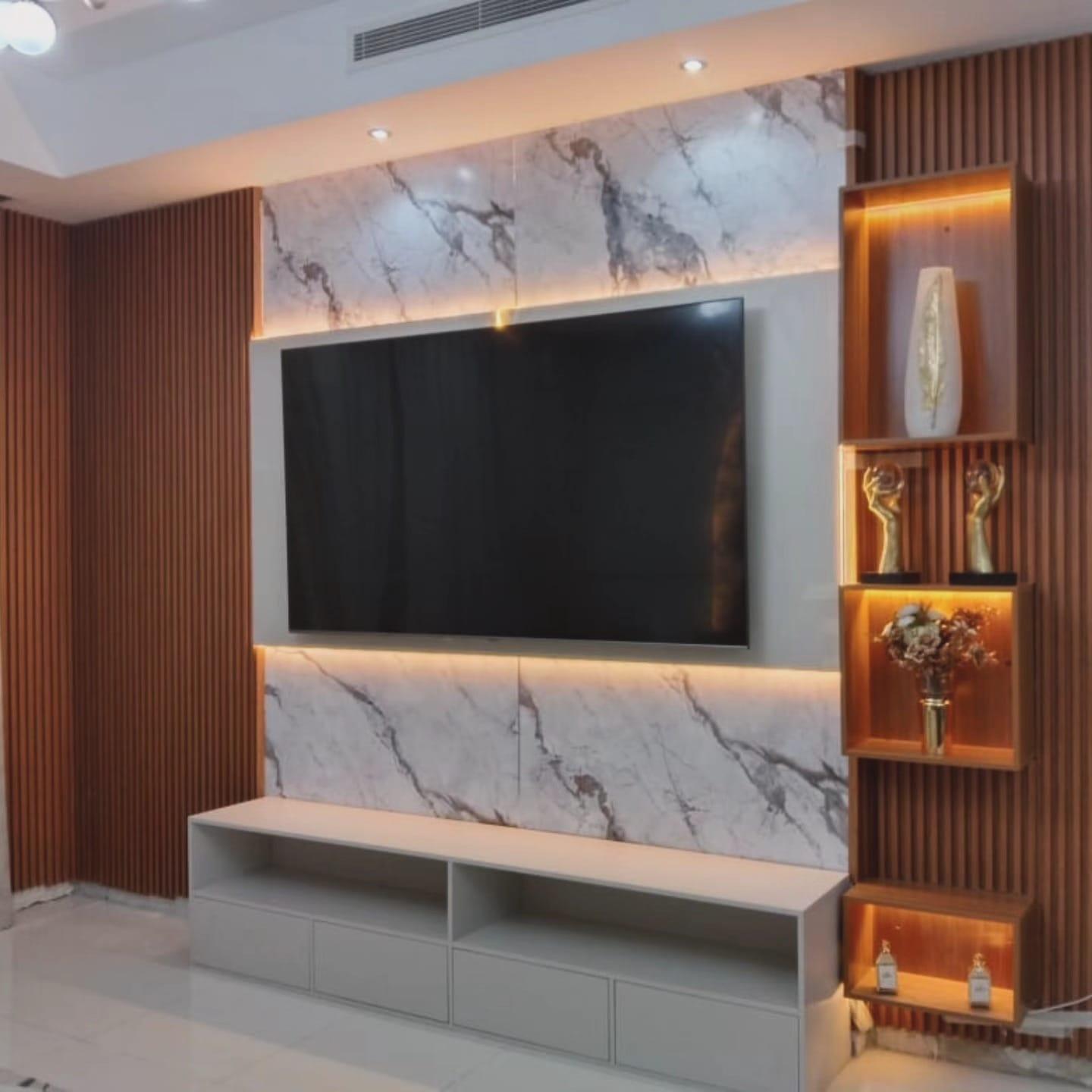
Safety: a TV standing on a unit must be anchored
A television on any piece of furniture can tip, and the risk is highest with small children. The US Consumer Product Safety Commission's release of 9 February 2023 says to anchor TVs and furniture such as bookcases and dressers securely to the wall, and to place TVs on a sturdy, low base and push them back as far as possible, particularly where anchoring is not possible. Its figures are American (an estimated annual average of 19,400 emergency-department-treated tip-over injuries between 2019 and 2021), but the physics does not change with the country.
So whichever option you choose, treat the fixing as part of the job. A TV on a unit needs an anti-tip strap or bracket into a wall that can take it. A TV on a wall needs a bracket rated for the screen into the right fixings. Those depend on the wall: MantelMount's guide lists different anchors for metal studs, brick, concrete and plaster, which is why our drawing records what your wall is made of. Ask whoever supplies the piece, in writing, how the TV and the unit are fixed; a quotation that does not mention it has not answered the question. Our checklist for reading a media wall quotation lists the mounting line to look for.
Small rooms and floor depth
In a compact living room the floor is the scarce resource. HomeKode's May 2026 guide to small UAE apartments says wall-mounted units that lift the piece off the floor are particularly effective, that deep units are worth avoiding in compact rooms, and that the TV unit is often the main storage of the whole room. A floating console and a thin panel follow all three points: they use almost no floor and still hold the router and the boxes.
That is why a compact wall is often the right answer in a smaller flat, and why a full wall of joinery is not automatically the better one. Compact or wall to wall compares the two. Planning a media wall walks through the measurements.
If the TV sits in the bedroom, a wardrobe with a TV bay can carry the screen instead of a separate piece.
The middle way: a compact panel and a floating console
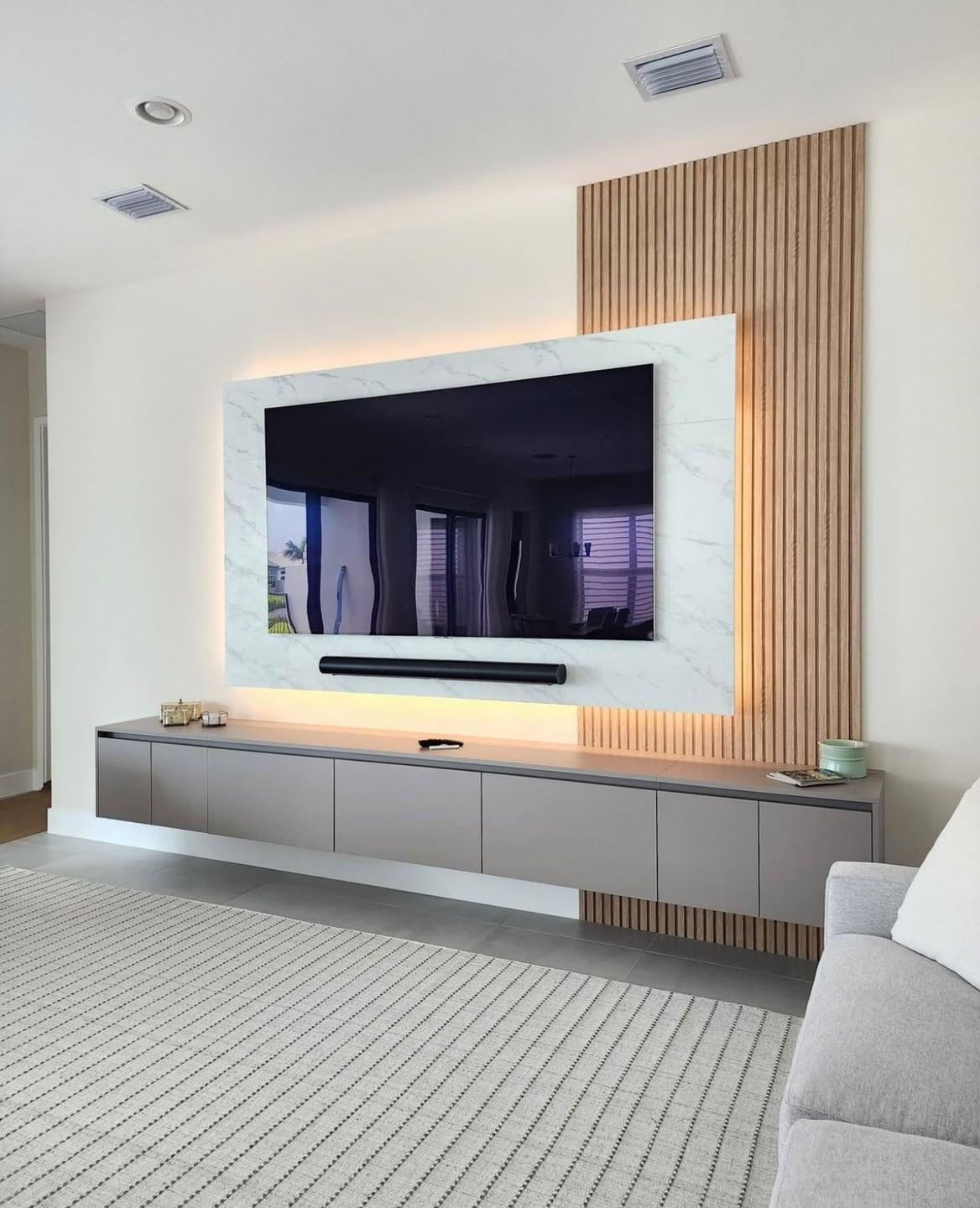
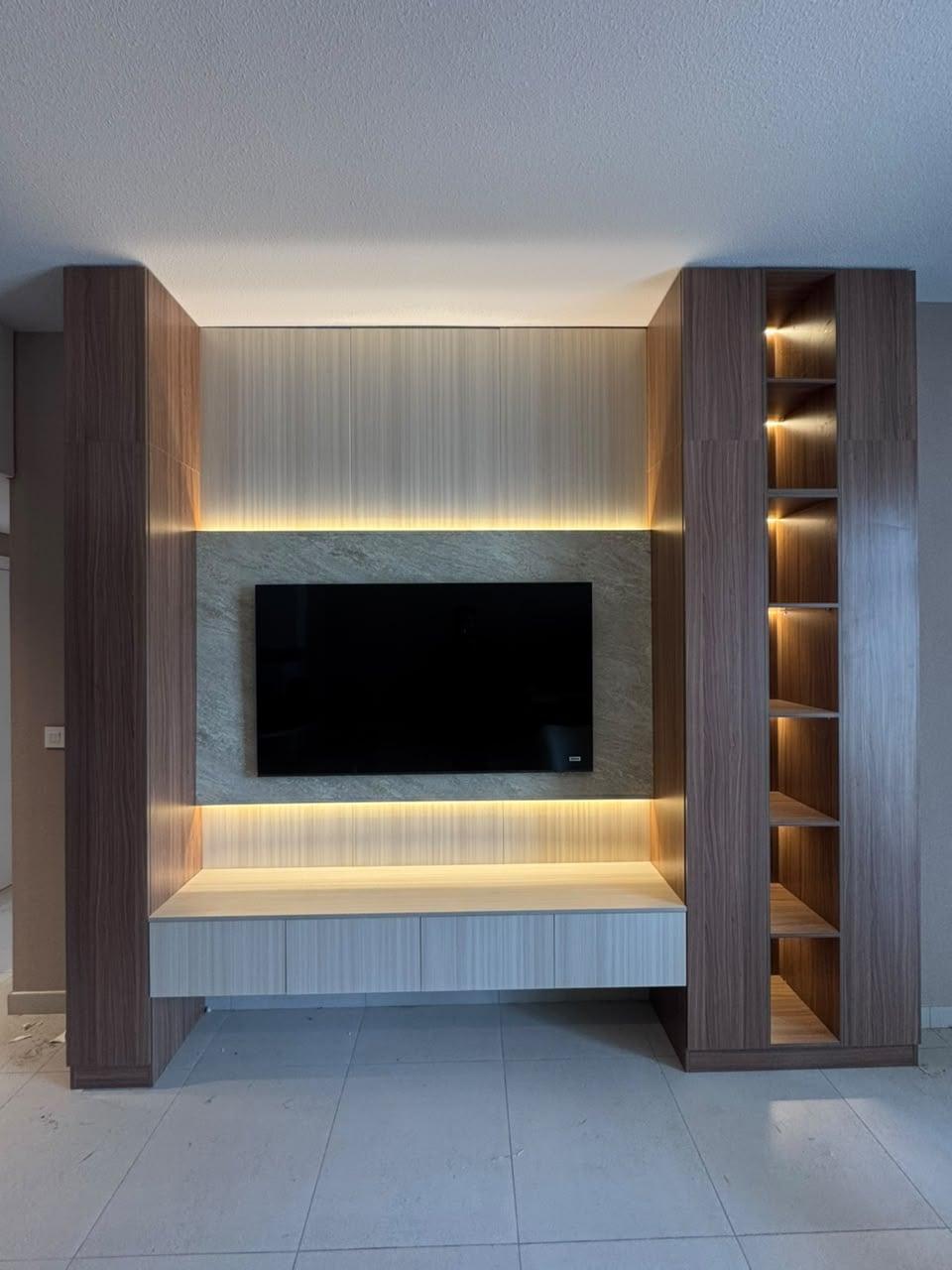
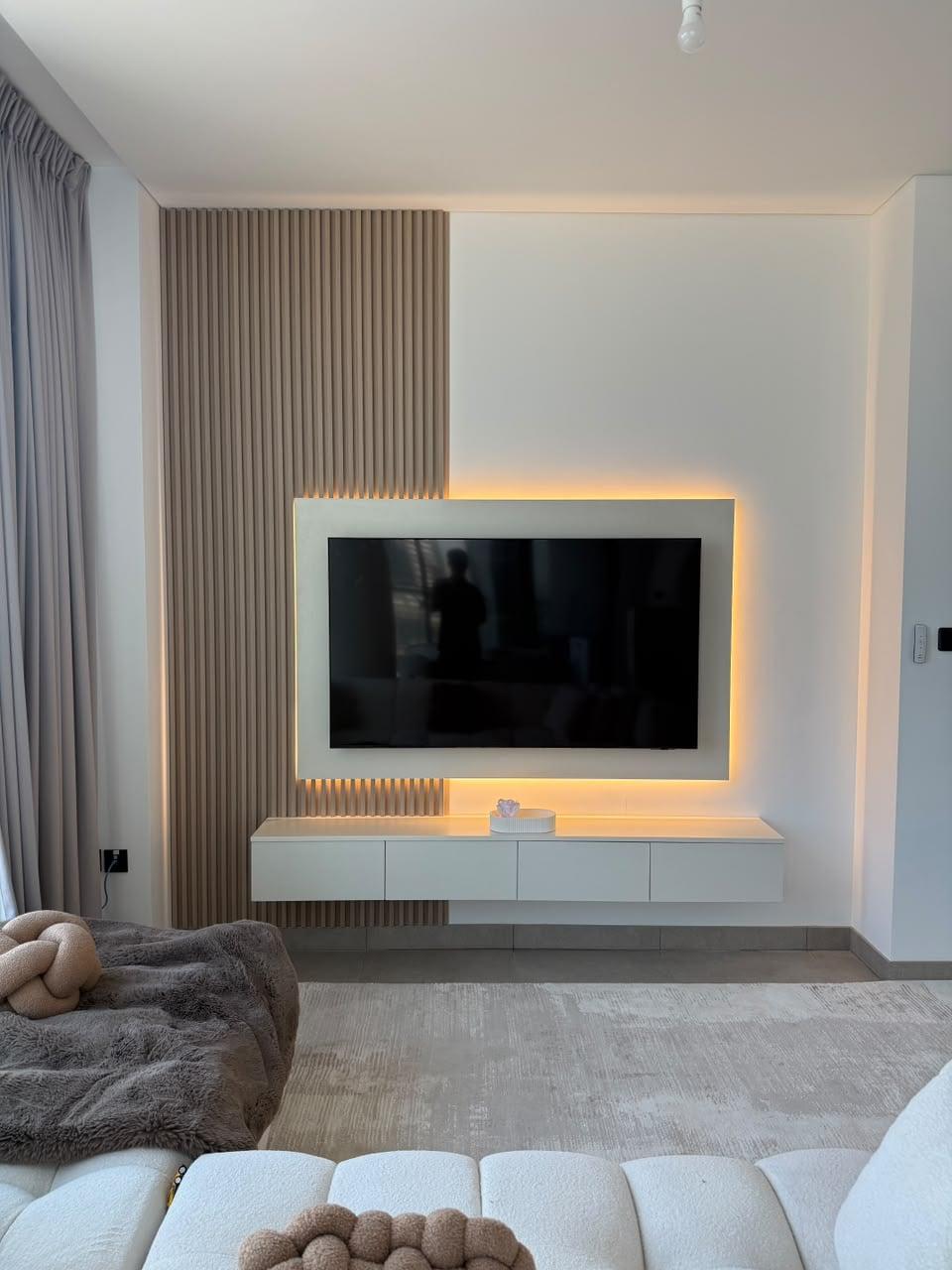
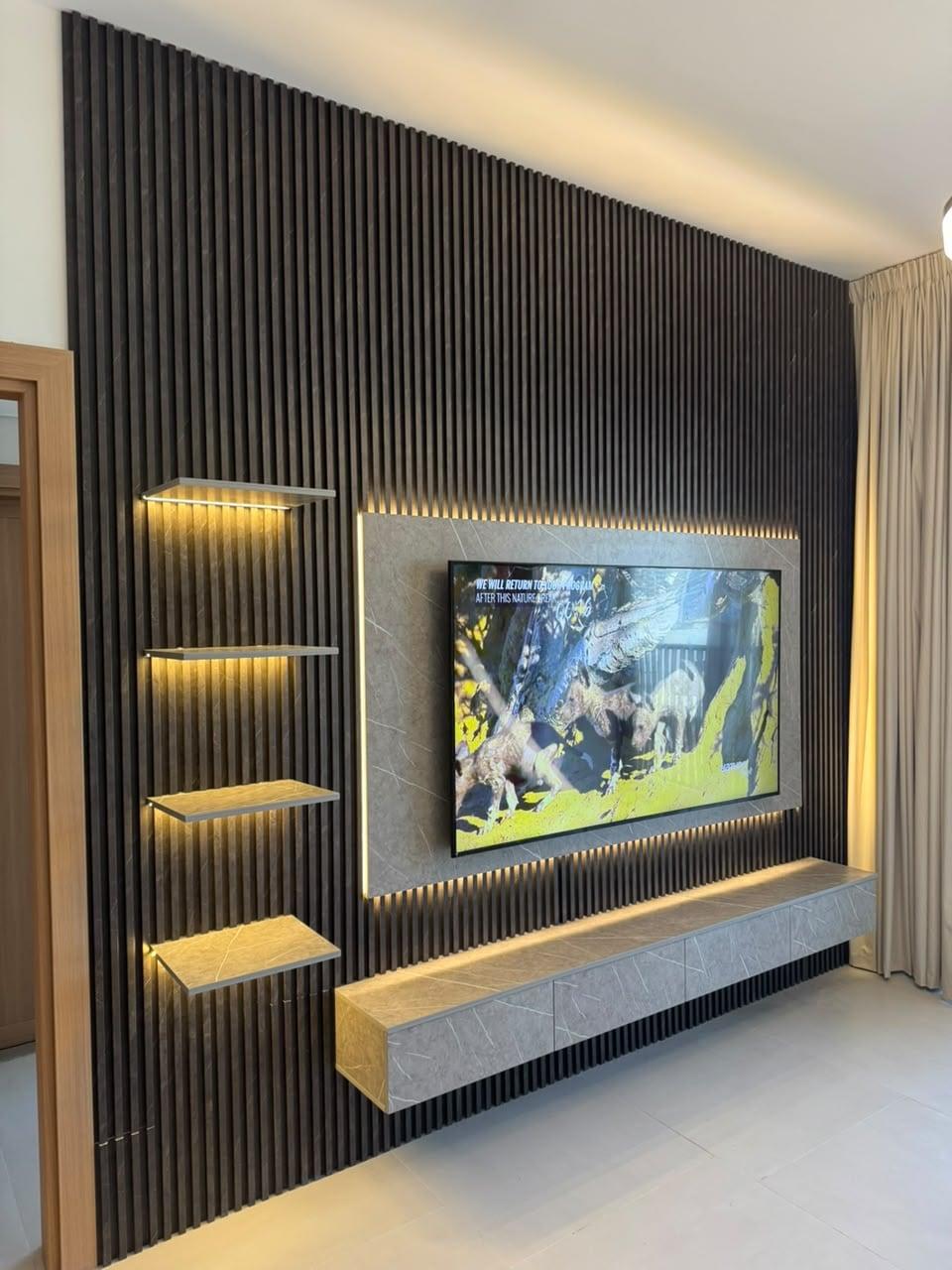
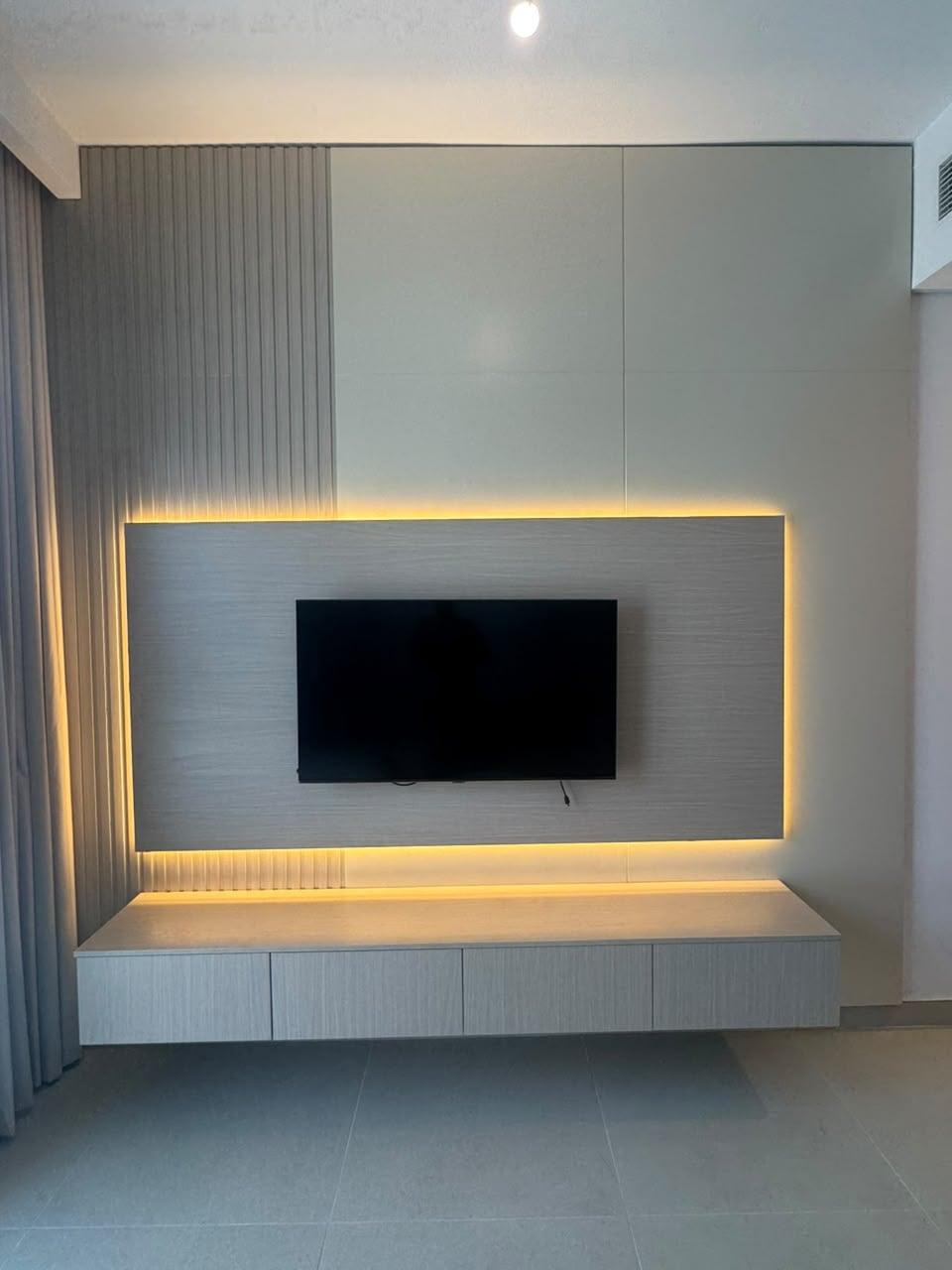
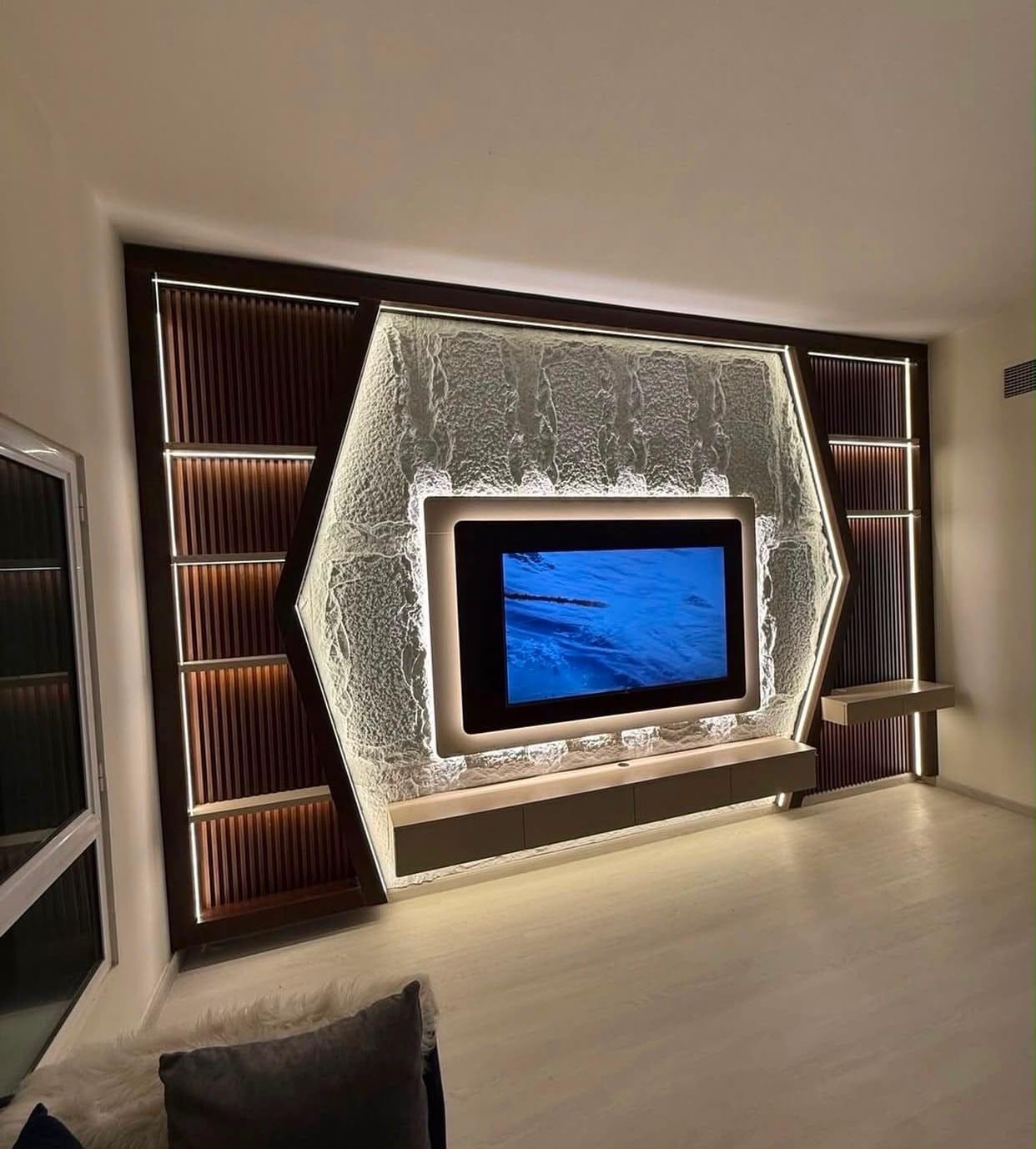
Between a stand and a wall of joinery sits the piece most buyers end up with: one backing panel behind the screen, a console hung beneath it, and perhaps one tall unit of shelves at one side. The cables vanish behind the panel, the console holds the equipment, the floor stays free for cleaning, and nothing covers the whole wall. Our entry brief, from AED 3,500 per project, is exactly this: a compact panel and a floating console in standard laminate. The final figure comes from the quotation, after the measuring visit, and depends on the wall size and the finish. Design ideas shows what the combinations look like.
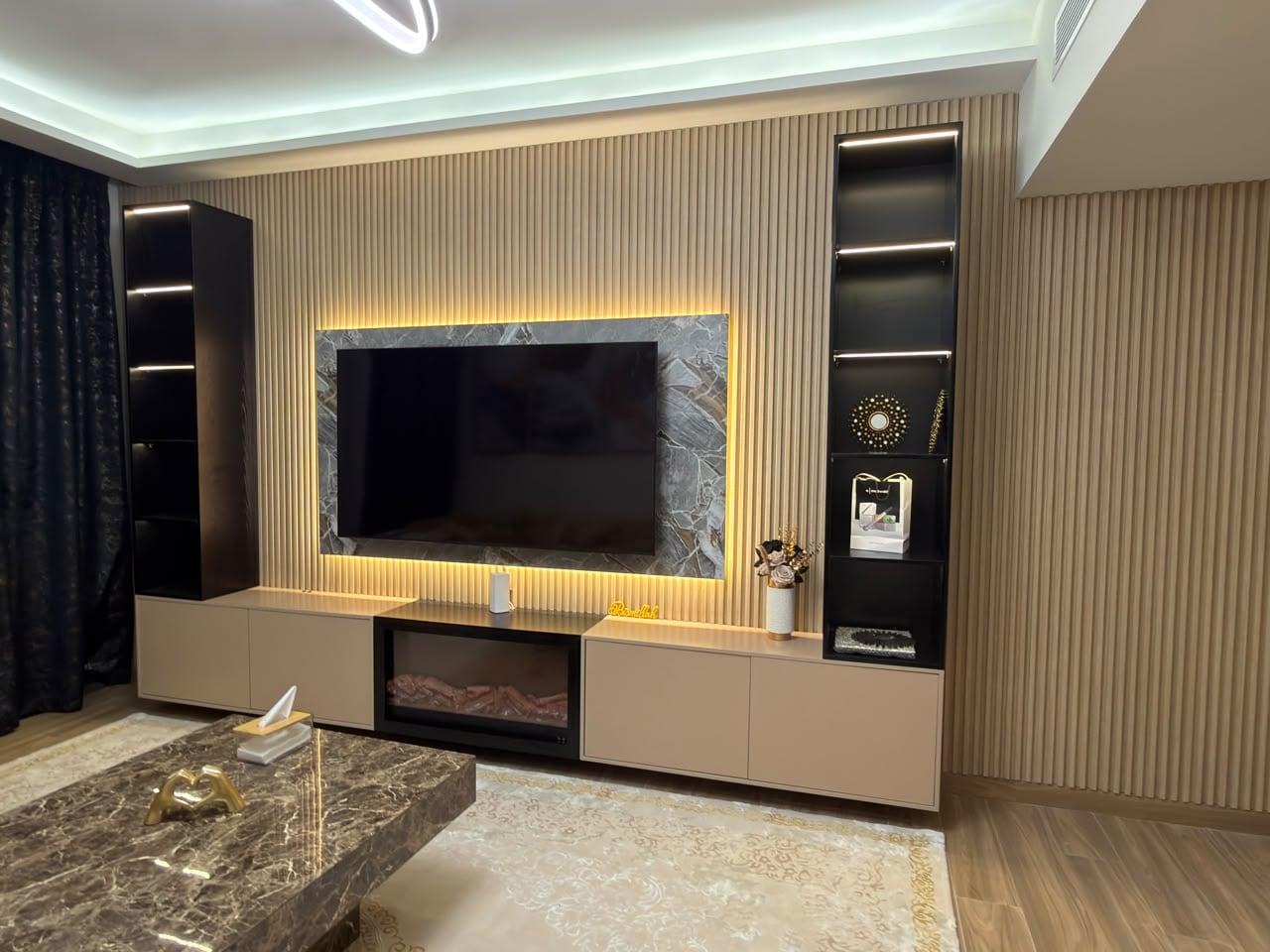
From that start, you add only what you will use. Slats, a marble-effect surface, LED lighting and an electric fireplace each become a separate line, so you can leave any of them out. The slatted wall guide is the usual first read for texture. For mood, start with LED lighting ideas.
Prefer a stone look? See marble-effect options. Considering a fire feature? Read about an electric fireplace.
Six questions that settle it
Answer these honestly and the choice usually makes itself. If four or more answers point one way, go that way; if they split, take the middle way.
- Will you leave this home within about three years? A unit travels; a wall does not.
- May the room be rearranged soon? A unit moves with it; a wall fixes the TV position.
- Must cables and boxes disappear? That is the wall's clearest advantage.
- Do you have things to display, or only things to hide? Lit shelves belong to the wall; closed storage works in both.
- Is the room small? A compact wall or floating console saves floor that a deep unit takes.
- Are there small children? Anchor either choice to the wall, as the safety section says.
Four imagined homes, four different answers
Rules are easier to trust once you see them applied. The four homes below are imagined, not customers, and none carries a price. They only show how the six questions play out when the answers are mixed, which is how they usually are.
A couple rent a one-bedroom flat on a one-year contract and expect to move within two years. Nobody has told them whether the walls may be drilled. Four of the six questions point to a unit: they may leave soon, the room will probably be rearranged, the wall is not theirs, and they have little to display. They choose a low unit with a flat top deeper than the feet of the TV, and they ask the landlord in writing whether a small anti-tip fixing is allowed. If the answer is no, the advice quoted above still applies: a sturdy, low base, with the TV pushed back as far as it will go. Mood comes from a lamp that moves with them.
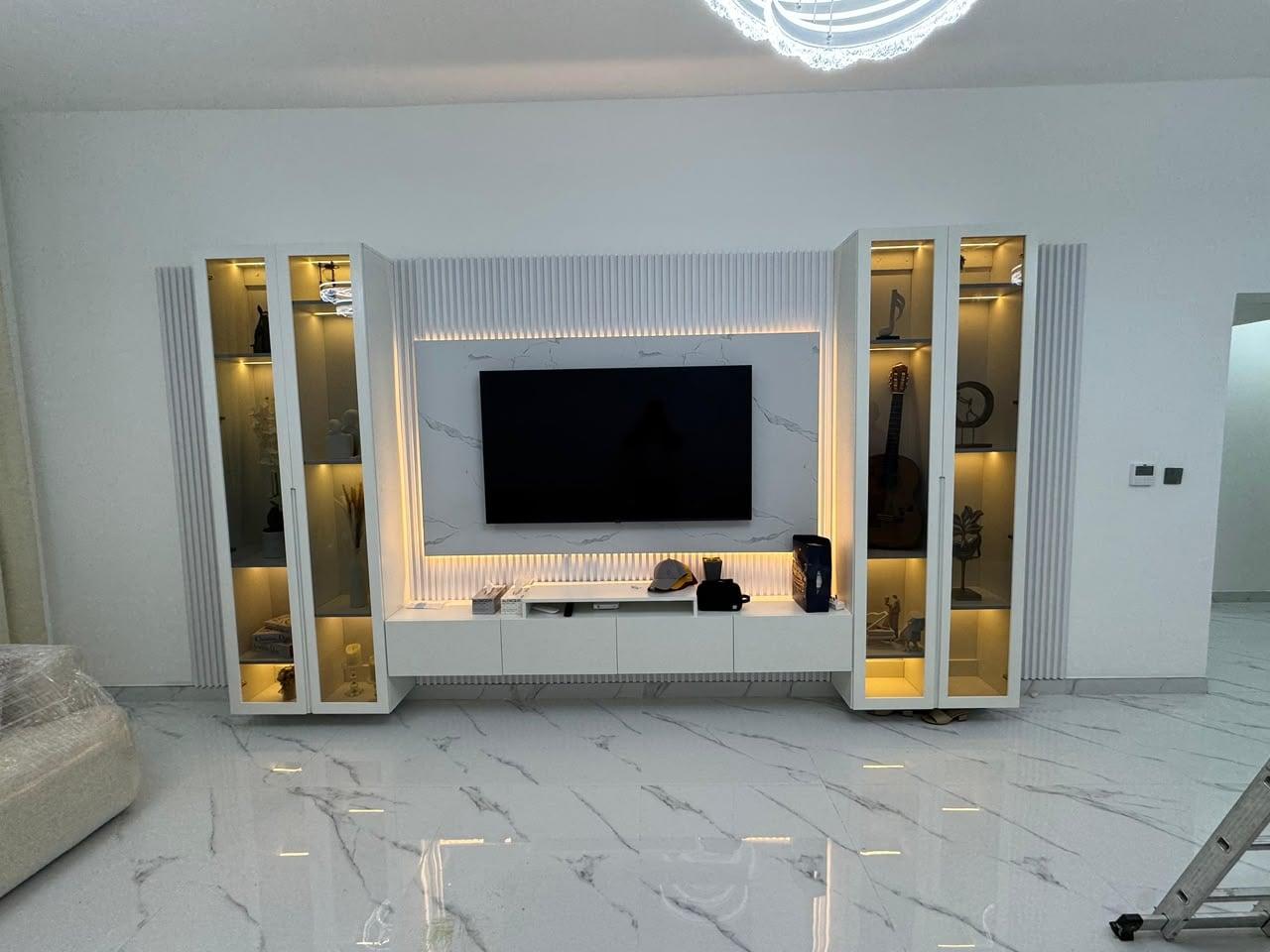
A family own their apartment and plan to stay for many years. They have two children under six, a large TV, a games console, a soundbar and a router, and at present the leads hang in a loop behind the sofa wall. The wall wins on cables, on staying, and on the need to plan every socket; the children make the fixing non-negotiable. Because the living room is not large, they take the middle way: a compact panel, a floating console that keeps the floor open for the children to play on, and one tall unit with closed doors at the side for the things they would rather not see. The cable route and the bracket are written on the drawing before they approve it.
A homeowner has a long living room, a collection of books and a wall of framed photographs. Here the answers to the display and staying questions are strong, and floor depth is not a problem because the room is generous. A fuller wall makes sense: lit shelving on both sides of the screen, a console as long as the room allows and a panel sized for a larger TV than today's. The caution is the one from the owner's side of the table: leave margin around the screen, so that a bigger television in a few years does not mean rebuilding the centre of the wall.
A family rent, but have signed a long tenancy and do not expect to move soon. Their answers split three against three, which is exactly the case for the middle way. Because the wall is not theirs, they first ask the landlord or building management in writing whether panels may be fixed to it, and they keep the answer. If the answer is yes, they build the compact version and treat it as a piece of the home they leave behind or ask to take with them; if it is no, they buy a unit and revisit the question at the next renewal.
What to measure before you decide
A measurement that was never taken is the easiest problem to prevent with either option. The list below is short on purpose. Take each one with a tape measure and a phone camera, and keep the photos: they are also what we ask for when you write to us.
Seven things to measure before you choose
Width of the whole TV, and of its stand or feet
- Why it matters
- A unit has to carry the stand fully; a wall panel has to frame the screen with margin
- Which choice it affects
- Both
Distance from the sofa to the screen
- Why it matters
- Sets the comfortable screen size and, with it, the panel or unit width
- Which choice it affects
- Both
Floor depth you can lose before the walkway tightens
- Why it matters
- A deep unit or a deep wall takes floor from the room
- Which choice it affects
- Unit and full wall most
Position of the sockets and the aerial or network points
- Why it matters
- Decides how far the leads run and what has to be moved
- Which choice it affects
- Both; the wall can reroute them
What the wall is made of (concrete, block, plasterboard)
- Why it matters
- The fixing for a bracket or an anti-tip strap depends on it
- Which choice it affects
- Both
Obstructions: door swing, curtain track, air-conditioning vent, window
- Why it matters
- A piece too close to a door or a vent causes trouble later
- Which choice it affects
- Both
The height of your eyes when seated
- Why it matters
- Sets the centre of the screen; the KEF guide starts here
- Which choice it affects
- Both
A checklist for the room, not a specification. Photographs of the whole wall help whoever draws the piece.
Living with each choice day to day
A decision made on a showroom visit is not the same as one made for a Tuesday evening two years from now. Four everyday things show the difference between the options better than a feature list does.
Dust and cleaning come first. Open shelves and slat gaps collect dust on any piece, but a floating console leaves the floor clear for a mop or a robot cleaner, and a unit standing on the floor does not. Closed doors on the tall unit keep ornaments cleaner than open bays, while lit open bays are what make a wall look finished; decide which of the two you will actually dust.
Heat and air come second. Boxes and consoles warm the space around them. Whatever you choose, ask how the equipment gets air: a console with doors fully closed over a box can trap heat, and a bay open at the back, or a gap left in the panel, solves it. Raise it with whoever draws the piece, rather than discovering it after the doors are hung.
New equipment comes third. Streaming boxes, soundbars and consoles arrive and leave every few years. A unit lets you shift them around freely, since nothing is fixed. A wall is happy with new equipment only if a spare socket and an accessible cable route were planned at the start, which is a good reason to ask for both on the drawing.
Children and visitors come last. Corners at head height, drawers that open wide, a loose shelf that can be pulled over: all of these belong in the conversation with whoever supplies the piece. The safety point from earlier applies to every option, and the quotation should say how each part is fixed.
Light and mood with either choice
Lighting is where the two options feel most different in the evening, so it is worth deciding on purpose. With a unit, light comes from outside the piece: a floor lamp, a table lamp, a plug-in strip behind the screen. That is flexible and cheap to change, and the lamps move with you when you leave. The cost is cables of its own, and light that is rarely placed exactly where it helps.
With a wall, light is part of the build. LED lines can edge the panel, run under shelves or glow in a niche, and everything is wired to a driver that sits out of sight. The advantage is a finished look with no loose leads. The thing to ask is where the driver sits and how it is reached if it fails, since a part that cannot be reached means opening the wall. Our channels come in warm 3000K and neutral 4000K, and whether they dim is a line on the drawing.
Whichever you choose, keep a bright light from shining straight onto the screen, because glare in the picture is more tiring than a dim room. A soft light behind or beside the screen, and a switch you can reach from the sofa, matter more than the number of fittings. Test the mood in the room at the hour you actually watch before settling it.
Starting with a unit and upgrading later
Not everyone has to choose once. A common and sensible path is to start with a low unit, live in the room for a year, and learn how the family really uses the wall before commissioning anything fixed. It costs little in patience and avoids a costly error in this whole decision: drawing a permanent wall around a habit you have not yet formed.
If you take that path, make the unit a good one: low, sturdy, with a top deeper than the TV's feet, and chosen to be reusable as a bedroom or study unit later. Keep the cable route tidy from the start, with a power strip and a spare socket for whatever you add. When you do commission the wall, bring the photos you took while living with the unit: where you put the remote, where the router lives and which side the sunlight hits. That information is worth more to a drawing than any inspiration picture.
The reverse path is rarely sensible: building a full wall first and discovering that the family wants a different layout. For that reason, the step to take right after a first visit to a showroom or a website is to measure and to talk it through with a person who will draw it, not to pick a finish.
If your answer is a unit: what to look for
A unit is not the lesser choice, and a good one earns its place for years. Check four things before you buy any. The top must be wider and deeper than the stand or feet of the TV, so that the whole screen sits on it with room to spare. The piece should stand level and steady when you lean on it, because a wobble at table height becomes a tip at TV height. The back should be open or slotted for cables, with room for a power strip, so the leads do not have to bend sharply against the wall. And the unit should be low: the lower the centre of the screen, the more you look down, and the less restful the picture.
Then fix it. Ask the seller, or whoever builds it, for the anti-tip strap or bracket and how it goes into your wall, and note what the wall is made of before you buy it. If the unit is made to measure, the drawing should show the strap position, the cable opening and where the equipment gets air. If it is bought ready-made, you carry those questions yourself.
If your answer is a wall: what to ask for on the drawing
A wall is decided on paper, so the drawing is where you protect yourself. Ask that it shows the screen at the size you intend, with margin around it; the position of every socket and the route of the cables; the bracket and what it fixes into; where the driver for the lights sits and how it is reached; which doors and drawers open and how far; and what stays open and what is closed. A wall that looks right on a photograph can still be wrong at your sofa, so ask for the measurement from the floor to the centre of the screen as well.
Approve the drawing only when you could explain every line of it to someone else. Changes cost least on the drawing and most after production starts, which is why our process puts the free measuring visit and your approval before any board is cut.
Mistakes worth avoiding with either choice
These are the errors that are easiest to prevent at the planning stage and hardest to fix afterwards. Each is stated as a plain rule rather than as a claim about how often it happens.
- Buying a unit before measuring the TV's stand. The unit must carry the stand completely; a few centimetres of overhang is a risk, not a style.
- Drawing the wall around today's television. Leave margin so a larger screen fits without rebuilding the panel.
- Fixing nothing. A TV on a unit without an anti-tip fixing, or a TV on a wall with a bracket that was not chosen for its weight, leaves the one risk the safety bodies warn about unaddressed.
- Forgetting the electrics. Count the devices that need power and add one spare socket; ask who does the electrical work.
- Choosing the finish first and the layout second. The layout (where the screen sits, where the cables go, what is closed and what is open) is the decision; the finish is what you choose after.
- Ordering a fixed wall in rented property without written permission. Ask your landlord or building management in writing first and keep the reply.
- Comparing a unit and a wall by total alone. A unit total and a wall total describe different things, so compare what each includes, line by line.
When the choice is still unclear
Sometimes the six questions split evenly and the evening plan still leaves you undecided. That is a normal result, not a failure, and it usually means the middle way is the right one. Do not force a decision at that point. Send the photos and the TV size and ask for a drawing of the compact version: seeing the panel, the console and the cable route on paper settles many doubts that a list of pros and cons cannot. You can then compare that drawing with a unit you could buy, and the difference will be concrete.
If the drawing still does not settle it, the unit is the safe choice for now. It leaves every option open, and the measurements, photographs and notes you made will be ready when you do commission a wall.
A plan for one evening
If you want to settle the choice in a single sitting, the steps below take about an hour. They do not need a showroom, and they work whichever supplier you eventually use.
- Step 1: photograph the whole wall straight on, and again from the sofa. Put the photos in one folder.
- Step 2: write the TV size, or the model you intend to buy, and measure the width of its stand.
- Step 3: answer the six questions above and count how many point each way.
- Step 4: if you rent, write to your landlord or building management and ask in writing about fixings. Keep the reply.
- Step 5: note any equipment that has to sit near the screen and how many sockets it needs.
- Step 6: decide your first choice: unit, middle way or full wall. Write one sentence on why, so that a later change of mind is a conscious one.
- Step 7: send the photos, the TV size and the one sentence on WhatsApp, and ask what the quotation will need to name.
What we do, and how to start on WhatsApp
We build both made-to-measure TV wall units and floating consoles and complete media walls in our Sharjah workshop, and our own fitters install them across the UAE. The measuring visit is free; the drawing shows the panel, the console, the cable route and the fixing, and you approve it before production. Once the details are agreed and a 60% advance is paid, production starts. A wall is usually ready up to about 10 days after order confirmation, depending on its size and design. The wood-based boards carry our 5-year limited warranty; hinges, runners, labour and misuse are outside it.
The quickest start is a message on WhatsApp. Send a photo of the whole wall, the TV size (or the model you plan to buy) and which room it is, and say whether you rent or own. With that we can tell you which of the options fits and what the quotation would need to name. What to send before the visit lists it in full. When the quotations arrive, our quotation checklist shows how to read them line by line.
Our media walls service page shows more work. The TV wall units and floating consoles page shows the lower-key option.
For open shelving, see media walls with display shelving. For fully made-to-measure designs, see custom media walls.
In Sharjah itself, media walls in Sharjah has the local details. Our pricing guide tool helps you plan a first budget.
Common questions
Is a media wall better than a TV unit?
Neither is better for everyone: a media wall suits owners who want cables and storage planned as one piece, a unit suits renters and rooms that may change. What a media wall is.
Can I mount the TV on the wall and still use a unit?
Yes, and many homes do: the screen goes on the wall and a low unit or floating console sits beneath it. TV height on a media wall.
Do I need permission to fit a media wall in a rented flat?
Ask your landlord or building management in writing before fixing panels to the wall. We cannot answer that for your building. Rented-flat wardrobe thinking.
How much does a media wall cost compared with a TV unit?
Our media walls start from AED 3,500 per project (a compact panel and floating console in standard laminate); the final figure comes from the quotation. Media wall price guide.
Do I have to anchor a TV that stands on a unit?
Yes: safety bodies advise anchoring TVs and furniture to the wall, especially with small children in the home. Media wall quotation checklist.
Which is better for a small living room?
A floating console with a compact panel usually saves the most floor. Compact or wall-to-wall media wall.
What should I send you on WhatsApp to get started?
A photo of the whole wall, the TV size and the room, plus whether you rent or own. What to send before the visit.

Sources & specifications
Manufacturer information applies to the named products and systems. Sources reviewed on 9 November 2026.
- US CPSC news release, 9 Feb 2023: anchor TVs and furniture; tip-over injury figurescpsc.gov(opens in a new tab)
- HomeKode, 21 May 2026: small living room TV unit ideas in UAE apartmentshomekode.com(opens in a new tab)
- MantelMount, 10 Dec 2025: mounting a TV on metal studs, brick, concrete and plaster (anchors depend on the wall)mantelmount.com(opens in a new tab)
- KEF, 27 Nov 2025: how to calculate the ideal TV height (from seated eye level)us.kef.com(opens in a new tab)
Want this planned for your home?
Consultation and measurement are free. Tell us the rooms, location and what you need; we arrange a sample visit and define the measured quotation.