Media Walls · 22 min read · 6 September 2026
Humidity and AC behind a media wall: protecting the boards
Humid air does not ruin a TV wall by itself; a damp outside wall, an AC drip, mop water and unfinished edges do. Where to look, what to ask for in the quotation and how to read one board datasheet, with each source named.

By Ali Haider Basra, Founder, Al Tareeq Decor · Contact our workshop
Key takeaways
- Humid air alone does not ruin a TV wall: boards follow the air's humidity slowly (US Forest Service), and the real threats are a damp outside wall, an AC drip, mop water and unfinished cut edges.
- The AC helps while it runs (the EPA says HVAC removes moisture), but a blocked drain or an AC left off after mopping raises humidity or drips onto the wall.
- Check the wall behind the panels first: a cold outside wall, a stain or a damp patch is a building problem, fixed by the right trade before any joinery.
- Ask for the board and its datasheet in the quotation; one low-swelling MDF sheet we opened is for 'dry conditions' yet talks of good behaviour in humid ones, so read the class, not the adjective.
- We quote no UAE humidity average because we opened no official dataset; the EPA's 60 percent and 30 to 50 percent are US guidance, not a UAE standard.
On this page
- Key takeaways
- Does a media wall swell in UAE humidity? The short answer
- Humidity and a media wall at a glance
- What wood and the air do to each other
- The wall behind the panels
- Four places moisture reaches the boards
- The AC: it dries the air, and it can also drip
- Edges, cut-outs and the floor line
- Questions to ask, and what a good answer sounds like
- Reading a board datasheet without being fooled
- Three walls, three different decisions
- Mistakes that cause most moisture trouble
- A short checklist to run before you order
- What a good quotation says about moisture
- A rented flat and a wall you do not own
- Living with the wall afterwards
- Signs to watch, and who to call
- What we do about it
- Common questions
Does a media wall swell in UAE humidity? The short answer
A media wall in a normal air-conditioned UAE home does not swell just because the air is humid. What hurts boards is liquid water or a damp wall reaching them: a cold outside wall behind the panels, an air-conditioner drain that drips, mop water at the base, a cut edge nobody finished. Wood-based boards do follow the humidity of the air, slowly, so a wall that is dry and cool all year is a much easier job than one on a sweating outside wall. A compact panel and console, as in full wall or compact media wall, also leaves less board against the wall than a full-height design.
This guide says where moisture really reaches a TV wall, what the AC does both for and against you, and what to ask for in the quotation so the board and its edges are chosen for your wall. It quotes no UAE humidity average, because we opened no official dataset; the figures it does give come from the sources named in the text, and the one board datasheet it uses is treated as one product, not as a rule for all MDF. If you are still choosing materials, start with MDF, WPC, PVC and wood panels compared.
Humidity and a media wall at a glance
Does humid air alone ruin the boards?
- Short answer
- Boards follow the air's humidity slowly; liquid water and damp walls are the real threat
- Where it is covered
- This section and the next
Which wall is the risk?
- Short answer
- An outside or cold wall behind the panels
- Where it is covered
- The wall behind the panels
What does the AC do?
- Short answer
- It removes moisture while it runs; a blocked drain or an AC left off changes that
- Where it is covered
- The AC section
Where do boards fail first?
- Short answer
- Cut edges, socket cut-outs and the base
- Where it is covered
- Edges, cut-outs and the floor line
Is a low-swelling board enough?
- Short answer
- One datasheet itself says 'dry conditions'; read the class, not the adjective
- Where it is covered
- Reading a board datasheet
Sources are named in the text and under the article. The EPA figure quoted later is US guidance for homes in general, not a UAE standard.
What wood and the air do to each other
Start with what a public wood reference says. A chapter of the US Forest Service's Wood Handbook states that the moisture remaining in wood tends to come to equilibrium with the relative humidity of the surrounding air, and that if moisture content is controlled within reasonable limits, major problems from dimensional changes can usually be avoided. Read plainly: boards take up and give back moisture with the room, slowly, and the aim is to keep that swing small. If you are new to the idea, what a media wall is explains the parts. A media wall in a living room that is cooled all day swings very little; one on a wet outside wall, or in a room where the AC is off for weeks, swings more.
The US EPA, in its guide to moisture in the home, advises keeping indoor humidity below 60 percent, ideally between 30 and 50 percent, if possible, and says condensation can be a sign of high humidity. That is US guidance for homes in general; we found no UAE equivalent, so treat it as a rule of thumb from one authority and not as a promise about your wall. A cheap humidity meter on the TV wall shows your own room better than any average.
The same wood chemistry is why a wardrobe and a media wall share advice. If you want the wider picture of where indoor moisture comes from, humidity and wardrobes in UAE homes walks through bathrooms, laundry and cold surfaces, and its habits apply to a TV wall too.
The wall behind the panels
The first thing we look at on a visit is the wall the media wall will stand against. The EPA's mould course says that when warm, humid air contacts a cold surface, condensation may form, and that mould is frequently found on walls in cold corners behind furniture where condensation forms. A media wall is furniture the size of the wall, and a bedroom TV wall often shares that wall with a wardrobe, as a bedroom wardrobe with a TV unit shows. If the wall behind it is an outside wall, a shared wall with a bathroom or a wall that has ever shown a stain, the panels can trap that condensation against the board.
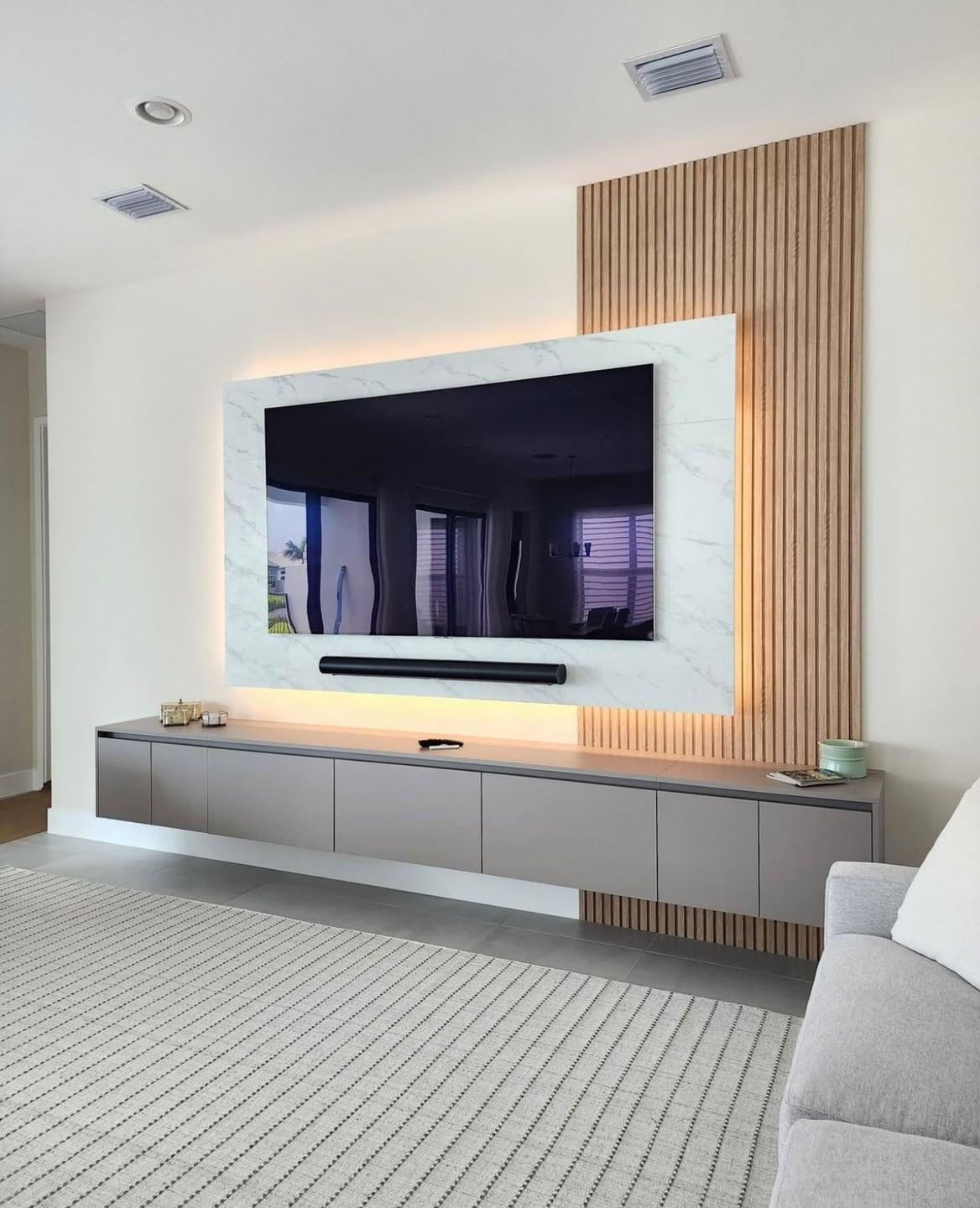
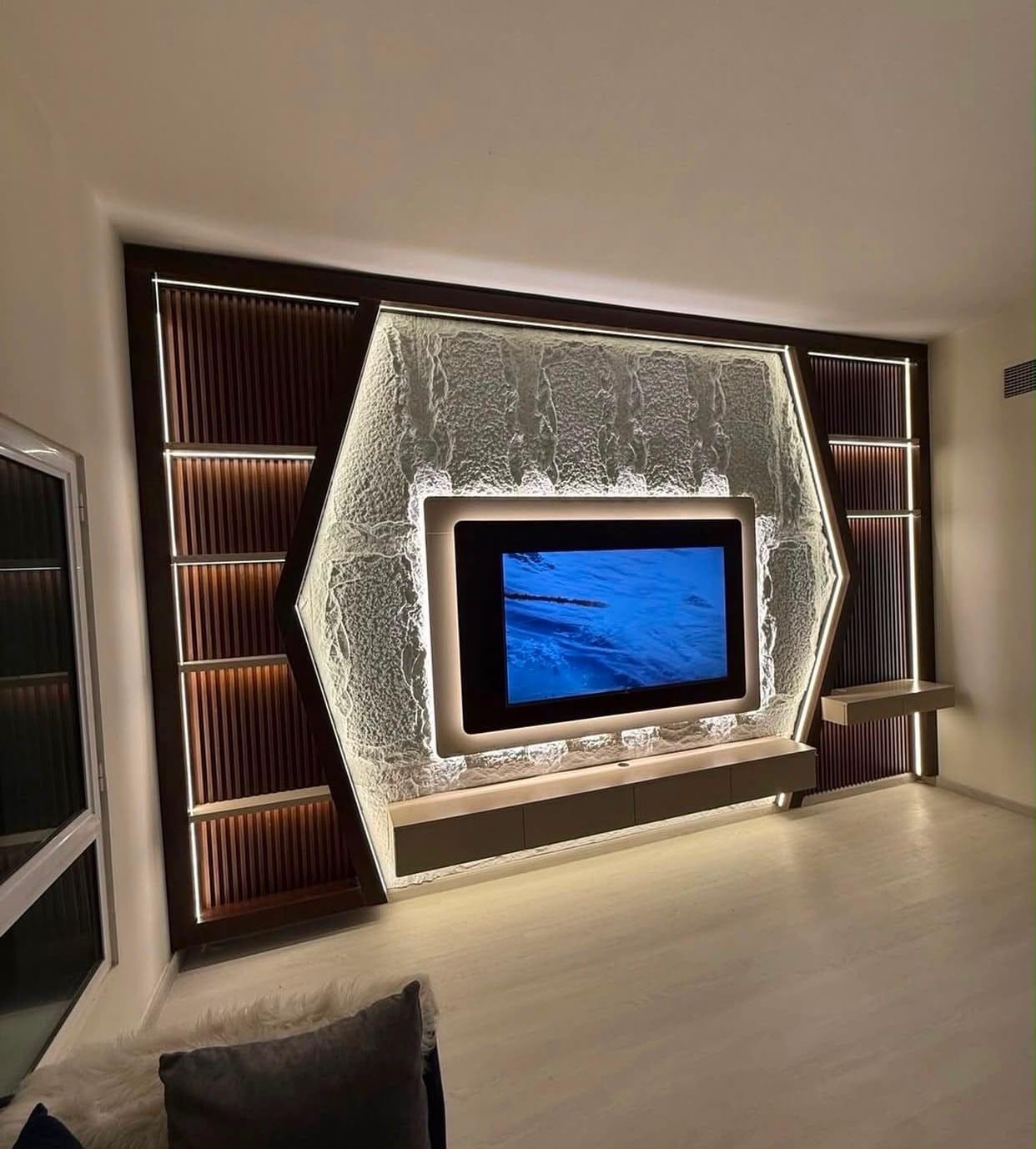
So the check is simple and costs nothing: look and touch. A patch that is colder than its neighbours, a tide mark, flaking paint, a musty smell near the skirting or a damp patch behind where a cabinet used to stand are all reasons to stop and ask why before a board is fixed over it. The photograph below shows a stone-effect panel (the choices are in marble and stone-look TV walls) and slatted side bays on a finished wall; whatever the finish, the wall behind is decided first.
In a rented flat, ask your landlord or building management in writing before anything is fixed to an outside wall, and keep the reply. A wall that shows damp is the landlord's or the building's to repair, with the right trade; we are joiners, we do not cure damp, and we say so at the visit so that a wall is not built over something still wet.
Four places moisture reaches the boards
The drawing puts the checks in order on a typical wall: the wall behind, the cut edges and cut-outs, the floor line and the AC above. The second half of the drawing shows five bars from a single board datasheet, which we explain further down. It has no UAE humidity number on it, because we have none we can source.
Every item on it is something you can ask about or look at before you order; none needs a lab. The text that follows takes them one at a time.
- 1. The wall behind: an outside or cold wall is where condensation forms behind furniture (US EPA)
- 2. Edges and cut-outs: ask how cut edges and socket cut-outs are finished; we publish no sealing method
- 3. The floor line: a floating console keeps the base off mop water, and mopping with the AC off raises humidity (US EPA)
- 4. The AC above: keep its drain line clear and fix a drip first, by an AC technician
The AC: it dries the air, and it can also drip
The air conditioner is on your side most of the time. The EPA's mould course says one function of a building's HVAC system is to remove moisture from the air before it is distributed, and that when the system is turned off during or shortly after major cleaning with a lot of water, such as mopping, the humidity may rise greatly. Translate that to a flat: if the unit is off for days while the family is away, or off after the floor has been washed, the TV wall sits in damper air than usual. Leaving the AC on a low setting when you are away is our suggestion, not a quoted rule, and your building may have its own.
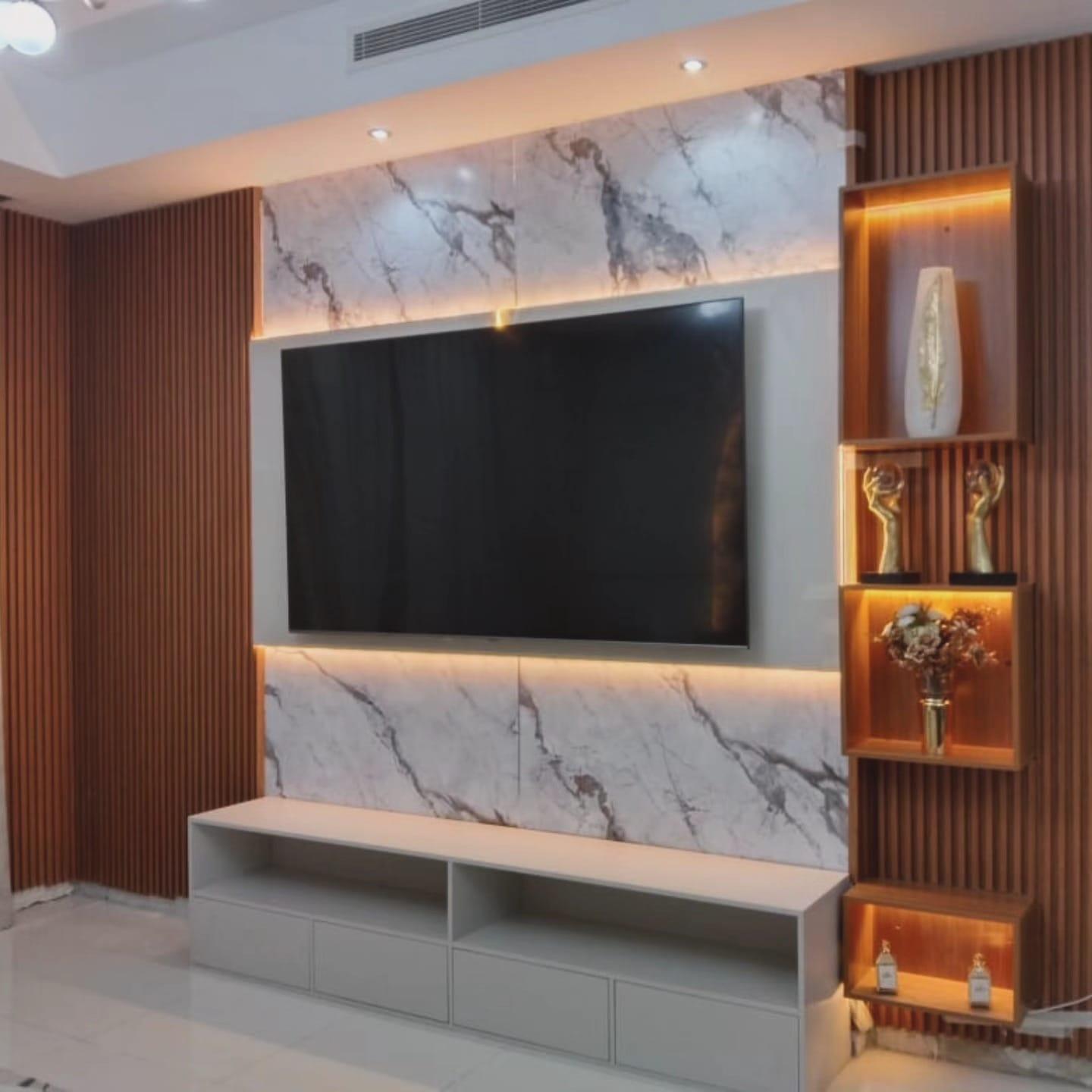
The AC is also a source, and a soundbar niche or a console drawn under a unit is the sort of detail the soundbar and speakers guide covers. The EPA's brief guide says to keep air conditioning drip pans clean and the drain lines unobstructed and flowing properly, and a drain that backs up or an indoor unit that drips lands exactly on the wall below it. Many media walls sit under a ceiling diffuser or a wall unit; in the photograph at the top of this page, the grille is directly above the wall. A stain below a unit is an AC technician's job, and it comes before any joinery.
A TV wall in an office or reception, as in office media wall design, has the same AC question. Planning where the unit and the TV wall sit relative to each other is part of the drawing, and our planning guide lists what to mark.
Edges, cut-outs and the floor line
Moisture enters a board where its protective face is cut. In a media wall those places are the edges, the cut-outs for sockets and cable passes, and the base near the floor. We found no source that gives a sealing method we can quote for these, and the owner has not published one, so we do not describe ours here; what you can do is ask the questions in the table below and get the answers written on the quotation.
The floor line is the plainest of the three. A floating console (see TV wall units and floating consoles and our media walls page), keeps the base off the floor, so mop water and spills have less to reach, and the slatted or panelled wall behind it can stop short of the floor. The EPA sentence about mopping with the system off is the reason to dry the floor and keep the AC running after a wash.
Cable and socket cut-outs deserve one thought. Every cut-out is an edge, and every extra one is more edge. Planning the routes once, as the cable and service-access guide describes, means fewer holes cut later; where a socket must move, which sockets can stay says how we decide.
Questions to ask, and what a good answer sounds like
The wall behind
- A good answer
- They looked at it and told you what they saw
- Who acts if there is a problem
- Landlord or building management, or a damp specialist
The board grade
- A good answer
- Named on the quotation, with the product's datasheet
- Who acts if there is a problem
- Ask the board supplier through the joiner
Cut edges and cut-outs
- A good answer
- How they are finished is written down
- Who acts if there is a problem
- Joiner, before production
The base and the floor
- A good answer
- Floating or lifted; the wall stops short of the floor
- Who acts if there is a problem
- Joiner, at the drawing
An AC unit above or beside
- A good answer
- Its position is marked on the drawing
- Who acts if there is a problem
- AC technician for drips or blocked drains
A rented flat
- A good answer
- You have the landlord's reply in writing
- Who acts if there is a problem
- Landlord or building management
We publish no board brand, back gap or sealing method; ask for these in the quotation.
Reading a board datasheet without being fooled
Board makers publish a datasheet for each product. We opened one as an example: Sonae Arauco's MDF Basic Low Swelling. It says the product is a medium-density fibreboard with improved swelling properties for basic applications in dry conditions, and, in its description, that it presents good behaviour in humid environments, with expansion and swelling inferior to the standard. Both sentences are on the same page. The label on a datasheet's cover is the one to hold the manufacturer to; an adjective in the description is not.
Its table lists the thickness swelling after 24 hours (test EN 317) as at most 18 percent for boards over 6 and up to 9 mm, 16 percent over 9 to 12, 14 percent over 12 to 19, 12 percent over 19 to 30 and 11 percent over 30 to 40 mm. On that sheet the thicker bands carry lower limits. It also says boards meet EN 622-5, type L-MDF, and that expansion and contraction in wood products is directly related to moisture content and must be considered during design and construction, and that boards must be stacked on a hard, level surface and protected from direct contact with water.
What this proves is narrow. It tells you how that one product is rated in one test; it does not tell you how any other MDF behaves, how it will behave on your wall, or that any grade is waterproof; the sheet makes no such claim. What it gives you is a way to ask: which product, which class, which thickness, and can I see the datasheet. We do not publish a brand for our boards; ask for the board and its datasheet in the quotation. Our materials guide lists what a quote should name. The grades are explained, with a wardrobe in mind, in moisture-resistant wardrobe boards; the logic carries over.
We found no source that ranks laminate, veneer and lacquer in UAE humidity, so we do not rank them here. The finishes we make are described in the panels guide. How a fluted face is built is in the fluted and slatted TV wall guide.
Three walls, three different decisions
Moisture advice only becomes useful when it is tied to a real wall, so here are three common situations and how we would think about each. None of them uses a humidity number, because the decision does not depend on one; it depends on what you can see, touch and ask.
The first is an inside wall in a living room that is cooled most of the year. Nothing on the wall is cold to the hand, the paint is clean, no unit sits above it and the floor is washed now and then. This is the easy case. The decisions are ordinary ones: choose the finish you like, keep the base off the floor with a floating console, and make sure the quotation names the board and says how edges and cut-outs are finished. Most media walls we are asked about fall here, and for them humidity is a reason to be tidy, not a reason to worry.
The second is an outside wall in a bedroom, perhaps one that is shared with a balcony door or sits in a corner. The EPA's mould course describes cold corners behind furniture as a place where condensation forms, so this is the wall to touch and photograph first. If it is dry, clean and the same temperature as its neighbours, a media wall can go ahead, and a little air behind the panels is a conversation worth having with the joiner. If there is a stain, a bubble or a smell, the order of work changes: the cause is found and fixed by the right trade, the wall is left to dry, and only then is anything drawn. A short delay is cheaper than rebuilding a wall.
The third is a wall with an air-conditioner above or beside it, which describes a large share of UAE living rooms. Here the AC is both the friend and the suspect. While it runs it takes moisture out of the air; if its drain is blocked it can drip on the wall below. So the drawing marks where the unit is, the TV wall avoids placing a recess or a soundbar niche directly under a drain point, and you ask the AC technician at the next service to confirm that the drain flows. That single question is cheaper than any amount of board grade.
Notice what the three cases share. In each, the first step is to look at the wall and the unit, the second is to write down what was seen, and the third is to choose the board and finish. Choosing the board first, and the wall second, is the order that goes wrong.
Mistakes that cause most moisture trouble
Fixing panels over a wall nobody has looked at. A tide mark, flaking paint or a cold patch is information. Boarding over it hides the information and keeps the cause. Look first, and ask your landlord or building management in writing if the wall is not yours to repair.
Mopping the floor and switching the AC off. The EPA's mould course warns that humidity may rise greatly when the system is off during or shortly after cleaning with a lot of water. If you wash the floor beside a TV wall, dry the edge of the floor and keep the AC running afterwards.
Letting an AC drip go on for weeks. A small drip below a unit looks harmless, but it keeps the same strip of wall wet. It is a service call to an AC technician, and the earlier it happens, the less there is to repair.
Treating the word 'moisture-resistant' as a guarantee. The datasheet we opened for this guide states 'dry conditions' in its first line and 'good behaviour in humid environments' in its description. The class and the test are what you hold the maker to, and no board is waterproof.
Ignoring the cut edge. Every socket, cable pass and shelf recess exposes the inside of the board. More cut-outs mean more edge, so plan the routes once and ask in writing how edges are finished.
Pushing a console flat to the floor and the wall with no gap to see behind. A floating or lifted base is easier to clean beneath, and it is easier to notice a problem. It also leaves the base out of reach of most mop water.
A short checklist to run before you order
Use this list at home, with your phone, before the visit. It takes about twenty minutes and it makes the conversation with any joiner more useful.
Step one: touch the wall where the media wall will stand, at three heights, and the wall next to it. Note any patch that feels colder or damper. Step two: look at the paint and the skirting for stains, bubbling, flaking or a tide mark, and take dated photos. Step three: find the AC unit or diffuser, note which side of the wall it is on and how far, and photograph it with the wall in the frame. Step four: look under the unit for a drip mark or a water stain on the ceiling or wall. Step five: note how the floor is cleaned and whether the AC is usually on when the family is away.
Step six: put a small humidity meter on the wall for a week if you are curious. It will not give you a legal answer, but it shows your own room, which is more useful than any average. Step seven: ask your landlord or building management in writing if the wall is an outside wall or shared with a bathroom, and keep the reply. Step eight: decide how much you want to show, because a wall of open shelves has more edge than a plain panel; see full wall or compact media wall.
Step nine: send the photos and the answers to us on WhatsApp with the TV size and the room. We reply with what we would check at the visit. At the visit we measure, look at the wall and the unit ourselves, and agree the finish, and the quotation then names the board so that you can ask for its datasheet.
What a good quotation says about moisture
A quotation is where good intentions become something you can check. On a media wall, six lines matter for the subject of this guide. The first names the board: the product and its class, not only 'MDF'. The second says where the datasheet can be seen. The third says how cut edges and socket cut-outs are finished, in the maker's own words. The fourth says whether the base is floating or lifted, and how high. The fifth marks the position of the AC unit on the drawing. The sixth records anything you were told about the wall, for example that it is an outside wall, so the joiner's decisions can be traced to what was known.
We do not publish a board brand, a back gap or a sealing method on this site, because the owner has not given us a figure we may state, so we will not invent one. What we do is tell you at the visit and write it on the quotation. If any joiner gives you a firm number in a chat message without seeing the wall, treat the number with caution; the wall decides it.
On warranty, be exact. Ours is a 5-year limited warranty on the wood-based boards only. Hinges, runners, labour and misuse are not covered, and damage from a leak, a drip or a wall that was wet before the work is the kind of thing the written terms address. Read them before you pay the advance, and ask us to point to the lines that cover boards.
A rented flat and a wall you do not own
If you rent, the wall belongs to someone else, and so does the answer to any damp question. Before anything is fixed to an outside wall, ask your landlord or building management in writing, say what you plan, and keep the reply with your photos. If the wall turns out to be damp, the repair is theirs to arrange with the right trade, and it should happen before the media wall, not after.
It also helps to think about what leaves with you. A design that is free-standing or easy to unscrew keeps the wall behind it visible and can move to your next home. Ask us at the visit what is practical for your wall, and we will say plainly if a fixed design is the wrong choice for a rental.
Living with the wall afterwards
Once the wall is up, the care is small. Wipe dust with a dry or barely damp cloth, and dry any spill straight away, especially near the base and around the sockets. Keep drinks and plant pots off open shelves that sit directly under an AC unit. Do not hang wet cloths or run a humidifier beside the wall.
Keep the AC serviced, and ask the technician to check the drain line, as the EPA's brief guide advises for drip pans and drains. If you go away for a long period, a low setting is kinder to wood-based boards than switching the unit off; that is our suggestion, not a quoted rule, and your building may have its own policy.
Look at the base and the edges twice a year. A raised edge, a darker patch or a swollen corner at the floor is the first sign; a dated photo is the best thing to send us. Then follow the order in the previous section: dry the area, find the source, call the right trade, and only then repair the board.
Signs to watch, and who to call
Most media walls never show a sign. If one does, the pattern tells you where to look: swelling or a raised edge at the base, a stain or bubbling on the wall behind a panel, a musty smell that follows the AC being off, or a drip below the unit. Take a dated photo, switch the AC on if it is off, and keep the area dry.
Then call the right person. A drip from an AC unit goes to an AC technician, a leaking pipe to a plumber and a damp wall to a building or waterproofing contractor, or to the landlord or building management in a rented flat. We can tell you at the visit what we see and what we would build around it, but a wall that is wet needs repair first, and nothing is built over it until it is dry.
If an electric fireplace is part of the design, the electric fireplace guide covers how it is planned into the wall. A rented flat has its own checklist, and a removable layout is sometimes the better route there; see the wardrobe version of that advice for a rented apartment for the questions to ask.
What we do about it
At the free measuring visit we look at the wall the media wall will stand against, where the AC unit and the sockets are, and what you plan to put on it, and we measure. The drawing and the quotation name the finish and the lighting, and the final figure comes from the quotation: wall size, finish (laminate, veneer or lacquer), marble-effect panels, lighting and an electric fireplace set it. Our media walls start from AED 3,500 per project, for a compact panel with a floating console in standard laminate; our price guide explains what changes it. Media wall design ideas shows what the finishes look like.
Once the details are agreed, a 60% advance is paid and production starts when it is received; the remaining stage is agreed with you. Most walls are built in our Sharjah workshop in up to about 10 days, depending on size and design. The boards carry a 5-year limited warranty on the wood-based boards only; hinges, runners, labour and misuse are not covered, and it is never a warranty on the whole wall. The written terms say exactly what is covered. Ali Haider Basra, our founder, has worked in the trade for 10 years.
If you want to talk it through, message us on WhatsApp with a photo of the wall, the TV size and the room, and tell us if the wall is an outside wall or has ever shown a stain. What to send for a media wall consultation lists the photos that help; we reply with what we would check at the visit. Our Sharjah media wall page gives the workshop location, and the pricing tool gives a rough starting point.
Common questions
Will MDF swell behind my TV in UAE humidity?
Wood-based boards follow the humidity of the air slowly, and the US Forest Service says controlling moisture within reasonable limits usually avoids major dimensional problems. Liquid water, a damp outside wall or a drip is what causes swelling. See MDF, WPC, PVC and wood panels compared.
Does the AC damage a media wall?
Normally it helps: the EPA says HVAC removes moisture from the air. Trouble comes from a blocked drain or a unit that drips onto the wall, or from leaving the AC off after mopping, when humidity may rise greatly. See planning a media wall.
Can I put a media wall on an outside wall?
Often yes, but the wall is looked at first for stains or damp, because condensation forms on cold surfaces behind furniture. In a rented flat, ask the landlord or building management in writing. See the media wall price guide.
What humidity should my living room have?
The EPA advises below 60 percent, ideally 30 to 50 percent, if possible. That is US guidance for homes, and we found no UAE standard. A small meter shows your room. See humidity and wardrobes.
Is a moisture-resistant MDF enough?
It is rated for damper air than an ordinary board in its own tests, but no board is waterproof and a datasheet applies to one product only. Ask for the board and its datasheet on the quotation. See what a media wall quote should name.
What do I do if the wall behind my TV wall is damp?
Stop, take dated photos and call the right trade: an AC technician for a drip, a plumber for a pipe, a building contractor or the landlord for a wall. We do not cure damp, and we do not build over a wet wall. See what to send for a consultation.
How do I start a media wall in Sharjah?
Message us on WhatsApp with a photo of the wall, the TV size and the room; we arrange a free measuring visit. Walls start from AED 3,500 per project. See media walls in Sharjah.

Sources & specifications
Manufacturer information applies to the named products and systems. Sources reviewed on 9 November 2026.
- US EPA, A Brief Guide to Mold, Moisture and Your Home (updated 18 February 2026): humidity below 60 percent, ideally 30 to 50; air conditioners and dehumidifiers when needed; condensation can be a sign of high humidity; keep AC drip pans clean and drain lines unobstructedepa.gov(opens in a new tab)
- US EPA, Mold Course chapter 2 (updated 1 December 2025): HVAC removes moisture; humidity may rise greatly with the system off after mopping; condensation on cold surfaces; cold corners behind furnitureepa.gov(opens in a new tab)
- USDA Forest Service, Wood Handbook chapter 13 (Bergman, 2021), abstract: wood moisture tends to come to equilibrium with the relative humidity of the air; controlled moisture avoids major dimensional problemsresearch.fs.usda.gov(opens in a new tab)
- Sonae Arauco, MDF Basic Low Swelling datasheet TDS.03.50.SAD.R01 (one product: dry conditions wording, 24-hour thickness swelling limits by thickness, EN 622-5 L-MDF)sonaearauco.com(opens in a new tab)
Want this planned for your home?
Consultation and measurement are free. Tell us the rooms, location and what you need; we arrange a sample visit and define the measured quotation.