Media Walls · 21 min read · 18 October 2026
Plywood for a beachfront villa media wall in the UAE: classes, sealing and salt-air hardware
Which board for a TV wall in a beachfront or sea-view villa in the UAE: plywood classes, why sealing matters, salt-air hardware, empty-house summers and a care calendar.

By Ali Haider Basra, Founder, Al Tareeq Decor · Contact our workshop
Key takeaways
- Wood-based boards follow the air: a beachfront villa swings between conditioned, closed and open-door air, so every unsealed surface is a weak point.
- Plywood is often considered for the coast because its cross-grain plies limit swelling, but no board is waterproof; ask the quotation to state the plywood class (EN 636-1, -2 or -3).
- Seal every face, back, cut edge and socket cut-out; the finish only protects the face.
- Near the sea, ask for the hardware material and finish in writing; the board warranty does not cover hinges or runners.
- Tell us how far the villa is from the sea and whether it is empty in summer; media walls start from AED 3,500 per project, with the final figure from the quotation.
On this page
- Key takeaways
- A villa on the shore asks a different question of a board
- The air moves, and the board follows
- What plywood is, and why it is considered for the coast
- Board choice for a coastal villa wall: questions, not a verdict
- Plywood classes: reading the mark on the board
- Seal every face, edge and cut-out
- Salt in the air: hinges, runners and fixings
- The terrace doors, the pool and the damp-towel zone
- Plywood edges: the layers you can see and how to finish them
- One villa wall, walked through
- The wall behind the wall
- The empty-house summer: habits that protect the wall
- LED, drivers and power: electrics near salt and damp
- Finish choice with sea light
- A care calendar for a coastal wall
- Care calendar for a beachfront villa media wall
- What it costs, in direction only
- Mistakes we see in coastal villas
- Our visit to a coastal villa, and the WhatsApp message to send
- Common questions
A villa on the shore asks a different question of a board
A media wall in a villa five minutes from the sea and a media wall in an inland apartment are built from the same kinds of material, but they live in different air. The beachfront villa has sea breeze through open terrace doors, a damp towel culture near the pool, a family that may be away for weeks in summer with the air conditioning set low, and salt in the air that settles on every metal part. The wall has to cope with all of that, and the board hiding behind the finish is where most of the coping happens.
This guide is about that board. It explains why plywood is often considered for a coastal villa wall, what the plywood class marks mean, why every face and edge needs to be sealed, how salt changes the choice of hinges and fixings, and what habits keep a wall in good shape in a house that is sometimes empty. It is not a claim that plywood is waterproof; no board is. The right board depends on the site, the finish and the budget, and we choose it with you after seeing the villa.
For the general picture of humidity in UAE homes, start with our guide to humidity and MDF in a media wall, which covers apartments and the air conditioning cycle. For the board families side by side (MDF, WPC, PVC and wood), see media wall panels compared. This page picks up where those end: the villa by the water.
The air moves, and the board follows
Wood and wood-based boards take up and lose moisture to match the air around them. The Wikipedia article on equilibrium moisture content explains it: the moisture content that wood settles at depends on the relative humidity and temperature of the surrounding air. When the air changes, the board slowly changes with it. That is not a defect; it is how wood behaves.
In a beachfront villa the air changes a lot, because the house lives in three different situations. With the family at home and the air conditioning running, the air inside is dry and steady, and the board settles. With the house empty and the air conditioning off or set very high, the air is closed and humid and the board takes up moisture slowly. And with terrace doors open to the sea on a still morning, the air swings from room to room with every breeze. The curve below is an illustration of that idea, not measured data.
The trouble for a wall is not the humidity itself; it is the cycling and the unprotected surfaces. A board that is sealed on every face changes slowly and evenly. A board with one bare edge or an unsealed back takes up moisture through that surface faster than the rest, and the result is a panel that bows, a joint that opens or a finish that lifts near the bare spot. The rest of this guide is about removing the bare spots.
- 1. Air conditioning on and the family at home: the air is low and steady, and the board settles
- 2. Air conditioning off and the house empty: the air is closed and humid, and the board takes up moisture slowly
- 3. Doors open to the sea: the air swings with the breeze, and unsealed surfaces move most
What plywood is, and why it is considered for the coast
Plywood is a board made of thin layers of wood veneer, stacked and glued so that the grain of each layer runs at right angles to its neighbours. The Wikipedia entry on plywood explains the benefit of that cross-graining: it reduces swelling and shrinkage, which gives the board better dimensional stability than a plank of the same wood. A wall panel that moves less across a season is a panel that holds its joints and its finish better.
MDF is a different construction. It is made from wood fibre pressed into a dense, smooth board, and Wikipedia notes that it is generally denser than plywood, takes paint well and has stable dimensions, but may warp or expand in humid environments if it is not sealed, and that low-grade MDF may swell and break when saturated. MDF is an excellent core for sprayed and laminated walls in a dry, air-conditioned apartment, and most of our walls use it. A beachfront villa is a place where we would discuss alternatives, and plywood is the first one.
That does not make plywood the automatic answer. Plywood costs more, can show its layers at the edge if it is not banded well, and is not smooth enough to take a sprayed finish without extra preparation. For some walls in a villa, MDF with a very good seal is perfectly sensible. The choice depends on where the wall is, what finish it carries and how the house is used, which is why the table below sets out the questions rather than a verdict.
Board choice for a coastal villa wall: questions, not a verdict
Does the wall face open terrace doors?
- Points toward plywood
- Yes, with frequent open doors
- Points toward MDF
- No, in a sealed, air-conditioned room
Is the house empty for weeks?
- Points toward plywood
- Yes, with the air conditioning off
- Points toward MDF
- No, the air conditioning runs all year
What finish will the wall carry?
- Points toward plywood
- Veneer or laminate
- Points toward MDF
- Sprayed lacquer, which wants a smooth face
Are there long panels or tall pillars?
- Points toward plywood
- Long runs where movement shows at the joints
- Points toward MDF
- Short panels with many seals
Do the board edges show?
- Points toward plywood
- A layered edge is part of the look, or is banded
- Points toward MDF
- Edges are covered for a smooth look
What is the budget?
- Points toward plywood
- Room for a dearer board where it counts
- Points toward MDF
- Tight, with a very good seal as the protection
Our workshop reasoning, not a rule. The board is chosen at the visit, and the quotation should name it.
Plywood classes: reading the mark on the board
Plywood is not one thing. The European standard EN 636 marks plywood by the conditions it is made for. Two trade sources set out the classes plainly. Elliotts, a UK builders' merchant, lists Class 1 as appropriate for normal interior conditions, Class 2 as suitable for protected external uses and for interior situations where the moisture is raised above Class 1, and Class 3 as designed for exposure to weather over sustained periods. Premier Guarantee, a UK warranty provider, describes the marks as -1 for dry conditions, -2 for humid conditions and -3 for exterior conditions.
The two sources also agree on how the glue enters into it. A board's EN 636 class cannot be higher than its EN 314 bond class; to achieve EN 636 Class 2, the board must have a minimum bond quality of EN 314 Class 2. And Elliotts adds a practical note for buyers: if you are looking for moisture-resistant plywood today, you would be purchasing a Class 2 board.
What does that mean for a villa by the sea? An interior wall in a humid coastal house is the situation that Class 2 describes: not weather exposure, but a room whose air carries more moisture than a dry interior. We do not name the class on this page as ours, because the board for your wall is chosen at the visit. What you should do is ask the quotation to state the plywood's class in writing, and ask for the supplier's data sheet. If a quotation says only 'plywood', ask again.
These classes concern the board and its glue. They say nothing about the finish, the sealing or the hardware, which is why the next three sections matter as much as the board itself.
- 1. EN 636-1: dry interior use only
- 2. EN 636-2: humid areas and occasional wetting, the step we ask about for a humid coastal room
- 3. EN 636-3: unprotected exterior use and frequent wetting
Seal every face, edge and cut-out
If you remember one thing from this guide, make it this: moisture finds the unsealed surface. Wikipedia's advice for MDF, when painting, is to coat all sides of the finished piece, and the same logic applies to every wood-based board in a humid house. The face you see carries the finish. The back, the edges, the inside of a socket cut-out and the walls of a screw hole are the surfaces that go unfinished unless someone decides to finish them.
A coastal wall should be built so that every one of those surfaces is sealed, banded or covered. Cut edges are banded or sealed, never left raw. The back of each panel gets the same treatment as the face, so the board takes up moisture evenly. Cut-outs for sockets and cable passages are sealed inside the hole. Screw holes near an edge are drilled first, because a forced screw splits the board and opens a path for moisture. The drawing shows the idea on a board in section.
In practice you cannot see most of this on a finished wall, so ask. Ask which edges are banded and how, whether the backs are sealed, and who checks it. Our guide to measuring visits lists what we note on site, and the quotation checklist shows which lines should name the board and its sealing.
- 1. Face and back both get the same finish, so the board takes up moisture evenly
- 2. Cut edges are sealed or banded, never left raw
- 3. Cut-outs for sockets are sealed on the inside edges as well
- 4. Screw holes near edges are drilled first, not forced
Salt in the air: hinges, runners and fixings
Salt changes the metal parts of a wall before it changes the board. Simpson Strong-Tie, a US maker of fasteners, lists ocean salt air up to 10 miles from the coast among the common factors that can negatively affect steel, and describes its Type 316 stainless steel as giving the maximum corrosion resistance for severe environments such as marine and seaside applications, resistant to chlorides (salt). Its Types 304 and 305 it describes as having very good corrosion resistance for exterior environments. Those are one maker's statements about its own products and distances, not a rule for every home, but the direction is clear: near the sea, the grade of the metal matters.
A TV wall has more metal than it looks. Behind the finish are brackets, fixing screws, hinges on the console doors, runners on drawers, handles if there are any, and the TV mount itself. Our media walls use soft-close hinges, with the brand and model confirmed in the quotation, but the finish and material of every metal part are things to ask about in a coastal villa. Ask the quotation to name the material or finish of the screws and hardware, and ask whether any grade or coating is available for the hardware you want.
Please note how warranty works here. Our 5-year limited warranty covers the wood-based boards only, subject to its terms; hinges, runners, labour and misuse are excluded, and the 24-month workmanship warranty is a separate line. So the choice of hardware material is a decision about how long your hinges and runners will last, not something the board warranty covers. Ask for the written terms with your quotation.
- 1. Type 304 and 305: very good corrosion resistance for exterior environments, as the maker describes them
- 2. Type 316: the maker's choice for marine and seaside use, resistant to chlorides
- 3. Our step: ask for the hardware grade in the quotation, and record it
The terrace doors, the pool and the damp-towel zone
A beachfront villa has habits an apartment does not. Sliding doors stay open for the breeze. Wet feet come in from the pool or the beach. A damp towel is left on a chair. Sand ends up everywhere. A TV wall near the terrace sees more of it all than a wall at the back of the house, and the layout can help: keep the wall off the line of the open doors where possible, and keep the lowest panel off the floor with a recessed plinth, so mopped water does not sit against a board edge.
Think about where the console stands. If the console is the only thing between the screen and a wet floor, its fronts take the splashes. A laminate finish handles daily wiping well, and the guide to veneer, lacquer and HPL explains why we like it for the low bands of a wall. For the plinth and the floor line, ask the drawing to show how the board is kept clear of the floor and how the joint is sealed.
A wet-area habit worth planning for is the air itself. A wall that is closed against the weather with no air movement behind it can hold moisture, while a wall with a vented cavity can dry. That is also why the guide to TV ventilation inside a media wall matters: the vents that keep the TV cool also keep the cavity moving.
Plywood edges: the layers you can see and how to finish them
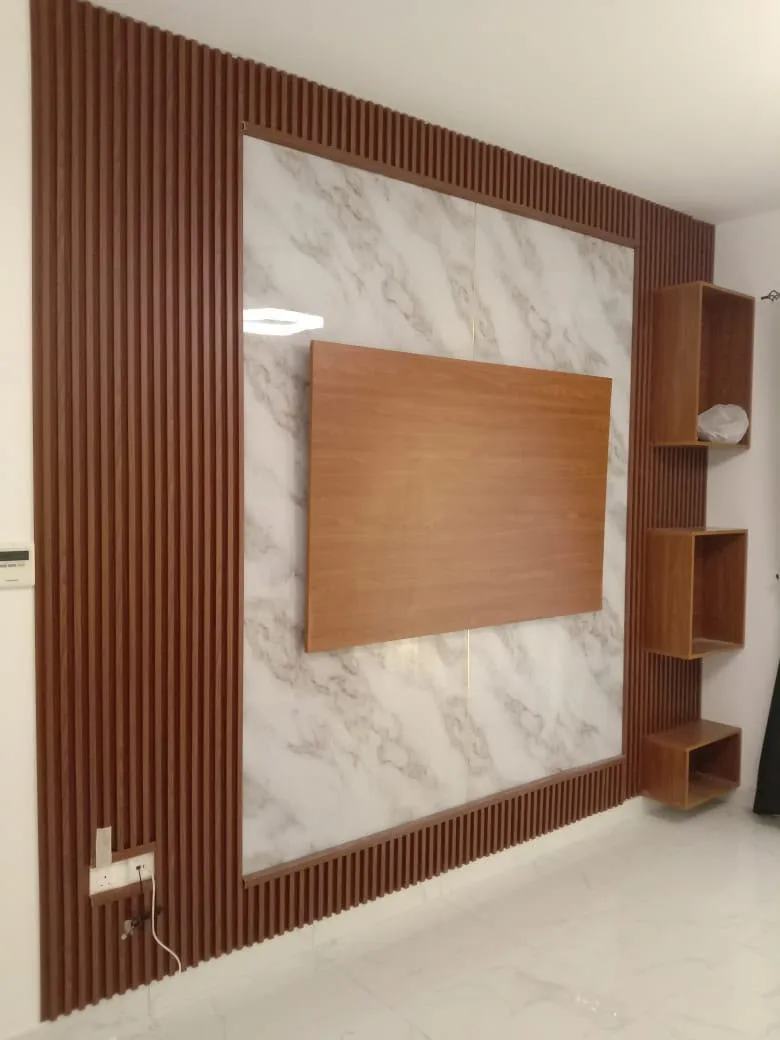
Plywood has one visual quirk that MDF does not: its layers show at the cut edge as thin parallel lines. Some designers like that look on an open shelf or a feature edge, and it is a real part of plywood's character. For a TV wall that wants a clean, painted or laminated look, the edges are banded or covered instead, and the quality of that work decides how good the board looks from across the room.
Edge treatment matters twice in a coastal villa. Visually, a clean banded edge looks crisp and ties the shelf or the console to the panel. Practically, a banded edge is a seal against moisture at the place where a board is most exposed, which is the end of every layer. Ask what the band is made of, whether it wraps the whole edge, and how the corners are finished. If a shelf will carry heavy objects, ask also how the shelf is supported, because a long plywood shelf is stiff for its thickness but still needs proper brackets.
Whatever the board, a heavy fixing such as the bracket for a large TV needs a plan: ask how the load reaches the wall frame and what the fixing relies on. The drawing should say so; if it does not, ask for it before the wall is made.
Finally, a smooth sprayed finish is usually built on a dense, uniform face such as MDF, which Wikipedia notes takes paint well, while a layered board needs its face prepared before it is painted; ask the workshop how it would finish a plywood face and what that adds to the price. That is one practical reason a coastal villa wall may use both boards: plywood where movement matters, MDF where a smooth sprayed face is wanted, and a good seal on both.
One villa wall, walked through
To make this concrete, picture a three-bedroom villa on the shore with a living room that opens through sliding glass doors onto a terrace and pool. The family lives there from October to May and travels in summer. The TV wall is on the side wall of the living room, about three metres from the doors. The owners want a full-height wall with a lit niche, a console and a veneer feature panel behind the screen.
At the visit we would look at three things the plan does not show. First, the base wall: block, and whether there is any stain or salt bloom near the floor. Second, the air path: the doors, the AC outlet and where a breeze would run. Third, the use: wet feet from the pool, a console that will hold remotes and a few photographs, and a summer when nobody is home. From those we might suggest a plywood core for the long feature panel and the pillars, banded and sealed on every face, and MDF with a good seal for the small, smooth console fronts; a laminate on the lowest band; hardware material to be named in the quotation; a plinth that lifts the lowest panel off the floor; and a lift-off service panel for the LED drivers.
The quotation would then name each line: the board for each part and its class, the sealing, the finish for each band, the hardware, the lighting, and the fireplace if there is one. The owners would approve a drawing before anything is cut. In summer they would brief the AC installer, take photos before leaving and look again in October. That is not a miracle, just a sequence of small decisions that match a wall to its house.
The wall behind the wall
A TV wall is only as dry as the wall it stands against. In a villa near the sea, check the wall behind the panels at the visit: is it block, concrete or gypsum, is there any stain, flaking paint or a salty bloom on the surface, and is there an outside wall or a bathroom behind it. A panel does not cure damp; it can hide it, and then it traps it. If we find a damp wall, we say so before drawing anything, because the right fix is on the wall, not on the panel.
Our guide to block versus gypsum walls behind a TV explains how the base wall changes the fixing, and the humidity guide covers how air gaps and concealed openings help a wall breathe; the principle is that ventilation depends on the site and does not repair a leak. If there is a moisture problem behind the wall, fix it first or move the wall.
Look also at the ceiling above. Where the wall meets a drop ceiling near an AC outlet, a cold surface can drip with condensation, and the junction is the place that shows it first. The next guide in this series, on where the wall meets the ceiling, covers the junction itself.
The empty-house summer: habits that protect the wall
Many beachfront villas are lived in only part of the year. When the family leaves for the summer, the air conditioning is often switched off or set high to save power, doors are shut, and the house sits closed. That is the second situation in the humidity illustration, and it is the one where a wall takes up the most moisture, slowly, over weeks.
We cannot tell you how to run your cooling, and the right setting depends on the house and the building's own rules. What we can say is that a house left fully closed and fully off is a different case from a house left with steady, gentle conditioning, and that the wall will experience the difference. If you will be away, ask your AC installer or building management in writing what setting they recommend, and mention the absence when you brief us, because it affects the board and sealing choice.
When you return, open the house gradually, let the air move before closing the doors again, and look at the wall: the joints, the edges at the floor and the console fronts. If you see a joint that has opened, an edge that has lifted or a finish that has bubbled, take photos and send them to us. An early look is much cheaper than a late one, and the 5-year limited board warranty works from a written record of what you saw and when.
LED, drivers and power: electrics near salt and damp
Lighting and power in a coastal villa wall deserve their own planning. LED strips, drivers and dimmers are small electrical devices inside a cavity, and a driver that is boxed in without air runs warm and wears out sooner. Place drivers where they can be reached and aired, behind a lift-off panel, and give every connection a route that can be serviced; the principles are in our guide to cable management and service access.
Our LED channels come in 3000K warm or 4000K neutral with dimmers, as on our service page, and in a villa with a sea-facing window the dimmer is worth having: the wall can brighten for the evening and fade down late. See media wall lighting ideas for layouts. Keep sockets away from the lowest part of the wall where mop water reaches, and discuss their position with us; the planning in sockets and power for a media wall applies fully here.
We do not do standalone lighting or socket jobs; our wiring work is part of a media wall. If your villa needs electrical work beyond the wall, your electrician or building management handles it, and we coordinate the drawing with them.
Finish choice with sea light
Sea light is strong and bright, and it reaches deep into a villa through large glazing. A finish chosen in a showroom may look different in that light: whites read warmer, dark finishes show dust, and gloss surfaces throw reflections across the room. Take samples into the villa and look at them at several times of day, as the finish sample approval guide explains, and look especially at the hour when the sun is lowest and strongest.
For a wall that faces the water, a matt or satin finish reduces glare on the screen, and a lighter colour keeps the wall from absorbing too much heat from the window. Sprayed lacquer allows an exact colour match to a coastal palette; laminate keeps maintenance low; veneer brings warmth and needs a sealed surface, as covered in the veneer guide. For the colours themselves, the colour and finish guide goes through white, wood, stone and dark options.
If the wall will use a stone-effect panel, the porcelain family suits the coast well because of its very low water absorption; the guide to porcelain and sintered-stone TV walls explains the numbers.
A care calendar for a coastal wall
A wall in a salty, humid house needs a little regular attention. The calendar below turns that into habits. Nothing in it is difficult, and most items take a few minutes.
Care calendar for a beachfront villa media wall
Weekly
- What to do
- Wipe the finish with a soft, slightly damp cloth, then dry it
- What you are checking
- Dust and salt film on the surface, drips at the console
Monthly
- What to do
- Check the lowest panel and the plinth
- What you are checking
- Any damp edge, lifting finish or stain at the floor line
Each season
- What to do
- Operate every hinge and drawer, wipe metal parts dry
- What you are checking
- Stiffness, squeaks or the first spots of corrosion
Before a long absence
- What to do
- Brief the AC installer, take photos of the wall
- What you are checking
- A record of how the wall looked on leaving
On return
- What to do
- Open the house gradually, look at joints and edges
- What you are checking
- Opened joints, bubbling, a changed fit of doors
Yearly
- What to do
- Send us a photo set of the whole wall
- What you are checking
- Anything you are unsure about, caught early
General household habits, not a warranty term. Care instructions for your finish come with the handover pack.
What it costs, in direction only
Media walls start from AED 3,500 per project for a compact panel with a floating console in standard laminate. A coastal villa wall is usually larger than that entry specification and may use a different board, better sealing and chosen hardware, so the figure comes from the quotation, not from the starting price. The levers are the wall size, the finish, the board class, the hardware, the lighting and any fireplace.
We cannot give you a number for plywood versus MDF without the wall in front of us, and we would not trust a number that was given without it. What we can promise is that the drawing and the itemised price are approved before production, so nothing is chosen behind your back. Our guides on what a media wall costs and what it is made of show where the figure comes from, and the materials tool is a quick reference.
Mistakes we see in coastal villas
Most of these come from treating a beachfront villa like an inland flat.
- Asking for 'plywood' with no class on the quotation, so nobody knows which board is meant.
- Sealing the face and leaving the back and the edges bare.
- Cutting socket and cable holes without sealing the inside of the cut.
- Choosing hardware by looks, with no thought for salt.
- Putting a wall directly in line with open terrace doors, with the lowest panel on the floor.
- Covering a damp or salt-stained wall with a panel instead of fixing the wall.
- Leaving the house shut and unconditioned for weeks without telling the installer.
- Skipping the service panel, so a failed driver means opening the wall.
Our visit to a coastal villa, and the WhatsApp message to send
We visit the villa, look at the wall behind the panels and the doors around it, draw the wall with its board, sealing and hardware named, and build it in our Sharjah workshop, with our own team fitting it. The measuring visit is free; the drawing and itemised price are approved before production; after measurements and details are agreed, a 60% advance is paid and production starts once it is received, with the remaining stage agreed with you. A wall takes up to about 10 days depending on size and design. We have been in the trade for ten years under founder Ali Haider Basra.
To start, send us a WhatsApp message with a photo of the wall and of the doors and windows near it, the TV size, how far the villa is from the sea, whether the air conditioning runs all year and whether the house is empty for part of it. Our guide to what to send for a media wall consultation lists the photos that help most. We work across the UAE from Sharjah; the Sharjah media walls page and our media walls service give the detail.
Common questions
Is plywood better than MDF for a beachfront villa?
Not automatically: plywood's cross-grain plies limit swelling, while MDF is smooth and takes paint well but may warp if unsealed. The choice depends on the wall, finish and how the house is used. Panels compared.
What does EN 636-2 plywood mean?
It is the class marked for humid areas and occasional wetting, between dry interior (-1) and exterior (-3). Ask the quotation to state the class of the board it uses. Humidity and MDF in a media wall.
Does salt air damage a media wall?
It mainly attacks metal parts such as hinges and fixings, and a fastener maker lists ocean salt air up to 10 miles from the coast as a corrosive factor, so ask for the hardware grade. Cable management and service access.
Should I leave the air conditioning on when the villa is empty?
We cannot set your cooling for you; ask your AC installer or building management in writing, and tell us about the absence so the board and sealing choice reflect it. Ventilation inside a media wall.
Does the 5-year warranty cover a coastal wall?
It is a limited warranty on the wood-based boards only, subject to its terms; hinges, runners, labour and misuse are excluded, and the 24-month workmanship warranty is separate. What a media wall costs.
Which finish suits a wall facing the sea?
Matt or satin reduces glare, laminate keeps maintenance low and lacquer matches an exact colour; approve samples in your own light. Veneer, lacquer or HPL.
What should I send on WhatsApp for a coastal villa?
A photo of the wall and nearby doors, the TV size, the distance to the sea, and whether the air conditioning runs all year. What to send for a consultation.

Sources & specifications
Manufacturer information applies to the named products and systems. Sources reviewed on 10 November 2026.
- Elliotts: Plywood classes explained (EN 636 classes 1, 2 and 3; Class 2 for moisture-resistant plywood)elliotts.uk(opens in a new tab)
- Premier Guarantee: Assessing plywood specification (EN 314 bond classes; an EN 636 class cannot exceed the EN 314 class; -1, -2, -3 marks)premierguarantee.com(opens in a new tab)
- Simpson Strong-Tie: Stainless Steel Solutions (ocean salt air up to 10 miles from the coast; Type 316 for marine and seaside; Types 304 and 305 for exterior)strongtie.com(opens in a new tab)
- Wikipedia: Plywood (plies stacked cross-grain; reduced swelling and shrinkage)en.wikipedia.org(opens in a new tab)
- Wikipedia: Equilibrium moisture content (wood moisture depends on the humidity and temperature of the surrounding air)en.wikipedia.org(opens in a new tab)
- Wikipedia: Medium-density fibreboard (denser than plywood; may warp or expand in humid environments if not sealed)en.wikipedia.org(opens in a new tab)
Want this planned for your home?
Consultation and measurement are free. Tell us the rooms, location and what you need; we arrange a sample visit and define the measured quotation.