Media Walls · 19 min read · 4 September 2026
Block wall or gypsum wall: what holds a TV on a media wall?
Block wall or gypsum wall behind a TV: what each is made of, why hollow cores and bare board matter, how to tell which you have, and what to ask in the quotation.

By Ali Haider Basra, Founder, Al Tareeq Decor · Contact our workshop
Key takeaways
- What holds a TV is whatever the bracket is fixed into, a wall or a frame, never the slats or panel on top.
- Neither wall is strong or weak by name: gypsum can be a steel frame or a bare board, and block can be solid, hollow or aerated.
- Most concrete blocks have hollow cores (Wikipedia), so a fixing can end in air; MantelMount advises anchors designed for block.
- No source we opened gives a TV load for plasterboard or hollow block, so ask for the maker's rated load for the exact fixing and wall.
- Send a photo of the wall, the TV size and the room on WhatsApp; at the free visit we note the wall type before the drawing.
On this page
- Key takeaways
- Block or gypsum: what actually holds the TV?
- What a gypsum wall is made of
- What a block wall is made of
- Block wall and gypsum wall compared
- The drawing: where the fixing lands
- How to find out which wall you have
- It is not only the TV that hangs on the wall
- What a plug maker's own page does and does not say
- If the wall is the weak link
- Three walls, three plans: worked scenarios
- Mistakes that lead to a second visit
- How to read a maker's page without over-reading it
- From photo to fixed bracket: the steps in order
- Questions to put in the quotation
- What we do and what to send on WhatsApp
- Common questions
Block or gypsum: what actually holds the TV?
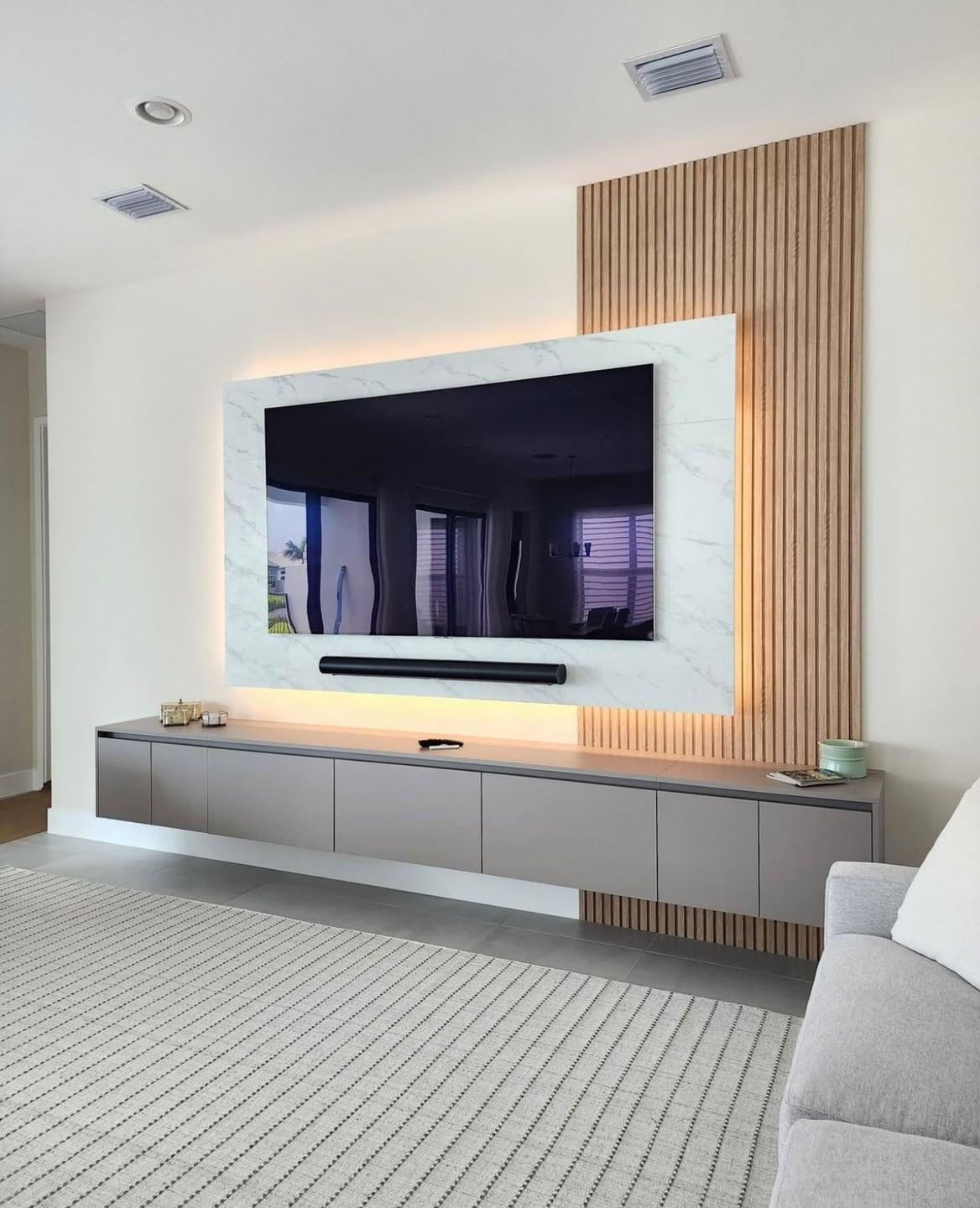
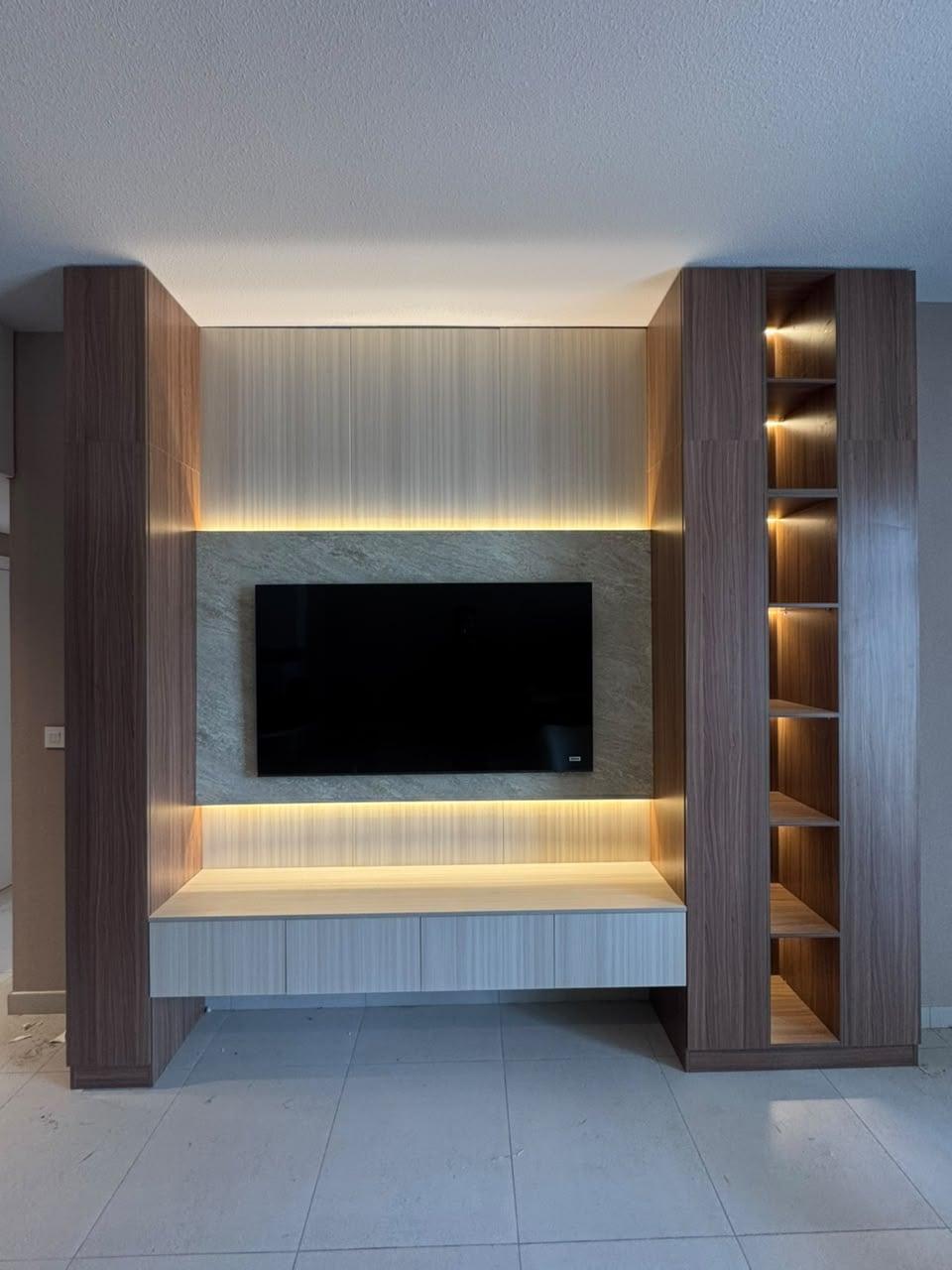
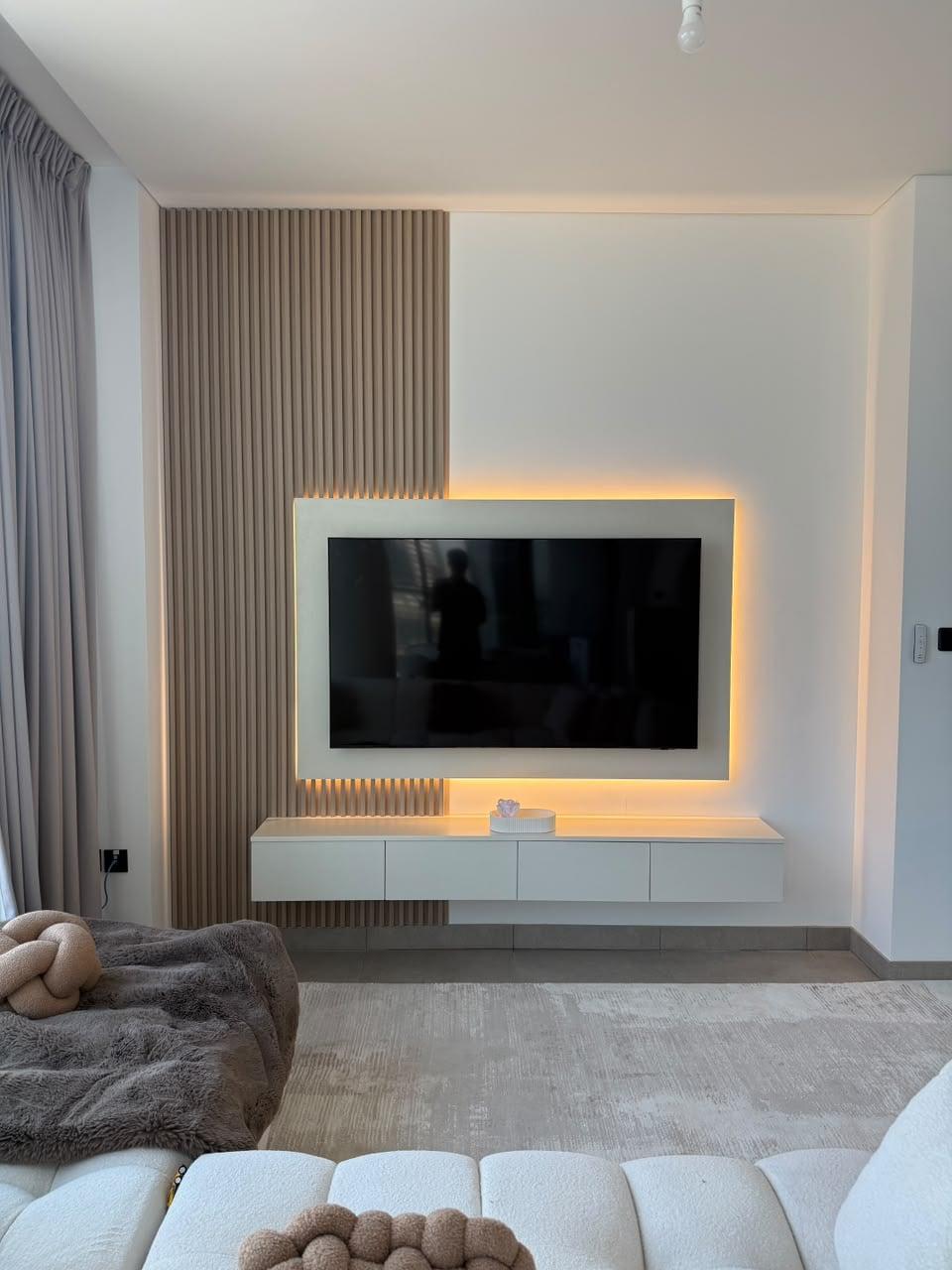
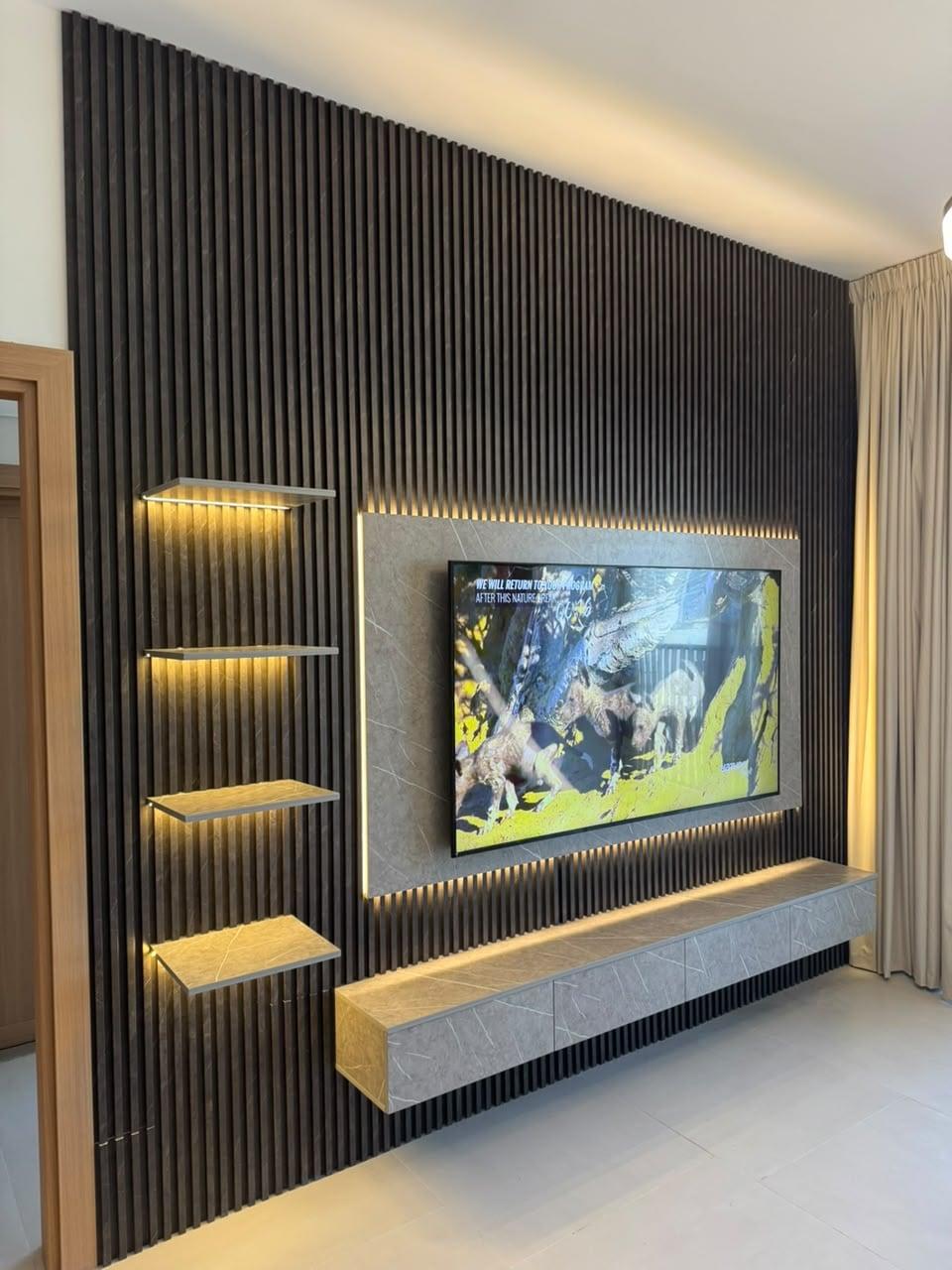
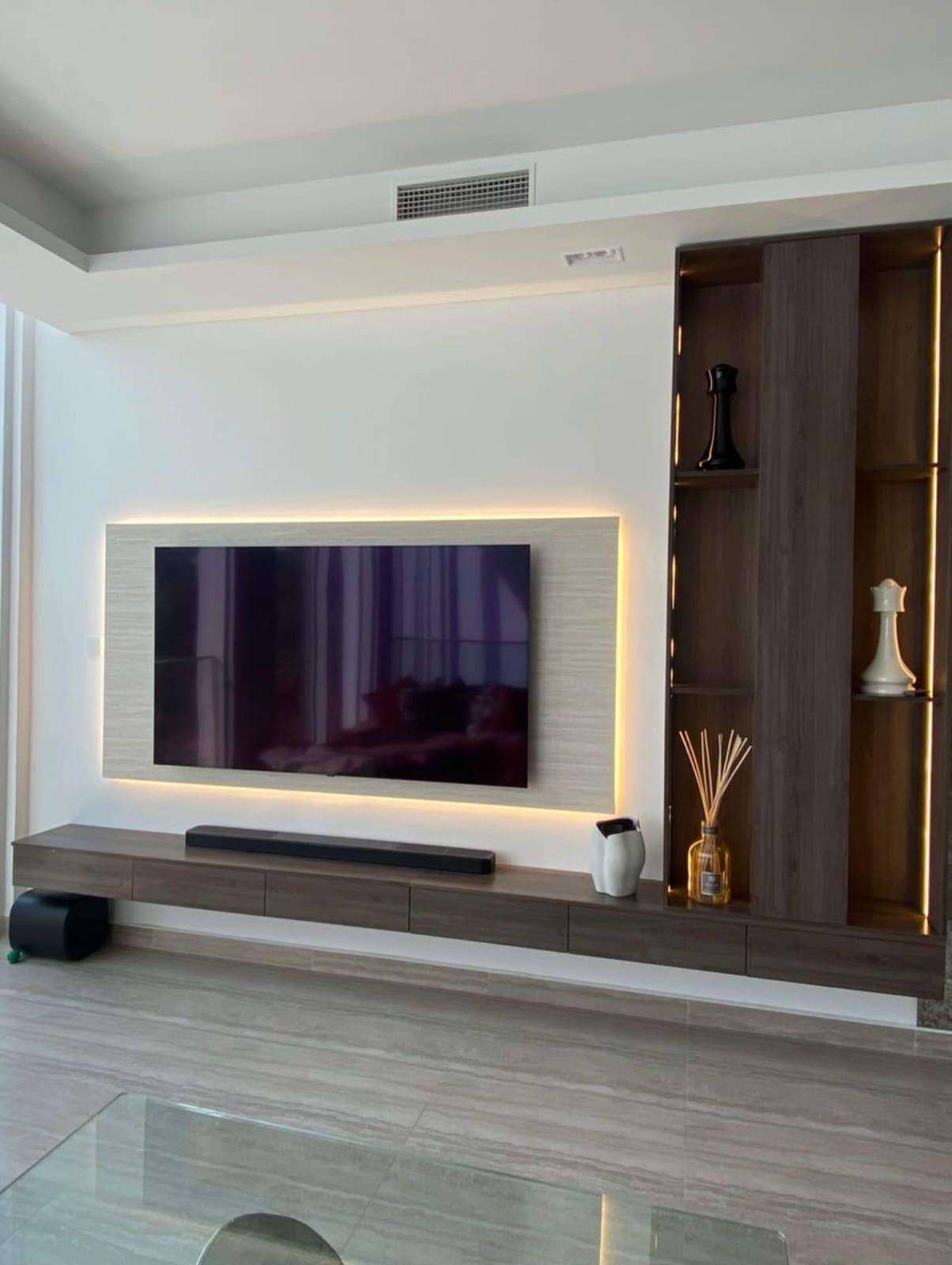
Not the finish. Slats, a marble-effect panel and a neat joint carry no load; what holds a screen is whatever the bracket is fixed into, and that is either the wall behind the media wall or a frame built in front of it. So the first useful question about a TV wall is not about style. It is: what is my wall made of, and what will the fixings reach? What a media wall is explains the build-up; this guide takes one layer of it, the wall itself. A bigger screen raises the stakes, and TV size and viewing distance helps you pick one before the frame is drawn.
Neither wall is strong or weak by name. A gypsum wall can be a steel frame that grips a bracket well or a bare board that cannot be trusted with a TV. A block wall can be solid or hollow, dense or light. We opened manufacturers' and reference pages to see what they say, and none of them gives a load figure for a TV on plasterboard or on hollow block, so this page gives none either. What it gives you is the thinking to ask for the right numbers, in writing, for your own wall.
What a gypsum wall is made of
Gypsum board, also sold as plasterboard or drywall, is a layer of gypsum plaster between two layers of paper; Wikipedia's entry on drywall describes it as a panel of calcium sulfate dihydrate extruded between sheets of facer and backer paper, then fixed to the structure with nails or screws and often glue. The board is a skin. What stands behind it is the structure: a frame of steel or timber, or sometimes a bonded layer on a wall.
In a partition wall the frame is often light steel. MantelMount, a US wall-mount maker, writes that thin steel framing, often 25 gauge, is common in condos and commercial buildings, and pairs it with toggle bolts for the metal. That is one maker's advice for one situation; what matters for you is the picture. A bracket screwed into the board alone hangs on a thin sheet, while a fixing that reaches the frame, or a backing board that is itself fixed to the frame, puts the weight on the structure.
The tell-tale of a good job is that you can answer this question before drilling: where is the frame behind this spot? That is why a media wall on a gypsum partition is drawn with a backing, as our media wall materials guide explains, and why the drawing should show which fixings reach it. The same board family is used overhead; gypsum false ceilings compared with other ceilings shows how the material behaves there.
What a block wall is made of
Concrete block comes in more forms than the word suggests. Wikipedia's entry on concrete block says blocks may be made with hollow centres, called cores, to reduce weight and improve insulation, that most have two cores, and that lightweight blocks can also be made from autoclaved aerated concrete. It also gives a wide range for the compressive strength of blocks and block walls, from about 3.4 to 34.5 MPa. So a block wall is not one material with one strength; it depends on the block, the mortar and how the wall was built.
For a bracket, the cores matter most. An anchor that expands into a hollow core is not holding in the same way as one gripping solid material, and MantelMount's advice for cinder block or hollow concrete is to use sleeve or toggle anchors designed for block. Notice the wording: designed for block, not just any plug in a block-shaped wall. A solid concrete wall or the solid web between the cores is a different case again.
Aerated block is the one to be careful with. The page we opened says only that such blocks exist and are widely used; it gives no fixing advice. Fixing in it is therefore a question for the maker of the anchor you intend to use, who should say in writing that the anchor suits that material.
Block wall and gypsum wall compared
What you drill into
- Gypsum board wall
- A thin board over a frame, with a cavity behind it
- Block wall
- Concrete block, solid or with hollow cores, or a lightweight aerated type
What a source says
- Gypsum board wall
- Board is fixed to the structure with screws (Wikipedia); steel frames are thin, often 25 gauge (MantelMount)
- Block wall
- Blocks may have cores; lightweight aerated blocks exist (Wikipedia); use anchors designed for block (MantelMount)
Where the weight must go
- Gypsum board wall
- To the frame, or a backing fixed to it; not the board alone (our reading)
- Block wall
- Into material the anchor suits, not into an empty core
The risk
- Gypsum board wall
- A fixing that stops in the board
- Block wall
- A fixing that lands in a hollow core or soft block
Ask in writing
- Gypsum board wall
- What is behind each fixing, and how is the backing fixed to the frame?
- Block wall
- Which anchor, for which block, and its maker's stated load
No source we opened gives a TV load for either wall, so no figure appears here. Planning notes, not a structural opinion; your wall is checked at the measuring visit.
The drawing: where the fixing lands
The drawing is a side section of two walls, each with a TV on a bracket. On the block wall, a fixing can end in a hollow core, so the anchor has to be one made for block. On the gypsum wall, one fixing reaches the steel frame and one stops in the board alone. The boards, cores and frame are schematic: no real wall looks exactly like this, and no load is drawn.
- 1. Block wall: hollow cores run through most blocks, so a fixing can end in air
- 2. Anchor made for block: MantelMount's advice for cinder block or hollow concrete
- 3. Gypsum wall: two boards with a cavity and a steel frame between them
- 4. A fixing that reaches the frame carries load on the structure; one that stops in the board does not (our reading)
- 5. Either way, ask the quotation what the bracket is fixed into
How to find out which wall you have
Start with the building, not the wall. Ask your landlord or building management, in writing, what the wall is made of, and whether you may fix into it; do not drill an unknown wall in a rented flat. A building's plans, or the person who fitted out the unit, may also say whether a partition is gypsum on a frame or block.
The wall itself gives clues but not proof. A hollow tap or a slight give suggests board over a cavity; a dull, solid sound suggests block or concrete; the thickness of the wall at a door opening or a socket cut-out tells you more. A clue only tells you which way to look. A stud finder, a small test hole made with permission, or a camera in a cut-out will confirm it, and a media wall is not planned on a clue.
That is why, at our free measuring visit, we note the wall type along with the sockets and the router and take laser measurements; our cable guide lists the same checks in the context of hidden routes and service access. Send us a photo of the wall first and tell us what you know; the drawing then shows how it will be fixed.
It is not only the TV that hangs on the wall
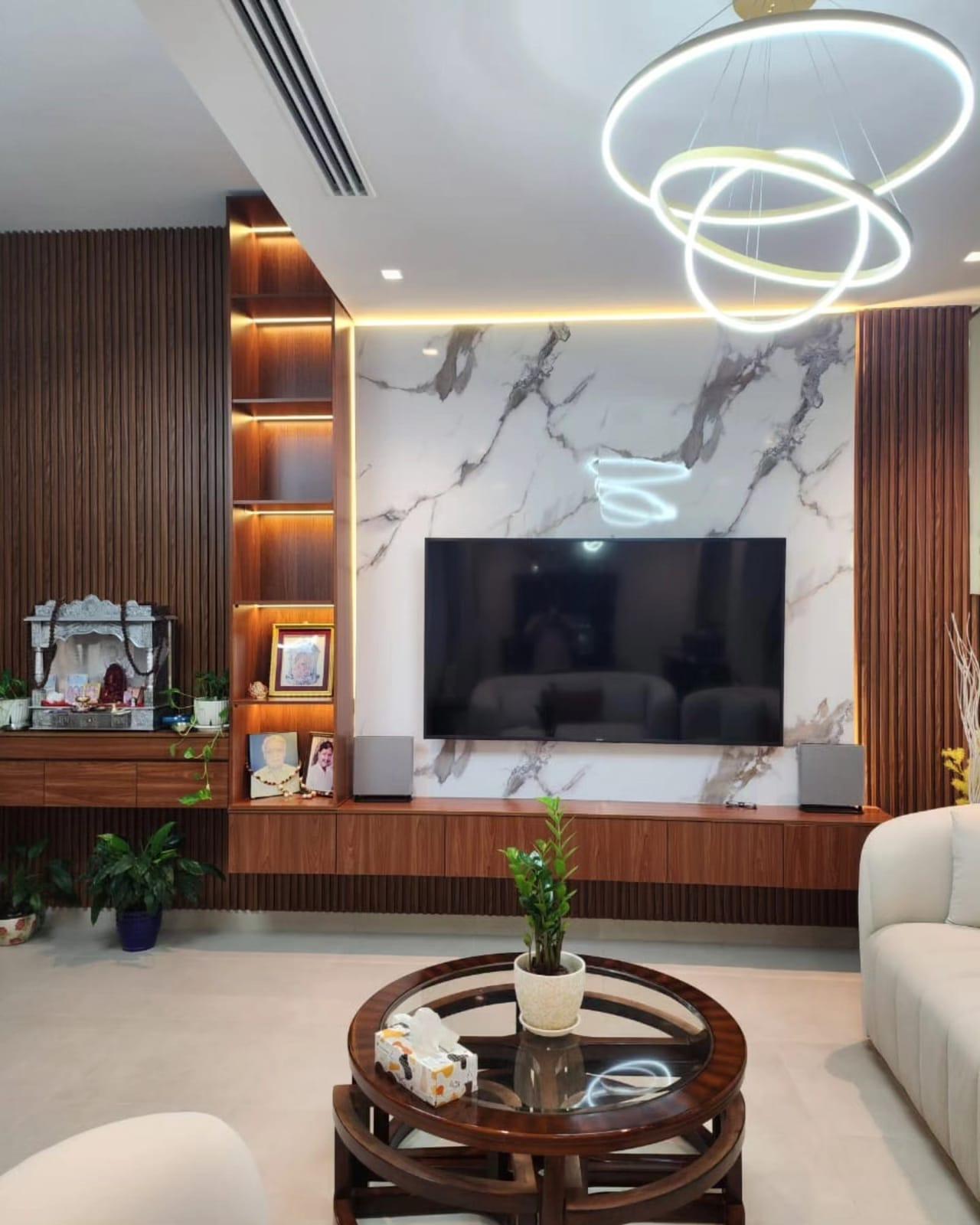
A screen is the load people think of, but it is not the whole list. The bracket holds the TV away from the wall, so the pull is outward as well as downward; a soundbar, a floating console full of equipment, a shelf tower, panels and a fireplace add to the wall or the frame. Planning a media wall lists the pieces to decide first.
The TV's own weight is on its specification sheet, which is one reason to choose the TV before the media wall. Its height and where the bracket sits also set where the fixings fall, and how high to hang the TV is worth settling before the frame is drawn.
Finishes weigh differently. Dense boards are heavier than foamed ones, as our guide to MDF, WPC, PVC and wood panels shows. Large panels, such as those in our marble TV wall options, add their own weight over a wide area.
A fluted slatted wall spreads its weight differently from one big panel. An electric fireplace is a unit that has to be carried too, so say if you want one.
That is also why a floating console is a decision about the wall, not only about looks. If it hangs, the wall or frame carries it; if it stands on the floor, the floor does. Our guide to a compact panel with a console versus a full wall gives the layouts, and the loads that follow from each are for the quotation to name.
Finally, a TV changes. The screen you buy in a few years may be larger and heavier, and planning for a future TV covers the margin to leave in the backing. The simple rule: whatever holds today's TV should take its replacement without opening the wall.
Sockets and cables run through the same build, so see media wall sockets and power before the wall is closed.
What a plug maker's own page does and does not say
It is tempting to buy a heavy-duty plug and call it settled. Look at what the maker says about that specific plug. The page for fischer's DuoBlade, a self-drilling plug for gypsum plasterboard and gypsum fibreboard, lists pictures, blinds, mirrors and curtain rods as its uses; a TV bracket is not on that list, and the page gives no load figures. Another fischer page describes its DuoTec nylon plug as an installation-friendly solution for high loads in board material, again without a kilogram figure.
Two lessons follow, and neither is a rule about all plugs. First, a plug is chosen for a wall and a load, so ask for the one in your quotation by name, with the maker's own rated load for the wall type you have. Second, MantelMount, as one vendor's advice, tells readers to make sure the total anchor capacity is at least four times the TV's weight; that is a margin idea worth borrowing, but the margin needed for your wall is a question for the product's own data and the person fixing it.
If you want a TV on a thin board and no frame behind it, that is a signal to change the plan, not to buy a bigger plug: add backing, move the fixings to the frame, or put the TV on a console that stands on the floor.
If the wall is the weak link
On a gypsum partition, the answers are about reaching the frame: a backing fixed to the frame behind the panel, fixings placed on the frame, or a plan where the heaviest items stand on the floor. Ask for the backing to be drawn and named in the quotation. The materials guide lists the lines to look for in a quotation and shows how the wall layer sits in the build-up.
On a block wall, the answers are about the anchor: one made for the block type, set to the depth its maker states, in a spot that suits the wall. If the block is lightweight or aerated, or you cannot tell, a frame fixed with suitable anchors and then used to carry the TV gives you one known fixing surface across the whole wall.
Whatever the wall, leave a way back in. LED drivers and cable joints sit behind the panel, and LED lighting ideas for a TV wall covers where a driver should stay reachable. A shaped or textured panel, like those in our 3D textured feature wall guide, is one more reason to plan the backing early.
In a rented flat, be careful twice. The wall may belong to the building, and the fixings leave holes. Ask your landlord or building management in writing before any media wall is planned, and keep the answer; our media wall design ideas include layouts that need few fixing points.
Three walls, three plans: worked scenarios
Scenarios make the thinking concrete. None of them is a real customer and none carries a number; they show how the same questions lead to different plans. Treat them as patterns to compare with your own wall, not as a prescription.
Scenario one: a rented apartment where the living-room wall sounds hollow when you knock on it. A hollow sound suggests board over a cavity, which suggests a partition on a frame, but it is only a clue. The first step is not a drill; it is a written question to the landlord or building management about what the wall is and whether fixing into it is allowed. If the answer is yes and the wall is board on a frame, the plan is a backing fixed to the frame, with the bracket fixed into the backing, and the drawing shows where the frame runs. If the answer is no, or unclear, the plan changes: a console that stands on the floor, a lighter panel and a screen on a floor stand or a bracket that needs fewer fixing points, so the wall carries as little as possible.
Scenario two: a villa living room with a plastered wall that sounds dull and solid, where the owner wants a wall-hung console, a tall shelf tower and an electric fireplace beside a large TV. A dull sound points toward block or concrete, but block comes in hollow, solid and aerated forms, and the console, shelves and fireplace are three more loads besides the screen. Here the right question is which anchor, made for which block, and what load its maker states for that material. If nobody can say what the block is, the safer plan is to fix a frame with anchors suited to the wall and let the frame carry the whole build, so one fixing surface is known across the entire wall instead of guessed at point by point.
Scenario three: an owner who has no idea what the wall is. This is the most common starting point and it is perfectly fine. Send a photo of the wall, the TV size and the room; say whether you own or rent and anything you know. At the free measuring visit we note the wall type with the sockets and the router, and the drawing then states what the bracket is fixed into. The one thing to insist on is that the quotation says what happens if the wall turns out different from what was assumed: who adjusts the plan, and what changes on the page, before anything is built.
Mistakes that lead to a second visit
Most problems with TV walls are decisions that were skipped, not bad workmanship. These are the ones worth avoiding, and each is cheap to avoid on paper and tiresome to repair on a finished wall.
- Treating the finish as the structure. Slats, panels and marble-effect sheets are skins; the bracket must reach the wall or the frame, and the drawing should say so.
- Assuming 'block' means one thing. A hollow core, a solid block and a lightweight aerated block each ask for an anchor suited to them, so name the block before naming the anchor.
- Trusting a clue as proof. A hollow tap, a thin door opening and a sound are reasons to check, not a result; confirm with the building, a stud finder or a test made with permission.
- Buying a plug before reading its maker's page. The page lists what the plug is meant for and, for the two fischer pages we opened, a TV bracket was not in the list and no load figure was given.
- Counting only the screen. The soundbar, a floating console full of equipment, shelves, panels and a fireplace all hang on the same wall or frame.
- Forgetting the next TV. If the backing only just takes today's screen, the replacement means opening the wall, so ask for room to grow.
- Skipping the written question in a rented flat. Fixings leave holes in a wall that is not yours, and a verbal yes is hard to prove later.
How to read a maker's page without over-reading it
Manufacturers' pages are the best evidence you can get, and they are also easy to over-read. A short method keeps you honest. First, find the product by its full name, since one maker's range includes plugs for different materials. Second, read the list of uses: if a TV bracket is not there, the page has not approved that use, whatever the product looks like. Third, find the wall material the page names; a plug for plasterboard says nothing about block, and the other way round. Fourth, look for a load figure and note the exact conditions it is given under; if there is none, there is none, and you should ask the maker or supplier rather than fill the gap with a guess.
The last rule matters most: never carry one product's number across to a different product. A figure belongs to the plug, the wall material and the test it came from. This is why this guide quotes no kilograms. Where a source states a margin, such as MantelMount's advice that the total anchor capacity be at least four times the TV's weight, we attribute it to that vendor and treat it as a way to think, not as a standard for your wall.
From photo to fixed bracket: the steps in order
Seen end to end, the route is short. Each step answers one question, and the next step depends on that answer, which is why skipping the early ones is what causes trouble.
- Choose the TV or at least its size, and note its weight from the specification sheet.
- Photograph the wall and the room, and write down what you know: hollow or solid sound, partition behind it, rented or owned.
- Ask the landlord or building management, in writing, what the wall is and whether fixing into it is allowed. Keep the reply.
- Send the photo, the TV size and the room to us on WhatsApp; we will tell you what else would help before the visit.
- At the free measuring visit we note the wall type, the sockets and the router, and take laser measurements.
- We draw the build-up: the backing or frame, what the bracket is fixed into, and where the console, shelves and any fireplace hang or stand.
- You read the quotation line by line, with the questions in the next section next to it, and approve only when each has a written answer.
- The wall is built in our Sharjah workshop and fitted, usually in up to about ten days depending on size and design.
Questions to put in the quotation
Wall type is the first thing a supplier should ask, not the last. Before you accept any quotation, find the answer to each of these in writing.
- What is my wall made of, and how was that checked?
- What is the TV bracket fixed into: the wall, a frame or a backing board?
- Which fixings are used, and what load does their maker state for this wall type?
- What else hangs on the wall: soundbar, console, shelves, panels, fireplace?
- Where is the backing or frame shown on the drawing?
- What happens if the wall turns out different from what we assumed?
- Can the TV be replaced by a larger one without opening the wall?
What we do and what to send on WhatsApp
We build media walls in our Sharjah workshop and fit them across the UAE; the founder, Ali Haider Basra, has ten years in the trade. A measuring visit is free: we note the wall type, the sockets and the router, laser-measure the wall, and then send a drawing and a quotation line by line for you to approve. Media walls start from AED 3,500 per project for a compact panel with a floating console in standard laminate; the final figure depends on wall size, finish, marble-effect panels, lighting and any electric fireplace, and most are fitted in up to about ten days, depending on size and design. The media wall price guide explains how the figure builds up, and the media walls page shows the range.
On WhatsApp, send a photo of the wall, the TV size and the room, and say whether you own or rent and anything you know about the wall: whether it sounds hollow, whether there is a partition behind it, what the building management told you. That is enough to start; the consultation guide says what else helps.
Our pricing tool gives an early idea of cost. The Sharjah media walls page covers visits there.
Browse TV wall units and floating consoles or marble-effect TV backdrops to see the finishes.
Common questions
Can a gypsum wall hold a TV?
It can when the fixings reach the frame or a backing fixed to the frame; the board alone is the weak point. No source we opened gives a TV load for plasterboard, so ask for the plan in writing. How a media wall is built.
Is a block wall always better for a TV?
Not always. Blocks may have hollow cores, and lightweight aerated types exist, so the anchor must suit the block. MantelMount advises anchors designed for block. Planning a media wall.
How do I know if my wall is block or gypsum?
Ask your landlord or building management in writing; tapping and wall thickness are only clues. We note the wall type at the free visit. What to send us.
Does the media wall panel carry the TV?
No. Slats and facings carry no load; the wall or the frame behind does. Ask the quotation what the bracket is fixed into. Media wall panels.
Can I drill into the wall of a rented flat?
Ask your landlord or building management in writing first and keep the reply. Layouts with few fixing points help. TV wall ideas.
Will a bigger TV later need a new wall?
Not if the backing is planned for it; the fixing surface should take the next screen without opening the wall. Planning for a future TV.
Should I buy the TV bracket before the media wall is drawn?
Better to wait. The bracket type and where it fixes belong on the drawing, so choose the TV first and let the drawing name the bracket and what it is fixed into.
What if the wall turns out different from what we assumed?
That is why the quotation should say who adjusts the plan and what changes on the page before anything is built. At the free visit we note the wall type so the drawing starts from the real wall.
Do you build media walls in Sharjah?
Yes, from our workshop there, and we fit across the UAE. A visit to measure is free. Media walls in Sharjah.

Sources & specifications
Manufacturer information applies to the named products and systems. Sources reviewed on 9 November 2026.
- MantelMount: How to mount a TV on metal studs, brick, concrete and plaster (10 Dec 2025)mantelmount.com(opens in a new tab)
- Wikipedia: Drywall (plasterboard: gypsum between paper layers, fixed to the structure)en.wikipedia.org(opens in a new tab)
- Wikipedia: Concrete block (hollow cores, aerated blocks, strength range)en.wikipedia.org(opens in a new tab)
- fischer: DuoBlade self-drilling plasterboard plug (listed uses)fischer.co.uk(opens in a new tab)
- fischer: DuoTec nylon plug for board materialfischer.co.uk(opens in a new tab)
Want this planned for your home?
Consultation and measurement are free. Tell us the rooms, location and what you need; we arrange a sample visit and define the measured quotation.