Curtains · 8 min read · 14 November 2026
Curtain fabrics for UAE homes: linen, velvet, polyester, cotton and blends
Compare linen, velvet, polyester, cotton and blends for UAE curtains: sun fading, lining, weight, washing, humidity and which fabric suits which room.

By Ali Haider Basra, Founder, Al Tareeq Decor · Contact our workshop
Key takeaways
- Sun exposure is the primary durability test: require a certified Blue Wool lightfastness rating of Grade 6+ for unshaded sunny windows.
- Polyester and synthetic blends provide the highest solar durability, washability and dimensional stability in UAE climates.
- Linen and cotton provide natural botanical beauty but require protective linings to prevent rapid UV degradation and humidity shrinkage.
- Velvet is a woven pile construction, not a raw fiber; choose polyester-based velvets for majlis longevity and crush resistance.
- Linings act as sacrificial UV barriers that protect face fabrics and dramatically improve heading drape.
On this page
- Key takeaways
- Read the label before the look: fabric specifications explained
- Sun and fading in the UAE: the Blue Wool Scale in plain terms
- Blue Wool lightfastness scale and UAE window recommendations
- The main curtain fabrics side by side
- Comprehensive curtain fabric comparison
- Deep dive into curtain fibers: behavior and characteristics
- Which fabric for which room and window elevation
- Curtain fabric recommendations by room and solar orientation
- Lining and interlining: what each protective layer does
- Curtain lining types and functional performance
- Fabric weight, hardware matching and yardage calculations
- Rub counts: why Martindale matters less for drapery
- Shrinkage control, care symbols and home laundering
- Coastal humidity, condensation and mould prevention
- Testing fabric samples in your home's natural light
- Cost drivers and pre-order fabric checklist
- Bespoke tailoring in our Sharjah workshop
- Common questions
Read the label before the look: fabric specifications explained
Most disappointment with custom curtains stems from imprecise trade terminology. Descriptive terms like 'velvet' define a weave construction rather than a specific raw fiber; phrases like 'linen-look' or 'linen-blend' encompass vastly different textile behaviors; and generic labels like 'luxury fabric' carry zero technical meaning.
Before selecting curtain textiles for UAE homes, require five specific lines on the fabric technical data sheet: fiber composition percentages (such as 100% polyester, or 60% linen / 40% cotton), the certified Blue Wool lightfastness rating, the international care symbol code, the usable roll width and pattern repeat, and verification of whether the yardage has been industrially pre-shrunk.
Sun and fading in the UAE: the Blue Wool Scale in plain terms
Due to high solar ultraviolet exposure across Dubai, Sharjah and the wider Emirates, colorfastness under sunlight is the primary technical determinant of curtain longevity. Textile laboratories test fabric lightfastness against the international Blue Wool Scale (standardized under ISO 105-B02 using xenon-arc daylight simulation).
The Blue Wool Scale measures fading resistance against eight standardized blue-dyed wool control swatches, graded from 1 (very poor color retention) to 8 (exceptional solar permanence). Importantly, the scale is geometric rather than linear: each progressive grade represents roughly double the solar exposure tolerance of the preceding grade, meaning grade 6 provides vastly superior sun resistance compared to grade 4.
The table below outlines international trade thresholds alongside our workshop recommendations for UAE glazing conditions.
- Natural silk is the most photosensitive interior fiber; UV radiation degrades protein fibers rapidly
- Standard piece-dyed cotton and linen achieve moderate lightfastness (grades 4 to 5)
- Continuous filament polyester typically achieves grade 6 or higher
- Solution-dyed synthetic fibers (where pigments are introduced prior to yarn extrusion) deliver maximum UV stability
Blue Wool lightfastness scale and UAE window recommendations
Grade 4
- International Interior Specification
- Minimum standard for interior decorative furnishings
- UAE Window Application Recommendation
- Unsuitable for UAE sunny windows; severe risk of rapid fading
Grade 5
- International Interior Specification
- Standard residential benchmark for temperate climates
- UAE Window Application Recommendation
- Acceptable on east/west windows only when protected by lining
Grade 6
- International Interior Specification
- Recommended for large glazing and south exposures
- UAE Window Application Recommendation
- Our recommended baseline for unlined curtains on sunny UAE windows
Grade 7–8
- International Interior Specification
- Superior commercial contract and marine outdoor grade
- UAE Window Application Recommendation
- Maximum longevity; typically achieved by solution-dyed yarns
Natural fibers (silk, unlined cotton) score lower on lightfastness unless specifically solution-treated.
The main curtain fabrics side by side
Different textile fibers offer unique combinations of drape, washability, dimensional stability and solar durability across different UAE living spaces.
Comprehensive curtain fabric comparison
Polyester & poly-blends
- Primary Advantages
- Superior UV stability, wrinkle resistance, stable drape
- Technical Vulnerabilities
- Low-grade variants look shiny; verify fabric weight
- Recommended Maintenance
- Machine washable on gentle cycle if unlined
Linen & linen blends
- Primary Advantages
- Distinctive natural slub texture, relaxed elegant fall
- Technical Vulnerabilities
- Wrinkles easily, hygroscopic shrinkage, sun-sensitive
- Recommended Maintenance
- Specialist dry cleaning or cautious hand wash
Cotton & cotton blends
- Primary Advantages
- Soft natural feel, crisp structured tailoring
- Technical Vulnerabilities
- Prone to UV fading and water shrinkage if unwashed
- Recommended Maintenance
- Dry clean; cool wash only if Sanforised pre-shrunk
Velvet (woven pile)
- Primary Advantages
- Luxurious acoustic dampening, deep theatrical pleats
- Technical Vulnerabilities
- Heavy pile marks, dust accumulation, sun fade on pale pile
- Recommended Maintenance
- Professional specialist dry cleaning only
Natural silk & silk-look
- Primary Advantages
- Lustrous sheen, refined fluid puddle puddling
- Technical Vulnerabilities
- Highly susceptible to dry rot and sun degradation
- Recommended Maintenance
- Mandatory dry clean; must be lined and shaded
Woven jacquard & chenille
- Primary Advantages
- Intricate multi-tone woven patterns, dimensional weight
- Technical Vulnerabilities
- Heavy weight increases hardware loads; complex care
- Recommended Maintenance
- Professional commercial curtain cleaning
Sheer voile & chiffon
- Primary Advantages
- Diffuses harsh glare while maintaining daytime privacy
- Technical Vulnerabilities
- Acts as sacrificial layer; ages faster than main drape
- Recommended Maintenance
- Frequent gentle laundering to prevent dust buildup
Deep dive into curtain fibers: behavior and characteristics
Polyester and polyester blends represent the undisputed workhorse for modern UAE window furnishings. Synthetic polyester filaments do not absorb atmospheric moisture, eliminating seasonal fabric drop and hem dragging. They hold sharp pleat memory, resist intense solar embrittlement, and drape uniformly.
Linen and cotton provide natural botanical beauty but feature low fiber elasticity. Pure linen naturally creases and expands hygroscopically with seasonal humidity shifts. For easier daily living, specify a 70% polyester / 30% linen blend that preserves natural flax slub texture while gaining synthetic dimensional stability.
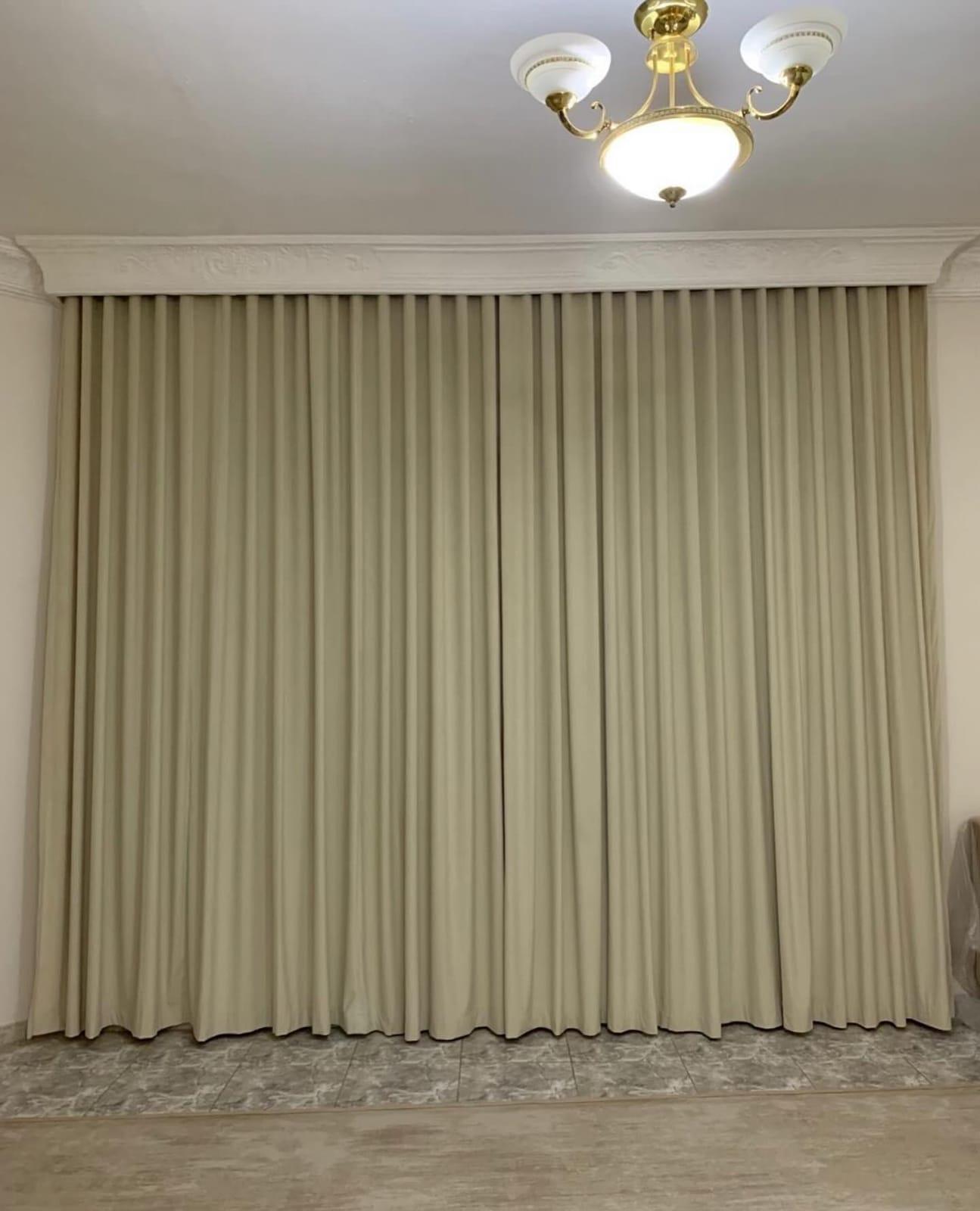
Velvet is technically a woven construction rather than a specific fiber, featuring dense vertical pile cut on dual-fabric looms. The pile exposes significantly more surface area to ambient light, making pale natural velvets vulnerable to sun fading. In UAE villas and majlises, specify heavy polyester-pile velvets that resist crushing and water-spotting (see majlis curtains).
Which fabric for which room and window elevation
Window orientation and functional room requirements dictate optimal fabric specification. South- and west-facing glazing in Dubai receives blistering unshaded afternoon heat, whereas north-facing windows receive gentler ambient light.
Curtain fabric recommendations by room and solar orientation
Living room (South / West glass)
- Solar Exposure Level
- Severe intense afternoon sun
- Recommended Fabric Specification
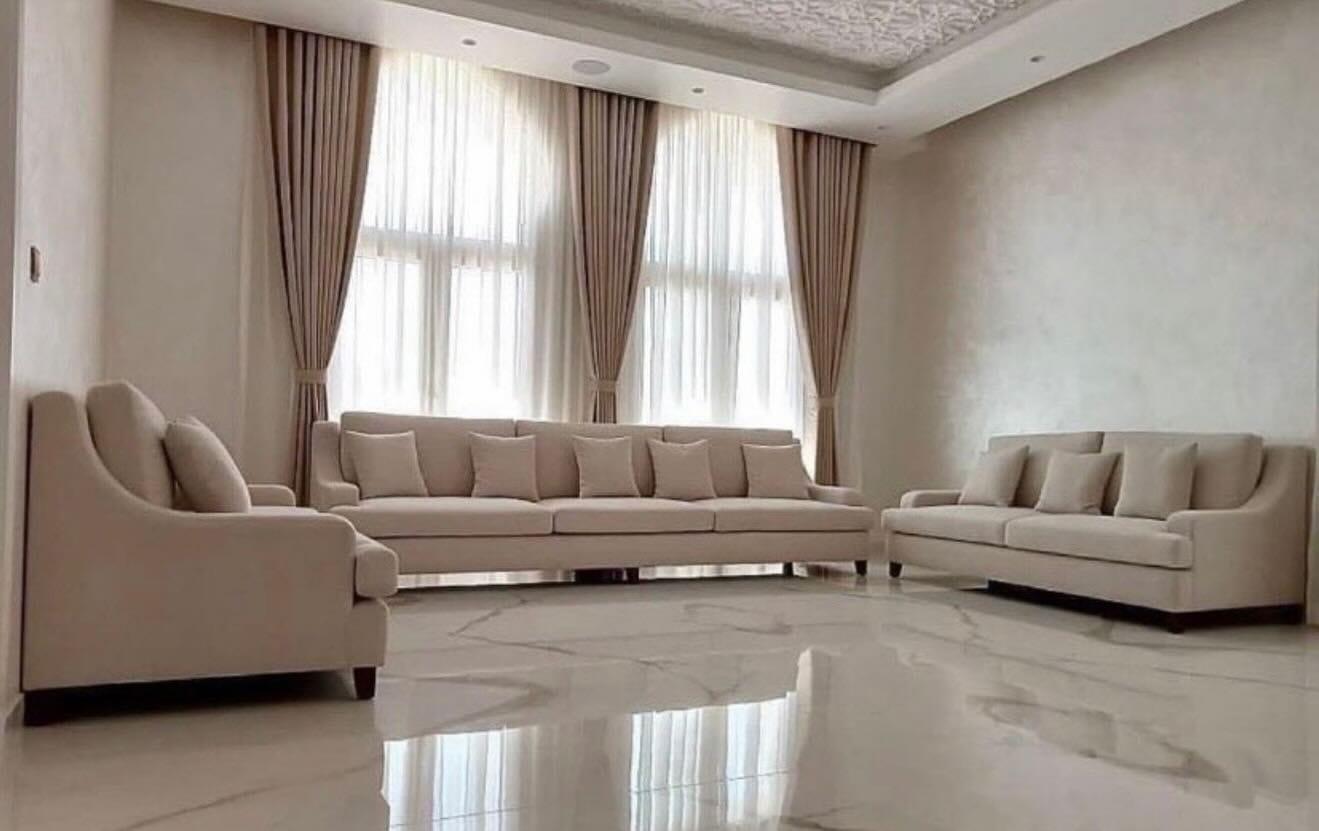
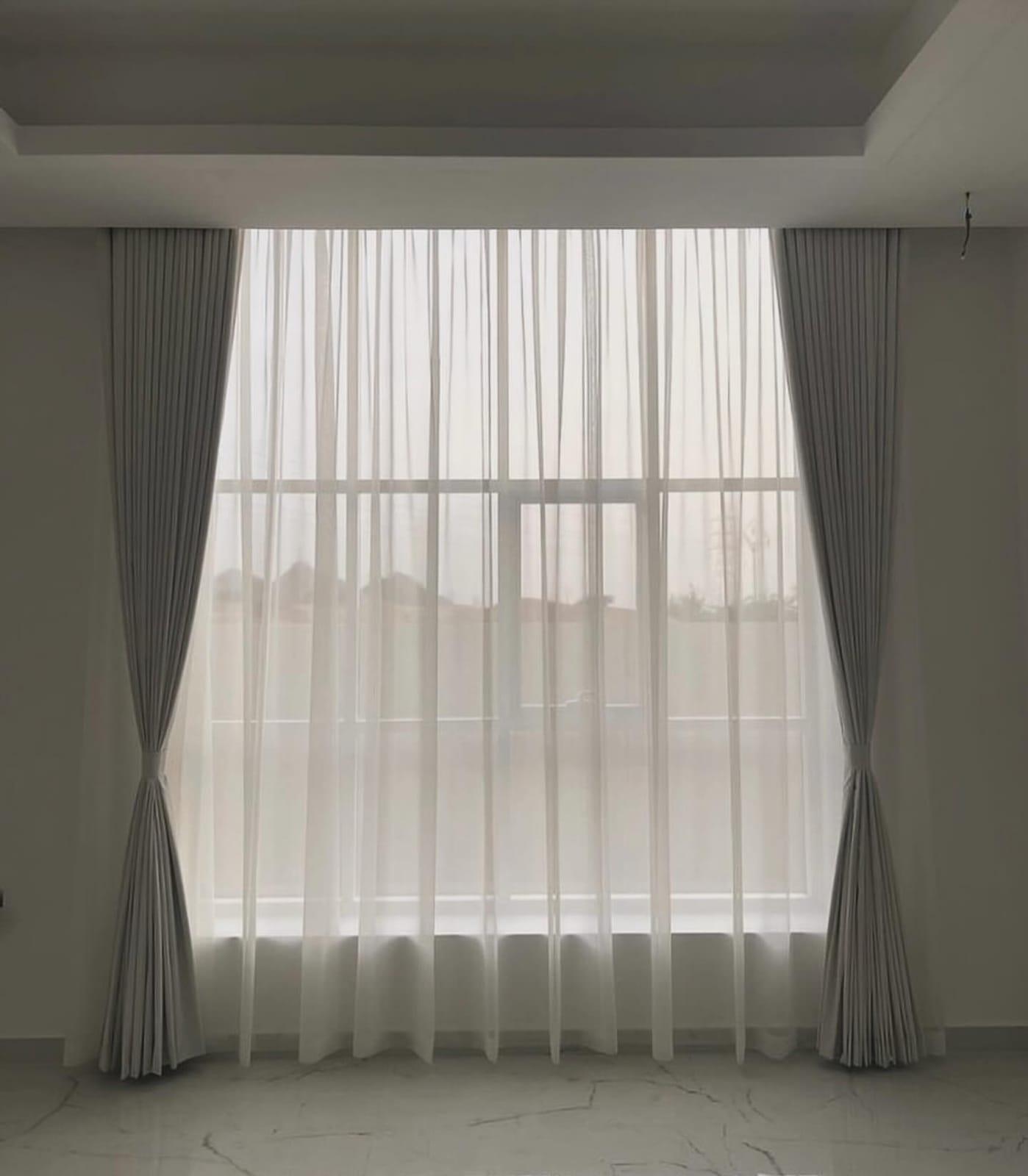
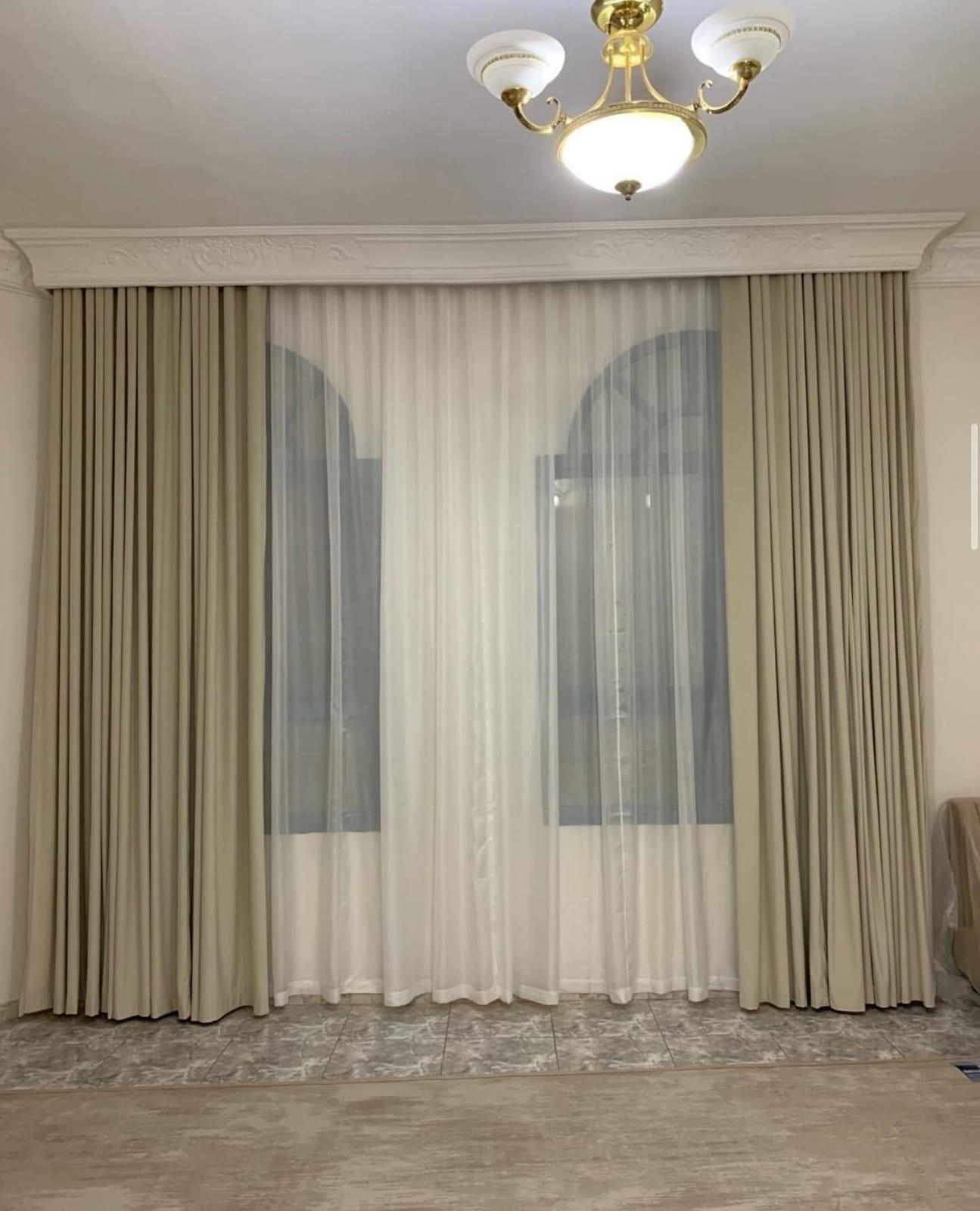
- Lined polyester blend drapes over sheer voile
- Fabrics to Avoid
- Unlined pure silk, delicate printed cotton
Formal Majlis
- Solar Exposure Level
- Moderate to high exposure
- Recommended Fabric Specification
- Heavy polyester velvet or jacquard with interlining
- Fabrics to Avoid
- Flimsy unlined fabrics lacking visual scale
Master bedroom
- Solar Exposure Level
- Severe exposure & sleep privacy
- Recommended Fabric Specification
- High-density face fabric backed by 3-pass blackout lining
- Fabrics to Avoid
- Translucent unlined linens and open meshes
Children's bedrooms & nurseries
- Solar Exposure Level
- Variable daylight exposure
- Recommended Fabric Specification
- Durable, washable polyester blends with blackout lining
- Fabrics to Avoid
- Delicate dry-clean-only silks and pile velvets
Dining room & kitchen zones
- Solar Exposure Level
- Moderate daylight & food aromas
- Recommended Fabric Specification
- Washable poly-cotton blends or moisture-resistant sheers
- Fabrics to Avoid
- Heavy absorption velvets that trap cooking odours
Shaded north-facing rooms
- Solar Exposure Level
- Low indirect daylight
- Recommended Fabric Specification
- Natural linen blends, lightweight cottons, unlined voiles
- Fabrics to Avoid
- Overly heavy blackout fabrics that darken space
Balcony sliding door walls
- Solar Exposure Level
- High solar heat & frequent transit
- Recommended Fabric Specification
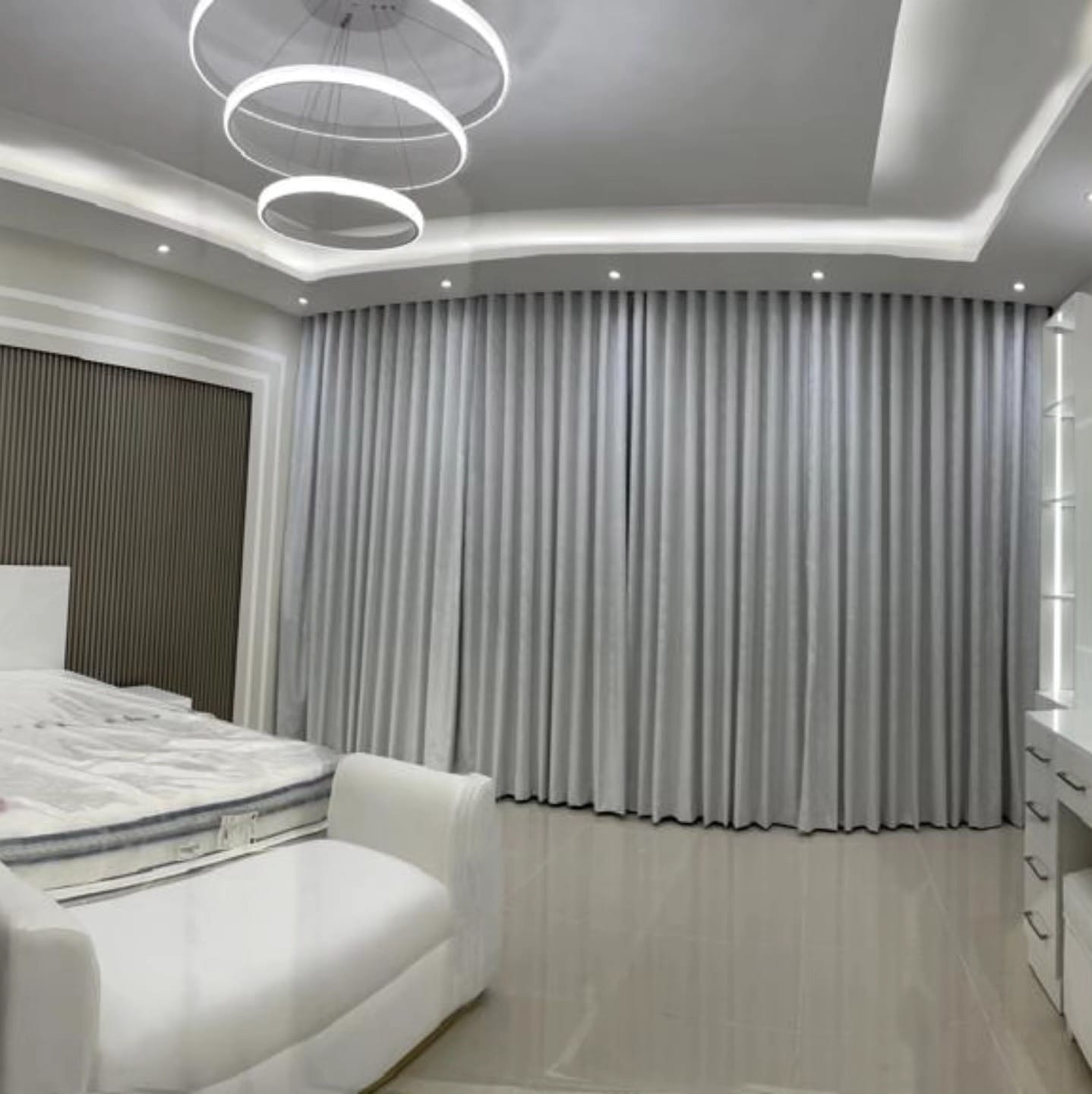
- Mid-weight polyester wave drapery with high rub durability
- Fabrics to Avoid
- Floor-dragging natural fibers that snag on door tracks
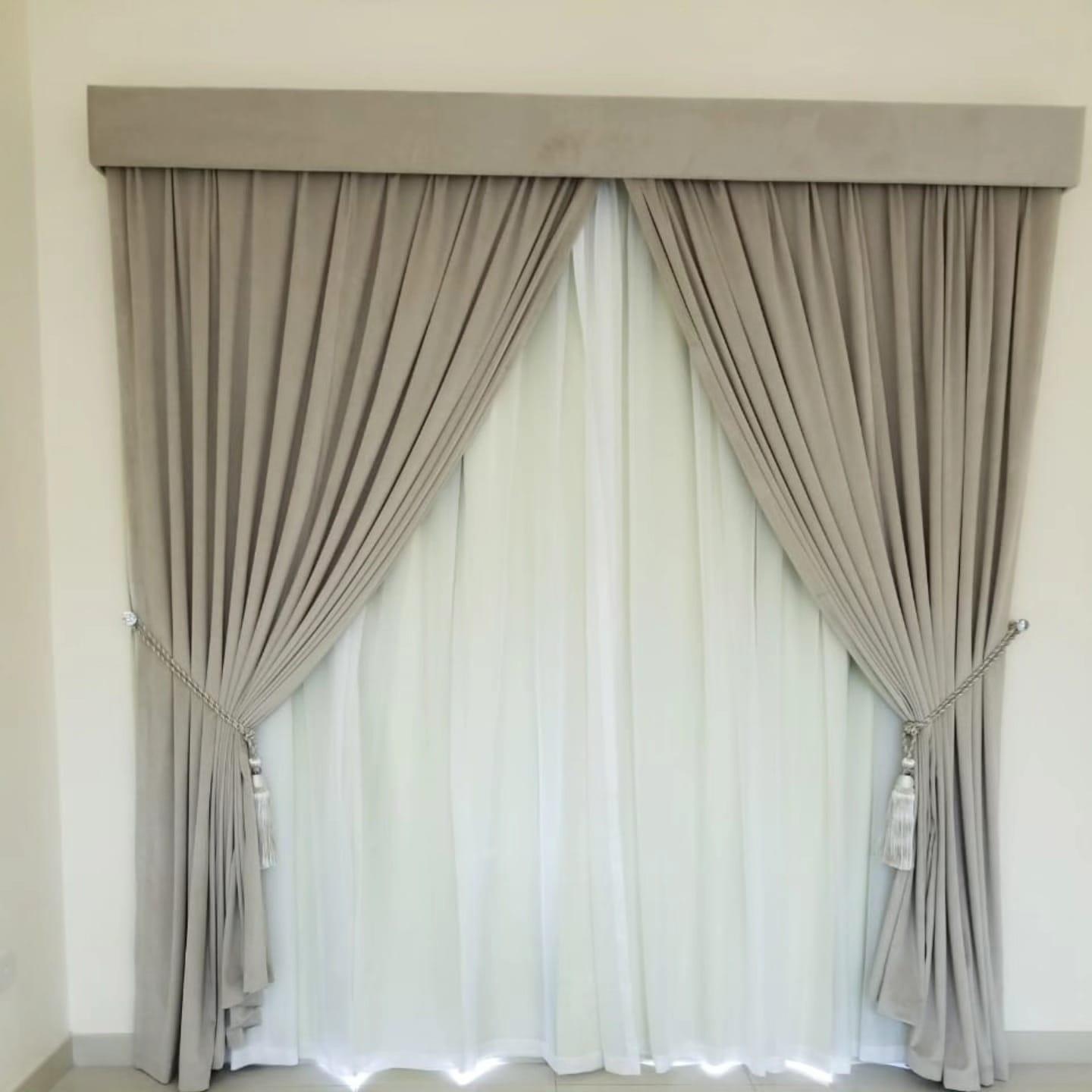
Pair heavy drapery on sunny facades with an independent sheer track to protect face fabrics.
Lining and interlining: what each protective layer does
A protective lining is the single most cost-effective investment in custom drapery. Beyond protecting expensive face fabrics from premature ultraviolet degradation, linings add substantive body, improve heading drape and enhance acoustic dampening.
As documented in technical classifications by James Dunlop Textiles, coated linings are defined by application passes: 1-pass coatings provide thermal insulation and light filtration, whereas 3-pass acrylic foam coatings deliver complete blackout opacity (detailed in thermal curtains in UAE heat). For luxury drapes, a heavy cotton flannel interlining ('bump') sewn between face fabric and lining yields rounded, sculptured folds.
Curtain lining types and functional performance
Standard poly-cotton lining
- Functional Performance
- Shields face fabric, neatens reverse look, improves drape
- Ideal Application
- General living areas, dining rooms
- Maintenance Requirement
- Launder or dry clean matching face cloth
Thermal lining (1-pass coating)
- Functional Performance
- Filters light scatter, reduces localized radiant heat transfer
- Ideal Application
- Perimeter desks, casual sitting rooms
- Maintenance Requirement
- Gentle wash; avoid abrasive creasing
Blackout lining (3-pass coating)
- Functional Performance
- Guarantees 100% light blockage through fabric weave
- Ideal Application
- Bedrooms, nurseries, media rooms
- Maintenance Requirement
- Professional dry cleaning or spot cleaning
Interlining (cotton bump flannel)
- Functional Performance
- Adds thermal mass, luxury weight and acoustic absorption
- Ideal Application
- Grand majlises, high-ceiling villa drapes
- Maintenance Requirement
- Specialist professional curtain dry cleaning
- 1. A sheer voile hangs in shallow folds and lets most of the daylight through
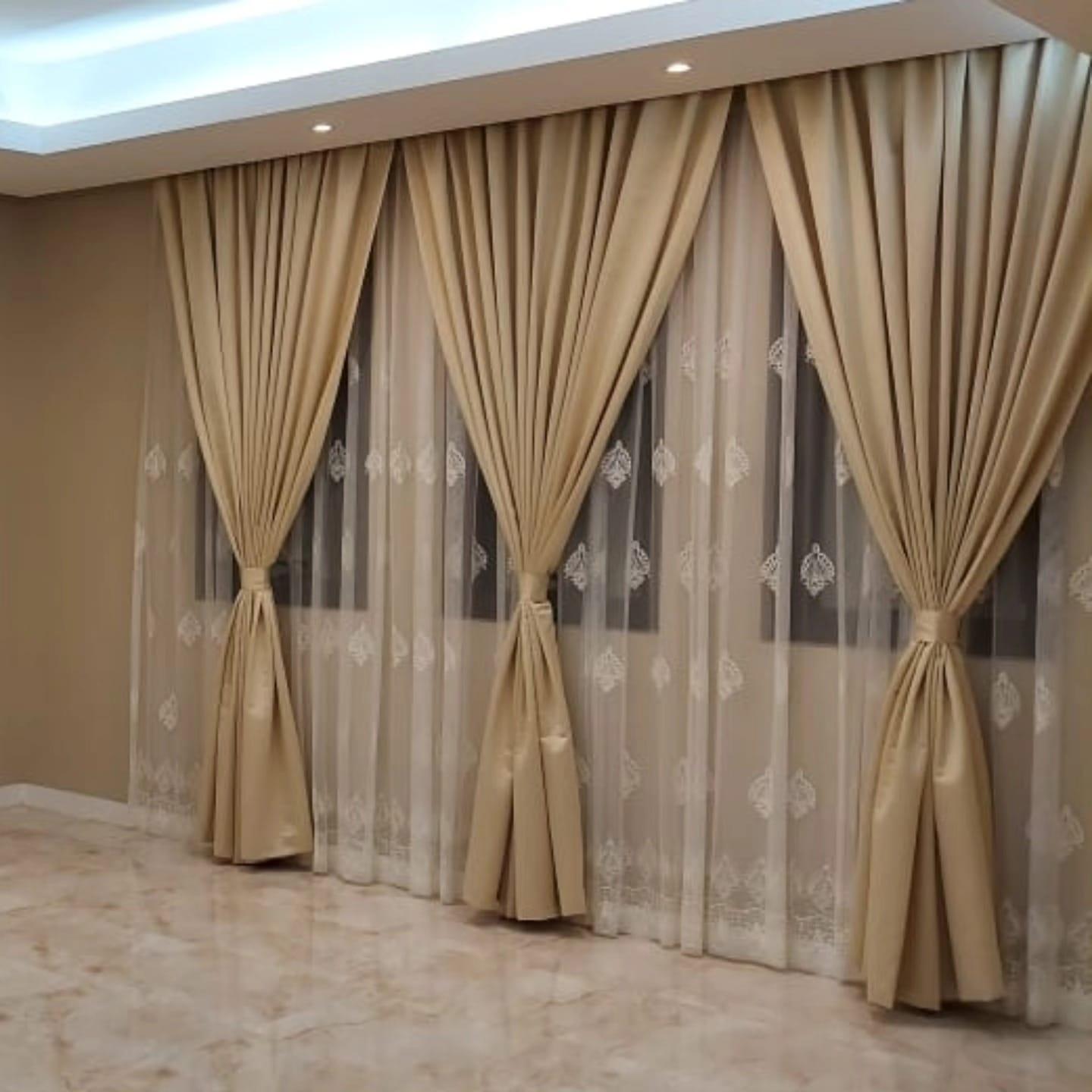
- 2. A linen blend falls in soft, deeper folds and filters the light
- 3. A velvet pile hangs in deep, heavy folds and lets little light through
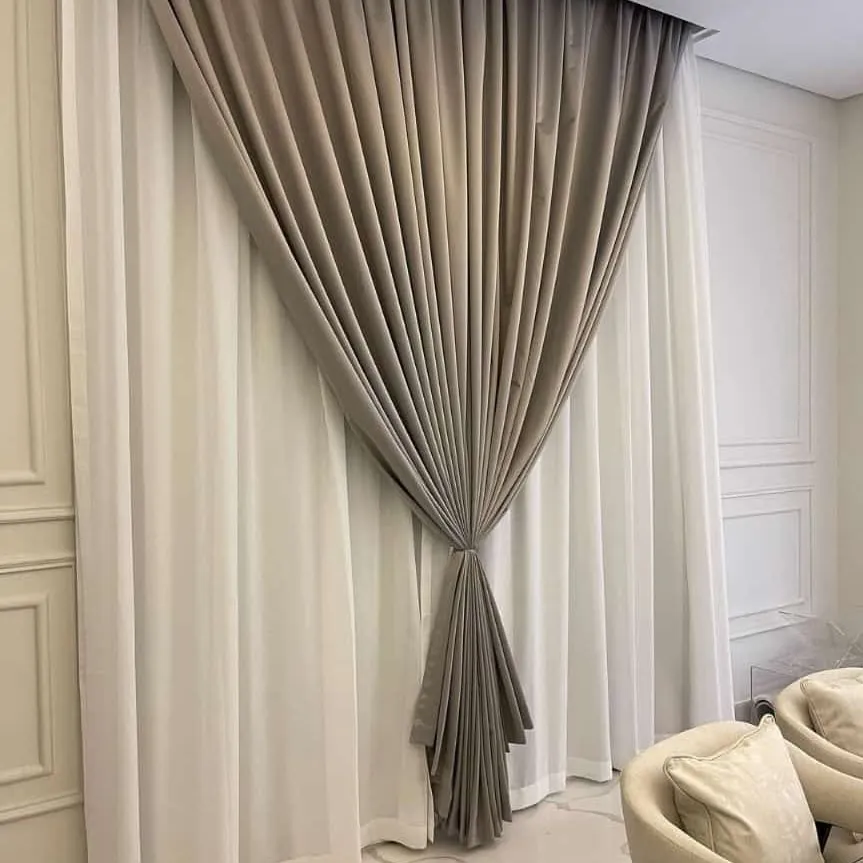
- 4. A face fabric with a lining behind it lets almost no light through
- 5. The lining takes the sun first, so the face fabric sits behind it
Fabric weight, hardware matching and yardage calculations
Fabric selection directly dictates hardware engineering. A lightweight sheer voile can glide on standard decorative rods, whereas an interlined velvet drape spanning a 5-metre majlis window weighs over 20 kg, requiring heavy-duty extruded aluminium tracks with steel ceiling brackets (see curtain rod vs track).
Total fabric yardage is governed by fabric roll width (typically 140 cm or double-width 280–300 cm) and pleat fullness (wave and pinch pleats consume 2.0× to 2.5× the window track width; see curtain headings and measuring guidelines). Thick interlined fabrics also require generous stacking depth inside gypsum ceiling pockets (see curtain pockets in gypsum ceilings).
Rub counts: why Martindale matters less for drapery
Homeowners frequently ask for the Martindale rub count when choosing curtain fabrics, confusing upholstery criteria with window treatments. The Martindale test (standardized under ISO 12947) measures frictional flat abrasion resistance by rubbing fabric swatches against worsted wool in an oscillating figure-of-eight motion until yarn breakdown occurs.
As noted by textile specialists at Kothea, Martindale rub ratings are vital for sofas and dining chairs subjected to body friction (see sofa fabrics for children and pets), but are virtually irrelevant for window curtains. Curtains terminate their service life due to solar degradation, leading-edge hand pulling, cleaning shrinkage and atmospheric oxidation—not abrasive friction. When evaluating drapery, prioritize Blue Wool lightfastness, dimensional shrinkage stability and care labels over rub counts.
Shrinkage control, care symbols and home laundering
Shrinkage is where bespoke curtains fail post-installation. Natural cellulosic fibers (cotton, linen) expand and contract with humidity and water temperature. The international 'Sanforised' trademark certifies that woven fabric has undergone mechanical compressive pre-shrinking to guarantee less than 1% dimensional change.
Lined curtains introduce differential shrinkage risk: if face fabric and lining shrink at divergent rates during wet cleaning, the drapery hem will ripple and pucker permanently. As a general rule: unlined polyester voiles and sheers can be machine-washed on a gentle cool cycle; lined drapes, blackout coatings, velvets and natural silks require professional dry cleaning (see our curtain and blind care guide).
Coastal humidity, condensation and mould prevention
Coastal regions across Sharjah, Dubai Marina, Jumeirah and the Northern Emirates experience severe summertime ambient humidity. The US Environmental Protection Agency (EPA) notes that damp interior fabrics must dry within 24 to 48 hours to prevent mould spore germination, recommending indoor relative humidity be maintained between 30% and 50%.
Dense woven pile (such as cotton velvet) retains atmospheric moisture longest. Avoid positioning moisture-absorbing natural velvets immediately adjacent to cold exterior glazing or beneath malfunctioning AC diffusers that drip condensation. Ensure room air circulates freely behind heavy drapery folds.
Testing fabric samples in your home's natural light
Never select curtain fabrics under showroom halogen lighting. Fabric dyes shift dramatically between artificial retail spotlights and the harsh desert daylight of your actual room.
During our complimentary consultation, Al Tareeq Decor brings full-scale physical fabric books directly to your home. Hold swatches vertically against your window at morning, midday and twilight; observe how the weave filters glare against your specific floor finishes; and inspect the reverse lining color that will be visible from the street.
Cost drivers and pre-order fabric checklist
Curtain pricing at Al Tareeq Decor starts from AED 550 per window (including manual aluminium track, standard fabric, tailoring and installation). Total project cost is driven by raw fiber composition, roll width, pattern repeat wastage, lining grade and heading fullness (see our custom curtain pricing guide).
- 1. Confirm exact fiber composition (percentages of natural vs synthetic fibers)
- 2. Verify certified Blue Wool lightfastness rating for your chosen colour code
- 3. Confirm whether fabric is pre-shrunk (Sanforised) or requires dry cleaning
- 4. Specify appropriate lining: standard, 1-pass thermal or 3-pass blackout
- 5. Ensure selected track hardware is engineered to support total calculated fabric weight
- 6. Review large fabric swatches inside your home across different times of day
- 7. Confirm Al Tareeq Decor's 24-month written workmanship warranty on custom tailoring
Bespoke tailoring in our Sharjah workshop
Every curtain order is individually measured, pattern-matched and stitched by master tailors in our dedicated Sharjah workshop (Industrial Area 4). We partner with leading international textile houses (including James Dunlop Textiles, JAB Anstoetz and Ultra Furnishing Fabrics) to provide an extensive library of premium drapery.
Standard custom curtains are tailored and installed by our in-house team within 3 to 5 working days following fabric selection, with 48-hour express service available. Every installation is backed by our comprehensive 24-month workmanship policy (see warranty and aftercare).
Common questions
What is the best fabric for curtains in the UAE?
For sun-exposed rooms, a lined polyester or polyester blend is the most durable choice. It resists UV fading and maintains its shape. Linen and cotton suit shaded rooms when protected by linings. See choosing curtain colours for sun.
Does linen fade in the UAE sun?
Yes, pure natural linen is susceptible to UV fading and embrittlement unless protected by a lining or formulated with solution-dyed yarns. Check the Blue Wool rating. See our curtain colour guide.
Is velvet good for curtains in hot climates?
Yes, particularly for majlises and formal living rooms where its heavy pile provides acoustic dampening. Specify polyester-pile velvet for easier cleaning. See our majlis curtains guide.
Do polyester curtains look cheap?
Not modern high-end weaves. Polyester is spun into slubbed faux-linens, matte voiles and architectural velvets; evaluate fabric weight and texture rather than fiber label alone. See blackout or sheer curtains.
Can I wash custom curtains at home?
Only unlined polyester sheers with washable care symbols. Lined drapes, blackout coatings and velvets must be professionally dry cleaned to prevent differential shrinkage. See how to clean curtains and blinds.
Which fabric is best for 100% room blackout?
Blackout is achieved by adding a 3-pass coated lining behind your chosen face fabric, allowing you to select any decorative surface cloth you prefer. See blackout and sheer curtain layers.
Can I review fabric samples at home before buying?
Yes. Our design consultants bring physical fabric sample books to your free in-home measuring visit. See choosing a curtain maker in Sharjah.

Sources & specifications
Manufacturer information applies to the named products and systems. Sources reviewed on 13 November 2026.
- James Dunlop Textiles: The Blue Wool Scale and lightfastness testing standards (ISO 105-B02)jamesdunloptextiles.com(opens in a new tab)
- Q-Lab: Xenon arc weathering and lightfastness test standards for textilesq-lab.com(opens in a new tab)
- Kothea: Architectural fabric specification guide and lightfastness thresholdskothea.com(opens in a new tab)
- US Environmental Protection Agency (EPA): Indoor moisture control and mould prevention guidelinesepa.gov(opens in a new tab)
Want this planned for your home?
Consultation and measurement are free. Tell us the rooms, location and what you need; we arrange a sample visit and define the measured quotation.