Media Walls · 17 min read · 28 October 2026
Fluted or flat media wall? How to choose the face for your TV wall
Fluted or flat for your media wall? How each face reads in light, collects dust, handles sound and what it asks of the workshop, with a decision path and a mix.

By Ali Haider Basra, Founder, Al Tareeq Decor · Contact our workshop
Key takeaways
- Choose plain where the wall is used and fluted where it is seen; most good walls are a deliberate mix of both.
- A ribbed face turns raking light into shadow lines and changes through the day; a flat face is one calm tone and relies on lighting for atmosphere.
- Grooves hold dust between wipes and need a groove-wise pass; a flat face clears with one sweep. Pick the one you will actually wipe.
- Ribs are decoration unless a real sound-absorbing core sits behind them; one vendor quotes NRC 0.70 to 0.90 for its own core panels, so ask for the test report.
- Judge a sample in your own room at three times of day and ask for the construction in writing before you approve.
On this page
- Key takeaways
- Ribbed or plain: the question behind the photographs
- What the two faces actually are
- How light reads a flat face and a ribbed face
- Dust: where it settles and what each face asks of you
- Sound: decoration is not absorption
- Effort and precision: what each face asks of the workshop
- The mix: ribbed where it is seen, plain where it is used
- Behind the TV: where each face works hardest
- A decision path from four everyday facts
- Flat, mixed or fully fluted at a glance
- Three faces for a media wall
- Three worked scenarios
- Mistakes people make choosing between the two
- Judging a sample in your own room
- What we do, and how to start on WhatsApp
- Common questions
Ribbed or plain: the question behind the photographs
Look through any set of media wall photographs and you will see two faces competing for the wall behind the TV. One is plain and calm: a smooth panel in white, grey or a stone-effect finish. The other is ribbed: vertical grooves or slats that catch the light and make the wall look deeper. Most people choose by looking at which photograph they prefer, and that is a sensible start. It is not enough, because the two faces behave differently once they are on your wall, in your light, under your cleaning habits.
This guide is only about the choice. How a fluted wall is built, which slat widths and gaps we use and how the lighting is planned are covered in our fluted TV wall panel guide and in the slatted wall guide; we link to them rather than repeat them. Here the questions are practical: how does each face read in the light of your room, what does each ask of you every month, what does each do to sound, what does each cost in effort, and when is a mix of the two the right answer?
A short answer, so that the rest is easier to weigh: choose plain where the wall is used and fluted where it is seen. A plain face suits the working part of a wall, the surfaces next to the console, shelves and sockets. A ribbed face earns its place where the eye lands, usually the panel behind and beside the TV. Walls that are entirely one or the other are possible and sometimes right, but most good walls are a deliberate mix.
What the two faces actually are
The words are used loosely, so it helps to fix them. A fluted panel, in the plain description of one vendor, is a solid panel with a routed or moulded profile: a continuous grooved face. A slat panel is made of individual timber slats with gaps between them, often over a backing. Stikwood, another vendor, puts it in similar terms: fluted wood panels usually have rounded vertical grooves or channels that create a ribbed decorative surface, while slat panels use individual linear slats over an acoustic backing.
The difference matters for the choice because the gaps between slats let light, dust and sound go in, where a fluted face is continuous. Throughout this article, when we say fluted we mean the ribbed face in general, and we say so when the slat construction matters. A flat face means a smooth panel: laminate, lacquer, veneer or a stone-effect sheet with no relief at all.
In our own work the materials follow what the site publishes for media walls: acoustic fluted slats in oak, walnut or charcoal, porcelain or marble-effect panels, and plain laminate faces. What is behind a particular ribbed face, and whether it has any sound-absorbing core, is something to ask for in the quotation rather than assume from the look, and the sound section below explains why.
How light reads a flat face and a ribbed face
A flat panel shows one tone. Whatever light reaches it, the surface looks the same everywhere, apart from the glare of a window or a lamp. That is its strength: it is calm and it makes the TV, the shelves and the decorative objects stand out. It is also its weakness, because a flat face is unforgiving about joints, uneven walls and marks, which show as lines on an otherwise uniform surface.
A ribbed face makes shadows. Each rib or slat blocks a little of the light that arrives along the wall, and the groove behind it falls into shade. The more the light grazes the wall from the side, the longer the shadows and the deeper the wall looks. The plan view shows this: the same light reaches a flat panel and a fluted one, and only the second turns it into a pattern. A window to one side of the wall will draw shadow lines in the morning and move them through the day.
That change through the day is a feature for some people and a distraction for others. If you like a wall that is a little different at nine in the morning and at nine at night, the ribbed face gives it to you. If you want a wall that is always the same, choose flat and get the atmosphere from the lighting design, which our lighting guide explains. Colour matters too: the colour and finish guide describes how the same finish changes from morning to evening, and sample boards judged in the room are the only honest test.
- 1. Flat panel: one even tone, so marks and joints show
- 2. Fluted panel: each rib throws a shadow and the wall gains depth
- 3. Light arriving along the wall draws the longest shadows
Dust: where it settles and what each face asks of you
Every vertical surface in the UAE collects dust, and the question is only where it sits and how long it takes to remove. On a flat face dust lies on the surface and a single pass with a soft cloth removes it. On a ribbed face dust falls into the grooves and stays there, out of the reach of a quick wipe. One vendor's own comparison of the two formats says that a continuous surface is easier to wipe clean and does not accumulate dust in gaps the way slat panels can.
That is a fair general point, and it is also the vendor's own view, not a test. What we say from our side is simpler: a ribbed wall needs a little more care, in a different direction. The right pass runs along the grooves, with a soft brush or a vacuum with a brush head, not across them, and the routine is described in the fluted panel care notes. Our care and maintenance tool gives general cleaning habits for finished surfaces.
The honest decision rule is about habit, not about the material. A person who wipes walls rarely will find a flat face the easier wall to live with, and a person who dusts weekly will not notice the difference. Dark finishes tend to show dust sooner than mid-tone ones, so the face and the colour should be chosen together. Neither wall is maintenance-free, and the wall you will actually wipe is the right one.
- 1. Flat face: one sweep clears the surface
- 2. Fluted face: dust sits in the grooves
- 3. Wipe along the grooves, not across them
Sound: decoration is not absorption
Many people choose a ribbed wall partly for the sound, and this is where the look and the facts part company. Unidus Acoustics, a maker of such panels, says in its own words that a fluted panel earns the word acoustic only when the grooved face sits on a real sound-absorbing core, and describes decorative cladding with no acoustic core at all as a different thing. The same page quotes an NRC of 0.70 to 0.90 for its own panels, which is that vendor's claim for its own construction and a reason to ask for a test report, not a number for every fluted wall.
The Panel Hub, a different vendor, makes the comparison between formats: slat panels with acoustic backing perform measurably better for sound absorption, and fluted panels have no gaps and provide minimal sound absorption. Put the two vendors together and the message is consistent: what absorbs sound is the material behind the face, not the grooves.
For a media wall this means three practical things. A flat board reflects sound. A ribbed face on plain board scatters it a little and absorbs little. A ribbed face on a proper absorbing core can soften a room, which matters in a large, hard-surfaced living room. If sound is part of your reason for choosing a ribbed face, ask what is behind it and ask to see the supplier's data, and do not treat the ribs themselves as acoustic treatment. The same caution applies to the guide to soundbars and speakers, which explains what the room and the position do to the sound.
- 1. Flat board: reflects sound back into the room
- 2. Fluted without a core: scatters sound, absorbs little
- 3. Fluted on an absorbing core: absorbs, if the core is real
Effort and precision: what each face asks of the workshop
A flat face is the simpler object to make and fit. It needs flat boards, clean joints and an even wall, and the main risk is a visible joint or a small tone difference between two sheets. A ribbed face asks for more: the grooves have to line up across boards, corners have to be wrapped or mitred, and the pattern has to meet sockets, shelves and edges without awkward cuts. Stikwood notes the same on its own page: the installation can become more involved if you need to wrap corners and align grooves across multiple panels.
This is the real cost of a ribbed face, and it is mainly a cost of planning, not of material. The pitch of the ribs has to be set against the TV's width and the shelf positions on the drawing so that a cut does not land through the middle of a slat. The slatted wall guide explains how screen edges and slat pitch are aligned. A good drawing prevents that problem before any board is cut.
Because every wall is quoted individually, we do not publish a price difference between the two faces. The final figure comes from the quotation and depends on the wall size, the finish and the lighting. Our media walls start from AED 3,500 per project, and what a media wall costs explains the drivers. A fair guide is that a ribbed face adds drawing time and cutting, and the plain face is where you save when the budget is tight.
The mix: ribbed where it is seen, plain where it is used
Most of the walls that people photograph and remember are mixes. A band of ribs behind and beside the TV carries the visual weight; the console, the shelf sides and the end panels stay flat. The reason is partly cleaning and partly calm: a wall that is ribbed from end to end can look busy, and ribs behind shelves and objects compete with what is on the shelves.
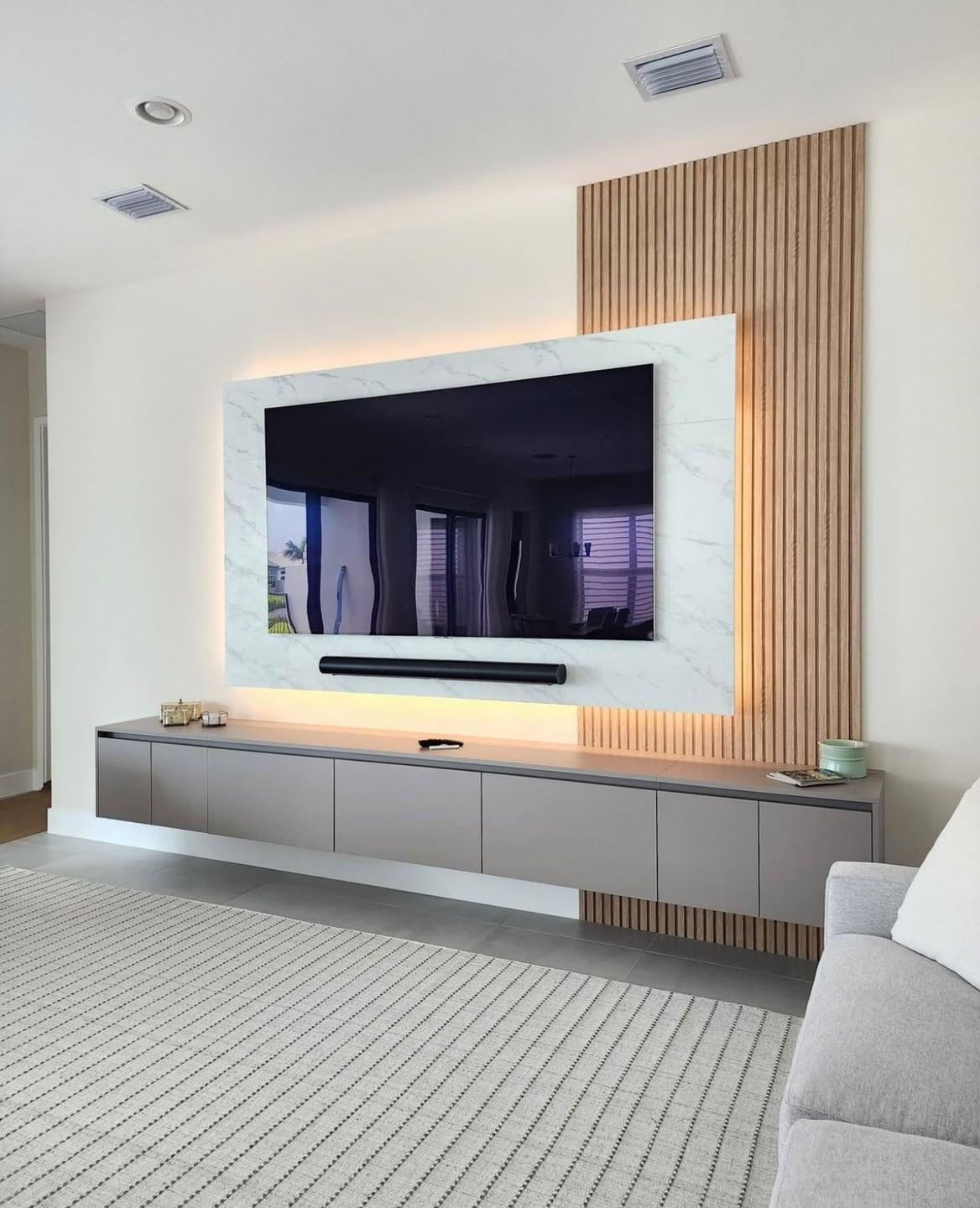
A good mix follows three rules. The ribs sit where the eye lands first, behind the screen and around it, and not where hands go. The plain surface continues the wall's lines, so that the two faces look like one design and not like a patch. And the finishes agree: a ribbed oak face next to a plain walnut one looks accidental, while a ribbed face and a plain face in the same finish, or in two tones chosen together, look planned. The marble TV wall guide shows the classic UAE pairing of a plain stone-effect panel with ribbed sides.
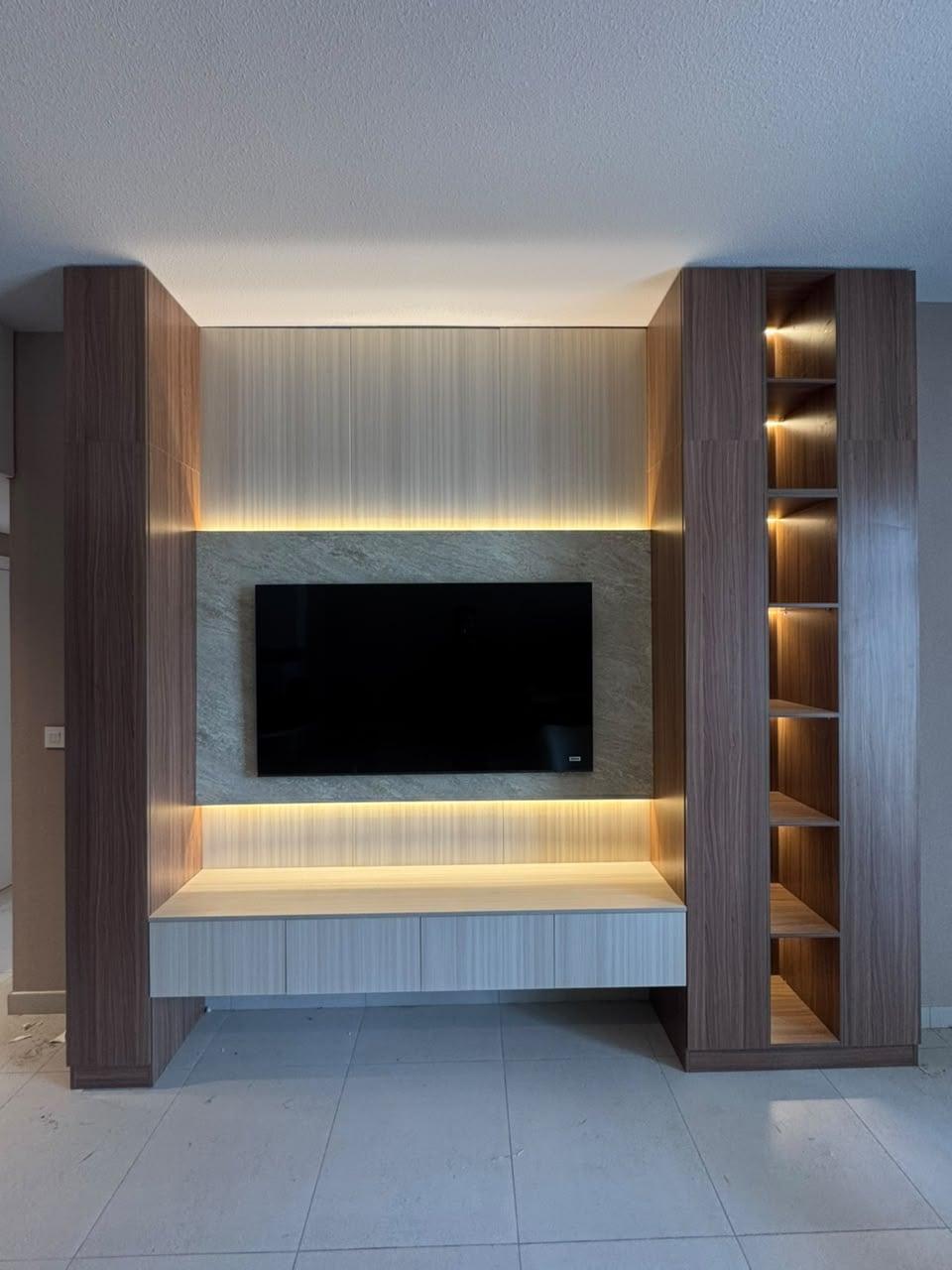
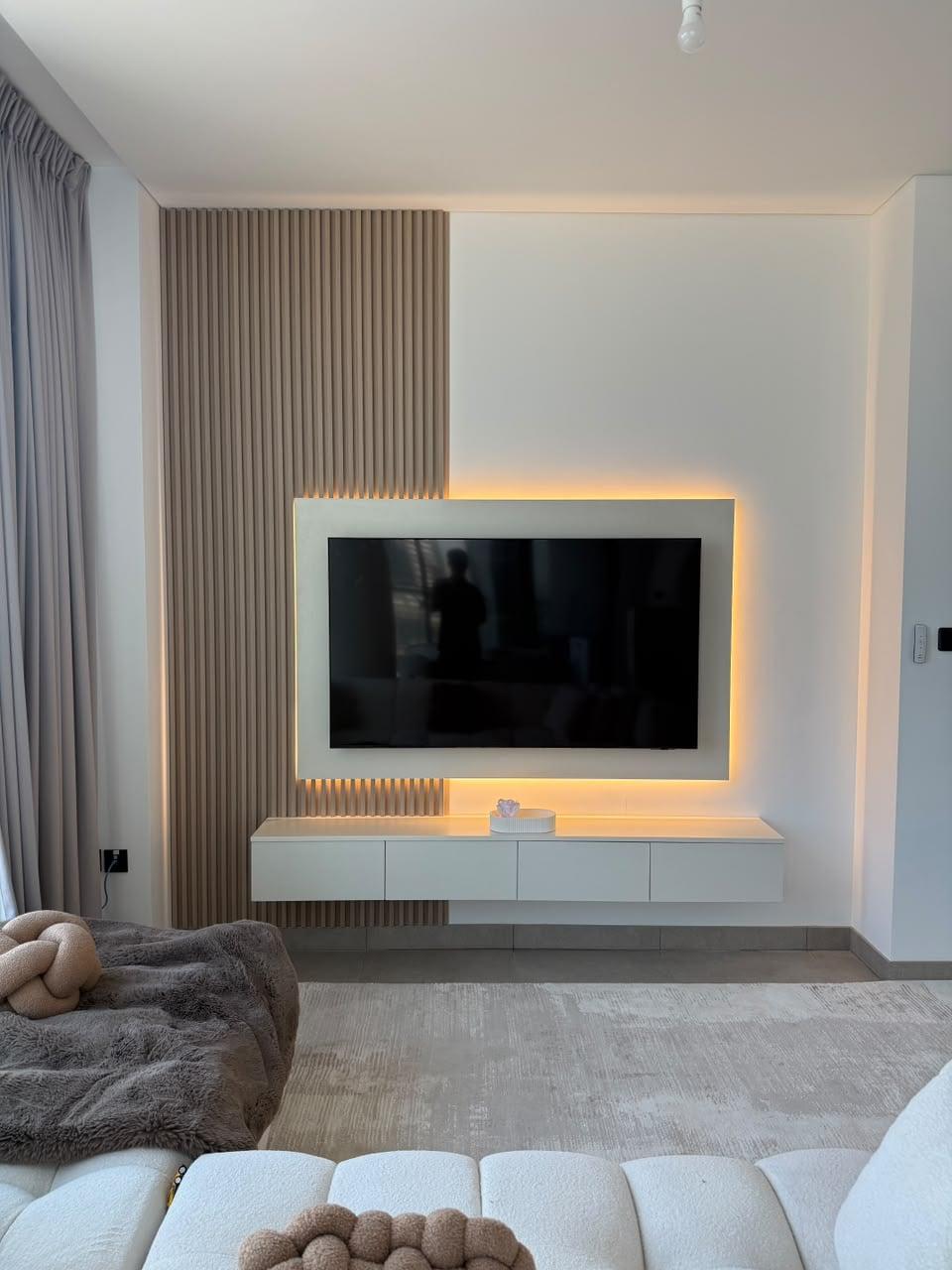
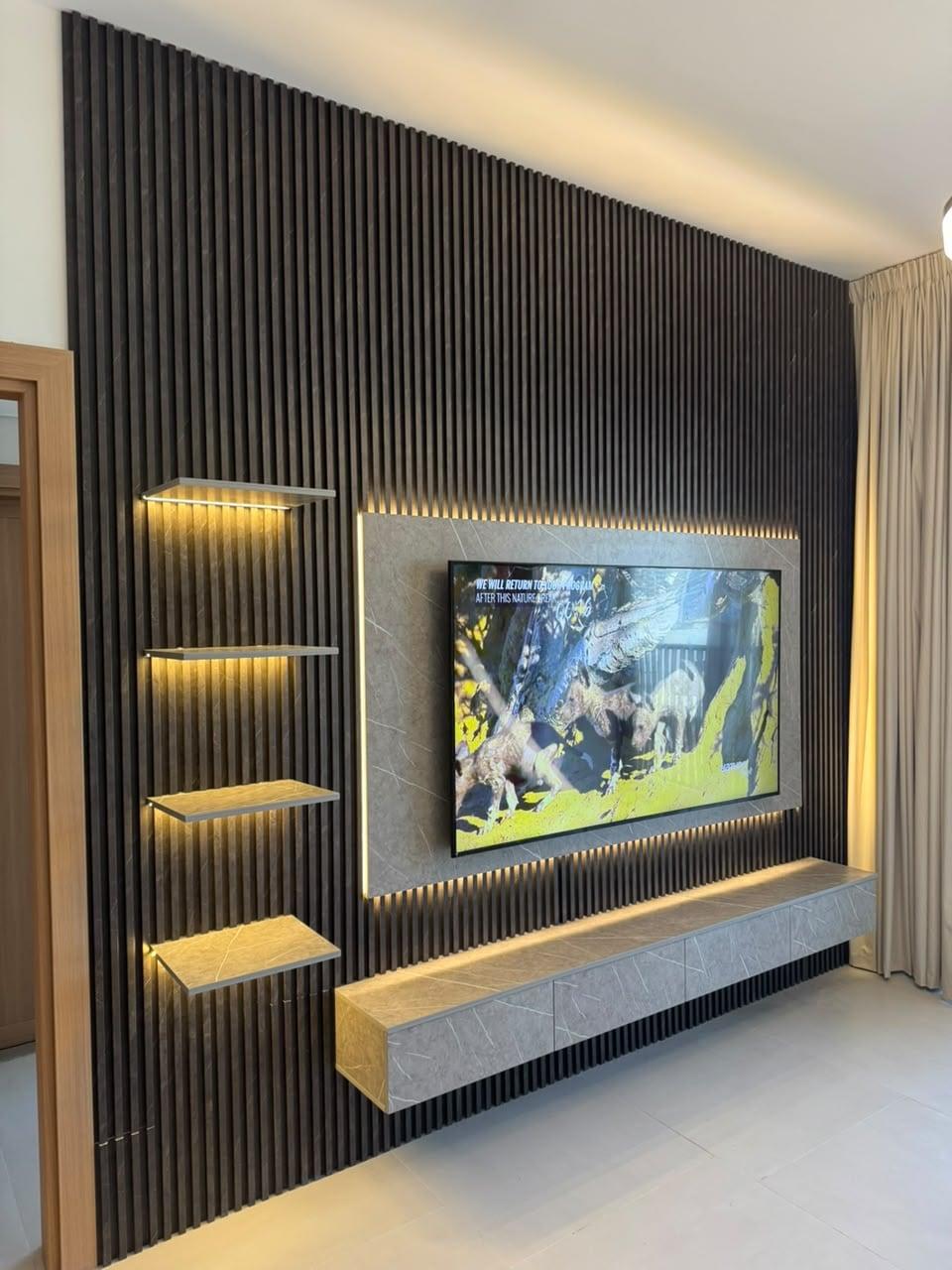
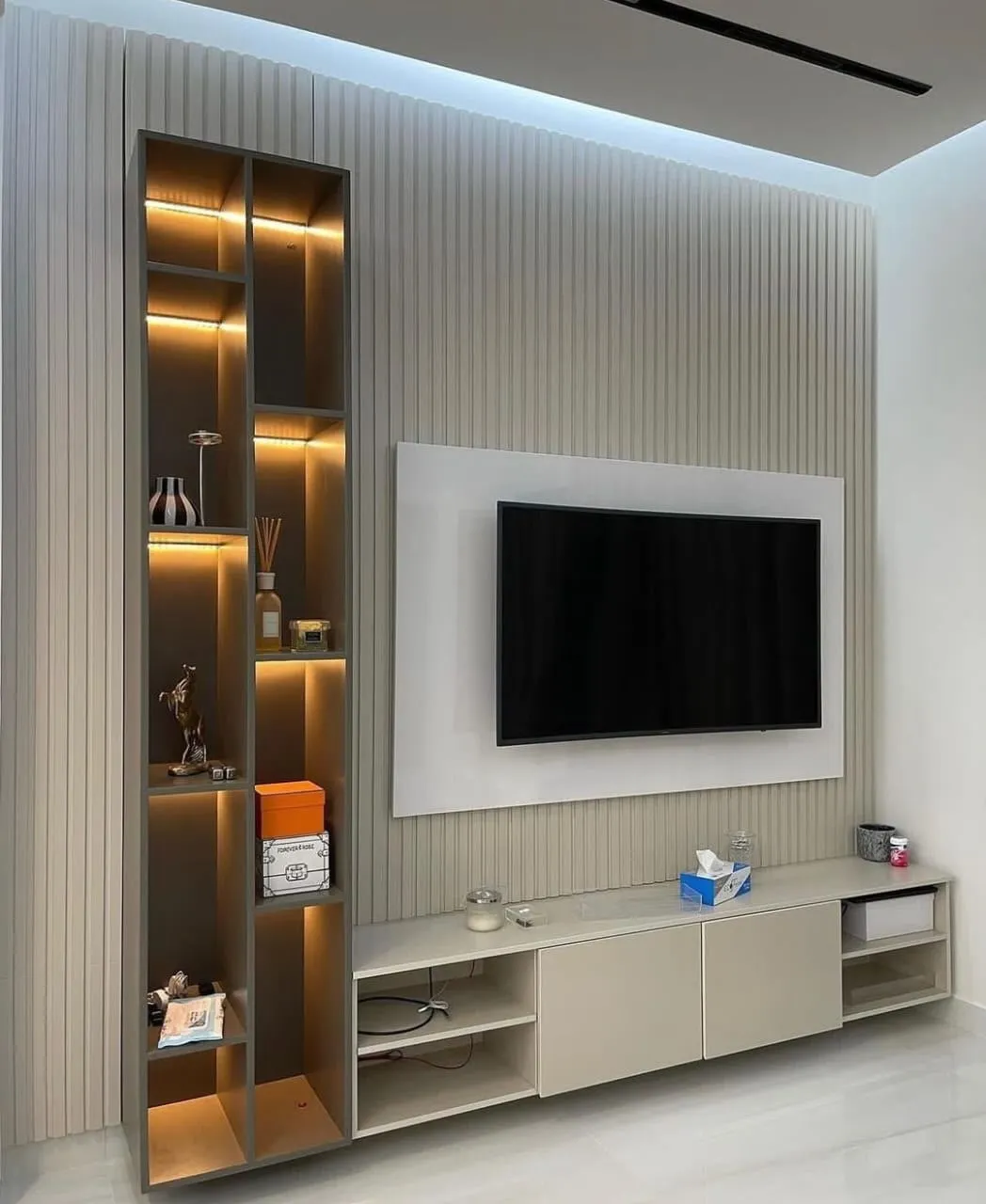
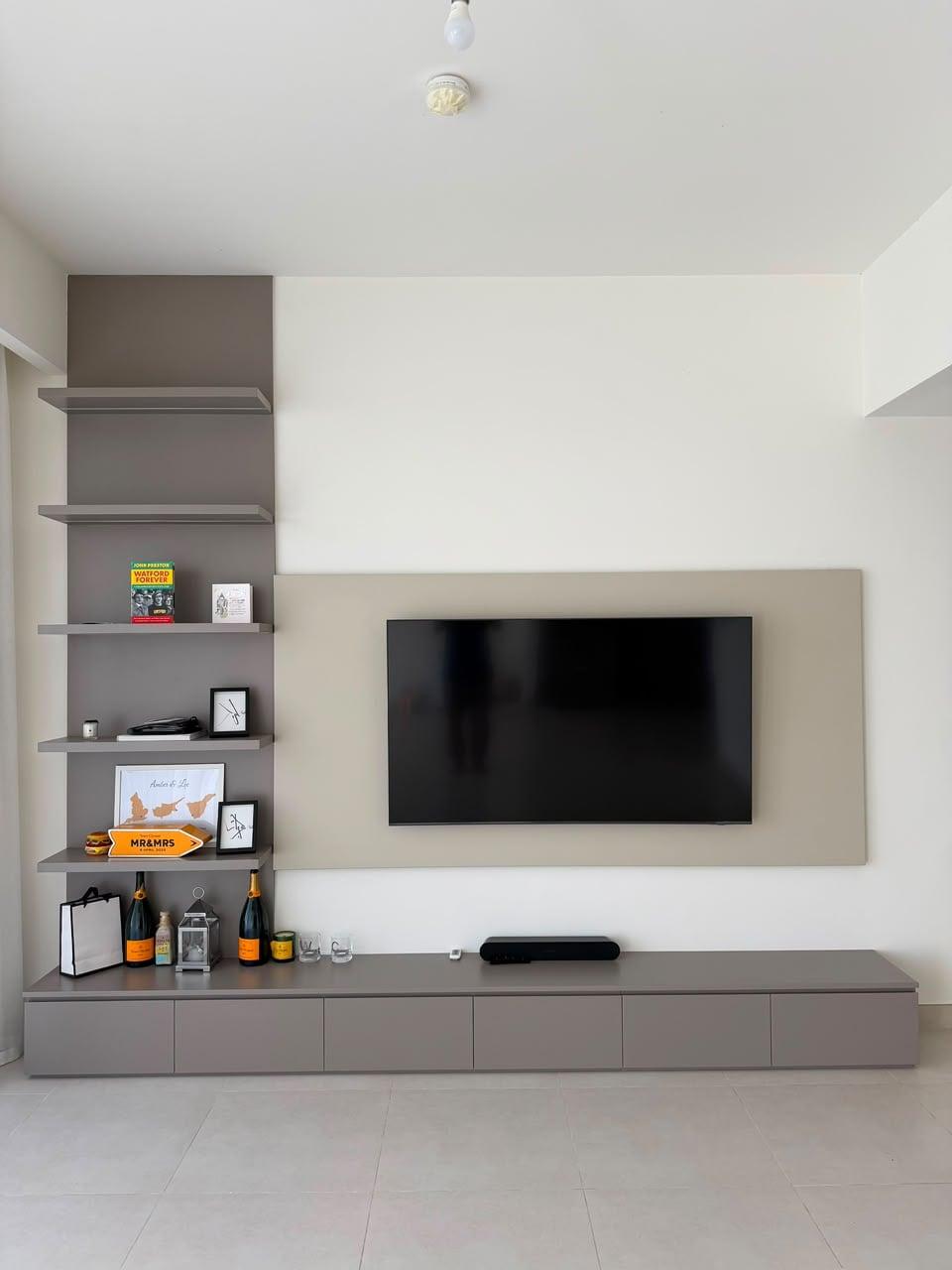
The photographs show two kinds of mix. In one, a grey ribbed face flanks a lit tower and a white panel. In the other, a minimal wall uses plain surfaces and floating shelves with the ribs confined to a narrow band. Both look designed, and neither would suit every room.
Behind the TV: where each face works hardest
The area directly behind the screen is the most visible part of the wall and the hardest to get right. On a flat face the screen sits cleanly, and a backlight reads as a soft halo. On a ribbed face the screen's edges have to be seen against the pattern, and a rib that is cut by the edge of the TV is a distraction you notice every night. That is why the pitch of the ribs is set against the screen's width, and why some of our drawings put a plain panel directly behind the TV and ribs at the sides.
Cable and bracket details work in your favour on a flat face. A bracket that holds the TV on a flat panel sits tight against it, and the leads can drop through a single, clean opening. On a ribbed face the bracket's back plate has to sit across the ribs or in a plain zone cut into them. Neither is a problem if it is drawn. Both are a problem if they are found on the day. Hidden cables you can still service explains the routes, and the TV height guide explains where the screen goes.
If you are choosing for a small room, a plain face behind the TV with a ribbed accent on one side often suits it best. Ribs make a wall look deeper, and in a small room that can be an advantage, as long as the pattern does not take over the wall. The small living room guide covers the proportions.
A decision path from four everyday facts
The decision can be made from four facts about how you live, and the diagram sets them side by side. Do you wipe walls rarely? Then plain, or ribs only as a small accent. Does a window throw strong side light across the wall? Then a ribbed face gains the most. Do you want a quiet, calm wall? Then plain surfaces with the light doing the work. Is the room echoing and hard? Then ask for a real absorbing core, and ask for the test report.
Note what the path does not say. It does not say that one face is more expensive in a way that matters for every wall, and it does not say that ribs are fashionable and plain is dull. Both are fine in the right place. What the path does is turn a taste question into a habit question, which is easier to answer honestly.
- 1. Rarely wipes walls: flat, or ribs only as a small accent
- 2. Strong side light: fluted gains the most
- 3. Wants quiet and calm: flat with light and a stone or wood panel
- 4. Echo in the room: ask for a real absorbing core and a test
Flat, mixed or fully fluted at a glance
The table compares the three approaches on the points covered above. It is a guide to reasoning, not a ranking, and the right column depends on the wall and on you.
Three faces for a media wall
Light and depth
- Flat throughout
- One tone, calm, relies on lighting
- Mixed: ribs where seen
- Depth where the eye lands
- Fluted throughout
- Strong shadows, changes through the day
Dust and wiping
- Flat throughout
- One sweep
- Mixed: ribs where seen
- Ribbed zone needs the groove-wise pass
- Fluted throughout
- Every groove needs care
Sound
- Flat throughout
- Reflects
- Mixed: ribs where seen
- Depends on what is behind the ribs
- Fluted throughout
- Only absorbs with a real core
Planning effort
- Flat throughout
- Lowest: joints and tone
- Mixed: ribs where seen
- Medium: pitch against screen and shelves
- Fluted throughout
- Highest: alignment across the whole wall
Best for
- Flat throughout
- Small rooms, busy shelves, rare wiping
- Mixed: ribs where seen
- Most living rooms and majlis walls
- Fluted throughout
- Large rooms, strong light, a statement wall
Our judgement from the sources above and our own drawings; confirm sound claims with the supplier's report.
Three worked scenarios
Scenario one: a two-bedroom flat in Dubai with a living room that gets bright afternoon sun on the TV wall from a balcony door to its right. The owners are drawn to ribs and worry about dust. The raking light is exactly what a ribbed face needs, so the drawing puts a band of ribs behind the TV where the light draws it, a plain finish in the same colour at the sides, and a flat console that is wiped with a cloth. The owners agree to a groove-wise brush pass monthly. The wall reads differently at four in the afternoon than at nine in the evening, which is what they wanted.
Scenario two: a studio in Sharjah, where the TV wall is also the wall seen from the bed. The owner wants calm, has little time to clean and a small budget. A plain panel in a light stone-effect finish, a lit niche and a floating console give the wall its character with light and not with relief. A single narrow ribbed band beside the screen is offered as an option and declined. The owner is told that ribs can be added in a later phase if the room changes.
Scenario three: a villa lounge with a high ceiling and an echo that the family notices every evening. They ask for ribs partly for sound. The honest answer is that the ribs themselves do little; what helps is a ribbed face on a real absorbing core and soft furnishings in the room. The drawing specifies the core and asks for the supplier's test report before approval, and the family agree that if the report is not available they will choose the plain version.
What the scenarios share is that the face followed the owner's light, habit and room, not the photograph they started from.
Mistakes people make choosing between the two
These are the mistakes we see most often, and they are all avoidable with a drawing and a sample.
- Choosing ribs for the sound without asking what is behind them.
- Choosing a dark ribbed face and not budgeting for the dusting it will ask for.
- Fluting the whole wall, shelves included, so that the ribs fight the objects on them.
- Letting a rib be cut by the edge of the TV because the pitch was not checked against the screen.
- Judging a sample under shop light instead of in the room at the hour you use it.
- Choosing a plain face in a room with lumpy walls without asking how the joints will be handled.
- Mixing a ribbed oak face with a plain walnut one because each looked good alone.
- Treating the choice as permanent when a plain wall can often take a ribbed accent later.
Judging a sample in your own room
Whatever you choose, look at a sample in the room before you approve it. Place the board on the wall where it will go and look at it in the morning, the afternoon and the evening, with the light on and off. A ribbed sample will show its shadows only in the right light, and a flat sample will show its tone drift between daylight and warm LED. Our finish sample approval guide explains the habit, and the colour and finish guide explains why the same board looks different at different times.
Ask also for the construction of the ribbed face in writing: the core, the thickness, how the ribs are fixed and what is behind them. The drawing should show the rib pitch and where the first and last rib land against the corners and the TV. The quotation checklist turns these questions into lines to look for.
What we do, and how to start on WhatsApp
We design and build both faces in our workshop in Sharjah and fit across the UAE. The measuring visit is free of charge. Production starts once the details are agreed and a 60% advance is paid, and most walls take up to about 10 days depending on size and design. Our media walls start from AED 3,500 per project, with the final figure from the quotation. Our 5-year limited warranty covers the wood-based boards only, subject to its terms. We have built media walls for ten years, and the question we ask first is how the wall is used, not which face is in fashion.
To start, send us a WhatsApp message with a photograph of the wall straight on, one from the sofa, the TV size, a note of where the window and the light are, and a photograph of the finish you like. Tell us how often you wipe the walls and whether the room echoes. We will say which face we would draw and why, and show a mix if it suits. What to send us lists the pictures that help most.
The media walls page shows the kinds of wall we make, and the wooden feature walls product page shows ribbed and slatted work. If you are starting from the room, the living room TV wall guide is the natural companion to this one.
Common questions
Is a fluted wall harder to clean than a flat one?
Slightly: dust sits in the grooves, so wipe along them with a soft brush, while a flat face clears with one sweep. Neither is maintenance-free. Fluted TV wall panels.
Do fluted panels improve the sound in the room?
Only if a real absorbing core sits behind the face; ribs on plain board do little. Ask what is behind them and for the supplier's report. Soundbars and speakers.
Can I have fluted panels only behind the TV?
Yes, and many of our walls do: ribs where the eye lands, plain surfaces where hands go. The rib pitch is set against the screen on the drawing. Fluted and slatted TV walls.
Does a flat wall look boring?
Not when light and a stone-effect or wood panel do the work; calm is a design choice. Marble and stone-effect walls.
Which is better for a small room?
A plain face behind the TV with a narrow ribbed accent often suits it, because ribs add depth without taking the wall over. Small living room media walls.
Can I add ribs to a plain wall later?
Often yes, if the wall was drawn to accept a panel; ask for that on the first drawing. Changing the TV later.
How much more does a fluted face cost?
There is no standard figure: a ribbed face adds drawing and cutting time, and the price comes from the quotation. Walls start from AED 3,500 per project. What a media wall costs.

Sources & specifications
Manufacturer information applies to the named products and systems. Sources reviewed on 11 November 2026.
- The Panel Hub: slat panels vs fluted panels (continuous grooved face vs individual slats; acoustic backing; dust in gaps; vendor page)thepanelhub.com(opens in a new tab)
- Unidus Acoustics: fluted acoustic panels in interiors (a fluted panel is acoustic only on a real absorbing core; vendor NRC claim)unidusacoustics.com(opens in a new tab)
- Stikwood: fluted wood panels vs slatwood (rounded vertical grooves; slats over acoustic backing; alignment and corners; vendor page)stikwood.com(opens in a new tab)
Want this planned for your home?
Consultation and measurement are free. Tell us the rooms, location and what you need; we arrange a sample visit and define the measured quotation.