Media Walls · 17 min read · 30 October 2026
Wall-mounted or floating console? How the support decides the choice
Wall-mounted, floating or floor-standing console: where the weight goes, how the wall type decides, what bracket ratings mean, the floor gap, cables and a choice path.

By Ali Haider Basra, Founder, Al Tareeq Decor · Contact our workshop
Key takeaways
- Follow the load: a floor-standing console passes it to the floor, a wall-hung one to the wall, and a plinth-set one looks floating but is carried from the floor.
- The wall decides what can hang on it: masonry takes a hung console well, dry-lined walls are the hardest to fix to, and a plasterboard partition holds only at its timbers.
- A bracket rating is per bracket and per test frame (one maker's 110, 80 and 50 kg), and it says nothing about your wall; the fitter assesses the wall.
- Add up what the drawers will really hold; heavy contents, a speaker on top or a marble-effect top point to a floor-carried console.
- Keep the TV on its own bracket and let the console carry only the equipment; ask for the support method on the drawing.
On this page
- Key takeaways
- Two names for something that seems to be the same thing
- Where the weight goes
- The wall decides what can hang on it
- What a bracket rating tells you, and what it does not
- What the console will actually hold
- The floor, the cleaning and the gap beneath
- Cables, sockets and air under a floating console
- Should a TV sit on a floating console?
- How each looks, and how to choose
- Three arrangements compared
- Floor-standing, wall-hung and plinth-set consoles
- Three worked scenarios
- Mistakes that make a console fall short
- What we do, and how to start on WhatsApp
- Common questions
Two names for something that seems to be the same thing
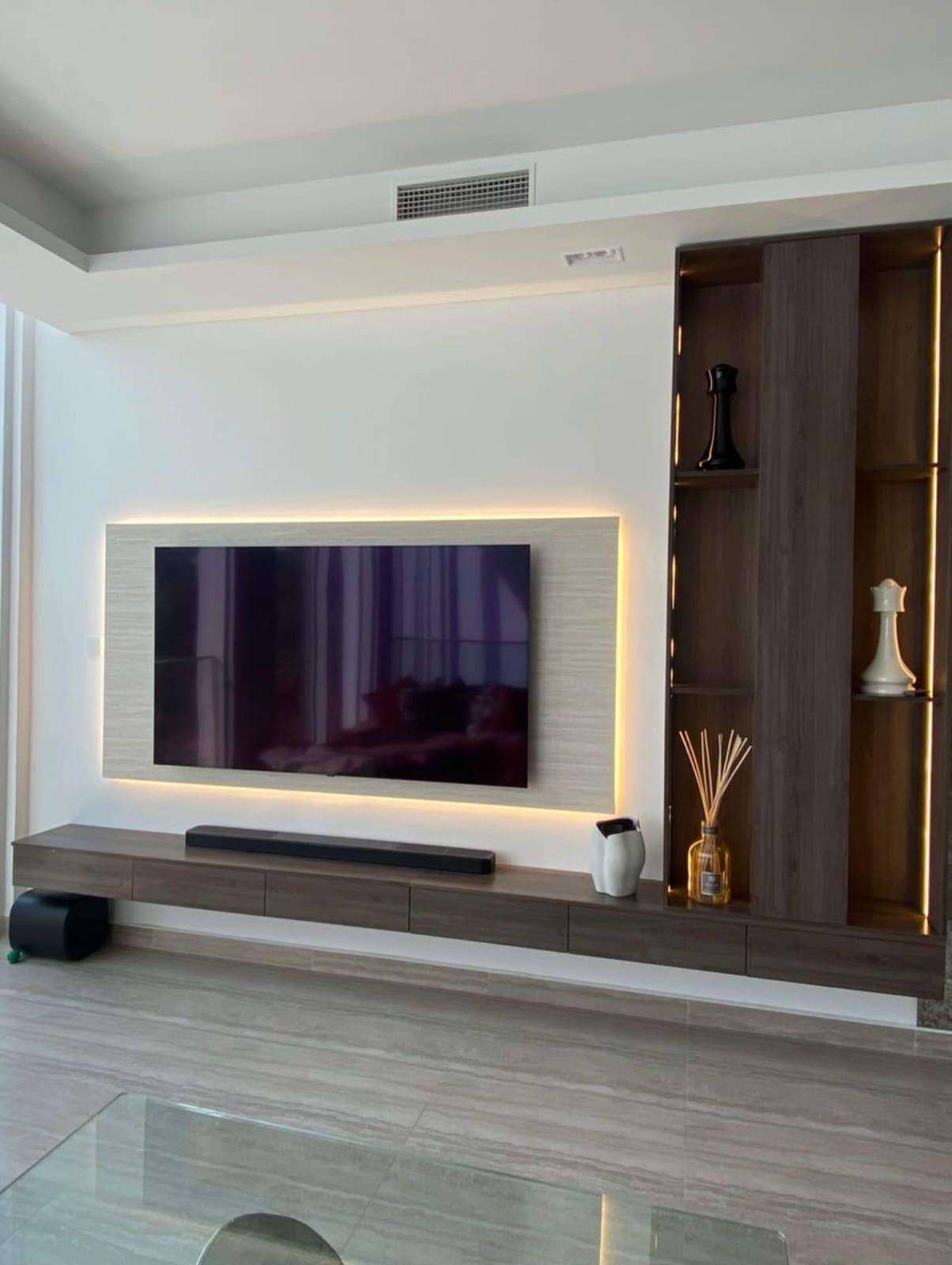
Ask for a floating console and you may be shown a cabinet that hangs from the wall. Ask for a wall-mounted console and you may be shown a cabinet that looks as if it floats but stands on a hidden base. The words are used loosely across the trade and in photographs, and the confusion is not a small one, because the way a console is supported decides what the wall must carry, how the floor looks and what happens when the owner fills it.
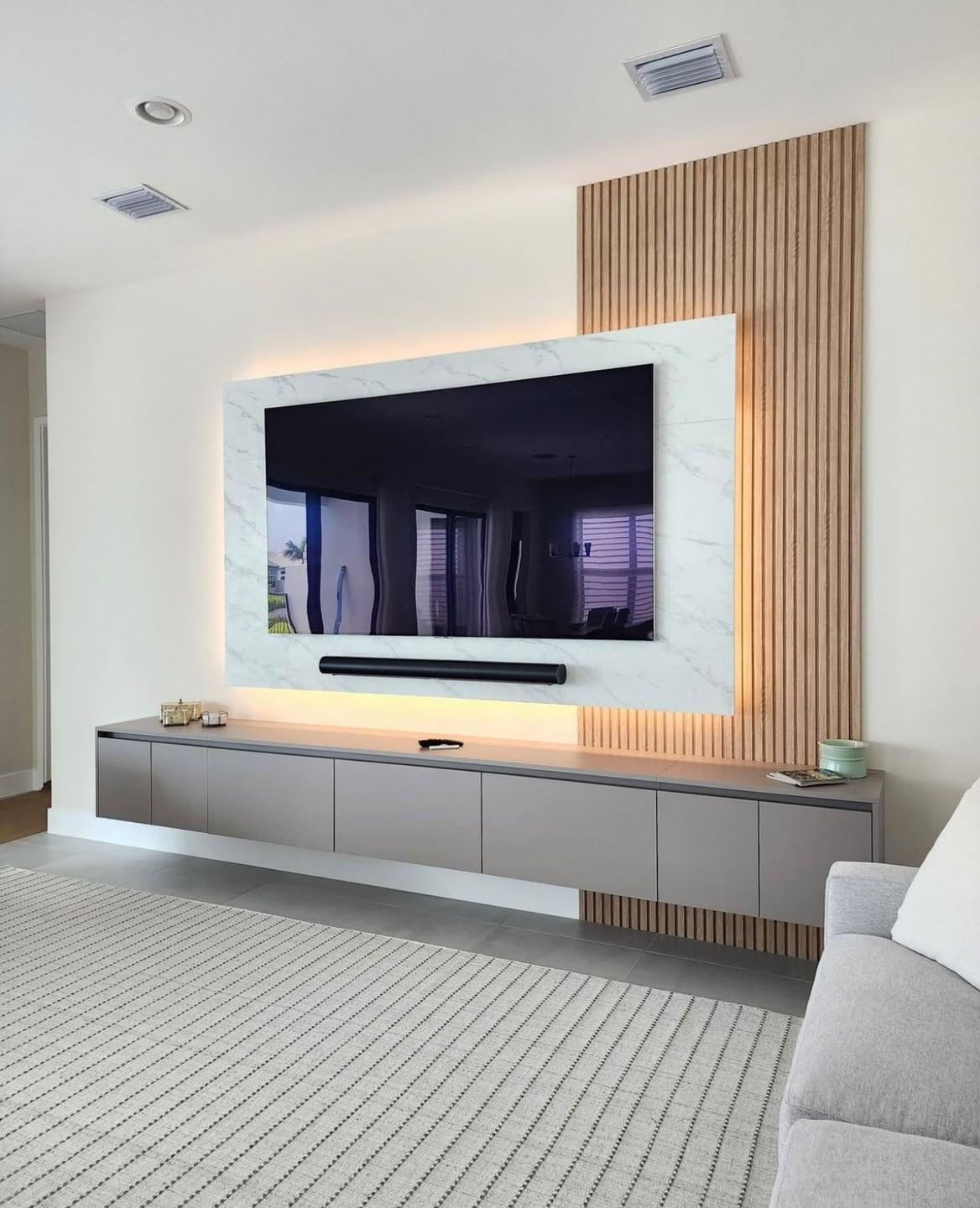
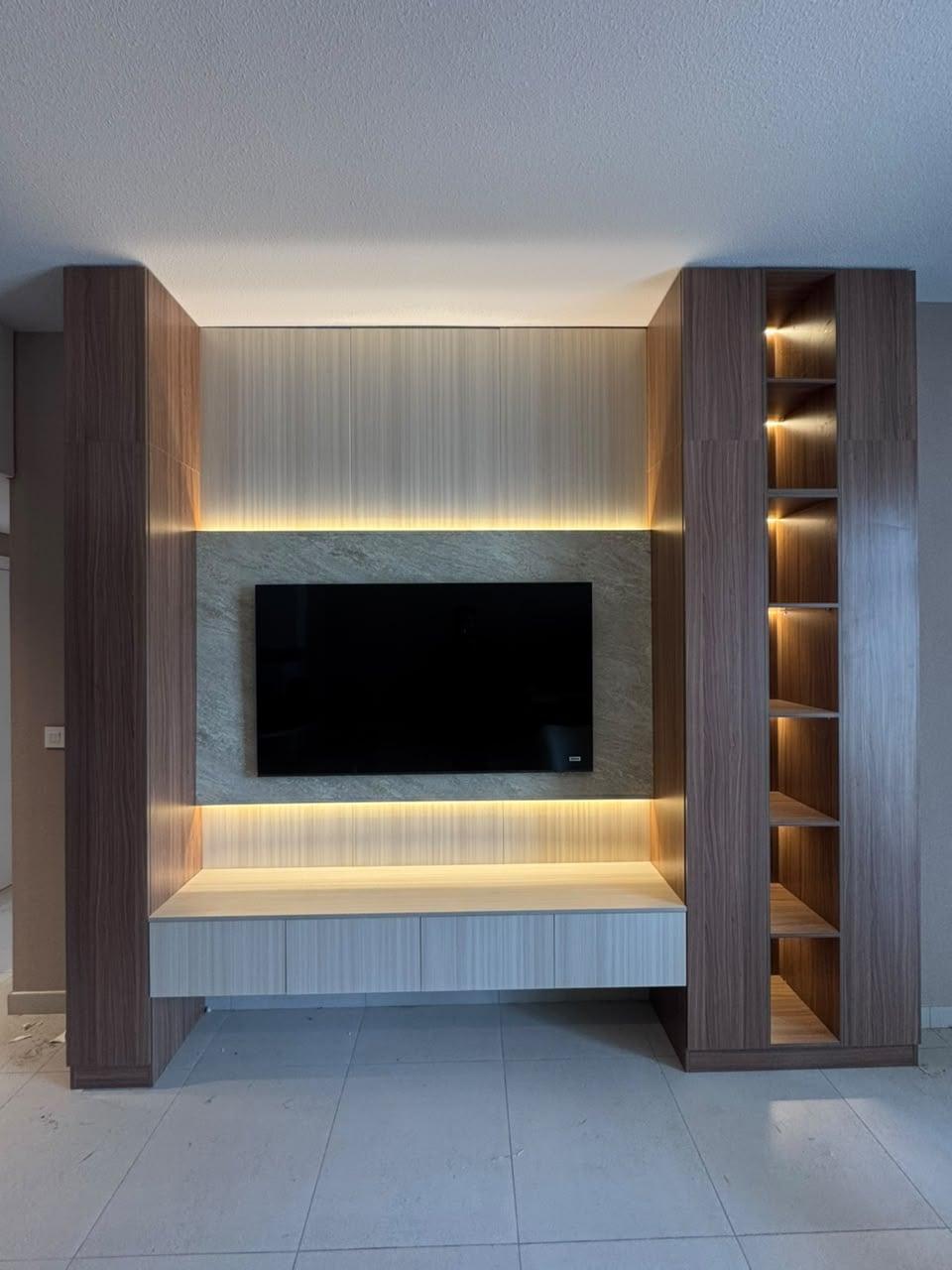
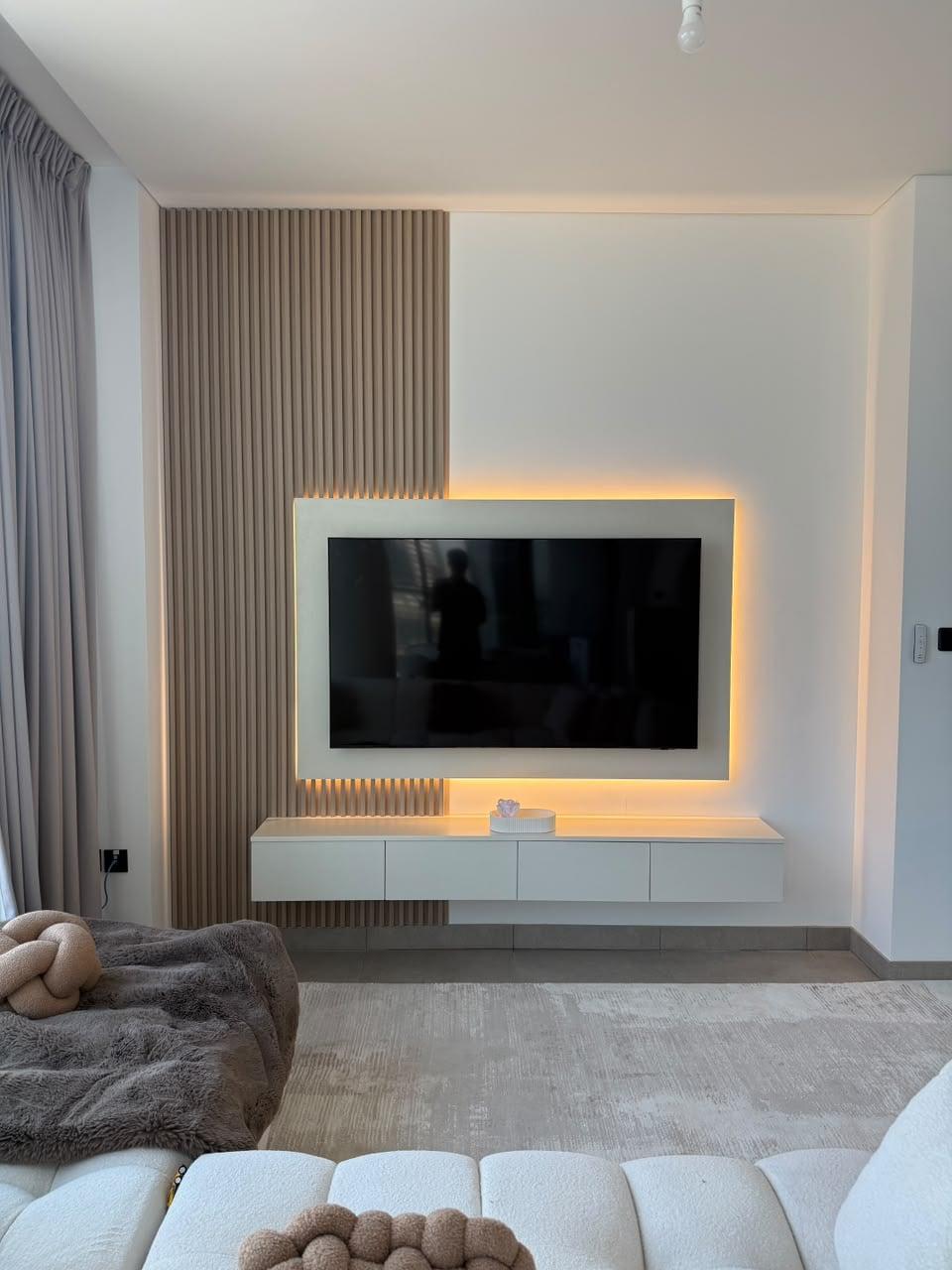
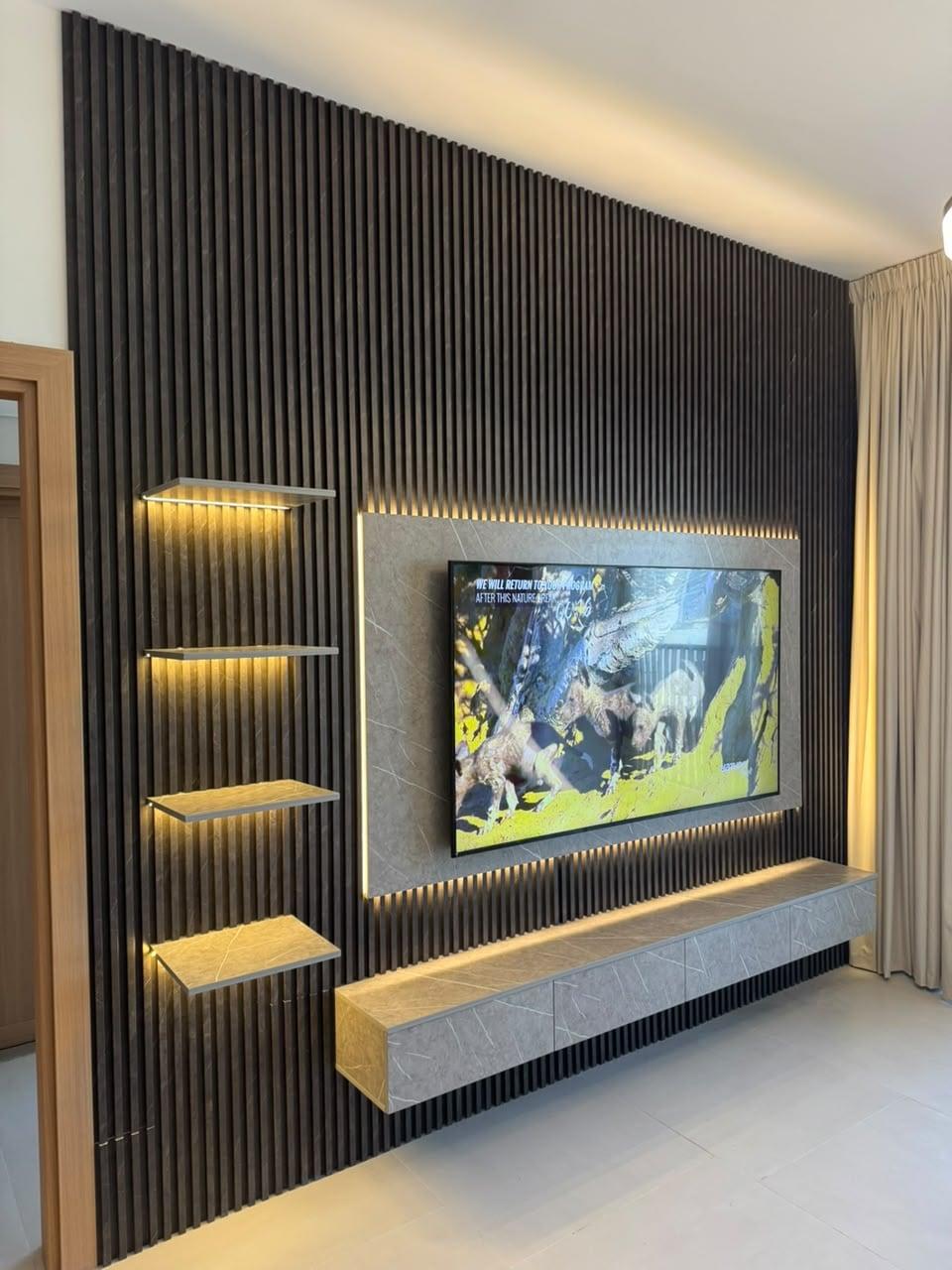
This guide separates the three arrangements and treats each on its merits. The first is a floor-standing console, which sits on the floor and carries its own load. The second is a wall-hung console, which is carried only by the wall, with a gap beneath. The third is what we will call a plinth-set console: a box set on a recessed base, so that it looks as if it floats while the floor takes the load. Some people use floating for the second, some for the third; what matters is that you know which one is being drawn.
The choice between a media wall and a unit, and between a full wall and a compact one, is covered in media wall or TV unit and full wall or compact media wall. Here we assume you have chosen a console under a panel or a TV, and ask only how it should be held up. If you are still at the start, planning a media wall lays out the order of decisions.
Where the weight goes
Follow the load. On a floor-standing console, everything that sits on the console, and the console itself, goes down through its base into the floor. The wall only keeps it from tipping. On a wall-hung console, all of that load goes into the wall through the brackets or the hanging rail, and the floor carries nothing. On a plinth-set console, the load goes into the floor through the recessed base, and the wall again only holds it steady.
The section drawing shows the three arrangements side by side, with the wall on the left and the load path in green. The difference is visible at a glance, and it explains almost everything that follows. A wall-hung console puts a demand on the wall that the other two do not, and a floor-standing or plinth-set console puts a demand on the floor that the hung one does not.
Neither is better in itself. A wall-hung console is the lightest-looking and leaves the floor clear. A plinth-set console gets almost the same look with the strength of the floor under it. A floor-standing console is the simplest and often the most forgiving of an unknown wall. The right one depends on the wall behind it and on what the console will hold, which the next sections take in turn.
- 1. Floor-standing: the load goes to the floor
- 2. Wall-hung: the load goes to the wall through brackets
- 3. Plinth-set: looks floating, carried from the floor
The wall decides what can hang on it
A wall-hung console is only as good as the wall behind it, and UAE homes have more than one kind. Practical DIY's guide to internal wall fixings sets out the picture in plain terms. Making strong fixings on most plastered masonry walls is normally fairly straightforward using screws with appropriate wall plugs. Plasterboard dry-lined on to masonry walls is probably the most difficult type of wall to get a strong fixing on. And on a plasterboard wall on a timber frame, a strong fixing is only obtained where brackets are screwed directly to the vertical timber framework.
Those three cases are the ones we meet. A plastered block wall is the common one in villas and older buildings, and it takes a hung console well. A dry-lined wall, where a plasterboard skin stands in front of the block, is common in apartments and in renovations; the fixing has to pass through the board and reach the solid wall behind it, and the board alone will not do. A gypsum partition on a metal or timber frame, found between rooms, takes loads only where the fixings meet the frame. Our block and gypsum guide explains how to tell them apart, and the drawing here shows how a fixing reaches solid material in each.
This is why we ask for photographs of the wall and, on a visit, check it before the drawing is final. We tell you what the wall is and what the fixing will have to do. If the wall cannot take a hung console, the answer is a plinth-set or floor-standing console, not a longer screw.
- 1. Plastered masonry: screws and plugs into the block, normally straightforward
- 2. Dry-lined on masonry: the fixing must pass through the board, the hardest to fix strongly
- 3. Plasterboard on a timber frame: strong only at the vertical timbers
What a bracket rating tells you, and what it does not
Hardware makers publish load ratings, and they are easy to misread. Hettich's page for its SAH 500 cabinet suspension bracket, wall-mounted element, gives load capacities of 110 kg each in test frame A, 80 kg each in test frame B and 50 kg each in test frame C, in accordance with DIN EN 15939. The same page says the integrated lift-off guard prevents the wall unit from accidentally falling off the wall, and adds that it is the fitter's or customer's responsibility to assess the wall and select suitable fixing hardware.
Three things follow. The rating is per bracket and for one product from one maker; it is not a rating for your console or for every bracket. The rating depends on the test frame, so the same bracket carries different loads in different set-ups. And the rating is for the bracket, not the wall: the maker says outright that the wall must be assessed and the fixings chosen by whoever fits it. The chart puts the three published figures beside an unknown that no data sheet can fill, which is your wall.
We do not quote a weight limit for our consoles from a bracket's figure, and you should be wary of anyone who does. The honest statement is that the capacity of a hung console is set by the whole chain: the board, the hanging hardware, the fixings and the wall. Ask the fitter which brackets or rail are used, what the wall is, and what load the arrangement is designed for, and ask for it in the quotation. We never state a hardware brand or load as a general claim for our work, and the details of each wall are confirmed on the drawing.
- 1. Test frame A: 110 kg per bracket
- 2. Test frame B: 80 kg per bracket
- 3. Test frame C: 50 kg per bracket
- 4. Your wall: unknown until it is assessed
What the console will actually hold
Before the support is chosen, list what goes into and on the console. A wall-mounted TV carries its own weight on its own bracket and not on the console. What the console holds is the equipment and the contents: a soundbar, a receiver, a games console, a router, boxes, remotes, cables, and the things a family puts in drawers, such as board games, photograph albums, chargers and cleaning cloths. Drawers fill up, and a console that is half-empty on the day of installation will be full a year later.
Add up what you expect to put in it, then add a margin, because the weight of a full drawer is always more than the owner guessed. A shallow console for a soundbar and a router is a light object. A deep console with two large drawers for board games and files is not. The two should not be treated alike, and the second is the one that justifies a floor-standing or plinth-set base.
The heavy cases are worth naming. A speaker or a subwoofer placed on top of the console adds a concentrated load and vibration. A marble-effect top adds weight to the console itself. A plant pot sitting at the front edge acts as a lever on the brackets. None of these is a reason to avoid a hung console, but each is a reason to say so on the first drawing.
The floor, the cleaning and the gap beneath
The most visible benefit of a console that does not touch the floor is the gap. The floor continues under the unit, the room reads as larger, and a mop or a robot vacuum can pass beneath. A thin LED line under the unit can mark the gap at night, and the lighting guide explains how such lines are planned. The gap is also where a skirting board runs behind the unit, so the base of the wall stays visible and the console does not hide a tangle where wall meets floor.
The drawing marks four things the gap changes: the floor gap itself, which is set on the drawing so that a cleaning tool fits; the skirting, which runs behind the unit; the cable drop, where leads go down behind and not across the floor; and the underside, which is finished and sometimes lit, because it is seen. A wall-hung console and a plinth-set one share the look, but the plinth-set one has a dark recess where the gap would be, and that recess is where dust gathers and a mop does not reach.
In a family home, the gap has a second side. Small objects roll under a hung console and a child can reach them; a toy car in the gap is an inconvenience rather than a danger, but a heavy console above a child's play area is a reason to be sure of the fixing. The care and maintenance tool offers general cleaning habits for finished surfaces.
- 1. Floor gap: set on the drawing, so a mop or vacuum can pass
- 2. Skirting: runs behind the unit, so the base of the wall stays visible
- 3. Cable drop: leads go down behind, not across the floor
- 4. Underside: finished and sometimes lit, because it is seen
Cables, sockets and air under a floating console
A console that does not touch the floor changes where the leads go. They cannot run along the floor to a socket behind the unit without being seen, so the route has to be planned: a drop behind the console to a socket at skirting height, or a conduit inside the panel above. The cable guide explains the routes and the service panel, and which sockets can stay explains the power side. A socket behind a hung console should be reachable, and the work on it is done by our team or a qualified electrician.
Air also matters. Equipment in a console makes heat, and a closed compartment traps it. A floating console has the advantage that air can move below it, but that does not help a closed drawer. The TV and equipment ventilation guide explains why we leave clear paths, and the soundbar guide explains where a soundbar sits.
Remote controls are the last point. A closed door in front of a set-top box blocks an infrared remote, and a floating console with solid doors is no different. Decide which devices are controlled how before the front is chosen. Glass, perforated or open compartments solve it.
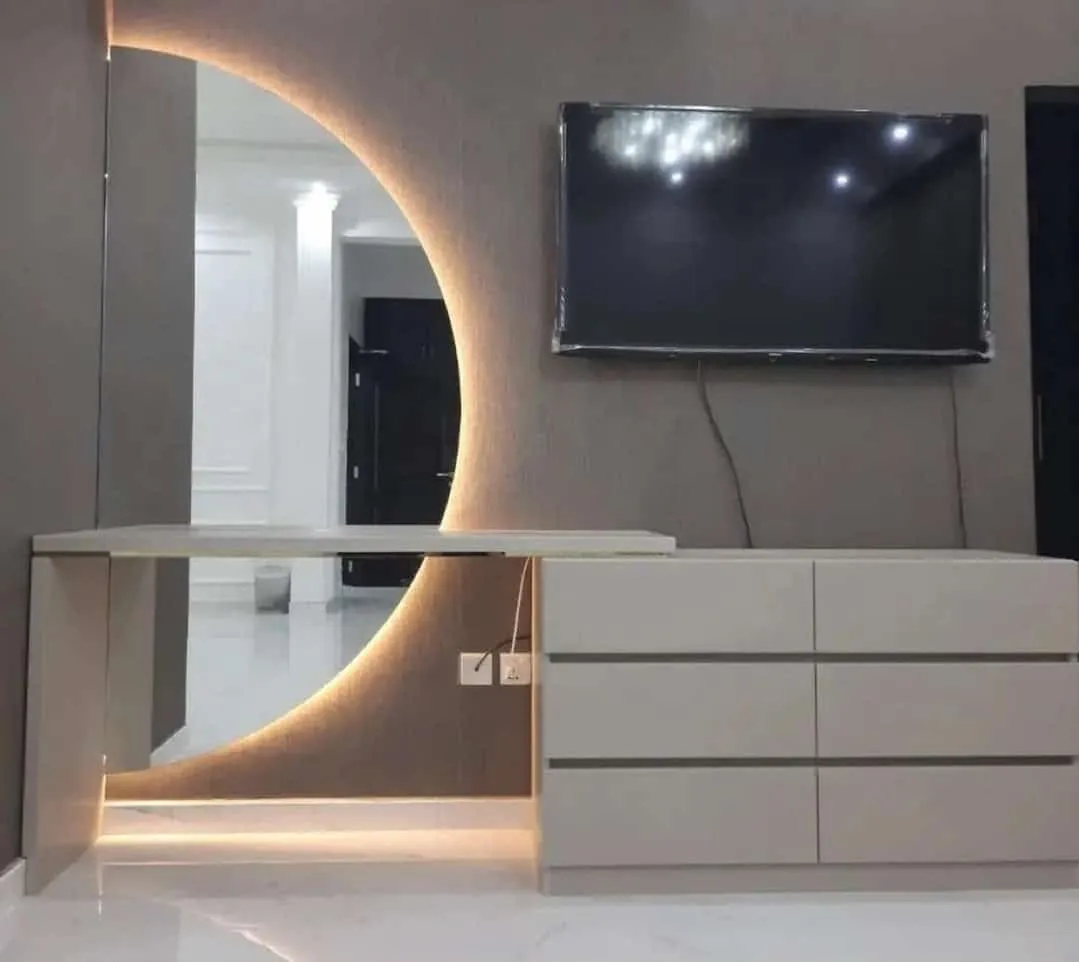
Should a TV sit on a floating console?
A question that comes up often: can the TV sit on the console, as it would on a unit? The safety advice is cautious. The CPSC's AnchorIt page says that televisions should only be placed on furniture designed to hold a television, such as television stands or media centers, and that televisions that are not wall mounted should still be anchored to the wall. A console that is hung from a wall is a different object from a stand that rests on the floor, and a heavy screen on a long, shallow hung shelf is a bigger lever on the fixings than the same screen on a floor stand.
Our answer in practice is to keep the TV on its own bracket on the wall or the panel, and to let the console carry only the equipment under it. That separates the two loads, and a heavier screen later does not change what the console sees. If a TV must stand on the console, say so on the first drawing so the arrangement can be designed for it and the anchoring planned, and check the TV maker's guidance for its feet.
Changing the TV later explains why the screen should be decided early, and how high to hang it explains where the console fits under it. A console that was drawn for a 55-inch TV does not always suit a 75-inch screen, and the support should have the margin.
How each looks, and how to choose
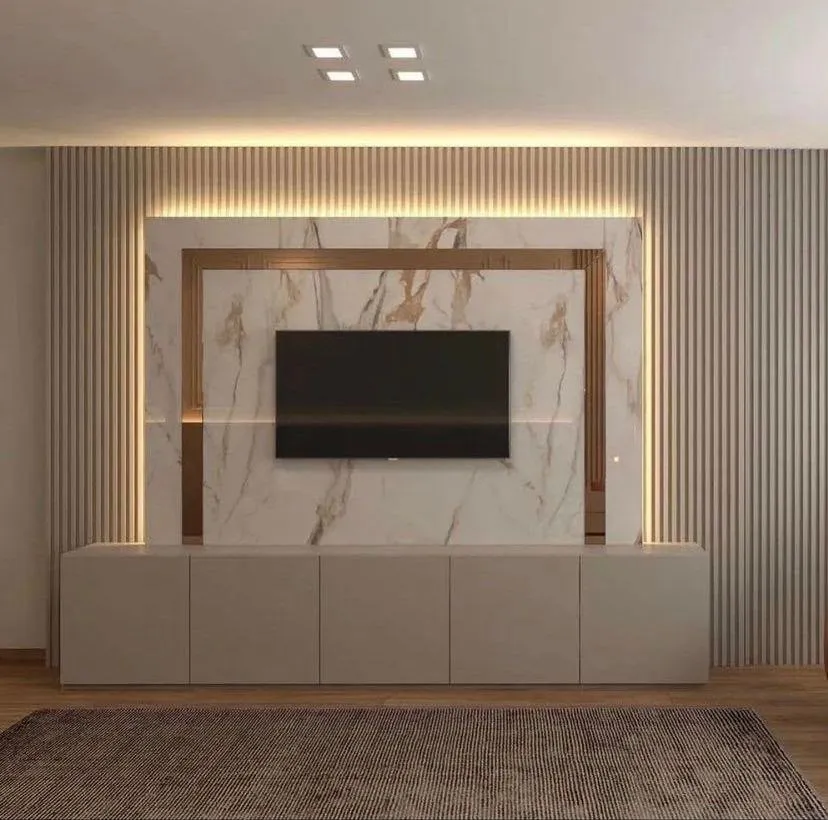
The three arrangements read differently in the room. A wall-hung console is the lightest and the most architectural; the unit appears to belong to the wall, which suits the long, low compositions of villa TV walls. A plinth-set console has nearly the same look with a shadow gap at the base, and it is the one that photographs as floating while resting on the floor. A floor-standing console is the most traditional and, in a family room with a lot to store, the most practical. In a small room the choice interacts with floor space, which the small living room guide discusses.
Choose by walking through three questions. What is behind the console: a masonry wall, a dry-lined skin or a partition? What will it hold: light equipment or heavy contents? And how do you clean: do you want the floor to run through? Masonry, light contents and a wish for a clear floor point to wall-hung. Dry-lined or partition walls and heavy contents point to plinth-set or floor-standing. A rental where you do not want to load the wall also points away from wall-hung.
In the UAE, rented apartments are often dry-lined, and landlords often care about what is fixed to a wall, so a plinth-set or floor-standing console is a common answer there. Ask your landlord or building management in writing before any fixing, and the moving-out guide explains what reinstatement means.
Three arrangements compared
The table summarises the three support methods on the points above. It is a guide to reasoning; the drawing for your wall decides.
Floor-standing, wall-hung and plinth-set consoles
Carries the load
- Floor-standing
- The floor
- Wall-hung
- The wall
- Plinth-set
- The floor, through a recessed base
Wall demand
- Floor-standing
- Low: it only steadies the unit
- Wall-hung
- High: the whole load and the fixings
- Plinth-set
- Low: it only steadies the unit
Floor look
- Floor-standing
- Floor hidden under the unit
- Wall-hung
- Floor runs through
- Plinth-set
- Looks like it floats; a dark recess at the base
Cleaning
- Floor-standing
- Cannot pass beneath
- Wall-hung
- A mop or vacuum passes
- Plinth-set
- Recess is hard to reach
Heavy contents
- Floor-standing
- Best suited
- Wall-hung
- Needs the wall and hardware checked
- Plinth-set
- Well suited
Renting
- Floor-standing
- Easy to move
- Wall-hung
- Fixings to reinstate
- Plinth-set
- Light fixings to steady it
Best for
- Floor-standing
- Heavy storage, unknown walls
- Wall-hung
- Masonry walls, light contents, a clear floor
- Plinth-set
- Dry-lined walls, the floating look, heavier contents
Our judgement from the sources opened; the wall assessment and the drawing decide the final arrangement.
Three worked scenarios
Scenario one: a villa on a plastered block wall with a 2.4-metre console under a slim panel. The contents are light: a soundbar, a box and a router, with two shallow drawers for remotes. The wall takes a hung console well, the owner wants the floor to run through, and the console is drawn wall-hung. The drawing names the hanging method and the wall, and the fixings are chosen by the fitter for the block wall. The owner is told that a heavy speaker on top should be mentioned first.
Scenario two: a rented apartment in Dubai with a dry-lined wall behind the TV. The tenant wants the floating look and has a large collection of board games. The wall is a poor candidate for a hung console loaded with games, and the landlord asks for minimal fixings. A plinth-set console carries the weight to the floor and only steadies against the wall. The look is floating and the wall is spared.
Scenario three: a family in Sharjah who keep the console in a play area. The children are small and the wall behind is a plasterboard partition. A floor-standing console is chosen for its simplicity and strength, and the TV is on a bracket on a plain panel above, away from reach. The gap that the family wanted is replaced by a light line under a shadow recess, and the owner accepts a floor that is not visible.
In each, the support was chosen by reading the wall and the contents before the look, and the look was then achieved within what the wall allowed.
Mistakes that make a console fall short
These are the mistakes that spoil a console, and each can be settled on the drawing.
- Choosing wall-hung from a photograph without checking what the wall is.
- Trusting a bracket rating as if it were a rating of the wall.
- Planning for light equipment and then filling the drawers with heavy contents.
- Putting a speaker or a marble-effect top on a hung console without telling the fitter.
- Treating a long shallow hung shelf like a TV stand.
- Forgetting where the leads go once the console leaves the floor.
- Closing every compartment so remotes and air cannot get through.
- Fixing to a rented wall without asking the landlord in writing.
What we do, and how to start on WhatsApp
We build floating consoles and compact media walls in our workshop in Sharjah and fit across the UAE. The measuring visit is free of charge, and we look at the wall as part of it. Our media walls start from AED 3,500 per project for a compact panel and a floating console in standard laminate, and the final figure comes from the quotation, which should state how the console is supported. Production starts once the details are agreed and a 60% advance is paid, and most take up to about 10 days depending on size and design. Our 5-year limited warranty covers the wood-based boards only, subject to its terms, and does not cover hardware. We have worked in this trade for ten years, and the question we ask first is what the wall is.
To start, send us a WhatsApp message with a photograph of the wall straight on, a close-up of where the console will go, the TV size, a note of what the console must hold, and whether the wall is plaster, painted block or dry-lined if you know. Say whether you rent. We will tell you which support we would draw and why, and the drawing will name it. What to send us lists the photographs that help most.
The media walls page shows our work, and the TV wall units and floating consoles page shows the consoles themselves. For the wider decision about the wall behind them, the living room guide is a good next read.
Common questions
What is the difference between a wall-mounted and a floating console?
Terms vary: wall-hung is carried only by the wall, while a floating look can also come from a recessed base that carries the load to the floor. Ask which is drawn. Media wall or TV unit.
Can a wall-mounted console hold a TV?
Keep the TV on its own bracket and let the console carry the equipment; if a TV must stand on it, say so on the first drawing. Changing the TV later.
Will my wall hold a wall-hung console?
It depends on the wall: masonry usually, a dry-lined wall with care, a partition only at its timbers. We check the wall on the visit. Block vs gypsum walls.
What is the load limit of a floating console?
No general figure: the board, hardware, fixings and wall together set it, and a bracket's rating is not the wall's. Ask for it in the quotation. Media wall quotation checklist.
Is a floating console easy to clean under?
Yes if the gap is set for a mop or vacuum; a plinth-set recess is harder to reach. Care and maintenance.
Where do the cables go with a floating console?
Down behind it to a socket at skirting height, or inside the panel above, planned on the drawing. Cable routes and service access.
How much does a floating console cost?
Our media walls start from AED 3,500 per project for a compact panel and a floating console in standard laminate; the final figure comes from the quotation. What a media wall costs.

Sources & specifications
Manufacturer information applies to the named products and systems. Sources reviewed on 11 November 2026.
- Hettich: SAH 500 cabinet suspension bracket, wall-mounted element (110/80/50 kg per bracket by test frame, DIN EN 15939; fitter assesses the wall)shop.hettich.com(opens in a new tab)
- Practical DIY: strong fixings for internal walls (plastered masonry, dry-lined, timber-frame walls)practicaldiy.com(opens in a new tab)
- CPSC AnchorIt.gov: anchoring TVs and furniture (TVs on furniture designed for them; anchor a TV that is not wall mounted)cpsc.gov(opens in a new tab)
Want this planned for your home?
Consultation and measurement are free. Tell us the rooms, location and what you need; we arrange a sample visit and define the measured quotation.