Media Walls · 19 min read · 24 September 2026
Media wall in a rented flat in the UAE: what is realistic
A media wall in a rented flat is possible: ask in writing first, then choose between a freestanding, a modular or a fixed build by how long you will stay and what your landlord allows.

By Ali Haider Basra, Founder, Al Tareeq Decor · Contact our workshop
Key takeaways
- Read your tenancy contract, then ask your landlord or building management in writing before anything is made.
- Choose the build by two things: how long you will stay and how much your landlord allows to touch the wall.
- Three builds: freestanding (no fixings), modular (a few agreed fixings, comes apart), fixed wall (fullest, hardest to take with you).
- Divide the price by the years you will stay: a short stay favours freestanding or compact; a long one can justify a fuller wall.
- Photograph the wall before the work and after it comes down, and keep the landlord's written reply.
On this page
- Key takeaways
- The short answer: ask first, then choose the build that fits how long you will stay
- What changes when you rent instead of own
- Step one: read the contract and ask in writing
- Three ways to build in a rented home
- What stays and what goes when you leave
- What to ask the maker about each part before you order
- What it costs per year of staying
- Matching the build to your stay and your landlord's answer
- The TV itself: where the bracket goes
- Cables, sockets and light in a rented flat
- A tenancy timeline: what to do and keep at each stage
- Move-out day and the deposit conversation
- Three tenants, three answers: a worked example
- Mistakes tenants make with a media wall
- Smaller options that cost nothing in permission
- What we do for tenants
- Send us the wall on WhatsApp
- Common questions
The short answer: ask first, then choose the build that fits how long you will stay
You can have a media wall in a rented flat, but two things come before the design: your tenancy contract and your landlord's written reply. Read what the contract says about changes to the property, then ask your landlord or building management in writing before anything is made. Once you know what is allowed, choose the build by two things only: how long you expect to stay, and how much your landlord will let touch the wall.
In practice that gives three kinds of build. A freestanding set-up, a console and a TV stand, touches nothing. A modular wall made of separate pieces with a few agreed fixings comes apart at move-out. A fixed wall build is the fullest design and the hardest to take with you. We make removable or relocatable designs as freestanding or modular arrangements, and we say plainly that not every fitted build can be removed; it depends on how it is built. This guide helps you decide which kind you are asking for, what it costs per year of staying, and what to do at each stage of the tenancy. Nothing here is legal advice: your contract and your landlord decide what is allowed.
What changes when you rent instead of own
When you own the home, a media wall is a design problem. When you rent, it is a design problem with a permission step in front and a move-out step behind. Three things change. The first is who decides: for any work that touches walls, floor, ceiling or fixed wiring, the landlord or building management has a say, and what they allow can shape the design. The second is the time horizon: a wall you will enjoy for six years can justify a fuller build than one you will leave in eleven months. The third is what happens at the end: whatever stays behind is a gift to the landlord, and whatever you take has to be taken down without leaving damage.
Those three shifts are the structure of this guide. The questions to put to a maker before you order are in questions to ask before you order a media wall, and the full guide to writing to your landlord is asking your landlord in writing. The construction details of pieces that come apart are in removable media walls for tenants. This page is the decision in between: which of the three builds suits you.
Step one: read the contract and ask in writing
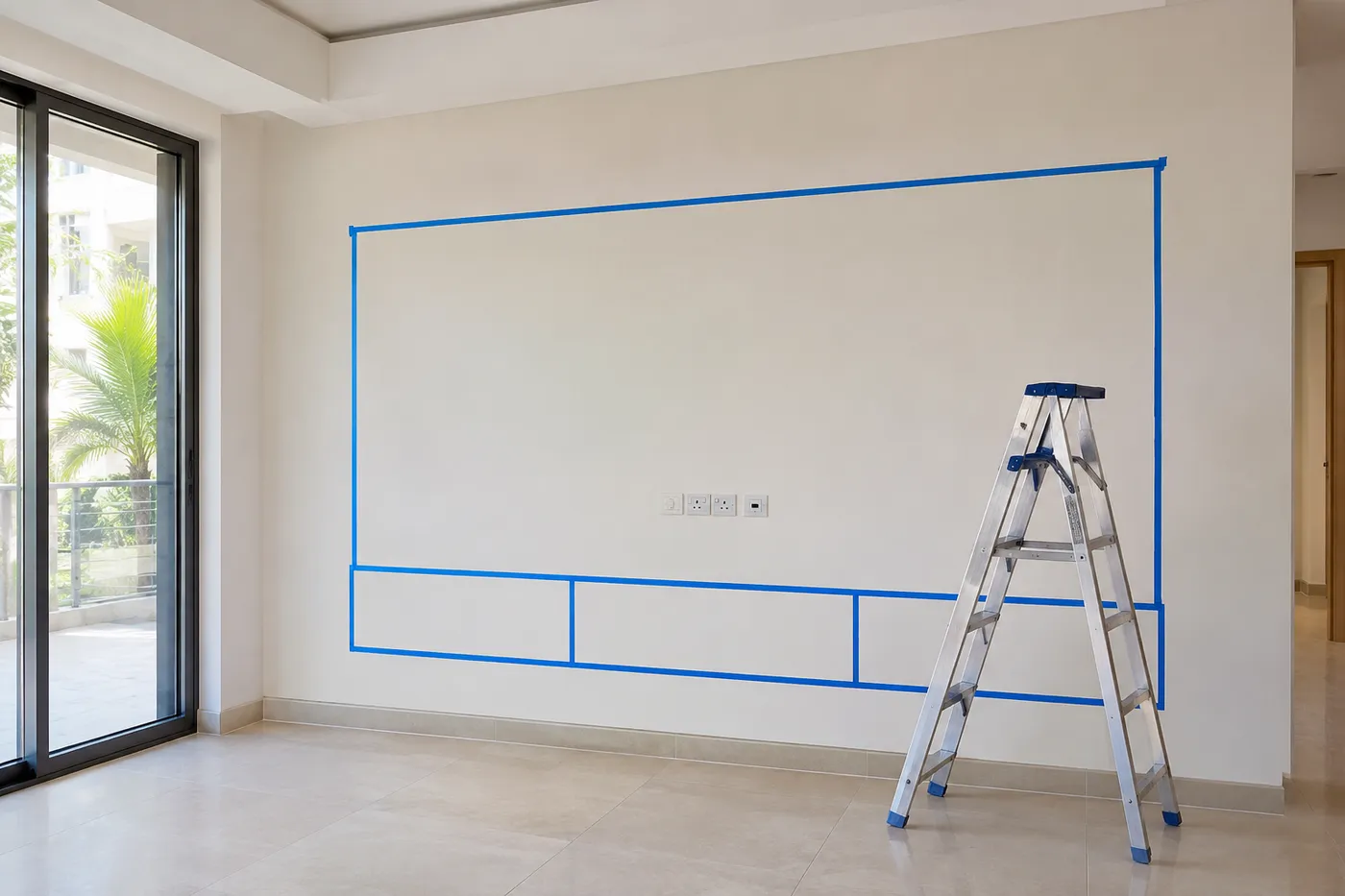
We do not know what your tenancy contract says, and we are not going to guess at tenancy rules. What we can say is how to proceed sensibly. Read the clauses on alterations and on returning the property at the end, and then write to your landlord or building management before you order. Describe the actual work: a custom TV wall in the living room, made in a workshop, fitted by the maker's team and held by small fixings at the points on a drawing. Attach photos of the wall as it is today and the drawing. Ask for the reply in writing.
To show how seriously other places treat this question, two government tenancy pages we opened are worth reading as examples, with the caution that they describe Australia and New Zealand, not the UAE. Consumer Affairs Victoria says the rules depend on the type of change, the type of rental property and the length of the lease, and that a rental provider may require that changes are done by a suitably qualified person. Tenancy Services New Zealand says to make the request to the landlord in writing. The pattern is the same: the request is written, the work is described, and the answer decides.
A written yes is what you keep. A spoken "fine, go ahead" is easily forgotten by both sides when the lease ends. Our landlord permission guide goes through what to put in the message and what to do with each kind of reply, including silence.
Three ways to build in a rented home
The three builds differ in one thing above all: what touches the wall. The drawing below shows them in side section, with the wall as the hatched bar and every fixing as a dot. The point is not that one is better. It is that each asks a different question of your landlord and leaves a different amount with you.
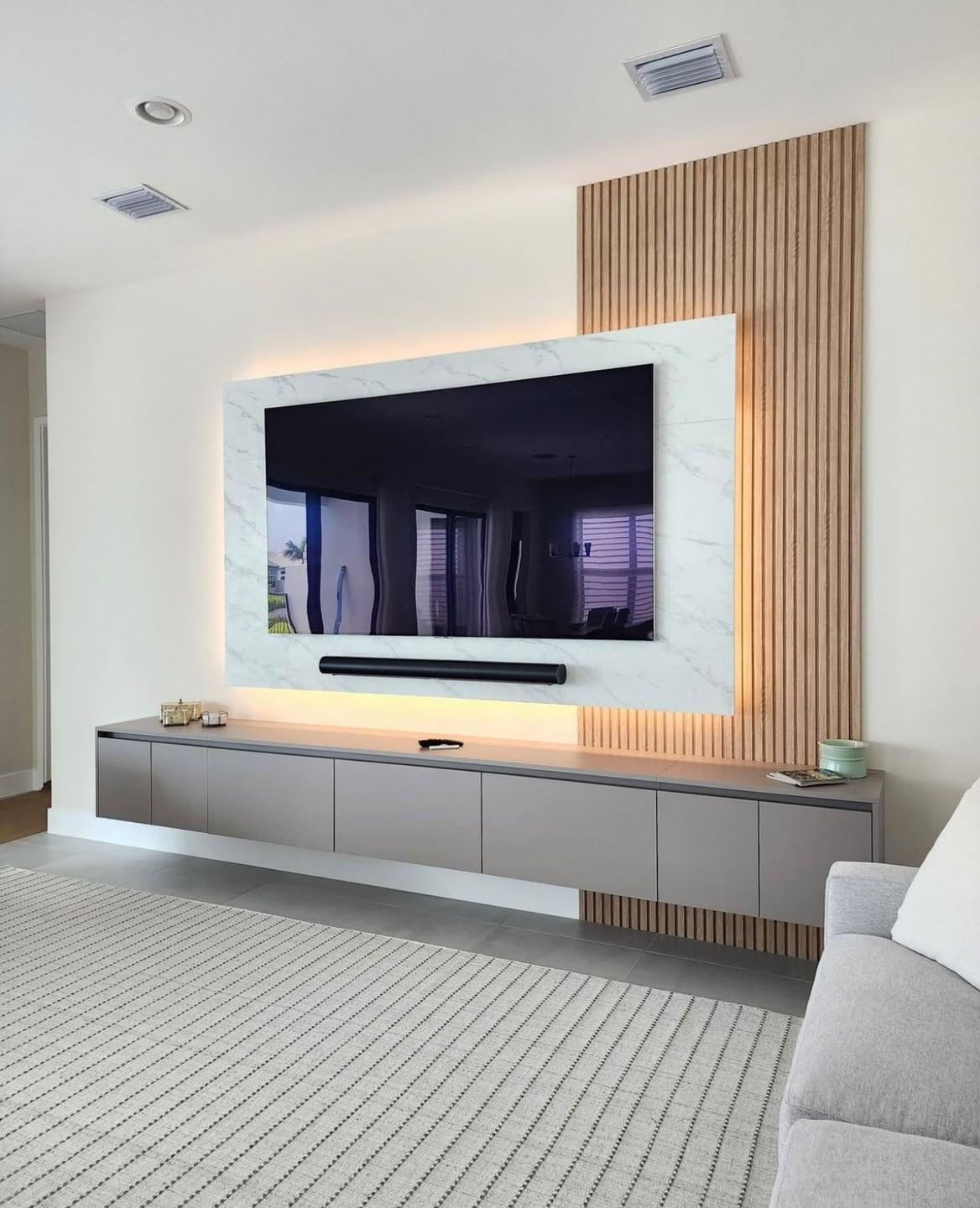
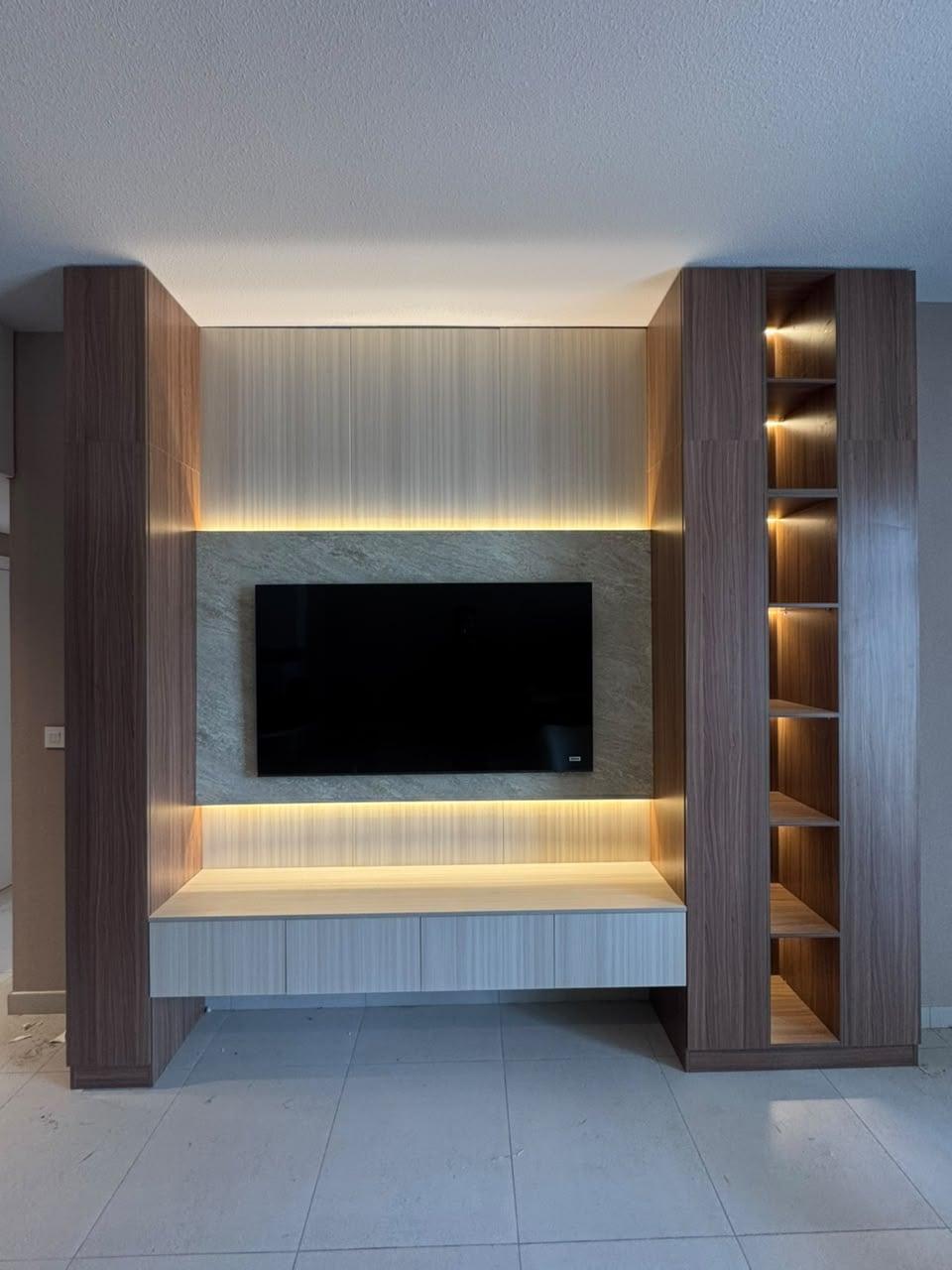
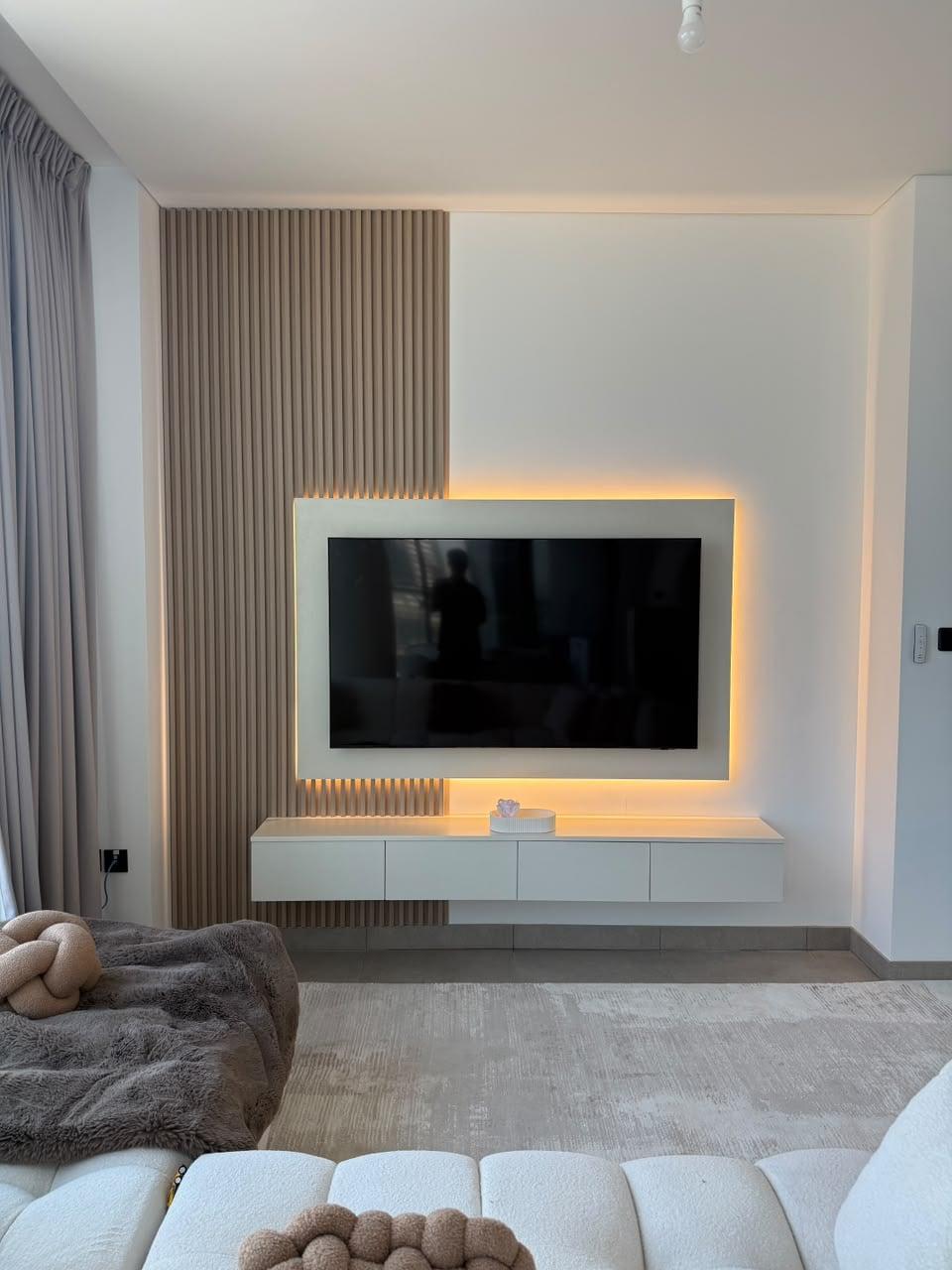
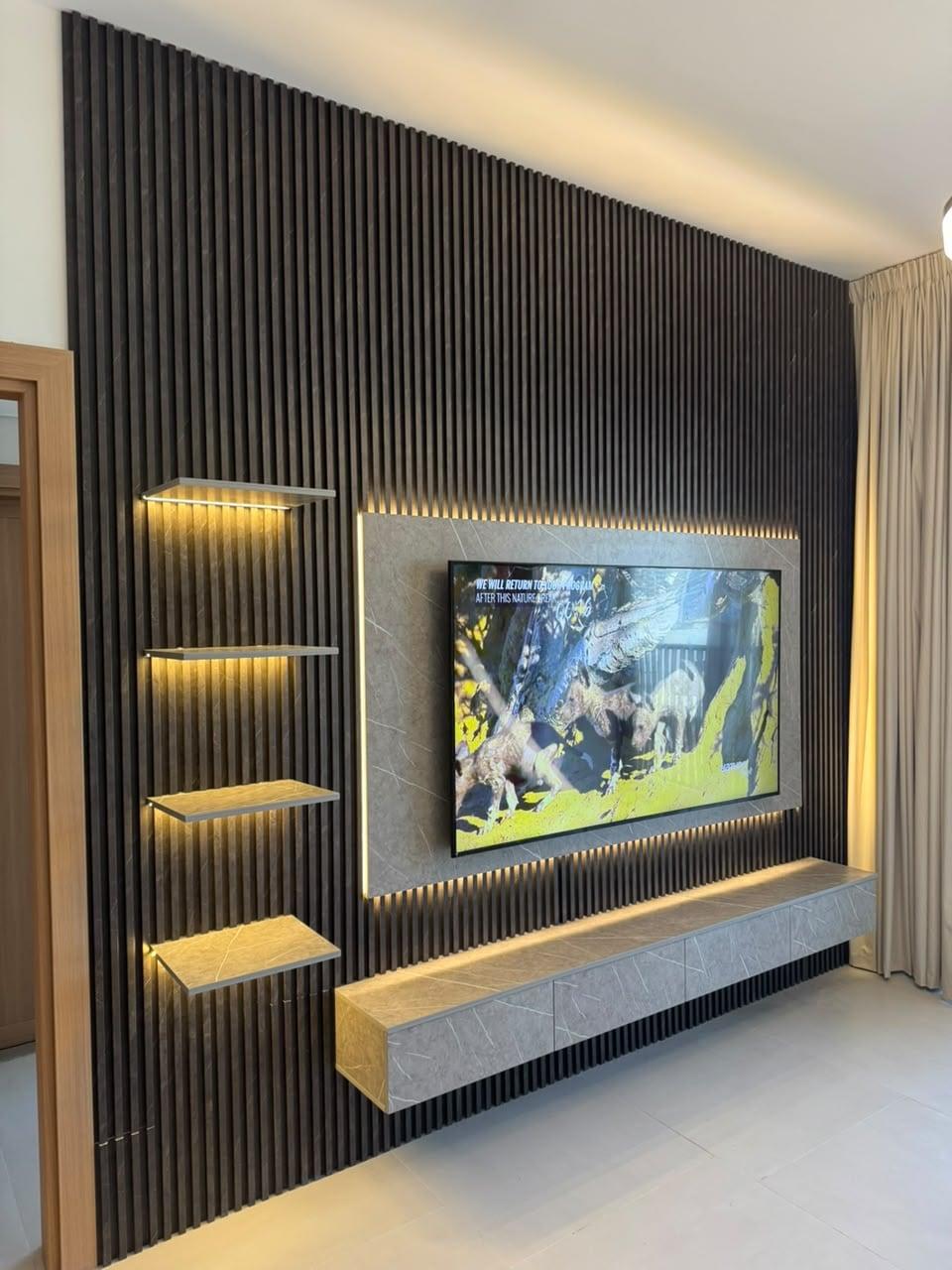
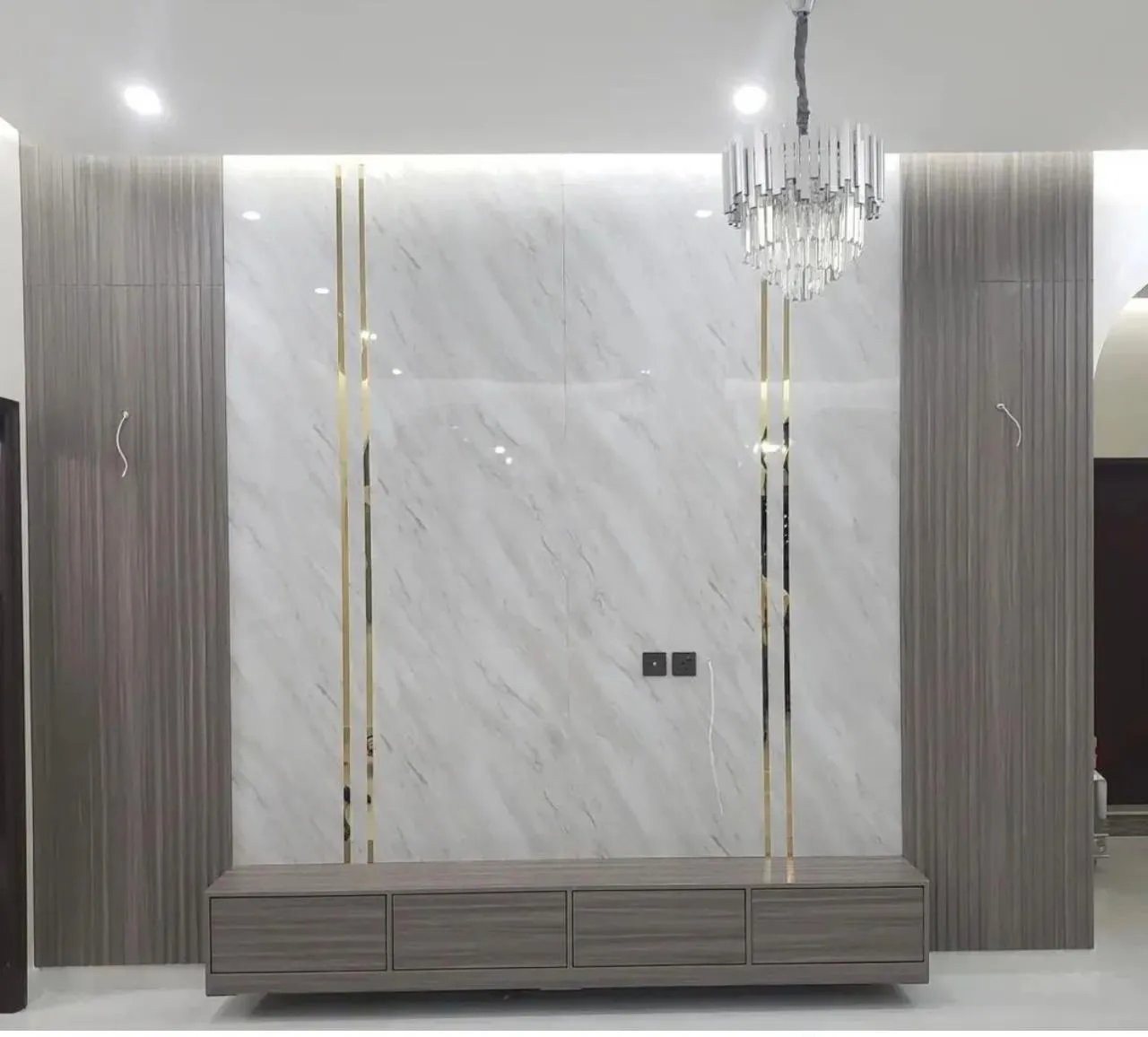
A freestanding build is a console and a TV stand, or a TV on a wall-hugging stand, with shelves that stand on the floor. There are no fixings in the wall, so there is little to ask other than permission to stand furniture against it, and everything leaves with you. A modular build is made of separate pieces: a console, shelf towers and a panel, each able to come apart, held to the wall with a few small agreed fixings. Most of it leaves with you, and the wall needs filling and touching up at the fixing points. A fixed wall build is the full design, panels carried across the wall with brackets at set points and often wiring and lighting concealed within it. It gives the most complete result, and what leaves with you depends on how it was built.
Our guide to fitted, modular and freestanding wardrobes for tenants draws the same line for wardrobes, and it is a useful comparison if your flat needs both. For the media wall specifically, the extra question is the TV: it hangs on the wall in all three unless you choose a stand, and a wall-mounted TV needs fixing points even in the lightest build. The guide to TV height tells you where the screen should sit before you decide where the bracket goes.
- 1. Freestanding: no fixings in the wall; everything leaves with you; ask only about standing it against the wall
- 2. Modular pieces: a few small fixings; most pieces leave with you; ask where the fixings go
- 3. Fixed wall build: several fixings at set points; what leaves depends on the build; ask about the whole build in writing
What stays and what goes when you leave
Tenancy Services New Zealand puts one rule very plainly: any fixture put up by a tenant that is not removed at the end of the tenancy becomes the property of the landlord, unless landlord and tenant have agreed otherwise. That is a New Zealand rule, not a UAE one, but it names a question worth settling in your own tenancy before you spend any money: if something stays, who owns it, and does anyone expect it to be removed? A wall you leave behind as a gift is a very different purchase from one you take.
The table below sorts the usual parts of a media wall by how likely they are to leave with you, as a typical pattern. The TV and its bracket almost always travel. A floating console comes off its fixings and can be reused if it is planned that way. Shelf towers depend on whether they are fixed to the wall or stand freely. Feature panels depend on how they are held. LED channels and the driver depend on how they were installed. Wiring inside the wall and the sockets belong to the building and stay. Your quotation should state the real answer for your wall, and you can ask for it before you order.
What to ask the maker about each part before you order
TV and bracket
- Typical outcome at move-out
- Travels
- Question to ask
- Can the bracket plate be unscrewed and the holes filled?
Floating console
- Typical outcome at move-out
- Travels if planned
- Question to ask
- How is it fixed, and can it be lifted off?
Shelf towers
- Typical outcome at move-out
- Depends
- Question to ask
- Do they stand free or are they fixed to the wall?
Feature panels
- Typical outcome at move-out
- Depends
- Question to ask
- How are they held, and do they come away in pieces?
LED channels and driver
- Typical outcome at move-out
- Depends
- Question to ask
- Where is the driver, and can it be removed safely?
Wiring and sockets
- Typical outcome at move-out
- Stays
- Question to ask
- Does any wiring change, and who agreed it?
A guide to the conversation, not a statement of what any particular build does. The quotation states the real answer.
What it costs per year of staying
A media wall in a rented flat is easiest to judge by dividing the cost by the time you will use it. The chart below does the arithmetic on our published starting price: from AED 3,500 per project for a compact panel with a floating console in standard laminate, divided by the years you stay. It is a simple division on an entry figure, not a quotation, and the final figure comes from the quotation because wall size, finish, marble-effect panels, lighting and any electric fireplace all move it.
Two things follow. A one-year stay carries the whole price in a single year, so a short stay favours a freestanding set-up or the compact end of the range. By five years the same wall costs a fraction of that per year, which is why a longer stay can justify a fuller design. And if the pieces can travel with you, the cost is not lost at move-out; the next home gets the use again, which changes the sum further. What a media wall costs breaks down what drives the figure, and the pricing guide gives a planning number for your wall.
- 1. One year: AED 3,500 a year
- 2. Two years: AED 1,750 a year
- 3. Three years: AED 1,167 a year
- 4. Four years: AED 875 a year
- 5. Five years: AED 700 a year
Matching the build to your stay and your landlord's answer
Put the two decisions together and the choice is mostly made. The grid below crosses how long you will stay with what your landlord allows. If the landlord says no fixings and you are staying about a year or less, a freestanding build is the clear fit. If fixings are agreed in writing and the stay is short, modular panels with a few fixings give you the look and come apart at move-out. If the landlord says no and you are staying longer, a furniture-style wall of tall free-standing units works, and you can revisit the question when the lease is renewed. If fixings are agreed and you are staying longer, a fixed build is reasonable, with a written agreement about who keeps it at move-out.
If you do not yet have an answer from the landlord, do not drill and do not order. The cost of waiting a week for a written reply is small compared with the cost of redesigning a wall after the panels are cut. If a tall free-standing unit is part of the plan, think about stability as well as permission: the US Consumer Product Safety Commission warns that chests and dressers can tip over if not attached to the wall. Tall units that stand free are an issue to raise with your landlord, because a single small fixing at the top may be the safe answer, and that is the landlord's decision.
- 1. Short stay, no fixings: freestanding console and TV stand
- 2. Short stay, fixings agreed in writing: modular panels with a few fixings
- 3. Longer stay, no fixings: a furniture-style wall of tall free-standing units
- 4. Longer stay, fixings agreed in writing: a fixed wall build with a written agreement on who keeps it
The TV itself: where the bracket goes
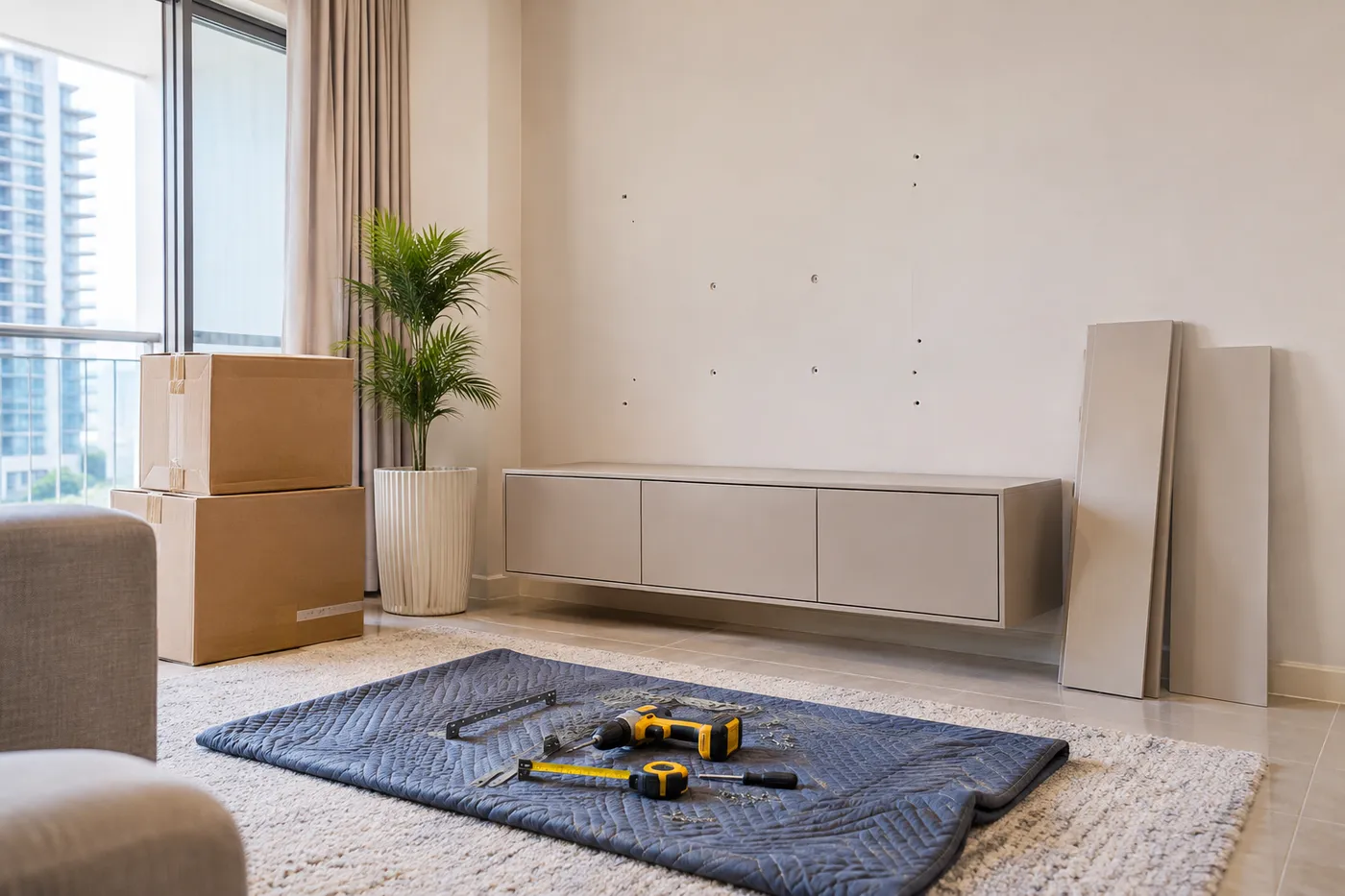
Whatever else you choose, the TV is usually the heaviest single item and the first fixing point. If you are allowed fixings, the bracket needs to go into something that can carry the load, and that depends on what the wall is made of. A TV-mount maker, Mantel Mount, advises people to understand what their home is built from before drilling, because it is critical to know so you use the right type of anchor. In a rented flat that is a question for the maker's visit as much as for the landlord, and our guide to block versus gypsum walls behind a TV shows why the answer matters.
If you are not allowed fixings, use a stand. A TV on a console, on a stand with feet or on a floor-standing unit needs nothing from the wall, and the screen can still sit at a good height if the unit is chosen for it. The TV size and distance guide tells you how big a screen your room suits. Whichever you pick, think about the next home: a screen that is a little larger than you need today may be right for a bigger flat later, and the guides on buying the TV before the wall and changing the TV later explain how much margin to leave.
Cables, sockets and light in a rented flat
Cables are where tenants most often run into trouble, because a clean wall usually hides them, and hiding them means working inside the building. In a rental the safe default is to keep wiring where it is: use the existing sockets, route cables along the unit rather than through the wall, and ask before any change to fixed wiring. If you want a socket moved, that is a separate job and a separate question for the landlord. Sockets and power on a media wall explains the options, and service access to cables shows how to keep them reachable.
Lighting follows the same logic. An LED channel inside a console or shelf unit, powered from a plug, moves with the unit. Lighting that is wired into the wall belongs to the building. Our own team installs the internal LED lighting in our units, and the question for a tenant is simply where the driver sits and whether the whole lighting set can be unplugged and taken. Media wall lighting ideas lists the layers, and you can ask for plug-in lighting where fixed wiring is not allowed. An electric fireplace needs its own socket and some heat clearance, so raise it with the landlord at the start; the electric fireplace guide explains the requirements.
A tenancy timeline: what to do and keep at each stage
A media wall in a rented home touches seven moments of your tenancy, and most of the protection comes from small habits at each. Before you commit to the flat, read the contract. Before you order, ask in writing, with the drawing. At design, mark the drawing with what travels with you. On fitting day, be home and keep the fixings to the agreed points. While you live there, look after the finish and avoid extra drilling. Before you leave, fix the take-down date with the maker and tell the landlord what will stay. On move-out day, remove, repair and photograph the wall again.
The diagram turns those moments into a path with a thing to do and a thing to keep at each. The record that matters most is photographic: photos of the wall before the work and after it is removed, side by side, are the quietest way to settle any later question about the condition of the wall. Our landlord permission guide shows exactly which photos to take and from where.
- 1. Before you commit: read the tenancy contract, keep a copy of the page
- 2. Before you order: ask the landlord in writing, keep the written reply
- 3. At design: choose freestanding or modular where you can, mark what travels
- 4. On fitting day: be home, keep fixings to the agreed points, photograph the result
- 5. While you live there: look after the finish, keep handover notes and warranty terms
- 6. Before you leave: fix the take-down date, message the landlord about what stays
- 7. Move-out day: remove, repair, photograph again, compare with the first photos
Move-out day and the deposit conversation
At the end of a tenancy the wall has to be left in an agreed condition, and the difference between a smooth handback and a dispute is usually paperwork. Consumer Affairs Victoria says that where a renter has made changes the provider did not agree to, the provider can require the renter to restore the property to the condition it was in immediately before the change, or pay the cost of doing so. That is Victorian law, but the principle is the one every landlord and tenant understands: what was changed has to be undone or paid for, unless agreed otherwise in writing.
That is why the written reply matters. If your landlord agreed in writing that you could install the wall and you wrote down how you would leave the wall, there is a document to look at. If you have a modular or freestanding build, the take-down is a matter of unscrewing, filling the fixing points and repainting if agreed. If you have a fixed build and the landlord is happy to keep it, the document should say so. Plan the take-down date with the maker, not with a friend and a screwdriver, because the order in which pieces come off protects both the wall and the pieces. Our guide to removable media walls sets out the order.
Three tenants, three answers: a worked example
Three invented tenants show how the decision falls out. The first is on a one-year contract in a furnished flat, and the landlord says no fixings. She wants a TV at a good height and some storage. A freestanding console with a TV stand and a free-standing shelf unit is the right answer; it costs the least, leaves nothing behind and travels. A compact wall would cost the whole entry price in a single year.
The second has a two-year lease on a studio, and the landlord agrees in writing to a few small fixings. He wants a feature wall that looks like a built-in. A modular build, a console, one shelf tower and a feature panel held by a few agreed fixings, gives the look, and the pieces come apart at move-out. He takes the drawing, marked with what travels, to the landlord, and agrees to fill and touch up the fixing points. The third is a family on a three-year villa lease, where the landlord agrees to a full fixed build and says they may leave it. For them a full wall with shelves, lighting and a fireplace is reasonable, and the written agreement says it stays. Three tenants, three builds, one method.
Notice what they share. Each asked first, each matched the build to stay and landlord, and each kept the paper. None of them started by choosing a finish. That order is what protects the money.
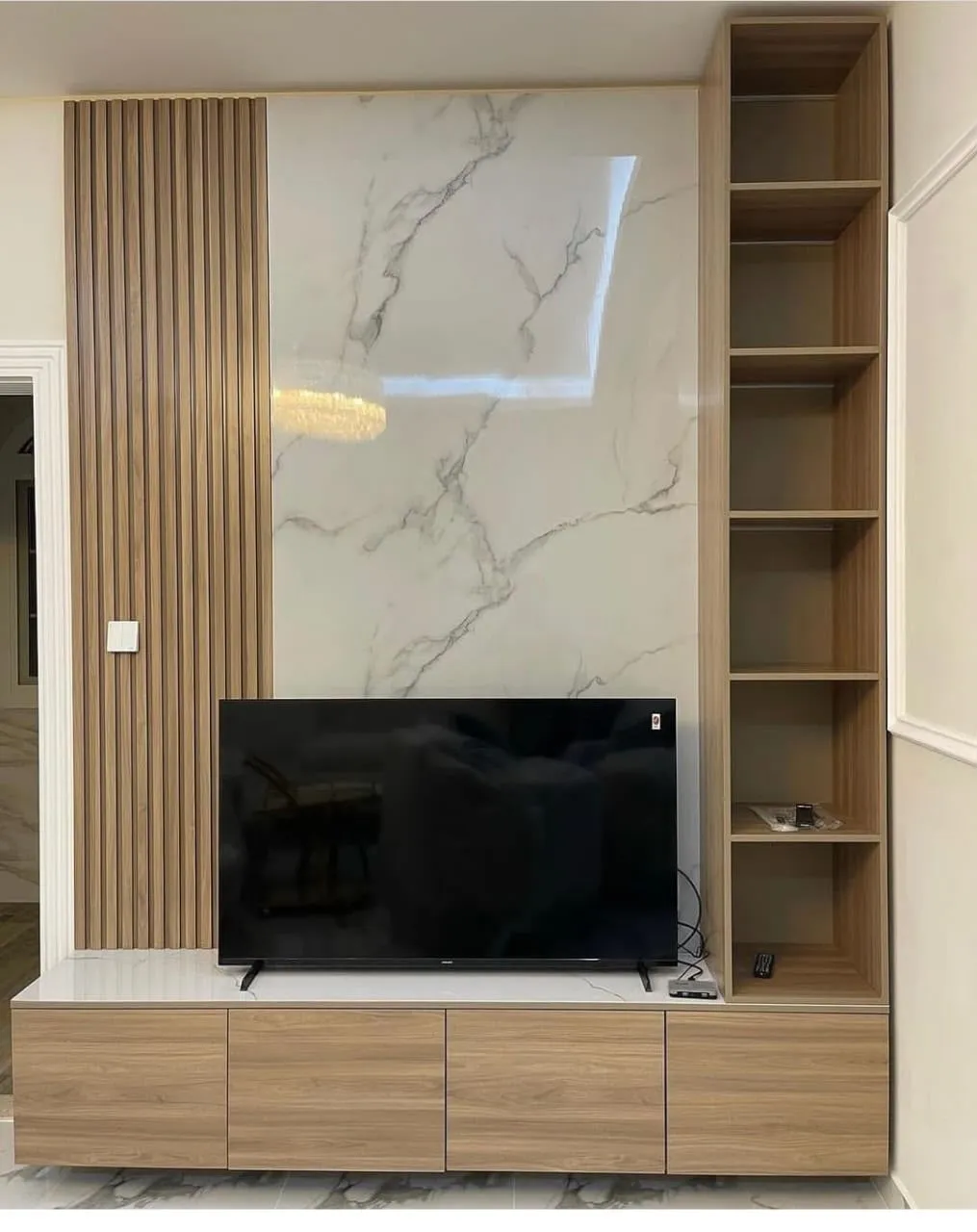
Mistakes tenants make with a media wall
The most common mistake is ordering before asking. A wall made to a drawing the landlord will not accept is a wall that has to be redesigned, and redesign after production starts is the costly kind. The second is relying on a spoken yes. The third is choosing the finish first and the build second; for a tenant the build comes first, because it decides what the landlord has to agree to. The fourth is hiding changes, such as a moved socket or a drilled ceiling edge, from the landlord, which turns a negotiable change into a dispute.
The fifth is forgetting the move-out. People plan the wall in detail and never ask how it comes down, who will do it and what the wall will look like afterwards. The sixth is not photographing the wall before the work starts. The seventh is buying a build much bigger than the stay justifies; the chart above shows what a short stay does to the cost per year. None of these needs expertise to avoid. They are avoided by the order: ask, match, keep paper, plan the exit. If you want a broader view of planning before you ask anyone, planning a media wall lists the decisions to settle first.
Smaller options that cost nothing in permission
If your landlord says no, or you do not want to ask, there is still a good deal you can do. A TV on a stand with a slim console beneath it, a floor-standing shelf unit beside it and a wall-washing lamp from a plug-in fitting gives much of the look of a media wall without touching the wall. A TV unit compared with a media wall sets out what you give up, and small living room media walls shows compact layouts.
These are not second-best by definition. Many people in rented homes are well served by a well-chosen console, and it moves with them. The point of the guide is not that a fixed wall is better, but that you should make the choice knowingly, with the landlord's answer in hand.
What we do for tenants
We make custom media walls in our Sharjah workshop and install them across the UAE, and we make removable or relocatable designs, as freestanding or modular arrangements, for rented homes. Not every fitted wall can be removed; it depends on how it is built, and we will tell you which kind yours is on the drawing. Our measuring visit is free and includes samples and a laser measure, and a drawing and an itemised price are agreed with you before anything is made. Once measurements and details are agreed, a 60% advance is paid and production starts when it is received; the remaining stage is agreed with you.
Walls start from AED 3,500 per project for a compact panel and floating console in standard laminate, and the final figure comes from the quotation. A typical wall is finished in up to about 10 days, depending on its size and design. The warranty is a 5-year limited warranty on the wood-based boards only, with hinges, runners, labour and misuse excluded. Our founder, Ali Haider Basra, has 10 years in the trade. See the media walls page, custom media walls and TV wall units and floating consoles, and our media walls in Sharjah page. For the visit itself, what happens at a measuring visit lists what we record.
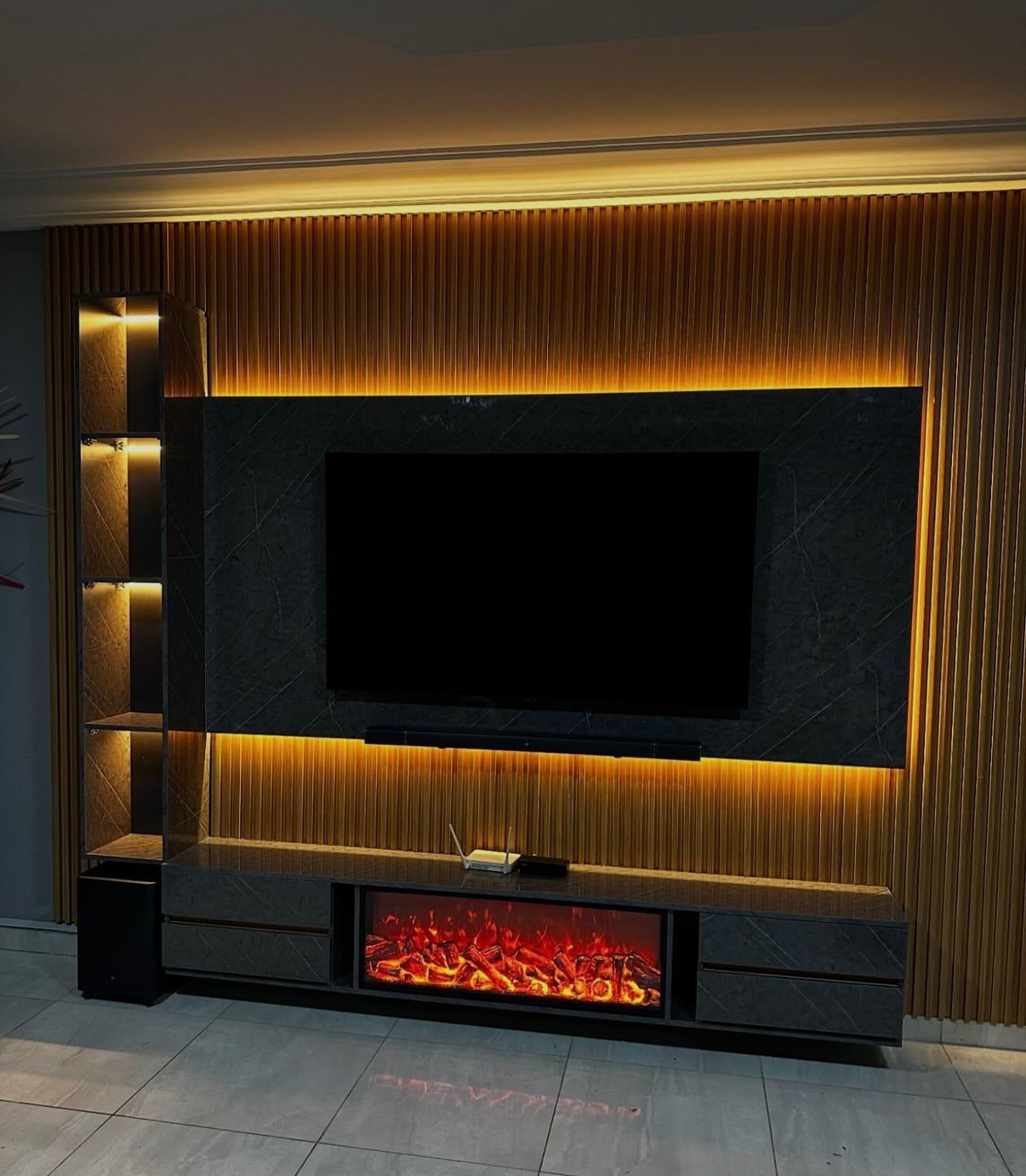
Send us the wall on WhatsApp
Tell us you are renting. Send a photo of the wall taken straight on from the middle of the room, the TV size, a photo of the room and how long you expect to stay, and say what your landlord has said or what you plan to ask. We will tell you which of the three builds fits and what a visit would look at. Orders are confirmed on WhatsApp, so the whole thread, including the drawing, stays in one place. A list of what to include is in what to send before a consultation.
Common questions
Can I install a media wall in a rented flat in Dubai or Sharjah?
Often, if your landlord or building management agrees in writing; we cannot say what your own contract allows, so read it and ask before anything is made. Freestanding or modular builds are the easiest to agree. Asking your landlord in writing shows what to put in the message.
What is the best media wall for a tenant?
For a short stay or a landlord who says no to fixings, a freestanding console and TV stand; with a few fixings agreed, modular panels that come apart at move-out. Removable media walls for tenants explains how they are built.
Can I take a media wall with me when I move out?
Modular or freestanding pieces can usually be taken; a fixed build depends on how it was made, and not every fitted wall is removable. Ask the maker which parts travel before you order. Removable media walls for tenants shows the typical pattern.
How much does a media wall cost for a rented flat?
Walls start from AED 3,500 per project for a compact panel and floating console in standard laminate, and the quotation gives the final figure. Dividing by the years you will stay shows what it costs per year. What a media wall costs breaks down what moves the figure.
Do I need my landlord's permission for a TV wall?
Check your tenancy contract and ask your landlord or building management in writing; we do not give legal advice on what is allowed. A written yes protects you at move-out. Questions to ask before you order lists what to confirm.
Can I mount a TV on the wall in a rented home?
Only if your landlord allows fixings; otherwise use a console or stand that needs nothing from the wall. If fixings are agreed, the maker should check what the wall is made of first. TV height on a media wall tells you where the screen should sit.
What should I photograph before the work starts?
Take wide shots from the corners, close-ups of the wall face, sockets, floor edge and ceiling edge, and anything already damaged. Send them to the landlord in writing. Our landlord guide shows the shots on a room plan.

Sources & specifications
Manufacturer information applies to the named products and systems. Sources reviewed on 10 November 2026.
- Consumer Affairs Victoria (Australia): Tenants installing fixtures and altering the rental property (rules depend on change, property and lease; restore or pay; example from another country)consumer.vic.gov.au(opens in a new tab)
- Tenancy Services New Zealand: Tenants making changes to the property (request in writing; fixtures left behind; reversible changes; example from another country)tenancy.govt.nz(opens in a new tab)
- US Consumer Product Safety Commission: IKEA offers free wall anchoring repair kit for chests and dressers (tip-over risk when not attached to the wall)cpsc.gov(opens in a new tab)
- Mantel Mount: Mounting a TV on drywall, stucco and plaster (know what the wall is made of)mantelmount.com(opens in a new tab)
Want this planned for your home?
Consultation and measurement are free. Tell us the rooms, location and what you need; we arrange a sample visit and define the measured quotation.