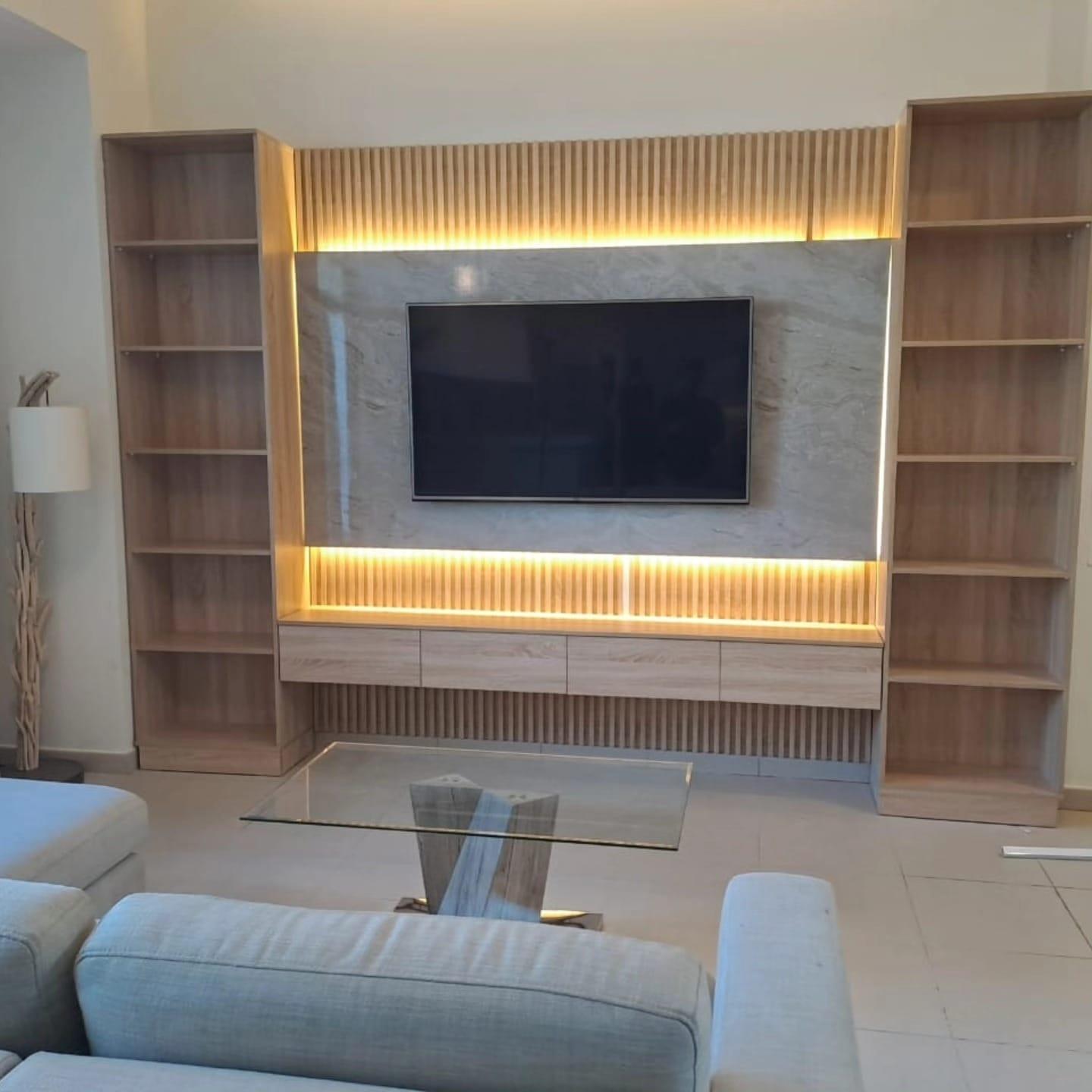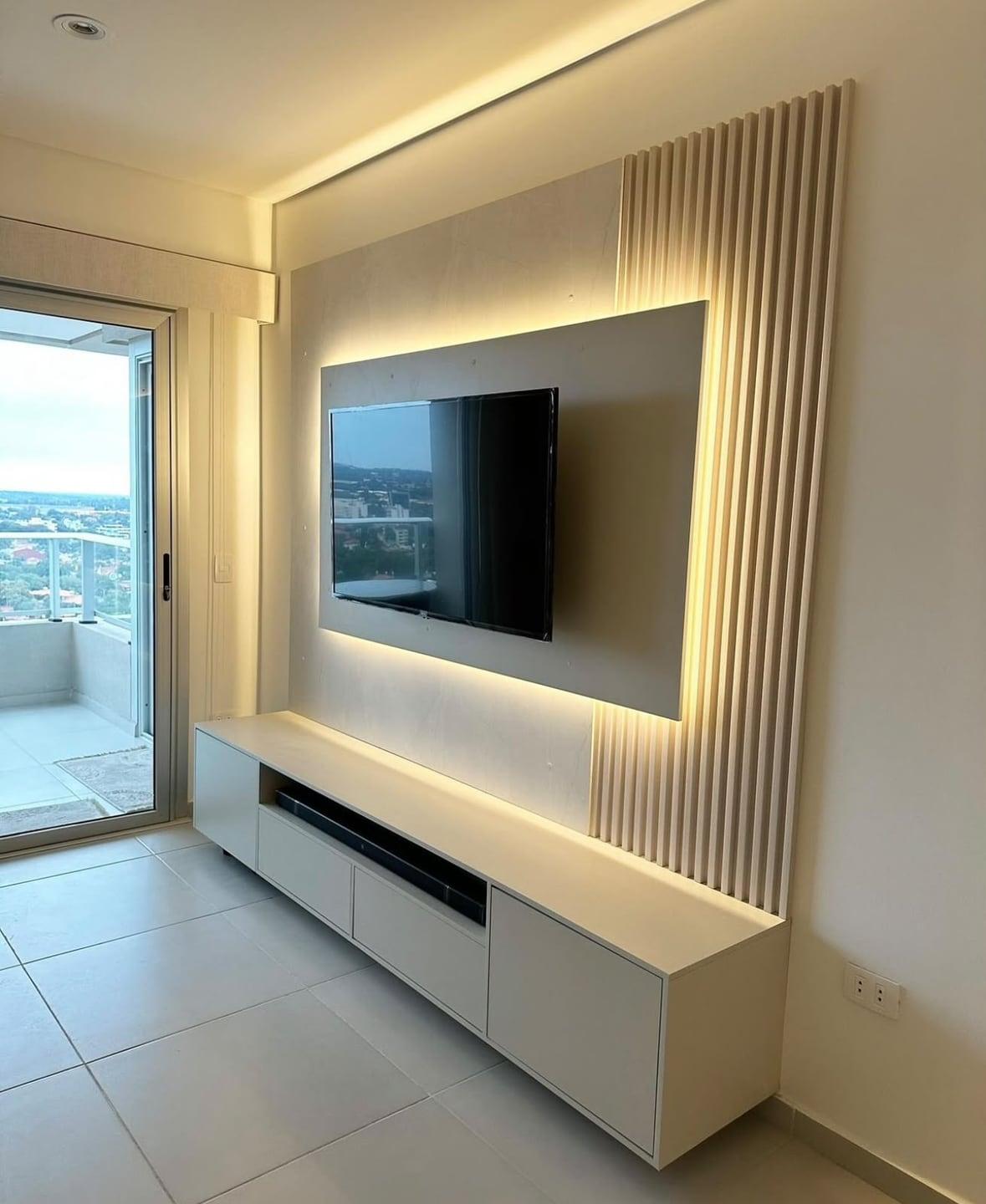
Media Walls · 22 min read · 23 September 2026
Questions to ask before you order a media wall in the UAE
About thirty questions to ask before ordering a media wall, in seven groups: your room, the wall and building, design, finish, money and paper, time, and aftercare, with the shape of a good answer and a message to copy.

By Ali Haider Basra, Founder, Al Tareeq Decor · Contact our workshop
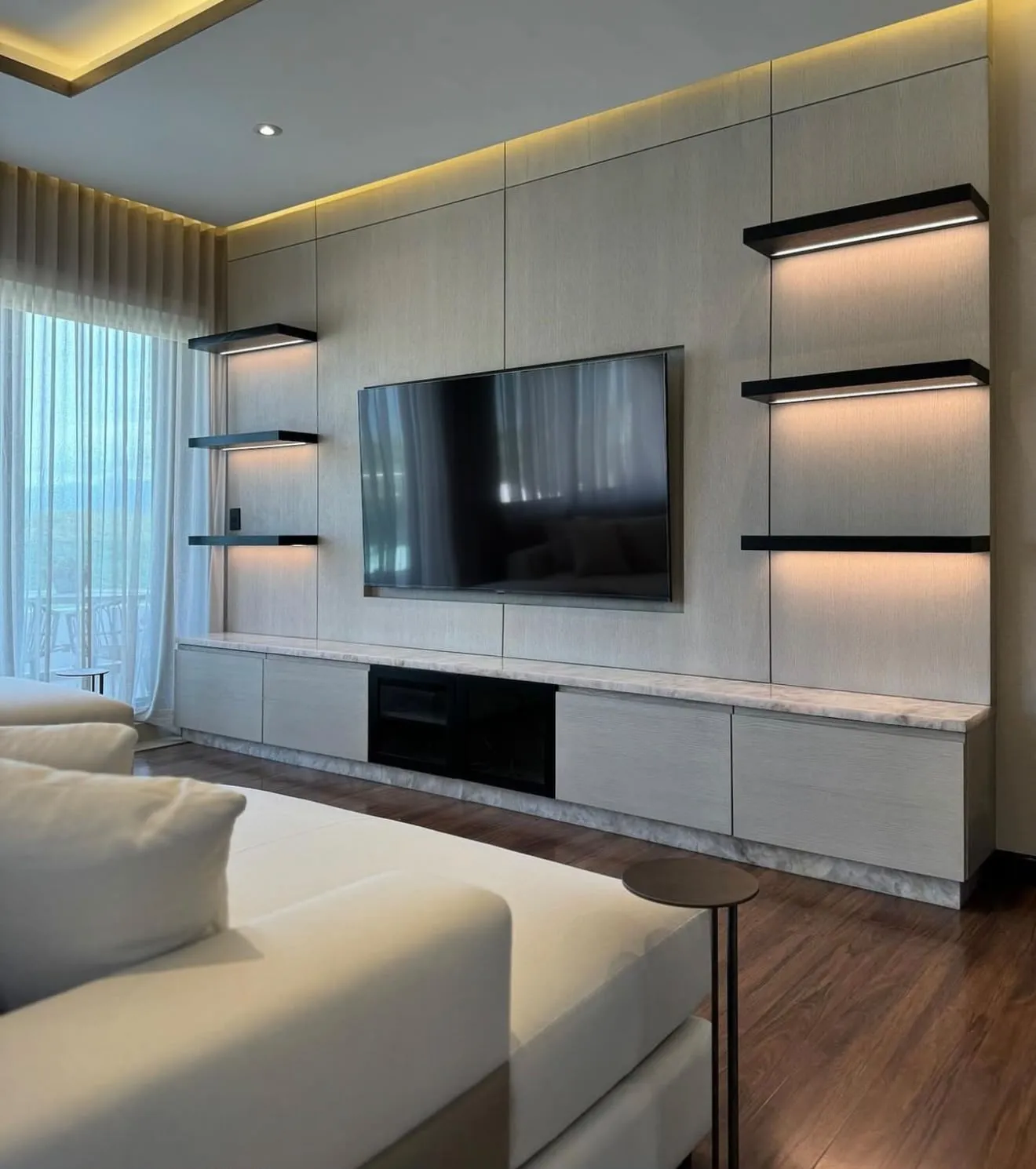
Key takeaways
- Answer five questions about your own room first, then put about twenty-five more to the maker in writing, grouped by topic.
- A good answer names a document, a step, a person or a limit; "all included" and "don't worry" name nothing.
- Decisions lock in a fixed order: TV size, sockets, lighting and fireplace at the drawing, shelf layout and finish at approval.
- If you rent, the landlord's written reply comes before the order, not after.
- Send the room facts and photos first, then the five or six questions that matter most; the rest follow the drawing.
On this page
- Key takeaways
- The short answer: thirty questions, in six groups, in a useful order
- Why the questions should be in writing
- Group 1: five questions to answer about your own room first
- Group 2: questions about the wall and the building
- Group 3: questions about the design
- Group 4: questions about the finish and the material
- Group 5: questions about money and paper
- The money and paper questions, with the answer to look for
- Group 6: questions about time and the day itself
- Group 7: questions about what happens afterwards
- The shape of a good answer
- Order now, or settle one thing first?
- A worked example: a couple in a rented two-bedroom flat
- Questions the maker will ask you (be ready)
- What a maker should ask you, and why
- Questions you can safely skip
- A message you can copy
- How the questions change by room
- What we do about your questions
- Send us the wall on WhatsApp
- Common questions
The short answer: thirty questions, in six groups, in a useful order
Before you order a media wall, answer five questions about your own room, then put roughly twenty-five more to the maker in writing, grouped under the wall and building, the design, the finish, the money and paper, the time and site, and what happens afterwards. Most of the answers will be quick. The ones that are slow or vague are the ones worth the most, because they show where the job is not yet understood.
This guide is the full list, with the reason each question matters, the shape of a good answer and a message you can copy. It deliberately does not repeat what other guides own. How to read the lines of a quotation is in our quotation checklist; the photos to send are in what to send before a consultation; the warning signs are in media wall red flags; and the positive checks on a maker are in how to choose a media wall contractor. This page is for the questions themselves.
Why the questions should be in writing
A spoken answer on a visit is easy to remember differently six weeks later, by either side. A written one is not. Citizens Advice, a UK charity, says to be very clear about the work you want done, because it helps you get the most accurate price and prevents misunderstandings later. It also says a quote should include a breakdown of the work and materials, how long the price is valid and when the price can go up. That is UK consumer advice, not UAE law, but the habit it describes, writing down what is wanted and what is promised, works anywhere.
The UAE government portal u.ae makes a related point from the consumer's side: a consumer has the right to correct information about the service they receive, and a supplier's invoice has to name the goods or service, the price and the quantity. We read that as a reason to expect specific answers: you are entitled to ask what you are buying, and a specific question deserves a specific reply. We are not giving legal advice, only pointing out that a clear question is a reasonable thing to send.
Practically, keep the whole conversation in one thread, which for us is WhatsApp, where orders are confirmed. Put one topic per message so the answers do not blur. When an answer matters, copy its key words back and ask the maker to confirm them: "So the drawing and itemised price come before any payment, yes?" That small habit turns a friendly chat into a record.
Group 1: five questions to answer about your own room first
Every question you ask a maker is sharper if you have already answered these five yourself. They are about the room, not the wall, and they take ten minutes. The plan below shows them on a typical living room: where everyone sits and how far that is from the screen, where daylight lands, how the door swings, where the sockets and data points are, and what lies on the other side of the wall.
Where do you sit? Count the seats and note the farthest one, because screen size and height depend on it. TV size and viewing distance gives the numbers and TV height on a media wall tells you where the centre of the screen should sit. Where does daylight fall? A glossy panel opposite a window turns into a mirror at certain hours; a matt one does not. Which way does the door swing, and how wide is the route in? A tall panel that does not pass the door has to be cut in pieces, which should be planned on the drawing, and our guide to apartment delivery and access covers the lift and corridor side.
Where are the sockets and data points? Note every one on the wall, with a photo, because moving them is a separate job and sockets and power on a media wall explains the options. What is on the other side of the wall? A bedroom, a kitchen, a corridor or an outside face changes the sound, the heat and the damp, and the maker needs to know. In a villa the answer might also be a shared wall with a staircase; in a flat it may be a neighbour. If you answer these five before you write, your first message is already better than most.
- 1. Where does everyone sit, and how far from the screen
- 2. Where does daylight fall on the screen and panels
- 3. Which way does the door swing, and can panels come in
- 4. Where are the sockets and the aerial or data points
- 5. What is on the other side of the wall
Group 2: questions about the wall and the building
These questions go to the maker, and they are the ones a photo cannot answer. The first is what the wall is made of. A media wall carries a heavy screen and often a floating console, so the way it is held depends on whether the wall behind is block, concrete or a lighter partition. Mantel Mount, a TV-mount maker, advises people to understand what their home is built from before doing anything, because it is critical to know so you use the right type of anchor. That is one company's advice about its own mounts, but the principle is general: do not guess, ask the person who will fix it. Our guide to block versus gypsum walls behind a TV shows the difference.
The second is what they will do about everything on the wall surface that is already there. Ask: what happens to the sockets and switches? Is there anything in the ceiling above, a curtain track, a pelmet, a cove light, that the design has to meet? What happens at the floor edge, with the skirting? What is the plan for cables and who can reach them later? The guide to cable routes you can still service lists the points to confirm.
The third is access. Ask whether the panels will fit the lift, corridor and door, and how they are brought in, whether the building has delivery hours, and who should apply to building management. If you rent, the landlord has to agree before any work starts; ask for that in writing, and see our guides on media walls in rented flats and on asking your landlord. Finally ask about humidity and heat. The coastal UAE climate and air-conditioning cycles affect boards, and the guide on humidity and MDF explains the choices.
Group 3: questions about the design
The design questions are where your wishes meet the wall's limits. Start with the screen: what is the largest TV the panel and console can take, and what margin is left round the TV I have now? Many people buy a bigger TV two years after the wall is finished, and a wall drawn tightly round a 55-inch set cannot take a 65-inch one. The guides on buying the TV before the wall and changing the TV later explain how much room to leave.
Then the shape: should this be a full wall or a compact panel with a floating console? A full wall gives you shelves, storage and a place for everything; a compact one costs less and fits a small room. Full wall or compact media wall sets out the trade-offs, and small living room media walls covers the compact end. Ask what the shelves will carry, whether a soundbar has a place (soundbar and speaker space), and whether the TV can breathe: TV ventilation in a niche shows why a closed box is a problem.
Lighting and fireplace decisions belong here too. Which light layers are planned, which are on a dimmer, and where do the driver and the switch sit? Media wall lighting ideas lists the options. If you are considering an electric fireplace, ask where its power comes from and how the heat is handled; the electric fireplace guide covers it. Finally ask for a drawing that shows all of these, and for the TV to be drawn at the height you chose. A design you cannot see on paper is not yet a design.
Group 4: questions about the finish and the material
Ask what the finish is made of and what is underneath it: laminate, veneer or lacquer, on which board. Each behaves differently when it is marked, cleaned or repaired, and the board beneath decides how it takes heat and moisture. Media wall panels compared explains the board types, and media wall materials and costs names the parts. Then ask for a physical sample, and look at it in your own room at two times of day. Our guides to finish samples and approval and to colour and finish go through how to judge a sample.
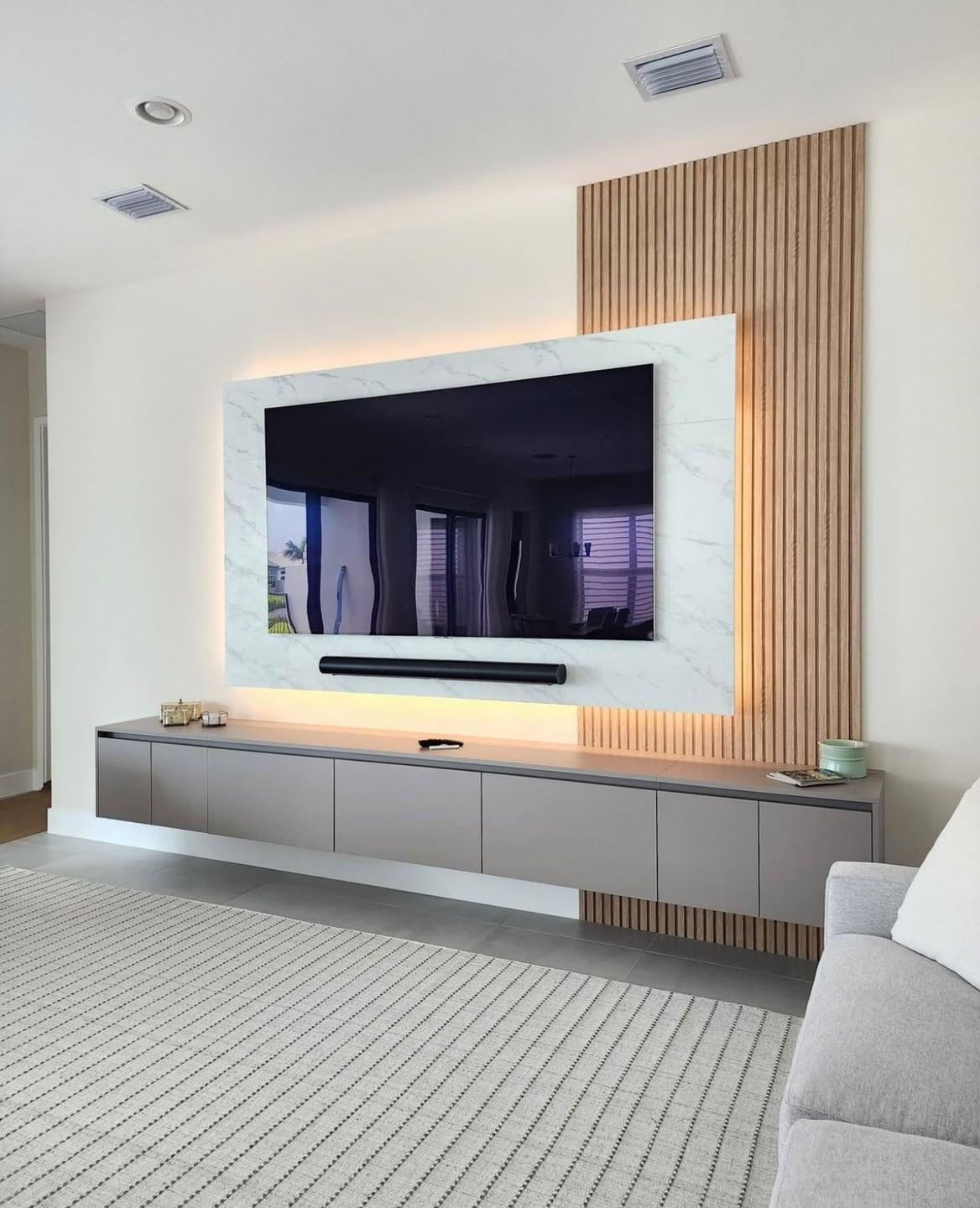
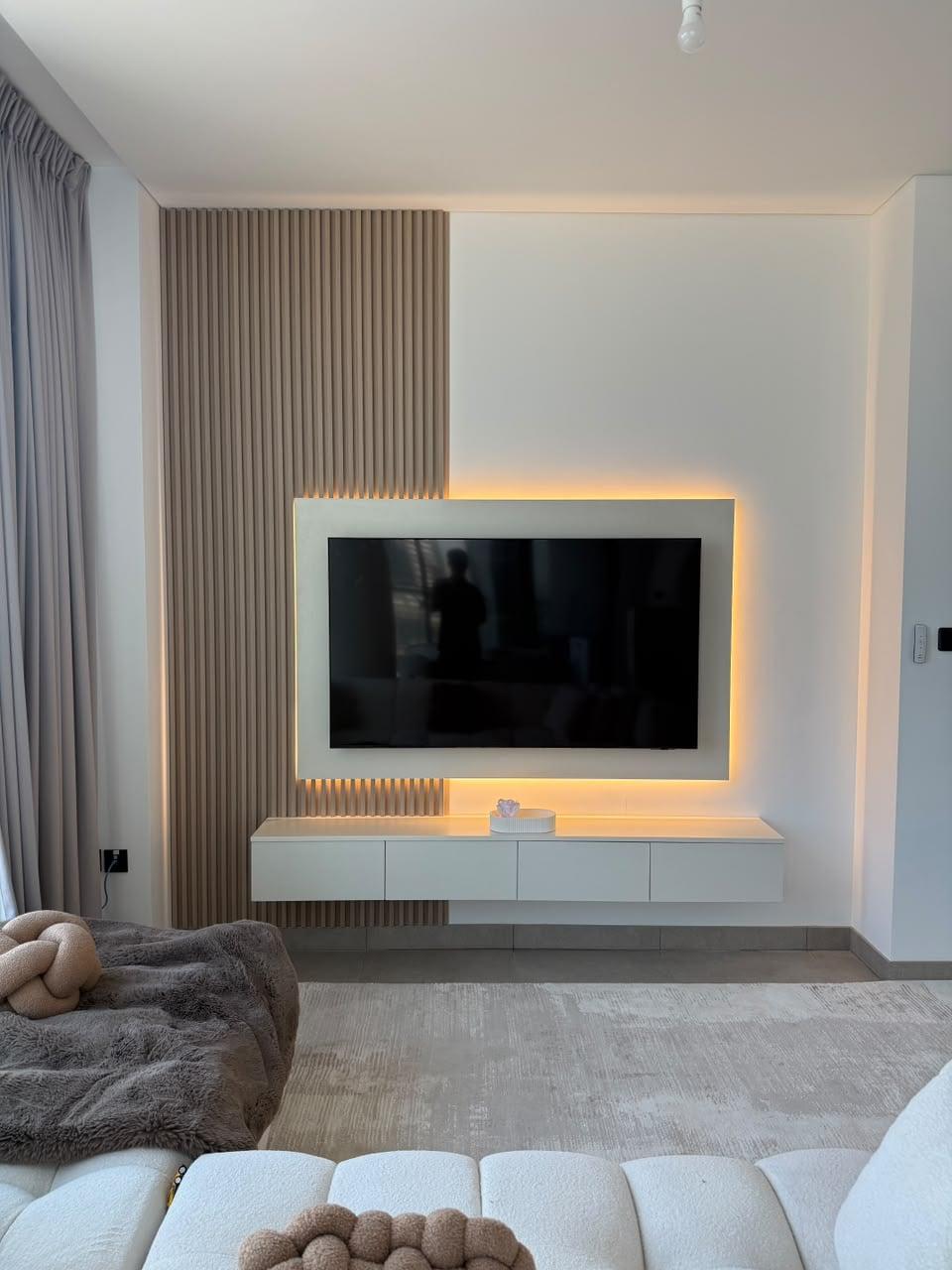
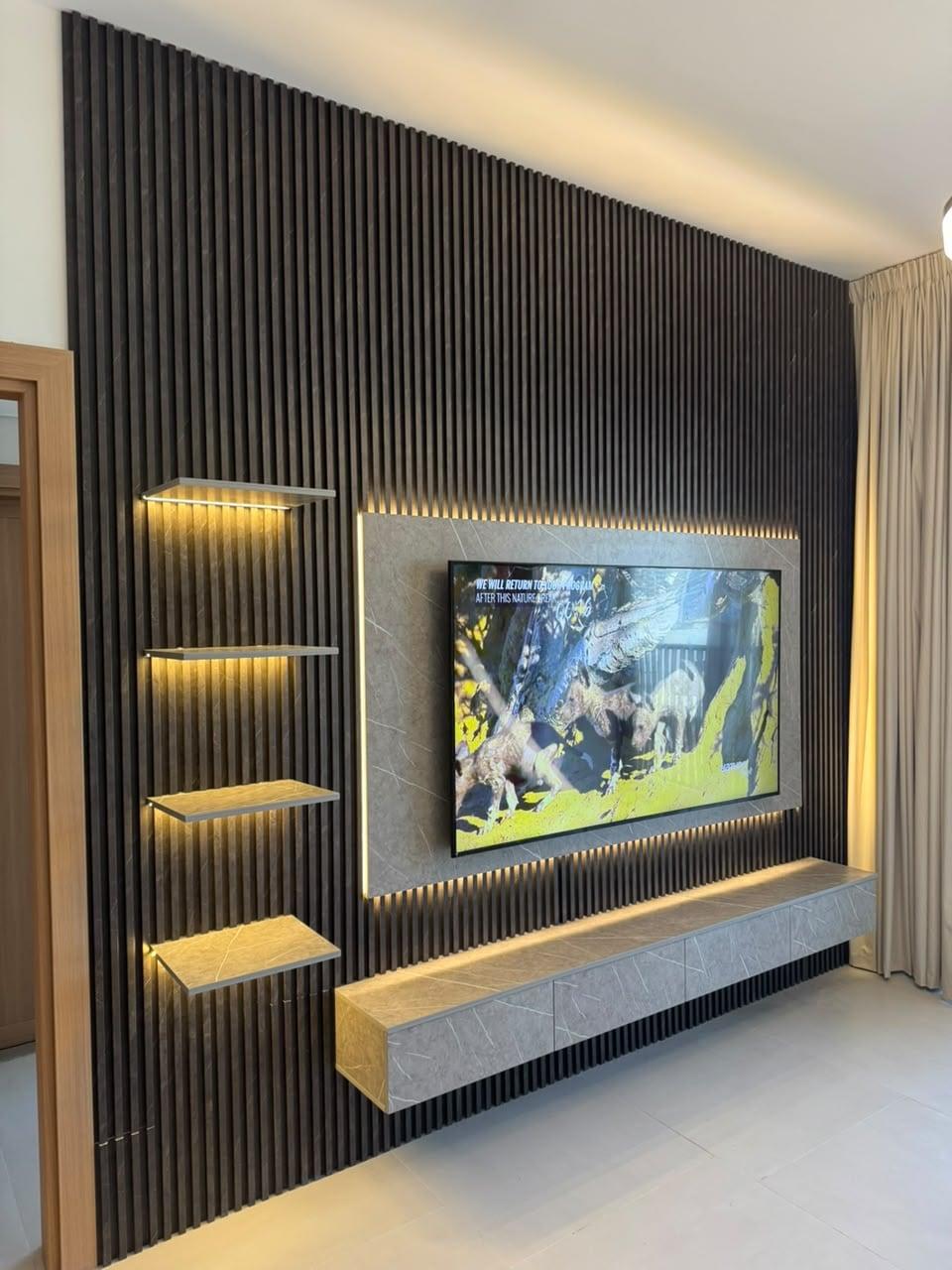
Two questions people forget: which edges will be visible, and how are the joins between panels handled? A finish that looks good face-on can be disappointing at the edge. Ask whether feature panels such as acoustic fluted slats, porcelain or marble-effect surfaces have their own joints, and where they fall. Our guides to fluted and slatted walls and marble-effect TV walls describe what to expect.
The last question in this group is about care: how do I clean it, and what should I avoid? A matt surface shows fingermarks differently from a gloss one, and a lit niche collects dust. A good answer names the cleaning method for your finish and says what damages it. If the reply is "anything is fine", ask again. We use acoustic fluted slats in oak, walnut and charcoal and porcelain or Calacatta marble-effect panels, and we bring samples of the finishes we make to the visit.
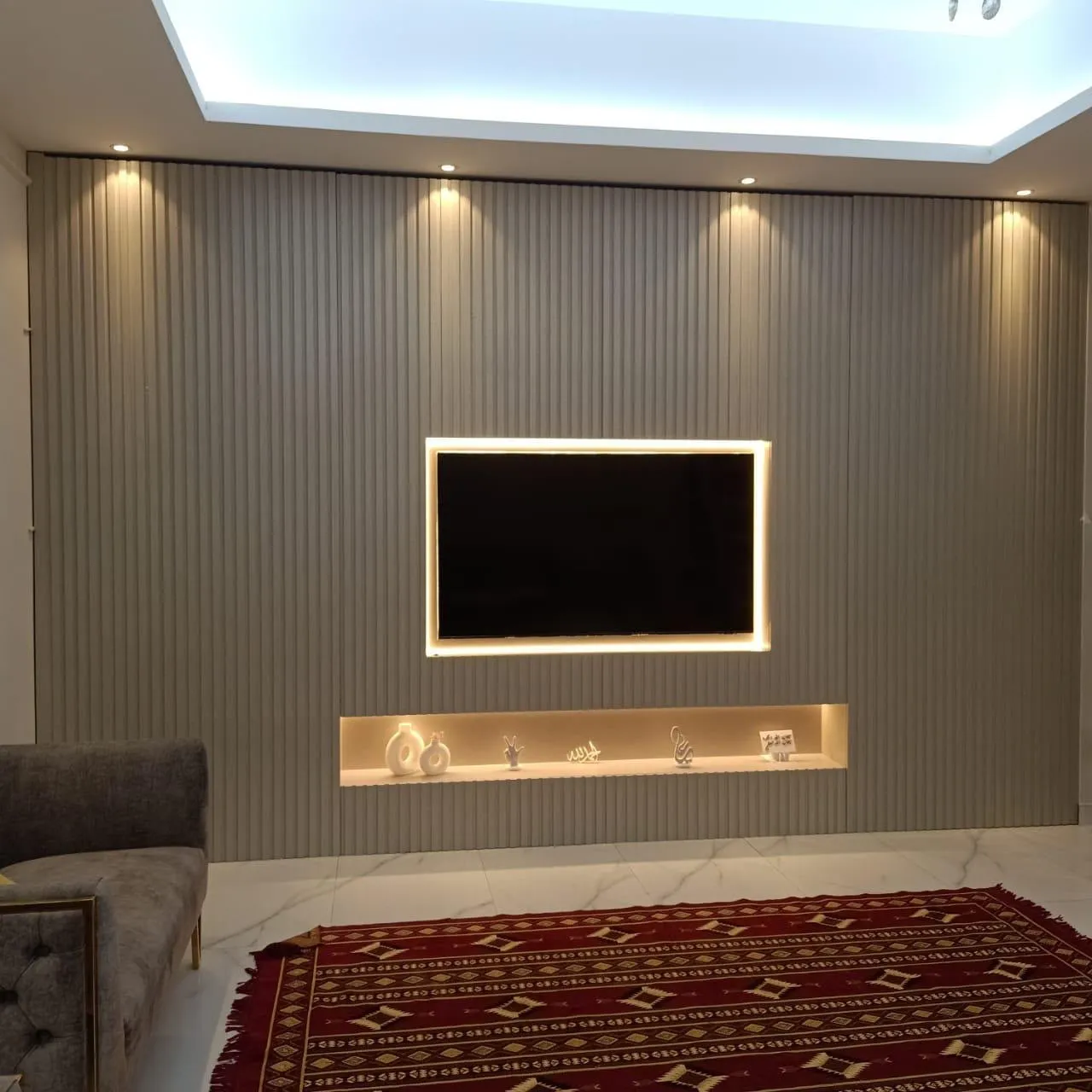
Group 5: questions about money and paper
Put the questions about price and paper in writing, and ask them before you ask for a discount. First: what is the price for, which drawing does it refer to and which lines does it name? Citizens Advice says a quote should break down the work and materials and give a total that is fixed, with the validity and the conditions on which the price can rise. Our quotation checklist turns this into eight lines. Second: what is not included? The honest answer names exclusions rather than saying nothing.
Third: what is paid when, and for what? In our own process, once measurements and details are agreed a 60% advance is paid and production starts when it is received; the remaining stage is agreed with you. Whatever the maker's process is, ask them to write it down and to confirm that you will get a receipt for each payment. Fourth: how long is the quote valid, and what can change it? Material and finish changes after the drawing is approved can alter the figure, and you should know in advance.
Fifth: what is the starting figure for a wall like mine? Ours are from AED 3,500 per project for a compact panel and floating console in standard laminate, and the final figure comes from the quotation, driven by wall size, finish, marble-effect panels, lighting and any electric fireplace. If the maker gives only a total, ask for it itemised; what a media wall costs explains how the parts add up. You can also use the pricing guide to set a planning figure before you ask.
The money and paper questions, with the answer to look for
Which drawing and which lines is this price for?
- Why it matters
- Ties the price to your wall
- A good answer
- A named drawing and itemised lines
What is not included?
- Why it matters
- Gaps show up on site otherwise
- A good answer
- A short, specific list of exclusions
What is paid when, and do I get a receipt?
- Why it matters
- Order matters more than amount
- A good answer
- Written stages, a receipt for each payment
How long is the price valid?
- Why it matters
- Avoids a surprise if you decide later
- A good answer
- A stated date or period
What could change the price?
- Why it matters
- Late changes cost time and materials
- A good answer
- Named triggers, such as a changed finish
Does the price include mounting the TV?
- Why it matters
- A missing line becomes your job
- A good answer
- Mounting named, and who does it
Questions to send in writing, not a price list. Media walls start from AED 3,500 per project for a compact panel and floating console in standard laminate.
Group 6: questions about time and the day itself
Ask for the timeline in writing, with its conditions. Citizens Advice says timings in a contract should cover start and finish dates and the delays that might happen and what the trader will do about them. Our own typical wall is finished in up to about 10 days, depending on its size and design; ask any maker what their figure covers and what would change it. The diagram below shows the order in which decisions lock, because the single biggest cause of delay is a decision made late.
Then the day itself. Ask how many people will come, how long they expect to be there, how the floor and furniture will be protected, how rubbish is handled and who is responsible for the TV while it is off the wall. Our installation day checklist lists what to prepare, and the apartment delivery guide covers lifts and booking. Ask who will be there from the maker's side and how you reach them on the day.
A question rarely asked is what the maker needs from you. Clearing the wall, moving furniture, switching off the electricity at agreed times, and keeping the room free for the planned period are all reasonable asks. A maker who tells you without being asked is a maker who has planned the day. And ask what happens if you are not satisfied with a detail on the day: the handover checklist tells you what to check and how to record it.
- 1. TV size and model lock at the drawing stage
- 2. Socket positions lock at the drawing stage
- 3. Lighting and dimmer lock at the drawing stage
- 4. Electric fireplace yes or no locks at the drawing stage
- 5. Shelf and drawer layout lock at approval
- 6. Finish and colour lock at approval
- 7. A change after cutting should be agreed before production
Group 7: questions about what happens afterwards
A wall is a product you live with for years, so a few questions should be about year three rather than week one. What does the warranty cover, in writing? Ours is a 5-year limited warranty on the wood-based boards only, and hinges, runners, labour and misuse are excluded. Who comes back if a door rubs or a light fails, and how do I reach them? Where is the access panel to the cables and the LED driver, and can I reach it without cutting anything?
Ask what service the wall will need and what it will not. If the lighting needs a driver replaced in five years, you should know where it is. If a hinge needs adjusting, you should know whether that is part of the service. And ask what happens if you move: can the wall come with you, or part of it? That question belongs mainly to tenants, and we cover it in removable media walls for tenants.
Keep the answers to these questions with your drawing. When something goes wrong in year four, the documents you hold will save you a lot of searching, and a maker who has already answered these questions in writing is far more likely to help at that point than one who has not.
The shape of a good answer
A good answer to any of these questions names a document, a step, a person or a limit. "A drawing and an itemised price, agreed before production" names two documents and a moment. "Once details are agreed and the advance is received" names a condition. "On the wood-based boards only" names a limit. A weak answer names nothing: "all included", "we take care of everything", "don't worry". The chat below shows four questions with examples of the shape, using our own answers to our own process.
If an answer is weak, ask once more in different words and watch what the second reply does. If it becomes more specific, the first was just brisk. If it stays vague or turns into a discount, the vagueness was the answer. You are not testing the maker's patience; you are testing whether the thing you are about to pay for is defined.
- 1. Is the measuring visit free: yes, with samples and a laser measure
- 2. What do I approve before anything is cut: a drawing and an itemised price
- 3. When does production start: once details are agreed and the 60% advance is received
- 4. What does the warranty cover: the wood-based boards only, 5-year limited
Order now, or settle one thing first?
Five gates sit between you and an approval, and each has a quick test. Is the TV chosen, with its size known? Has someone measured the wall in person? If you rent, do you hold your landlord's written reply? Have you seen the finish in your own light? Do you hold a drawing and an itemised price? A no at any gate does not mean giving up on the wall; it means one task. The path below turns each no into the thing to do.
The gate people skip most often is the landlord. A wall ordered before the landlord's reply may have to be redesigned, and a redesign after production starts is the most expensive kind. If you are renting, read media walls in a rented flat first; if you own the home, you can skip that gate and move on to the finish sample.
- 1. Is the TV chosen, with its size known
- 2. Has someone measured the wall in person
- 3. If you rent, do you hold the landlord's written reply
- 4. Have you seen the finish sample in your own light
- 5. Do you hold a drawing and an itemised price
A worked example: a couple in a rented two-bedroom flat
Take a couple in a rented flat who want a media wall in the living room. They have a 55-inch TV and are thinking of a 65-inch one. The wall is block, there are two sockets at hip height, and the sofa is 3 metres from the wall. They have never ordered joinery. Everything here is an invented scenario showing how the questions work; it describes no real customer.
They answer the five room questions first. They sit on one sofa and two chairs; the window is on the right and faces the afternoon sun, so a matt panel is wise; the door swings into the room and is wide enough for a compact panel; the sockets are on the wall and need a plan; and behind the wall is the bedroom, so sound matters. Then they write to the maker with a photo, the TV size and these five answers, and ask the questions that matter for a tenant: how is the wall fixed, how much comes with us when we leave, and what should we ask the landlord?
The reply that matters most is the one about the landlord. The maker explains where the fixings would go, offers a modular layout with fewer fixing points, and says to ask the landlord in writing. The couple write to the landlord with the drawing, and only then approve. If the landlord says no, they have lost nothing but a few days; if they had ordered first, they would have lost money. That order, room, questions, landlord, then approval, is the whole lesson of this guide.
Questions the maker will ask you (be ready)
A good conversation runs both ways, and a maker who asks nothing is not working on your wall. Expect questions about the TV (size, model and weight if known), the wall (material, what is above and beside it, sockets), the room (seating, light, door and lift) and your wishes (storage, shelves, lighting, a fireplace). Have the answers ready and the first reply will be faster and more useful. The table lists the questions and why they are asked.
If you do not know an answer, say so. "I don't know what the wall is made of" is a perfectly good answer, because a visit will find out. A maker who presses you to decide something you cannot yet know, such as a finish before you have seen a sample, is rushing you, and the guide to red flags lists that among the signs to notice.
What a maker should ask you, and why
Which TV, and what size?
- Why it is asked
- Sets the panel, margin and bracket
- What helps
- Model, size and weight if you know them
What is the wall made of?
- Why it is asked
- Decides how heavy parts are held
- What helps
- A photo; the visit will confirm
Where are the sockets and what is above?
- Why it is asked
- Decides cables, lighting and the ceiling edge
- What helps
- A straight-on photo with the sockets visible
Where do you sit, and how far?
- Why it is asked
- Decides screen height and size
- What helps
- The distance to the farthest seat
What will it hold?
- Why it is asked
- Decides shelves, drawers and weight
- What helps
- A list: console, soundbar, books, plants
Do you own or rent?
- Why it is asked
- A rental needs the landlord's reply
- What helps
- The landlord's contact and your tenancy
Questions you can safely skip
Not every question earns its place. "Is your MDF really MDF?" is not something a maker can prove in a message, and neither is "are you the best?". Questions that ask a maker to praise themselves tend to produce a slogan. Spend the effort instead on questions that ask for a document, a step or a limit. Likewise, do not ask for a firm price from a photo alone; you will get a number, but it is a guess. Ask what the price depends on.
And do not ask for everything at once. A message of thirty questions gets a thin reply to each. Send the room facts and photos first, ask the five or six questions that matter most to you, then go through the rest as the drawing takes shape. The sequence in the deadline diagram is a good guide: sockets, TV and lighting before the drawing, shelf layout and finish before approval.
A message you can copy
Here is a message that carries the essentials. Change the details and send it with a straight-on photo of the wall and one of the room: "Hello, I am planning a media wall for my [living room / majlis / bedroom]. The wall is [width] by [height], the TV is [size], I sit about [distance] from it. The sockets are at [positions], and I [own / rent] the home. Could you tell me: whether someone will measure the wall in person; whether I will receive a drawing and an itemised price before anything is made; what the payment stages are and whether I get a receipt for each; the timeline and what could change it; and what the warranty covers and excludes?"
That is five questions, one paragraph and a clear picture of the job. A maker who answers it fully has shown you how they work. For the photos, see what to send before a consultation; for a bigger-picture guide to the whole job, see planning a media wall.
How the questions change by room
The same list shifts weight depending on where the wall goes. In a living room, the sofa distance and daylight dominate, and living room TV walls shows layouts. In a villa the wall is often larger, with a fireplace or a double-height ceiling, and the cable and ceiling questions grow; villa TV walls covers that. In a bedroom the question is storage and a wardrobe that shares the wall, which is the subject of wardrobe with TV unit. In a rented flat the first question is the landlord's.
An office wall asks about cable management and meeting-room screens, and we treat it in office media wall design. Whatever the room, the order of the questions is the same: your room first, then the wall and building, then design, finish, money, time and aftercare. If you want a broader introduction to what a media wall is and what it is made of, [what is a media wall is the starting point, and media wall design ideas shows finished walls in different rooms.
What we do about your questions
We make custom media walls in our Sharjah workshop and install them across the UAE. Our measuring visit is free and includes samples and a laser measure, so most of the wall-and-building questions are answered on the spot. A drawing and an itemised price are agreed with you before anything is made, and once measurements and details are agreed a 60% advance is paid and production starts when it is received; the remaining stage is agreed with you. Our own team makes, fits and mounts the TV, and a typical wall is finished in up to about 10 days, depending on its size and design.
Walls start from AED 3,500 per project for a compact panel and floating console in standard laminate; the final figure comes from the quotation. The warranty is a 5-year limited warranty on the wood-based boards only, with hinges, runners, labour and misuse excluded. Our founder, Ali Haider Basra, has 10 years in the trade. See the media walls page, the custom media walls and TV wall units and floating consoles pages, and our media walls in Sharjah page.
Send us the wall on WhatsApp
Send us a photo of the wall taken straight on from the middle of the room, the TV size you have or plan to buy, a photo of the room, and your five answers from the first group of this guide, and add whichever of the questions above matter most to you. We will reply with what a visit would look at, and orders are confirmed on WhatsApp so the thread stays in one place. The list of what to include is in what to send before a consultation.
Common questions
What should I ask before ordering a media wall?
Ask whether someone will measure your wall, whether you will get a drawing and itemised price before anything is made, what is paid when, how long it takes and what the warranty excludes. Answer five questions about your own room first. Our quotation checklist shows how to read the reply.
How do I prepare for a media wall consultation?
Send a straight-on photo of the wall, one of the room, the TV size and where you sit, and note the sockets. The more you send, the more specific the reply. What to send before a consultation lists everything.
Do I need to buy the TV before ordering a media wall?
Not always, but you need to know its size, and the maker should leave a margin for a larger set later. Buying the TV before the wall explains how to decide.
What questions should a tenant ask before ordering a media wall?
Ask your landlord in writing whether the work is allowed and how it may be fixed, and ask the maker how much can be taken away when you leave. Do not order before the reply. Media walls in a rented flat covers the details.
How long does a media wall take after I order?
Production for our walls is up to about 10 days, depending on size and design, once details are agreed and the 60% advance is received. Ask any maker what their figure covers. Our installation day checklist shows what to prepare.
What should the maker ask me?
They should ask about the TV, what the wall is made of, where the sockets are, where you sit and what the wall must hold. A maker who asks nothing is not yet working on your wall. Media wall red flags lists other signs to notice.
Is it rude to ask for everything in writing?
No. Writing the answers down protects both sides, and u.ae says a consumer has the right to correct information about the service they receive. How to choose a media wall contractor shows what to keep on paper.

Sources & specifications
Manufacturer information applies to the named products and systems. Sources reviewed on 10 November 2026.
- Citizens Advice (Scotland): Before you get building work done (be clear about the work, what a quote and a contract should include, timings and delays)citizensadvice.org.uk(opens in a new tab)
- u.ae: Consumer protection (right to correct information, what a supplier's invoice must include)u.ae(opens in a new tab)
- Mantel Mount: Mounting a TV on drywall, stucco and plaster (know what the wall is made of)mantelmount.com(opens in a new tab)
Want this planned for your home?
Consultation and measurement are free. Tell us the rooms, location and what you need; we arrange a sample visit and define the measured quotation.