Media Walls · 18 min read · 8 November 2026
Dark or light TV wall in UAE homes: how to choose the tone
A dark feature panel with lighter flanks suits most UAE living rooms. Here is what dark and light change about the black screen, glare, room size, lighting and dust.

By Ali Haider Basra, Founder, Al Tareeq Decor · Contact our workshop
Key takeaways
- A dark feature panel with lighter flanking sections suits most UAE living rooms; a mid-tone is the safe single-colour choice.
- A dark wall makes the black screen disappear when off; a light wall shows it as a dark block.
- Gloss dark panels mirror the window; matt finishes scatter the light and are usually the better choice beside a screen.
- Dark walls need their own lighting at night and show dust more; light walls make small rooms feel larger.
- Send photos of the wall in daylight and with evening lights on, and we will show samples in your own light.
On this page
- Key takeaways
- Dark or light TV wall? The short answer
- What dark and light actually measure
- The black-screen problem: how the TV reads when it is off
- Daylight, glare and the gloss question
- UAE light: strong sun, big windows and warm evenings
- Room size and ceiling height
- Lighting a dark wall, and what a light wall does not need
- Dust, fingerprints and upkeep: what each tone shows
- The mid-tone and the split wall
- A scorecard from fitted walls
- When marble, veining or a fireplace changes the answer
- How to decide in fifteen minutes
- Three worked rooms (illustrative cases, not named customers)
- Matching the floor, sofa and curtains
- Mistakes we see with dark and light TV walls
- What we do about it
- Send us your wall on WhatsApp
- Common questions
Dark or light TV wall? The short answer
For most UAE living rooms we recommend a dark feature panel behind the TV with lighter flanking sections, or a mid-tone wall if you want one colour. A fully dark wall suits a large room watched mostly in the evening; a fully light wall suits a small room, a rental or a household that wants the TV to be the only dark thing in the room. The choice is not about taste alone: it changes how the black screen reads when it is off, how much glare you see, how big the room feels and how much dust shows.
This guide is about that single decision. Our colour and finish guide already covers what sits under the colour (laminate, lacquer, veneer), how a sample changes through the day and how two finishes meet; we do not repeat those here. Here we ask only: dark, mid or light, and what follows from the answer.
You will find what the words dark and light measure, what happens to a black screen on each tone, how finish and daylight interact, a scorecard from fitted walls, three worked rooms, the mistakes we see, and what to send us on WhatsApp so we can show you samples in your own light.
What dark and light actually measure
Paint and board makers describe how light or dark a colour is with its light reflectance value, or LRV. Resene's architects' memo defines it as the amount of light a colour reflects, and adds three points that matter for a TV wall: many different colours can share the same LRV, so a number alone does not tell you what a colour looks like; one particular colour has one LRV however it is tinted or matched; and LRV says nothing about durability or opacity. In plain terms, a darker wall takes more of the room's light and a lighter wall gives more of it back.
That matters because a TV wall is often the largest surface in a living room. A dark one removes light from the room and a light one adds it. Neither is a fault; each changes what the other lights need to do. A dark wall in a room with big windows is lifted by the daylight; the same wall in an interior room with one small window can feel heavy until the evening lights are on.
The diagram sketches the idea with six common tones. The bar heights are only a sketch of the principle, not measured values, because the real figure belongs to the specific board or sample, which is why we recommend a full-size sample in your own room before you approve anything. The finish sample approval guide explains how.
- 1. Near-black and charcoal return the least light
- 2. Walnut and oak sit in the middle
- 3. Beige and white return the most
- 4. The arrow reads from reflects less to reflects more
The black-screen problem: how the TV reads when it is off
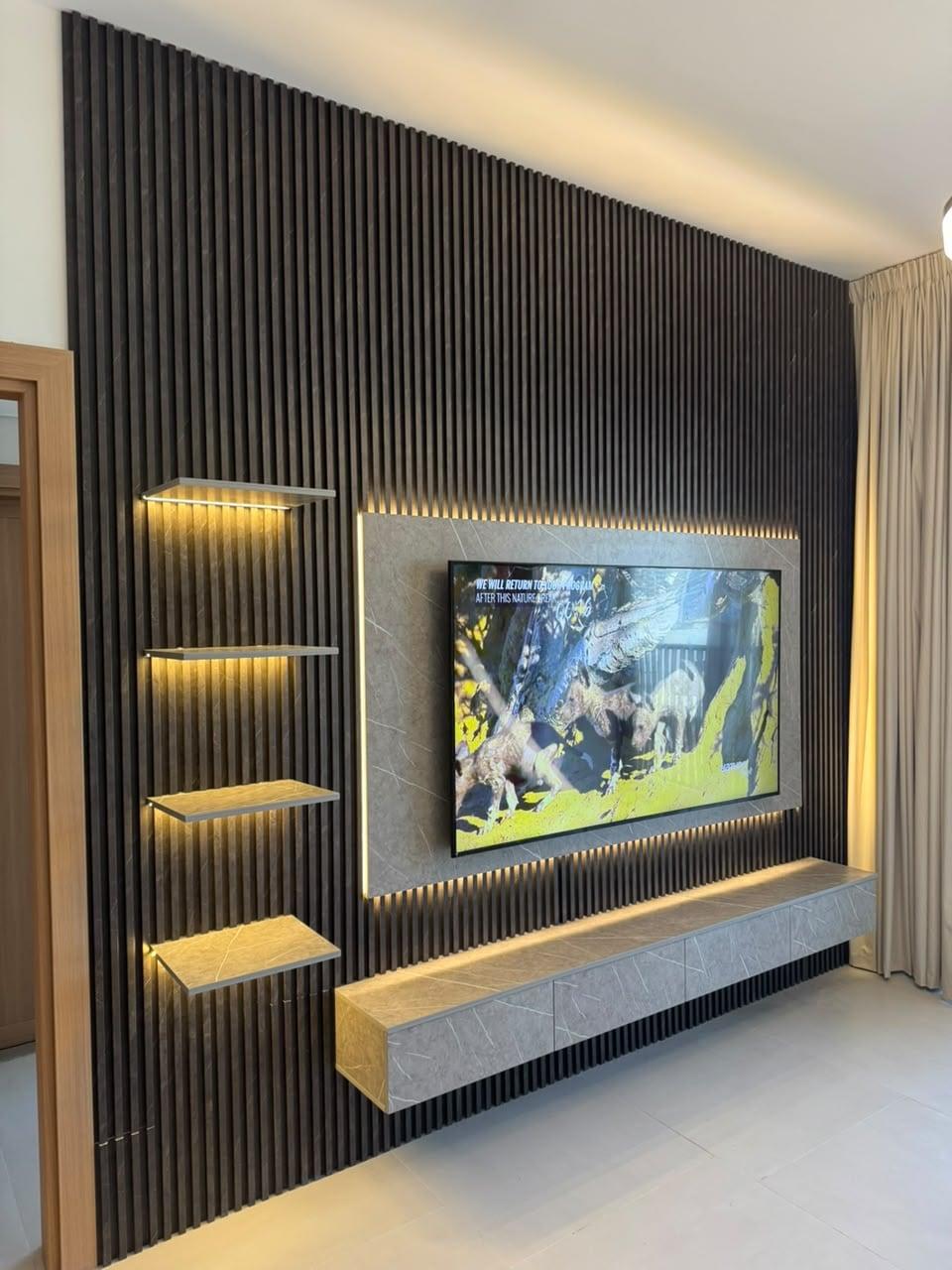
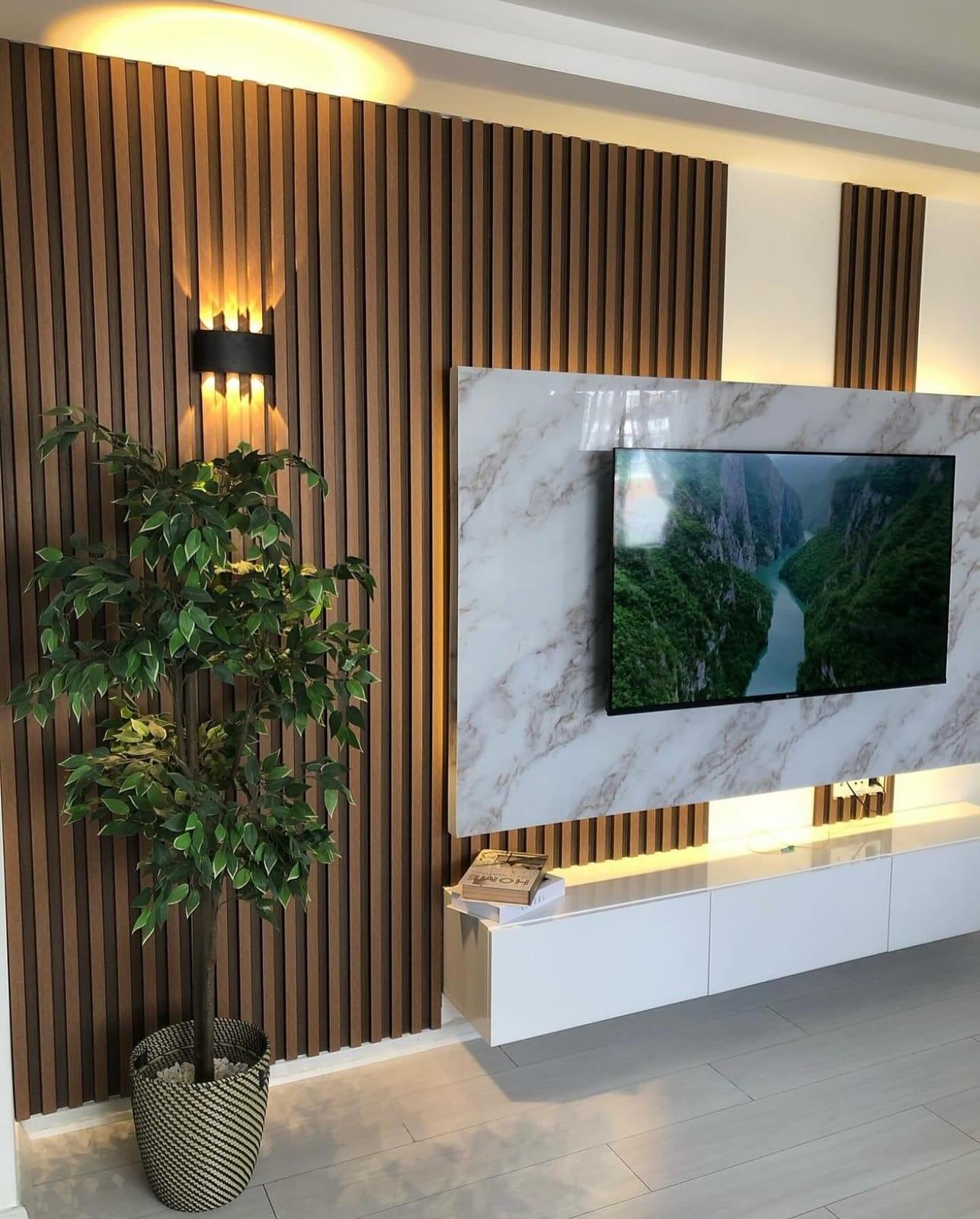
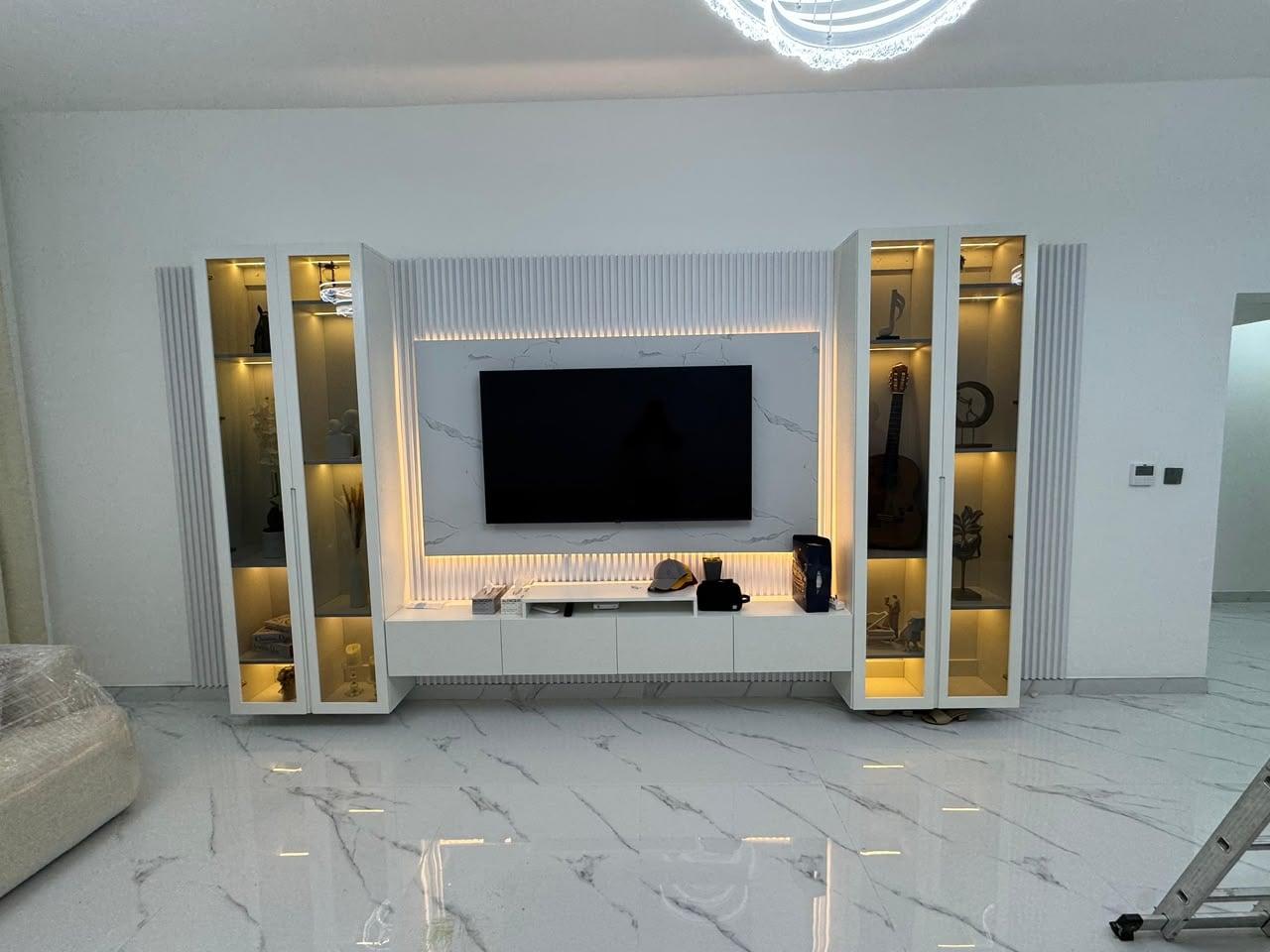
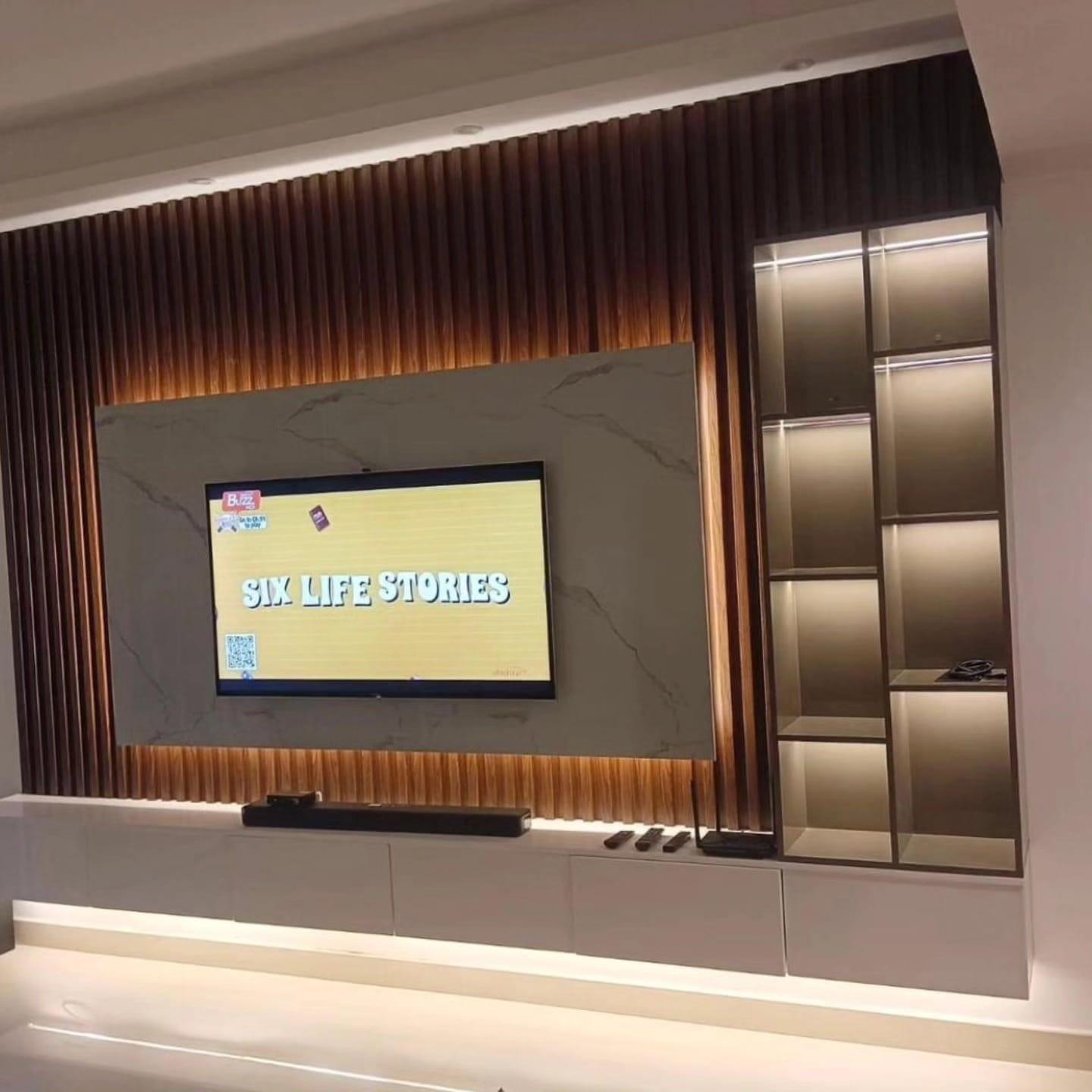
A modern TV is a large black rectangle for most of the day. On a light wall it stands out as a dark block, which is why light walls often need a feature panel or a frame of lighting to make the screen look deliberate. On a dark wall the screen melts into the surface when off, and when on it glows like a window. On a mid-tone wall the edge is visible but calm.
This is the real argument for a dark TV wall: it makes the screen disappear. If you dislike seeing a black screen when the TV is off, a dark or textured panel behind it is the answer. If you like the TV to look like a piece of equipment, a light wall will show it as one. The choice is one of character, and it is easy to see in the diagram's three elevations.
A related point is the screen edge. On a very dark wall, a black screen bezel with a faint reflection can look like a hole in the wall, which some people love and others find heavy. A thin line of backlight around the screen, as our lighting guide explains, gives the edge definition without making the wall brighter. Our guide on TV size and viewing distance helps decide the screen size before you decide its surroundings.
- 1. Dark wall: the screen blends in when off
- 2. Mid-tone wall: a calm, visible edge
- 3. Light wall: the screen reads as a dark block
Daylight, glare and the gloss question
Dark walls raise the question of gloss. RTINGS, testing TV screens, explains that when light shines on a display most of it is absorbed but some is reflected, and that some comes straight back like a mirror while the rest is scattered; it adds that no TV escapes reflections completely when the room is bright. Walls follow the same optics: a gloss finish returns a sharp mirror image of the window, a matt finish scatters it.
In a room with a dark wall beside the screen, a gloss panel can reflect a bright window and compete with the picture. A matt panel does not. That is why we usually recommend a matt or low-sheen finish for dark walls, and keep gloss for small accents away from the line of sight. A light matt wall scatters light and brightens the room while softening the contrast between the wall and the screen.
Philips' placement guide gives the practical side: note any windows or lamps that cast reflections, place the TV where sunlight will not hit it directly, and use curtains or blinds to diffuse light if a window cannot be avoided. Our corner TV wall guide draws where the reflection travels for a screen opposite a window and beside one; the same drawing helps decide how dark the wall beside the screen can be.
- 1. Gloss dark: one sharp reflection of the window
- 2. Matt dark: light scatters, a soft dim reflection
- 3. Matt light: scatters and returns light to the room
UAE light: strong sun, big windows and warm evenings
The UAE's daylight is strong and the sun is low in the late afternoon, so west-facing windows can flood a room with warm light that makes dark finishes look richer and light ones look cream. The same room in the evening is lit by warm white LED, and a dark wall that looked dramatic at noon can look flat or heavy at night if the wall has no lighting of its own.
Many apartments have large glass walls on one side and no windows on the other. A TV wall on the dark side of a deep room gets little daylight; a dark finish there will need integrated lighting to look intentional. A TV wall on the window side is the opposite problem: glare. In both cases, the position of the wall matters more than the colour, and we note it at the measuring visit.
Our living room TV wall guide explains how the wall is composed for the room; this guide only adds the tone decision. If the room is a majlis, where the TV wall may face a long row of seats, see the majlis TV wall guide for how colour and seating interact.
Room size and ceiling height
Our experience from fitted walls is that dark walls make a room feel more enclosed and light walls make it feel larger. That is a visual judgement, not a measurement, but it is consistent: a dark wall in a small room brings the wall closer, while a dark wall in a large room anchors it. If your ceiling is high and the room is wide, a dark wall adds weight where it is needed; if the room is small, a dark wall may feel heavy unless it is limited to a feature panel.
This is where the split approach helps. A dark panel behind the TV, with lighter flanks and a light ceiling, gives the depth of a dark wall without enclosing the room. The small living room guide shows how to keep a compact wall light, while the villa TV wall guide shows how large rooms carry a darker composition.
A full-height dark wall in a room with a low ceiling is the combination to avoid. It lowers the ceiling visually and draws attention to the wall's top edge. If you want a dark wall in such a room, stop it below the cornice or use a mid-tone.
Lighting a dark wall, and what a light wall does not need
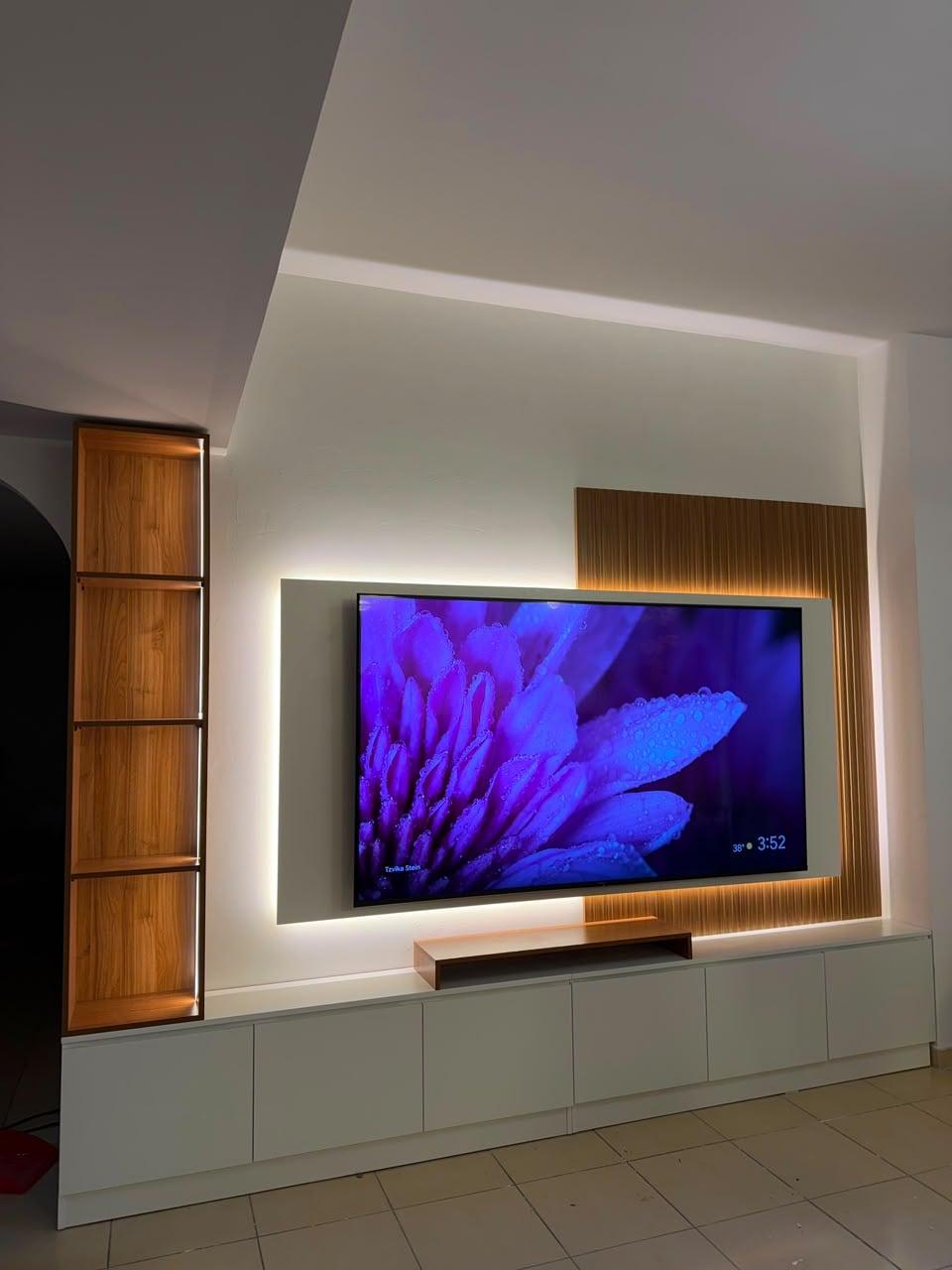
A dark wall without lighting looks flat at night. Integrated LED, in 3000K warm white for a warm room or 4000K for a more neutral one, with dimmers, gives the wall shape: a backlit panel, a lit niche or a cove strip. Our own team installs the lighting inside the wall as part of the agreed scope, and the lighting guide covers the options.
A light wall does not need as much, but lighting still helps, because it controls the contrast between the bright wall and the screen in the evening. A bright light wall behind a TV in a dim room can tire the eyes; a dimmable backlight softens it. A dark wall absorbs the glow, which is why dark walls often feel better for evening viewing.
Think of the lighting as part of the colour. A dark wall with a low-glow strip behind it reads as a different colour than the same wall without, which is why we judge samples under the lights that will be used, as our sample approval guide recommends.
Dust, fingerprints and upkeep: what each tone shows
Dark finishes show dust and fingerprints more than light ones, especially in gloss. Light finishes show dirt and stains differently: a pale wall shows scuffs from a bag or a child's shoe, a dark one shows pale dust. Neither is maintenance-free, so the best answer is a finish that suits how you clean.
EGGER's cleaning page for laminate worktops recommends a soft sponge or cloth that is only slightly wet, with a gentle agent such as diluted dish soap, then a dry cloth, and lists abrasive powders, steel wool and strong acids among the things to avoid. That is guidance for that manufacturer's laminate; the sample or specification for your wall will name its own care rules, and you should follow them. For a fluted or slatted wall the grooves collect dust, which our guide to cleaning fluted panels covers in detail.
A practical rule: if you have children, pets or a lot of dust from open windows, choose a matt mid-tone, which hides both pale and dark marks best. If you have a clean, closed apartment, the tone matters less and the choice can follow taste.
The mid-tone and the split wall
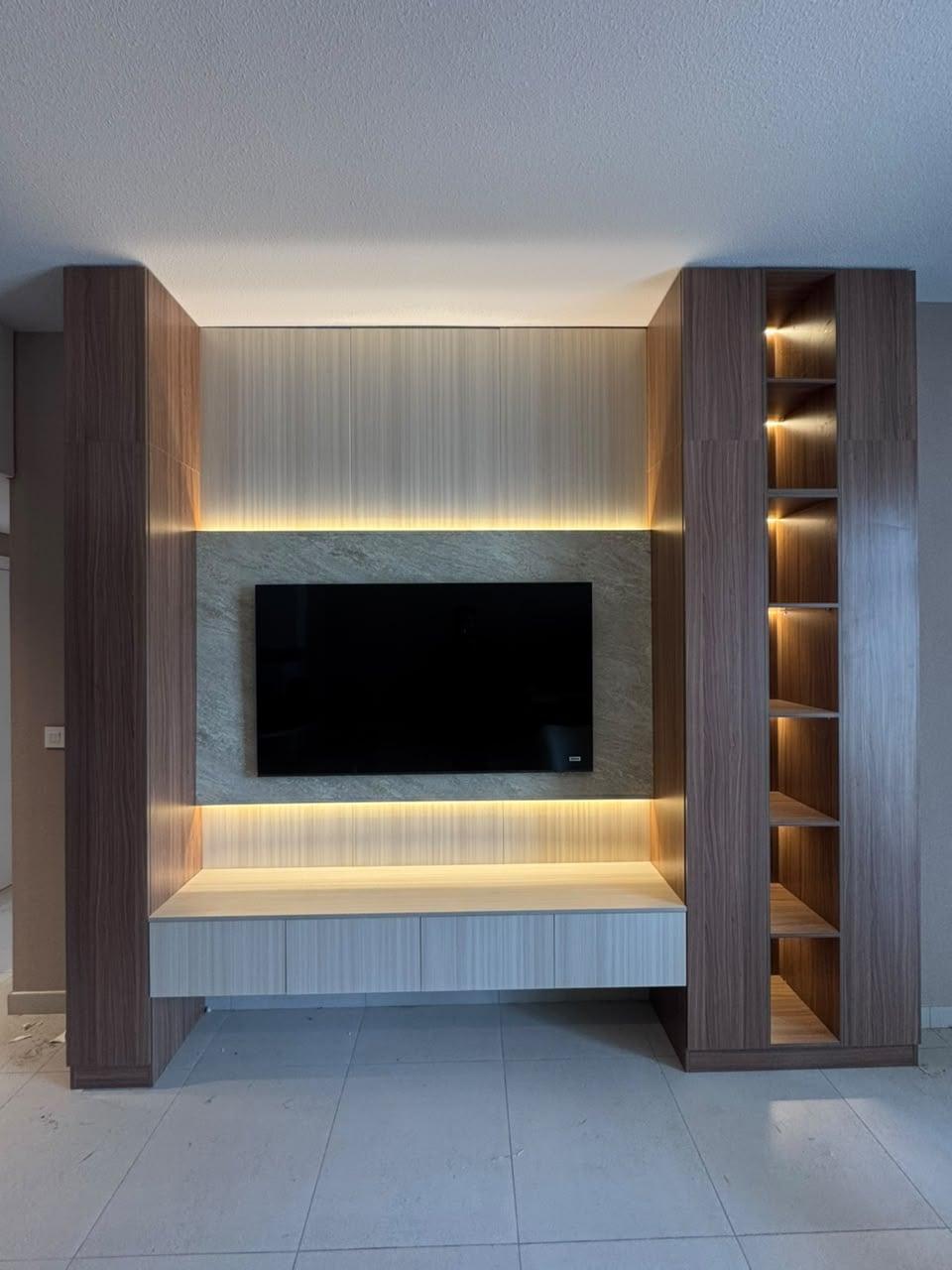
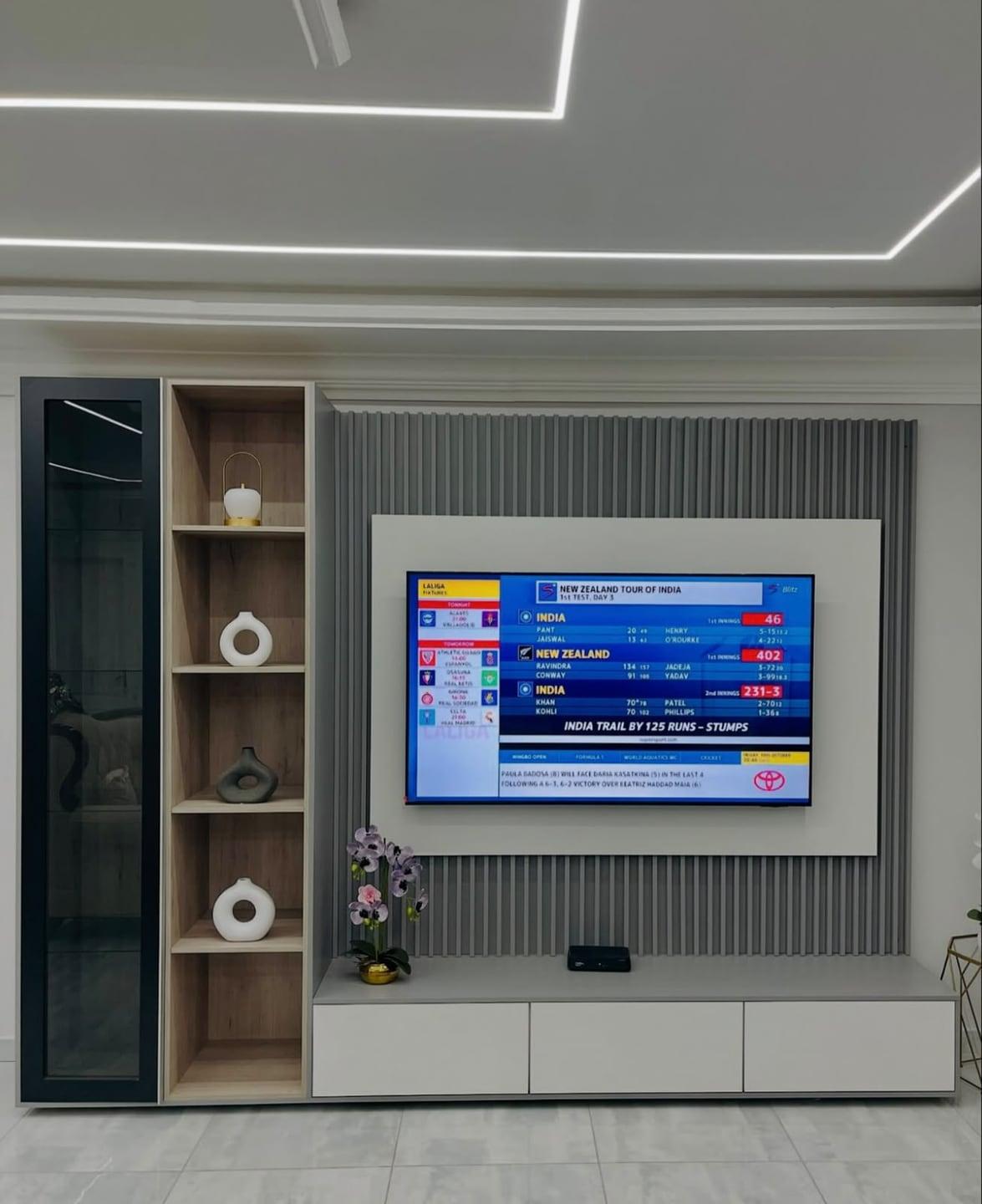
A mid-tone, such as a warm grey, taupe or a medium wood, is the most forgiving choice. It gives the screen a calm surround, it does not fight daylight, it does not need as much lighting as a dark wall, and it shows marks less than either extreme. If you cannot decide, choose a mid-tone and put the contrast into a lit niche or a feature panel.
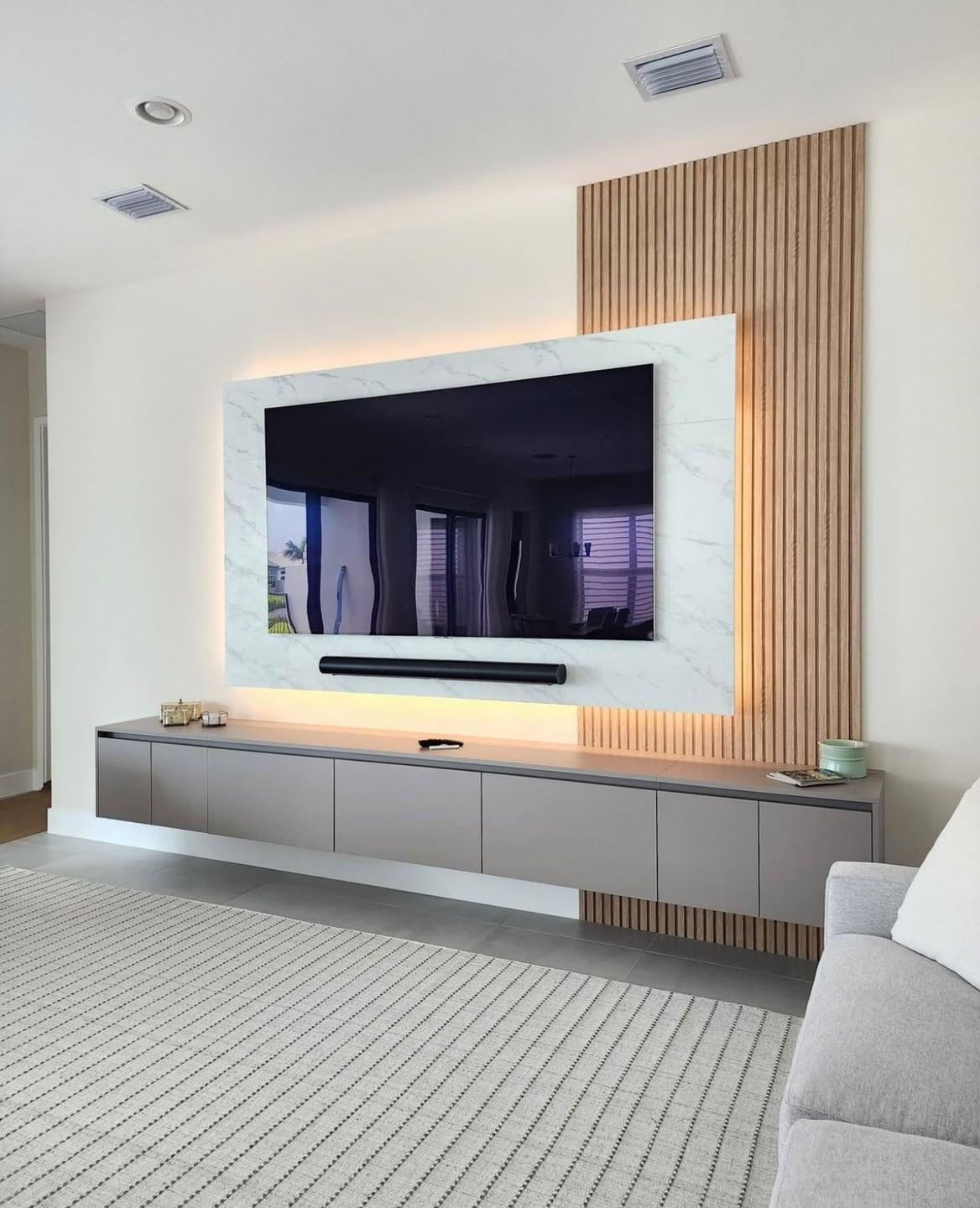
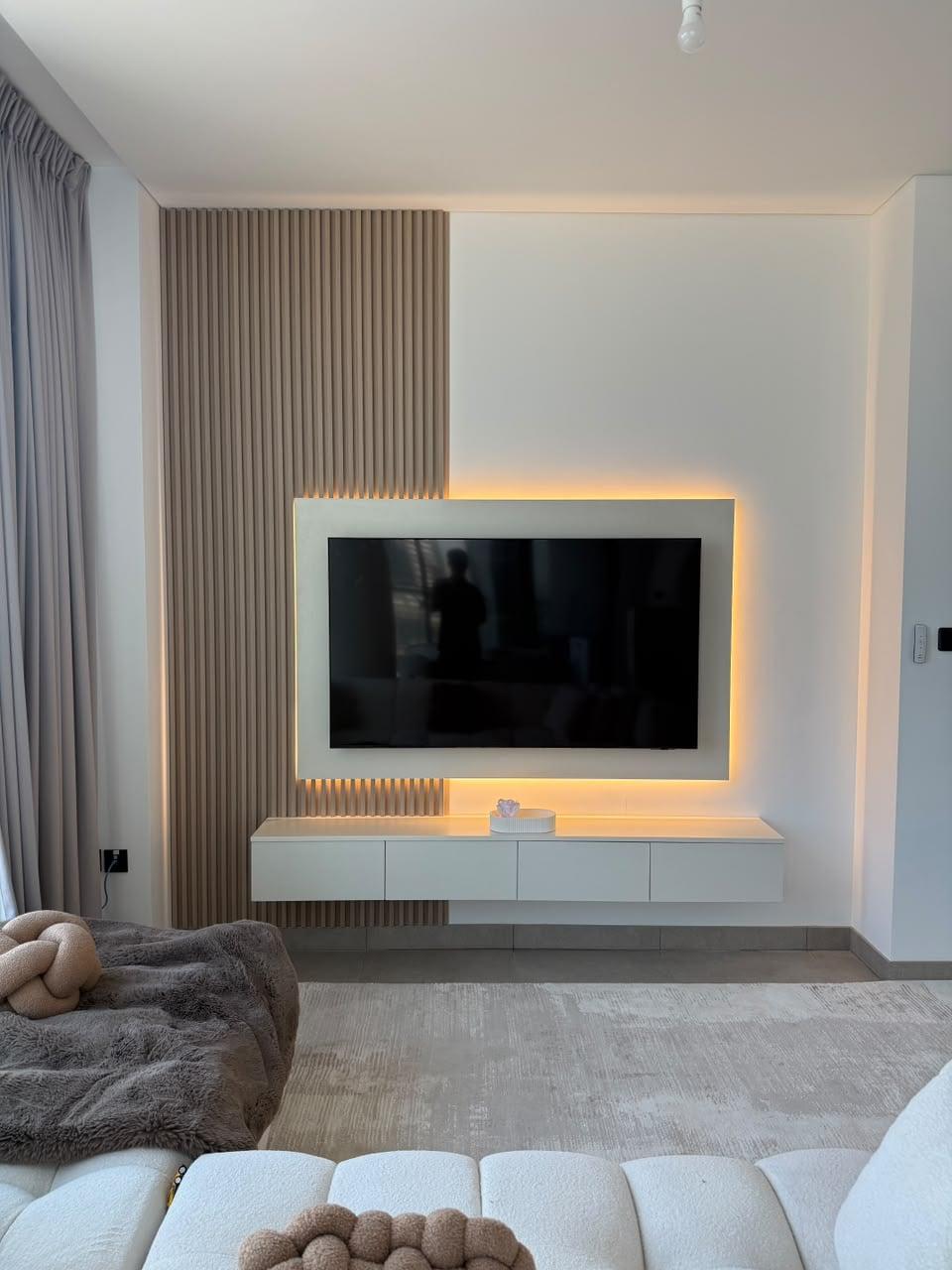
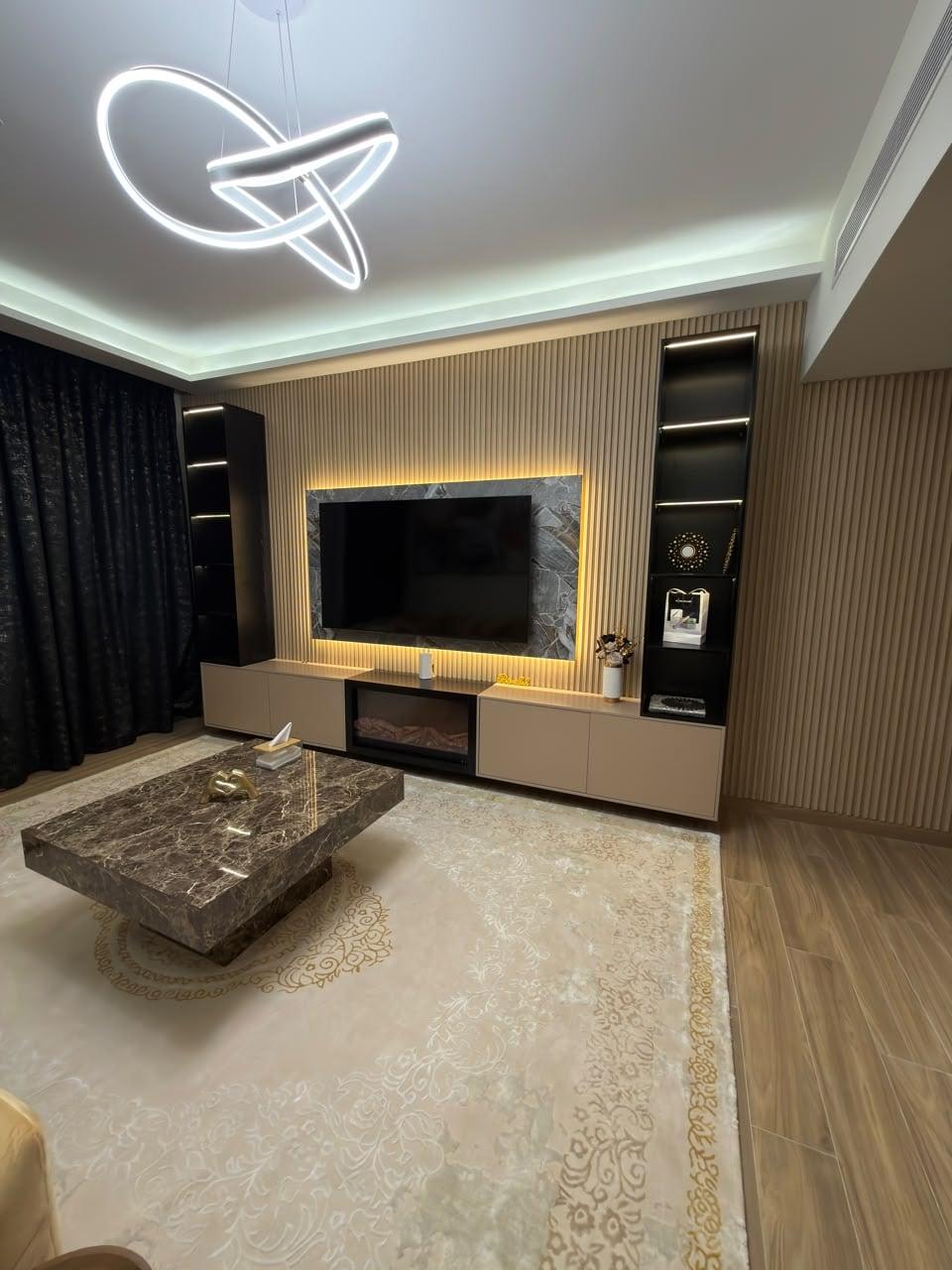
The split wall is our most common recommendation: a dark or textured panel behind the TV, in wood-effect, marble-effect or fluted board, with lighter flanking sections in laminate or lacquer. The dark section anchors the screen and hides it when off; the lighter sections keep the room open. The marble TV wall options guide and the fluted slatted TV wall guide show finishes that suit the dark panel.
Be careful where the two tones meet. A junction between dark and light is the first place the eye goes, and an uneven line shows. The colour and finish guide covers the junction details; we agree them on the drawing before cutting.
A scorecard from fitted walls
The scorecard summarises our view from walls we have built. It is qualitative: more dots mean more of the thing named. A dark wall makes the room feel smaller, hides the screen when off, shows dust and needs more lighting. A light wall does the opposite. The mid-tone sits in between on every row, which is why it is the safe choice.
Use the scorecard as a starting point and add your own priorities. If hiding the screen is the main aim, weight that row. If the room is small, weight the first. If you rent, weight the neutral choice. There is no right answer for every household; the point is to make the trade-offs visible before you choose.
- 1. Room feels larger: light scores highest
- 2. Screen blends in when off: dark scores highest
- 3. Shows dust and marks: dark shows most
- 4. Needs extra lighting: dark needs most
When marble, veining or a fireplace changes the answer
A pattern changes how dark or light a wall reads. A marble-effect panel with strong veining reads as a mid-tone from across the room even when its base is white or black, because the veins break the surface into small areas of light and dark. That is why a dark marble-effect panel can sit behind a TV without the heavy look of a plain black one, and why a white marble-effect panel does not reflect as flatly as plain white. Our marble TV wall guide explains the panels.
An electric fireplace brings its own light and its own colour. A flame effect in a dark wall looks warm and rich; in a very light wall it can look pale. If the wall has a fireplace, choose the tone with the fireplace on and off, and agree the surround finish on the drawing. The electric fireplace guide covers the unit and its clearances, and we only use electric fireplaces.
Slats and fluting add shadow, and shadow darkens. A pale oak fluted panel can read darker than flat pale oak, because each groove holds a line of shade. If you want a light wall with texture, test the fluted sample in your light, since the effect changes with the angle of the sun. See the fluted TV wall panels guide for the profiles.
How to decide in fifteen minutes
Start with the screen. Stand where you usually sit with the TV off and ask whether the black rectangle bothers you. If it does, lean dark or textured; if it does not, any tone works. Second, look at the window: if the wall faces or sits beside strong daylight, choose matt. Third, look at the room's size: if it is compact or low, keep the large surfaces light and put the dark into a panel.
Fourth, think about the evening. If you mostly watch after dark, a dark wall with its own lighting is a pleasure; if the room is used all day, a mid-tone suits every hour. Fifth, think about cleaning: children and pets favour matt mid-tones. Sixth, think about the lease: if the wall is not yours, choose neutral and add the dark in a removable piece.
Write the six answers on one line each and send them with your photos. Most households find the answer is a split wall with a matt dark panel; the rest is detail we work out with samples. A short list like this is also a good way to discuss the wall with a partner who has different taste.
Three worked rooms (illustrative cases, not named customers)
Room one, a compact apartment living room with one window and a light floor, where the owner wants a dark wall for drama. Our advice would be a dark wood-effect panel only as wide as the TV section, light lacquer flanks and a warm backlight. The room keeps its space and the screen disappears when off.
Room two, a villa family room with large west-facing windows and a high ceiling, where the owner wants white for brightness. We would suggest a mid-tone for the TV section, because a very bright wall beside strong windows makes the screen harder to read, and a matt finish to avoid mirror reflections. The aim is a wall that stays calm in the afternoon and warm in the evening.
Room three, a rented flat, where the tenant likes charcoal but cannot repaint at the end of the lease. We would suggest a light neutral wall with a dark panel behind the TV that can be removed, so the room can be returned unchanged and the panel moved. Always ask your landlord or building management in writing before fixing anything to the wall; see our renovation guide for changing an existing wall.
Matching the floor, sofa and curtains
The wall does not stand alone. A dark floor and a dark wall together can feel heavy; a light sofa against a dark wall looks crisp; a patterned curtain beside a dark panel can look busy. Put a sample of the wall next to the floor and the sofa fabric and look at them together in the room's own light.
If the room already has strong colour, let the TV wall be the quiet part. If the room is plain, the wall can carry the colour. Our design ideas guide shows finished walls in different rooms for reference, and the panel materials guide explains what each board can achieve.
Mistakes we see with dark and light TV walls
The first mistake is choosing from a photograph taken in different light. The same wall looks different at noon and at night. The second is a gloss dark panel opposite a window. The third is a full dark wall in a small, low room. The fourth is a dark wall with no lighting. The fifth is a white wall with a black TV and no frame or panel to anchor it.
The sixth is mixing too many tones: three or four tones on one wall make it busy. The seventh is ignoring the ceiling and floor. The eighth is choosing the colour before the TV: a different screen size changes the proportions of the wall. And the ninth is approving a small sample under shop lights instead of a full-size one at home.
What we do about it
We bring finish samples to your free measuring visit and show them against your wall in your own light, in the morning and, where possible, with the evening lights on. We build the wall in our Sharjah workshop from MDF, plywood or other suitable wood-based boards in laminate, veneer or lacquer, with soft-close hinges, concealed wiring and 3000K or 4000K LED channels with dimmers. The measuring visit guide shows what happens on the day.
A media wall starts from AED 3,500 per project for a compact panel with a floating console in standard laminate; the final figure comes from the quotation and depends on wall size, finish, lighting and any fireplace or marble-effect panels. We agree the measurements and details, a 60% advance is paid, and production starts once it is received. Work is ready in up to about 10 days, depending on size and design. Wood-based boards carry a 5-year limited warranty; hinges, runners and labour are not included. The founder, Ali Haider Basra, has worked in the trade for 10 years.
See our media walls service page, the wooden feature walls and marble-effect TV backdrops; for budget see the media wall price guide and the pricing tool; and for a local view the Sharjah media wall page.
Send us your wall on WhatsApp
Send us a WhatsApp message with a photo of the wall in daylight and another with the evening lights on, the TV size, where the windows are and what you are leaning towards. We reply with questions and a measuring visit, and we show samples before the drawing is agreed. Our guide on what to send for a media wall consultation lists the rest.
Common questions
Is a dark TV wall better than a light one?
Neither is better for every room. Dark hides the screen when off and suits large rooms and evening viewing; light makes small rooms feel larger. A dark panel with lighter flanks suits most. See the colour and finish guide.
Does a dark wall make a living room look smaller?
It can, especially in a small or low room, because a dark wall absorbs light and feels closer. Limit it to a feature panel or choose a mid-tone. See the small living room guide.
Should a TV wall be matt or gloss?
We usually recommend matt or low sheen beside a screen, because gloss returns a sharp reflection of windows, as RTINGS describes for screens. Keep gloss for small accents. The lighting guide covers the lights inside the wall.
Does a dark TV wall show dust?
Yes, more than a light one, especially in gloss. A matt mid-tone hides both pale and dark marks best. See cleaning fluted panels for grooved walls.
Can I get a dark TV wall in a rented flat?
Ask your landlord or building management in writing what may be fixed to the wall. A light wall with a removable dark panel is a common compromise. See renovating a media wall.
How do I test a colour before I order?
Look at a full-size sample on your own wall at morning, afternoon and with the evening lights on. We bring samples to the visit. See the sample approval guide.

Sources & specifications
Manufacturer information applies to the named products and systems. Sources reviewed on 13 November 2026.
- Resene: LRVs reprised, Architects Memo 125 (Nov 2016)resene.com(opens in a new tab)
- RTINGS: Direct Reflections On TVs (updated 26 Mar 2025)rtings.com(opens in a new tab)
- Philips: How to place your TV right in any room (TV buying guide)philips.co.uk(opens in a new tab)
- EGGER: How to clean and restore laminate worktopsegger.com(opens in a new tab)
Want this planned for your home?
Consultation and measurement are free. Tell us the rooms, location and what you need; we arrange a sample visit and define the measured quotation.