Media Walls · 21 min read · 3 November 2026
Is a media wall worth it in the UAE? A fair test before you spend
Is a media wall worth it? A fair test for UAE homes: what the money buys, the yearly cost, TV tip-over safety figures, when it is not worth it, a fit score and three worked households.

By Ali Haider Basra, Founder, Al Tareeq Decor · Contact our workshop
Key takeaways
- A media wall is worth it if you will stay for years, the TV is the room's centre, and you want hidden cables, built-in storage and a screen fixed to the structure.
- Spread the quotation over the years you will keep it: an example AED 3,500 wall is about AED 700 a year over five years and AED 350 over ten; the average TV lasts 7 to 10 years (Asurion).
- US CPSC figures: about 17,800 tip-over injuries a year (2020 to 2022) and 217 reported deaths (2013 to July 2023), 47% involving a TV; anchoring to the wall is the advice. US data, not UAE.
- It is not worth it if you will move within a year or two, rent without written permission, or have not chosen your television; a good anchored unit can serve until then.
- Use the six-question fit score: five or six yes answers means plan a wall; three or four, a compact panel; two or fewer, a unit.
On this page
- Key takeaways
- Is a media wall worth it? The short answer
- What worth means: three kinds of value and three kinds of cost
- What the money actually buys
- The yearly cost: divide the quotation by the years you will keep it
- Safety: what the published figures say about fixing the TV
- Cables, sockets and the tidy room
- Storage and display: what a wall holds that a unit cannot
- Light and mood in the evening
- When a media wall is not worth it
- A six-question fit score
- Owner or tenant: the question behind the question
- Three households, three verdicts
- How to get more value from the same money
- A Tuesday evening with the wall, and without it
- When you move: what happens to a wall
- Which parts of a wall are worth the money, and which are not
- What we do, and what to expect
- Send us your wall on WhatsApp
- Common questions
Is a media wall worth it? The short answer
A media wall is worth it when you will live with it for years, when the television is the centre of the room, and when you want the cables hidden, the storage built in and the screen fixed safely to the wall. It is not worth it when you will move within a year or two, when you rent and your landlord has not agreed in writing, or when you have not decided what television you will own. In between, a compact panel with a floating console gives most of the benefit for a smaller outlay.
That is a verdict, but a verdict is only useful if you can test it against your own life, so this guide gives you the tools: what the money actually buys, a yearly-cost calculation you can repeat with your own quotation, a safety discussion that uses published figures, a six-question fit score, a rent-or-own decision path, three worked households and a short list of ways to get more for the same money. We name the cases where the answer is no, because a guide that only says yes is a brochure. Anyone new to the idea can start with the guide to what a media wall is.
If you are comparing against buying a ready-made unit, our media wall or TV unit guide covers that choice in detail. The custom versus ready-made comparison looks at it from the maker's side. This page is about worth: what you get for what you give up.
What worth means: three kinds of value and three kinds of cost
People use the word worth loosely, so separate it. A media wall can give you three kinds of value. The first is daily use: storage within reach of the sofa, a place for every box and cable, light you can dim. The second is safety and tidiness: a television fixed to a structure instead of leaning on a stand, and no cables trailing across the floor. The third is look: a finished wall that makes the room feel designed.
Against these sit three kinds of cost. The first is money, the quotation. The second is time, the weeks from the first message to the finished wall. The third, which people forget, is flexibility: a fitted wall is harder to take with you than a piece of furniture, and it commits you to a layout. A wall is worth it when the value you will actually use outweighs all three costs.
Notice that the three kinds of value are not equally important to everyone. A family with small children may care most about safety. A couple who entertain may care most about look. A person who works from the sofa may care most about the hidden cables and a socket in the right place. Decide which of the three you value most before you read further, because that is the one to test your quotation against.
What the money actually buys
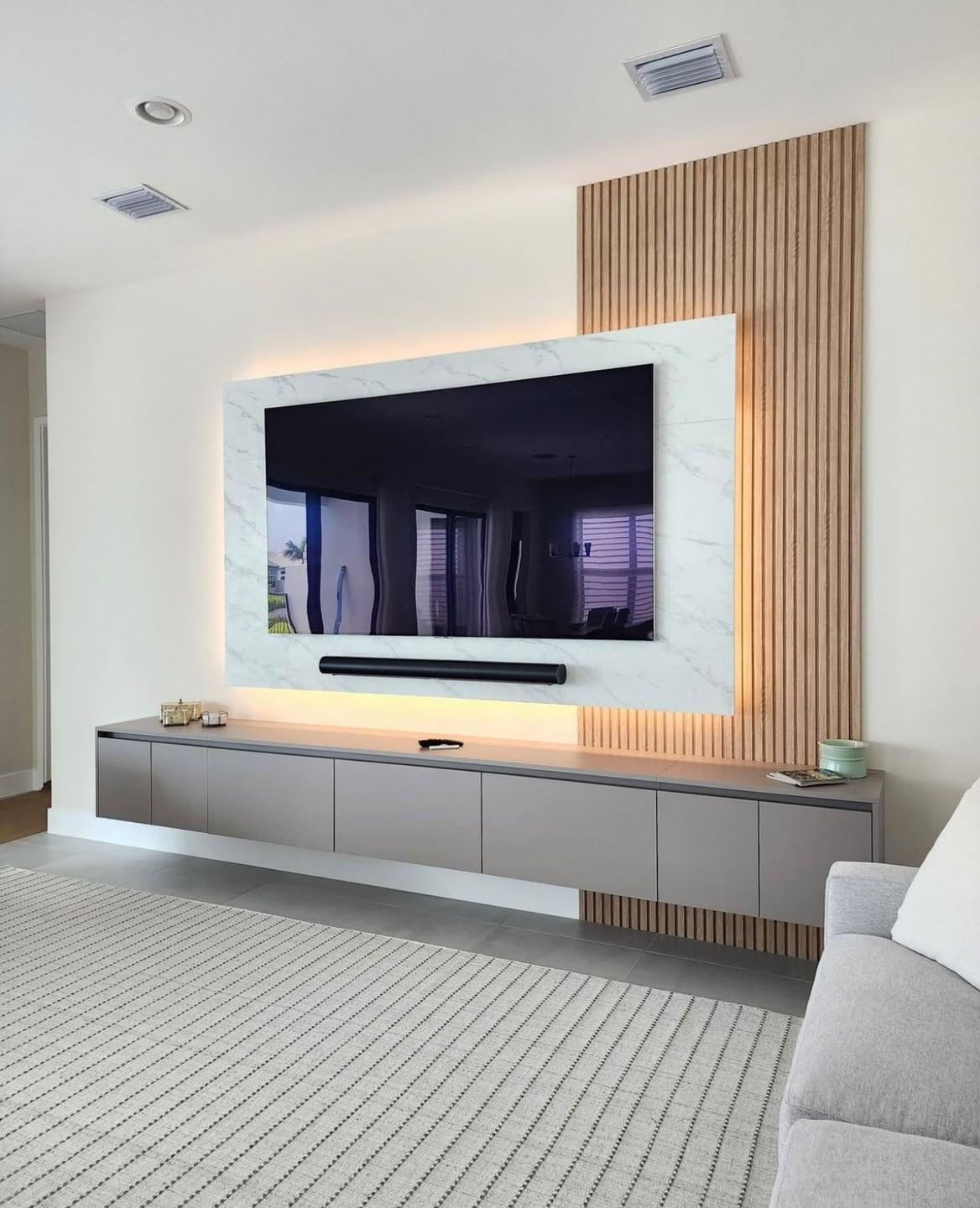
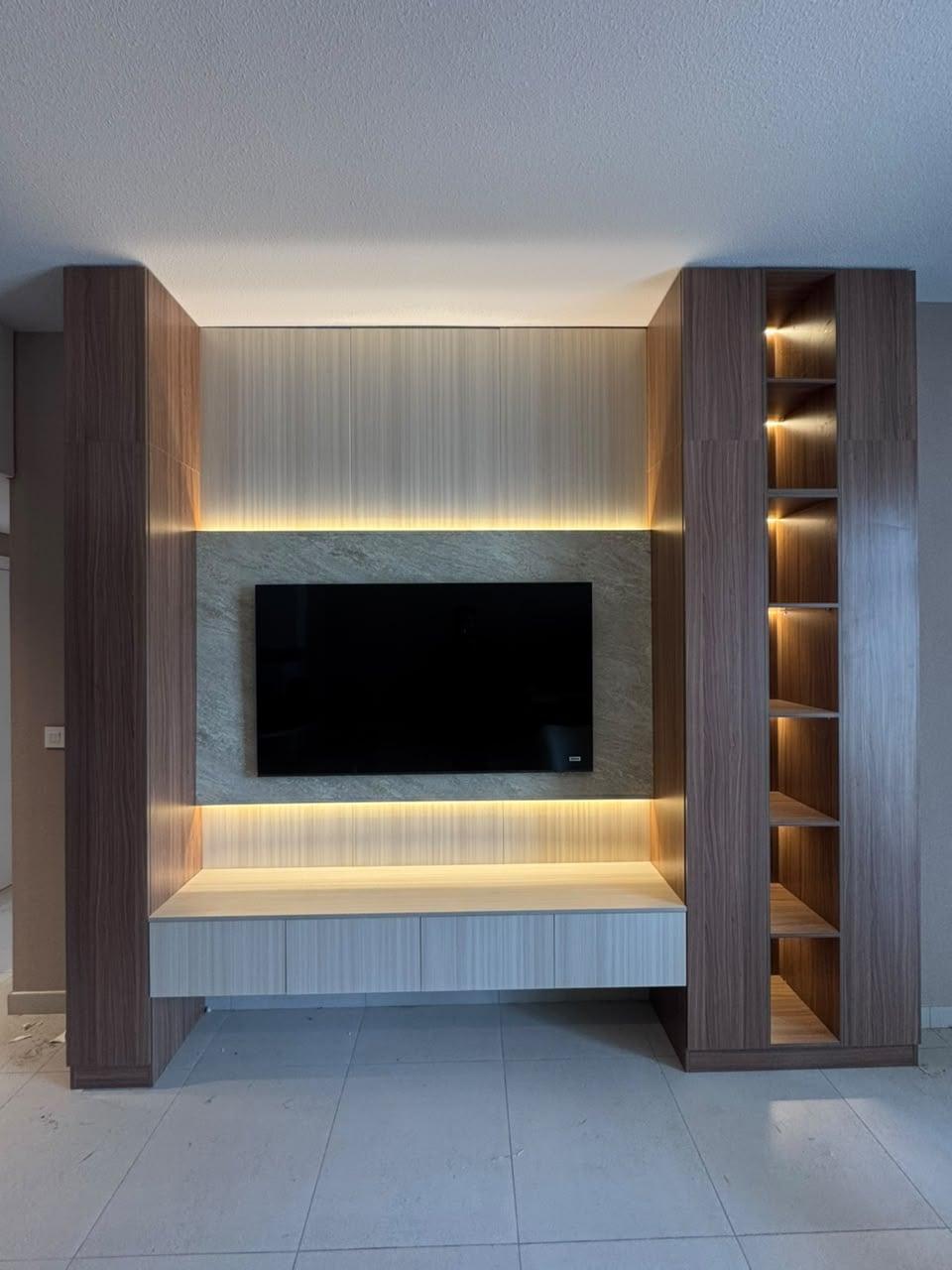
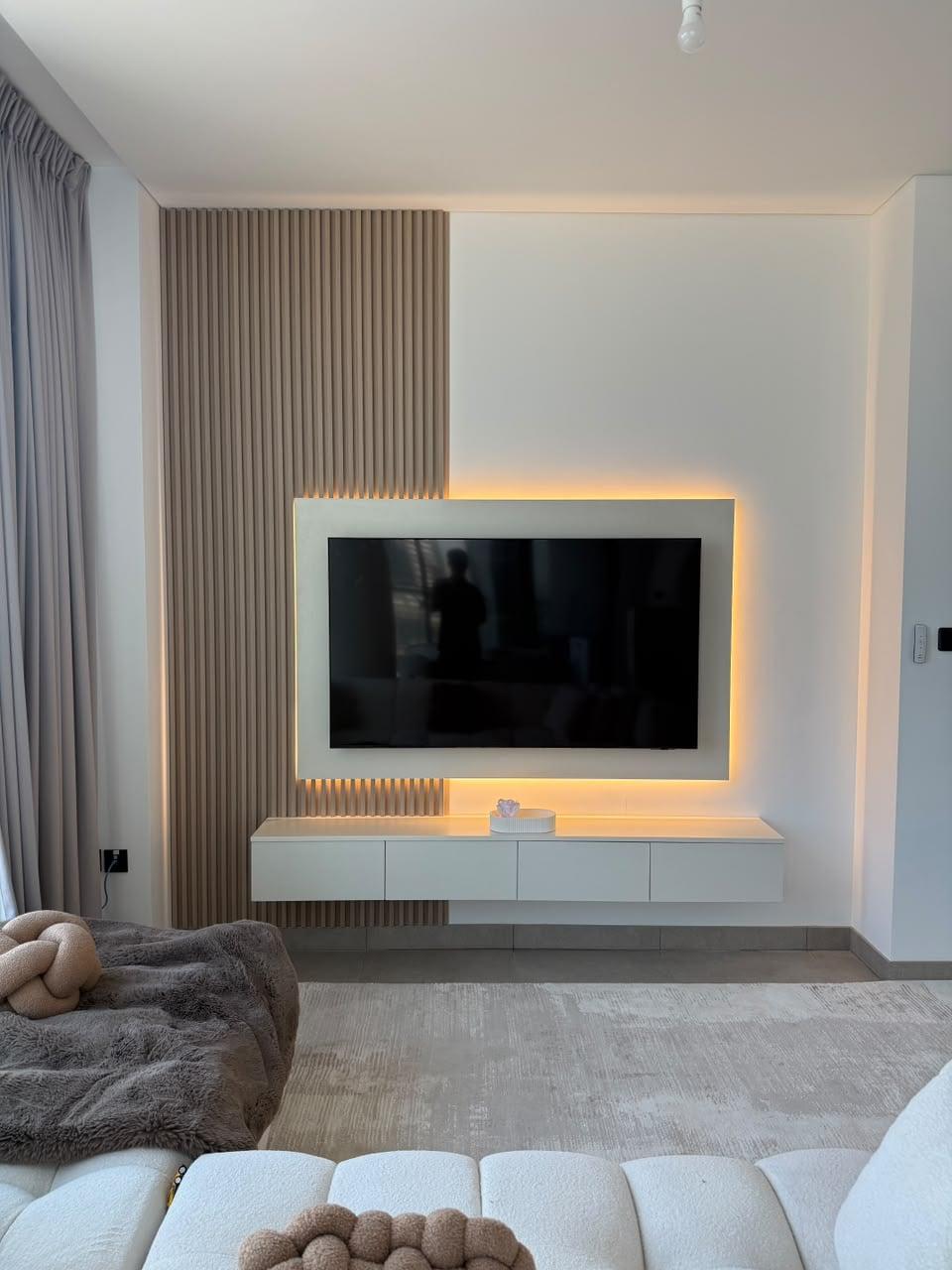
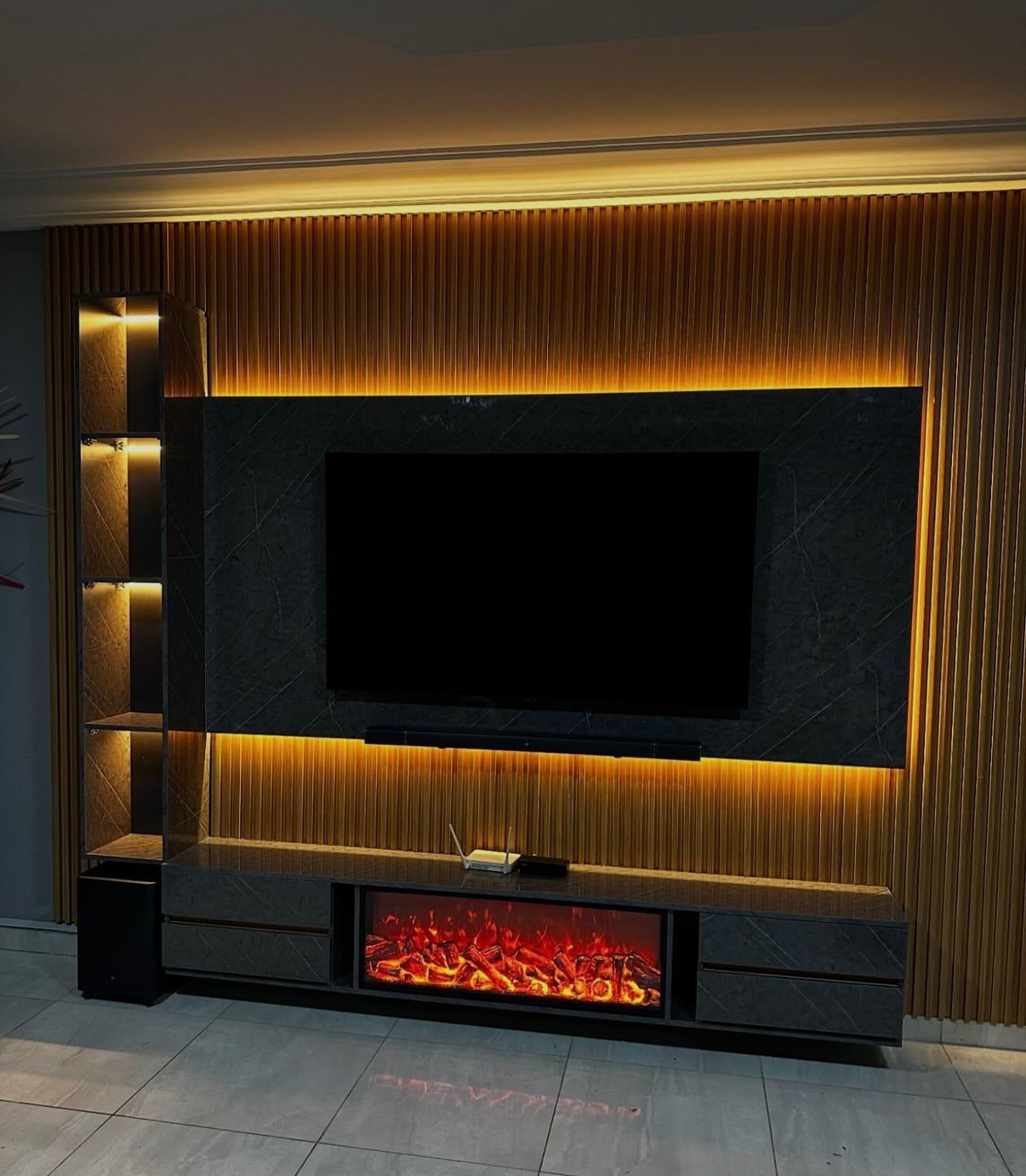
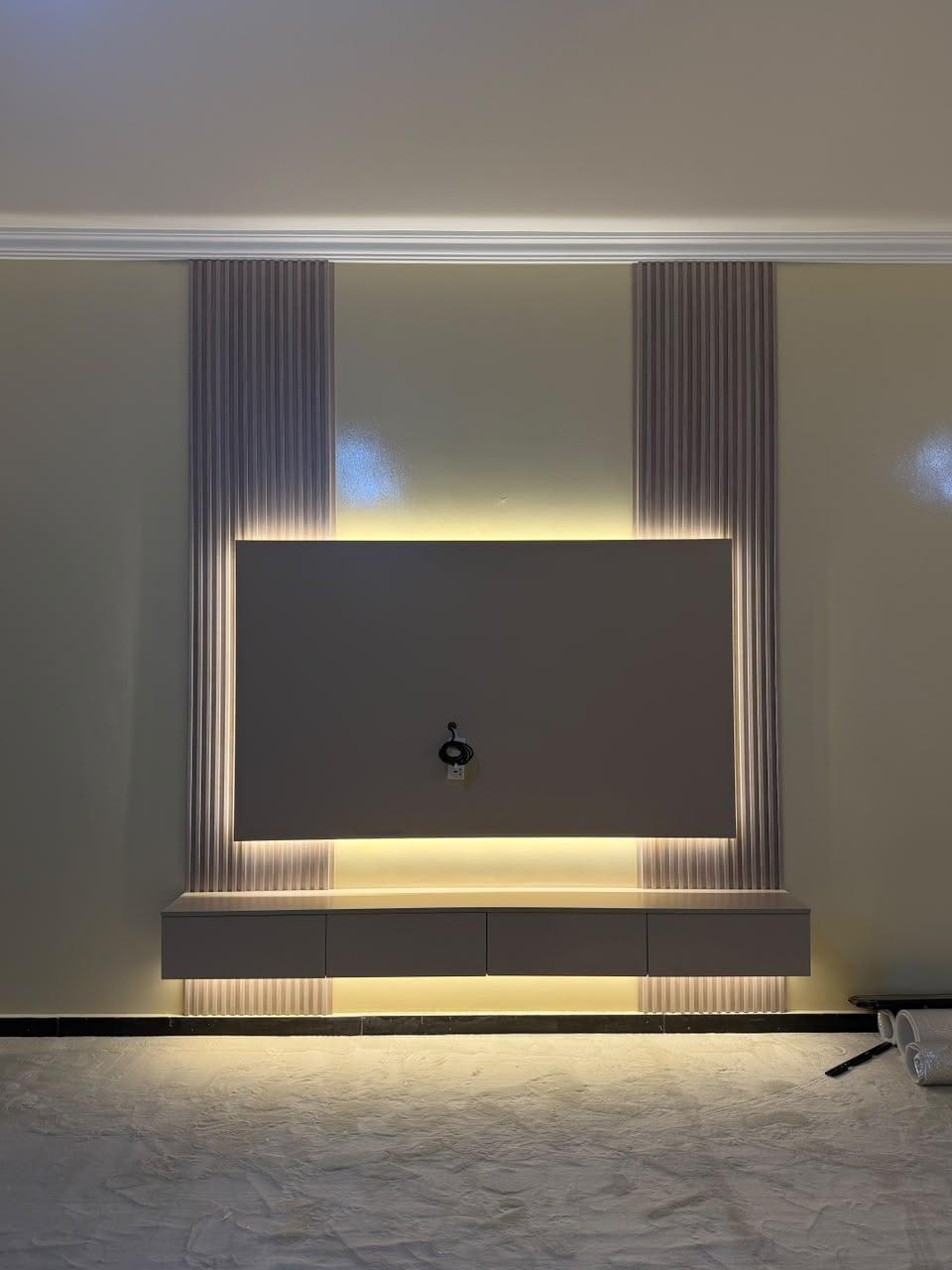
A quotation is easier to judge when you can see where the money goes and what it turns into. The boards and finish become the one finished wall, in place of loose furniture. The hinges and runners become doors and drawers that close quietly. The LED lighting and concealed wiring become cables you never see and a glow you can dim. The making and fitting by our workshop and team become a television fixed to the wall, not standing on a unit. And the extras you choose, such as an electric fireplace, glass cabinets or extra shelves, become storage and display built around your things.
The ledger below pairs each cost with its daily return. It is deliberately qualitative: we cannot put a figure on a quiet drawer, and we will not pretend to. But the pairing shows you what to ask of a quotation. If a line adds cost and you cannot name the daily return, either it does not belong on your wall or it has not been explained. The price factors guide shows which lines move the total most.
For orientation, a media wall starts from AED 3,500 per project, for a compact panel and floating console in standard laminate. The final figure depends on the wall size, the finish, any marble-effect panels, the lighting and an electric fireplace, and comes from your quotation after the free measuring visit. Nothing in this guide changes that: the examples use 3,500 only as a round number for arithmetic.
The yearly cost: divide the quotation by the years you will keep it
One honest way to judge cost is to spread it. Take your quotation, divide it by the number of years you expect to live with the wall, and compare the result with what you value. As a round example, a wall costing AED 3,500 kept for three years comes to about AED 1,167 a year; kept for five years, AED 700; for seven, AED 500; for ten, AED 350. These are arithmetic on an example total, not a price for your wall.
How long might a wall last? That depends mostly on you and your home, but there is a useful comparison. Asurion, a device-protection company, says the average television lasts seven to ten years, and rates LED and QLED panels at 40,000 to 60,000 hours of peak performance. A wall that stays for seven to ten years will therefore outlive at least one television, which is the point of designing it to take a bigger screen later; our guide to changing the TV later shows how, and the wall's value should be spread over both televisions.
The chart makes the point visually. The yearly cost falls steeply in the first few years and flattens after that, which is why a wall is a poor choice if you will move in a year and a sensible one if you will stay for a decade. It also shows why the cheapest option is not always the cheapest per year: a wall that you replace after three years costs more per year than one that lasts ten.
Safety: what the published figures say about fixing the TV
The safety case for a wall-fixed television is real, but we want to state it carefully. The US Consumer Product Safety Commission publishes an annual report on tip-over injuries. Its 2023 report, issued in February 2024, estimates an annual average of 17,800 emergency-department-treated injuries from televisions, furniture and appliances tipping over in 2020 to 2022, and counts 217 reported fatalities between January 2013 and July 2023, with a note that recent counts are incomplete because of reporting lag. These are United States figures and cover furniture and appliances as well as televisions; they are not UAE data.
A CPSC news release from February 2024 adds detail: children under 18 account for 44 percent of the injuries and 71 percent of the tip-over deaths, and 47 percent of the 2013 to 2023 deaths involved a television. Its advice is to anchor televisions and furniture securely to the wall; where that is not possible, use a sturdy low base, push the television back and keep cords out of reach of children. The agency's Anchor It campaign began in 2015.
What does this mean for a media wall? A television mounted on a bracket fixed to a proper backing is anchored to the structure by design, which removes the stand that can tip. That is a genuine benefit in a home with children. It is not a guarantee, because the fixing must suit the wall behind it. A plasterboard fittings data sheet from Bullfix, tested on a British plasterboard, says its fixings are not recommended with extendable TV arms and that a load centre more than 150 mm from the wall risks exceeding the fixing's capability; that is one maker's guidance for one product, but it shows why we fix brackets into a backing frame and check each maker's limits. How the wall behind your TV changes the fixing explains the difference between block and gypsum.
Cables, sockets and the tidy room
Hidden cables are the benefit people notice first and value longest. A flat with a wall-mounted television and a trail of wires can look unfinished however good the furniture is, while a media wall that routes the signal and power to the console makes the room feel calm. The test is whether the hiding still allows service: a wall that must be broken open to replace one lead has not solved the problem. The cable guide explains conduit, pull cords and service panels. The guide to sockets explains which can stay.
If your main complaint is cables and little else, ask yourself whether a media wall is the cheapest fix. A surface channel can hide cords on a plain wall at a fraction of the cost, as the cable guide explains. A media wall earns its cost when cables are one of several problems: storage, light and the look of the wall as well.
Storage and display: what a wall holds that a unit cannot
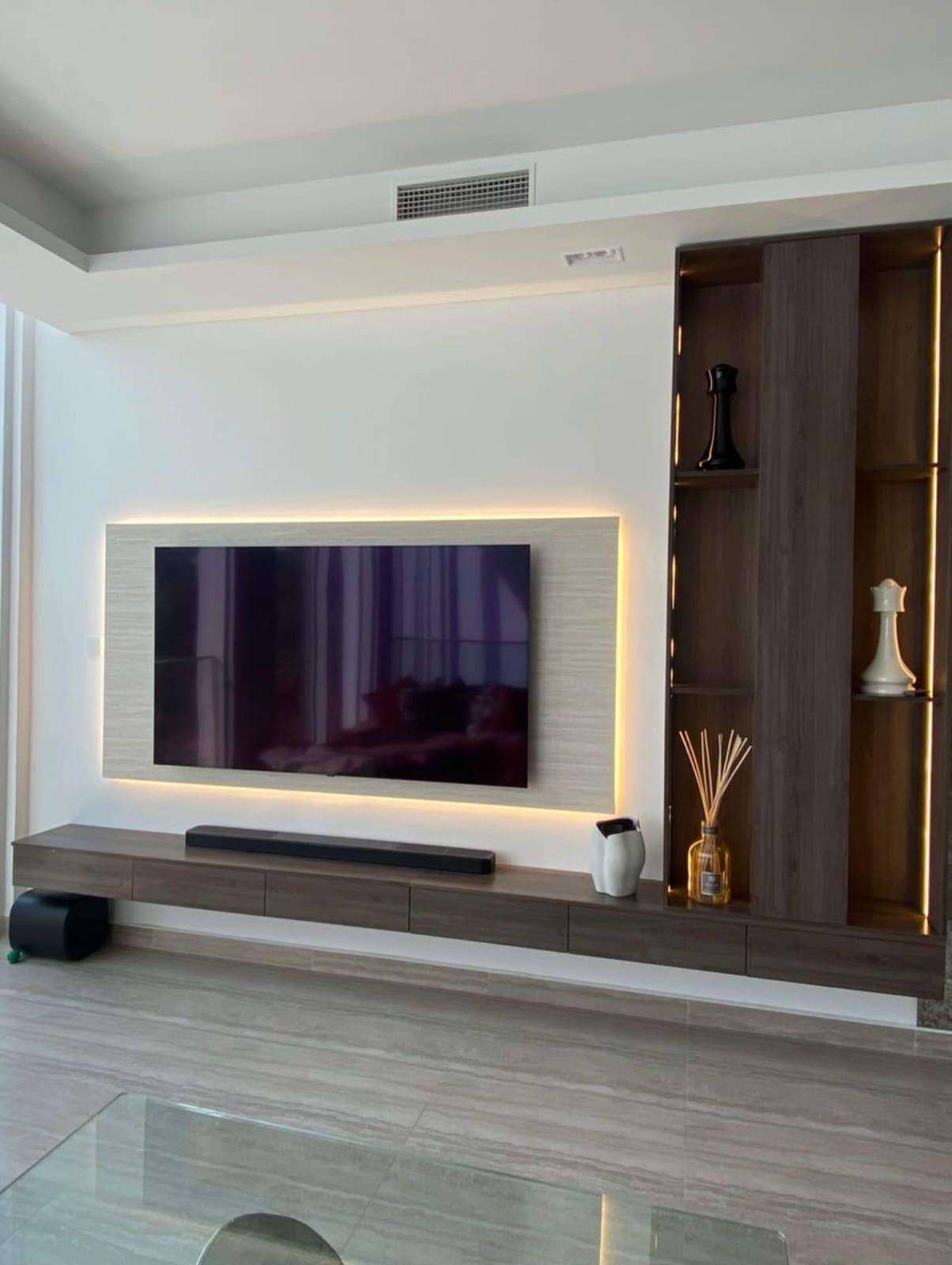
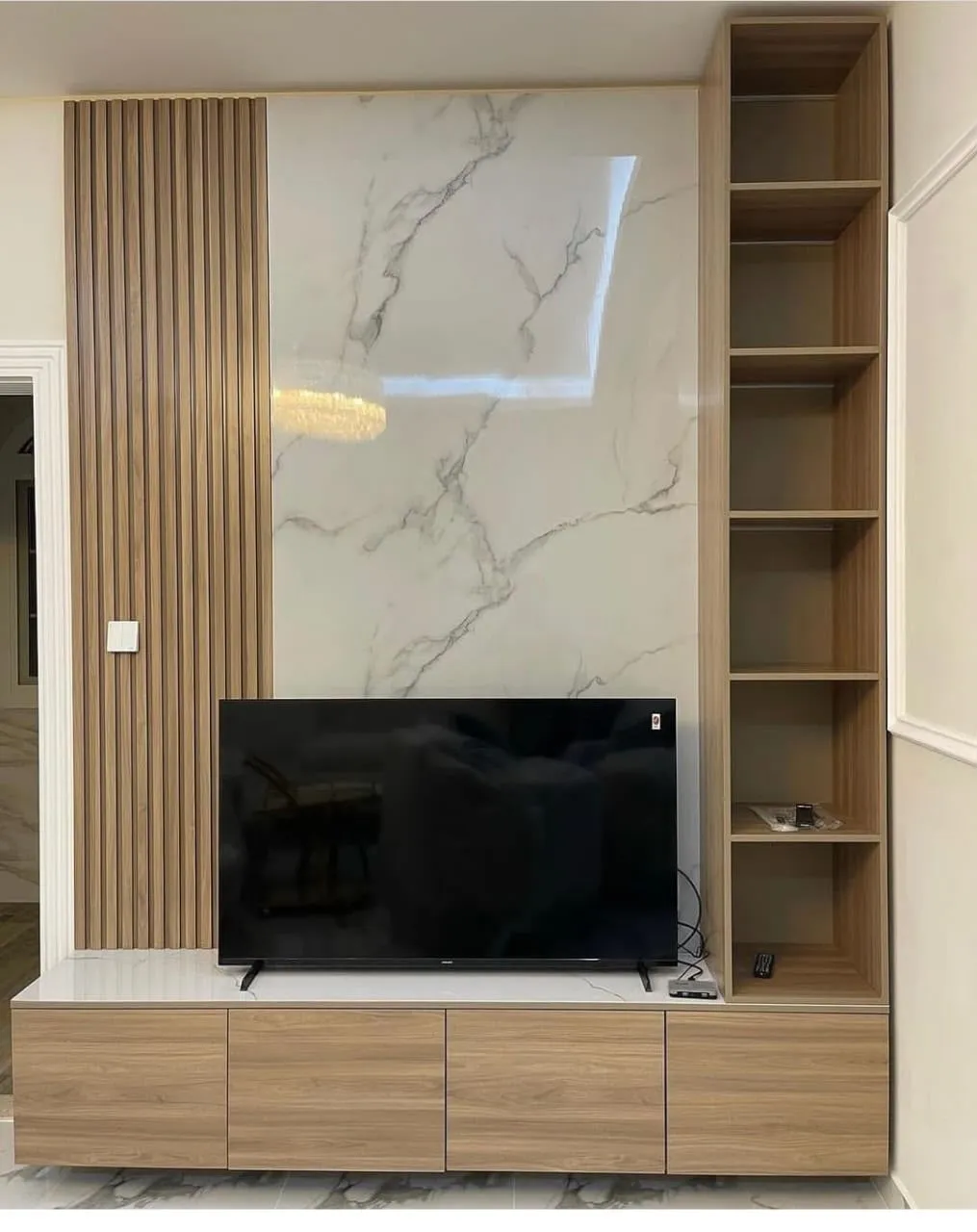
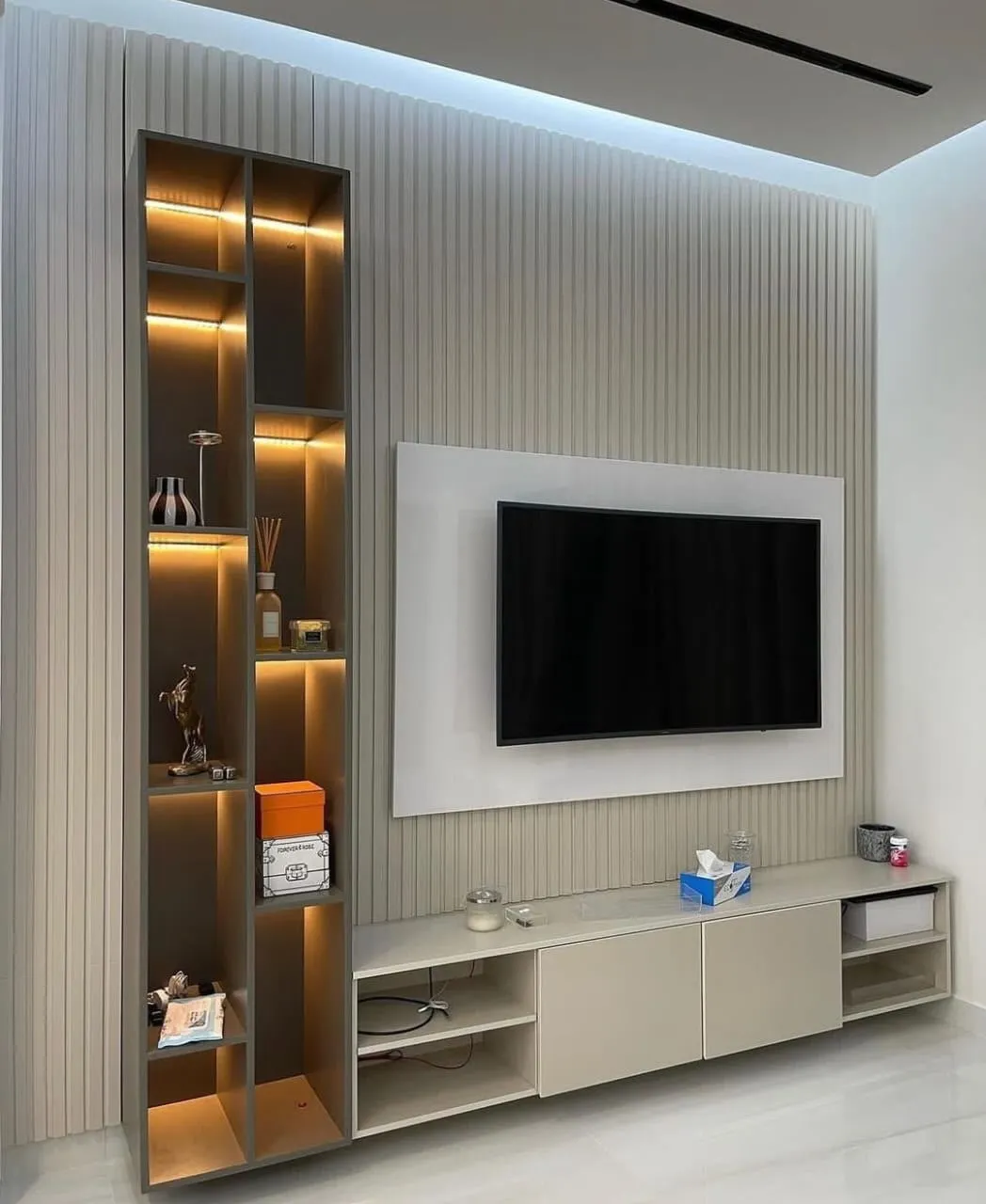
A unit holds what fits in the unit. A wall can include a floating console, tall shelving, lit niches, glass cabinets and closed storage in one composition, planned around what you own. If your home has a majlis, the majlis TV wall guide covers storage on that scale. If your living room has no other storage for games consoles, board games, books and decor, a wall can replace a sideboard and a bookcase with one coordinated piece; our guide to TV walls with shelves goes into depth, lighting and what shelves actually carry.
The question to ask is how much storage you really need. If you own little, a wall's storage is wasted; if you own a lot, a compact panel and a console may not be enough, and a fuller wall gives better value. Full wall or compact media wall compares the two, and it is often the decision that most changes the value of the project.
Light and mood in the evening
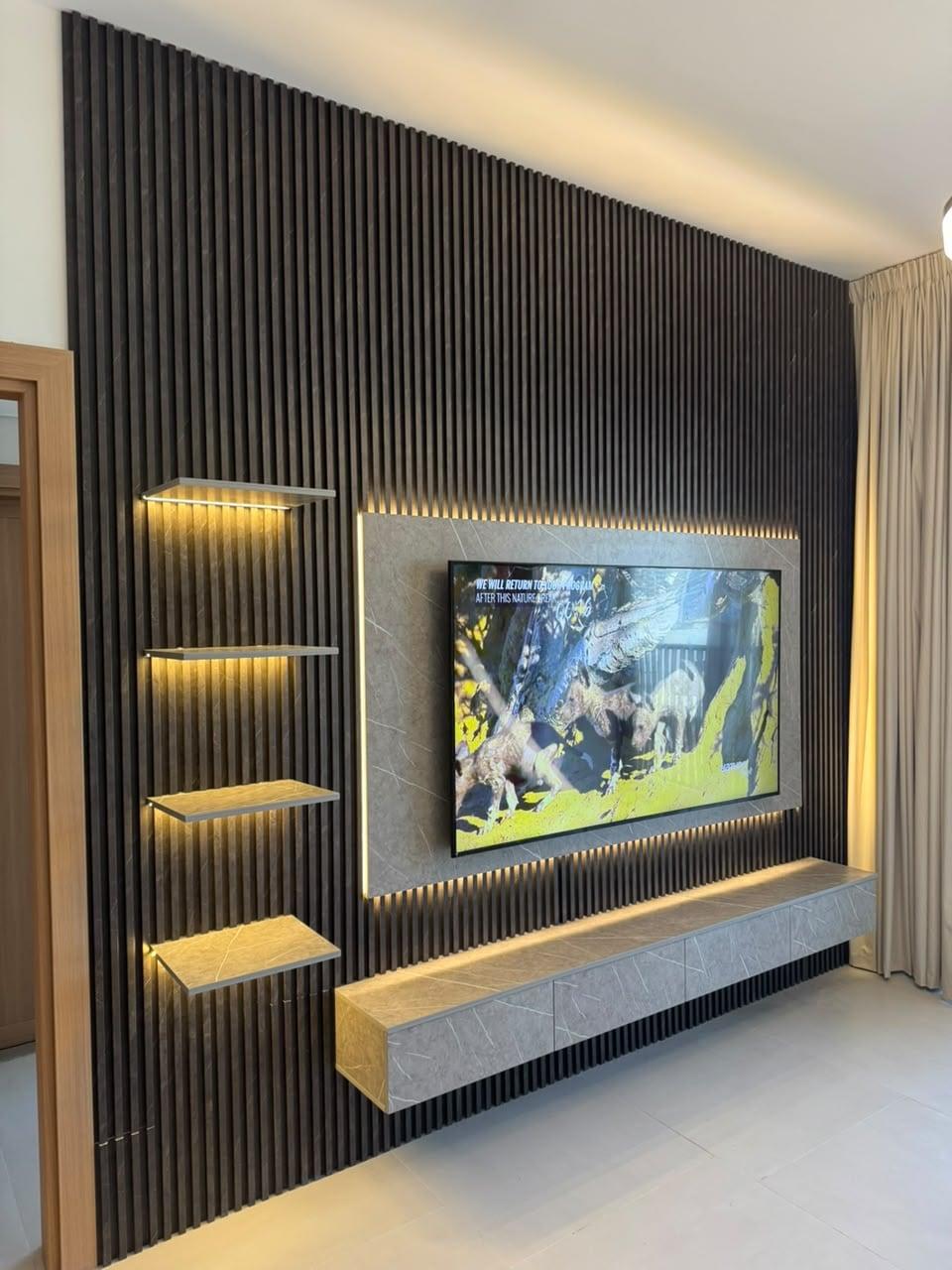
A media wall can also carry light: LED channels behind a panel, under a shelf or inside a niche, on dimmers. Our media walls offer 3000K warm or 4000K neutral channels with dimmers. In the evening, a lit wall turns a television wall into a source of soft light and changes the mood of the room; during the day, it simply looks tidy. That is a value some people prize highly and others do not care about at all. The lighting guide explains the layers and colours, and it is worth reading before you decide whether to pay for lighting.
When a media wall is not worth it
We would rather say this plainly. A media wall is not worth it if you expect to move within a year or two, because a fitted wall is not easy to take with you. It is not worth it if you rent and have not asked your landlord or building management in writing, because the permission is yours to get. It is not worth it if you have not decided on a television, because the drawing depends on its size. And it is not worth it if your only wish is to hide a few cables, for which a channel is cheaper.
It may also not be worth it right now if the budget is very tight. In that case a good unit with the television wall-mounted or properly anchored does much of the job, and you can build a wall later when the budget allows; the budget guide and the TV-unit comparison show how to stage it. A budget media wall that lasts explains where to save and where not to.
For tenants there is a middle route: some designs can be freestanding or modular, and therefore removable or relocatable, though not every fitted wall can be taken out and it depends on how it is built. Ask us at the visit, and write the answer on the quotation.
A six-question fit score
The simplest way to test your own case is a score. Answer six questions with yes or no: do you expect to stay five years or more; do boxes and cables show today; do you need storage near the television; do children or pets share the room; do you like dimmable evening light; is the wall yours to change, or will your landlord agree in writing. Count the yeses.
With five or six, a wall is likely worth planning. With three or four, a compact panel and floating console may fit best. With two or fewer, a good television unit, anchored, may be enough. This is a rule of thumb, not a calculation, and the questions are ours; but each yes is a reason to build, and the score keeps you honest about how many reasons you actually have.
Owner or tenant: the question behind the question
Whether you own the wall changes the whole answer. An owner can plan a fixed wall, full height or a compact panel with a floating console, and enjoy the benefits for as long as they stay. A tenant has to ask first. Our advice is to ask your landlord or building management in writing, and to keep the reply. If the answer is yes, ask us about a removable or relocatable design; if it is no or there is no reply, a good television unit, anchored to the wall in line with the CPSC advice, is the sensible choice.
We do not state building rules or authority requirements here, because they differ by building and by community, and we are not the right source. The only reliable route is the written reply of the people who control the building. That reply also protects you at the end of the tenancy, which is why we suggest keeping it with your papers.
Three households, three verdicts
Three imagined households, not our customers. The Al-Kaabi family owns a four-bedroom villa and plans to stay for a decade. They have two young children, a large television, a games console, and a living room with no storage. They answer yes to almost every question. Verdict: worth it, with a full wall or a generous compact wall, lit shelves for the children's things kept low, and the television on a bracket fixed to a backing frame. The yearly cost over ten years is a small fraction of what they will get from the room.
Priya rents a one-bedroom apartment in Sharjah and expects to move in two years. She has not asked her landlord. Verdict: not yet. She should ask in writing; if the answer is yes, a removable design is an option; if not, a good anchored unit gives her most of the value without a fitted wall. A fitted wall for two years would cost more per year than almost any other choice.
Omar and Layla own a two-bedroom flat in Ajman, have a modest budget and want a tidy living room but not a showpiece. They have cables showing, little storage and a medium television. Verdict: worth it, as a compact panel with a floating console in standard laminate, which is the entry specification. They can add lighting later if the wiring allows, which we would plan in at the start; see the guide to a small living room wall for how proportions work.
How to get more value from the same money
If the verdict is yes but the quotation is higher than you want, there are sensible ways to reduce it without ruining the result. Choose a compact panel and a floating console instead of a full wall. Keep the finish simple on the largest areas and spend on one feature. Plan the wiring for lighting and add the lights later. Fix the television size before drawing so that nothing is redrawn. And keep the design flexible enough to take a bigger screen later.
The mistakes that waste money are mirror images: a full-height wall with no storage need, lighting nobody wanted, a finish that will date, a layout that cannot take a larger television. The budget guide explains where to save and where not to. The quotation checklist shows how to see exactly what you are paying for.
A Tuesday evening with the wall, and without it
Numbers only go so far, so here is a plain picture of an ordinary evening. Without a wall, a family comes home, the television stands on a long unit, and four remote controls lie on the sofa. A games console trails a cable down the back, the router blinks beside the plant, and the children's board games sit in a bag by the door because the unit has no room for them. The television is fine; the wall around it is a series of small compromises, and nobody notices them until a guest does.
With a wall, the same family comes home to a screen on a bracket, a console where the devices sit with their doors closed, and a lit niche with a few chosen objects. The remote controls live in a drawer. The games are on a shelf at child height. One dimmer turns the room from bright to evening in a second. None of this is dramatic, and none of it changes what is on television. It changes how the room feels, and how much effort it takes to keep it that way.
That is the real question behind worth. If a small daily friction does not bother you, you are unlikely to feel the benefit enough to justify the cost. If it does, because you are tidy, because you host, because the children's things are everywhere or because you simply like the room to look finished, the wall repays itself every evening. Decide which household you are before you decide whether to build.
When you move: what happens to a wall
People worry, reasonably, about leaving a wall behind. The honest answer depends on how the wall is built. A fitted wall, fixed to a backing frame on the structure, is part of the room: if you own the home it adds to it, and if you rent it should only exist with your landlord's written agreement. Some designs can be freestanding or modular, and these can be taken apart and relocated, though not every fitted wall is removable, and it depends on its construction.
If a move is likely within a few years, say so at the first message. We can draw a design that is easier to take down, and we can tell you plainly if a fitted wall would be a poor investment for your plans. If you rent, the same applies to the end of the tenancy: ask your landlord or building management in writing what they expect, and keep the reply with your papers. We do not state rules for buildings here, because they differ, and the people who control the building are the right source.
A last point on moving: a wall is a set of parts, and the finishes, the hardware and the television are separate things. The television and its equipment always move with you. Whether the wall does is a design question to settle before the order, not after.
Which parts of a wall are worth the money, and which are not
Within one wall, some items repay their cost more than others. In our experience the best value is usually in the parts you touch daily: a console with soft-close doors and drawers, a socket and a cable route that work, and a bracket fixed properly. These are not glamorous, but they are what you use. Good lighting is next for many people, though it depends on taste, and the lighting guide helps you decide how much to spend on it.
The parts that repay least are those chosen for a photograph: a feature material covering more area than the room needs, a niche for objects you do not own, a fireplace in a household that will not use it. None of these is wrong, but each should earn its place. If you are drawn to a stone look, the stone-look and wood comparison explains what it asks of the room. If you are weighing boards, MDF or plywood explains where each earns its keep.
A last tip is to look at what our finished consoles include before deciding what you need: the TV wall units and floating consoles page shows the range. Our pricing guide tool then helps you see how the choices add up before the free visit.
What we do, and what to expect
We start with a free measuring visit and bring finish samples. From it we draw the wall, with the television, console, shelves and lighting positioned, and send an itemised quotation. A media wall starts from AED 3,500 per project, and the final figure depends on the wall size, the finish, any marble-effect panels, lighting and an electric fireplace. Once the details are agreed, a 60% advance is paid and production starts when we receive it; the remaining stage is agreed with you. Production takes up to about 10 days, depending on size and design.
Our wood-based boards carry a 5-year limited warranty, subject to its terms; it covers the boards only, and hinges, runners, labour and misuse are excluded. A separate 24-month written workmanship warranty covers fabrication and fitting by our team. For the range we build, see our media walls service page. How the whole order runs is walked through in the ordering and advance guide.
Send us your wall on WhatsApp
The quickest way to find out whether a wall is worth it for you is to send us the facts. Message us on WhatsApp with a photo of the wall, the television size and a line about the room, and tell us whether you own or rent, how long you expect to stay and what annoys you most today. We will tell you honestly whether we would build a wall, a compact panel or neither, and book the free measuring visit if you want to go ahead.
What to send us for a consultation lists the photos and numbers that help. The planning guide helps you think about size and layout.
Common questions
Is a media wall worth the money?
Yes if you will stay for years and value hidden cables, storage and a fixed screen; no if you will move soon or rent without written permission. Media wall or TV unit.
How much does a media wall cost per year of use?
Divide the quotation by the years you keep it: an example AED 3,500 wall is about AED 700 a year over five years. Your quotation sets the real figure. What a media wall costs.
Is a wall-mounted TV safer than one on a stand?
CPSC (US) advises anchoring TVs and furniture to the wall; a bracket fixed to a proper backing does this by design. Block or gypsum wall behind the TV.
Is a media wall worth it in a rented flat?
Only with your landlord's or building management's written agreement; ask us about removable or relocatable designs. Planning a media wall.
Can I build a cheaper media wall that still lasts?
Yes: a compact panel with a floating console, simple finishes and wiring planned for lights later. A budget media wall that lasts.
Will a media wall fit a bigger TV later?
It can, if the drawing leaves margins and the bracket stays reachable. Changing the TV later.
How do I find out if a wall is right for my home?
Send a photo of the wall, the TV size and the room on WhatsApp and we will say honestly what we would build. Media walls in Sharjah.

Sources & specifications
Manufacturer information applies to the named products and systems. Sources reviewed on 12 November 2026.
- CPSC: Product Instability or Tip-Over Injuries and Fatalities Associated with Televisions, Furniture, and Appliances, 2023 Report (US data)cpsc.gov(opens in a new tab)
- CPSC news release, 8 February 2024: TV and furniture tip-overs (children's share, anchoring advice)cpsc.gov(opens in a new tab)
- Asurion: How to protect and extend the life of your TV (average 7 to 10 years)asurion.com(opens in a new tab)
- Bullfix: Plasterboard Fittings data sheet, Rev B (TV bracket and load-centre limits)media.wickes.co.uk(opens in a new tab)
Want this planned for your home?
Consultation and measurement are free. Tell us the rooms, location and what you need; we arrange a sample visit and define the measured quotation.