Media Walls · 19 min read · 6 October 2026
What changes the price of a media wall in the UAE: eight levers explained
Why two media walls of the same size cost different amounts: eight levers from area and finish to lighting, appliances, site and late changes, ranked and explained without invented prices.

By Ali Haider Basra, Founder, Al Tareeq Decor · Contact our workshop
Key takeaways
- Two media walls of the same width can need very different amounts of work; a price per metre hides that.
- Eight levers explain the difference: area, finish, number of boxes and doors, lighting and electrics, bought-in parts, design detail, the wall and site, and late changes.
- A panel just wider than one board sheet costs more than its size suggests: a second sheet, an offcut and a joint.
- A price is firm only on an approved drawing. A change after approval costs boards and days that a change on paper does not.
- Entry price: from AED 3,500 per project. Your figure comes from the quotation after the free measuring visit.
On this page
- Key takeaways
- Why two media walls of the same width never cost the same
- A price is made of hours, board and bought-in parts
- Lever 1: how much wall you cover
- Lever 2: the finish on the face
- Lever 3: how many boxes, doors and drawers
- Lever 4: lighting and the electrical lines
- Lever 5: parts that are bought in
- Lever 6: detail in the design
- Lever 7: the wall behind and the site around it
- Lever 8: changes after approval
- Two walls, eight levers, no prices
- The eight levers and what you can do about each
- Reading a quotation for the levers
- Saving without weakening the wall
- What we do about it, and what to send us on WhatsApp
- Common questions
Why two media walls of the same width never cost the same
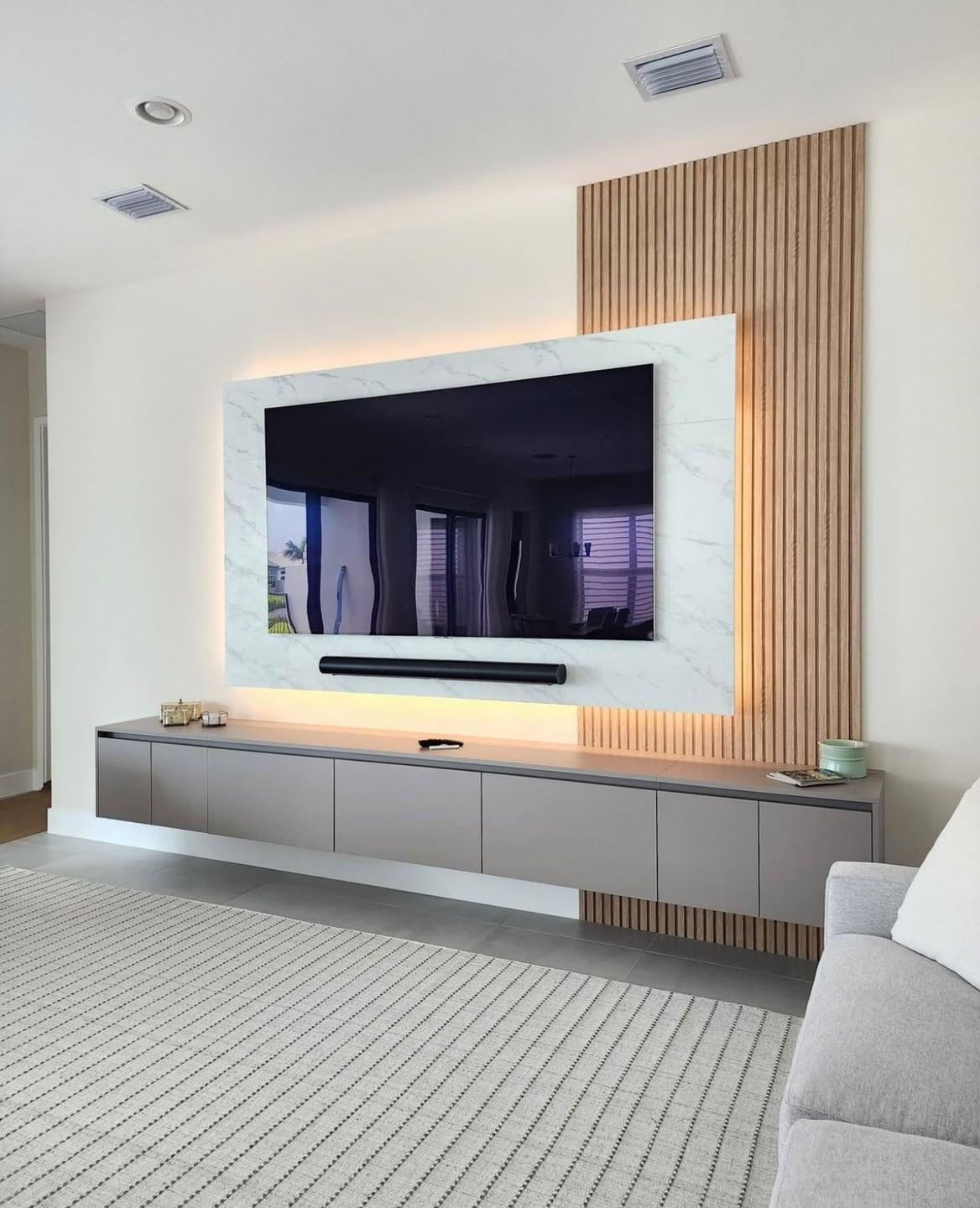
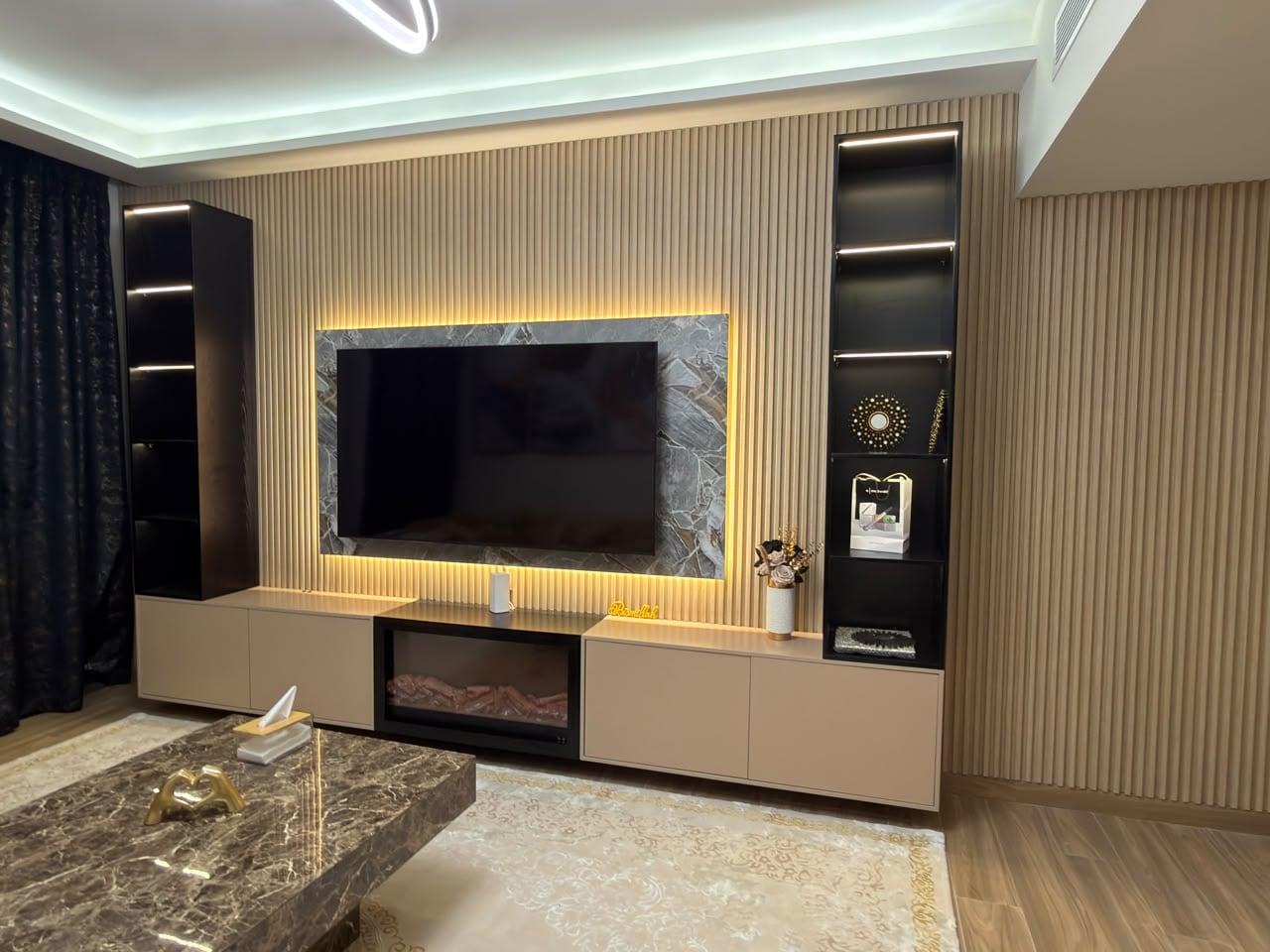
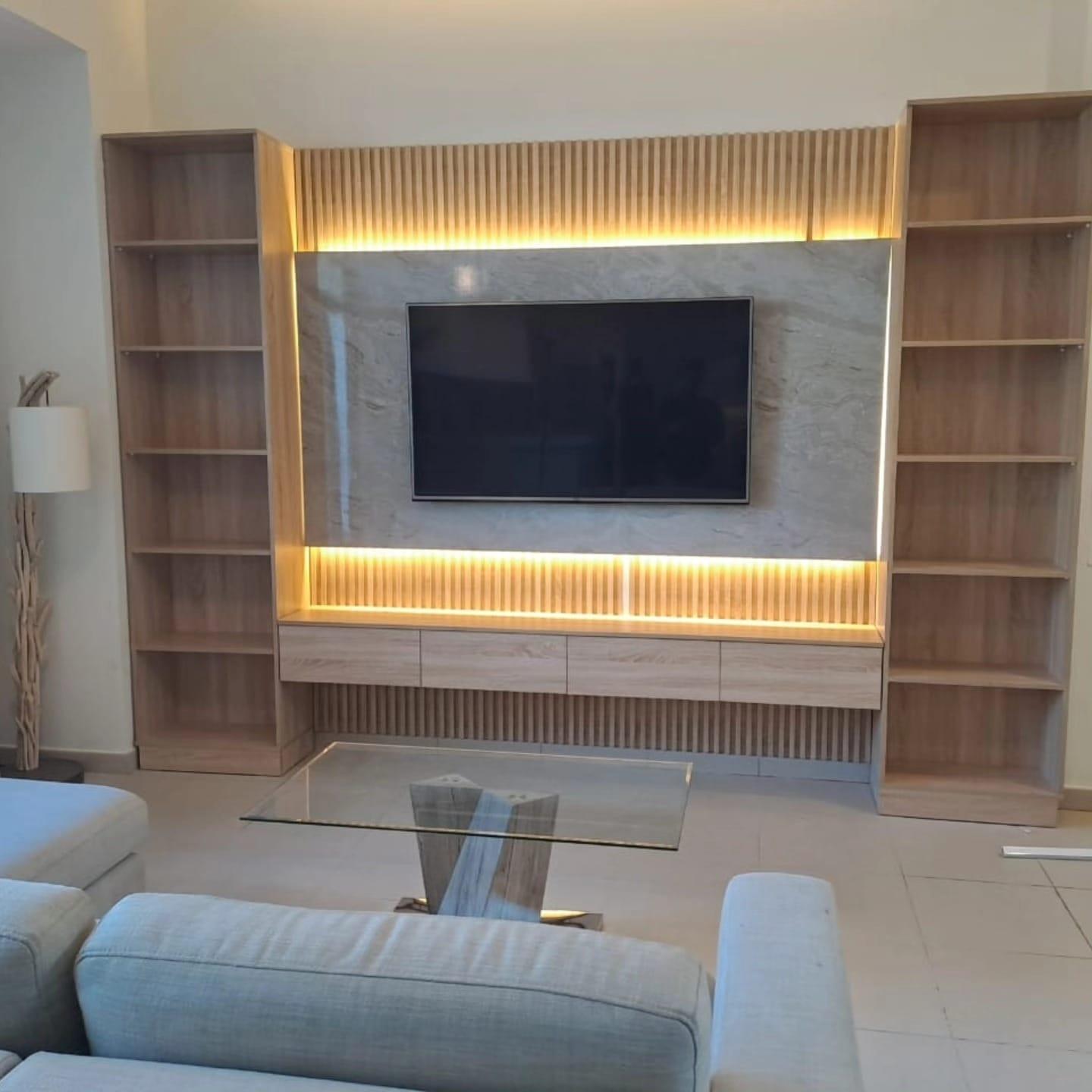
Take two living rooms with a 4.2 metre TV wall each. In the first, a flat laminate panel sits behind the screen and a plain console hangs below it. In the second, slats run either side of the screen, a lit edge frames the panel, the console has four drawers and an electric fireplace is set into the middle. Both walls measure the same, and anyone who prices by the metre would quote them alike. Anyone who has watched them being made knows they are not alike at all: one is a morning of cutting and a short fitting visit, the other is days of workshop time, a bought-in appliance and an electrician's attention.
That gap is the whole subject of this guide. It is not about how much a media wall costs, which our media wall price guide answers from the AED 3,500 entry brief upward. It is about why the figure moves, so that you can see which of your own choices are pulling it and decide, one by one, whether each is worth what it adds. We have built walls in homes across the UAE for ten years, and the same eight levers explain almost every difference between two quotations for the same size of wall.
Everything here is written so that you can use it before you speak to anyone. Rank the levers against your own wall, drop the ones that do not earn their place, and the conversation that follows, on WhatsApp or at our free measuring visit, starts from a clear brief instead of a vague wish.
A price is made of hours, board and bought-in parts
Strip a quotation down and it contains only three kinds of thing. The first is workshop and fitting time: someone cuts the boards, edges them, assembles carcasses, fixes the panels and finishes the joints. The second is material that the workshop buys by the sheet or by the length: boards, laminate or veneer faces, edging, hinges, runners, LED profiles and strip. The third is parts that other people make and that arrive finished: an electric fireplace, glass display cabinets, a driver for the lights, a TV bracket.
Each lever below works on one or more of those three. Covering more wall adds board and cutting time. A richer finish changes the material. More doors add hardware and assembly time. A fireplace adds a bought-in part and the careful opening it needs. Seen this way, a price stops being a mystery number and becomes a list of things you can point at on the drawing, which is also how a good quotation is written. The quotation checklist shows the eight lines such a list should have.
Two housekeeping points before the levers. First, the figures here are ranked, not priced: where we say a lever pulls strongly, we mean in our workshop's experience it usually moves a quotation more than a weak one does, not that it adds a fixed amount. Second, the only price we publish is the entry one, from AED 3,500 per project for a compact panel with a floating console in standard laminate. The final figure for any wall comes from the quotation after we have measured it.
- 1. Area covered, finish and number of boxes pull hardest
- 2. Lighting, appliances and design detail sit in the middle
- 3. The wall, the site and late changes pull least but surprise most
Lever 1: how much wall you cover
Faced area is the strongest lever because it is the one that scales everything else. Every extra metre of panelling is more board, more laminate or veneer on its face, more edging, more fixings and more minutes at the saw. Run slats from wall to wall and you have not just widened the wall, you have multiplied the number of separate pieces that someone must cut, finish and fix one by one.
There is a second effect that few people expect, and it comes from the boards themselves. Panels are cut from sheets whose size is set by the board maker, not by your wall. A panel that sits comfortably inside one sheet width wastes only a strip. A panel that is a little wider than one sheet needs a second sheet cut for a thin strip, leaves most of that second sheet as offcut, and creates a joint that must be aligned and hidden. The drawing below shows both cases side by side. Nothing about the wall looks different from the sofa, but the second one used more board, took more cutting and carries one more joint.
This is why a few centimetres of width, decided early, can matter more than half a metre decided late. It is also why we ask which board sizes the workshop cuts from before fixing the width of a panel run. If your wall allows it, setting the screen panel to a size that sits inside the sheet is one of the quietest savings available, and it costs nothing in appearance. For the wider question of whether to cover the whole wall or only the centre, see full wall or compact media wall.
- 1. A panel just inside one sheet width wastes only a thin strip
- 2. A panel just over it needs a second sheet and leaves most of it as offcut
- 3. The extra sheet also adds a joint line that has to be aligned and hidden
Lever 2: the finish on the face
The same board core can wear very different faces, and the face is the second strongest lever. A laminate is a thin decorative sheet bonded to the board. EGGER, a board maker, describes decorative laminate as a sheet of around 0.8 mm that is bonded to a substrate, and notes that faced boards are commonly made at 18 mm thick. Because the sheet is so thin, the board underneath, and the labour of bonding and edging it, still matter to the final cost. Standard laminate is our entry finish and the one in the AED 3,500 brief.
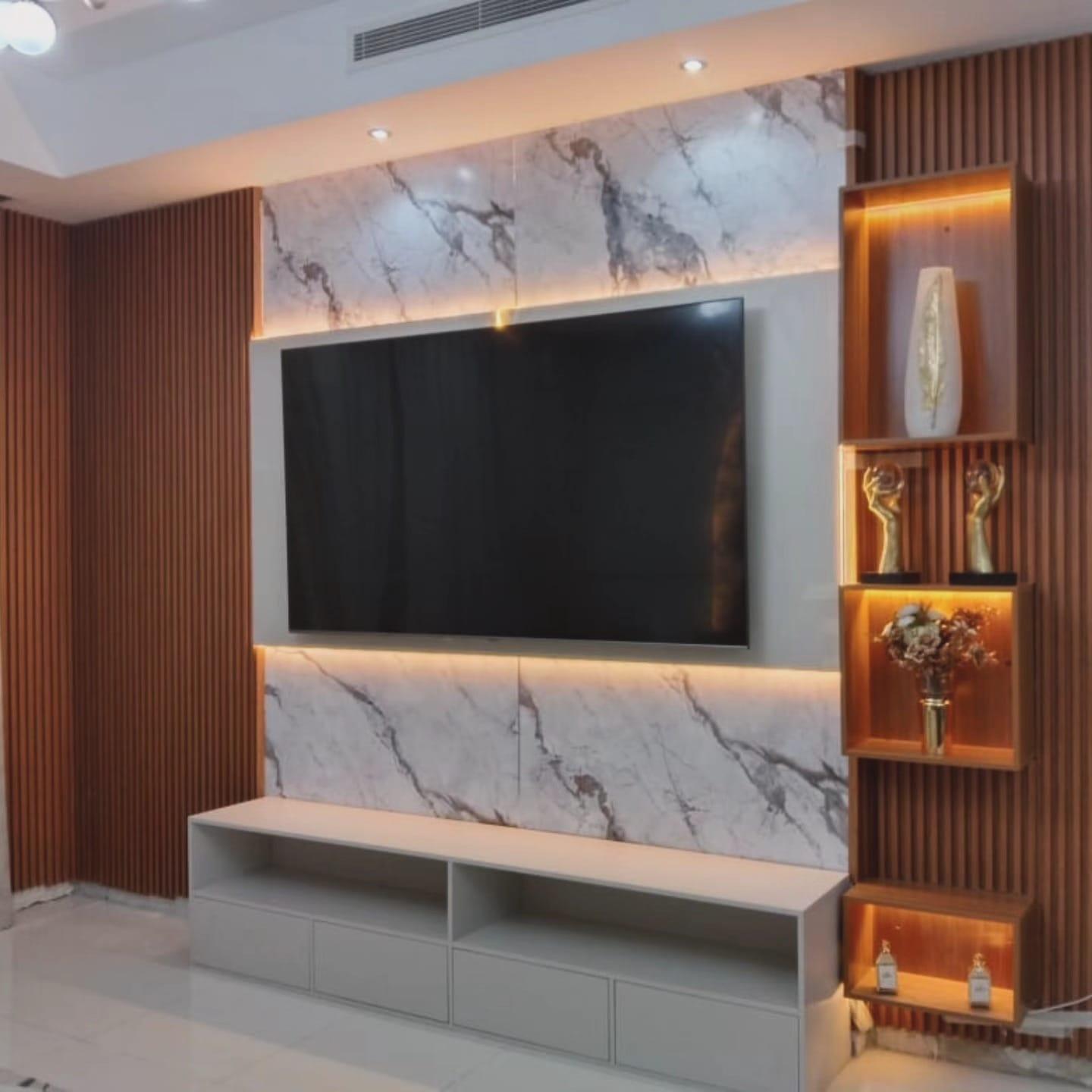
Real wood veneer, sprayed lacquer and marble-effect panels each cost more than standard laminate, for different reasons. Veneer is a real slice of wood and has to be matched, sequenced and sealed. Lacquer is applied in coats, with drying time between them, so it adds days in the workshop rather than materials. A marble-effect panel is a larger, heavier surface that has to be cut and fixed with more care. How these finishes behave in a living room is covered properly in media wall colour and finish, and the stone-look options in particular in marble TV wall options.
A useful habit is to price the finish zone by zone. The panel behind the screen is what every guest looks at, so a richer face there repays the money. The last half metre of wall beside the curtain is looked at by nobody, so standard laminate is enough. A quotation that lists the finish per panel, with the sample reference, lets you make exactly that split; a quotation that names a single finish for the whole wall takes the choice away from you.
Lever 3: how many boxes, doors and drawers
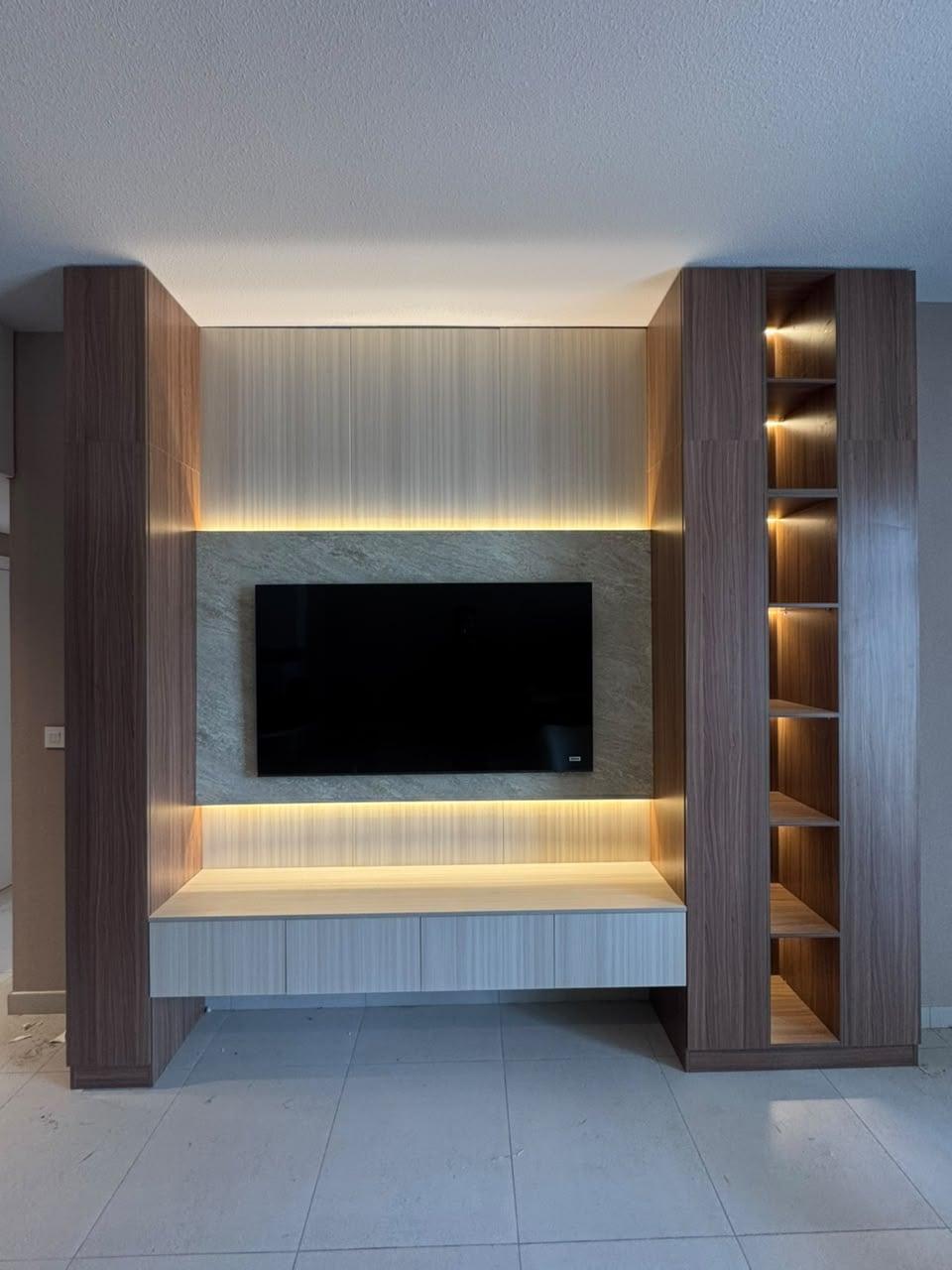
Count the parts. A console with two doors is one box and two fronts. A console with four drawers is one box, four fronts, four sets of runners and more assembly. Add a tall display unit on each side and you have added two more boxes, glass or open shelves inside each, and their own lighting. Every box needs a carcass cut, edged and assembled, and every moving front needs hardware chosen, fitted and adjusted so it closes softly and lines up with its neighbour.
That is why the two walls in the drawing below, same width and same height, are such different jobs. Counting only what is drawn: the plain wall has two panels and boxes, two doors and drawers, one cut-out and no lit runs; the detailed wall has four panels and boxes, four doors and drawers, three cut-outs, one lit run and one bought-in appliance. None of those counts is dramatic by itself. Together they are the difference between a morning and several days.
The practical advice is to decide what actually has to live in the wall. A router, a set-top box and a games console need one well-planned cabinet with room for plugs and air, not three decorative ones. Display pieces want open or glass-fronted shelves. Books want depth. Pay for the storage you will fill, and leave the rest as clear wall. Our guide to planning a media wall shows how to count the contents before the drawing is made, and TV wall with shelves shows how shelves change the build.
- 1. Plain wall: two panels and boxes, two doors, one cut-out, no lit run
- 2. Detailed wall: four panels and boxes, four doors and drawers, three cut-outs
- 3. The detailed wall also has a lit run and one bought-in appliance
Lever 4: lighting and the electrical lines
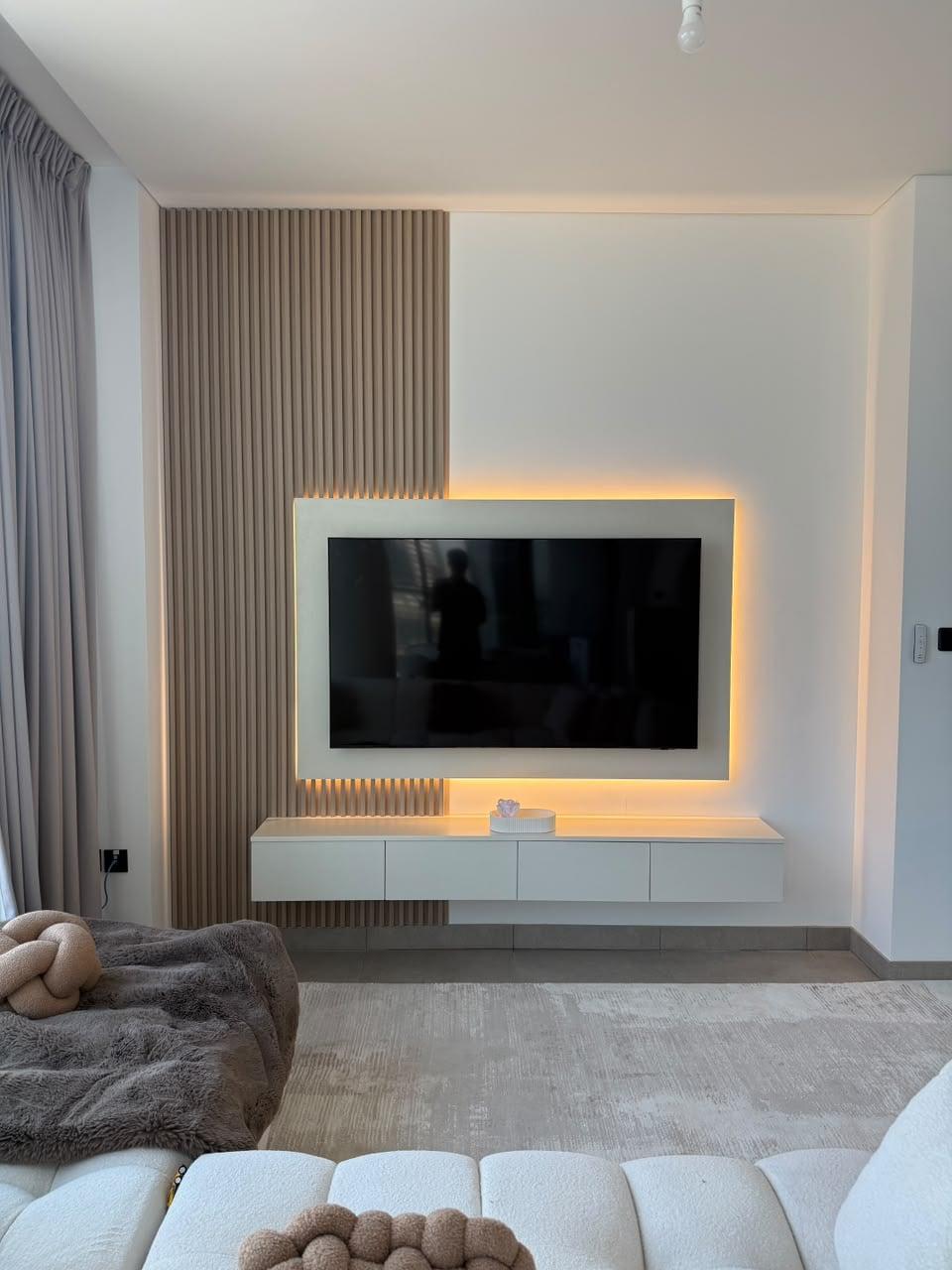
Light is where a wall comes alive in the evening and where cost is easiest to underestimate. A lit edge around the screen panel is one run. Light inside every shelf of two display units is many more, each with a profile, a strip and a share of a driver and dimmer. We offer 3000K (warm) and 4000K (neutral) channels with dimmers, and the wiring is done by our own team. A UK pricing guide for trades that we read keeps the lighting circuit with its driver, the TV bracket and the electrics as separate lines, which is a sensible way to look at them anywhere.
Power is its own line. If a socket behind the TV or in the console has to move, or the lighting needs a new feed, the electrical work is priced separately, and it is settled before the panels go up. Our guides on socket and power planning and cable routes you can still service explain how we decide what can stay and what must move. The cost lever is not the strip itself, which is modest, but the number of runs, the number of switch points, and whether the driver sits where someone can reach it later.
For ideas on where light earns its keep, see media wall lighting ideas. A fair rule is to light only what you want people to notice and leave the rest to daylight. Each lit run you remove takes out a profile, a strip and some wiring time, with no loss to the wall's character.
Lever 5: parts that are bought in
Some features are not made in the workshop. An electric fireplace is an appliance with its own maker, its own clearances and its own socket. Glass display cabinets combine joinery, glass and lighting, so they carry all three costs. These are the only items in a quotation where a large part of the cost is somebody else's product, and where the warranty on that part is the maker's, not ours. We do not offer anything other than electric fireplaces.
Their effect on price is not just the part itself. A fireplace needs an opening cut to its dimensions, a recess of the right depth, clearance around it and a dedicated power point, all of which have to be drawn in before the first board is touched. Our electric fireplace guide explains what to settle first, and you can see finished examples on the electric fireplace media walls page.
If you are undecided, ask for the fireplace as an optional line, so the wall is priced with and without it. That way you see exactly what the feature adds and can decide on facts, instead of discovering the figure inside a single total.
Lever 6: detail in the design
Detail is the quiet lever: cut-outs for sockets and niches, mitred corners where two panels meet, slat patterns that must be aligned across a joint, angles where the wall is not square, curved or chamfered edges. None of these shows up as a line in a quotation, yet each one adds workshop time, because a detailed edge is cut more slowly and checked more often than a straight one.
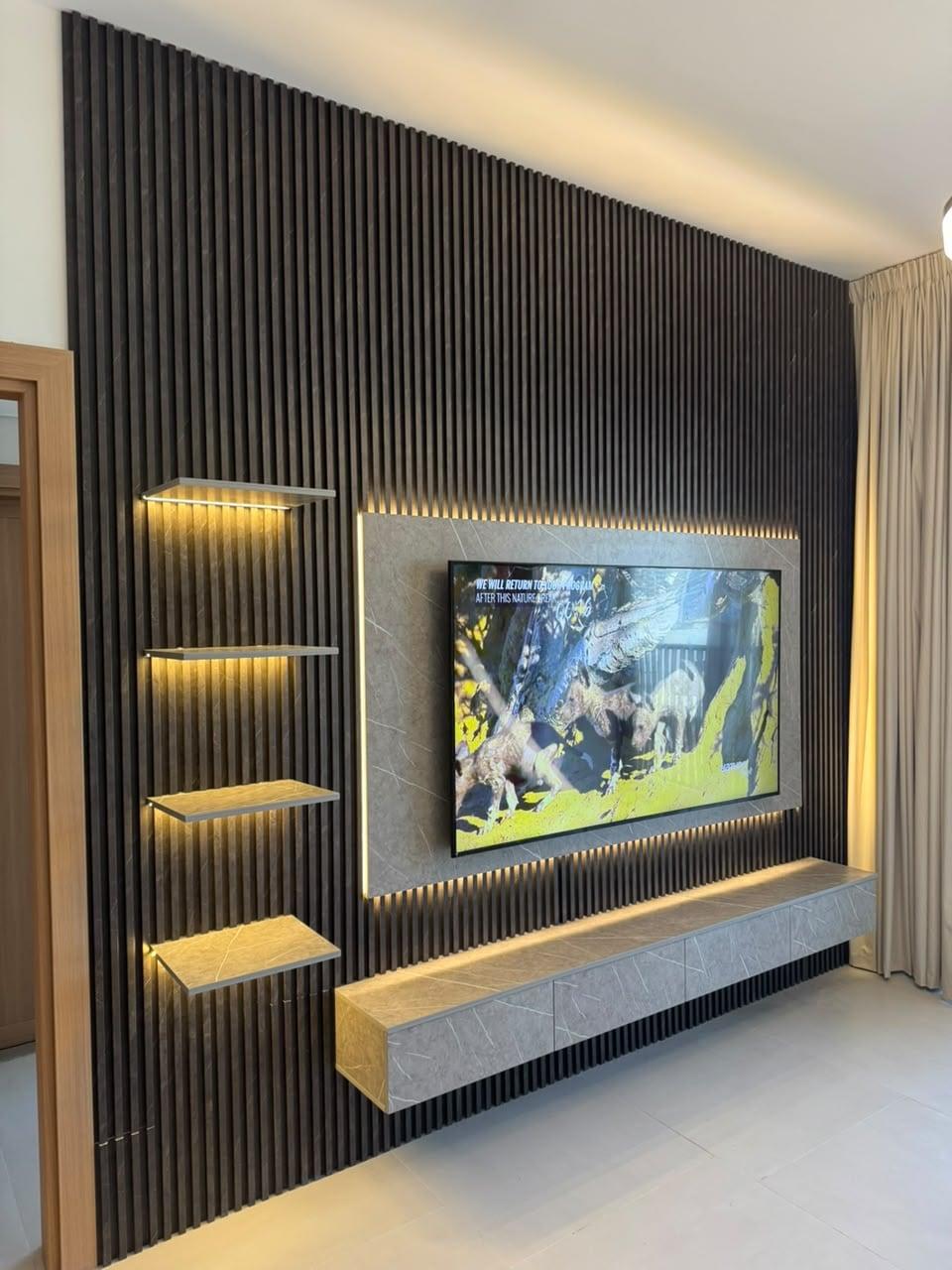
Slats are a good example. A fluted or slatted face is not one panel but many parallel pieces, and the effort goes into keeping their spacing and alignment true over a long run, especially across any joint. How different slat profiles look and behave is covered in fluted and slatted TV walls, and if you want a relief pattern rather than slats, 3D textured feature walls shows how the build differs.
The cheapest detail is the one the drawing resolves in advance. A joint placed behind a trim line, a pattern repeat that lands on a panel edge, a corner that is simply butted and treated: these are decisions that cost nothing on paper and a good deal on site if left until the fitting day. When the drawing arrives, look at the joints and corners first.
Lever 7: the wall behind and the site around it
The wall you are fixing to changes how the support is built. A block wall, a gypsum partition and an old plastered villa wall do not take fixings in the same way, and the support behind the TV has to be designed for the one you actually have. A TV mount maker, MantelMount, makes the same point in its guide to fixing a screen: the fixing that works in one wall type is wrong in another. We look at what the wall is made of during the free measuring visit, not from a photo alone, and our guide to block walls versus gypsum explains why.
Then there is the site. A third-floor flat with a lift that needs booking is not the same delivery as a ground-floor villa with a drive. Long runs of stairs, narrow corridors, protected floors and building working hours all add time on the day. Our guide to lift, access and delivery for a media wall lists what to ask your building in writing, and installation day shows what the fitting visit involves.
This lever is small in the ranking because most walls are straightforward, but it is the one most often missing from a first figure, since nobody has seen the wall. A wall with a column, an uneven plaster face or an air-conditioning pipe in the way will be priced differently after the visit than before it, and the honest move is to say so early.
Lever 8: changes after approval
The last lever is the only one you control entirely. Until the drawing is signed off, a change is only a pencil line. After approval and once production has started, a change can mean boards already cut, finishes already applied and time already booked. The same alteration that would have cost nothing on paper now costs material and days.
Our process is built around this. The measuring visit is free, we bring samples, the drawing and itemised quotation come next, and once measurements and details are agreed a 60% advance is paid and production starts when it is received. The remaining stage is agreed with you. Everything you want to change should be changed before that point, which is why the drawing deserves more of your attention than anything else in the process. Our guide on approving the finish sample covers the one decision people most often reopen late.
The drawing below shows how firm a price is at each stage. At the first message it is only a direction. After the visit it narrows, on paper it narrows further, and at approval it is fixed for that drawing. A late change widens it again. Treat stage three as the moment to settle finish, shelves, lights and fireplace, and let stage five be only a handover.
- 1. Stage 1: photos and a TV size give a direction, not a figure
- 2. Stages 2 and 3: the visit and the drawing narrow it to a price on paper
- 3. Stage 4 fixes it for this drawing; stage 5 reopens it
Two walls, eight levers, no prices
Here is how the levers read on two imaginary walls. First, a 3.6 metre wall in a rented one-bedroom flat. The tenant wants a clean look and no fuss: one screen panel in standard laminate sized inside a single sheet width, a floating console with two doors for the router and receiver, no lighting beyond what the room already has, no appliance. Area is small, finish is standard, parts are few, there are no lit runs, and the site is a simple lift delivery. This is close to the entry brief, and the quotation will have very few lines.
Second, a 5.5 metre wall in a villa majlis. The owner wants slats across the whole wall, a veneer feature panel, a long console with six drawers, two tall lit display units, a lit edge around the panel and an electric fireplace. Every lever is pulled: area is large, the finish is richer, the parts are many, the lighting has several runs, there is a bought-in appliance and the design has joints to hide. The quotation will be long, and each line is a decision. If the budget is fixed, the owner can drop the fireplace to an option, keep slats to one side, and run veneer only on the panel, and the wall remains recognisably the same wall.
The point is not that the second wall is wrong. A family that will use a majlis for years and wants it to look right on the first evening may spend exactly that. The point is that both owners can see why their figures differ, and can steer them. For a villa-scale view see villa TV wall, and for the smaller end small living room media wall.
The eight levers and what you can do about each
Area covered
- What pulls the price
- More board, cutting and fixing
- What you can steer
- Panel only behind and around the screen; size panels to the sheet
Finish
- What pulls the price
- Veneer, lacquer or marble-effect over standard laminate
- What you can steer
- Rich face on the screen panel, standard laminate at the edges
Boxes and doors
- What pulls the price
- Carcasses, runners, hinges, assembly
- What you can steer
- Fewer, better-planned cabinets; open shelves where nothing needs hiding
Lighting and electrics
- What pulls the price
- Runs, drivers, dimmers, moved sockets
- What you can steer
- Light only the features you want noticed; keep existing sockets where possible
Bought-in parts
- What pulls the price
- A fireplace or glass cabinets and their power
- What you can steer
- List them as options and price with and without
Design detail
- What pulls the price
- Cut-outs, mitres, slat alignment, angles
- What you can steer
- Let the drawing resolve joints and corners in advance
Wall and site
- What pulls the price
- Wall type, access, lift, building rules
- What you can steer
- Share photos, ask your building in writing, accept the free visit
Late changes
- What pulls the price
- Boards already cut, time already booked
- What you can steer
- Settle everything at the drawing stage
Levers are ranked in the diagram above, not priced. Your own figure comes from the quotation after the measuring visit.
Reading a quotation for the levers
Once a quotation arrives, hold it against the eight levers. Is the panelled area stated, and with which finish for which panel? Is every cabinet listed with its hardware? Are lighting runs counted, with the driver and dimmer named? Is the electrical work its own line? Are appliances separate, with the maker's warranty noted? Does the quotation say what the wall is fixed to, and what it assumes about access?
A quotation that answers these is a quotation you can compare. One that does not is a total you can only guess at. Our detailed method for putting two quotations side by side is in how to compare media wall quotes, and what a supplier should name is in the specification checklist. The UAE government's consumer protection page describes the invoice a supplier owes you: dated, in Arabic, and showing what was sold, at what price and in what quantity. A quotation is not an invoice, but it is fair to expect that clarity before you pay.
A second check is to look for what is missing. Hidden electrical work, an unlisted bracket, no mention of delivery or lift: any of these can make a lower total look like a better one. We cover that trap in hidden costs in a TV wall.
Saving without weakening the wall
There are three kinds of saving. Design savings remove a line without hurting the wall: slats on one side only, a plainer face at the outer edges, open shelves instead of two of the closed cabinets, one lit feature instead of five. Sizing savings use the sheet well: a panel that sits within a board, a console length that suits standard cutting. Process savings come from deciding early: a final finish sample chosen in your own light, a drawing approved once.
False savings are the ones you pay for later. Do not trim the support behind the TV, the cable route or a lift-off service panel, and do not cut the screen panel tight around today's TV if a bigger one is likely. Swapping one panel later is a smaller job than rebuilding the whole wall, and planning for a future TV shows how much margin to leave. If you are still choosing a TV, buying the TV before the wall explains why the model matters to the drawing. For a full budget approach, see a budget media wall that lasts.
What we do about it, and what to send us on WhatsApp
We make media walls in our Sharjah workshop and fit them across the UAE with our own team, from AED 3,500 per project for the entry brief. The measuring visit is free, and we bring finish samples to it. The drawing and an itemised quotation follow, and the wall is built to the approved drawing, in up to about 10 days depending on size and design. The boards in our walls carry a 5-year limited warranty on the wood-based boards only; hinges, runners, labour and misuse are excluded, and our workmanship is covered separately by a written 24-month warranty. Our founder, Ali Haider Basra, has ten years in the trade.
To get a first direction, send a WhatsApp with a photo of the whole wall, its rough width and height, your TV size or model, and what has to live in the wall: receiver, router, console, soundbar. Add a picture of a wall you like and say which of the eight levers matter most to you. The checklist in what to send for a media wall consultation lists exactly what helps, and our media walls service shows the range. The firm price follows the free visit.
Common questions
Why do two media walls of the same size cost different amounts?
Because size is only one of eight levers. Finish, the number of boxes and doors, lighting, bought-in parts, design detail, the wall and the site, and late changes each add work. Compare two quotations properly.
Is a media wall priced per square metre?
No. We price from the approved drawing, with each element on its own line, because two walls of equal area can hold very different amounts of work. What a media wall costs.
Which choice adds the most to a media wall price?
How much wall you cover, then the finish and the number of boxes and doors. Lighting, a fireplace and design detail follow. Planning a media wall.
Can I get a firm price on WhatsApp?
You get a direction from photos, a TV size and the wall's rough measurements. The firm price follows our free measuring visit and the drawing. What to send us.
How can I lower the price without making the wall look cheap?
Keep a richer finish for the panel behind the screen, use plain laminate at the edges, size panels to the board, and list the fireplace as an option. A budget media wall that lasts.
What costs extra that I might not expect?
Moved sockets, an old unit to remove, wall repair and access arrangements are the usual ones. Ask for each in writing. Hidden costs in a TV wall.
Do you build media walls outside Sharjah?
Yes. We make them in our Sharjah workshop and fit them across the UAE. Media walls in Sharjah.

Sources & specifications
Manufacturer information applies to the named products and systems. Sources reviewed on 10 November 2026.
- GR8 Fires: how much does it cost to build a media wall (size, design detail, materials and finish, location, appliances named as cost drivers)gr8fires.co.uk(opens in a new tab)
- squote: media wall installation pricing guide (lighting circuit, TV bracket and electrics as separate lines; last verified 14 August 2026)squote.app(opens in a new tab)
- EGGER: what is laminate (0.8 mm laminate, 18 mm faced boards, layers of a laminate)egger.com(opens in a new tab)
- MantelMount, 10 Dec 2025: mounting a TV on metal studs, brick, concrete and plaster (fastener changes with the wall)mantelmount.com(opens in a new tab)
- u.ae: Consumer protection (a supplier's dated invoice, in Arabic, with type of goods or service, price and quantity; updated 2 Sep 2026)u.ae(opens in a new tab)
Want this planned for your home?
Consultation and measurement are free. Tell us the rooms, location and what you need; we arrange a sample visit and define the measured quotation.