Media Walls · 20 min read · 7 October 2026
How to compare media wall quotes in the UAE: a seven-step method
A seven-step method to compare media wall quotations in the UAE: one drawing, one template, the same finish, the same units, the missing lines and the terms, with a worked three-quote example.

By Ali Haider Basra, Founder, Al Tareeq Decor · Contact our workshop
Key takeaways
- A total says how much a supplier will charge, not for what. Compare only after every quote prices the same wall.
- Seven steps: one drawing, one template, one finish reference, the same units, the gaps, the terms, and who measures, builds and fits.
- Mark each line of each quote as named, in the total, or blank. Every blank or lump becomes one written question.
- A lower total can simply leave lines out: lighting, electrics, the mount, delivery. Ask before you call it cheaper.
- An estimate is a rough guess; a quotation is a fixed price. Keep one thread, one drawing and one quotation per supplier.
On this page
- Key takeaways
- Three quotations, three totals, and no way to tell which one is right
- Why the lowest total is not always the lowest price
- Step 1: put every supplier on the same drawing
- Step 2: build one template and put every quote on it
- Step 3: the same finish, down to the sample reference
- Step 4: watch the units
- Step 5: find out what each quote leaves out
- Step 6: compare the terms, not only the money
- Step 7: who measures, who builds, who fits
- A worked example: one wall, three quotations
- Three quotations for one wall, after the questions
- Estimate, quotation, invoice: three different documents
- Putting your questions in writing
- Special cases: fireplaces, shelves and a unit you could buy instead
- Deciding: when the lowest is right and when it is not
- What we do about it, and what to send us on WhatsApp
- Common questions
Three quotations, three totals, and no way to tell which one is right
You asked three makers for a price on the same TV wall. One came back the same afternoon with a single figure and a line of text. One arrived two days later as a two-page document with a dozen lines. The third was a voice note and a number. The totals are far apart, and the obvious move is to look at the smallest one and feel a little suspicious of the largest. That instinct is understandable and, more often than not, wrong, because a total only says how much a supplier will charge. It does not say for what.
This guide is about the step between receiving quotations and choosing one. It is a method, not a checklist of lines: how to put two or three quotes on the same footing so that the difference between them becomes visible and explainable. When the same wall sits behind every total, a gap tells you something real. When it does not, a gap tells you nothing at all.
The method has seven steps, from fixing one drawing for everyone to reading what each supplier asks you to agree to. None of them needs a spreadsheet, only patience and a willingness to ask for things in writing. If you want the list of lines a media wall quotation should contain, our quotation checklist has it; this guide assumes you have that list and shows how to use it across several quotes.
Why the lowest total is not always the lowest price
Quotations differ for three reasons, and only one of them is a real difference in price. The first is a difference in scope: one supplier has included lighting, electrics, delivery and fitting, another has left some of them out. The second is a difference in specification: a standard laminate in one quote and a veneer in another, a fixed shelf against a lift-off panel, soft-close hardware against plain hinges. The third is a difference in how the supplier prices the same job, which is the only one you would call cheaper or dearer.
A comparison that ignores the first two will mislead you. The Queensland Building and Construction Commission, a building regulator, advises people to compare quotes like for like, with the same specification, materials and timelines, and not to decide on price alone. The advice is about building work in another country, but the logic applies to any custom joinery, including a media wall. A lower total can mean a lower price, or it can mean a shorter list.
Our guide to what changes a media wall price explains the eight levers that make quotations for the same size of wall differ. Read it alongside this one, because every lever is a place where two suppliers can quietly be quoting two different walls.
Step 1: put every supplier on the same drawing
The first step is the one most people skip. If each supplier has measured and sketched their own version of the wall, you are not comparing prices, you are comparing designs. One has drawn slats on both sides, another only on one, a third has a longer console. Their totals will differ for reasons that have nothing to do with their rates.
Deciding early whether the wall will be compact or run edge to edge removes half of the mismatch, and full wall or compact media wall helps with that choice. If you are still unsure what a media wall includes, what is a media wall sets out the basics.
The fix is to fix the design before you collect prices. A single drawing, a photo with notes, even a hand sketch with the main dimensions and the list of what must live in the wall, gives everyone the same brief. Better still is a drawing from the first supplier you trust, which you then ask the others to price as drawn. If a supplier wants to propose changes, ask for those as a separate option so that the base price still compares.
The decision path below shows the four questions to ask before any totals are compared. If the answer to the first is no, nothing else matters yet: ask for a quote on one drawing. The path is deliberately short, and the point of it is that it stops you comparing before the comparison means anything.
- 1. Question 1: do both quotes price the same drawing and sizes?
- 2. Question 2: is the finish the same, down to a sample reference?
- 3. Question 3: is every line named, lighting and electrics included?
- 4. Question 4: are timing, advance and warranty written down?
Step 2: build one template and put every quote on it
Take a sheet of paper, or a note on your phone, and write the lines down the left side: panels and finish, console and hardware, lighting and driver, electrical work, TV mount, delivery and lift, fitting, warranty wording. Then make a column for each supplier. Go through each quotation and mark every cell one of three ways: named, meaning the line is there with its own description; in the total, meaning it may be included but is not itemised; or blank, meaning it is not mentioned at all.
The drawing below shows what this looks like for two quotations. Quote A names panels, console and fitting and says nothing about lighting, electrics or the mount. Quote B names almost everything but folds the console into a single lump. Neither is complete. What matters is that the blanks and lumps are now visible, and each of them is a question: does the price include lighting, and if so what is the lighting run, the driver and the dimmer?
Every blank and every lumped cell becomes one written question to the supplier. Once all the cells are answered, you are comparing like with like. This takes perhaps twenty minutes and it is the single most useful thing you can do with three quotes in your hand. For the content of the lines, the specification checklist shows how a good quotation words them, and our guide to what a quotation must show explains why each one is there.
- 1. Quote A leaves lighting, electrics and the mount blank
- 2. Quote B lumps the console into the total but names the rest
- 3. Each blank cell becomes one question, answered in writing
Step 3: the same finish, down to the sample reference
“Laminate” is not a specification. Laminates differ in colour, texture, thickness of the decorative sheet, and what they are bonded to. In its explainer on laminate, the board maker EGGER treats the decorative sheet and the board beneath it as two separate things, and lists faced boards as a product in their own right. Two quotes that both say laminate may therefore be pricing different surfaces on different cores.
Ask each supplier to name the finish by reference: the maker's code, the colour name, the gloss level. Ask which core the face is bonded to and what thickness the board is. If you have already chosen a sample, ask every supplier to quote that sample, not their nearest equivalent. If you have not, compare the finishes in your own room first. Our guides to approving the finish sample and colour and finish in the UAE light explain how to do this properly.
It also helps to compare finish zone by zone. One supplier may quote a richer face on the screen panel and plain laminate elsewhere, while another uses one face throughout. Neither is wrong, but the totals cannot be compared until you know which. The panel core guide explains how MDF, WPC, PVC and wood differ, so that when a quote names a core you know what it means.
Step 4: watch the units
A quotation can state its price in four different ways: a total for the project, a rate per square metre of wall, a rate per metre of run, or a price per item. These are not interchangeable, and a figure in one unit cannot be set against a figure in another without knowing the quantity behind it. A per-metre rate that looks low may exclude lighting, the console and the electrics; a total that looks high may include them.
Media walls are awkward to price by area, because two walls of equal size can hold very different amounts of work. That is why we quote per project from an approved drawing, with the elements itemised; our price guide explains the logic. When a supplier quotes by area or length, ask for the quantity in the quote and the list of what the rate includes, and ask what is not covered by it.
Also look for per-day or per-hour wording. The Citizens Advice charity in Scotland, writing about home improvements, says a written quote should give a fixed total price, not a daily rate, with a breakdown of the work and the materials. That is a sensible expectation anywhere. If a figure is described as an estimate, the same source says it is only a rough guess and you could end up paying more. Treat estimates and quotes as different documents.
Step 5: find out what each quote leaves out
Once every quote is on the template, look at the gaps. The usual ones are lighting, electrical work, the TV mount, delivery and lift arrangements, removal of an old unit, and any repair to the wall behind. Squote, a UK pricing guide for trades, treats lighting circuits with their drivers, the TV bracket and the electrics as separate lines, which shows how easily they can sit outside a headline figure. A supplier may leave them out honestly because they do not do that work, or simply because they have not looked.
The drawing below shows an illustrative case. Quote A includes everything. Quote B looks lower, but three lines are missing: lighting, electrical work and the mount. When those lines are added back, the two quotes cover the same work and the difference shrinks or disappears. Illustrative proportions are shown, not prices; the point is the mechanism. A supplier who leaves something out has not necessarily done anything wrong, but you now know that someone, probably you, will pay for it later.
Three gaps deserve a closer look. Electrical work is the first: whether a socket must move is explained in socket and power planning, and the number of lit runs is a matter for lighting design. Delivery is the second: a building that requires a booked lift or protected corridors adds time, as lift, access and delivery shows. Fitting is the third, and installation day explains what a proper visit includes, so that you can see whether a quote has priced it.
When you find a gap, ask the supplier in writing whether the item is included, and if not, what it would be priced at and who does it. Then add the answer to the template. Our guide to hidden costs in a TV wall lists the items most likely to turn up late, so that you can check them all at the start.
- 1. Quote A: every line named
- 2. Quote B as received: lighting, electrical and mount missing
- 3. Quote B with the lines added: the two now cover the same work
Step 6: compare the terms, not only the money
Two suppliers with the same price and the same scope can still be offering very different deals. Look at how and when you pay, how long the price holds, when work starts and ends, and what the warranty covers. Our process is typical of custom joinery: once measurements and details are agreed, a 60% advance is paid and production starts when it is received, and the remaining stage is agreed with you. Whatever a supplier's process, it should be written in the quotation, not left to conversation.
Citizens Advice lists what a good written quote should say: a fixed total, a breakdown of work and materials, separate costs for each material and part of the work, how long the price is valid, whether it includes VAT, and when the price can go up. Those are good things to look for in any media wall quotation. The u.ae consumer protection page adds a local yardstick for the invoice that follows a job: dated, in Arabic, naming what was sold with its price and quantity. A quotation comes earlier and is a different document, but the same clarity is worth asking for.
Warranty wording is the term most often compared wrongly. Ours is a 5-year limited warranty on the wood-based boards only, with hinges, runners, labour and misuse excluded, plus a written 24-month warranty on our workmanship, and parts we buy in carry their makers' terms. Another supplier may say five years, ten years or lifetime without saying what is covered. Ask what the words cover, and ask for them in the quotation. Our guide to choosing a media wall contractor goes further on the questions to put to each maker.
- 1. Issue: the lines, the date and how long the price holds
- 2. Questions and drawing: each answer and each size in writing
- 3. Advance, production and handover: terms agreed before money moves
Step 7: who measures, who builds, who fits
A quotation written from photographs is a guess dressed as a price. Ask each supplier whether they will measure the wall in person before the price is firm, and whether the measuring visit is free. Ours is, and we bring samples. A supplier who has not seen the wall cannot know about a column, an uneven plaster face, a pipe, or how the lift works, and each of those can change the price after the fact.
Ask also who makes the wall and who fits it. In some cases the maker and the installer are the same team; in others one party sells and a second builds. Neither is wrong, but you should know who you are dealing with when something needs adjusting, and the quotation should say who is responsible. Our measuring visit guide shows what a proper visit covers, and our Sharjah media wall page shows where our workshop is and how we serve the rest of the emirates.
If you are comparing makers as well as quotes, the questions to ask a media wall contractor go deeper than a price ever can, and the handover checklist shows what a finished wall should be measured against.
Finally, check how long the work takes and what it depends on. Ours takes up to about 10 days depending on size and design, which is what we state in the quotation. A supplier who promises much less may be rushing, and one who gives no time at all may not have planned. A realistic timeline is part of the price you are paying.
A worked example: one wall, three quotations
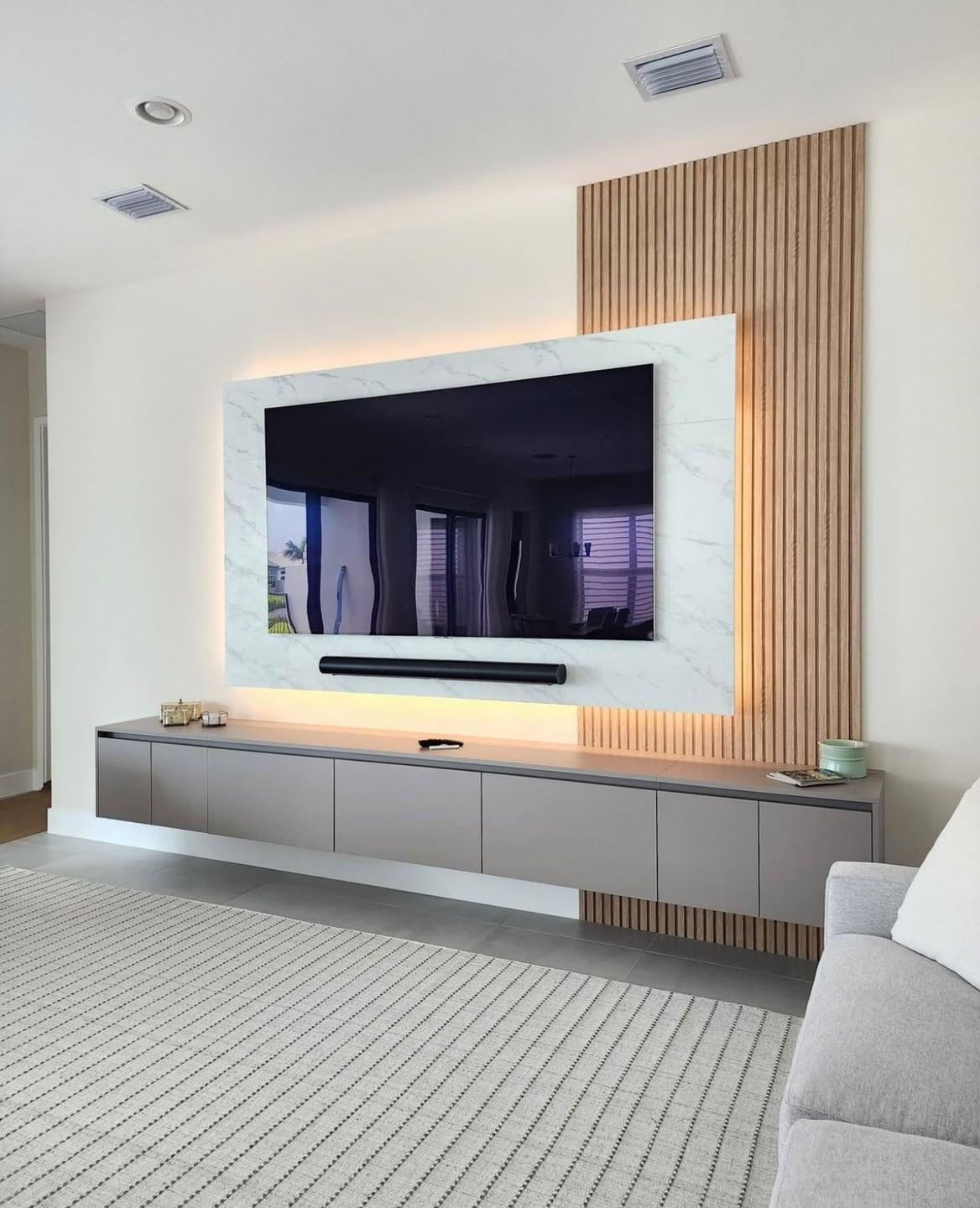
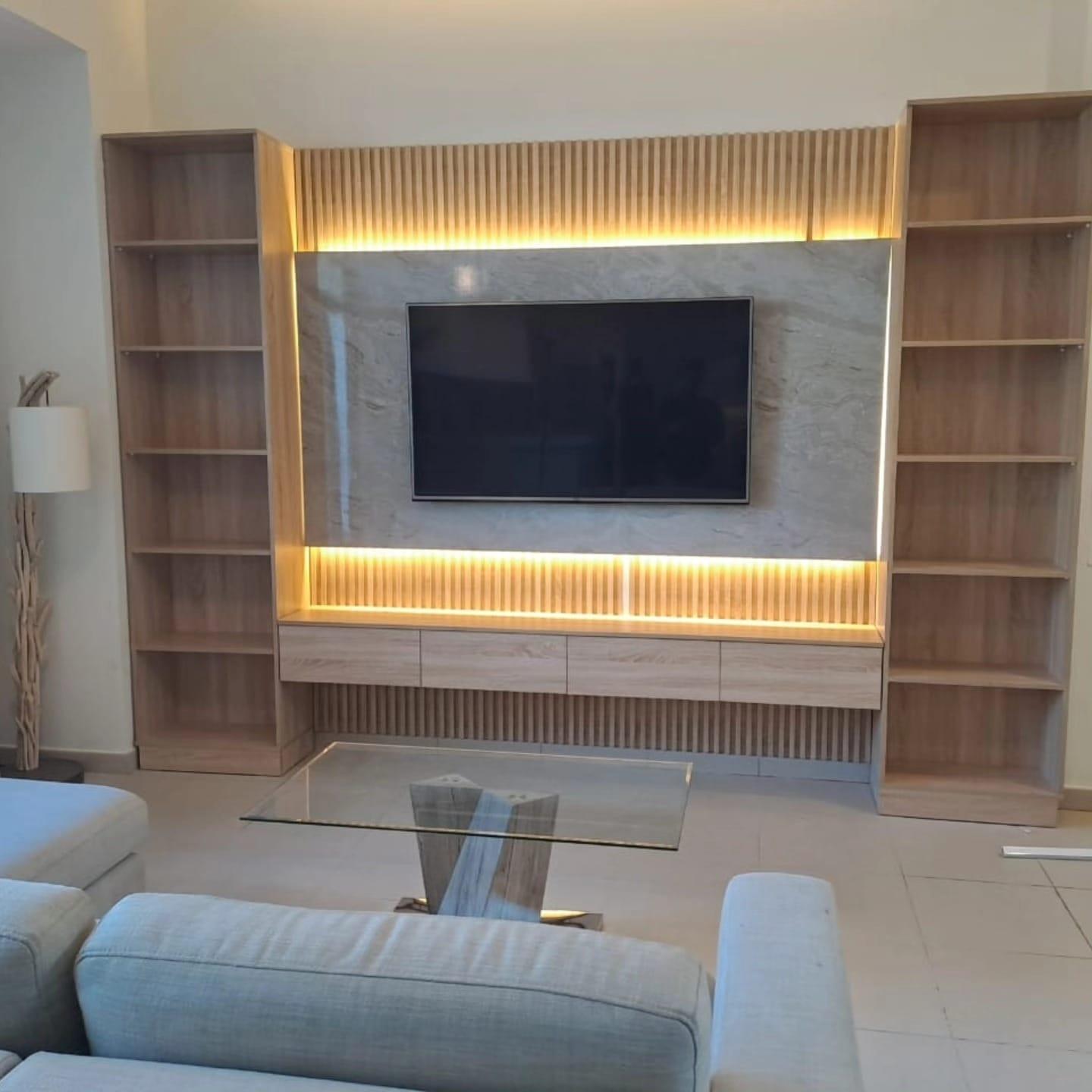
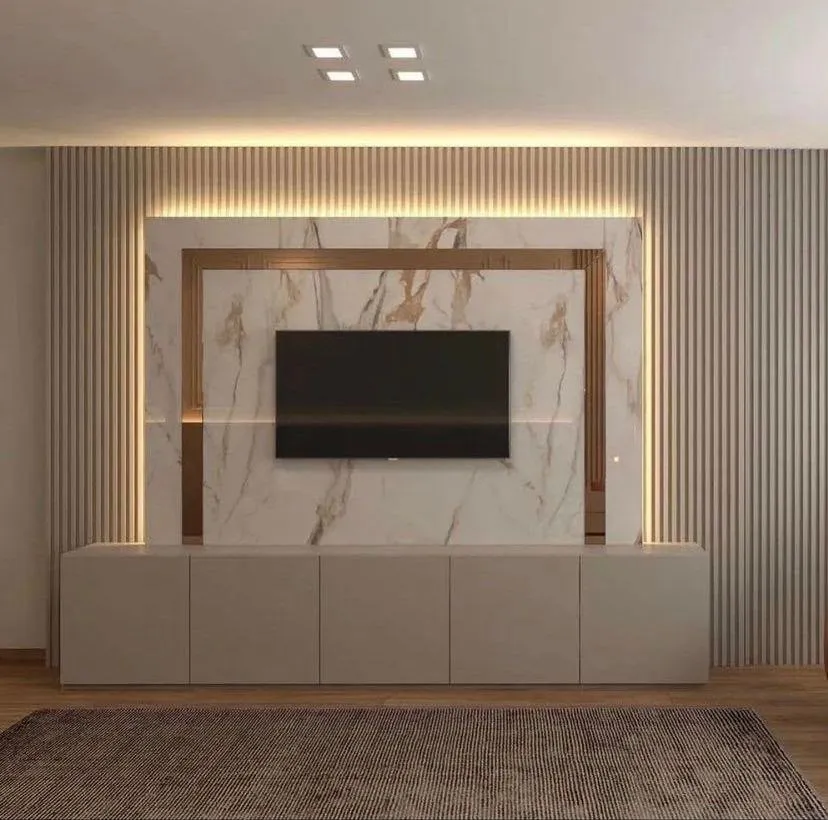
Suppose you have a 4 metre living room wall, a marble TV wall in mind, and you ask three suppliers to quote the same drawing: a screen panel in marble-effect, slats on one side, a four-drawer console and a lit panel edge. You get three replies.
The first names every line and gives a total, including a separate line for the electrics and one for the mount. It states that production starts after an advance and gives a timeline. The second gives a lower total and lists panels, console and fitting, but nothing for lighting, electrics or the mount. The third gives the lowest total on one line with a short description: “TV wall, marble, slats, console, LED”.
You put them on the template. The first has no blanks. The second has three blanks and no mention of delivery. The third is one big lump with every cell unknown. You send both of the others the same written questions and, a day later, the answers arrive. The second says lighting is extra, the electrical work is by the customer and the mount is not included. The third says everything is included but cannot itemise it. With the second's missing lines added, its total is close to the first; the third's total remains a promise you cannot check.
In the end you choose between the first and the second. The difference is now small, explainable and in your favour either way, and the decision is about who you trust to measure, build and fit. That is what a comparison is for. The table below summarises what you learn from each answer.
Three quotations for one wall, after the questions
First
- What it names
- Every line, with the electrics and the mount separate
- What was missing
- Nothing
- What you learn
- A complete quote you can check against the drawing
Second
- What it names
- Panels, console and fitting
- What was missing
- Lighting, electrics and the mount
- What you learn
- Cheaper only because three lines sit outside it; with them added it is close to the first
Third
- What it names
- One line: wall, marble, slats, console, LED
- What was missing
- Everything, unitemised
- What you learn
- A promise you cannot check line by line; ask for a breakdown or set it aside
No prices are given: the point is the method, and every real quotation will differ.
Estimate, quotation, invoice: three different documents
One source of confusion is that people use the words interchangeably. An estimate is an approximate figure, given early and not binding. A quotation is a fixed price for a defined piece of work. An invoice is a demand for payment for work done or goods supplied. Citizens Advice puts the difference simply: a quote is a promise to do the work at a fixed price, and an estimate is a rough guess.
In practice, ask which document you have been given. If it is an estimate, ask when it becomes a quotation and what will change between the two. If it is a quotation, ask how long it is valid and what would make the price change, such as a change in the drawing, in the finish or in access. And if you are asked to pay, check what the payment is for, and ask for a receipt or an invoice that states it.
None of this is hostile. A good supplier will be glad to answer, because a customer who understands the document is less likely to dispute it later. Our own process puts the quotation in writing after the free visit and the drawing, which is why we ask that finish, shelves, lights and fireplace be settled at that stage. The price factors guide explains why a late change costs more than an early one.
Putting your questions in writing
Phone calls are quick, and WhatsApp messages are quicker, but a written thread is the only record that survives a disagreement. When you send questions to suppliers, send the same questions to all of them, in the same words, so that the answers can be put side by side. Ask for each answer on the same thread, rather than a separate call.
A good set of questions covers six things. Which drawing and which finish reference is the price based on? Which lines are included, and which are not? Who does the electrical work? What does delivery and fitting include, and what do you need to arrange with the building? When does production start, and how long does it take? What exactly does the warranty cover and exclude? These six map directly onto the template and make it hard for a gap to survive.
Keep one thread, one drawing and one quotation per supplier. If the design changes, ask for a revised quotation, not a verbal adjustment. The wall will be built from those documents, and so will any later conversation about whether it was built correctly. Our handover checklist shows how that same paper trail is used on the day the wall is finished.
Special cases: fireplaces, shelves and a unit you could buy instead
Some walls carry features that deserve their own treatment when you compare. An electric fireplace is a bought-in appliance, so ask each supplier to name it, its size and its warranty, and to say whether the opening, the recess and the power point are priced; the electric fireplace guide lists what to settle. A shelving-heavy wall carries many boxes and a lot of lighting, so compare the count of shelves and lit runs rather than the headline; TV walls with shelves shows how shelves change the build.
It is also worth comparing against the alternative of not building a wall at all. A ready-made TV unit has a price that is simple to read, but it does not hide cables, fit a column or follow a wall edge to edge. Media wall or TV unit sets out the trade-off, and custom or ready-made TV unit looks at what each actually gives you. If your quotes are all far above what you expected, that comparison may be the most useful one you make. Our pricing guide tool also shows how we explain a price.
Deciding: when the lowest is right and when it is not
After the template is complete, the decision is usually clearer than people expect. If two quotes cover the same work and one is lower, the lower is likely the better value, provided you trust the supplier. If the lower one covers less, the real comparison is between the higher quote and the lower plus the missing lines. If a quote cannot be itemised, it is not a quote you can compare, and it is reasonable to set it aside.
The remaining differences are about trust and process: who will measure, who will build, how the advance and the timeline are stated, what the warranty says, and how willing each supplier has been to answer questions in writing. Their answers during the quoting stage are a preview of how they will answer after you have paid. A supplier who is vague now will probably be vague later.
A last point on timing: take the time. A media wall is built to last for years, and the price difference between suppliers is rarely as large as the cost of getting the wrong wall. Ask your questions, wait for the answers and decide from the template rather than from the pressure of a discount that expires tomorrow. The budget guide shows how to plan the spend once you have chosen.
What we do about it, and what to send us on WhatsApp
We would rather be compared properly than chosen by accident. Our quotations are itemised from an approved drawing, our measuring visit is free and includes samples, and a 60% advance is paid after measurements and details are agreed, with production starting when it is received. Media walls start from AED 3,500 per project for a compact panel and floating console in standard laminate, built in our Sharjah workshop and fitted across the UAE in up to about 10 days depending on size and design. Our founder, Ali Haider Basra, has ten years in the trade.
To get a quotation you can compare, send a WhatsApp with a photo of the whole wall, its rough width and height, your TV size or model, and a list of what has to live in the wall. If you already hold quotes from others, tell us what they include and we will say plainly how ours lines up against them. The consultation checklist shows what helps, and our media walls service shows the range.
Common questions
How many media wall quotes should I get?
Two or three is enough, as long as they price the same drawing and finish. More quotes only help if you can put them on the same footing. What a quotation must show.
Is the cheapest media wall quote the best one?
Not by itself. A lower total can mean a lower price or a shorter list of lines. Compare scope and specification first. Hidden costs in a TV wall.
Should every supplier quote the same design?
Yes, for the comparison to mean anything. Give them one drawing or one detailed sketch and ask for options as separate lines. Planning a media wall.
What if one quote is just one line and a total?
Ask for a breakdown by panel, console, lighting, electrics, mount, delivery and fitting. If it cannot be itemised, it cannot be compared. Choosing a media wall contractor.
How do I compare warranties?
Ask what is covered, what is excluded and for how long, and ask for the wording in the quotation. Ours is a 5-year limited warranty on the wood-based boards only. Media wall specification checklist.
Does a quotation include VAT?
It should say. Ask whether the total includes VAT and how long the price is valid. What changes a media wall price.
Can you compare a quote I already have?
Yes. Send it on WhatsApp with a photo of the wall and we will say how ours lines up. What to send.

Sources & specifications
Manufacturer information applies to the named products and systems. Sources reviewed on 10 November 2026.
- Queensland Building and Construction Commission: seeking and comparing quotes (same specification, materials, timelines; not price alone)qbcc.qld.gov.au(opens in a new tab)
- Citizens Advice (Scotland): before you get building work done (quote versus estimate; fixed total, breakdown, validity, VAT)citizensadvice.org.uk(opens in a new tab)
- u.ae: Consumer protection (a supplier's dated invoice, in Arabic, with type of goods or service, price and quantity; updated 2 Sep 2026)u.ae(opens in a new tab)
- squote: media wall installation pricing guide (lighting circuit, bracket and electrics as separate lines; last verified 14 August 2026)squote.app(opens in a new tab)
- EGGER: what is laminate (about 0.8 mm laminate, 18 mm faced boards)egger.com(opens in a new tab)
Want this planned for your home?
Consultation and measurement are free. Tell us the rooms, location and what you need; we arrange a sample visit and define the measured quotation.