Media Walls · 19 min read · 10 October 2026
Custom or ready-made TV unit in the UAE: fit, safety and the years ahead
Custom or ready-made TV unit in the UAE: how each fits the wall, floor, cables and TV, why a standing unit must be anchored, and what each does when you move or change TV.

By Ali Haider Basra, Founder, Al Tareeq Decor · Contact our workshop
Key takeaways
- A ready-made unit has a fixed size chosen before your wall was seen; a made-to-measure unit takes its size from your wall.
- The wall decides a lot: a plain flat wall suits a standard unit, while a column, recess or old plaster favours made to measure.
- A TV standing on a unit should be anchored to the wall (CPSC advice). A wall-hung console and fixed panel are attached by construction.
- A ready-made unit is cheaper to start and moves with you; a made-to-measure unit fits better and usually stays. Which wins depends on how long you stay.
- Ask the same questions of both: board, finish, hardware, fixing, warranty and what it excludes. Our entry price: from AED 3,500 per project.
On this page
- Key takeaways
- Two ways to get a TV unit: bought finished or made to measure
- What the words actually mean
- Fit at the wall: where a standard size leaves gaps
- Fit in the room: width, height and depth
- Standing or fixed: why a TV on a unit must be anchored
- Cables, power and the router
- Materials, finish and what to ask about both
- Price today and cost over the years
- Four life events and what each does to your choice
- Five questions that tip the balance
- If you buy a ready-made unit: what to check
- What to check before you buy a ready-made unit
- If you have one made: what to ask
- Four households, four answers
- What we do about it, and what to send us on WhatsApp
- Common questions
Two ways to get a TV unit: bought finished or made to measure
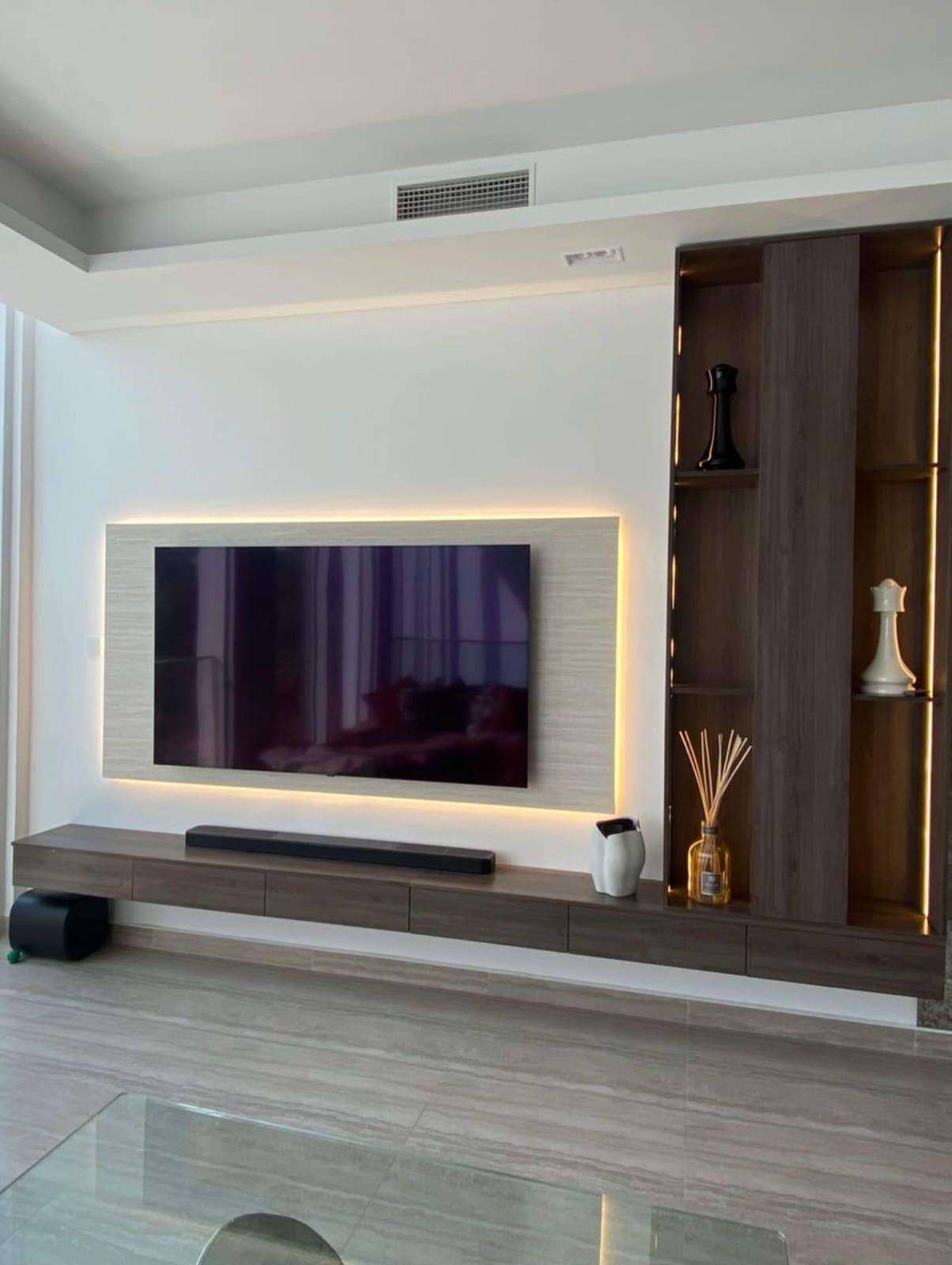
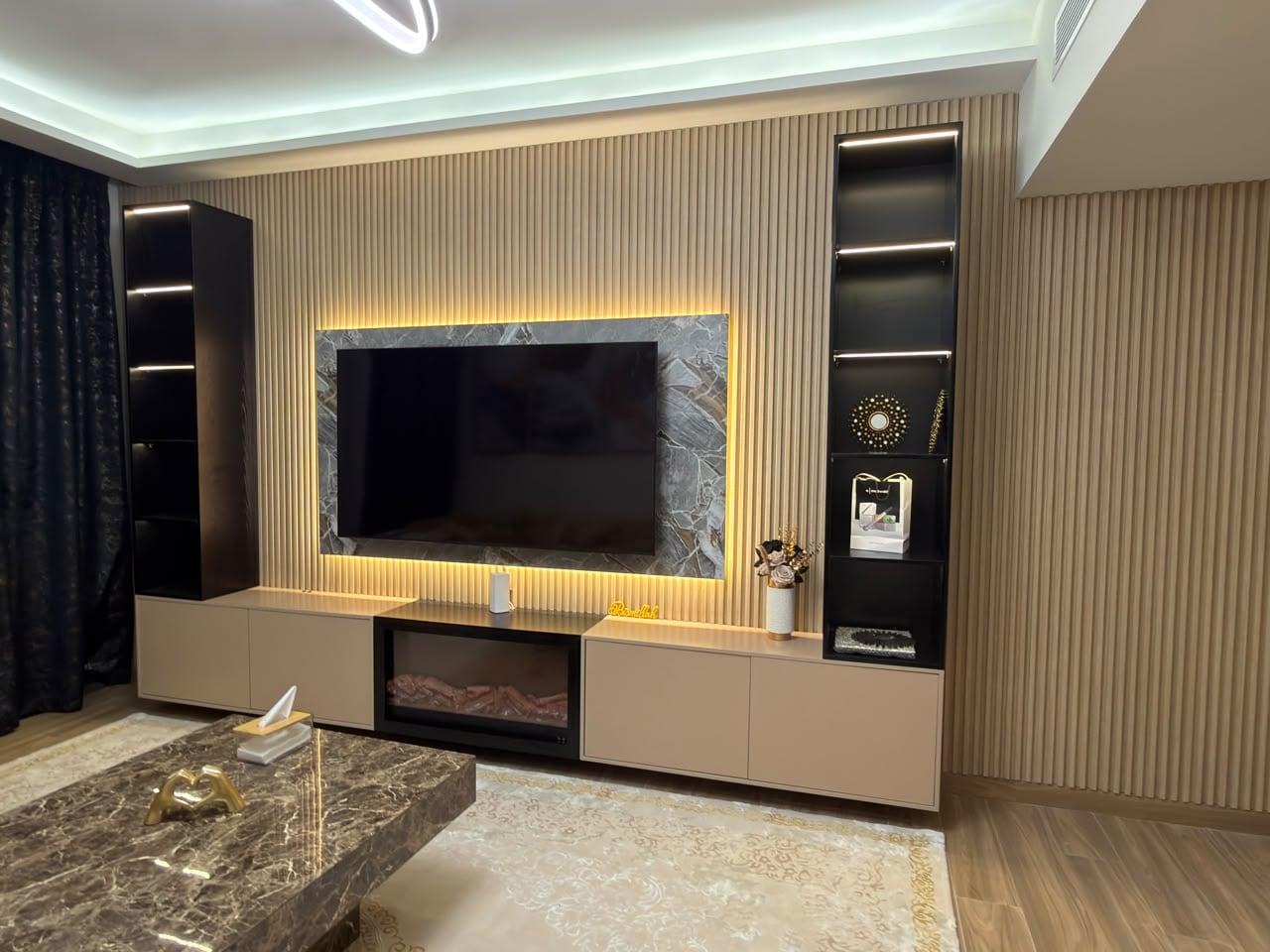
Almost every TV in a home sits on, in or against something, and that something arrives in one of two ways. Either you buy it finished, from a shop or a catalogue, in a size somebody else chose, or you have it made to the measurements of your wall, in a size you chose. The first is a ready-made TV unit. The second is a custom, or made-to-measure, unit, which can be anything from a single floating console to a full wall of panels and storage.
This guide is about the difference between those two ways, and specifically about fit and about life: how each meets your wall, your floor, your cables and your television, and what each does when you change TV, move house or need more storage. It is not the same question as whether to have a media wall at all. That is a different choice, covered in media wall or TV unit. Here we compare the two kinds of unit directly, so that whichever you choose, you choose it knowing what you are getting.
We make made-to-measure units and walls, so we have an interest, and we will say so plainly where it matters. We will also say when a ready-made unit is the better answer, because for some homes it is. The point is to match the choice to the wall and the life, not to sell one thing.
What the words actually mean
Ready-made covers a range. At one end is flat-pack furniture you assemble yourself; at the other is a finished piece from a furniture showroom that arrives assembled. What they share is that the maker chose the size, the depth, the finish and the layout before they knew about your wall. Nothing is wrong with that, and for many rooms the standard size is close enough.
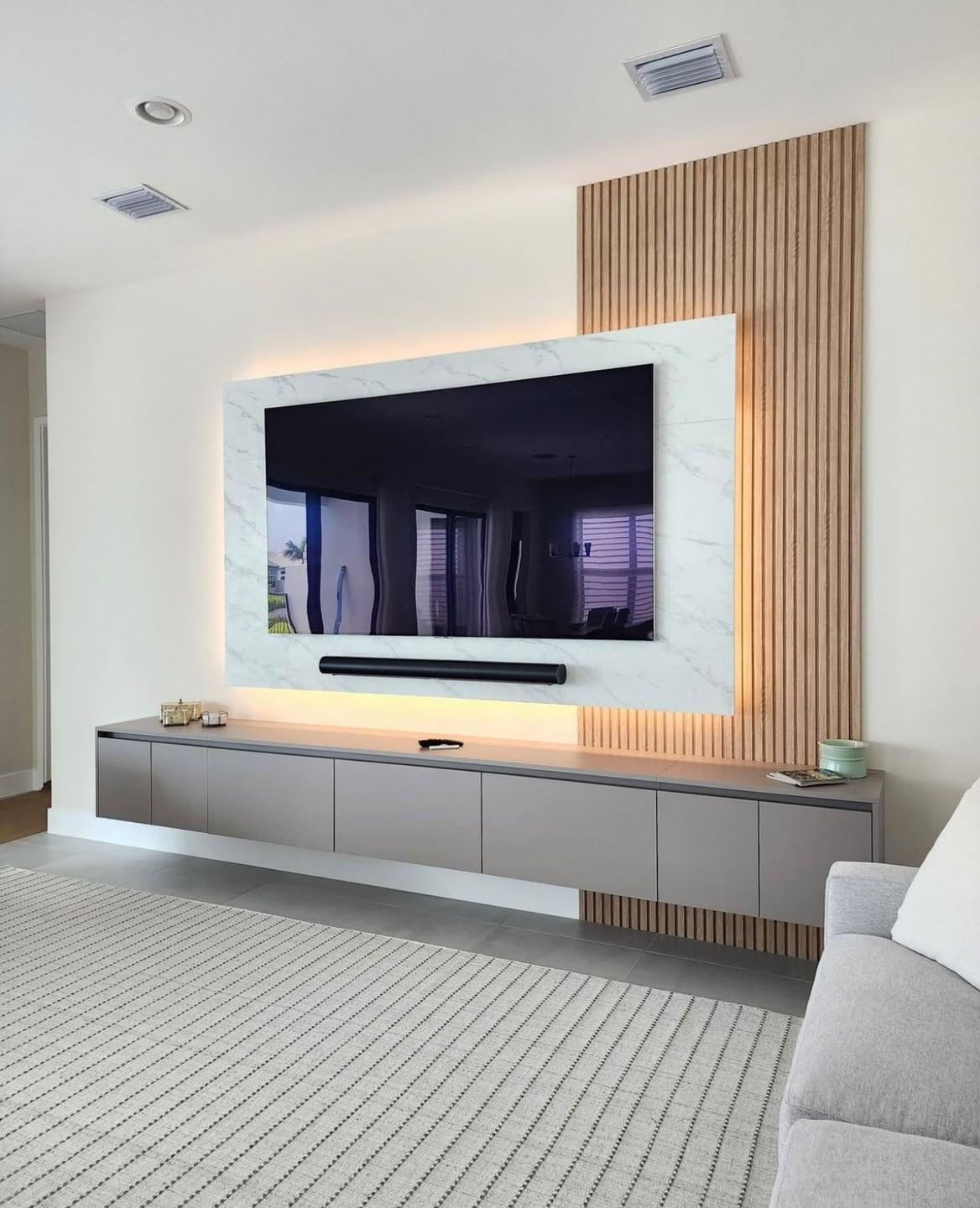
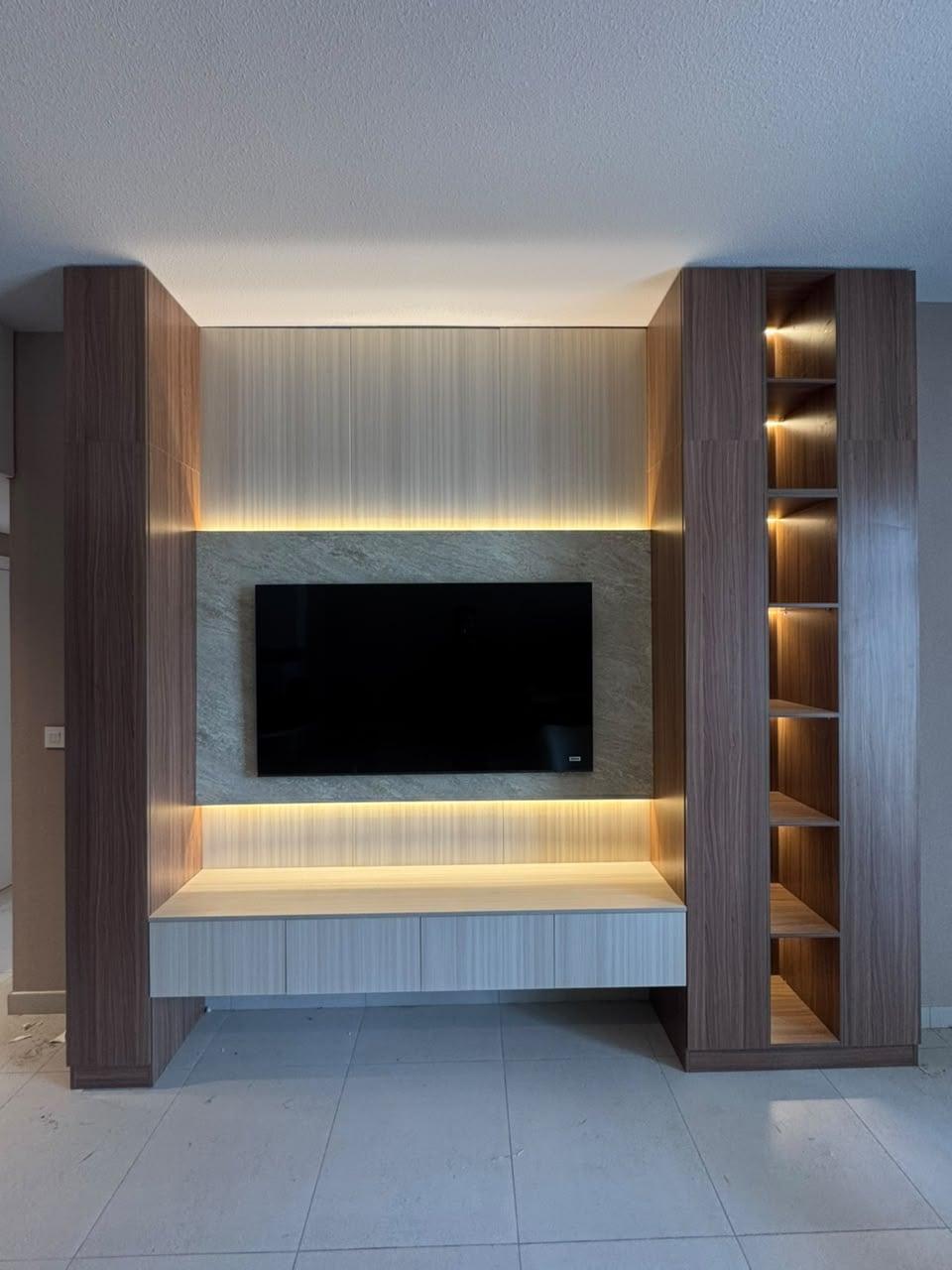
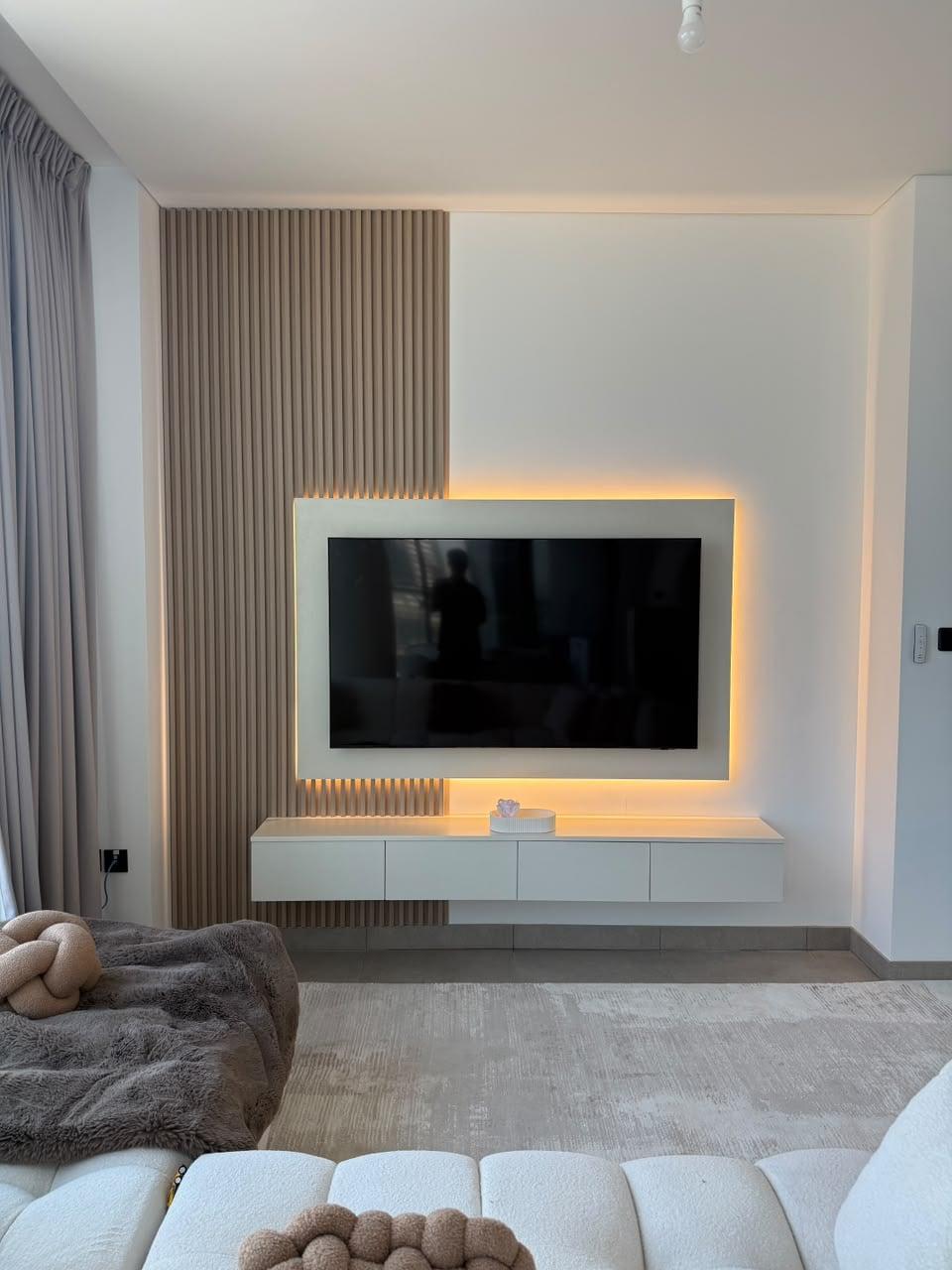
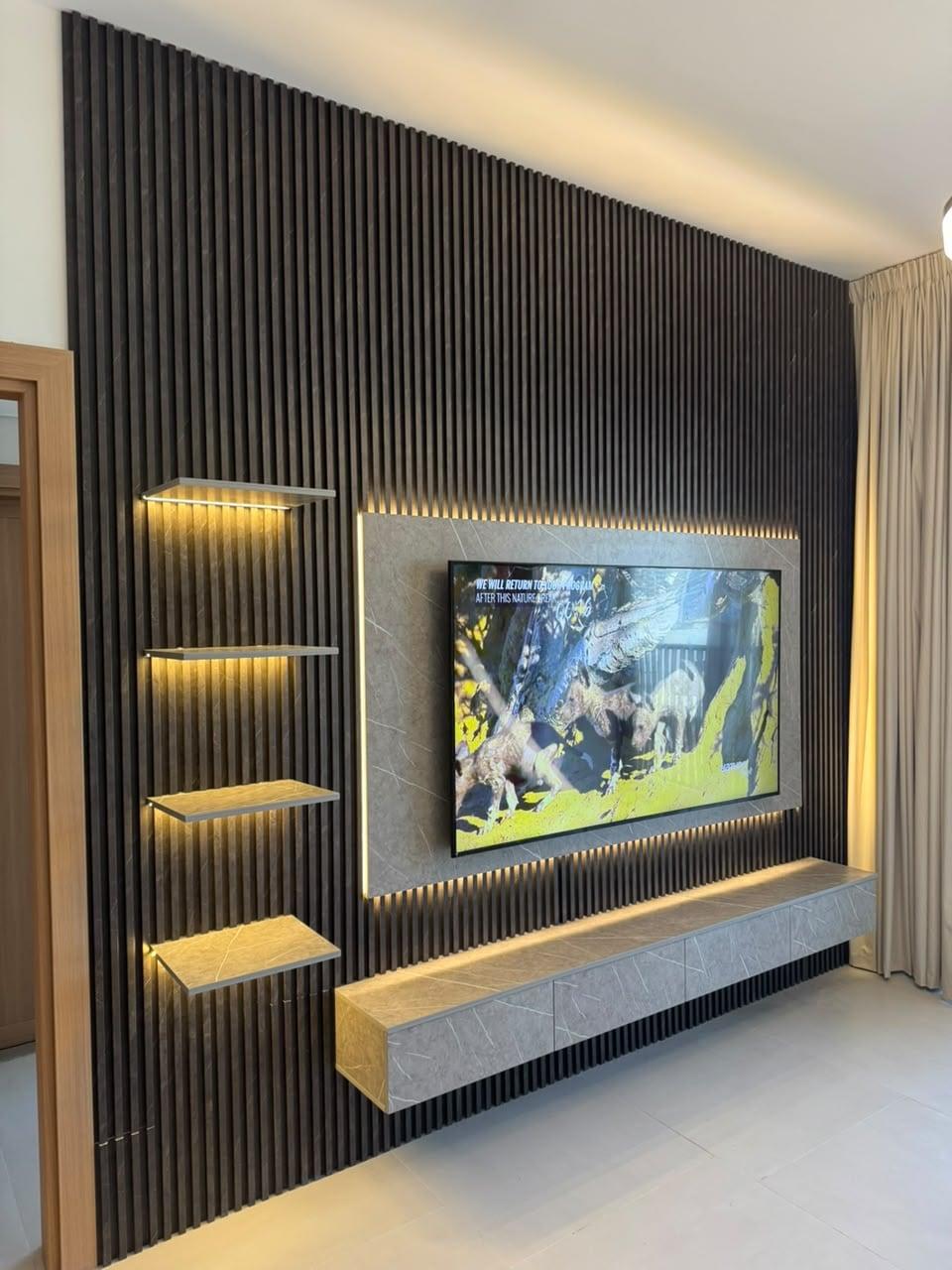
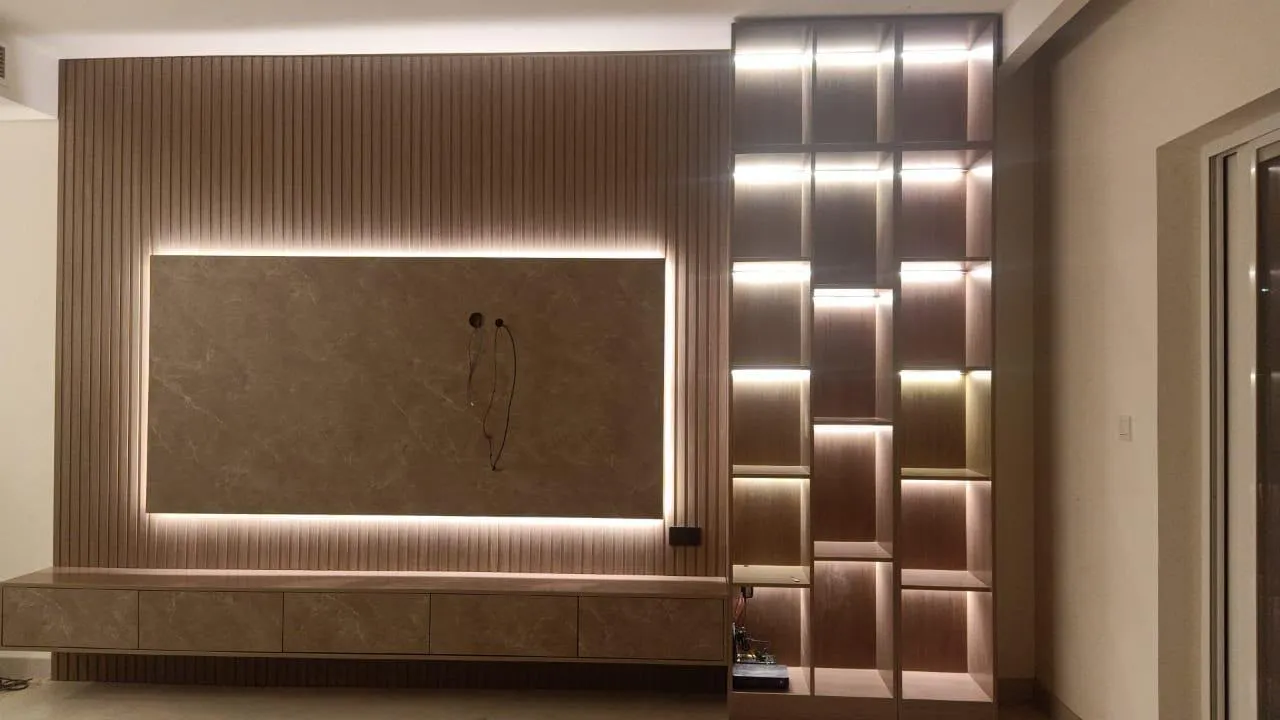
Made-to-measure also covers a range. The simplest is one console, cut to your width and hung on the wall. The next is a console with a panel behind the TV, the compact form that our published entry price refers to, from AED 3,500 per project. The fullest is a wall of panels, slats, storage and light. What these share is that the size comes from your wall and the details from your drawing. Our guide to what a media wall is shows where a unit ends and a wall begins.
We will not name a brand of ready-made unit or make claims about any one product's quality. Quality varies, and anyone buying should check it for themselves. What we can compare fairly is the structure of the choice: standard against measured, standing against fixed, visible cables against routed ones, and what each does over time.
Fit at the wall: where a standard size leaves gaps
Look at the wall from above. A ready-made unit is a box of a fixed width and depth. Your wall is a line with features: a column, a recess, a skirting board, an air-conditioning pipe, a socket. Put the box against the line and three things happen. A box narrower than the run leaves gaps at the sides, which collect dust and look unplanned. The skirting board stands proud of the wall, so the back of the box cannot touch it and a gap opens behind. And a socket that sits at the back may end up behind the unit, where the plug cannot reach.
A made-to-measure unit is drawn against the same line. The width runs from the column to the far end. The back is cut around the skirting so the unit sits flush against the wall. The depth is chosen for the room instead of the catalogue. The socket and cable route are drawn in from the start. The plan below shows the two side by side. Neither is wrong, and the difference is the difference you are paying for, or choosing not to pay for.
In an apartment, where walls are often straight and unbroken, a ready-made unit may fit well and the gaps may be small. In a villa with an old plastered wall, a column or an alcove, the gaps grow. The first question to ask of your wall is therefore how straight and clear it is. If it is a plain flat wall, a standard unit has a fair chance. If it has features, a measured unit earns its keep. Our guide to block walls versus gypsum also matters here, because what the wall is made of decides how a unit can be fixed to it.
- 1. Ready-made: gaps at the sides, held off the wall, socket may end up behind
- 2. Made to measure: column to far end, flush to the wall
- 3. Socket and cable route are planned in, not worked around
Fit in the room: width, height and depth
Three measurements decide whether a unit suits a room. The first is width. HomeKode, a UAE retailer writing about small living rooms, says a unit should be no narrower than the screen and ideally somewhat wider; wider than the screen also looks more settled than a TV standing on a narrow stand. The second is height. A low-profile unit keeps the room open and leaves the TV at a comfortable eye level, which depends on how you sit. Our guide to TV height on a media wall shows how to work it out.
The third is depth, and it is the one people forget. HomeKode advises avoiding units with excessively deep profiles in small rooms, because depth takes floor area. In a narrow room, a unit that projects a long way into the walkway is a daily nuisance, and a made-to-measure floating console can be as shallow as its contents allow. In a larger room, depth is less of a problem, and a deeper unit can hold more.
Floating units help in every room. Wall-mounted or floating units free the floor beneath, which makes a room feel larger and makes it easier to clean. A made-to-measure console can float because the wall is built to carry it; many ready-made units stand on the floor because they are designed to. Our guides to TV size and viewing distance and small living room media walls help you settle the sizes before choosing either kind.
Standing or fixed: why a TV on a unit must be anchored
This is the point where the two choices differ most in safety. A television standing on top of a unit puts weight high, and a tall, narrow unit with a heavy screen can tip forward if it is knocked or pulled. The US Consumer Product Safety Commission, in a news release of 9 February 2023, advises anchoring TVs and furniture to the wall, and says that if a TV is not anchored it should sit on a sturdy, low base, pushed back as far as possible. The same release reports that most fatalities from tip-over involve children.
The drawing below shows the difference in section. On the left, a standing unit with a TV on top: the weight sits high and a pull or a knock can tilt it forward, unless a strap ties it to the wall. On the right, a wall-hung console and a fixed panel: everything is attached to the wall, the TV hangs on a bracket, and the floor stays clear. Neither is unsafe by nature, but one relies on someone fitting the strap and the other is fixed by construction.
Anchoring is only as good as what it is anchored to. MantelMount, a TV mount maker, notes that the right fastener depends on the wall, and offers a rule of thumb: add up what the fixings can carry and aim for several times the weight of the screen (it says at least four). A strap into a gypsum partition is not the same as a strap into block. If you buy a ready-made unit, fit the anchor that comes with it, and fit it into something that will hold. If you have a unit made, the fixing is part of the drawing, and our guide on what holds a TV explains how it is chosen.
- 1. Left: weight sits high; a knock or pull can tip it; a strap ties it to the wall
- 2. Right: panel and console fixed to the wall, TV on a bracket
- 3. The floor stays clear underneath on the right
Cables, power and the router
A television, a receiver, a games console and a router make a bundle of cables, and where they go is a large part of how a unit looks day to day. Most ready-made units have a hole or a slot at the back, and the cables hang down behind. That works and is easy to change. What it does not do is hide the cables between the wall and the unit, or keep power apart from signal.
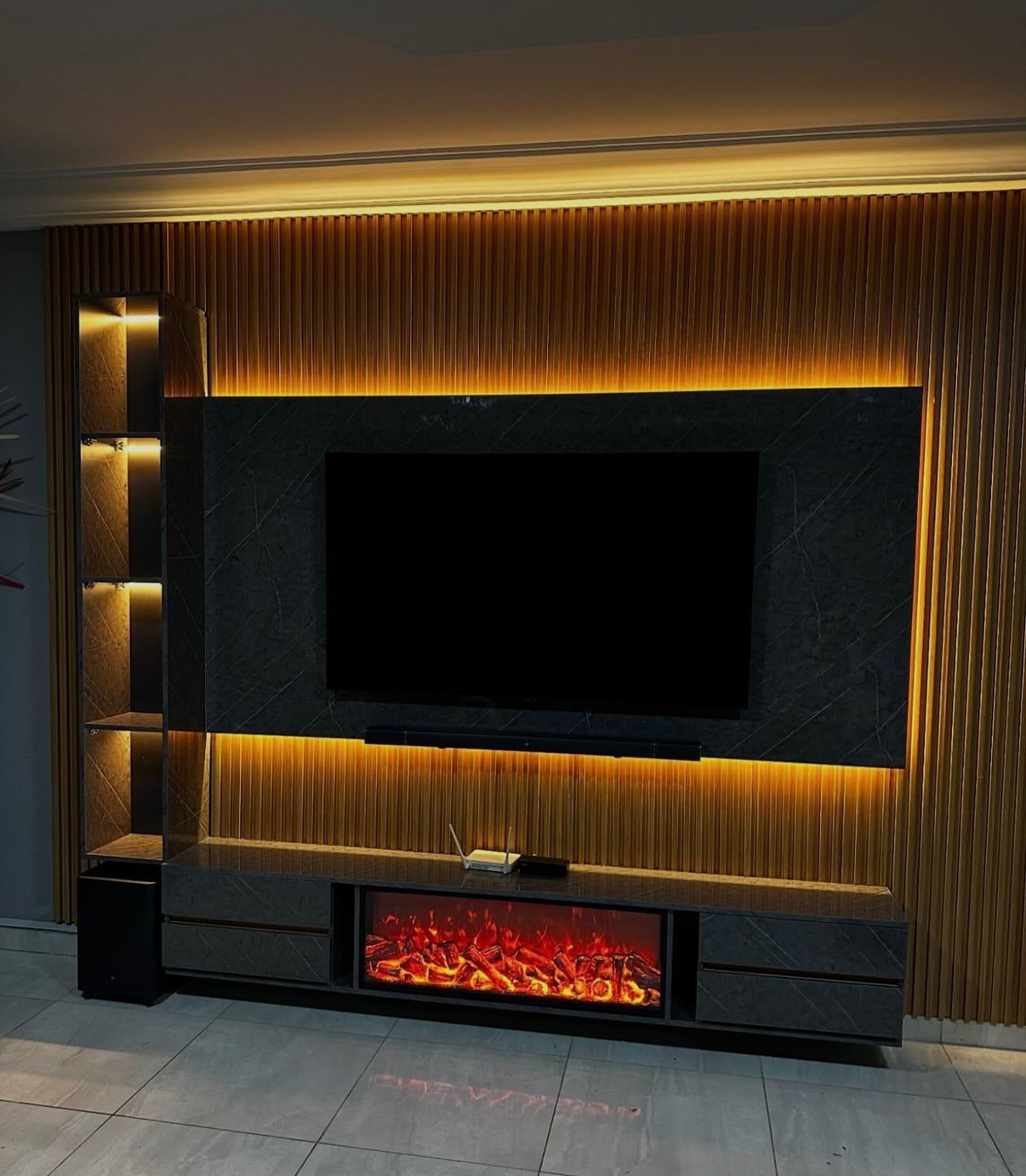
A made-to-measure unit or wall can route them: a conduit sized for the plugs, a pull cord, a service panel, and sockets placed where the equipment will sit. Our guide to cable routes you can still service explains how this is done so that a lead can be replaced without damaging the wall, and socket and power planning explains how we decide which sockets can stay. If the sight of the wires bothers you, that is a real reason to choose made-to-measure. If it does not, a ready-made unit with a tidy back is fine.
Ventilation matters in both. Equipment needs air, and a closed door on a ready-made cabinet can trap heat as easily as a custom one. Check that whatever you choose leaves room for air around the devices; see TV ventilation in a niche for how much a screen and a receiver need. And if you add a soundbar, soundbar and speakers shows where it fits.
Materials, finish and what to ask about both
Neither kind of unit is automatically better made. A ready-made unit can be well built or poorly built, and so can a custom one. What you can do is ask the same questions of both: what is the board, how thick, what is the finish, how are the edges treated, what hardware is fitted, what is the warranty and what does it exclude. The board maker EGGER explains that decorative laminate is a very thin sheet glued onto a core board, so if any unit says laminate it is fair to ask which core sits underneath.
For our own units, the wood-based boards carry a 5-year limited warranty. Hinges, runners, labour and misuse are excluded, and our workmanship has a separate written 24-month warranty. We state this plainly because the question that matters for any unit is not how long the warranty is but what it covers. Ask the same of a ready-made unit, and compare what the answers actually say rather than the number of years.
A made-to-measure unit also lets you choose the finish to suit the room. Our guide to media wall colour and finish explains how finishes read in UAE light, and approving the finish sample shows how to check one in your room. A ready-made unit comes in the finishes it comes in, which may or may not match your floor and curtains; check it against them before buying, not after.
Price today and cost over the years
A ready-made unit has an advantage that is hard to beat: the price is on the label, and it is simple to read. A made-to-measure unit is priced after the wall is measured, from a drawing. Our entry price, from AED 3,500 per project, is for a compact panel with a floating console in standard laminate, and everything above it depends on the wall and your choices. Our price guide explains the entry brief, and what changes a media wall price explains why it moves.
Over the years the comparison shifts. A ready-made unit often moves with you, so its cost is spread over several homes. A made-to-measure unit fits one wall and usually stays with it, so its cost is spread over the years you live there. A unit that fits well may also save money elsewhere: no extra shelf to hide a socket, no filler strip to close a gap, no replacement when the TV grows. These are modest effects, and which way they point depends on your life.
The honest summary is that a ready-made unit is cheaper to start and easier to carry, and a made-to-measure unit costs more to start and fits better. The question is how much the fit is worth to you. If you plan to stay, if the wall is awkward, if you want hidden cables or a floating console, it is probably worth a good deal. If you are renting for a year in a plain room, probably not. Our budget guide shows how to spend on a made-to-measure unit if you do choose one.
Four life events and what each does to your choice
The drawing below sets out four events that happen to most households, and what each does to a ready-made unit and a made-to-measure wall. You buy a larger TV: a ready-made unit may need its top width and weight rating checked again; a made-to-measure panel was drawn with a margin for it. You move house: a ready-made unit usually goes with you; a made-to-measure one stays, unless it was planned as removable. You need more storage: you can add another ready-made piece beside the first; a made-to-measure wall takes a new cabinet only if the drawing left room. A drawer front is damaged: spare parts for a ready-made unit depend on the maker, and for ours the boards carry a 5-year limited warranty, with hinges and runners excluded.
None of these events is a reason to choose one or the other. They are a way of asking what you will want in five years. If your life is likely to move, a unit that moves with you is worth more. If your life is likely to stay, a unit that fits is worth more.
If you rent, the question has an extra layer. Removable or relocatable designs are possible, though not every fitted piece can be removed; it depends on the construction. Whether you may fix to the wall at all is a question for your landlord, in writing, and our guide to moving out and leaving a media wall as found covers the end of the tenancy.
- 1. A larger TV: check the top width and rating, or use the panel margin
- 2. Moving house: a ready-made unit moves, a made-to-measure wall usually stays
- 3. More storage, a damaged front: depends on room in the drawing and on the maker
Five questions that tip the balance
If you are still undecided, ask yourself five questions. Is the wall awkward, with a column, an alcove or an uneven face? Will you stay in the home for years? Must the cables vanish into the wall? Is the budget the smallest sensible one? Will you take the unit with you when you move? Each answer leans towards one choice, as the drawing below shows.
Count which end most of your own answers sit near. If an awkward wall, a long stay and hidden cables dominate, made-to-measure is the stronger answer. If a small budget and a likely move dominate, ready-made is. If the answers split, a compact panel with a floating console may be the middle way: it is made to measure but modest, and it is the design our entry price describes.
The drawing is not a test with a right answer; it is a way of putting your own situation in order. A person who answers yes to the awkward wall and yes to the move has a genuine conflict, and the conflict is worth talking through. That is what the free measuring visit is for. Our guide to planning a media wall also helps you list what the unit has to do.
- 1. Awkward wall, a long stay and hidden cables lean towards made to measure
- 2. A small budget and a likely move lean towards ready-made
- 3. If the answers split, a compact panel and floating console is the middle way
If you buy a ready-made unit: what to check
A ready-made unit can be a good choice, and a good choice is a checked one. Measure your TV's width and weight and check them against the unit's top and its stated rating. Measure the wall run and the depth available. Check where the cable holes are and whether they suit your sockets. Look for the anchor point and the strap, and decide what you will fix them to. Check the finish against your floor and curtains. And find out what happens if a part breaks: who supplies spares, and for how long.
Fit the anchor. This is the one step that is easy to skip and expensive to regret; the CPSC advice applies to any TV on any furniture. And keep the TV pushed back on the unit, with the unit pushed back against the wall, as far as the cables and the skirting allow. A ready-made unit that is anchored, matched to the TV and checked against the wall is a sound purchase.
If, after measuring, you find the standard width leaves large gaps or the depth takes too much floor, that is useful information. It may be that a made-to-measure console is a better answer, and it is worth a message to ask. Our custom media walls product page shows what is possible.
What to check before you buy a ready-made unit
TV width and weight
- What to look for
- The unit's top is wider than the screen, with a stated rating that covers the weight
- Why it matters
- A narrow stand or an overloaded top is unsafe and looks unsettled
Wall run and depth
- What to look for
- The unit fits with the skirting and any column, and does not project too far
- Why it matters
- Gaps and depth take floor and look unplanned
Cable holes and sockets
- What to look for
- Holes sit where the plugs reach, and the socket is not hidden behind
- Why it matters
- Cables on view, or a plug that cannot be reached
Anchor point
- What to look for
- A fixing point and strap are supplied, and the wall will hold them
- Why it matters
- A TV on furniture should be anchored to the wall
Finish against the room
- What to look for
- Colour and sheen suit the floor, the curtains and the light
- Why it matters
- Cannot be changed after delivery
Spares and warranty
- What to look for
- Who supplies parts, and what the warranty covers and excludes
- Why it matters
- A broken front is common; the answer should be known
These are questions to ask of any unit. We make no claim about any particular product.
If you have one made: what to ask
Made-to-measure has its own questions. Is the unit measured in person? Is there a drawing before anything is cut, with the sizes and the finish reference on it? Is the quotation itemised, with the hardware and any electrical work on separate lines? What is the board and what is the finish? How is the unit fixed, and to what? What does the warranty cover and exclude? How long will it take, and what does that depend on?
These are the same questions that run through our other guides. What a quotation must show lists the lines, how to compare media wall quotes shows how to put two quotations side by side, and hidden costs in a TV wall lists what turns up after the quote. If you are choosing a maker, how to choose a media wall contractor goes into the questions in depth.
Our own process follows the same shape: the measuring visit is free, with samples; then the drawing and an itemised quotation; once measurements and details are agreed, a 60% advance is paid and production starts when it is received; and the unit is built to the approved drawing in up to about 10 days, depending on size and design. If you want to see what a made-to-measure wall looks like finished, our media walls with display shelving page and Sharjah media walls page show examples.
Four households, four answers
A tenant in a flat with a plain, flat wall, who may move in a year. A ready-made unit, anchored, with a tidy back. The wall is straight, the lease is short, and a unit that moves is worth more than a unit that fits. If the tenant wants a neater look, a removable design is worth asking about.
A couple in a new apartment with a recess for the TV, planning to stay. A made-to-measure console and panel, drawn to the recess. A ready-made unit would leave gaps either side and the recess would still show, and the couple will see it every day for years.
A family in a villa with an old plastered wall and a column at one end. Made-to-measure, from the column to the far wall, with the support designed for the actual wall. The wall is the problem, and a unit drawn to it is the answer.
A student in a shared flat with a tight budget. A ready-made low unit, pushed back and anchored. It is cheap to buy, easy to carry and good enough. For each household the right answer is the one that matches the wall and the life, which is why we ask for photos of the wall before we offer an opinion.
What we do about it, and what to send us on WhatsApp
We make made-to-measure units and media walls in our Sharjah workshop and fit them across the UAE, from AED 3,500 per project for a compact panel with a floating console in standard laminate. If, after hearing about your wall, a ready-made unit seems the better answer, we will say so. The measuring visit is free and we bring samples. The wood-based boards carry a 5-year limited warranty, with hinges, runners, labour and misuse excluded, and our workmanship has a separate written 24-month warranty. Our founder, Ali Haider Basra, has ten years in the trade.
To get an honest view, send a WhatsApp with a photo of the whole wall, its rough width, your TV size or model, and a note of whether you rent or own and how long you expect to stay. Add anything you have already looked at, including a ready-made unit you are considering. The consultation checklist lists what helps, and you can see the range on our media walls service page.
Common questions
Is a custom TV unit better than a ready-made one?
Not always. It fits an awkward wall and hides cables better; a ready-made unit is cheaper to start and moves with you. Match the choice to the wall and the life. Media wall or TV unit.
Do I need to anchor a TV unit to the wall?
Yes. The US CPSC advises anchoring TVs and furniture to the wall; fit the anchor into something that will hold. Block walls versus gypsum.
How much does a made-to-measure TV unit cost?
Our entry price is from AED 3,500 per project for a compact panel and floating console in standard laminate; the final figure comes from the quotation. What AED 3,500 buys.
Can a custom unit move with me when I rent?
Removable or relocatable designs are possible, though not every fitted piece can be removed. Ask your landlord in writing first. Moving out and leaving the wall as found.
Will a ready-made unit fit my wall?
Measure the run, the depth, the skirting and the socket first. A plain flat wall suits a standard unit; a column or recess leaves gaps. Planning a media wall.
What is the middle way between a unit and a full wall?
A compact panel with a floating console: made to measure but modest. Full wall or compact media wall.
How do I start?
Send a photo of the wall, its width, your TV size and whether you rent or own on WhatsApp. What to send us.

Sources & specifications
Manufacturer information applies to the named products and systems. Sources reviewed on 10 November 2026.
- US CPSC news release, 9 Feb 2023: anchor TVs and furniture; tip-over injuries and fatalities; a sturdy low base and pushing the TV back if not anchoredcpsc.gov(opens in a new tab)
- HomeKode, 21 May 2026: small living room TV unit ideas in UAE apartments (at least as wide as the screen, floating units, avoid deep profiles, matte finishes)homekode.com(opens in a new tab)
- MantelMount, 10 Dec 2025: mounting a TV on metal studs, brick, concrete and plaster (fastener by wall type; anchor capacity at least four times the TV weight)mantelmount.com(opens in a new tab)
- EGGER: what is laminate (about 0.8 mm laminate, 18 mm faced boards)egger.com(opens in a new tab)
Want this planned for your home?
Consultation and measurement are free. Tell us the rooms, location and what you need; we arrange a sample visit and define the measured quotation.