Media Walls · 18 min read · 9 October 2026
A budget media wall that lasts in the UAE: spend in the right order
How to spend a tight media wall budget in the UAE so the wall lasts: a priority ladder, the five wear points, where the eye lands, phasing and what to keep, trim or postpone.

By Ali Haider Basra, Founder, Al Tareeq Decor · Contact our workshop
Key takeaways
- A small budget and a wall that lasts are not opposites: the order of spending matters more than the amount.
- Use a ladder: protect the unseen base, keep the screen panel and console, add one accent, and leave the rest for later if the drawing plans for it.
- Five places take the wear: door edges, hinges and runners, the LED driver, the TV support and the floor edge. Hardware is outside the 5-year board warranty, so choose it well.
- Spend around the screen and on the console; save at the outer edges. One accent gives focus; two multiply the work.
- Phasing works only when the first drawing plans every phase. Entry price: from AED 3,500 per project.
On this page
- Key takeaways
- A small budget and a wall that lasts are not opposites
- Start with the ceiling, not the wish list
- The budget ladder: protect, keep, add, later
- Protect the unseen base
- Keep the two parts that every wall needs
- Where the eye lands: spend there, save elsewhere
- Five places that take the wear
- Finishes on a budget
- Build it in phases, but plan every phase on day one
- Lighting on a budget
- Storage and the room it lives in
- Keep, trim, postpone: a table for a tight budget
- Keep, trim or postpone on a tight budget
- Three imagined budgets
- False savings that make a cheap wall expensive
- What we do about it, and what to send us on WhatsApp
- Common questions
A small budget and a wall that lasts are not opposites
People often ask for a cheap media wall as if cheap and lasting were two ends of a rope. In joinery they are not. A modest wall that is well planned, with sound support, a sensible cable route and hardware that closes properly, can outlast an expensive wall that was drawn in a hurry. What separates them is rarely the amount of money. It is where the money goes.
This guide is about spending a limited budget in the right order. It starts from the one price we publish, from AED 3,500 per project for a compact panel with a floating console in standard laminate, and shows how to decide what to add above it, what to leave until later and what to protect at all costs. It does not repeat the price breakdown in our media wall price guide, nor the explanation of why two walls differ in what changes a media wall price. It is a method for the person who has a ceiling on what they can spend and wants the wall to be worth it in five years.
The method has four parts: a ladder of priorities, a set of places that take the wear, a map of where the eye lands, and a plan for building in phases. None of it needs an amount to be named, so you can apply it to whatever figure you have in mind.
Start with the ceiling, not the wish list
The usual way to plan is to collect pictures, make a wish list and then ask what it costs. With little money the reverse order serves you better. Decide the most you are willing to spend, and then ask what the best wall inside that ceiling looks like. A wall designed to a ceiling has fewer regrets than a wall cut down from a dream.
Write down three things before you speak to anyone. The ceiling, as an honest figure that includes a margin for the unexpected. The non-negotiables, meaning the two or three things the wall must do: hide the cables, carry the TV safely, hold the router and the receiver. And the nice-to-haves, in order, from the one you would add first to the one you would add last. The ceiling and the non-negotiables set the shape; the nice-to-haves tell us what to leave room for.
Keep a margin. A wall priced to the last dirham leaves no room for the one change that always comes. If you have to choose between a slightly smaller wall and no margin, choose the smaller wall. Our guide to hidden costs in a TV wall lists what typically needs a margin.
The budget ladder: protect, keep, add, later
Think of the wall as four tiers, each resting on the one below. At the bottom is what you protect: the unseen base, meaning the support behind the TV, the route for the cables and the access for service. Above it is what you keep: the screen panel and the console, the two parts every wall of this kind needs. Above that is what you add if there is room: one accent, such as slats on one side or a lit panel edge. At the top is what you leave for later, provided the drawing plans for it: an electric fireplace, display units and extra storage.
Spend from the bottom up and stop where the budget stops. The reason is simple: the lower tiers cannot be added afterwards without rebuilding, while the upper tiers can. A wall with a proper base and a plain face can be upgraded for years. A wall with a lovely face and a weak base has to be taken apart to be mended. The drawing below shows the ladder.
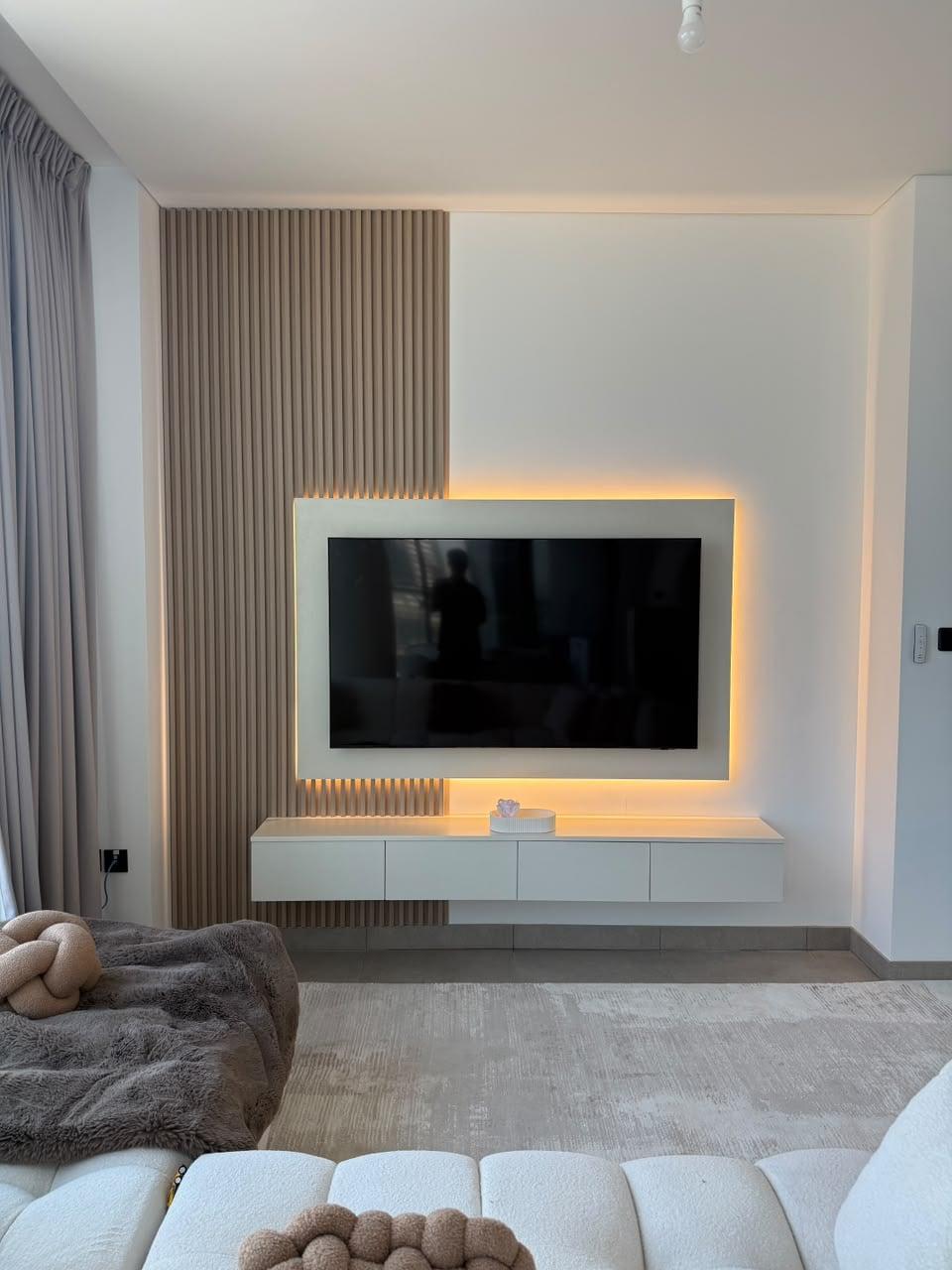
It is also worth saying what is not on the ladder: symmetry. A wall does not need to be symmetrical to look right, and spending to make it so is one of the commonest ways to burn a budget. A single accent beside the screen, balanced by a plain section on the other side, often looks more deliberate than two matching halves.
- 1. Protect: support behind the TV, the cable route and service access
- 2. Keep: the screen panel and the console
- 3. Add one accent if there is room; the rest is later, if planned now
Protect the unseen base
The bottom tier is the one nobody photographs. The first part is the support behind the TV: whatever the screen is fixed to has to be fixed to something solid. Whoever fixes a screen to a wall should match the fixing to the wall type, as the mount maker MantelMount's guide stresses. We look at the wall during the free measuring visit, and our guide to block walls versus gypsum explains why a panel can look the same on two walls and be built very differently behind.
The second part is the cable route. A wall that hides the cables but cannot be opened to replace one has a hidden problem: when a lead fails, the wall has to be damaged. Conduit sized for the plugs, a pull cord and a service panel cost little to draw and a lot to retrofit. Our guides to cable routes you can still service and socket planning explain the details, and they are the best money you will spend on a small wall.
The third part is ventilation and access for the things that make heat: the TV itself in a niche, the receiver in the console, the light driver. See TV ventilation in a niche for how much air a screen needs. A budget wall that overheats its equipment is not a saving. None of this shows from the sofa, and all of it is what makes the difference between a wall that lasts ten years and one that is opened up in two.
Keep the two parts that every wall needs
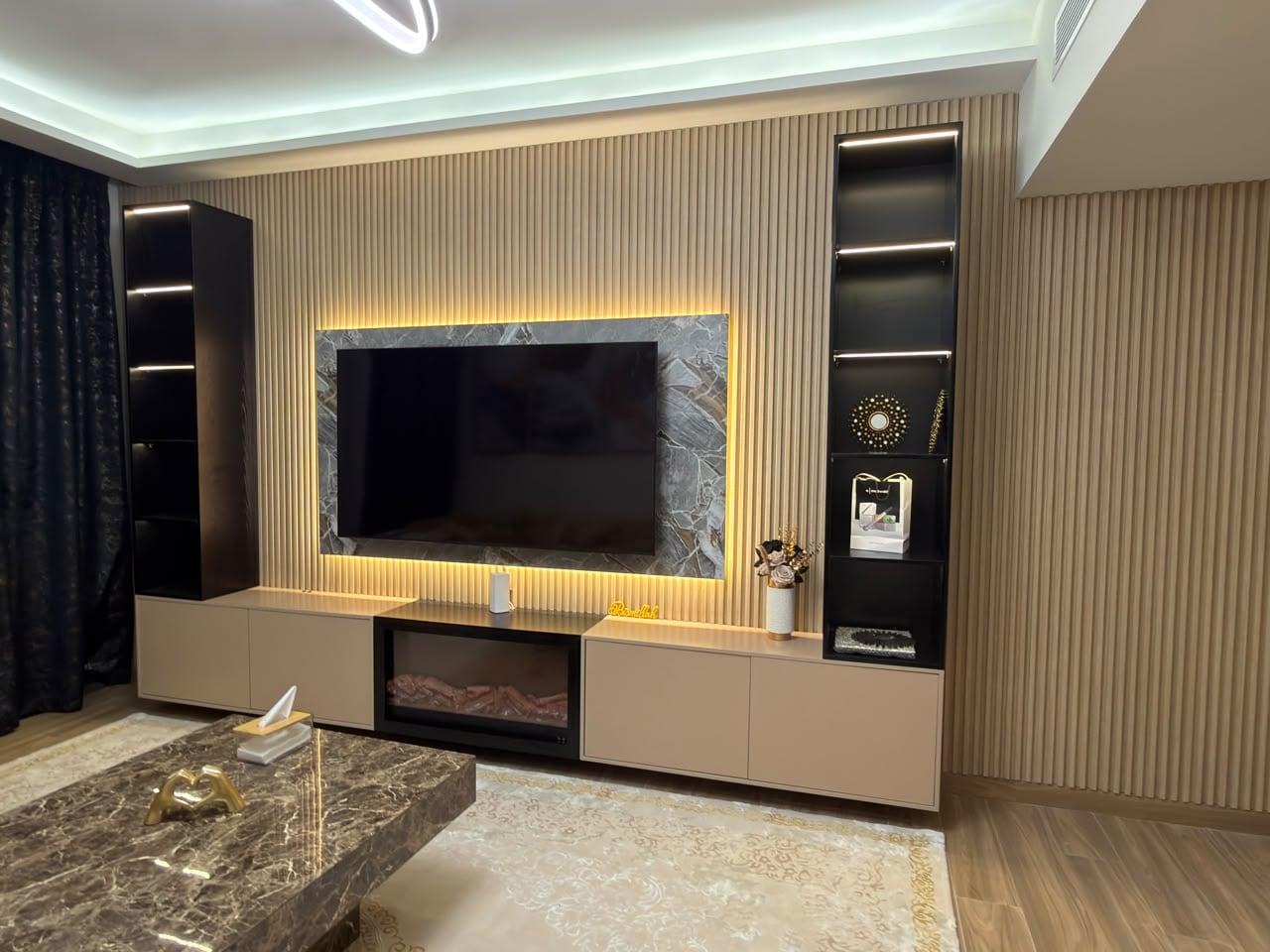
The screen panel and the console are the heart of a small wall, and getting them right matters more than adding anything else. The screen panel gives the TV a background that finishes the wall and hides the fixings; the console gives the equipment a home and clears the floor. Together they are the compact design that our entry price describes.
The panel's size should follow the TV, with a margin that leaves room for the next one. Our guide on TV size and viewing distance helps you settle the screen, TV height on a media wall helps you set the position, and changing the TV later explains how much margin to leave. If you are still choosing a television, buying the TV before the wall shows why the model matters to the drawing.
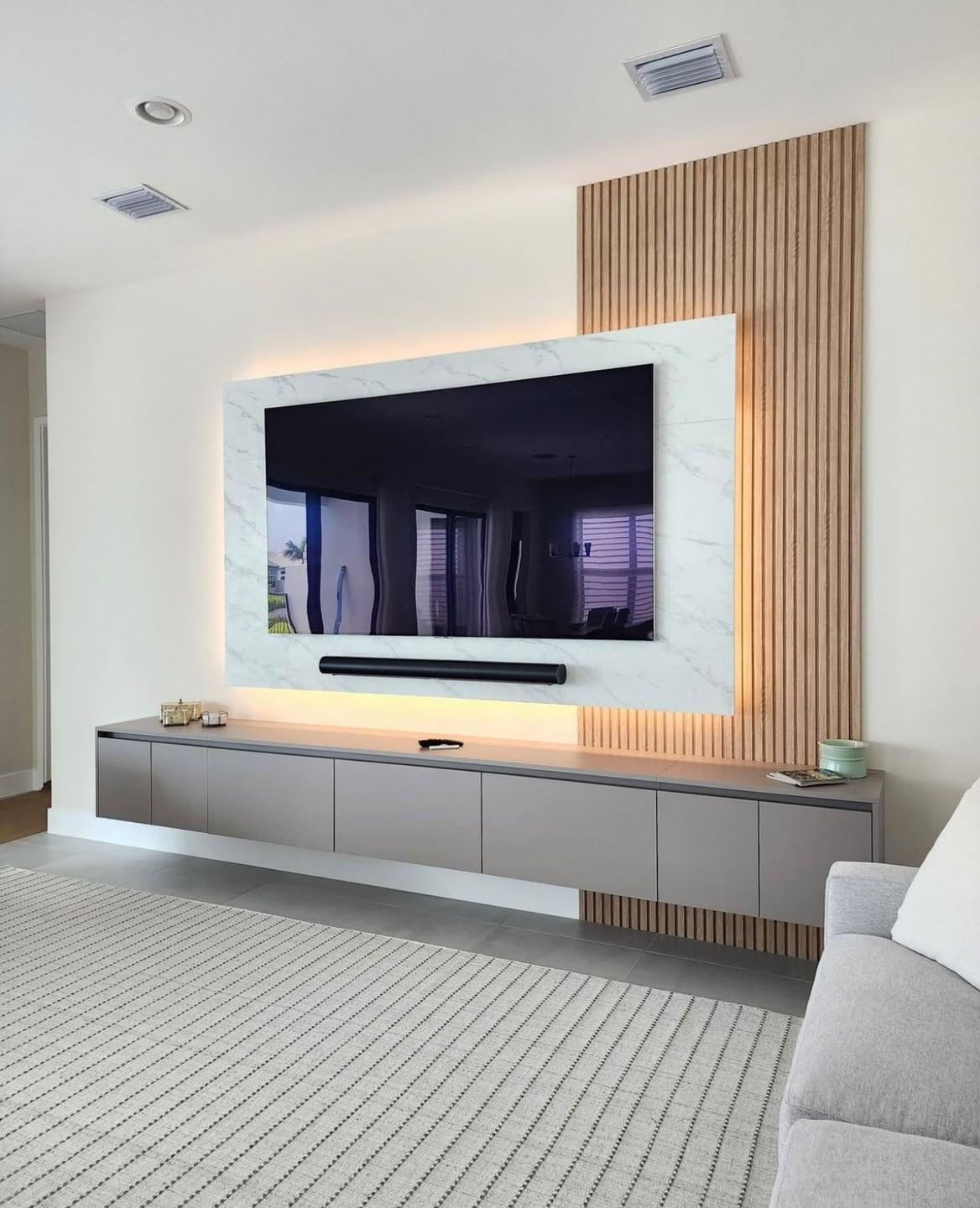
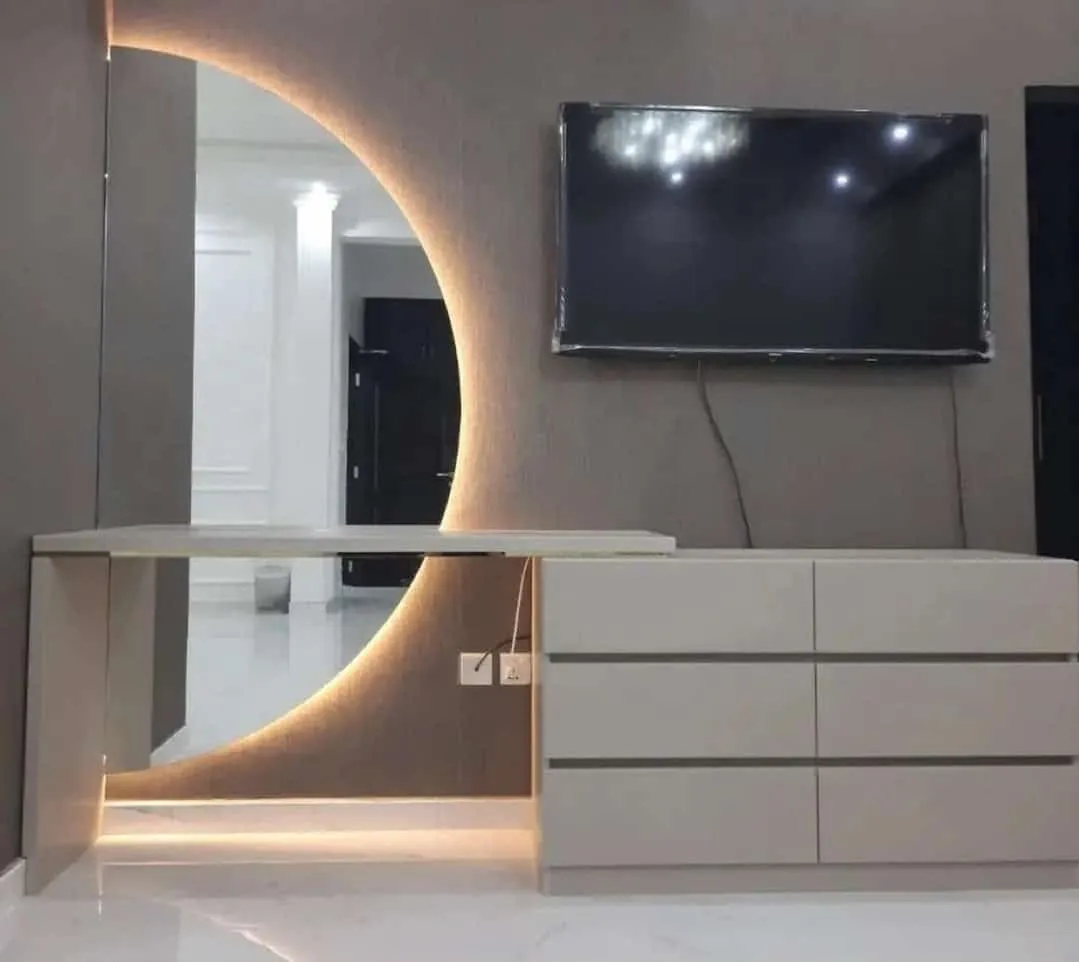
A floating console is a good choice for a small room. HomeKode, a UAE retailer writing about small living rooms, recommends wall-mounted or floating units, closed storage with a few drawers and minimal open shelving, and says matte finishes tend to work better than high gloss in small UAE living rooms. We would add one thing: a floating console also frees the floor under it, which makes a small room feel larger and is easy to clean. Small living room media wall goes further on compact planning.
Where the eye lands: spend there, save elsewhere
Look at any media wall from the sofa and your eye goes to the screen, then to what frames it. The edges of the wall, the band above the panel and the far side of the room get a glance, if that. A budget wall should be spent accordingly: richer finish and better hardware on and around the screen and the console, plain laminate and simple lines where nobody looks.
The drawing below marks the zones. The centre around the screen is where to spend: a good panel, a good face, a clean lit edge if you can. The console is the second place: it is touched every day, so its hardware earns its cost. The outer strips and the band above the panel are where to save, in plain laminate. The flanks, where slats would go, and the fireplace position are for later.
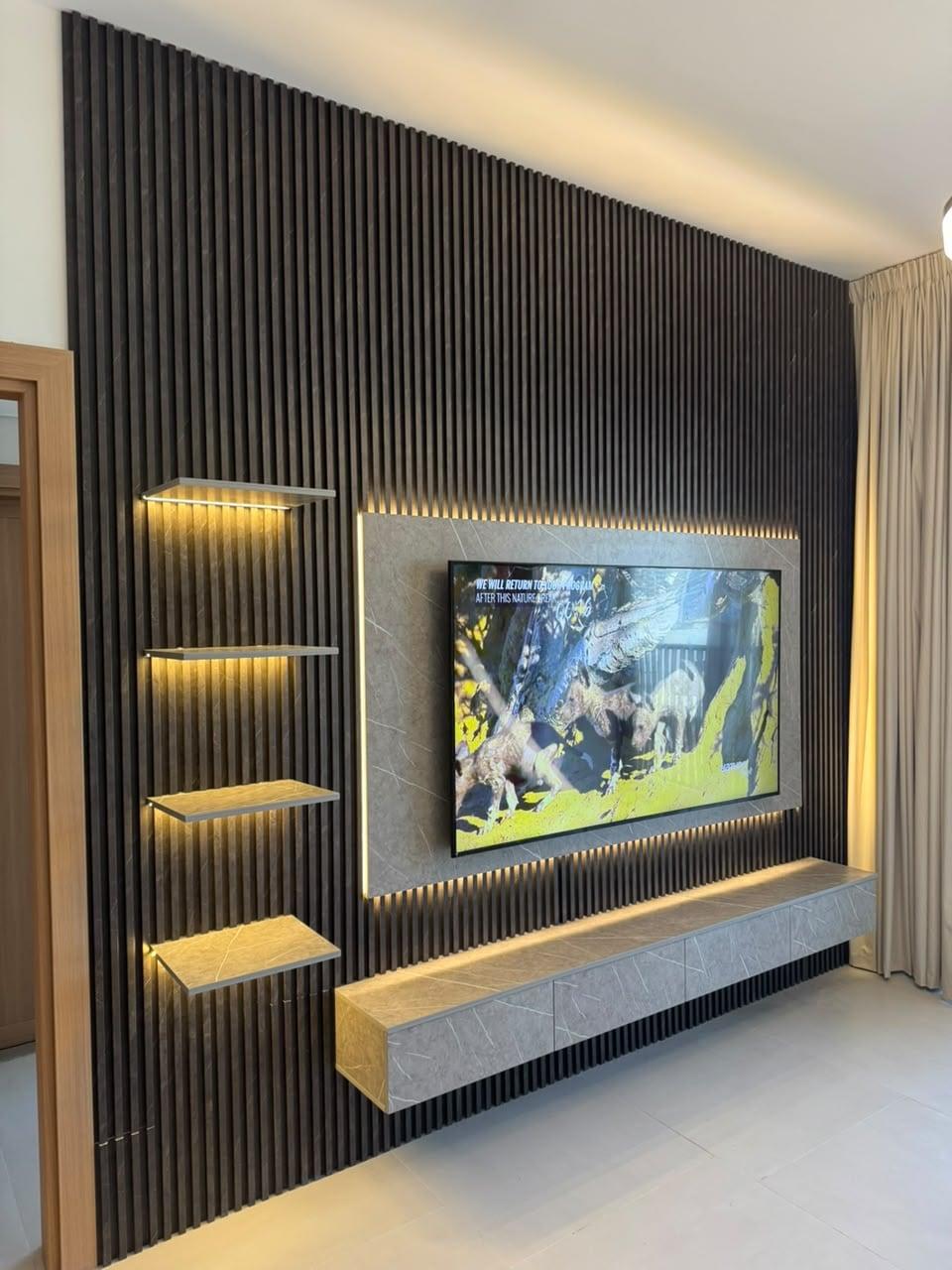
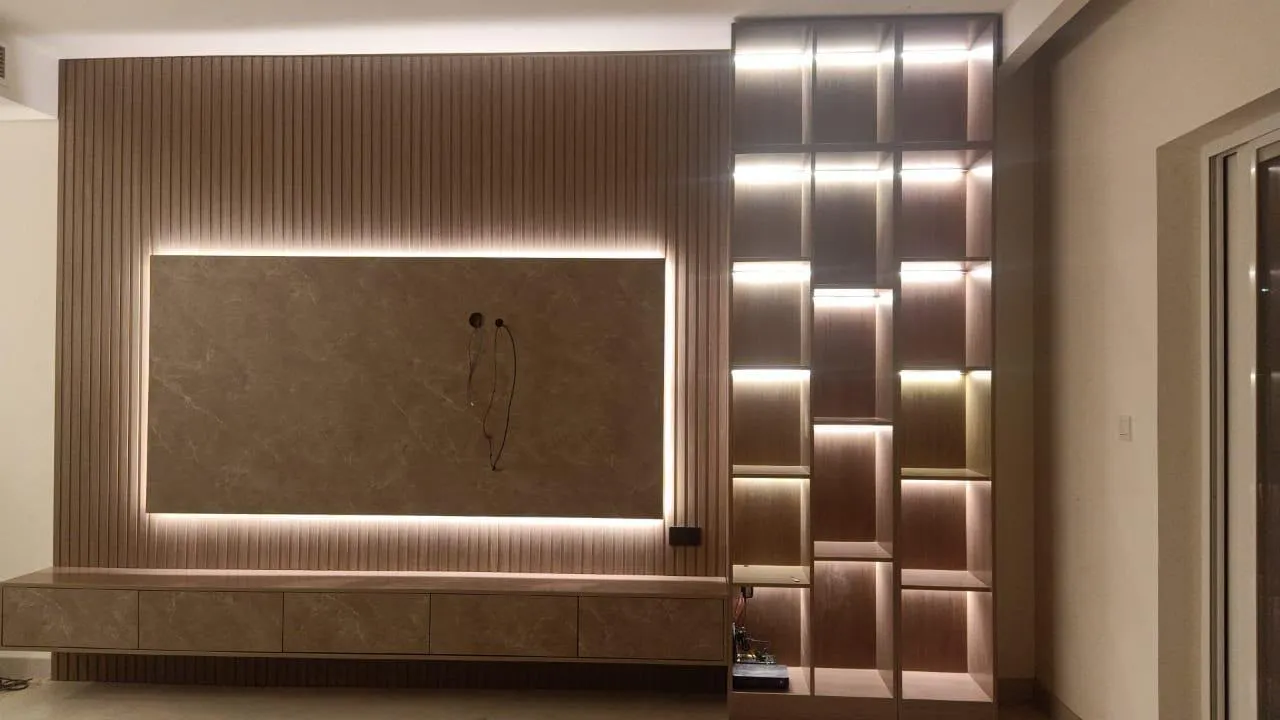
This approach also explains why one accent works better than several. Slats on one side of the screen, with the other side left plain, create focus. Slats everywhere create texture but no centre, and they multiply the number of pieces to cut and fix. For the effect of slats on a wall and how profiles differ, see fluted and slatted TV walls. And since a budget wall usually has one finish to spare, media wall colour and finish shows how to choose one that suits your light.
- 1. Spend: behind and around the screen, and on the console with its hardware
- 2. Save: the last half metre, the band above the panel, plain laminate
- 3. Later: slats on the flanks and a fireplace, if the drawing allows
Five places that take the wear
A wall wears in particular places, and a wall that lasts is mostly about those places. The first is the edges of the console doors and drawer fronts, touched every day; ask how edges are treated and have it named on the quotation. The second is the hinges and drawer runners, the moving parts; choose soft-close hardware and make sure it is listed line by line. The third is the LED driver: if lights are fitted, the driver should sit behind a hatch you can reach without tools. The fourth is the support behind the TV, which must be fixed into proper backing and shown on the drawing. The fifth is the floor edge: a floating console keeps the base of the wall away from mops and spills.
Our warranty is worth understanding here, because it shapes where you should look. The wood-based boards carry a 5-year limited warranty; hinges, runners, labour and misuse are excluded, and our workmanship has a separate written 24-month warranty. So the hardware, which does most of the moving, is exactly what the board warranty does not cover. That is a reason to choose it well and to ask about it, not a reason to worry.
Cheap walls rarely fail on the surface first. They fail at these five. A budget that protects them lasts; a budget that spends on the face and starves these points does not. The drawing below puts the five on a wall, with what protects each.
- 1. 1 and 2: door edges, and hinges and drawer runners
- 2. 3: the LED driver, behind a hatch you can reach
- 3. 4 and 5: support behind the TV, and the floor edge
Finishes on a budget
Standard laminate is our entry finish and a good one for a budget wall. EGGER's explainer puts decorative laminate at roughly 0.8 mm, glued to a core, and says faced boards are usually 18 mm overall. It is hard-wearing, easy to wipe and consistent from board to board. Choose a matte or low-sheen surface: it hides marks and dust better than gloss, and, as HomeKode notes for small UAE living rooms, matte finishes tend to work better.
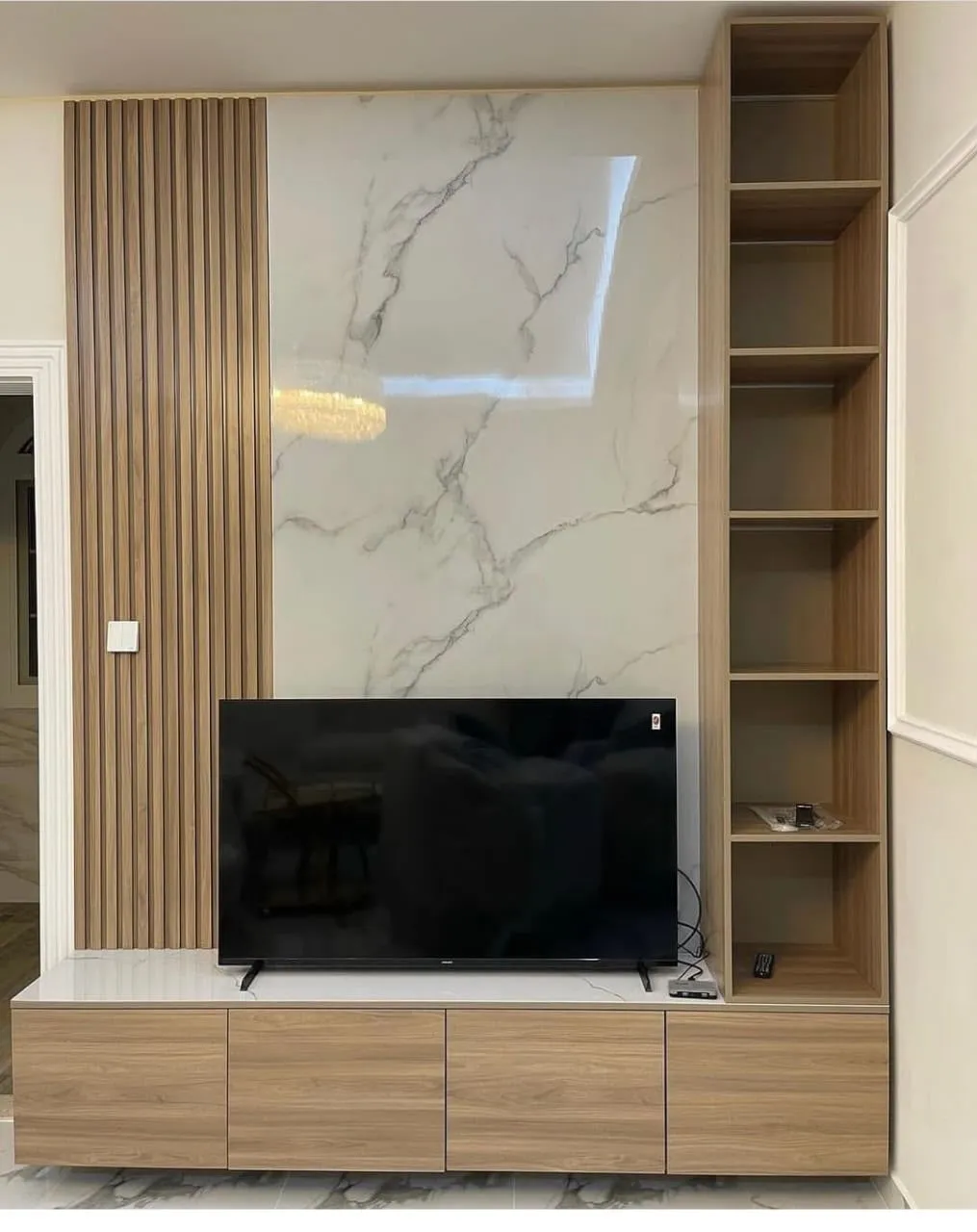
If you want to spend a little more on the face, spend it on the screen panel only. Veneer, lacquer or a stone-look panel behind the screen changes how the whole wall reads, while standard laminate elsewhere keeps the total in check. Our guide to marble TV wall options shows the stone-look faces, and media wall colour and finish explains how finishes read in UAE light.
Also think about the core. A budget wall in a flat with air conditioning running all day has different needs from one in a humid ground-floor villa. Our guides to humidity and MDF boards and the four panel cores compared explain how to match the board to the room. Asking this before the drawing costs nothing and can save a wall.
Build it in phases, but plan every phase on day one
If the budget will not stretch to the wall you want, you can build it in phases. The condition is that the first drawing plans for all of them. A wall built in three phases looks like this: the first phase is the screen panel and a floating console; the second adds a lit panel edge and slats on one side; the third adds slats on the other side. The first drawing leaves space for the slats, runs power and a driver hatch to where the light will go, and fixes the panel so that the slats can sit beside it.
That planning is what makes phasing work. Without it, each phase is a small rebuild: the new slats do not line up, the power is in the wrong place, the driver is sealed in. With it, each phase is an addition. The drawing below shows three phases of one wall. The dashed zones are planned but not built.
A caution: phasing works only for additions that do not change what is already built. A fireplace needs its opening, recess and power drawn at the start, so you must decide on day one whether you ever want one. If you might, say so, and our electric fireplace guide shows what to leave room for. The same goes for display units; see TV walls with shelves. If you do not know, ask for the wall to be priced both ways.
- 1. Phase 1: screen panel and floating console, with space and power planned
- 2. Phase 2: a lit panel edge and slats on the left
- 3. Phase 3: slats on the right, and nothing is rebuilt
Lighting on a budget
Light is where budgets leak, because it is easy to add one more run. Choose one lit feature and let it carry the wall: a soft edge around the screen panel, or a lit niche, but not both and not every shelf. Our LED channels are 3000K (warm) or 4000K (neutral) with dimmers, wired by our own team; warm light is usually kinder in an evening living room.
If you cannot afford light now but may later, plan for it. A driver hatch and a power point in the drawing cost almost nothing at the start and are very hard to add afterwards. Then the lit edge, or the lit shelf, becomes a phase and not a rebuild. Our guide to media wall lighting ideas shows how to decide which feature deserves the light.
Do not skimp on the driver's access. A light strip that fails inside a sealed wall means opening the wall. That is the one saving in lighting that is false.
Storage and the room it lives in
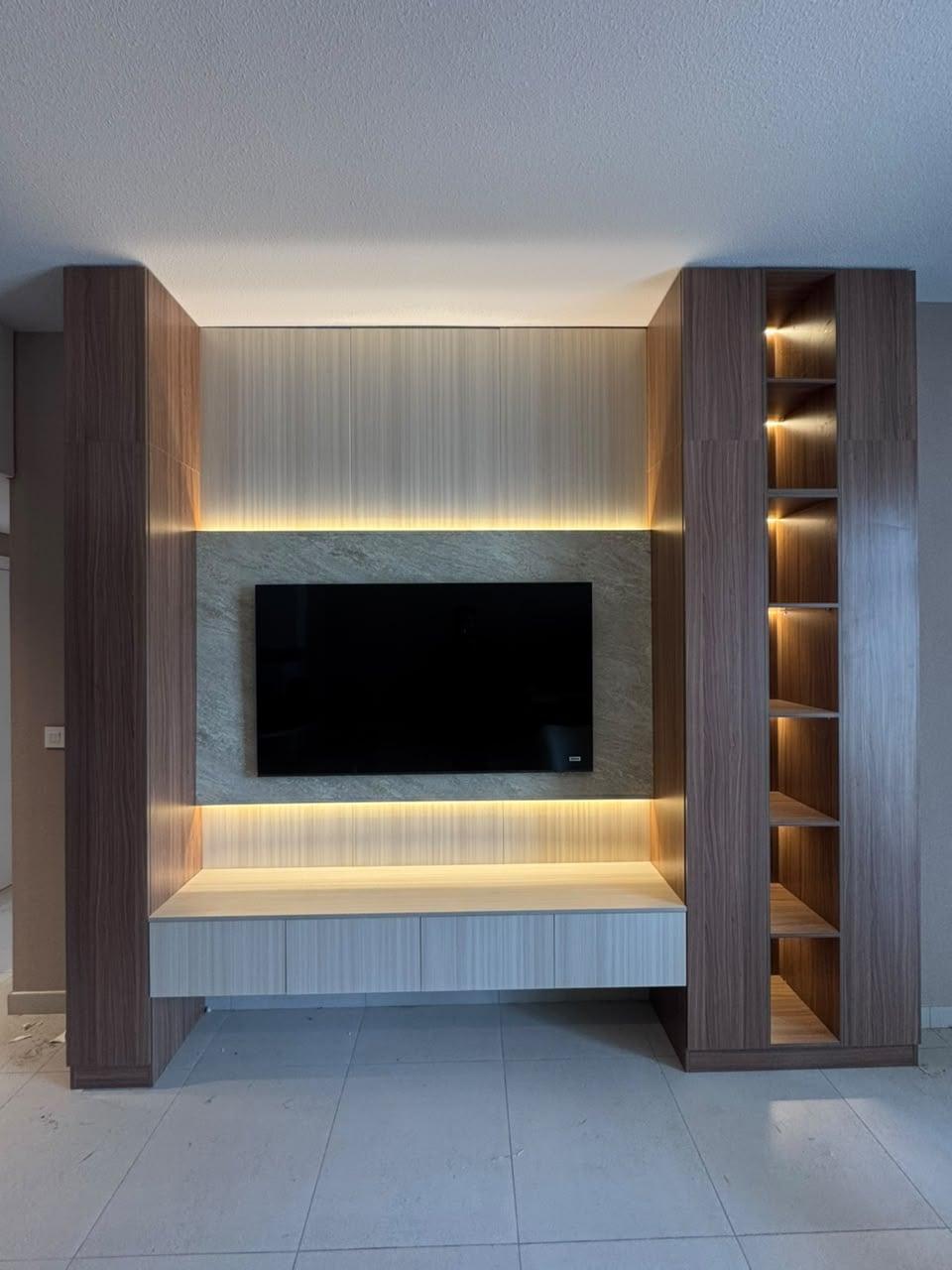
On a budget, storage is where the most money can be wasted, because it is easy to buy cabinets that hold nothing. List what has to live in the wall: router, receiver, games console, speakers, cables. Then size one well-planned cabinet for them, with room for plugs and air, and let the rest of the wall be clear. If you want display space, one open shelf or niche does more than three.
The room matters too. A bedroom needs different storage from a majlis; see bedroom TV unit and wardrobe and office media wall for other cases. In a small room, a floating console and a plain panel give the most for the least. In a large living room, a living room TV wall planned around the sofa distance can be built in phases. And if you rent, our guide to moving out and leaving a media wall as found shows what to think about before spending.
If a wall is not the right answer at all, a ready-made unit may be. Media wall or TV unit sets out the choice, and custom or ready-made TV unit looks at the trade-off in detail. A good ready-made unit properly anchored is better than a poor wall.
Keep, trim, postpone: a table for a tight budget
The table below puts the ideas together. Take the items down the left and decide for each: keep it, trim it or postpone it. Keep what protects the wall and what the eye lands on. Trim what adds area without adding focus. Postpone what can be added later if the first drawing plans for it.
Do not treat the table as fixed. A household that entertains will postpone less lighting and more storage; a household with children will keep the console hardware and postpone the display shelves. The point is to make each decision deliberately, in the order that protects the wall, so that when the money runs out the thing that is missing is a nice-to-have and not a foundation.
Keep, trim or postpone on a tight budget
Support behind the TV and the cable route
- Decision
- Keep
- Why
- Cannot be added later without rebuilding
Service access and the driver hatch
- Decision
- Keep
- Why
- A sealed driver turns a small fault into a demolition
Screen panel sized to the TV with a margin
- Decision
- Keep
- Why
- The focus of the wall, and the margin saves a rebuild
Console with soft-close hardware
- Decision
- Keep
- Why
- Touched daily; hardware is outside the board warranty
A richer finish on the screen panel only
- Decision
- Trim
- Why
- The eye lands there; plain laminate elsewhere
Slats on both sides
- Decision
- Trim to one side
- Why
- One accent gives focus; two multiply the pieces
Lit edge or lit niche
- Decision
- Trim to one feature
- Why
- Plan the power now, add more later
Closed storage beyond what you will fill
- Decision
- Trim
- Why
- Pay for what you will use
Electric fireplace
- Decision
- Postpone
- Why
- Only if the drawing plans for the opening and power
Display units and glass cabinets
- Decision
- Postpone
- Why
- Add when the budget allows; plan the socket now
Decide each item on your own wall; the table shows the order in which to protect it.
Three imagined budgets
First, a tenant in a one-bedroom flat with a modest ceiling and a tenancy that may end. The wall is a compact panel with a floating console, standard matte laminate, no lights beyond the room's own. The base is protected: solid fixing, a conduit and a service panel. Nothing is spent on symmetry. If the tenant moves, the question of what happens to the wall is settled with the landlord in writing.
Second, a couple in their first home who intend to stay. The wall is the same compact panel and console, with a richer face on the panel, one lit edge, and a drawing that leaves space and power for slats on one side. The slats are phase two, added a year later when the budget allows, and they fit because the first drawing planned them.
Third, a family with a second living room and growing children. The console hardware is the priority, since drawers are used daily, and the finish is hard-wearing matte. The display shelves are postponed. Lighting is a single soft edge. In each case the shape is the same: protect the base, keep the two parts, add one accent, plan the rest. Only the amounts differ, and they come from the quotation.
False savings that make a cheap wall expensive
A few savings are traps. A panel cut tight around today's TV has to be rebuilt when the TV grows. A console with no service access has to be opened when a lead fails. A bracket that was not on the quotation turns up on the day. A finish chosen from a small swatch under shop lighting disappoints in the room. A wall priced by the metre that quietly leaves out the lighting and the electrics looks cheaper than it is.
The last of these is the commonest. Our guide to comparing media wall quotes explains how to put quotations on one template so that you can see what a lower total leaves out, and what a quotation must show lists the lines every quotation should have. A budget wall deserves the same scrutiny as an expensive one, because a few missing lines matter more when the total is small.
A final trap is deciding too fast. Because the budget is tight there is a temptation to accept the first figure. Resist it for a day. Check the sample in your own light, read the drawing twice, and ask the questions in writing. Approving the finish sample covers the decision that most often goes wrong.
What we do about it, and what to send us on WhatsApp
We make media walls in our Sharjah workshop and fit them across the UAE, from AED 3,500 per project for a compact panel with a floating console in standard laminate. The measuring visit is free and we bring samples. The drawing and an itemised quotation follow, and once measurements and details are agreed a 60% advance is paid and production starts when it is received. A wall takes up to about 10 days depending on size and design. The wood-based boards carry a 5-year limited warranty, with hinges, runners, labour and misuse excluded, and our workmanship has a separate written 24-month warranty. Our founder, Ali Haider Basra, has ten years in the trade.
To plan a wall to a ceiling, send a WhatsApp with a photo of the whole wall, its rough width and height, your TV size or model, and the figure you are comfortable with. Add the two or three things the wall must do and the nice-to-haves in order. We will say which fit the ceiling, which to postpone and what the first drawing should leave room for. The consultation checklist shows what helps, and our media walls service shows the range. A budget wall that lasts is mostly a matter of order.
Common questions
What is the cheapest media wall that still lasts?
A compact panel with a floating console in standard matte laminate, with solid fixing, a serviceable cable route and soft-close hardware. We start from AED 3,500 per project. What AED 3,500 buys.
Where should I spend on a limited budget?
Around the screen and on the console and its hardware. Save at the outer edges and above the panel, where nobody looks. What changes a media wall price.
Can I build a media wall in phases?
Yes, if the first drawing plans every phase: space, power and a driver hatch for what comes later. Planning a media wall.
What should I never cut to save money?
The support behind the TV, the cable route, service access and soft-close hardware. These cannot be added later without rebuilding. Cable routes you can still service.
Is a ready-made TV unit cheaper than a media wall?
Often at first, but it does not hide cables or fit a wall edge to edge. Custom or ready-made TV unit.
Does the warranty cover hinges and drawer runners?
No. Our 5-year limited warranty covers the wood-based boards only; hinges, runners, labour and misuse are excluded, and workmanship has a separate 24-month warranty. Hidden costs in a TV wall.
How do I get a plan to a fixed ceiling?
Send photos of the wall, your TV size and the figure you are comfortable with on WhatsApp. What to send us.

Sources & specifications
Manufacturer information applies to the named products and systems. Sources reviewed on 10 November 2026.
- HomeKode, 21 May 2026: small living room TV unit ideas in UAE apartments (floating units, closed storage, matte finishes)homekode.com(opens in a new tab)
- EGGER: what is laminate (about 0.8 mm laminate, 18 mm faced boards, layers of a laminate)egger.com(opens in a new tab)
- MantelMount, 10 Dec 2025: mounting a TV on metal studs, brick, concrete and plaster (the fastener changes with the wall)mantelmount.com(opens in a new tab)
- GR8 Fires: how much does it cost to build a media wall (size, design detail, materials and finish, appliances named as cost drivers)gr8fires.co.uk(opens in a new tab)
- Citizens Advice (Scotland): before you get building work done (written quote with fixed total and breakdown)citizensadvice.org.uk(opens in a new tab)
Want this planned for your home?
Consultation and measurement are free. Tell us the rooms, location and what you need; we arrange a sample visit and define the measured quotation.