Media Walls · 21 min read · 31 October 2026
MDF or plywood for a media wall in the UAE: which board goes where
MDF or plywood for a media wall, part by part: how each board is built, screws and edges, shelf spans, damp wording, a decision path and what to write on the quotation.

By Ali Haider Basra, Founder, Al Tareeq Decor · Contact our workshop
Key takeaways
- For the large, flat, finished parts of a dry media wall (screen panel, slat faces, console fronts), MDF is the usual choice: it has no grain or knots and takes laminate, veneer and lacquer evenly.
- Plywood is worth considering for a long open shelf, a heavily loaded cabinet side, and elements where the glue class can be named near damp.
- Shelf sag grows with the cube of the span: double the span and the sag is about eight times, so add a support or deepen the section.
- Neither board is waterproof. Ask for the grade or glue class and the edge sealing in writing, instead of accepting the single word board.
- Ask the quotation to name the board and its thickness for each element; a wall rarely needs one board throughout.
On this page
- Key takeaways
- MDF or plywood for a media wall: the short answer
- How each board is built
- The face: why MDF suits finished surfaces
- Screws, hinges and edges
- Where the choice matters on your own wall
- Shelves and spans: stiffness is a maths problem
- Damp, humidity and what to ask for in writing
- Weight: heavier is not always better
- MDF and plywood side by side, using only what we could verify
- How the board choice touches lighting, cables and heat
- A decision path you can follow in two minutes
- Three walls, three different boards
- What to write on the quotation
- What we do, and what the warranty covers
- Mistakes that cause most board disappointment
- Send us your wall on WhatsApp
- Common questions
MDF or plywood for a media wall: the short answer
For most media walls in a cooled, dry living room, MDF is the sensible board for the large flat parts: the screen panel, the slat faces and the console fronts. It has no grain, no knots and a very even surface, so laminate, veneer and lacquer sit on it without telegraphing anything through. Plywood earns its place in particular parts instead: a long open shelf, a heavily loaded cabinet side, or a zone where damp is a real risk and the glue class can be named on paper.
So the honest answer is rarely one board for the whole wall. A good drawing labels the core of every element, and the decision is made part by part, the way the diagram below walks through it. This guide explains how the two boards are built, why that changes the way screws, hinges, edges and shelves behave, what to write on a quotation, and which questions to put to any maker before a panel is cut.
A word on scope. Other guides on this site already cover the wider list of cores, including WPC and PVC, in our comparison of MDF, WPC, PVC and wood. The layer-by-layer anatomy of a wall is in the materials list. This page does one narrow job: MDF against plywood, part by part, for a wall that holds a television.
How each board is built
Plywood is made from thin sheets of wood, called veneers, glued together under heat and pressure. The key detail, which APA (the Engineered Wood Association) puts at the front of its plywood page, is that the veneers are laid in cross-laminated layers with alternating grain directions. Wikipedia adds that each layer sits at right angles to its neighbour and that there is usually an odd number of layers so the sheet stays balanced. The practical result is a panel whose strength is similar along both directions, and that swells and shrinks less across its thickness than a plank would.
MDF, medium-density fibreboard, starts from the opposite idea. Wood residue is broken down into fibres, bound with wax and resin, and pressed hot into a sheet. Wikipedia notes that the mat is compressed to roughly one and a half times its finished thickness, which leaves the faces denser than the core, and that MDF contains no knots or rings, so it is more uniform than natural wood. The same page gives a typical density range of 500 to 1,000 kg/m³ for the category. That range is a category statement, not a promise about any one product, which is why a datasheet matters.
Put the two cross-sections side by side and the differences in daily behaviour start to make sense. Plywood has structure: you can see the layers on a cut edge, and each layer pulls against the next. MDF has uniformity: the same fibre everywhere, with a harder skin on each face.
The face: why MDF suits finished surfaces
Almost everything you see on a media wall is a finish applied over a board: high-pressure laminate, a sheet of real-wood veneer, sprayed lacquer or a marble-effect skin. Those finishes are thin. Veneer, for example, is sliced to a fraction of a millimetre; one veneer maker, Danzer, lists its standard sliced veneer at about 0.5 mm depending on the species. A skin that thin will copy whatever is underneath it, so the substrate has to be flat and uniform.
That is MDF's strongest argument. Wikipedia describes typical MDF as having a hard, flat, smooth surface that is suitable for applying a veneer, and it takes paint well when all faces and edges are sealed. A lacquered panel, where any dent or ridge is magnified by a glossy coat, is the clearest case. On the long, uninterrupted area behind a television, a plain MDF core gives the finishing line the least to fight against.
Plywood can carry a finish too, and it is common under veneer in furniture. Its drawback in a wall panel is that the face veneer of the plywood can show faintly through a very thin or glossy skin, and the layer lines show on any cut edge that is not covered. Where an edge will be seen, for instance the front of a floating shelf, you would normally cover it with a matching edge band, or choose a build that needs no visible edge at all. Either way, ask which edge treatment the drawing assumes; the quotation should say.
If the finish itself is still undecided, work through the finish and colour guide first, and then match the board to it. The board is rarely the most visible decision, but it quietly limits which finishes will look their best.
Screws, hinges and edges
Fixings are where the two boards really differ, and where most disappointment comes from. A media wall hangs doors on hinges, screws shelves to supports, fixes a bracket and joins cabinet sides. Every one of those depends on a screw gripping the board.
MDF holds screws better than its soft, dusty look suggests, provided it is treated properly. The European Panel Federation's MDF information site says MDF has good screw retention in both faces and edges, and gives the method: pilot holes sized at 85 to 95% of the screw's core diameter, and edge screws kept at least 70 mm from the corners. Wikipedia names the failure that follows when that is ignored: MDF may split when screws go into the edge without pilot holes, and fine-pitch screws hold poorly, especially in an edge.
Plywood's cross-laminated layers help with the same problem. Wikipedia notes that the cross-graining reduces splitting when fixings go in near an edge. That makes plywood attractive for a hinge side, a drawer-runner mounting or the end of a cabinet that carries a lot of weight. We did not find a published, like-for-like screw-withdrawal comparison between the two boards in the sources we opened, so we do not give a number or say one is stronger in every case. The honest reading is narrower: MDF performs well when it is drilled and screwed correctly, and plywood is more forgiving when someone is in a hurry.
What this means for you is a question of workmanship more than of material. Ask how the hinge plates are fixed, whether pilot holes are drilled, and whether heavy items such as a bracket are fixed into the frame behind the panel rather than only into a thin face. A board that is correct on paper can still be spoiled by a rushed fixing. Our guide to the backing frame and the TV bracket shows why the structure behind the panel decides the load, whatever the panel is made of.
Where the choice matters on your own wall
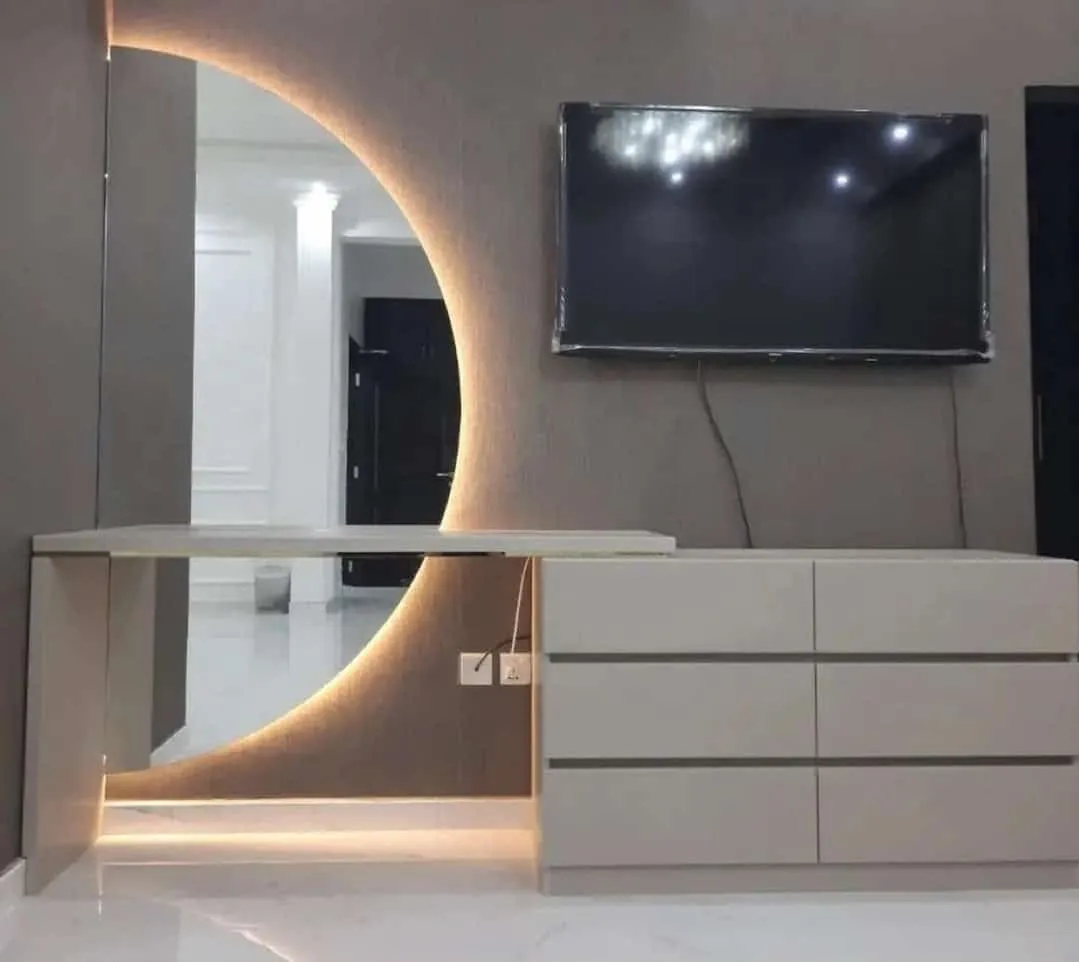
Take a typical media wall in elevation and number the parts where the board question is really live. The screen panel and the slat faces come first: they are large, flat and finished, and uniform MDF suits them. The console carcass is next, and either board can serve, so the deciding factors are the hinges, the drawer runners and the finish on the front.
A long open shelf is a different matter. It carries books, decor or a speaker, it is only supported at its ends or by a few brackets, and it is seen from the front. Its question is about stiffness over a span, which we come back to in the next section. At the foot of the wall, where the board meets the floor, the question is damp: a mop, a spill or a leak finds the lowest edge first. Finally, the edges where hinges and handles are fixed deserve their own attention, because that is where screws and splitting meet.
Five zones, five slightly different questions: that is why a quotation that says only one board for the whole wall tells you very little. Ask for the board to be named for each element, as the diagram suggests, and you will also find it much easier to compare two quotations later, as the quotation checklist explains.
Shelves and spans: stiffness is a maths problem
Anyone who has seen a bookshelf bow in the middle knows the problem, and a floating media-wall shelf is the same beam with a more expensive finish. How much a shelf sags depends on three things: the span between supports, the stiffness of the material, and the depth and thickness of the section. The span is the most powerful of the three.
Wikipedia's page on deflection gives the formula for a beam resting on two supports with a load at its centre: the midpoint deflection equals F times L cubed, divided by 48 times E times I, where F is the force, L the length between supports, E the stiffness of the material and I the stiffness of the cross-section. The same page notes, for a cantilever, that if the span doubles the deflection increases eightfold. The important word is cubed: doubling the span multiplies the sag by about eight, not by two.
Take our own illustrative figures, labelled as such. A shelf between supports 600 mm apart, 900 mm apart and 1,200 mm apart, in the same board with the same weight in the middle, sags in the proportion 1, about 3.4 and 8. Those are relative numbers from the formula, not a test of any particular board, but they explain a habit every cabinetmaker has: when a shelf must be long, add a support, make the front edge deeper, or choose a build with a stiffer section.
Where does plywood come in? APA says the cross-laminated layers give plywood strength and stiffness in both panel directions, which makes it a sensible candidate for a long span or a heavily loaded cabinet side. MDF can do the same job if the section is deep enough and supports are added. Neither board is magic; the span is the lever. If a design shows an unsupported shelf more than about a metre wide, ask the maker how it will be stiffened and what load it is meant to carry. Our shelves guide covers depth, lighting and what shelves actually hold.
Damp, humidity and what to ask for in writing
Both boards dislike water, and neither is waterproof. Wikipedia calls MDF mainly an indoor board, given how poorly it resists moisture, that low-grade MDF may swell and break when saturated, and that an unsealed board can warp or grow in damp air. APA, for plywood, publishes a technical topic on moisture exposure recommendations for wood structural panels and makes the point that panels are made with different bond classifications, which tells you the glue is a variable you should ask about, not assume.
In a UAE living room the air is usually conditioned and the main enemies are not the weather but the building: a leak behind the wall, a damp outside wall, condensation near a balcony door or a bathroom wall that shares a partition. For the full picture of where moisture reaches a wall and what to do about it, read humidity and the AC behind a media wall. The one thing this guide adds is the wording.
If your wall backs onto a wet room or an outside face, do not accept the single word board. Ask for the grade or the glue class to be written on the quotation for the elements near the damp, whichever board is chosen. EGGER's page for one of its thin raw MDF boards states that its high-density board meets the requirements of EN 622-5, a European standard for MDF; that is a statement about that one product, and it shows the kind of reference to ask for. A maker who can name the class can tell you what they are buying. A maker who cannot is guessing.
Sealing matters as much as the board. Cut edges and holes are where moisture enters, so the edges of any element near the floor, a window or a wet wall should be sealed or banded. Wikipedia recommends coating all sides of MDF when painting it, to seal in free formaldehyde and moisture alike. Ask what is done to the bottom edge, and whether the console is kept clear of the floor so a mop cannot reach it.
Weight: heavier is not always better
People often assume that the heavier board is the better one. For a wall panel it is more nuanced. Wikipedia gives MDF a typical density of 500 to 1,000 kg/m³ as a category, and one EGGER thin raw MDF board lists 900 kg/m³, which is a dense, thin, high-density product rather than a general wall board. For plywood, Wikipedia quotes approximate densities for European basic plywood of about 680 kg/m³ for birch, around 620 for mixed species, and 460 to 520 for conifer. These are approximate figures by species group, not one maker's datasheet.
What the numbers tell you is that there is no simple rule such as plywood is lighter than MDF or the opposite. It depends on the product, the species and the thickness. For a media wall the practical question is not the board's weight alone but how much total weight hangs on the wall and what it is fixed to. A full panelled wall, a stone-effect skin and a television add up, and the answer lives in the backing frame and the fixings, not in the choice of one board.
If you are planning a heavy face, for example a porcelain-effect panel, read our marble TV wall guide before you settle the board, because a heavy skin changes what the backing must carry. And whichever board you choose, a television that stands on a unit or hangs from a bracket needs to be properly anchored; the weight sits on the structure, not the cosmetic panel.
MDF and plywood side by side, using only what we could verify
How is it made?
- MDF
- Wood fibre, wax and resin, hot-pressed
- Plywood
- Thin veneers glued, grain turned 90° layer to layer
What does the face look like?
- MDF
- No knots or rings; hard, flat, smooth
- Plywood
- Wood veneer face; layers visible on a cut edge
Typical density (category range)
- MDF
- 500 to 1,000 kg/m³ (Wikipedia)
- Plywood
- About 460 to 680 kg/m³ by species (Wikipedia)
Screws near an edge
- MDF
- Good retention with pilot holes; may split without them
- Plywood
- Cross-layers reduce splitting near edges
Damp
- MDF
- Mainly indoor; swells if saturated and not sealed
- Plywood
- Bond class varies; ask for it in writing
Where we would look first
- MDF
- Screen panel, slat faces, painted or laminated fronts
- Plywood
- Long shelves, loaded cabinet sides, damp-prone elements
Density ranges are category statements from Wikipedia, not a maker's datasheet. Always ask for the exact board and its datasheet on your quotation.
How the board choice touches lighting, cables and heat
A media wall is not only boards. The board you pick has to cooperate with the lighting, the cable routes and any heat source, and it is cheaper to think about that at the drawing stage than at the fitting. LED channels are routed into the board or hidden behind a shadow gap, and every routed groove exposes a fresh edge that must be sealed, which is one more reason to ask how edges are treated. The positions, colour temperatures and dimmers are covered in our LED lighting guide. Our pricing guide tool shows how options like these add to a project. Consoles can carry their own light too, as the range on the floating console page shows.
Cables cross the boards too. Holes for conduit, plates and ventilation are cut through panels, and each hole has an edge. Keep power and signal on separate routes and leave a way in to service them, as the cable routing guide explains. Which sockets stay is a separate decision, covered in the sockets and power guide. A cabinet that holds equipment also needs air before you close a back panel.
Heat is the third factor. If the wall will carry an electric fireplace, the board and the finish around the outlet should be ones the fireplace maker says suit that distance, and the drawing should keep the clearances; we build electric fireplaces only, and the electric fireplace guide lists the depth, the electrical line and the vents. Do not assume that a board that is fine behind a television is fine above a heater. Air for the television and its equipment is a separate question, covered in TV and equipment ventilation.
Finally, think about the future. A bigger television later may need a wider backing behind the panel, which is much easier to build in now than to add; changing the TV later explains the margins. And for the money side, the board is one line among many; the price factors guide shows which lines move the total most.
A decision path you can follow in two minutes
The easiest way to turn all of this into a decision is to ask three questions in order. First: does this part back onto a bathroom, a kitchen or an outside wall? If yes, damp governs the choice, and the answer is a damp-grade board with the grade or glue class written on the quotation. Second: is a long shelf or a heavy load planned? If yes, look at plywood, or shorten the span and add a support. Third: do you want a painted, laminated or routed front? If yes, MDF is the usual choice for the flat, uniform surface. If none of these applies, either board will do and the decision comes down to what each quotation names and what it costs.
That last sentence is deliberately modest. In a dry room, with a TV on a bracket, a console and a couple of short shelves, MDF and plywood both work. The difference between a good wall and a poor one is in the drawing, the fixings and the finish. If you want a budget view of where money goes, the media wall price guide explains why the board is one line among many, and rarely the biggest.
Three walls, three different boards
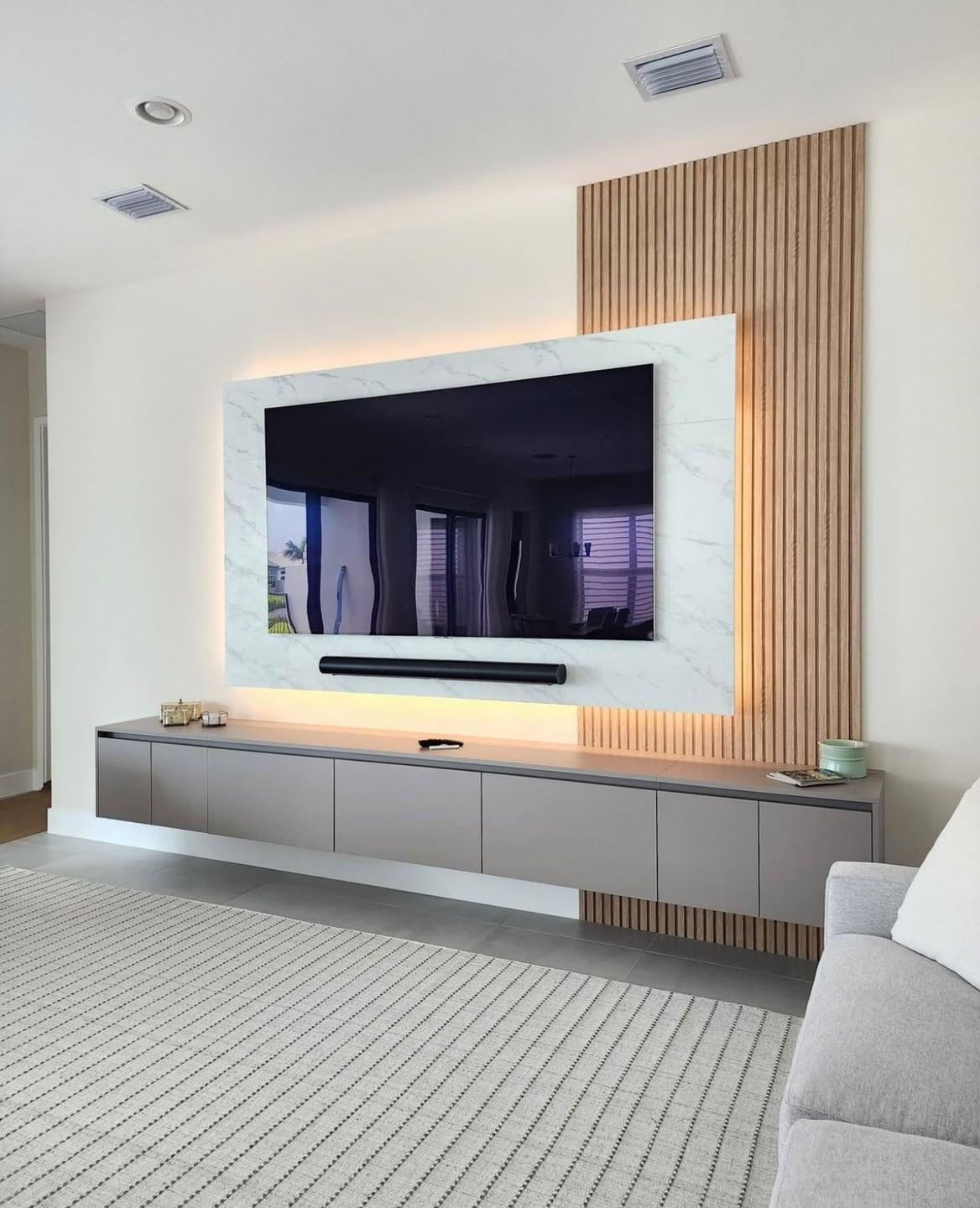
Wall one is a living room in a Sharjah apartment, 3.6 m wide, dry and air-conditioned, with a 65-inch television on a bracket, a floating console and a laminated finish. Everything here is flat, finished and lightly loaded. We would draw MDF for the screen panel, slat faces and console, with sealed edges and pilot-drilled hinge plates. Nothing in the room argues for plywood, and asking for it would only add a line to the price. For narrow rooms, the small living room guide goes through proportions.
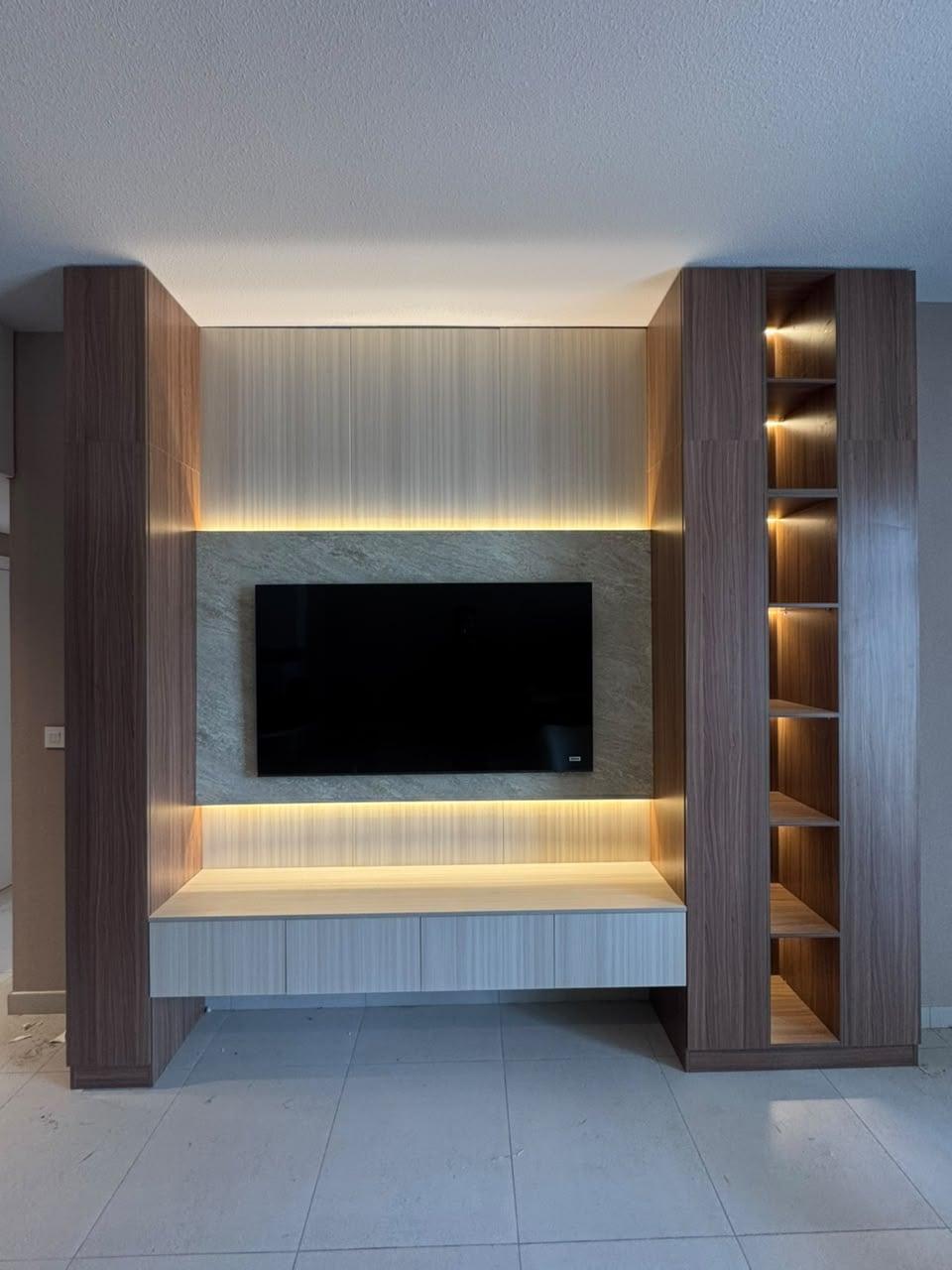
Wall two is a villa majlis, a long wall with a 1.4 m open shelf to hold a collection of decorative pieces and a speaker. The panel and faces stay in MDF, but the shelf is the problem part. Following the span rule, we would add a mid-support or choose a deeper front edge, and for the shelf itself we would discuss plywood or a stiffened build. The shelf is not a place to economise. For other ideas, the villa TV wall guide looks at what changes when a wall grows in scale.
Wall three backs onto a kitchen partition in an older apartment. Here the foot of the wall and the lower console are exactly where a spill or a cooking-steam problem would show, so the quotation should name a damp grade for those elements and describe the sealed edges. The wall behind might also need checking before anything is fixed; if there is any sign of damp, the humidity guide says what to look for before you order. In all three cases the board was chosen last, after the wall. How a full-width living room wall is composed is covered in the living room TV wall guide.
What to write on the quotation
Everything above is only useful if it lands on paper. A quotation that says media wall, laminate finish, one price, leaves every board decision to someone else. Ask instead for the following lines, and keep the answers with your drawing.
- The core board named for each element: screen panel, slat faces, console, shelves, and any element near a wet wall.
- The board thickness for each element. The standard structural board for our joinery is 18 mm; special designs may differ, so ask rather than assume that every part is the same.
- The grade or glue class for any element near damp, and what sealing is done to cut edges and the bottom edge.
- How long shelves are supported and what load they are meant to carry.
- Where the hinge plates and drawer runners are fixed, and how the television bracket is fixed to the backing frame.
- The edge treatment where an edge shows: banded, covered, or hidden.
- The warranty wording, covered below, in writing.
What we do, and what the warranty covers
Our workshop in Sharjah builds media walls in MDF, plywood and other suitable wood-based boards, chosen by budget, design, site and finish; not every wall uses the same board, and that is deliberate. We work from a free measuring visit, where we look at the wall behind, the room and the equipment; then we draw the wall with the core named for each element, and send an itemised quotation. A media wall starts from AED 3,500 per project for a compact panel and floating console in standard laminate; the final figure depends on the wall size, the finish, any marble-effect panels, lighting and an electric fireplace, and it comes from your quotation.
Once the details are agreed, a 60% advance is paid and production starts when we receive it; the remaining stage is agreed with you. Typical production takes up to about 10 days, depending on size and design. The wood-based boards carry a 5-year limited warranty, subject to its written terms. It covers the boards only, so hinges, runners, labour and misuse are excluded, and it is never a warranty on the whole wall. Our separate 24-month written workmanship warranty covers fabrication and fitting by our team, and is a different line.
If you are comparing makers, how to choose a media wall contractor lists the checks we would run ourselves. Our media walls service page shows the range of finishes and fittings we build.
Mistakes that cause most board disappointment
The most frequent mistake is a one-word specification. Board is not a specification; MDF, 18 mm, with a named grade for the lower edge is. The second is an unsupported long shelf, drawn for the photograph and sagging within a year. The third is driving screws into the edge of MDF with no pilot hole, then blaming the board for splitting. The fourth is letting the lowest edge of a console sit on the floor, unsealed, in a room where the floor is mopped.
A fifth, subtler mistake is choosing the board for its reputation rather than for its job. People who read that plywood is stronger may ask for it everywhere and find the price and the finish do not reward it. People who read that MDF is cheaper may ask for it on a shelf that then bows. The path in this guide exists to stop both. And a last mistake: skipping the measuring visit, because the wall behind the panel, which no photograph shows, often decides more than the board does; our measuring visit guide explains what is recorded and why.
Send us your wall on WhatsApp
If you want a part-by-part board recommendation for your own wall, message us on WhatsApp with a photo of the wall, the television size and a line about the room, and tell us whether any part backs onto a bathroom, kitchen or outside wall. Add the longest shelf you would like and what you will put on it. We will reply with questions, and book the free measuring visit when you are ready.
Not sure what to send? What to send us for a consultation lists the photos and numbers that save a visit. The planning guide helps you settle size and layout first.
Common questions
Is plywood better than MDF for a TV wall?
Not across the board. MDF suits the large flat finished faces; plywood is worth a look for long shelves and loaded cabinet sides. MDF, WPC, PVC or wood compared.
Will MDF expand in a humid UAE home?
In a dry, air-conditioned room with sealed edges it normally behaves; trouble starts with leaks, damp outside walls and unsealed cut edges. Humidity and the AC behind a media wall.
Can screws hold in MDF?
Yes, if the holes are pilot-drilled and edge screws stay well away from the corners; without that it can split. What is fixed to what behind a TV wall.
How long can a floating media wall shelf be?
Sag grows with the cube of the span, so past about a metre we add a support or deepen the section. TV walls with shelves.
Which board should the quotation name?
Every element should name its board, thickness and edge sealing, rather than a single word for the whole wall. The media wall quotation checklist.
What does the 5-year warranty cover?
It is limited and covers wood-based boards only; hinges, runners, labour and misuse are excluded, and workmanship has its own 24-month line. Choosing a media wall contractor.
How do I start a media wall in Sharjah?
Send a photo of the wall, the TV size and the room on WhatsApp, and we book a free measuring visit. Media walls in Sharjah.

Sources & specifications
Manufacturer information applies to the named products and systems. Sources reviewed on 12 November 2026.
- APA – The Engineered Wood Association: Plywood (cross-laminated veneers, alternating grain)apawood.org(opens in a new tab)
- Wikipedia: Plywood (layers at right angles, odd number of plies, densities)en.wikipedia.org(opens in a new tab)
- Wikipedia: Medium-density fibreboard (manufacture, density, smooth surface, moisture)en.wikipedia.org(opens in a new tab)
- European Panel Federation: MDF, Screwing (pilot holes, edge distance)mdf-info.eu(opens in a new tab)
- Wikipedia: Deflection (engineering) (centre-load beam formula)en.wikipedia.org(opens in a new tab)
- EGGER: Thin Raw MDF E1E05 HD (EN 622-5, density 900 kg/m³)egger.com(opens in a new tab)
Want this planned for your home?
Consultation and measurement are free. Tell us the rooms, location and what you need; we arrange a sample visit and define the measured quotation.