Media Walls · 21 min read · 1 November 2026
Stone-look panel or wood for your media wall: how to choose in the UAE
Stone-look panel or wood for a media wall in the UAE: mood, glare, sound, cleaning, joins, weight and how to mix the two, with a scorecard and three worked homes.

By Ali Haider Basra, Founder, Al Tareeq Decor · Contact our workshop
Key takeaways
- Stone-look reads cool, formal and crisp; wood reads warm and soft. Most good walls use both, with one leading and one supporting.
- Gloss reflects a window towards the sofa as one bright patch; matt wood scatters light. Test the sample at the hour the sun is lowest.
- Hard, smooth faces reflect most sound (smooth concrete absorbs only 0.01 to 0.02); slats over an absorbent backing can soften a hard room.
- Thin porcelain slabs are light, but the board and frame behind them add weight; ask for the weight of the exact product.
- Approve two sample pieces side by side, in your own light, in the afternoon and in the evening.
On this page
- Key takeaways
- Stone-look or wood: the short answer
- What stone-look and wood mean on a wall
- Mood: cool and formal against warm and soft
- Light and glare: where the window light goes
- Sound: hard faces and slats over backing
- Cleaning and everyday upkeep
- Joins, pattern and grain
- Weight and what it asks of the wall
- Mixing the two: let one lead
- Where each look is easier: a quick scorecard
- Stone-look and wood compared on what you will live with
- Three homes, three choices
- Heat, fireplaces and lighting behind the panel
- Which look moves the price, and which does not
- Children, pets and everyday knocks
- Ten questions to ask at the sample table
- What we do, and what you can ask for
- Mistakes to avoid
- Send us your wall on WhatsApp
- Common questions
Stone-look or wood: the short answer
Choose the stone look when you want a calm, formal, cool-toned wall that frames the screen like a picture, and when the room has enough light and warmth elsewhere to balance it. Choose wood when you want the wall to feel warm and soft, to scatter light instead of reflecting it, and to take some of the echo out of a hard room. Most of the walls we draw end up using both, with one material leading and the other supporting, and the decision that matters is which one leads.
This guide is about that choice, not about the materials themselves. How real marble, thin porcelain and engineered panels differ is covered in our marble TV wall guide. How slat profiles and spacing work is covered in the fluted panels guide. Here we compare the two looks on the things you will actually live with: mood, light and glare, sound, upkeep, joins, weight and the way they combine.
One caution before we start. We cite published sources where they exist, and where they do not, we say so and give our workshop view, labelled as such. Nothing here is a lab test, and nothing is a promise about a specific product; the final word always comes from the sample in your own room.
What stone-look and wood mean on a wall
On a media wall, stone-look means a panel or slab whose surface reproduces marble or stone: a printed marble-effect skin on a board, a thin porcelain-effect slab or a larger porcelain panel. It can be glossy or matt. Wood means any of three things: solid or board-based slats with a wood-grain face, real wood veneer glued to a board, or a wood-look laminate. The sample in your hand will tell you which of the three you are looking at, and each behaves a little differently.
The services we publish line up with this split. Our media walls include acoustic fluted wood slats in oak, walnut and charcoal, and porcelain or Calacatta-marble-effect panels in gloss or matt, alongside floating consoles and concealed wiring. A wall can use either, or both, and the starting point is the same: a compact panel and floating console in standard laminate begins from AED 3,500 per project, with veneer, lacquer, marble-effect panels, lighting and fireplaces moving the final figure. Your quotation sets the real number.
If colour is still open, settle that first with the colour and finish guide, because a stone-look panel in warm cream and one in cool grey feel quite different, and a walnut slat reads differently from an oak one. This page assumes you have a shortlist and want to know which look to lead with.
Mood: cool and formal against warm and soft
The first difference is emotional, and no datasheet will settle it. A pale veined stone-look surface reads as crisp, formal and a little cool. It suits rooms where the furniture is simple and the colours are light, and where you want the television wall to look like a gallery. Wood reads as warm and soft: the grain adds texture, the vertical lines add rhythm, and a living room with a lot of white and grey picks up a welcome note of nature.
Think about what else is in the room. A cream sofa, a pale floor and light curtains can carry a stone-look wall easily, and may even need its crispness to avoid feeling bland. A room that is already hard, with large tiles, glass and a lacquered dining set, tends to feel cold with a stone-look wall as well, and wood is the better lead. If you are unsure, hold a stone-look sample and a wood sample at the wall and ask which one you would prefer to sit in front of at nine in the evening, not at noon.
Evening matters because that is when the wall is lit by your own lamps and LED strips, not by the window. A warm LED glow brings out the grain in wood and softens the coolness in stone. Our guide to media wall lighting explains how to choose the colour temperature. The sample check in finish sample approval tells you what to look at before you decide.
Light and glare: where the window light goes
A glossy surface acts like a weak mirror. Light from a window, a lamp or a bright wall opposite hits it and bounces on in a single direction. If that direction runs towards the sofa, you see a bright patch on the wall, and if the patch lands near the screen, the screen looks washed out. Wikipedia's article on glare describes the effect in general terms: bright areas that reflect off glass, plastic or water reduce contrast, and anti-reflective coatings are used to cut the glare from indoor lights and screens. It says nothing specific about wall panels, so what follows is our own reasoning, labelled as such.
A matt wood-grain surface does the opposite. The grain and the microscopic texture scatter the light in many directions, so there is no single hot spot, only a soft overall brightness. A gloss stone-look panel can look wonderful in a showroom with lamps overhead and terrible in a living room with a west-facing window at four o'clock.
The practical rules are short. If a window faces or sits beside the television wall, test the sample at the hour when the sun is lowest. If the panel is the main surface, a matt or honed stone-look finish is safer than a gloss one; if gloss is the look you want, keep it to a smaller area that does not sit in the line between the window and the sofa. And remember that the television screen itself is also a reflective surface; the guide to TV height and angle covers where reflections from the room land on the screen.
Sound: hard faces and slats over backing
A modern living room with tiled floors, glass and a big television is acoustically hard. Voices and the television's own sound bounce around, and a soundbar has to work harder against the echo. Wall finishes can help or hurt. Wikipedia's article on acoustic absorption states the principle plainly: dense, hard, impenetrable materials reflect most of the sound that reaches them, while soft, pliable or porous materials absorb it. Its table lists smooth concrete with absorption coefficients of only 0.01 to 0.02, which means almost all of the energy comes back.
A hard, smooth stone-look panel belongs to the reflective family. That is not a fault, only a property: a room with one large reflective wall and little soft furnishing will sound brighter and more echoey than the same room with a slatted wall. The page does not mention slats or wall panels, so we cannot give you a number. What we can say is that slats set over an absorbent backing break up the surface and let some sound in, and our published description of our slat panels is acoustic fluted wood. Whether that makes a noticeable difference in your room depends on the backing, the gap and everything else in the room, so have the backing named on the drawing.
For a living room where the television is the main sound source, this can matter more than people expect. If you plan a soundbar or speakers, read the soundbar and speaker guide alongside this one, because the wall's surface and the speaker's position work together. A stone-look wall with a good rug, curtains and soft seating can sound perfectly good; a stone-look wall in a bare room will sound hard.
Cleaning and everyday upkeep
Both looks are easier to live with than people fear, and both have a weak point. A smooth stone-look surface wipes clean in a few seconds; its weak point is gloss, which shows fingerprints, dust and smears more than matt does. A slatted wood wall is more forgiving of marks but collects dust on the slat edges and in the gaps between them, and a tall wall is awkward to dust.
For the cleaning itself, we can quote a manufacturer. EGGER's technical leaflet on cleaning and care of its product surfaces, revised in May 2026, recommends a soft, slightly damp cloth and gentle cleaners such as glass cleaner, and tells you not to use abrasive and scouring agents such as scouring powder or steel wool. It also advises against polishes, waxes, bleach and strong acids, says steam cleaning is not recommended, and cautions against putting hot pots and pans straight onto the surface because the gloss may change. This is guidance for EGGER's products, not for all laminate, but it is a sensible starting point for any decorative surface until you have the care sheet for yours.
A short routine suits both walls: dust with a dry microfibre cloth, wipe marks with a soft damp cloth, and keep spray cleaners off the slat gaps and LED channels. Ask for the care sheet of your finish at handover; the handover checklist lists what to collect on the day.
Joins, pattern and grain
Every wall is made of pieces, and the joints between them show differently in each look. A stone-look surface has a pattern that is meant to flow: veining that runs across a panel should continue across the next one. A mismatched join, where a vein stops dead or jumps, is the most visible flaw on a stone-look wall. The maker can book-match, reverse or arrange panels so the veining reads as continuous, but only if the drawing says so and the panels are cut from a consistent set.
Wood has the opposite problem. Real wood and real-wood veneer differ from piece to piece; Danzer, a veneer maker, lists its standard sliced veneer at about 0.5 mm depending on species, which gives you an idea how thin the real wood layer is, and that thin layer carries the individual grain of the log it came from. That variation is the charm, but it also means two sheets from different logs may not match, so the sheets for one wall should come from the same batch and be laid in sequence.
In both cases, the answer is on paper: ask for the join positions on the drawing, and ask which sheets will sit side by side. When you approve a sample, look at two pieces next to each other, not one on its own. The detail is covered under pattern and direction decisions in our sample guide.
Weight and what it asks of the wall
Weight is where the stone look can surprise people, in both directions. A thin porcelain slab can be far lighter than its reputation: Laminam, a thin-slab porcelain maker, lists its 2 mm and 2+ mm slabs on a technical sheet at about 4.8 and 5.1 kg/m², which is our reading of that sheet. Compare that with an 18 mm board of MDF, which at Wikipedia's category density range of 500 to 1,000 kg/m³ comes to roughly 9 to 18 kg/m² by simple arithmetic. A thin slab is not the heavy part; the board and backing behind it are.
That is the key point: a thin stone-look slab still needs a flat, stable board behind it, so the finished panel weighs the slab plus the board plus the frame. A marble-effect printed skin on a board is lighter still, and wood slats in MDF or WPC differ again by core. None of this makes any look impossible, but a very heavy full-height face can change what the backing frame and fixings must carry, which depends on the wall behind it. The guide to block and gypsum walls explains how the wall type changes the answer.
As always with a heavy or large panel, the information that decides the build is the exact product's datasheet, not a category. Ask the maker for the slab or board weight of the actual product on your drawing, and ask how the face is fixed. If you want the full discussion of real marble, porcelain and engineered panels, the marble TV wall options guide goes into weight and fixing in depth.
Mixing the two: let one lead
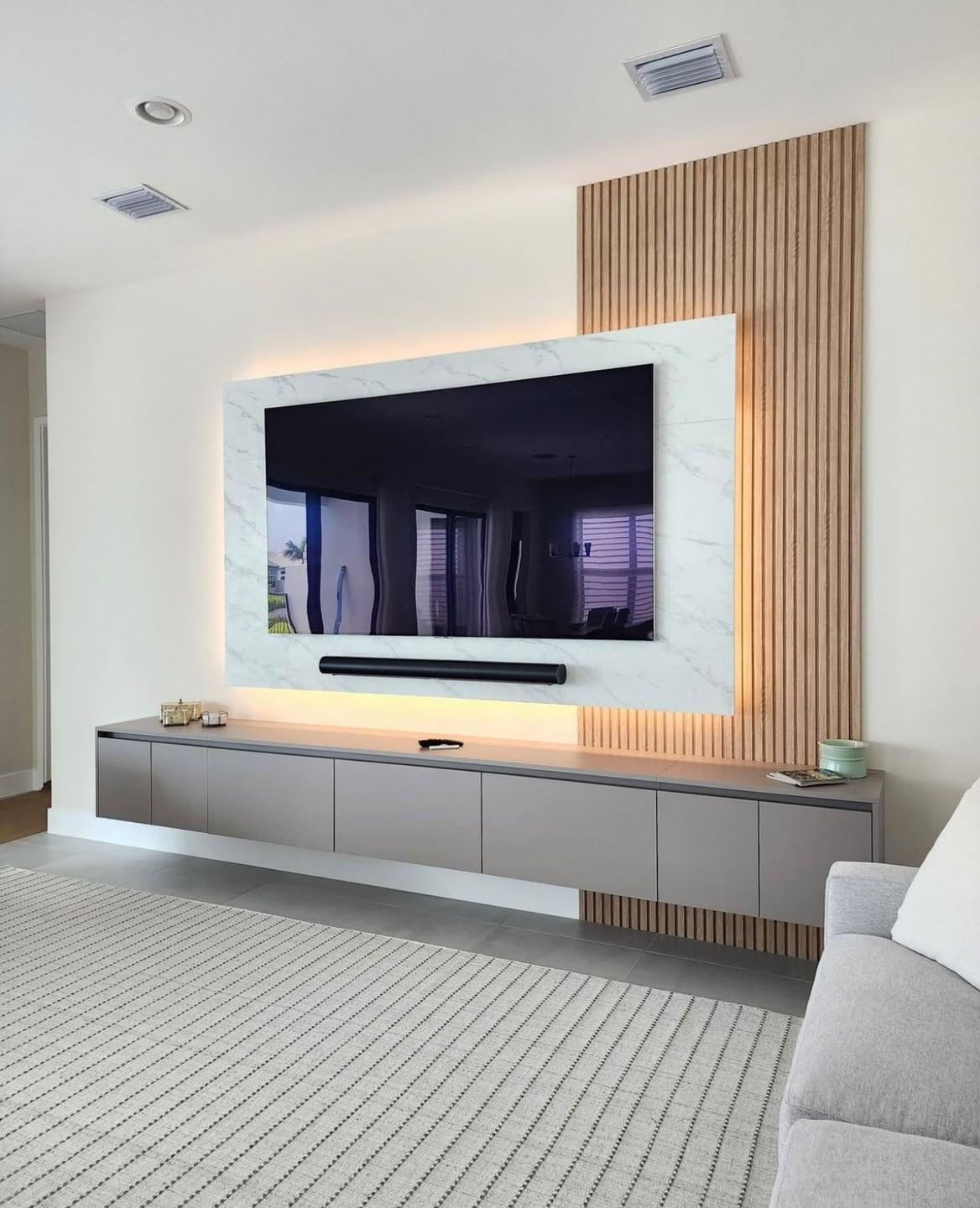
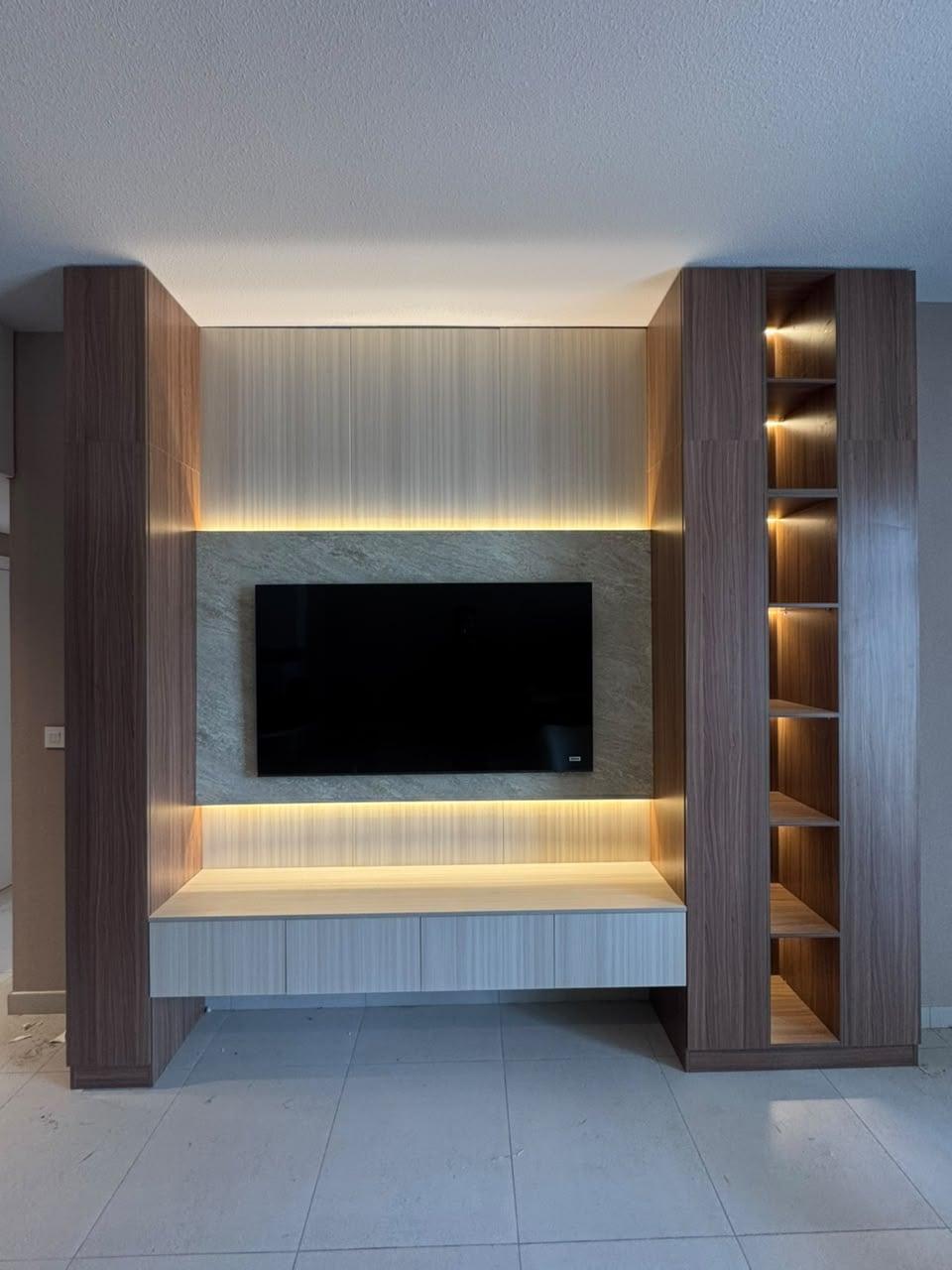
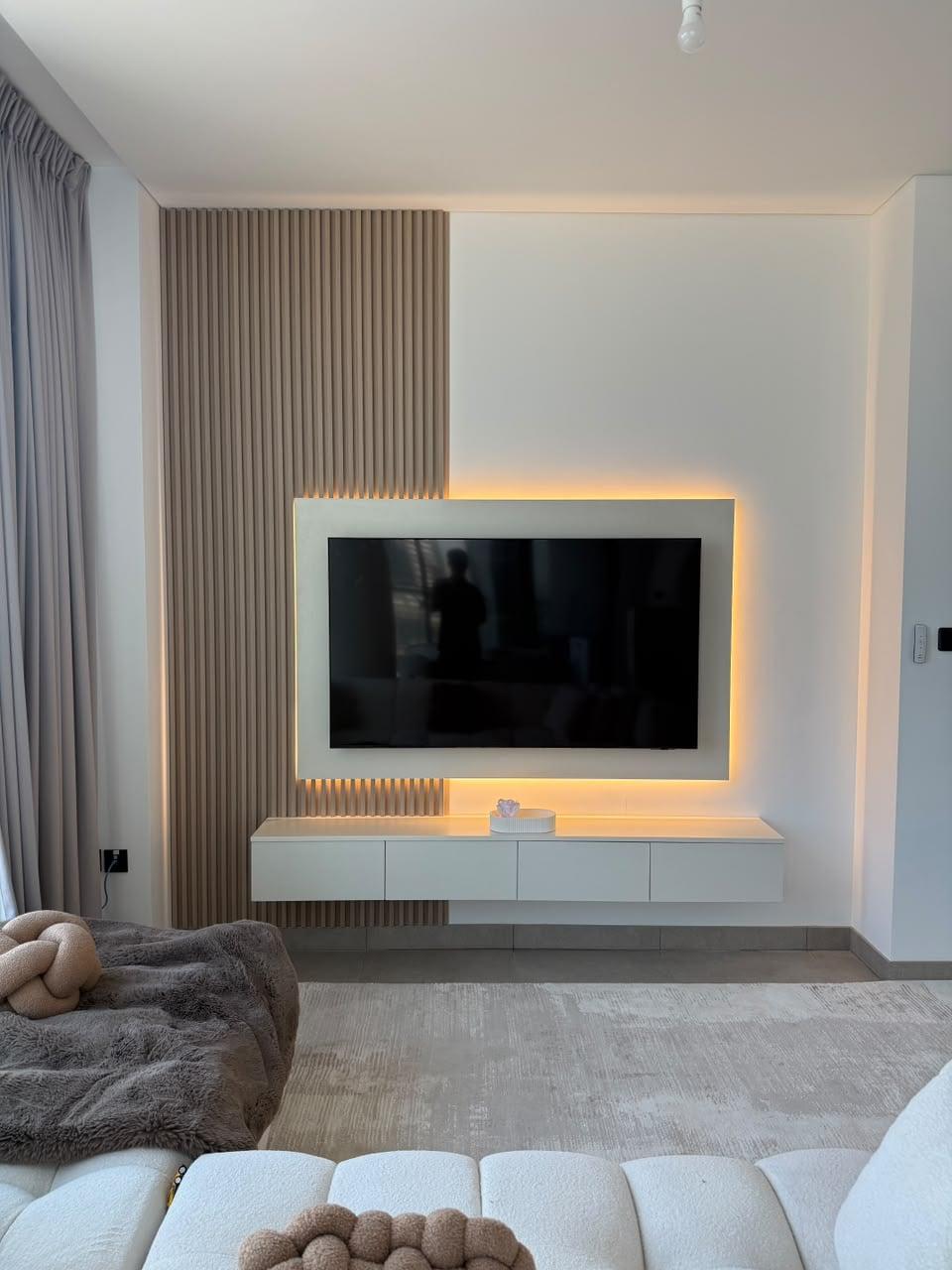
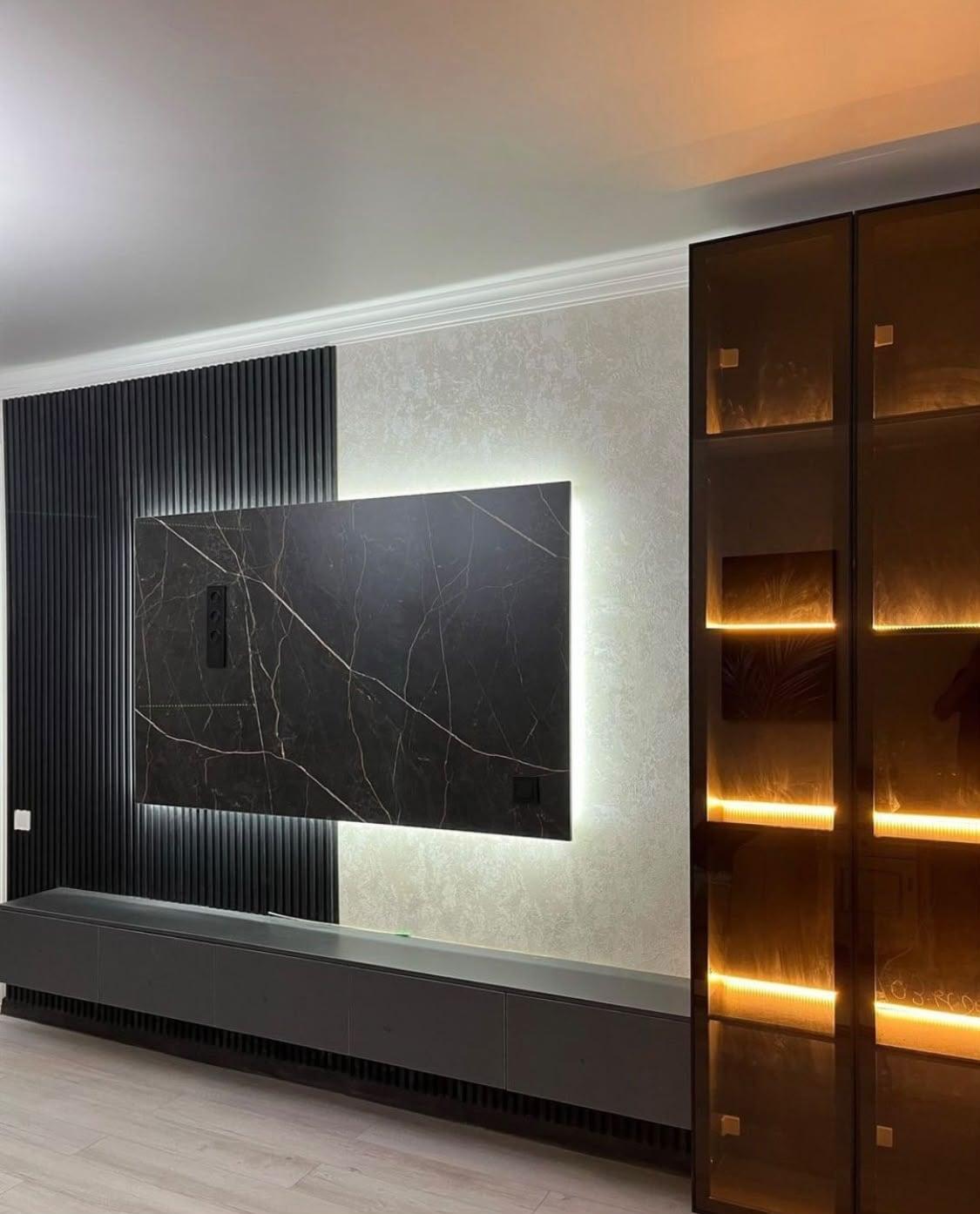
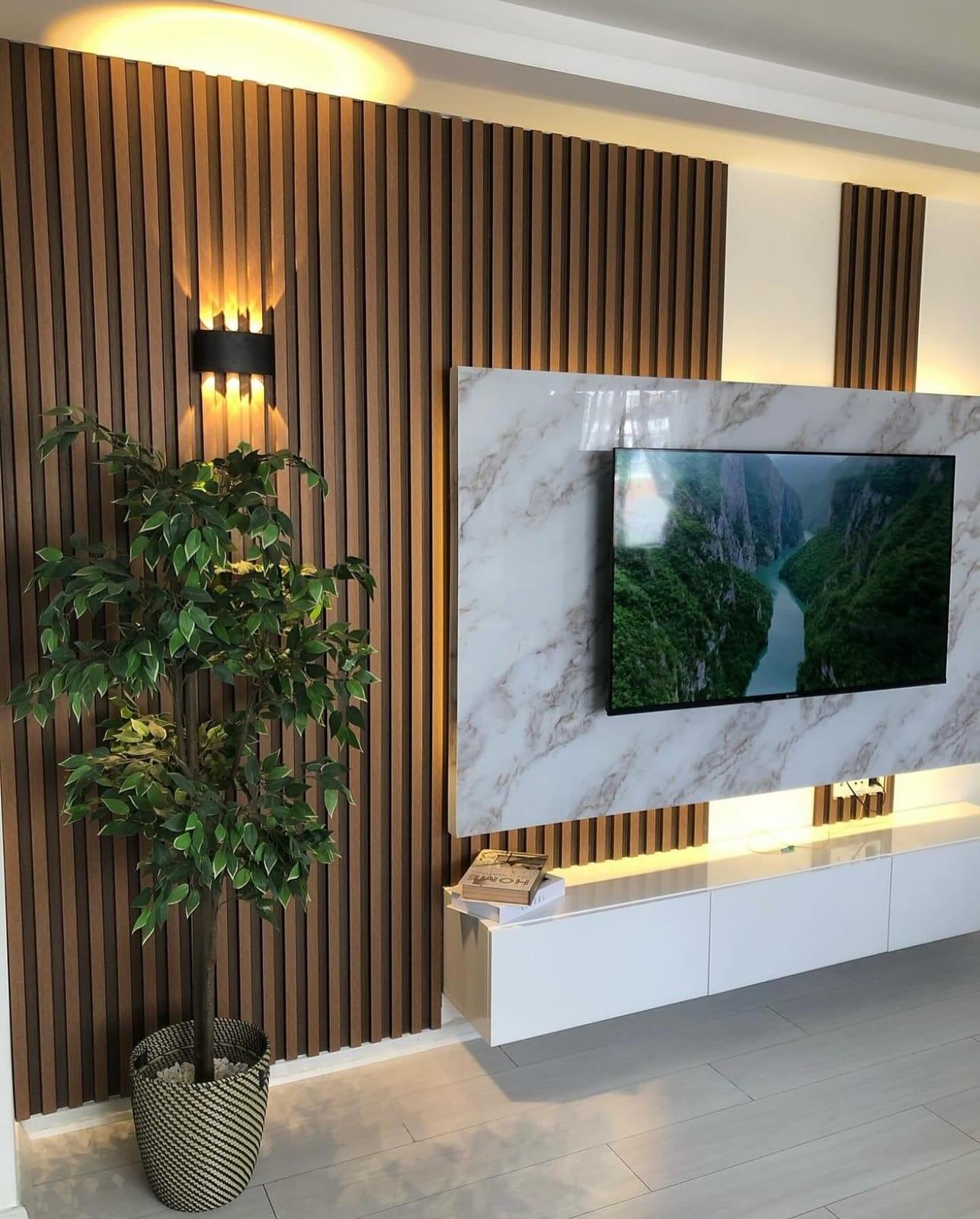
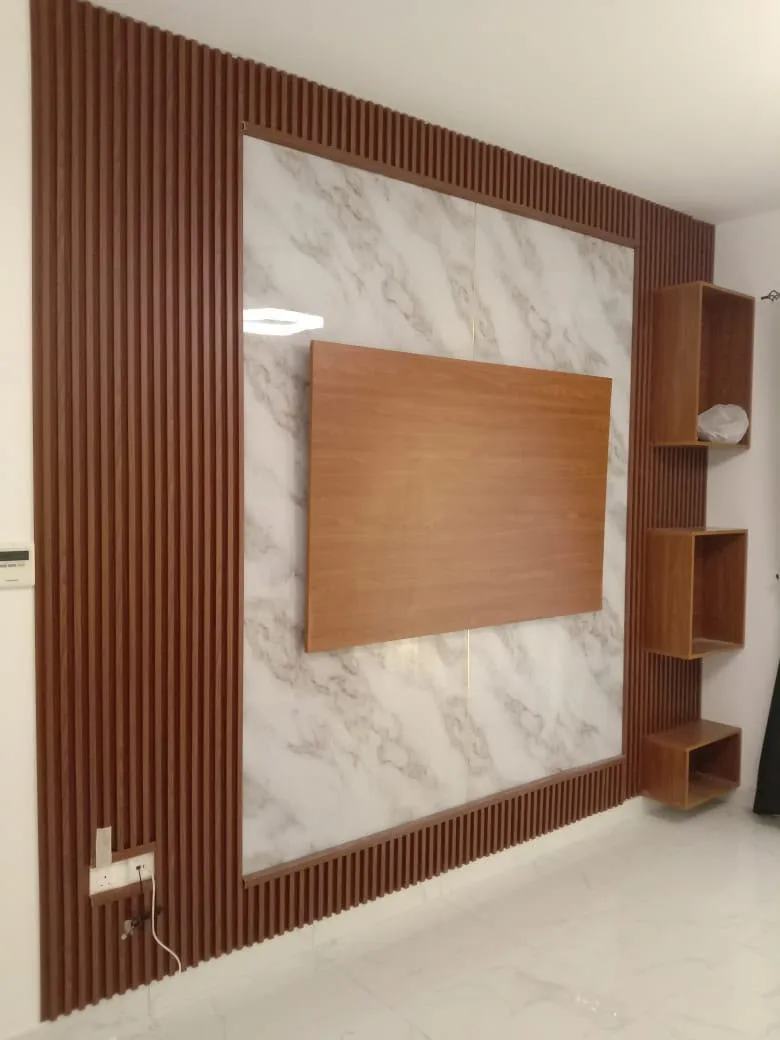
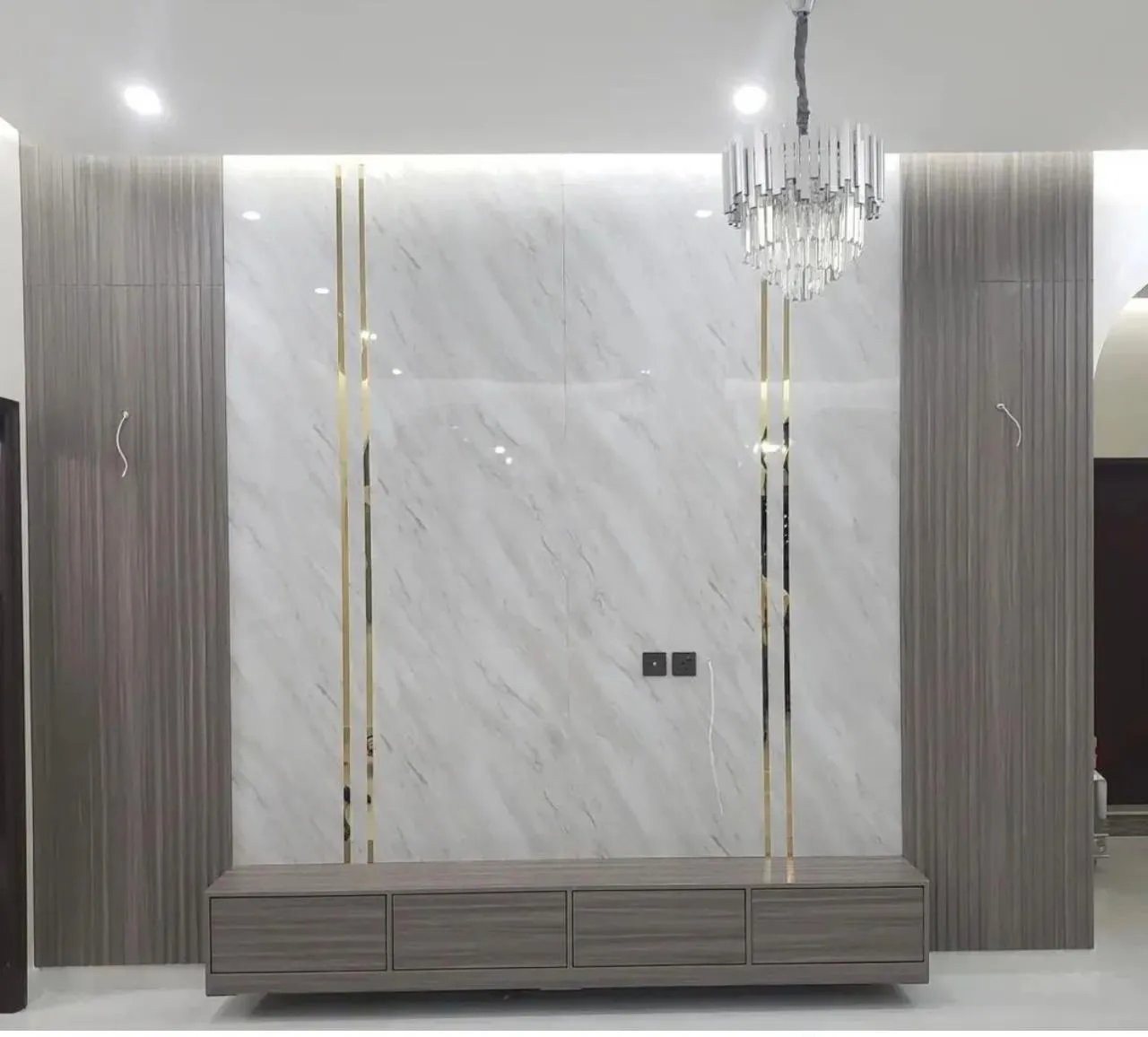
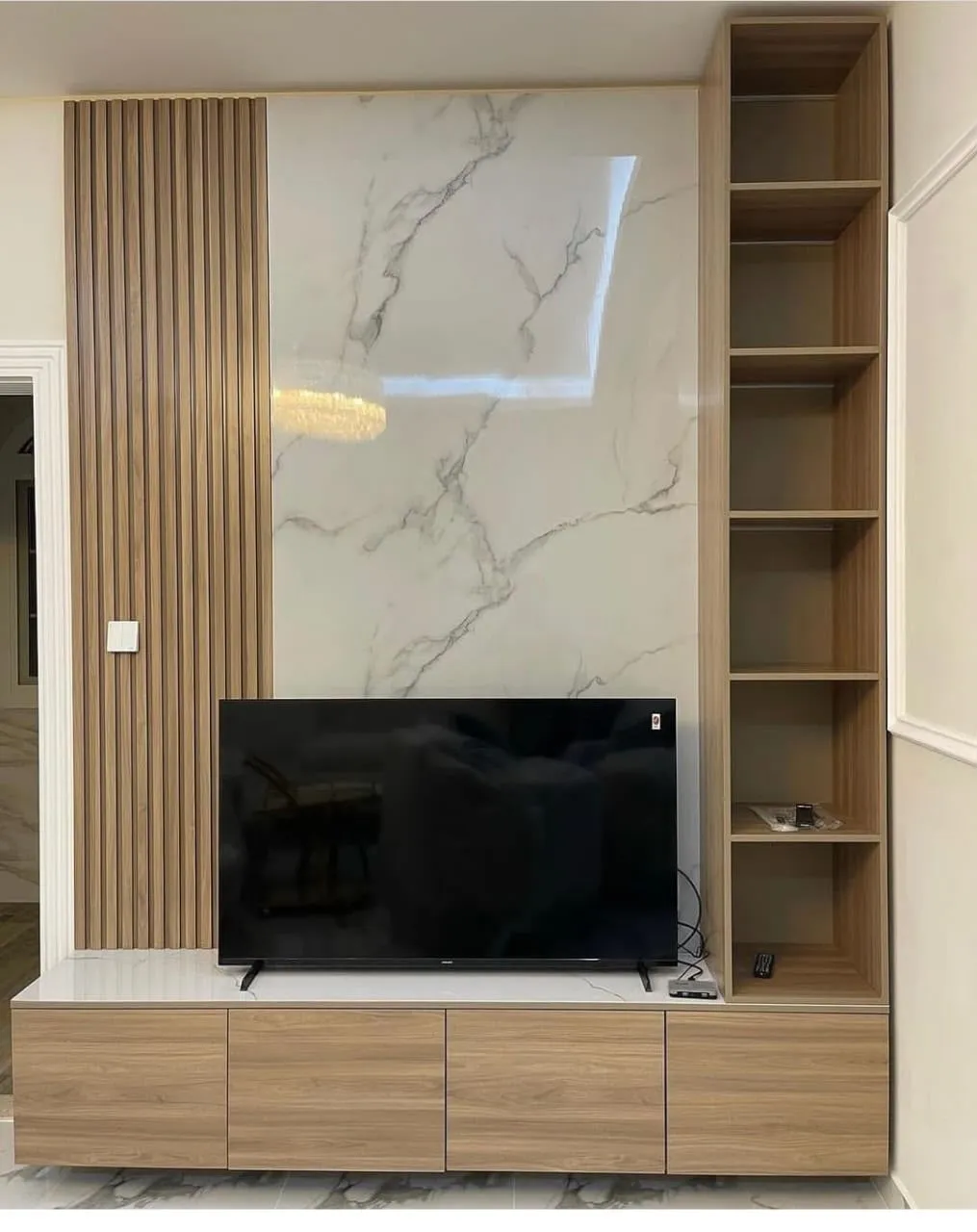
Most good media walls use both looks, and the rule that works is the same as in any room: one material leads and the other supports. A common version puts a stone-look panel behind the television, framed by slats on both sides. The stone look gives the screen a calm, bordered setting; the slats add warmth, texture and a little sound softening where the eye lands on the edges.
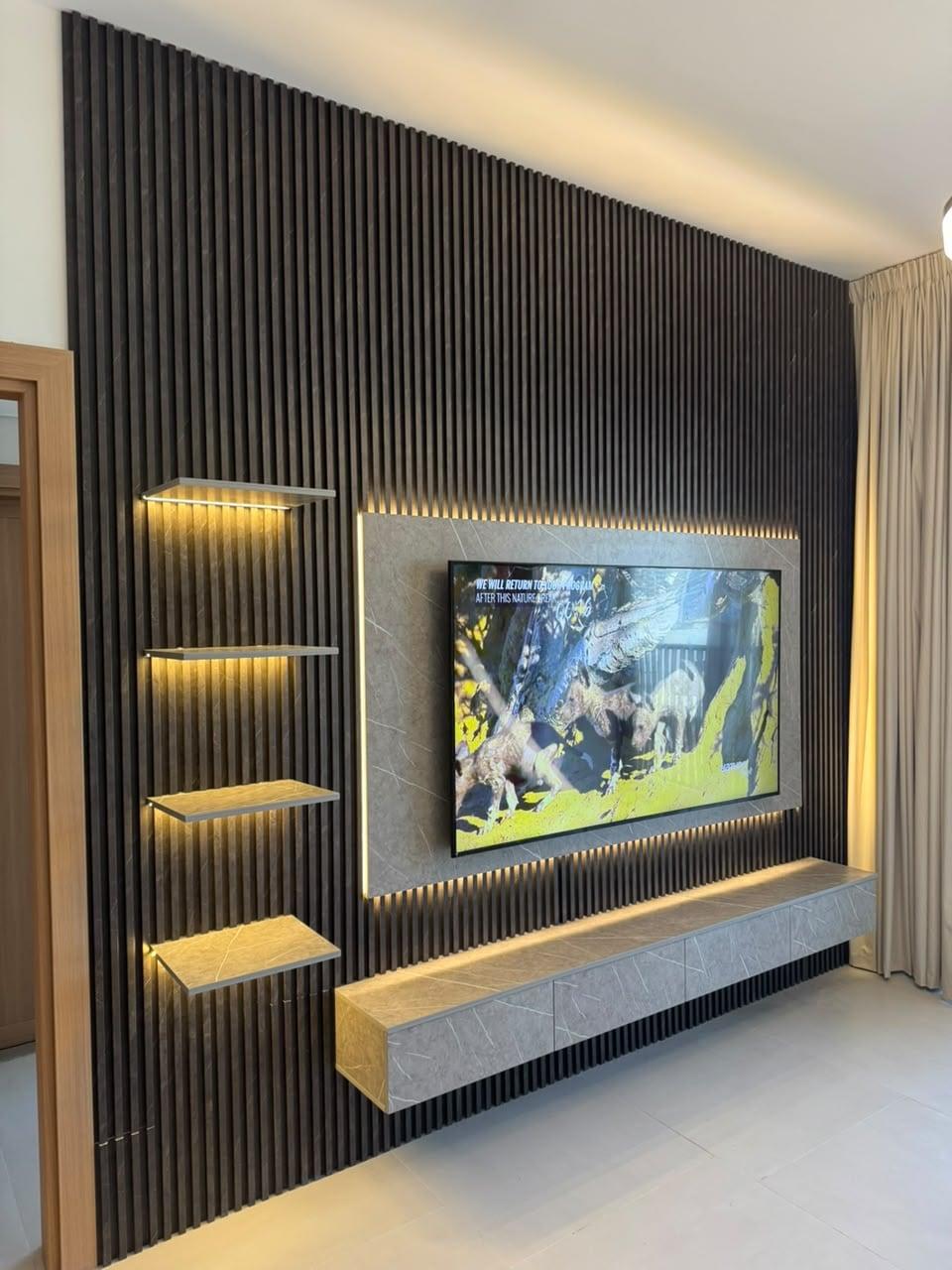
The opposite arrangement is just as valid, and a living room wall composed across its full width shows the idea at scale. A fully slatted wall can carry one stone-look panel set in behind the television as a focus, which gives a warm, relaxed room a single crisp accent. A relief or 3D texture can play the supporting role too; see 3D textured feature walls. A third option, a full stone-look wall with a wood shelf and a wood-look console, suits a formal living room where wood keeps the surface from feeling cold.
What does not work is an even split, with half the wall in each material and nothing leading. The eye has nowhere to rest, and the result looks like a sample board. If you are tempted by an even split, pick the one you love more and give the other a smaller role. Our design ideas guide shows more combinations. The lighting guide explains how the LED colour changes how each material reads.
Where each look is easier: a quick scorecard
The comparison below puts the points above in one place. It is a workshop view, not a lab test: the ticks mark where one look is usually easier to live with, and the blank rows are matters of taste. Treat it as a prompt for the conversation at the sample table.
Stone-look and wood compared on what you will live with
Mood
- Stone-look panel
- Cool, formal, crisp
- Wood slats and veneer
- Warm, soft, natural grain
Light
- Stone-look panel
- Gloss can mirror a window; matt or honed is safer
- Wood slats and veneer
- Matt grain scatters light
Sound
- Stone-look panel
- Hard face reflects most sound
- Wood slats and veneer
- Slats over absorbent backing can soften a room
Cleaning
- Stone-look panel
- Soft damp cloth; no scouring powder
- Wood slats and veneer
- Dust collects in slat gaps
Joins
- Stone-look panel
- Veining must run on across each join
- Wood slats and veneer
- Real grain differs from piece to piece
Weight
- Stone-look panel
- Thin slabs are light; the board behind adds to it
- Wood slats and veneer
- Depends on the core: ask for the product
Best as
- Stone-look panel
- Focus behind the screen
- Wood slats and veneer
- Frame, rhythm and warmth
A workshop view based on the sources in this article, not a test of any product.
Three homes, three choices
Home one is a three-bedroom apartment in Sharjah with a white tiled floor, glass dining table and a west-facing window beside the television wall. The room is hard, bright and cool, and the afternoon sun hits the wall at a low angle. Our recommendation: lead with wood, keep any stone-look panel matt and small, and confirm the sample at four in the afternoon. The wood scatters the sun and softens the room's echo.
Home two is a villa living room with warm limestone-coloured flooring, deep sofas, thick curtains and no window facing the wall. It is already soft and warm, so a stone-look wall can lead without making it cold. For villa-scale walls, see the villa TV wall guide. Here we would draw a large honed stone-look panel behind the television, framed by slender walnut slats, with a warm 3000K LED channel; the LED guide explains the options. The panel gives the room a formal centre and the slats add a quiet note of texture.
Home three is a studio apartment with a compact living area and a long, narrow wall. Space is tight, so the finish carries a lot. A full stone-look wall would feel heavy and formal in a small room; a wood-slat wall can make it feel taller and calmer. We would suggest wood leading, with a thin stone-look accent only if it fits the budget. For small rooms, our small living room media wall guide goes through proportions and storage.
Heat, fireplaces and lighting behind the panel
Two things deserve a short check whichever look you choose: heat and lighting. If the wall will have an electric fireplace, the surface around the outlet should be a material and a finish that the fireplace's maker says is suitable for that distance, and the drawing should keep the clearances. We only build electric fireplaces into walls, and the fireplace guide explains the depth, the electrical line and the vents; read the electric fireplace guide before choosing a finish above the unit.
For lighting, a stone-look surface under a bright LED channel can show every unevenness and reflect the strip as a bright line, while a matt wood face absorbs the LED softly. Ask for a sample test with the LED on if you plan backlighting, and use a dimmer. The way light reads on each surface is a good reason to approve your sample in the room you will use it, at night as well as in the afternoon.
Which look moves the price, and which does not
People often assume the stone look is the expensive choice and wood the cheap one, or the reverse. In practice the look matters less than the area it covers, the finish applied to it and everything built around it. A wall that is mostly one standard laminate, in either look, starts from the entry figure of AED 3,500 per project; veneer, lacquer, marble-effect panels, lighting and an electric fireplace are the items that move the total, and the quotation shows them one by one.
So compare the looks on the same wall, in the same finish grade, and ask which lines change when you swap one for the other. The price factors guide explains the biggest levers. If you want a rough sense of a project's cost drivers before the visit, our pricing guide tool walks through them, and the consoles that sit under either look are shown on the floating console page.
Children, pets and everyday knocks
A television wall lives in the busiest room of the house, and the people who share it include children with toy trucks and pets with claws. Neither look is indestructible, and both have habits worth knowing. Our view here is a workshop view, not a test, so take it as a starting point for your own sample check.
A glossy stone-look surface shows fingerprints and dust more than a matt one, and a hard knock can chip a corner or an edge, where the layer beneath shows. A matt stone-look finish hides most small marks but may show a grease mark from a hand until it is wiped. Slats take knocks differently: a ball against the lower slats can dent a soft edge, and the gaps collect dust and the odd crayon. Neither is a reason to avoid a look. The practical answer is to keep the lowest half metre of the wall simple: a console or a plain panel at toy height, with the feature material above it where small hands do not reach.
If children or pets share the room, also think about what happens when the television is switched on and someone climbs the console: fixings matter far more than finish. The CPSC advice, which we cite in the guide to whether a media wall is worth it, is to anchor televisions and furniture securely to the wall, and a bracket fixed to a proper backing does exactly that. Ask us how the console is fixed as well as how it looks.
Ten questions to ask at the sample table
When you hold the samples at your wall, the conversation is more useful if you ask the right questions. These are the ones we would ask in your place. Keep the answers with your drawing, and send us a photo of the sample in place if you want a second opinion before approving.
- Is this sample the exact product and finish that will be used, or a similar one?
- Is the surface gloss, satin or matt, and how does it look with the lights on?
- Where will the joins fall, and does the veining or grain run on across them?
- Which sheets will sit side by side, and are they from the same batch?
- What is behind the face: which board, and what backing, if the wall has slats?
- How is the panel fixed, and what does the fixing rely on in my wall?
- What are the care instructions for this surface, in writing?
- How does it look next to my floor, my sofa and my curtains, at four in the afternoon and at nine in the evening?
- What is the heat limit, if the wall will have an electric fireplace or hot equipment?
- Which parts of the drawing change the price if I swap this finish for another?
What we do, and what you can ask for
At our free measuring visit we bring physical samples of both looks and hold them at your wall, so you see the gloss, the grain and the colour in your own light. We then draw the wall with the face for each area named, the join positions marked and the LED channels placed, and send an itemised quotation. A media wall starts from AED 3,500 per project, and the final figure depends on the wall size, the finish, any marble-effect panels, lighting and an electric fireplace.
Once the drawing and details are agreed, a 60% advance is paid and production starts when it is received; the remaining stage is agreed with you. Typical production is up to about 10 days, depending on size and design. The wood-based boards carry a 5-year limited warranty on the boards only; hinges, runners, labour and misuse are excluded, and our separate 24-month workmanship warranty covers fabrication and fitting. If you want help choosing, our media walls service page shows both looks. The measuring visit guide explains what happens when we come.
Mistakes to avoid
The commonest mistake is choosing from a photograph. A photograph is lit by a photographer; your room is lit by a window that moves. The second is picking gloss for a wall with a window opposite, and discovering the reflection only after installation. The third is forgetting the board behind a stone-look face, and the weight and fixing that come with it.
The fourth is an even split with no lead material. The fifth is approving one sample sheet when the wall is made of many; look at two pieces side by side. And the sixth is ignoring sound: in a hard room, the wall surface is part of the audio system. If any of these resonates, say so when you message us.
Send us your wall on WhatsApp
To get a recommendation for your own room, send us a photo of the wall on WhatsApp, the television size and a line on where the windows are and what the afternoon light does. If you already have a favourite look, send a picture of it; if you are torn between the two, say so and we will bring both samples to the visit. We will reply with questions and book the free measuring visit.
What to send is set out in the consultation guide. The planning guide helps you settle the wall's size first.
Common questions
Is a marble-effect TV wall better than wood?
Neither wins outright: stone-look gives a formal, cool focus and wood a warm, soft one. Most walls lead with one and support with the other. Marble TV wall options.
Does a glossy panel cause glare on the TV?
It can mirror a window or lamp towards the sofa as one bright patch. Matt or honed finishes and a sample test at low sun reduce the risk. TV height and angle on a media wall.
Do wood slats improve the sound in a living room?
Slats over an absorbent backing can soften a hard room, whereas a hard smooth face reflects most sound. Have the backing named on the drawing. Soundbars and speakers with a media wall.
How do I clean a stone-look or wood-grain panel?
Dust with a dry cloth and wipe with a soft damp cloth; EGGER's leaflet advises against scouring powder and steel wool. Media wall handover checklist.
Can I mix stone-look and wood on one wall?
Yes; let one material lead and the other support, for example a stone-look panel framed by slats. Media wall design ideas.
Is a stone-look wall heavy?
A thin porcelain slab can be light, but the board and frame behind it add weight; ask for the weight of the exact product. Block or gypsum wall behind the TV.
How do I see both looks before I decide?
We bring physical samples of both to the free measuring visit so you see them in your own light. Media walls in Sharjah.

Sources & specifications
Manufacturer information applies to the named products and systems. Sources reviewed on 12 November 2026.
- Wikipedia: Absorption (acoustics) (hard surfaces reflect sound; smooth concrete 0.01 to 0.02)en.wikipedia.org(opens in a new tab)
- Wikipedia: Glare (vision) (reflections reduce contrast)en.wikipedia.org(opens in a new tab)
- Danzer: Natural veneer (standard sliced veneer about 0.5 mm)danzer.com(opens in a new tab)
- EGGER: Cleaning and care recommendations for EGGER product surfaces (technical leaflet, 22.05.2026)downloads.egger.com(opens in a new tab)
- Laminam: technical sheet for 2 and 2+ mm slabs (hosted by Crossville)crossville.com(opens in a new tab)
Want this planned for your home?
Consultation and measurement are free. Tell us the rooms, location and what you need; we arrange a sample visit and define the measured quotation.