Media Walls · 18 min read · 27 October 2026
Repair, refinish or replace an old TV unit? A UAE guide
How to decide whether an old TV unit is worth repairing, refinishing or replacing: a ten-minute inspection, laminate refinishing, hinges, anchoring and what to replace it with.

By Ali Haider Basra, Founder, Al Tareeq Decor · Contact our workshop
Key takeaways
- The base, the shelf and the frame decide: a swollen base, a sagging shelf or a rocking frame points to replacement; chips and dated colour point to refinishing.
- Refinish laminate in order: light 120-grit scuff, a bonding primer, thin coats, a test patch first and time to cure; damaged laminate will not hold paint.
- A TV that is not wall-mounted should still be anchored to the wall (CPSC AnchorIt); a unit that cannot be anchored is a reason to replace it.
- Compare the unit's top with the screen: a unit narrower than the TV is the wrong size, and no repair changes proportion.
- Send us photographs and the TV size and we say honestly whether a repair will last or whether a floating console or media wall is the better route.
On this page
- Key takeaways
- The old TV unit: keep it, mend it or let it go
- A ten-minute inspection: six checkpoints
- Four conditions and the usual answer to each
- What an old unit is made of, and why that decides the repair
- Refinishing a laminate unit, layer by layer
- Hinges, doors and runners: the repairs that are worth doing
- Why a TV on a unit must be anchored, old or new
- Cables, sockets and the problems an old unit cannot solve
- When replacing is the better answer, and what to replace it with
- Repair, refinish, replace or upgrade: a comparison
- Four routes for an old TV unit
- Three worked scenarios
- Mistakes that waste money on an old unit
- Moving out, renting and what happens to the old unit
- What we do, and how to start on WhatsApp
- Common questions
The old TV unit: keep it, mend it or let it go
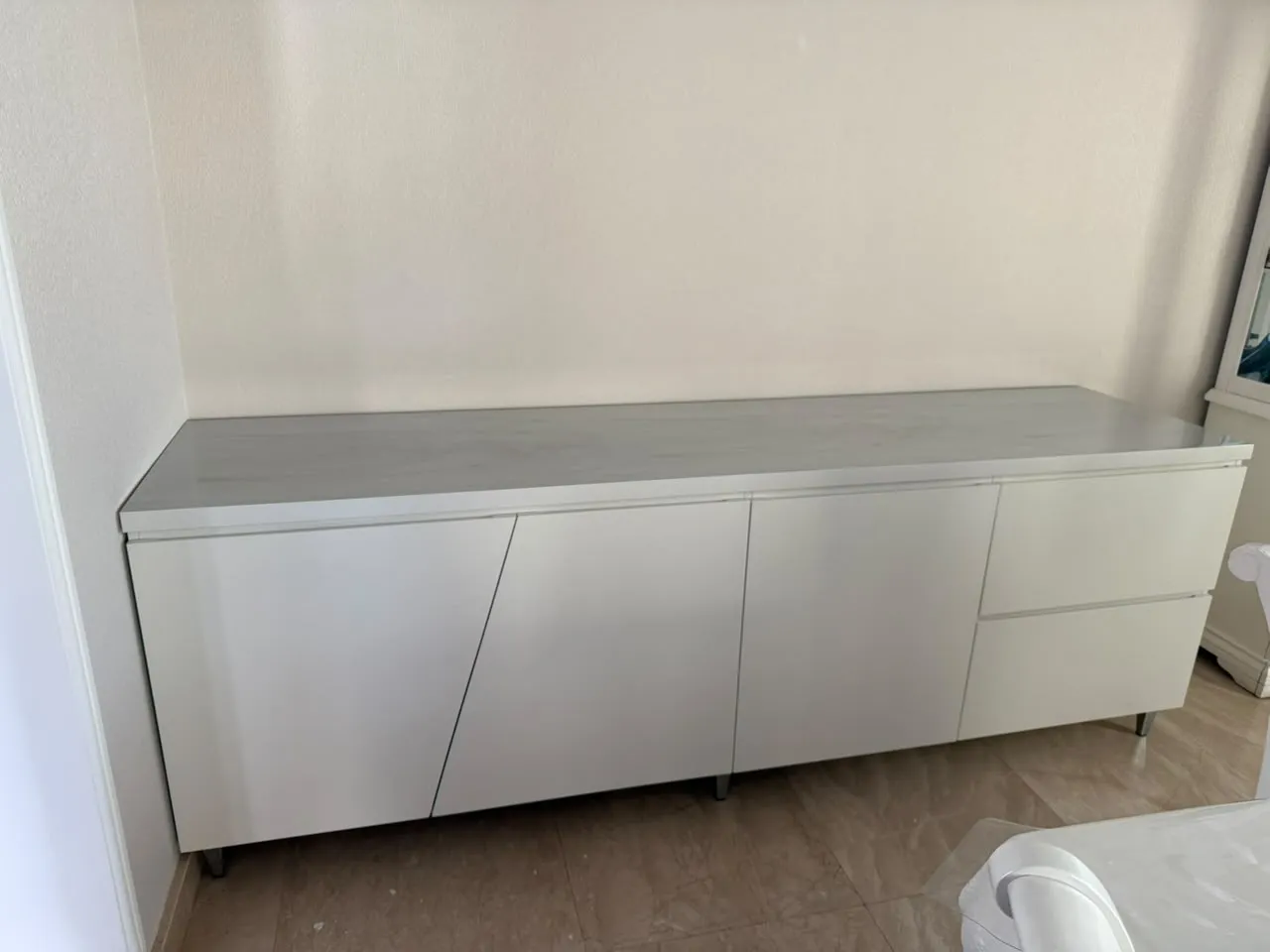
Almost every flat has one: the TV unit that arrived with the first sofa, or that came with the tenancy, or that was bought in a hurry for a screen that has since been replaced twice. It is chipped at one corner, the doors no longer close with a click, and it looks a decade older than the room around it. The question people type into a search box is simple: is it worth repairing, or should it go?
This guide is about that unit, the freestanding one, and nothing else. It is not about a built-in wall, which is a different object with different repair paths; for that, renovating an existing media wall is the guide. Nor is it a general comparison of walls and units for a new room, which media wall or TV unit already answers. Here we take a unit that exists, look at it honestly, and decide.
The decision comes down to three questions. What is actually wrong with it? What would a repair or a new finish really buy you? And what does your TV, your room and your next two years look like? A chipped edge on a sound unit is a small job. A swollen base on a unit that wobbles under a heavy screen is not a repair at all. The sections below help you tell the difference in about ten minutes with a torch and your phone.
A ten-minute inspection: six checkpoints
Start at the floor and work up, because the base tells you the most. Press gently on the plinth and the bottom edges of the sides. Laminated board that has met moisture swells at its cut edges first, and a swollen edge does not return to flat. Then check the top: chips and scratches there are cosmetic. Open each door and look at the hinge: loose screws are one thing, a hinge hole that has opened up into an oval is another. Press the middle of each shelf. A shelf that has bowed under load will not straighten. Look at the back panel and the cable opening. Finally, push the whole unit gently at the top corner. If it rocks, the frame has lost its stiffness.
Number the points as you go and take one photograph of each. The drawing shows the six checkpoints on a typical two-door unit and what each one decides. A defect on the top edge or the doors points to repair or refinishing. A defect in the base, the shelf or the frame points to replacement, because those are the parts that carry the weight.
Do the inspection with the TV off the unit, and with the unit empty. Moving the screen is easier than it sounds, and a unit that is inspected under load can hide a lean or a bow. If the screen is heavy, ask a second person to help rather than risk a drop.
- 1. Top edge: chips are cosmetic and can be refinished
- 2. Doors: loose hinges or worn holes mean repair or new doors
- 3. Base: swelling at floor level usually means replace
- 4. Shelf: a dip in the middle means it is weak
- 5. Back panel: a cable hole can be re-cut
- 6. Whole box: a wobble means the frame is tired
Four conditions and the usual answer to each
Most old units fall into one of four conditions. The first is sound structure with a dated look: nothing is swollen, nothing sags, the doors hang true, and the only complaint is the colour. That unit can be refinished, and the next section explains how far that goes. The second is hardware wear: hinges that have pulled loose or a door that hangs low. Hinges and door fronts can often be replaced on a sound box, as long as the board around the hinge is still solid.
The third condition is swelling. Particle board and MDF both take on water, and laminate does not make them waterproof; it only hides the board until an edge is exposed. In a UAE flat the usual causes are a spill that was not wiped, a mop that touched the plinth, a leaking air-conditioner tray near the wall, or the humidity of a room where a window stays open. A swollen base should not be sanded flat and repainted, because the board has lost its strength, and it will swell again. The fourth is a structural wobble or sag, which is not a cosmetic fault at all.
The decision path sets all four side by side. Notice that two of the four end in replacement, and that both of them are about structure. People often spend money refinishing a unit whose frame has failed, and the finish then outlives the unit by a few months.
- 1. Dated colour, sound structure: refinish or re-face the fronts
- 2. Doors hang low: new hinges or doors on a sound box
- 3. Swollen base: replace the part or the unit
- 4. Wobbles or sags: replace, and do not load a weak frame
What an old unit is made of, and why that decides the repair
Most mass-produced TV units are a thin decorative skin over an engineered board. The skin may be high-pressure laminate, melamine paper or a thin veneer, and the core is particle board or MDF. The skin gives the colour and the scratch resistance; the core gives the stiffness. When the skin chips you see the pale core, and when the core takes on moisture it swells under an intact skin and lifts it from inside.
That structure explains the limits of any repair. A skin can be repainted or covered, and a chipped corner can be filled. A core that has swollen has changed shape, and nothing sits flat on it again. Veneer is the exception worth knowing about: because the layer is real wood, it can sometimes be sanded back and refinished. Our colour and finish guide explains how laminate, lacquer and veneer behave differently, and the panel guide describes the board cores.
A final point about old units: they were designed for a different screen. A cabinet made for a deep television will have a deep, narrow top; a modern flat screen is wide and shallow and often stands on feet set far apart. If the feet overhang the unit, or if the screen is wider than the top, the unit is the wrong size for the TV, and no repair fixes proportion. Compare the unit's width with the screen before anything else; the TV size and viewing distance guide shows how to think about the screen.
Refinishing a laminate unit, layer by layer
Refinishing means changing the colour of the skin, and on a sound unit it works well when it is done in the right order. Bob Vila's guide to painting laminate cabinets sets out the sequence: lightly sand with 120-grit paper, enough to dull the shine but not enough to tear through the paper-thin laminate surface; apply a bonding primer that is made to stick to laminate; then paint. Sherwin-Williams' guide to laminate furniture makes the same point from its own angle: sanding to remove the shine and add texture is crucial, and a bonding primer provides the adhesion that the topcoat needs.
Two further points from those guides matter in practice. First, test the paint on a small hidden patch and let it cure before you commit: Bob Vila advises looking for bubbles, which mean that the paint is not adhering. Second, the paint must be left to dry between coats; Sherwin-Williams gives at least four hours for its coat and tells you to follow the instructions on the can. A unit that is loaded with a heavy speaker or a remote control tray a day later will mark, and the mark will stay.
Honest limits apply. Bob Vila's guide notes that if the laminate is cracked, warped or peeling, paint may not bond properly, which is exactly the swollen-edge case. A refinished unit also shows its past in a few places: the hinge screws are still the old ones, the handles may no longer suit the colour, and the edges that were chipped keep their texture under the paint. Refinishing gives a new colour on the same strength, nothing more.
- 1. Clean: grease and polish off before anything else
- 2. Scuff: light sanding, never through the laminate
- 3. Prime: a bonding primer made for slick surfaces
- 4. Paint: thin coats with drying time between
- 5. Cure: leave it before loading the unit
Hinges, doors and runners: the repairs that are worth doing
Hardware is where repair pays best. A door that hangs low usually has a loose or stripped hinge screw, and in a particle board carcass the fix is to move the hinge to fresh board or to fill the hole properly before refitting, not just to drive in a longer screw. A drawer that sticks may have a runner that has come away from the side. These are small, cheap repairs and they are worth doing if the board around them is sound.
If a hinge hole has opened out and the board crumbles, the repair has reached its limit. In that case the options are replacing the door with one that is hung differently, or accepting that the carcass has done its job. Replacing doors on a sound carcass is a real option, and our guide to wardrobe door replacement shows the idea on a bigger carcass, though a TV unit is a different object and we judge each from photographs. For the units we build, see TV wall units and floating consoles.
Soft-close hinges are the one upgrade people ask about. They are a pleasant touch on a new unit, but they do not turn a weak board into a strong one. If you are spending money on new hinges for an old carcass, make sure the carcass is worth hanging them on.
Why a TV on a unit must be anchored, old or new
An old unit that wobbles is a safety question, not only a comfort one. The AnchorIt page of CPSC, the US product safety regulator, says that televisions should only be placed on furniture designed to hold a television, such as television stands or media centers, and that televisions that are not wall mounted should still be anchored to the wall. It also advises following the manufacturer's instructions to secure TVs and furniture properly.
In practice that means a strap or bracket from the unit to the wall behind it, so that a pulled cable, a leaning child or a slammed door does not bring the stack forward. The drawing shows why: the weight of a screen sits above and in front of the unit's centre, and a small push can tip the lot. A unit that cannot be anchored, because the back panel is too weak to take a fixing or the wall will not hold one, is a good argument for replacement.
The same logic applies in rented homes. Anchoring means a small hole in the wall, so put the question to your landlord or building management in writing before drilling, and pick a fixing that suits the wall; our guide to block and gypsum walls explains why the wall matters. If the answer is no, wall-mounting the TV and keeping the unit as low storage is a safer arrangement than leaving a heavy screen loose on top.
- 1. Unanchored: the weight sits forward and the stack can tip
- 2. Anchored: a strap from the unit to the wall keeps it upright
Cables, sockets and the problems an old unit cannot solve
An old unit often has a single round hole in the back panel and a tangle of leads behind it. If the cable hole is the only complaint, it can be re-cut or a grommet fitted; if what you want is a clean wall with no visible lead, a unit will never deliver it. Leads will always run from the TV to the socket, and the unit simply hides the lower end.
That is the moment to ask whether the unit has reached the end of what it can do. A new slim panel above a floating console (see full wall or compact) carries the leads inside itself; our guide to hidden cables you can still service explains the routes, and which sockets can stay explains the power side. None of that is a reason to discard a unit that serves you well, but it is a reason not to keep a unit hoping it will become a media wall.
A soundbar and a games console add their own demands. They need a shelf of the right depth, air around them, and in some cases a remote path through the door. An old unit with closed doors and a shallow shelf will cook an amplifier, and the guide to soundbars and speakers and the ventilation guide explain why.
When replacing is the better answer, and what to replace it with
Replace the unit when the base is swollen, when the frame rocks, when the shelf sags, when the top is narrower than the screen, or when the unit cannot be anchored. Replace it too when you are about to buy a bigger screen, because the unit will probably be the wrong size again. In all of those cases the spending on repair is better put towards something that will last.
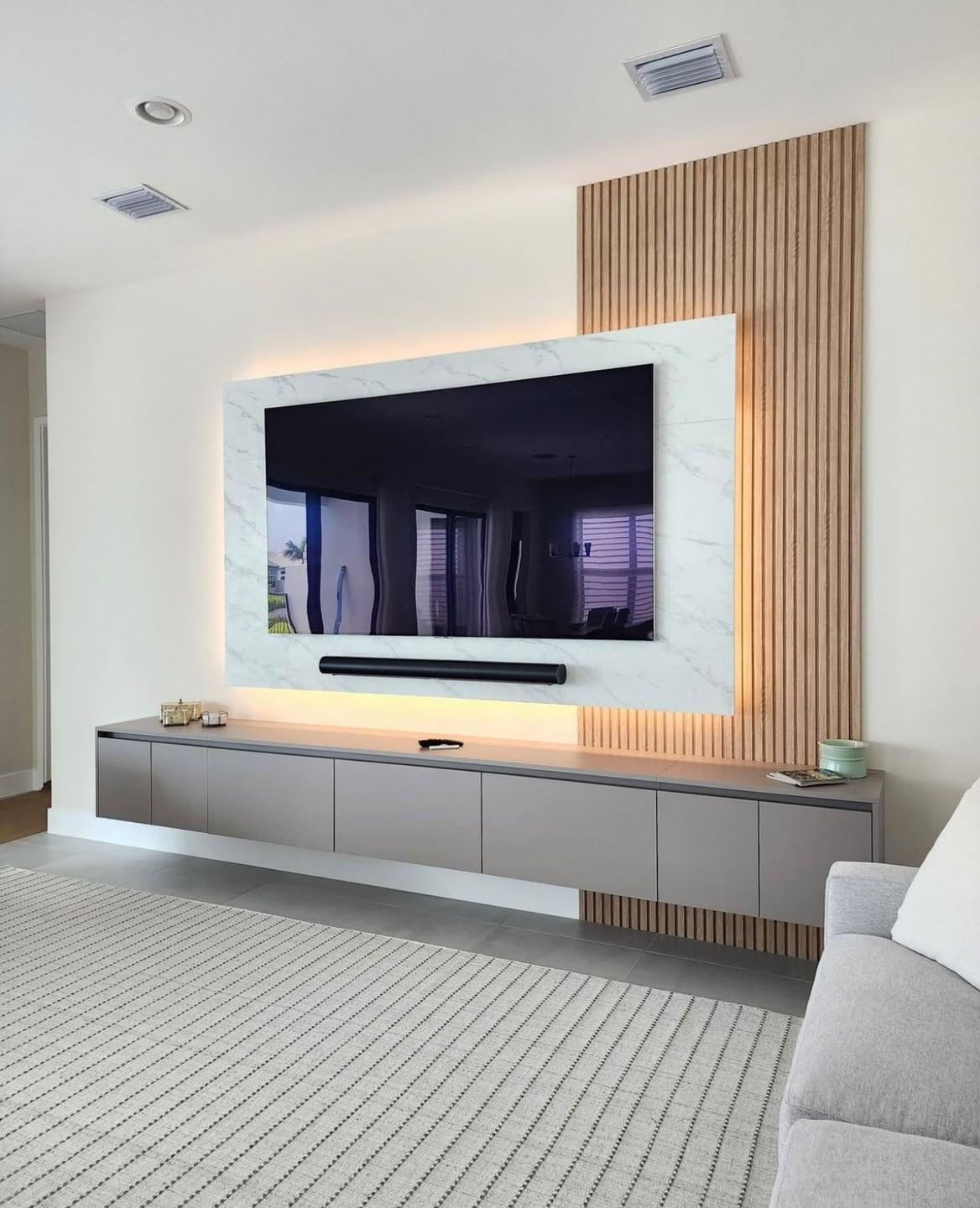
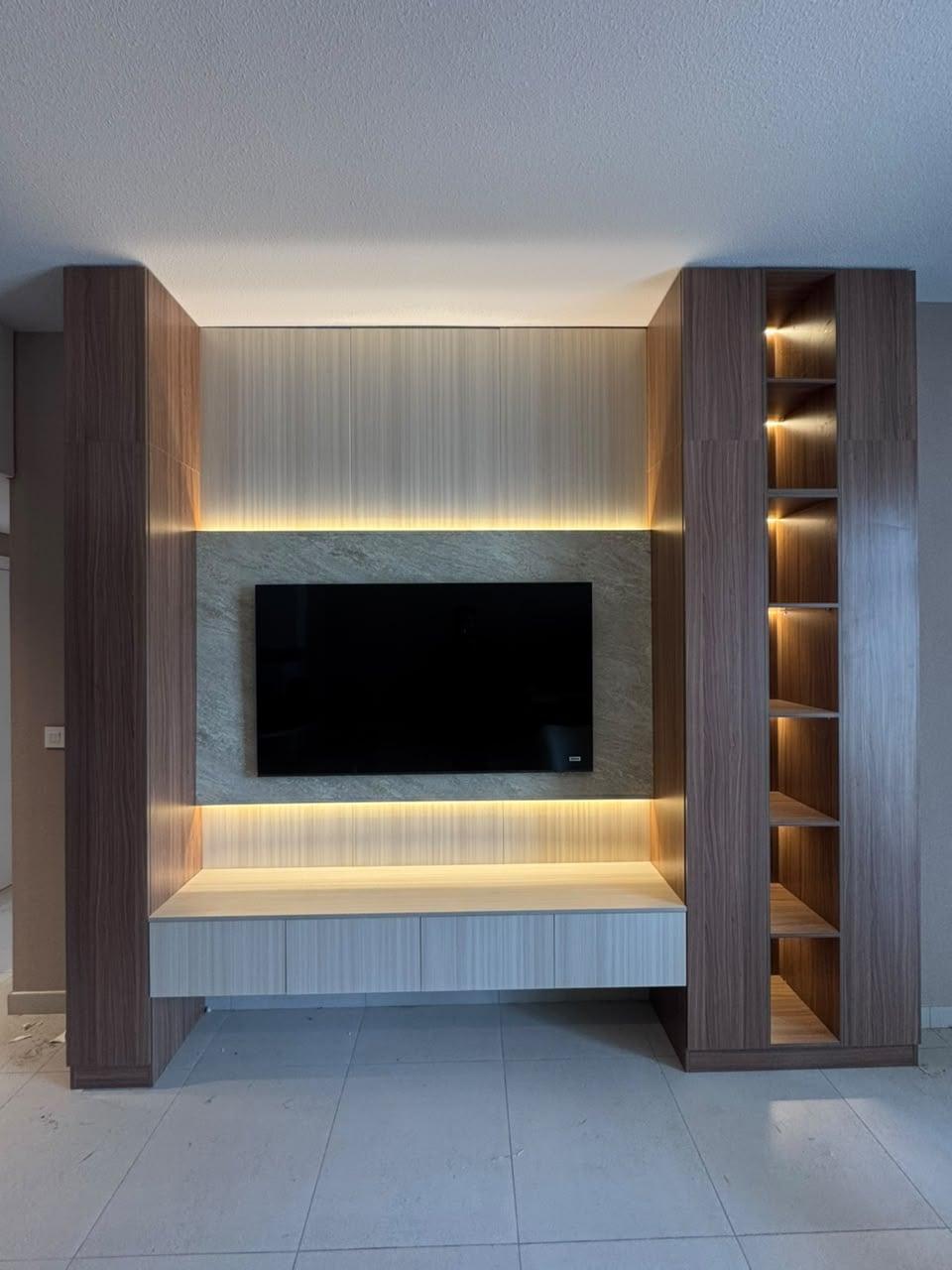
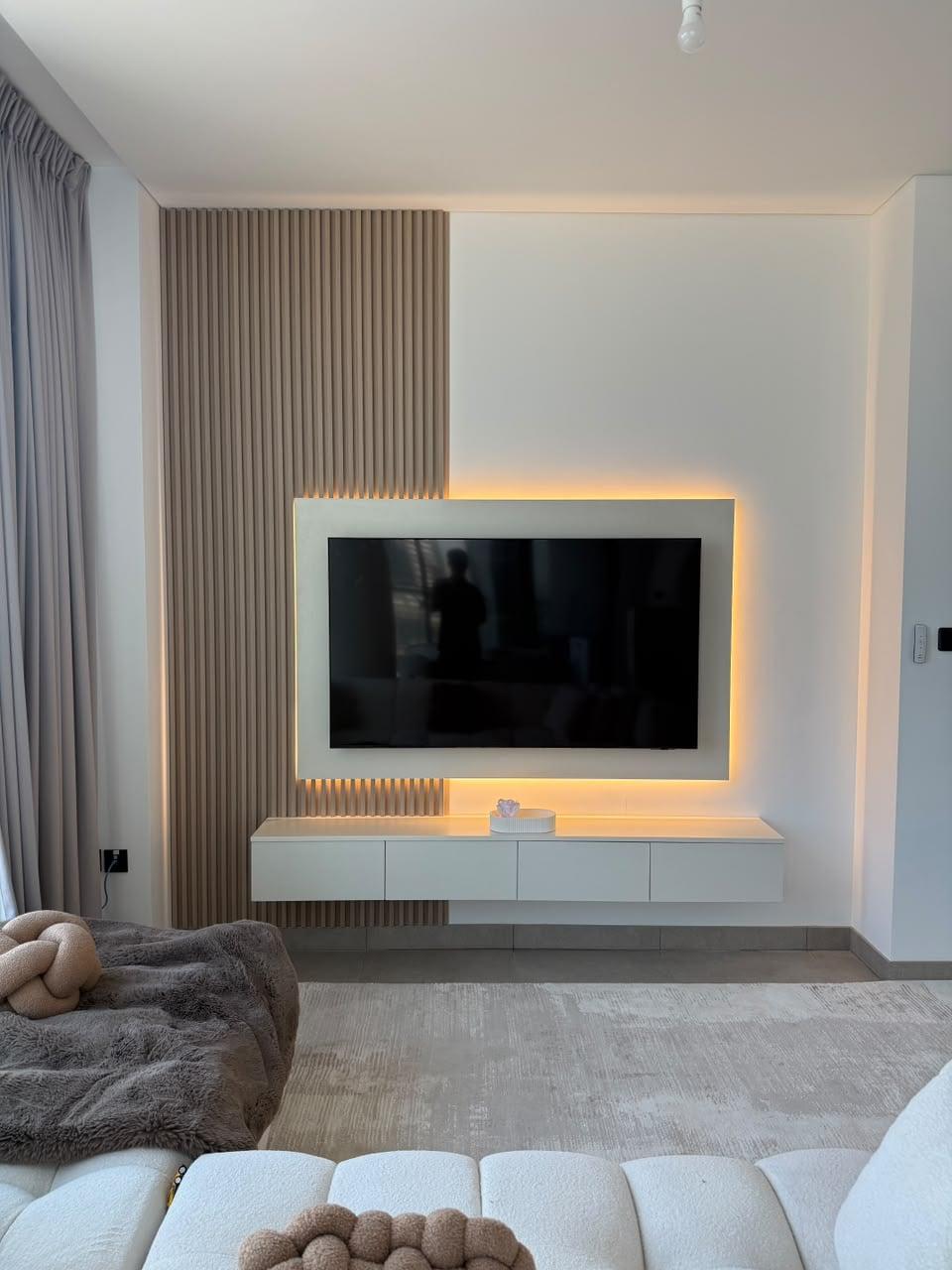
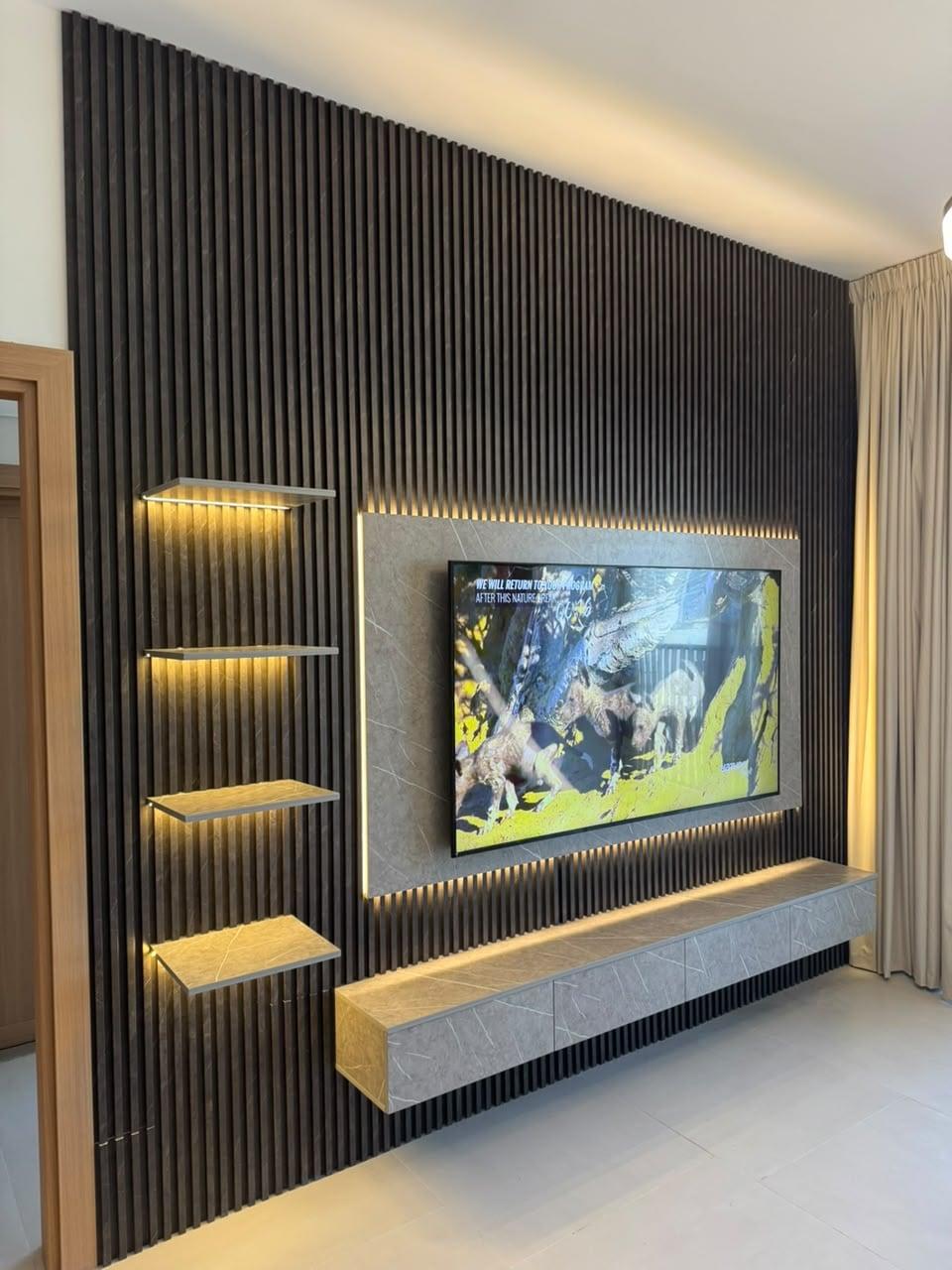
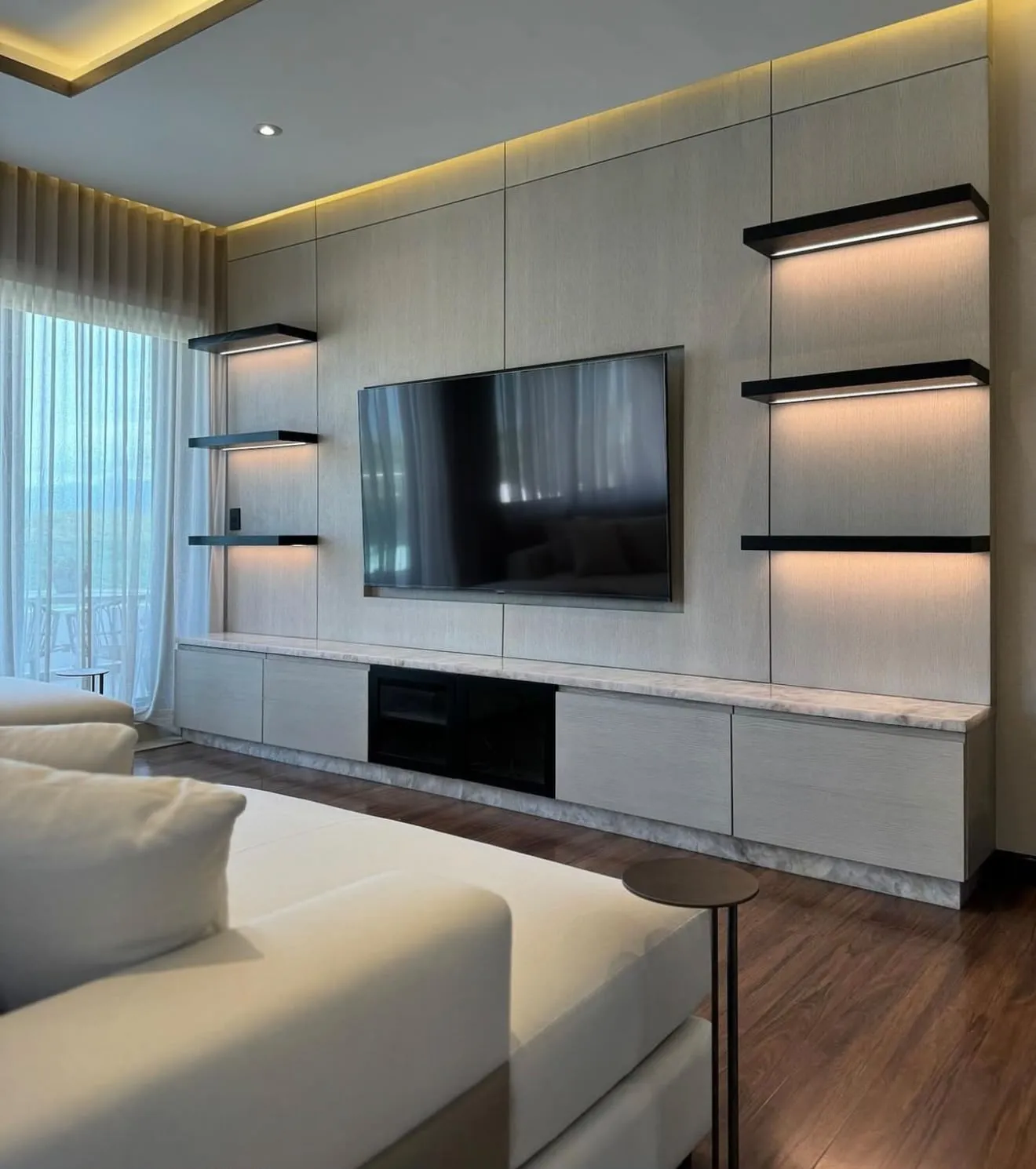
There are three sensible replacements. The first is another freestanding unit, chosen for the weight of your screen and the depth of your equipment. The second is a floating console with the TV on a bracket or a slim panel behind it: the floor stays visible, the room looks larger, and the wall carries the weight. The third is a full media wall, which makes sense if you are redecorating the room. Planning a media wall walks through the decision, and the guide on buying the TV before the wall explains why the screen comes first.
A floating console is a particularly good answer in small rooms, where a freestanding unit eats floor space. Small living room media walls shows how compact walls behave, and bedroom TV units with wardrobes covers the case where the screen shares a wall with storage.
Repair, refinish, replace or upgrade: a comparison
The table compares the four routes by what they fix, what they leave alone, and the sign that tells you it is the right one. We deliberately give no prices: the cost of refinishing depends on who does it and on the size of the unit, and the cost of a new wall depends on the quotation. Our media walls start from AED 3,500 per project, which gives an idea of the scale of the last row, and the price guide explains what moves it.
Four routes for an old TV unit
Repair hardware
- What it fixes
- Loose hinges, a stuck drawer, a re-cut cable hole
- What it does not fix
- Weak board, swelling, wrong size
- Choose it when
- The board is sound and only a part has failed
Refinish
- What it fixes
- Dated or scratched colour on a sound unit
- What it does not fix
- Swollen edges, sag, proportion
- Choose it when
- You like the unit's shape and the structure is firm
Replace the unit
- What it fixes
- Swelling, wobble, sag, wrong width
- What it does not fix
- Nothing: it is a new start
- Choose it when
- The base or frame has failed, or the TV is changing
Upgrade to a floating console or media wall
- What it fixes
- Cables, storage, a tidy wall, a larger screen
- What it does not fix
- A tight budget or a short stay
- Choose it when
- You are redecorating, or the unit no longer suits the room
A guide to reasoning, not a quotation; the right route is decided by the unit itself.
Three worked scenarios
Scenario one: a one-bedroom flat in Ajman with a white laminate unit that is four years old. The top has two chips and the colour is not what the owner would choose today, but the base is dry, the shelf is flat, the doors close, and the unit does not rock. This is the refinishing case. The owner tests the primer on the back of a door, sands lightly, primes, paints in thin coats and waits before putting the TV back. The unit costs a weekend and a little paint. The same owner anchors the unit to the wall in the same weekend, after asking the landlord.
Scenario two: a villa majlis with an oak-effect unit that came from a previous owner. The base is swollen on one side where a mop has touched it for years, the right door has dropped, and the unit rocks slightly when a child leans on it. Painting would hide all that for a month. Replacing the unit is the honest answer. The family sends photographs and the wall width, and we discuss a floating console with a panel behind the screen; our majlis TV wall guide shows how a seating-room wall differs from a living room.
Scenario three: a family in Sharjah who bought a 75-inch TV and found it wider than the old unit's top. The unit is sound; the proportion is wrong. A repair would not change that. The screen is wall-mounted on a bracket and the unit is kept, lowered in importance, as a storage chest under it. The result is cheaper than a full replacement, and it is safe, because the TV no longer relies on the unit at all. If the family later decides on a media wall, the unit moves to another room.
In all three the winning move was a ten-minute inspection and an honest answer to the structure question. None of them started with a wish to spend money.
Mistakes that waste money on an old unit
These are the errors that turn a small problem into a bigger one.
- Painting over a swollen base, which hides the damage for a month and then lifts.
- Sanding through the thin laminate layer, so that the paint has no skin to grip.
- Skipping the bonding primer on a glossy surface because the paint tin says it covers everything.
- Putting the TV back on the unit before the paint has cured.
- Fitting soft-close hinges onto a carcass whose hinge holes have already crumbled.
- Leaving a heavy TV on an unanchored unit because it has never moved.
- Keeping an old unit in the hope that it will turn into a media wall.
- Throwing the unit out before measuring the wall and the new screen, so that the replacement is the wrong size too.
Moving out, renting and what happens to the old unit
If you rent, an old unit is more portable than a built-in wall, which is its single advantage. A unit that you can lift into a van or take apart is an asset that moves with you. A fitted wall is different; the moving-out and reinstatement guide lists what a tenant should clear with the landlord in writing ahead of any fixing.
When a unit is truly finished, the practical question is disposal. Large furniture is usually collected under building or municipal arrangements that differ by community, so ask your building management what applies and when. Do not leave a swollen unit in a common corridor.
If you are replacing the unit with a custom piece, the old one is useful as a template: its width, its depth and the position of its cable hole tell the designer how you live. Send a photograph of it in place along with the new drawing request, and note what you liked and disliked.
What we do, and how to start on WhatsApp
We build media walls, floating consoles and TV units from our workshop in Sharjah and fit across the UAE. The measuring visit is free of charge. When a wall or a console is ordered, production starts once the details are agreed and a 60% advance is paid, and most take up to about 10 days depending on size and design. Our media walls start from AED 3,500 per project, and the final figure comes from the quotation. Our 5-year limited warranty covers the wood-based boards only, subject to its terms. Ten years in this trade have taught us that the first question about an old unit is the right one: what is wrong with it?
To start, send us a WhatsApp message with a photograph of the unit from the front with the TV on it, a close-up of the worst damage (the base, the hinge or the shelf), the size of the TV, the width of the wall, and whether you rent. Tell us what you would like to change. We tell you honestly whether a repair or a refinish is likely to last, and if replacement is the better route we draw it. What to send us lists the photographs that help most.
You can see the kind of work we do on the media walls page, and the guide to our measuring visit explains what happens when we come. Should the new room get a wall at all, the living room wall guide is the natural next read.
Common questions
Can I repaint a laminate TV unit?
Yes, if the structure is sound: scuff lightly, use a bonding primer, test a hidden patch and let it cure before loading it. Cracked or peeling laminate will not hold paint. Finishes compared.
Is it worth repairing a swollen TV unit?
Usually not; a swollen board has lost its strength and will swell again, so replace the part or the unit. Check the base first. Media wall or TV unit.
Do I need to anchor a TV that sits on a unit?
Yes: CPSC says a TV that is not wall-mounted should still be anchored to the wall. Ask your landlord in writing before drilling. Block and gypsum walls.
My new TV is wider than the old unit. What now?
No repair fixes that; wall-mount the screen and keep the unit as low storage, or replace it with a console sized to the screen. TV size and viewing distance.
What replaces an old TV unit in a small room?
A floating console with the TV on a bracket or slim panel usually, because it frees the floor. Small living room media walls.
Will you tell me whether to repair or replace from photos?
Yes; send the unit from the front, the worst damage and the TV size, and we say honestly what is worth doing. What to send us.
How much does a new floating console or media wall cost?
Our media walls start from AED 3,500 per project, and the final figure comes from the quotation after we see the wall. What a media wall costs.

Sources & specifications
Manufacturer information applies to the named products and systems. Sources reviewed on 11 November 2026.
- Bob Vila: painting laminate cabinets (light 120-grit sanding, bonding primer, test a patch, damaged laminate)bobvila.com(opens in a new tab)
- Sherwin-Williams: how to paint laminate furniture (sanding to remove shine, bonding primer, drying time)sherwin-williams.com(opens in a new tab)
- CPSC AnchorIt.gov: anchoring TVs and furniture (TVs on furniture designed for them; anchor a TV that is not wall mounted)cpsc.gov(opens in a new tab)
Want this planned for your home?
Consultation and measurement are free. Tell us the rooms, location and what you need; we arrange a sample visit and define the measured quotation.