Media Walls · 20 min read · 24 October 2026
TV wall for a kids' or second living room in the UAE: low, closed and anchored
How to plan a TV wall for a children's or second living room in the UAE: height zones, anchoring, rounded corners, wipeable finishes, a games console bay, hidden cables and a wall that grows with the children.

By Ali Haider Basra, Founder, Al Tareeq Decor · Contact our workshop
Key takeaways
- Plan the wall by height: low and closed for children, the screen at a seated eye line in the middle, display and breakables high.
- Fix everything to the wall: the US Anchor It campaign says anchoring furniture prevents tip-over injuries and deaths, and a fitted wall with a floating console avoids a loose standing unit.
- Ask for rounded corners and soft-close doors on the lower band, and keep sockets and cables inside the console, out of reach.
- Choose a wipeable matt or satin laminate for the low band; keep veneer for the high band if you love it.
- Build the structure for the oldest child and fill it for the youngest, with a vented games console bay and a controller drawer.
On this page
- Key takeaways
- A TV wall for a second living room used by children: the short answer
- What makes a children's second living room different
- Height zones: low and closed, middle for the screen, high for the adults
- Stability and anchoring: the part you should not leave to chance
- Corners, edges and pinch points
- Finish: wipeable, scratch-tolerant and calm
- A games console bay: air, cables and a door the child can close
- Cables and power in a room where little hands pull
- Toys, games and storage: what goes behind which door
- Who reaches what: a storage plan for a family-room wall
- Screen size and seating when children sit low and close
- The wall as the children grow
- Lighting, sound and the evening routine
- Three imagined families, three walls
- What it costs and how we work
- Your WhatsApp step: what to send
- Common questions
A TV wall for a second living room used by children: the short answer
A second living room, a family room or a playroom is the room where the TV is switched on for cartoons at breakfast, for a game after school and for a film on Friday night, and where the floor is covered in things that were not there an hour ago. The wall in such a room has a different job from the wall in the main living room. It has to look tidy when guests arrive, take a lot of everyday knocks, hide the toys and the games, and still look right in three years' time when the children are three years older.
The design that suits most such rooms is simple. Keep the lower part of the wall closed, with soft-close doors and rounded edges, because that is where children reach. Keep the screen at a comfortable height, mounted to a solid frame. Keep what you do not want touched high and out of reach. Choose a wipeable face that hides fingerprints. And plan the cables and the games console bay so that nothing trails across the floor.
This guide is design guidance, not a safety standard. We do not promise that any wall is child-proof, and no wall replaces watching small children. What a good design can do is remove avoidable hazards, such as a tall unit that could tip, a sharp corner at running height and cables that can be pulled. It can also make the room easier to tidy, which is half of what a family room needs.
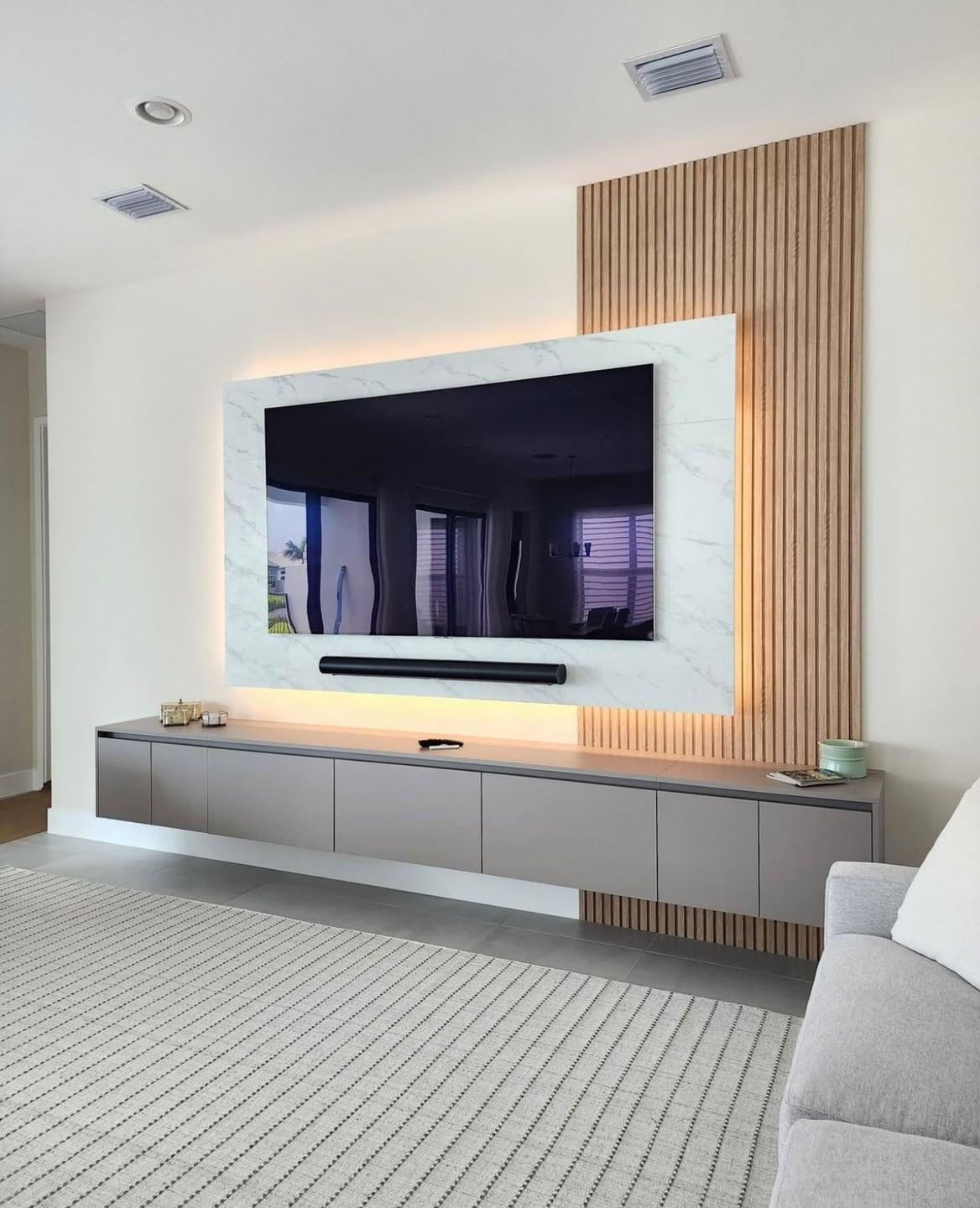
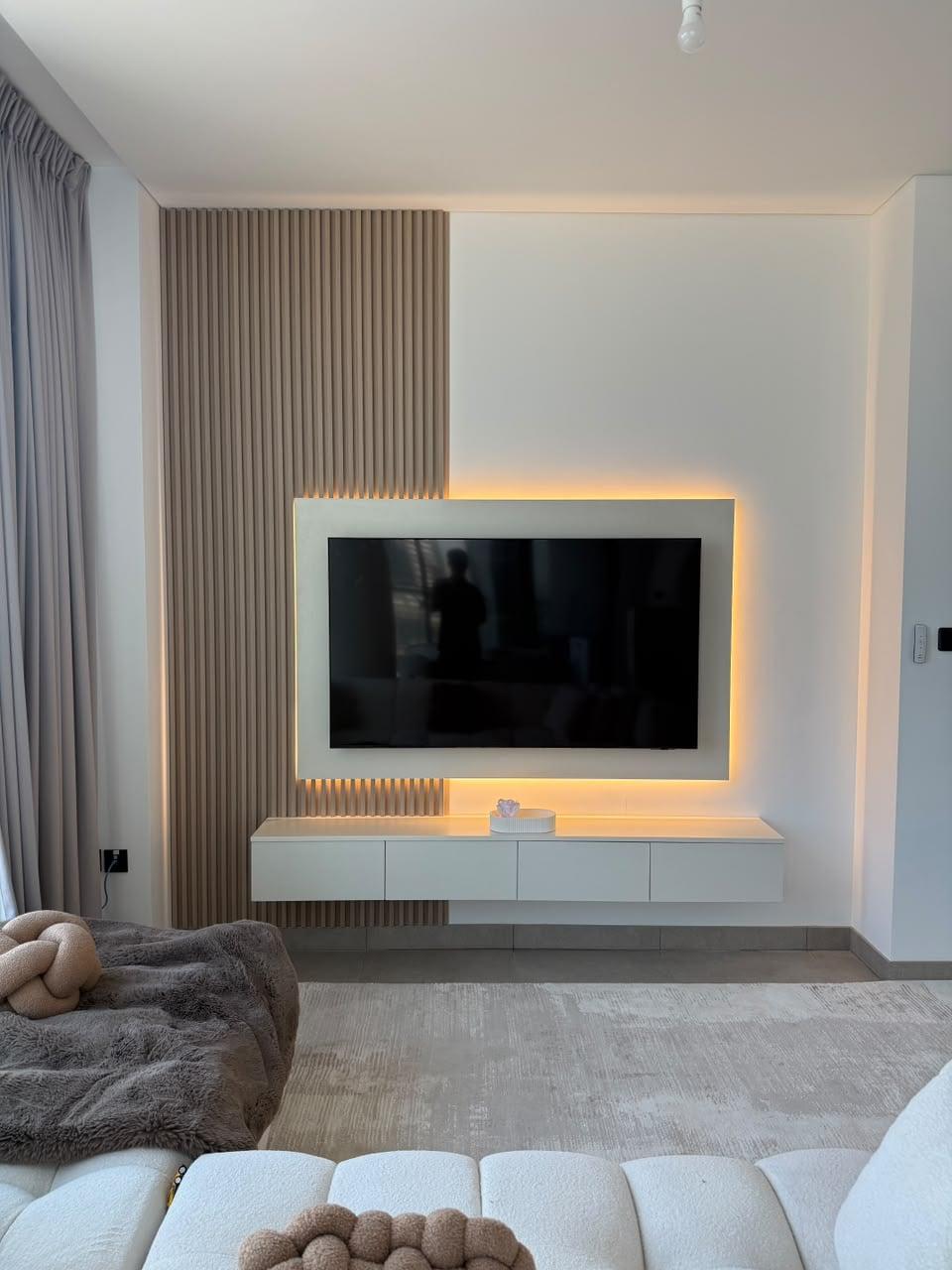
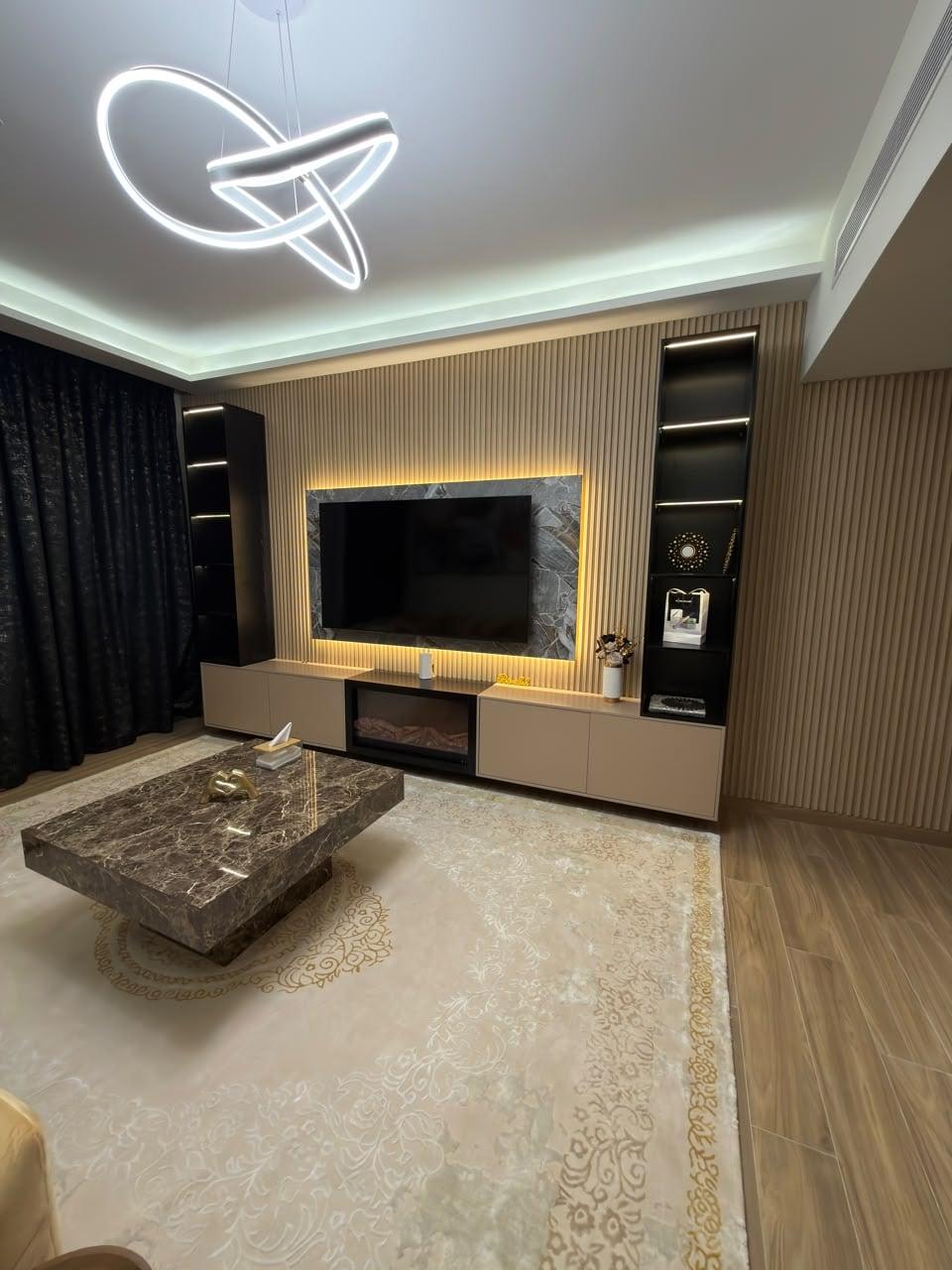
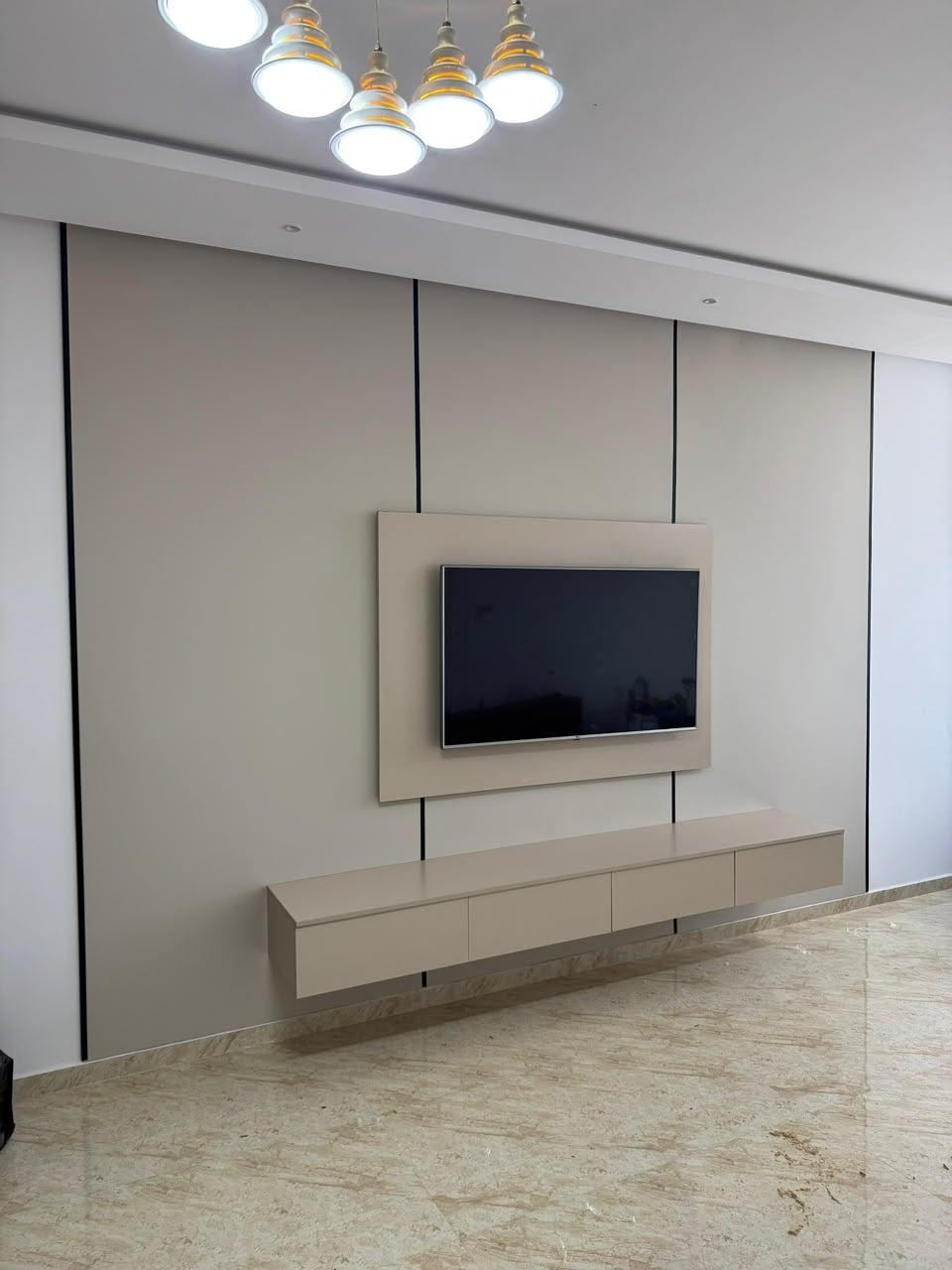
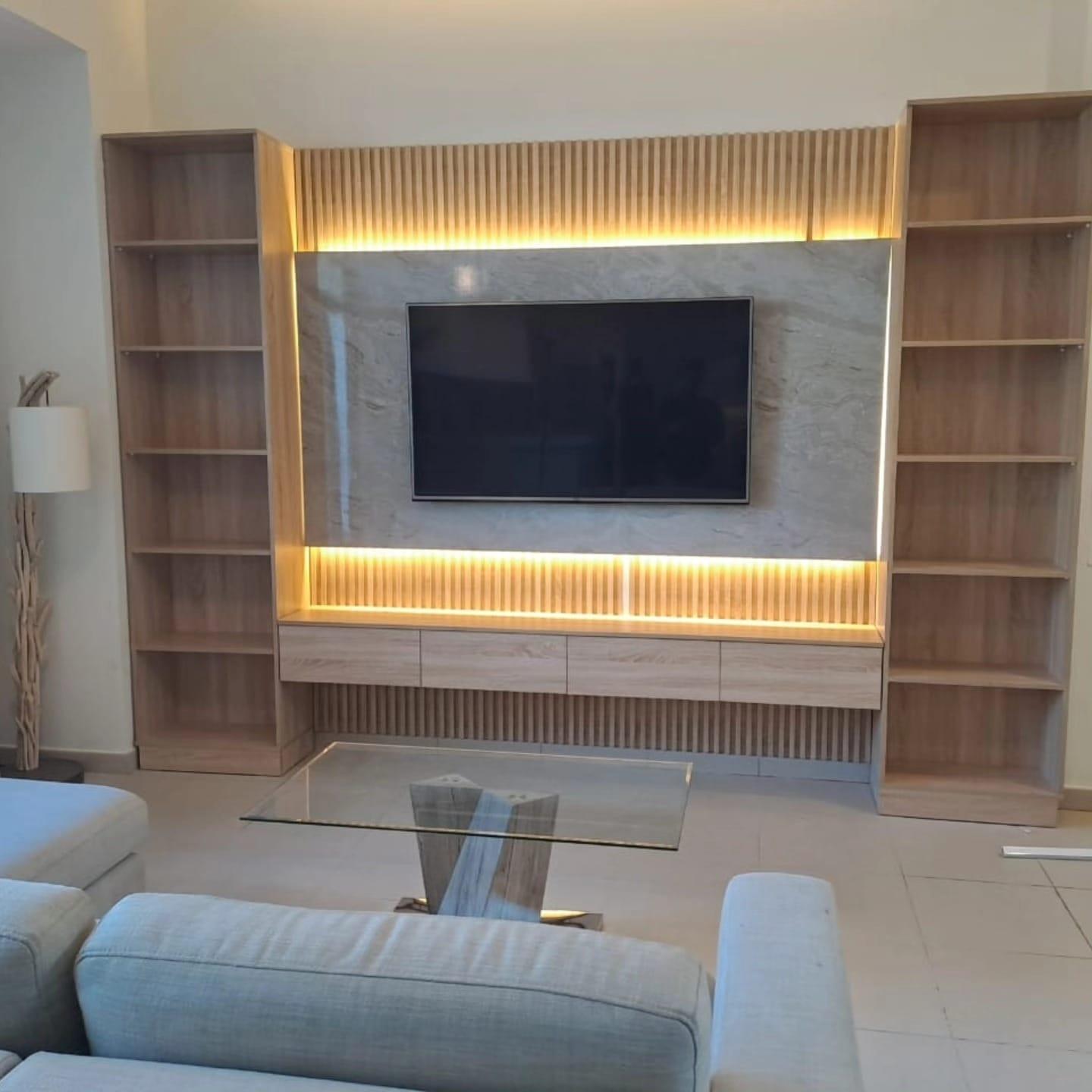
A media wall from us starts from AED 3,500 per project for a compact panel with a floating console in standard laminate, and a family room often fits that format well. The final figure depends on wall size, finish, lighting and any extras, and comes with the drawing and quotation. If you are planning the main living room instead, start with our living room TV wall guide; if the TV is in a bedroom, see the bedroom TV and wardrobe guide.
What makes a children's second living room different
Think about how the room is used for a week. The TV is on for hours at a time but not always watched. The floor is where the family sits, so the screen is viewed from low seats, from cushions and from the floor itself. Games consoles, controllers and headsets come out and are left out. Visitors' children arrive and treat the room as their own. Cleaning is frequent and quick.
Compare that with a formal living room, where the TV is a centrepiece and the wall is a showpiece. In a family room the wall is closer to a workhorse. It can still look good; a wall in a family room can be finished as well as any other. But the priorities change: access, durability, stability and tidiness come before display.
The children's age range matters, and it moves. A wall that suits a toddler is different from one that suits a teenager, and the room's life is long. The design principle that works best is to build the structure for the oldest child you will have and fill it for the youngest. We come back to this in the section on growth, with a timeline.
It also matters who is in charge of the screen. In some homes the TV is the children's and the adults come second; in others it is shared. Say which when you tell us about the room, because it changes where the screen sits, how high the games bay is and where the remote lives.
Height zones: low and closed, middle for the screen, high for the adults
The most useful way to plan a family-room wall is by height. Divide the wall into three bands and decide what lives in each.
The low band is the children's zone, from the floor up to roughly the height a small child reaches. Put closed storage here: doors that close softly, drawers with push-to-open fronts, rounded edges. Toys, games and the controller drawer live here. It is the band that gets knocked and opened most, so it should be the toughest and the simplest. Do not put anything fragile, heavy or valuable in this band.
The middle band is the screen band. The TV sits here, with the centre of the screen at the height of a seated child's eye line rather than an adult standing. In a family room where people sit low or on the floor, a screen that is too high causes neck strain for everyone. Our guide to TV height on a media wall covers the principle, and a mark at the real seat height on your own wall is the best test.
The high band is for adults. Display shelves, a lit niche, books you want to keep and anything breakable go up here, above reach. For a tall wall the upper band can also be closed cabinets for seasonal storage. The heights in the diagram are examples to show the idea; the real numbers are drawn for your child's age and your room, and we set them with you on the drawing.
- 1. Low zone, children's reach: closed doors with soft-close, rounded edges, toys and games.
- 2. Screen band: the TV centred for a seated child's eye line, set for your household.
- 3. High zone, adults only: display, a lit niche and anything breakable.
Stability and anchoring: the part you should not leave to chance
A TV, a tall cabinet or a loaded shelf can tip if a child climbs or pulls. This is a well-known hazard. The US Consumer Product Safety Commission's Anchor It page says that anchoring all furniture with drawers, doors and shelves to the wall prevents tip-over injuries and deaths, and frames its campaign as a response to rising furniture and TV tip-over injuries and fatalities. It also describes a federal rule on furniture tip-over that took effect on 1 September 2023. The page is [anchorit.gov](https://www.anchorit.gov/), and its message is simple: fix the furniture to the wall.
A fitted media wall changes the picture in a useful way. The structure is built to the wall and fixed into it, so the main unit is not freestanding in the way a loose cabinet is. The TV is mounted on a bracket fixed to a solid part of the frame, and a floating console hangs from the wall instead of standing on the floor. How a wall is fixed depends on the wall type, which our team checks at the measuring visit; the guide to block and gypsum walls explains why this matters.
Where a freestanding unit is chosen, for example in a rented flat, ask how it is anchored to the wall and whether the anchor is acceptable to your landlord, which you ask in writing. The guide to media wall against a TV unit has a section on anchoring a TV that stands on a unit. A child's room should not rely on a TV balanced on a low cabinet.
A last practical tip. Teach children early that cabinet doors and drawers are not for climbing, and keep the heaviest items in the lowest drawers of any tall unit. We cannot make that rule for your household, but the design can make it easier by keeping heavy storage low and display light and high.
Corners, edges and pinch points
Children run. A square corner at head height is a hazard that costs nothing to remove at the drawing stage. Ask for the corners of the console, and of any tall unit that sticks out into the room, to be rounded. A rounded end looks softer and friendlier and is gentler in a collision.
The diagram shows three treatments of the console's end in plan: a sharp square end that stands out into the room, a rounded end, and a console tucked against a return wall so that there is no free corner at all. The tucked version needs a room layout that allows it, but when it is possible it removes the problem. The rounded version is the most flexible, and it adds little to the cost compared with the benefit.
Look at pinch points as well. A door that swings against a neighbour can trap fingers; soft-close hinges slow the last part of the closing, and our consoles use soft-close hinges, with the brand and model confirmed in the quotation. A drawer with push-to-open needs a clear surround so that fingers are not pinched between drawer and frame. Where you can, keep handles flush or recessed, since a protruding handle at head height is another edge to think about. Our guide to edge banding and sealing explains why the edges at the lower band deserve the most careful finish.
These are design choices, not guarantees. We do not claim that a rounded corner or a soft-close hinge makes a wall safe. They remove common causes of knocks and trapped fingers, and the household's habits do the rest.
Finish: wipeable, scratch-tolerant and calm
A family-room finish needs to survive fingerprints, crayon, sticky hands, toy impacts and frequent wiping. High-pressure laminate is a sensible starting point. [The reference on decorative laminate](https://en.wikipedia.org/wiki/Decorative_laminate) explains that laminate is made of layers pressed together, and that the clear overlay on the surface improves abrasion, scratch and heat resistance. That does not make it indestructible, but it explains why laminate is a common choice for surfaces that get a lot of use.
Matt and satin faces hide fingerprints better than gloss. A very dark gloss shows every mark, while a mid-tone matt wood-effect or a light matt colour is forgiving. Avoid a surface with deep texture at child height if you expect crayon or food, because texture holds dirt. A smooth matt surface wipes clean with a damp soft cloth, which is the usual care for laminate and sprayed colour; ask the team for the specific care for the finish you choose, and see the guide on care after handover.
Think about the colour in terms of the room, not only the wall. A family room usually has a busy floor and brightly coloured toys. A calm wall, in a warm neutral or a soft wood tone, gives the eye somewhere to rest. The colour and finish guide goes through families and how UAE light affects them, and the sample boards guide shows how to judge a sample at the wall.
Real-wood veneer is beautiful but asks for more care. In a room used by small children, we usually suggest laminate for the lower band and, if you love veneer, veneer for the high band where hands do not reach.
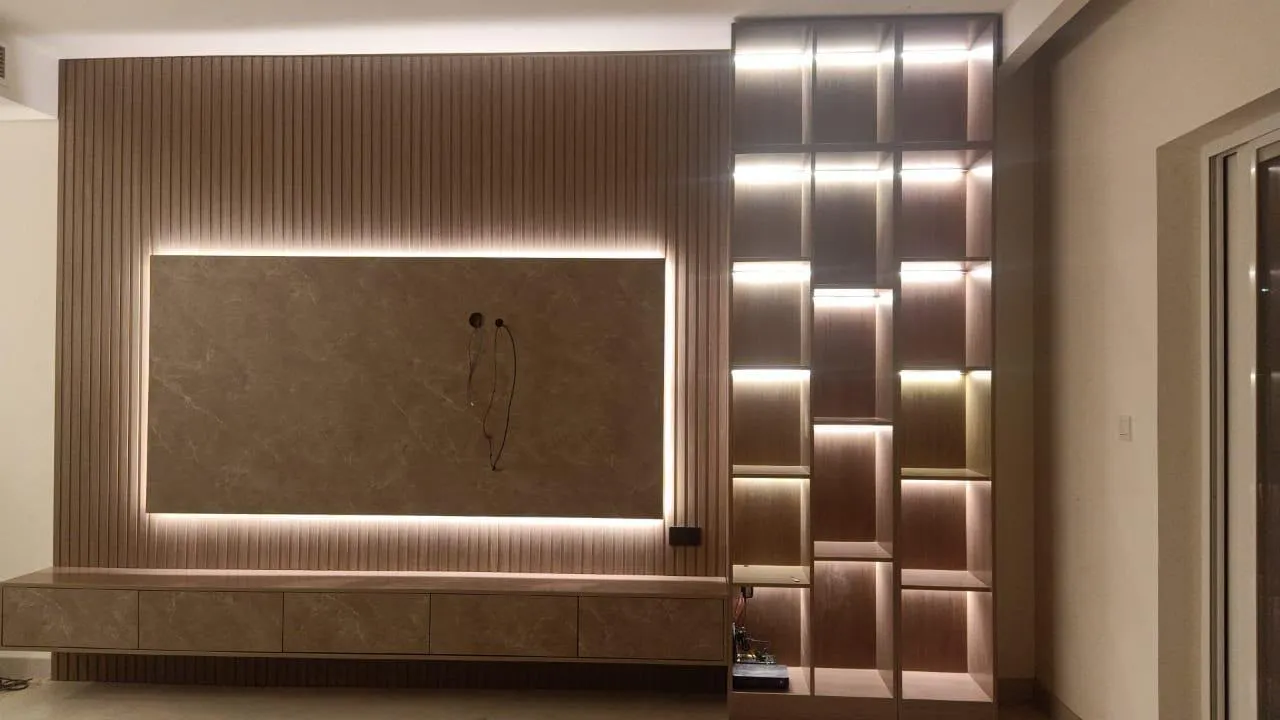
A games console bay: air, cables and a door the child can close
Children's games consoles and streaming boxes deserve a place of their own. A well-planned bay keeps them off the floor, keeps the cables inside the wall and gives the child a tidy place to return the controllers.
The bay has five points to settle, shown on the diagram. First, air: games consoles and boxes warm up, and a closed cupboard traps heat. Leave the space the device's manual asks for above and behind it, and see our TV and equipment ventilation guide for the reasoning. Second, the cable route: a conduit from the TV plate to the bay, so that the HDMI and power do not hang in a loop. The cable and service access guide shows how routes are drawn.
Third, a door the child can close without effort, with soft-close and a handle at a low height, so that tidying is easy and the door is closed by habit. Fourth, a controller drawer, where wireless pads are stored together and can be charged. A drawer that is too small turns into a heap, so size it for the controllers you own and a few spare. Fifth, the router and any set-top box on a separate vented shelf, not under the console, because a router wants open air and a clear signal.
If you are not sure about a device's heat, check its manual. We do not quote figures for any device here, because every product states its own.
- 1. Air above and behind: leave the gap the device manual asks for.
- 2. Cable route: a conduit from the TV plate to the bay.
- 3. A door the child can close: soft-close, handle set low.
- 4. Controller drawer: wireless pads charge and stay together.
- 5. Router and box: a separate vented shelf, not under the console.
Cables and power in a room where little hands pull
Cables are a hazard in a family room in a way they are not in a quiet living room. A cable that dangles from a console can be pulled, and a plug within reach of a small child can be played with. The design answer is to put all cables inside the wall and the console, and to keep any socket out of reach.
The TV's power and signal cables run through conduit behind the panel, as our cable guide describes, and power and signal are kept apart. Sockets for the console and chargers sit inside the console, behind a closed door or a drawer, rather than on an open wall at floor height. Where a socket must be in the room, ask about a cover. The sockets and power guide explains which sockets can stay and which should move.
A charging drawer is a small but useful addition. Wireless controllers, headsets and tablets return to the drawer and charge there, and the room's other sockets stay free. The drawer needs a power strip and a hole for the cord, and the design should say where the strip is fixed.
Any electrical work beyond our agreed scope, such as new circuits, is not part of a media wall job. We install the LED lighting inside the wall as part of the project; standalone socket jobs we do not take on. Say what you need at the measuring visit and we will tell you what the wall can include.
Toys, games and storage: what goes behind which door
A family-room wall has to absorb a lot of things. The trick is to sort them by who uses them and how often, and then give each group a place at the right height.
The children's daily things, such as the controllers, a few favourite games and a box of small toys, belong in the lower band where they can reach them. Seasonal or larger items belong in a tall closed cabinet at the end of the wall. Things that must not be touched, such as adult games, papers or breakable items, belong in the upper band or in a cabinet you can close off. If you want a latch or lock on one, ask for it at the quotation and we will say what is possible.
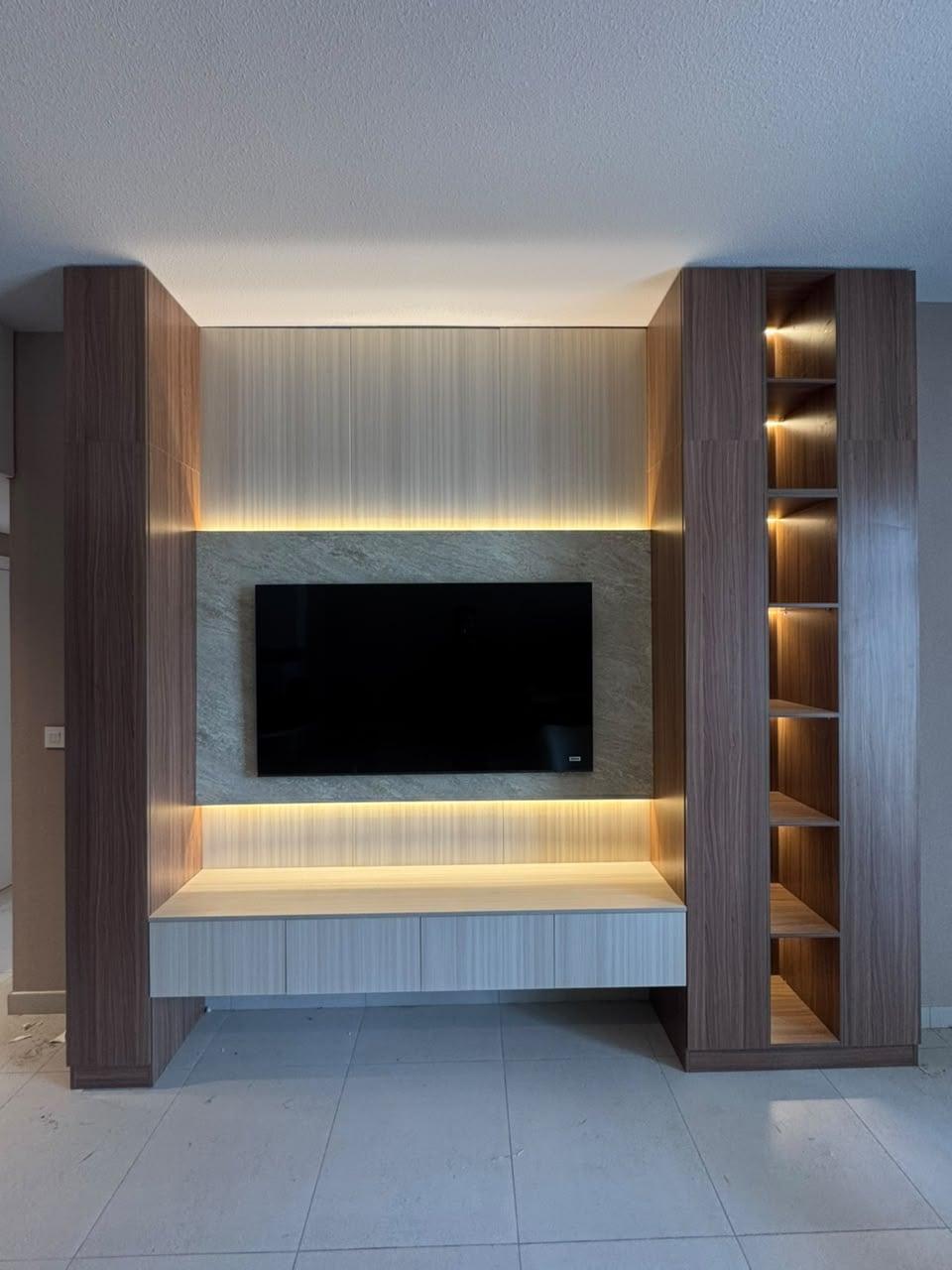
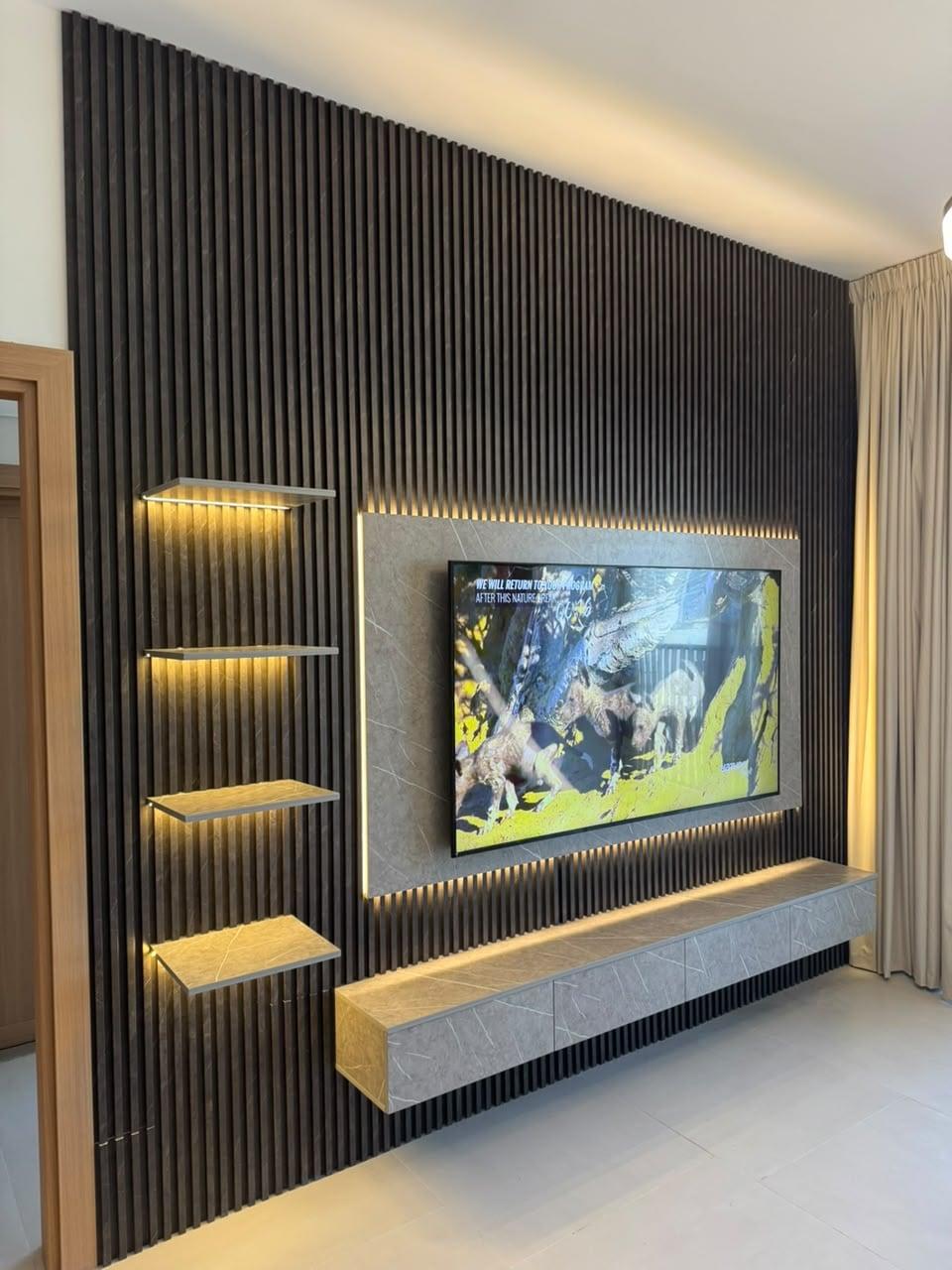
Open shelves in the low band tend to become a mess within a week; closed doors hide it. Open shelves are better for the middle height, if at all, and for a few styled things. The shelves guide shows how deep to make them and how to light them, and our living room guide covers the balance between open and closed in a larger wall.
Who reaches what: a storage plan for a family-room wall
Low (children's reach)
- What lives there
- Toys, controllers, games, a charging drawer
- Door and edge choice
- Closed, soft-close, rounded edges
Middle (screen band)
- What lives there
- TV, soundbar, a few styled objects
- Door and edge choice
- Fixed to a solid frame; no loose items on the bracket
High (adults only)
- What lives there
- Breakables, books to keep, a lit niche
- Door and edge choice
- Open display or closed seasonal storage
Tall cabinet at the end
- What lives there
- Large toys, seasonal items, spare bedding
- Door and edge choice
- Ask about a latch at the quotation; heaviest items at the bottom
The heights are set on your drawing for your child's age and your room.
Screen size and seating when children sit low and close
Children sit closer and lower than adults, often on the floor, so screen size and distance deserve a second thought. The Samsung Gulf TV buying guide frames the sizing question as finding a good balance between viewing distance and resolution. In a family room, that means working out where people really sit, including the floor, and choosing a screen that works from there, rather than choosing the largest screen that fits.
A practical way to test is to mark the seating positions on the plan, including a cushion on the floor, and measure from each to the wall. If the nearest position is very close, a very large screen makes the room's low-level viewing uncomfortable, and a mid-size screen with a decent distance suits the room better. Our guide to TV size and viewing distance has the method, and the [Samsung Gulf TV buying guide](https://www.samsung.com/ae/tvs/tv-buying-guide/) explains how the manufacturer frames the choice.
If you plan to upgrade the TV when the children are older, build the extra width into the panel now. A screen that grows from 55 to 75 inches needs more margin, and the guide to changing the TV later shows how to leave room for it. It is much cheaper to plan that on the drawing than to rebuild the wall.
The wall as the children grow
A family room's wall has to last. A toddler's wall and a teenager's wall are different, but you can build one structure that serves both if you separate what is built from what changes.
What is built once: the wall, the cable routes, the console, the fixing for the screen. What changes cheaply: the contents of the shelves, the doors on an open shelf, and accessories. The diagram shows four stages. For a toddler, low closed doors, a TV out of reach and cables inside. For a school-age child, a games bay, a controller drawer and a low open shelf. For a pre-teen, a homework shelf, a headset hook and a screen that can be higher. For a teenager, desk or lounge use, with the wall mostly as built.
A teenager's wall can also be a quieter wall. The low band that once held toys can hold books, and the games bay becomes the household's media centre. Because we install the wall in a fixed structure, you do not need to rebuild it; you change the contents and, if you wish, the doors. If a bigger change comes, our renovation guide explains refacing fronts and updating a wall without starting again.
The design principle again: build the structure for the oldest child you will have and fill it for the youngest.
Lighting, sound and the evening routine
A family room is used in the evening, and the light matters. A dimmer on the wall's LED channels lets you drop the light for a film and raise it for homework. We install integrated LED channels in warm 3000K or neutral 4000K with dimmers, as published on our media wall service page. In a family room, a warm light is kinder in the evening, and a neutral one is brighter for homework; ask for a dimmer so you can have both. The lighting ideas guide explains the layers.
Choose lights that are not aimed straight into the room. A glow behind or beneath a panel is gentler on young eyes than a beam, and it hides the source. We are not making a health claim here; it is a comfort point, and glare is simply unpleasant for anyone.
Sound in a family room is a matter of both comfort and neighbours. A soundbar in the console, aimed at the seating, lets you keep the volume sensible. The soundbar guide explains the placement. If the wall includes an electric fireplace, follow the fireplace maker's guidance on clearances and heat, and talk to us at the planning stage; the electric fireplace guide covers the planning.
Three imagined families, three walls
These are illustrative examples, not customer stories. In each case the real design comes from a measuring visit and a drawing.
The first family has two children under six in a villa's second sitting room. The wall is compact, with a floating console at a low height, rounded ends and soft-close doors on the lower band. The TV is on a solid frame at a seated eye line, the cables run inside the wall, and a closed cabinet at one end holds the adults' things. The finish is a matt laminate in a warm neutral.
The second has a nine-year-old and a thirteen-year-old in an apartment's family room, where a games console is the centre of the evening. The wall includes a vented console bay with a controller drawer and a vented shelf for the router, a homework shelf at mid height and a dimmable warm light. The screen is large enough for the room's real seating and is mounted so that it can be replaced by a bigger one later.
The third is a household that uses the second living room as a majlis for visiting family and as a playroom on weekdays. The wall's upper band is a lit display of items the family values, and the lower band is closed storage. For majlis arrangements, our majlis TV wall guide is the right companion read.
What it costs and how we work
A media wall from us starts from AED 3,500 per project for a compact panel with a floating console in standard laminate. Wall size, finish (laminate, veneer or lacquer), marble-effect panels, lighting and any electric fireplace set the final figure, quoted from the drawing. The price guide and the price factors guide explain the drivers, and the quotation checklist shows what to compare.
The free measuring visit brings samples and a laser measure to your home anywhere in the UAE, and our team talks through the heights and the household. We send a drawing and an itemised quotation. Once the details are agreed and the 60% advance has been received, production starts in our Sharjah workshop, and the wall is usually ready in up to about 10 days, depending on size and design. Our own team fits it and mounts the TV. The boards carry a 5-year limited warranty on the wood-based boards only, subject to the written terms, with hinges, runners, labour and misuse excluded; our workmanship carries a separate 24-month written warranty.
See the media walls category for the range, and the local pages for media walls in Dubai and media walls in Sharjah. The pricing guide tool gives a starting picture.
Your WhatsApp step: what to send
Message us on WhatsApp with a photo of the wall, the TV size you have or plan, and the room. Tell us the children's ages, whether a games console will be in the wall, and where the family sits when watching, including the floor. If the room doubles as a majlis or a guest room, say so.
What to send for a media wall consultation lists the photos and details that help most. We will reply with the next step and arrange a free measuring visit.
Common questions
How do I make a TV wall safer for young children?
Fix the wall and TV to a solid frame, keep a floating console, round the corners, use soft-close doors on the low band and hide cables inside. No wall replaces supervision. Living room TV wall guide.
Should the TV be anchored to the wall?
Yes. The US Anchor It campaign says anchoring furniture and TVs to the wall prevents tip-over injuries and deaths, and a bracket must go on a solid frame. Media wall or TV unit.
What finish stands up best to children?
A smooth matt or satin laminate is easy to wipe and hides fingerprints, while deep texture and dark gloss show marks. Ask for the care instructions of your finish. Media wall colour and finish.
Where should a games console go in the wall?
In a vented bay with a cable route, a soft-close door and a controller drawer, with the router on a separate vented shelf. TV and equipment ventilation.
How high should the TV be in a family room where kids sit low?
Centre it at the eye line of a seated child, tested at the real seating on your own wall. TV height on a media wall.
Will the wall still work when the children are teenagers?
Yes, if the structure is built for the oldest child and the contents change; shelves, doors and accessories can be updated. Renovating a media wall.
What does a family-room media wall cost?
From AED 3,500 per project for a compact panel with a floating console in standard laminate; size, finish and lighting set the final figure. Media wall price guide.

Sources & specifications
Manufacturer information applies to the named products and systems. Sources reviewed on 11 November 2026.
- Anchor It (US CPSC): anchoring furniture and TVs to prevent tip-overanchorit.gov(opens in a new tab)
- Samsung Gulf TV buying guide: balance between viewing distance and resolutionsamsung.com(opens in a new tab)
- Decorative laminate: overlay, decor paper and kraft layersen.wikipedia.org(opens in a new tab)
Want this planned for your home?
Consultation and measurement are free. Tell us the rooms, location and what you need; we arrange a sample visit and define the measured quotation.