Media Walls · 21 min read · 30 September 2026
How heavy is a media wall? Panel weight, fixings and safe carrying
How heavy is a media wall? Weight per square metre from datasheets, a worked compact and full wall, hung versus standing loads, what plugs hold in different walls and how to carry heavy panels.

By Ali Haider Basra, Founder, Al Tareeq Decor · Contact our workshop
Key takeaways
- Board is most of the weight: 18 mm MDF at the density band of one maker's datasheet is about 12 kg per square metre, so a full wall is roughly a hundred kilograms of boards before frame, shelves and TV.
- Hung parts pull on fixings, standing parts press on the floor: the heavier the part, the more it should rest on the floor.
- What a plug holds depends on the wall: one maker's table rates the same plug about seven times lower in aerated concrete than in concrete.
- Plasterboard alone carries very little per fixing; fixings must reach studs, backing or the structural wall.
- No safe weight limit exists on its own: split the wall into modules two people can carry and plan the route.
On this page
- Key takeaways
- How heavy is a media wall, and does it matter?
- Weighing a panel: thickness times density
- A worked example: weighing a compact wall and a full wall
- Hung or standing: following the weight to the ground
- What a fixing can hold depends on the wall
- Reading a fixing or bracket page without over-reading it
- The load a console carries beyond its own weight
- Splitting a wall into modules two people can carry
- Carrying heavy pieces safely
- Three walls, three weight plans
- Mistakes that make a heavy wall a problem
- A weight checklist before the drawing is approved
- Choosing designs with weight in mind
- What we do about it, and what to send us
- Common questions
How heavy is a media wall, and does it matter?
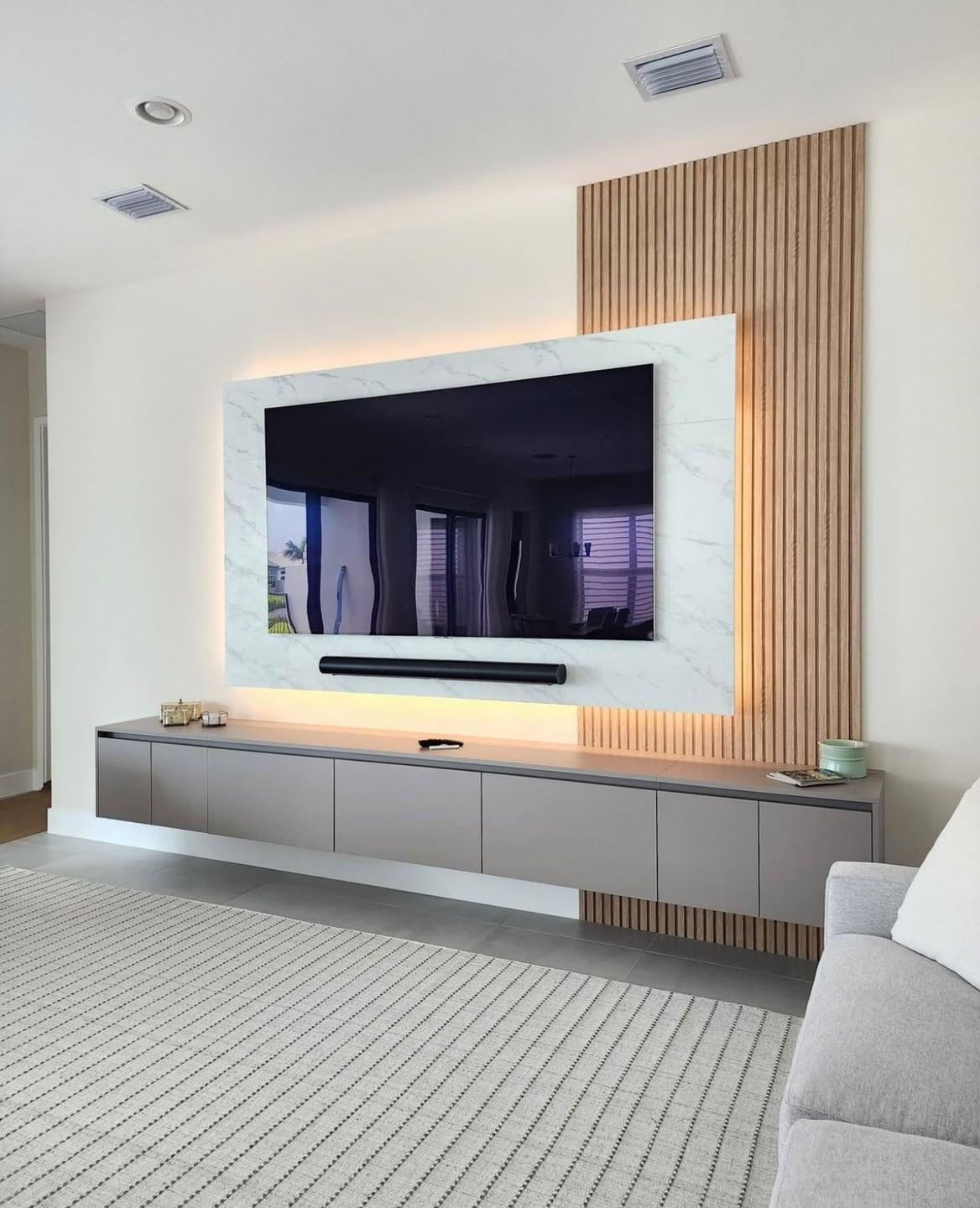
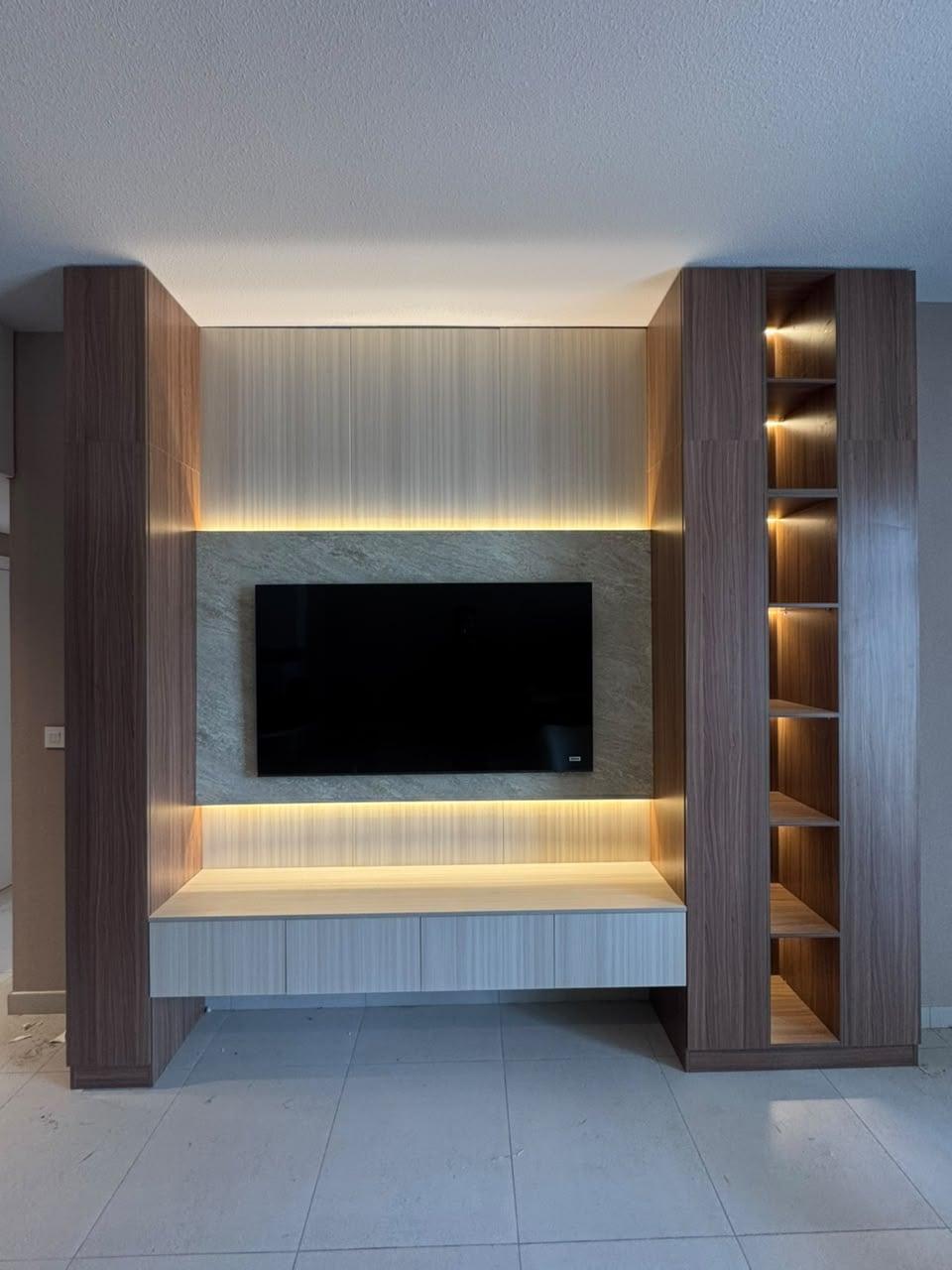
A media wall is heavier than it looks. The faces are board, the shelves are board, the console is a box of board with drawers or doors, and where marble-effect or porcelain panels are used the surface adds to the mass again. A full wall of 18 mm board over eight square metres is, on the boards alone, close to a hundred kilograms before you add a frame, a TV, equipment or books. That is not a reason to worry; it is a reason to plan where the weight sits.
Weight matters in four ways. It decides how the wall is fixed, because a hanging part pulls on its fixings while a standing part presses on the floor. It decides what the wall behind can take, because a block wall and a gypsum partition hold very different loads. It decides how the pieces are carried and by how many people, which affects the route and the day. And it decides how a wall is split into modules, so that the heaviest piece is one that two people can handle.
This guide gives you numbers you can check. They come from published datasheets and manuals, calculated step by step, and labelled so you can tell what is a source and what is arithmetic. We do not publish the weight of our own panels, because it changes with the board, the finish and the design, and we do not give a per-metre price. What we can do is teach you to read a wall as a set of loads, which is the first step to a wall that stays up.
- Board is the bulk of the weight; the finish and the face add to it.
- Hung parts pull on fixings; standing parts press on the floor.
- The wall behind decides what a fixing can hold.
- The heaviest module should be one that two people can carry.
Weighing a panel: thickness times density
The simplest way to estimate the weight of a board is to multiply its thickness by its density. Wikipedia's page on medium-density fibreboard says the density is typically between 500 and 1,000 kg/m³, which is a wide range, and it notes that MDF is used mainly indoors because of its poor moisture resistance. A manufacturer's datasheet narrows it down. FINSA's technical sheet for one of its MDF grades gives density bands by thickness: 720 kg/m³ for 10 to 12 mm, 690 to 640 for over 12 up to 19 mm and 630 to 620 for over 19 up to 30 mm. The sheet itself says these values are a rough guide only.
Take the bands and do the arithmetic. A 12 mm board at 720 kg/m³ weighs 0.012 × 720 = about 8.6 kg per square metre. An 18 mm board, using a mid-band density of about 665, is 0.018 × 665 = about 12 kg per square metre, and the sheet's own range gives 11.5 to 12.4. A 25 mm board at about 625 is about 15.6 kg per square metre. The drawing shows those three as bars, beside a thin 3 mm sheet from one stone-effect maker whose datasheet gives 7 kg per square metre.
Two cautions. First, these are the numbers for one maker's MDF and one maker's thin sheet, not for every board or every product: other grades, other makers and other cores differ. Second, a wall is not only board. Frames, rails, hinges, runners, glass, lighting channels and the TV add to the total, and a finish layer adds a little. So use the figure as the weight of the boards alone and expect the real total to be larger. If a thin sheet is bonded to a backing board, add the two together; we do not claim any particular build-up for our own panels here.
Our guide to panel materials explains how the board types differ, and the materials cost guide shows how those choices feed the quotation. Neither guide gives per-metre weights, and neither should be read as a load table.
A worked example: weighing a compact wall and a full wall
Here is the arithmetic for two walls, using 12 kg per square metre for 18 mm board as above. Treat the results as the weight of the boards only, rounded, and not as the weight of any wall we build.
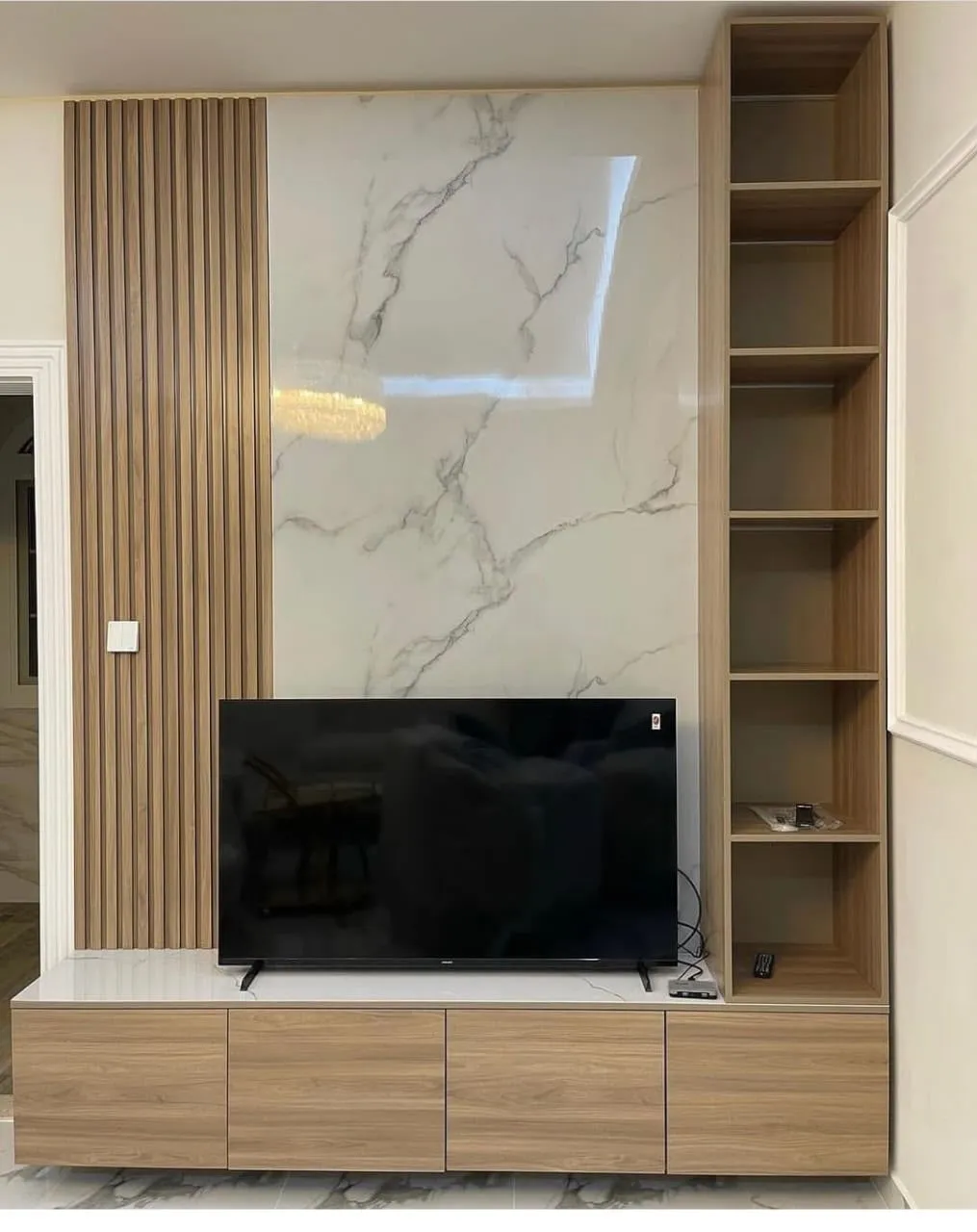
A compact wall first. A feature panel of 1.6 m by 1.0 m is 1.6 square metres, or about 19 kg. A floating console 2.2 m long and 0.4 m deep has a top and bottom of 2.2 × 0.4 each, two sides of 0.4 × 0.35 each and a back of 2.2 × 0.35, together about 2.8 square metres, or about 34 kg. Add doors or drawer fronts of 2.2 × 0.35, another 0.77 square metres or about 9 kg, and the console reaches roughly 43 kg before anything is put in it. Put in 15 kg of books and equipment, and the console load is about 58 kg. The TV is extra: read its own label for the weight.
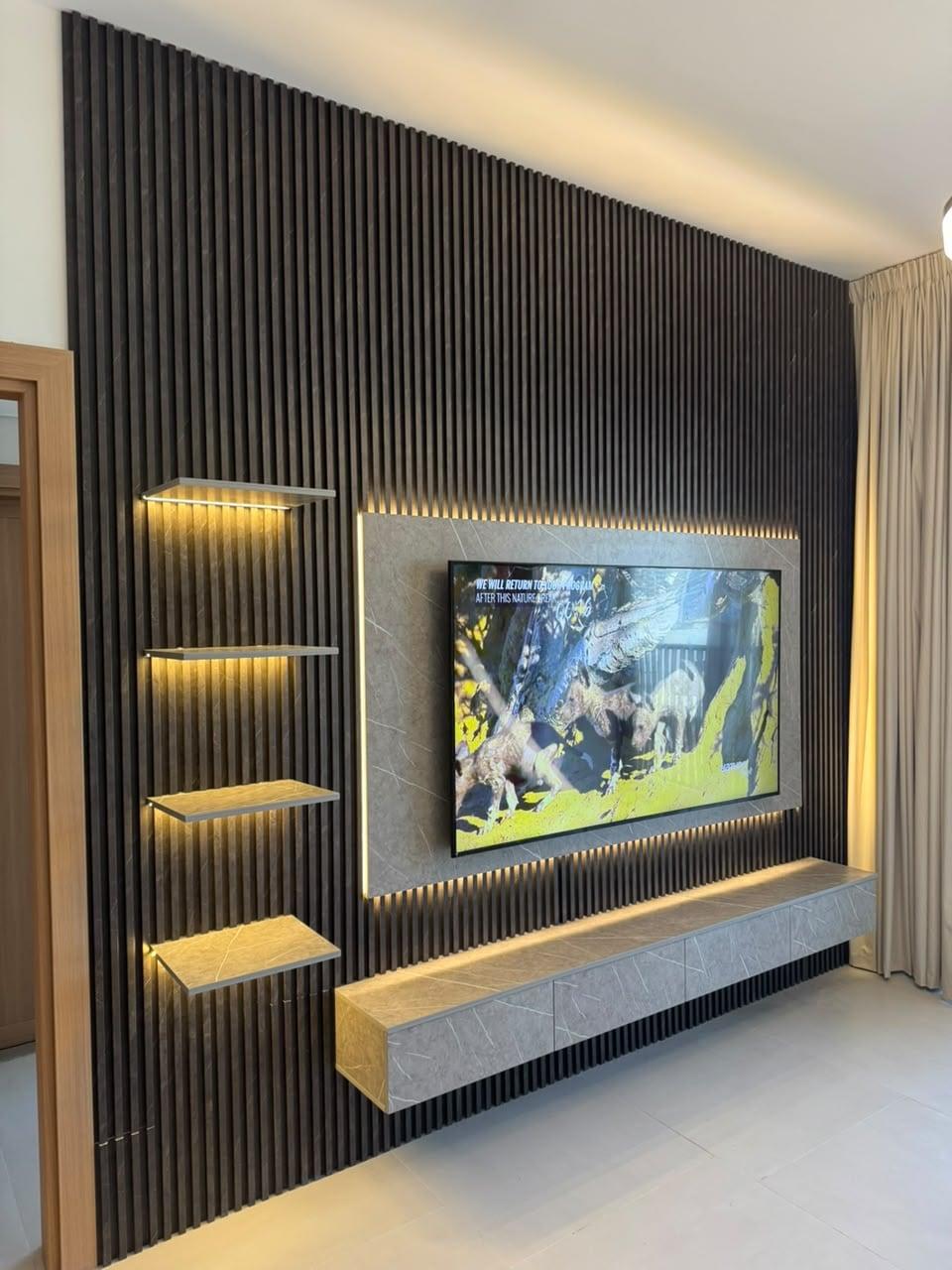
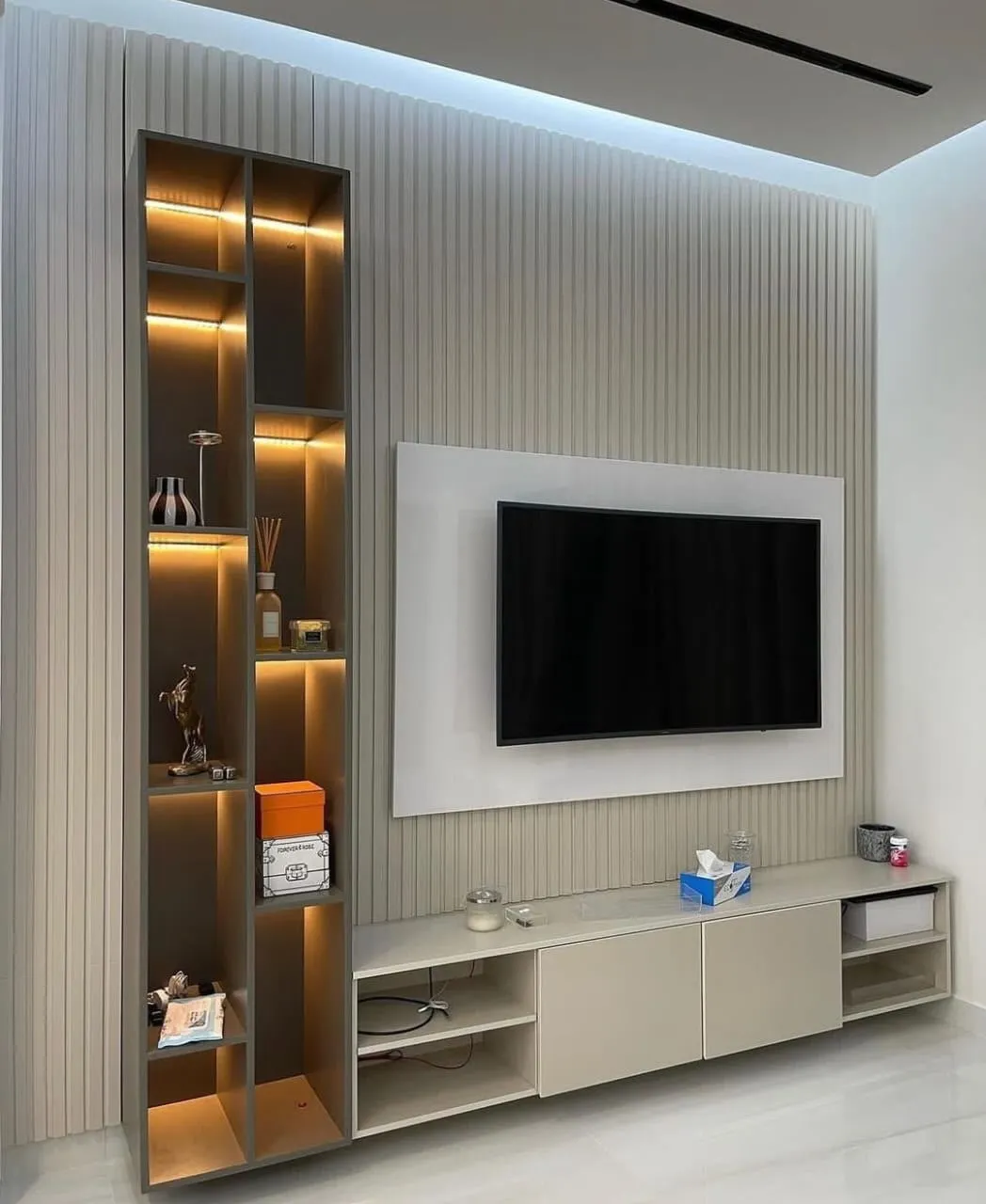
A full wall second. A slatted or fluted wall 3.0 m wide and 2.6 m high is 7.8 square metres, which at 12 kg is about 94 kg of boards. Split into five modules, each is about 19 kg, which two people can carry and one person can lift with care. Add shelves and a console and the total passes 150 kg. None of it is a surprise; it is simply what board weighs. But it explains why a full wall is fixed in modules, and why the fixing plan is drawn before the first panel is cut.
If a part is made of marble-effect or porcelain-effect sheet, the calculation changes. A thin sheet is light for its size, but it is brittle and often bonded to a backing board, so the total is the sum of the two. A 1.2 m by 2.4 m sheet of the 3 mm material above is 2.88 square metres, or about 20 kg at 7 kg per square metre, before the backing. We do not claim a build-up; ask for the construction of any face in the quotation. Our guide to marble TV walls explains the options.
Hung or standing: following the weight to the ground
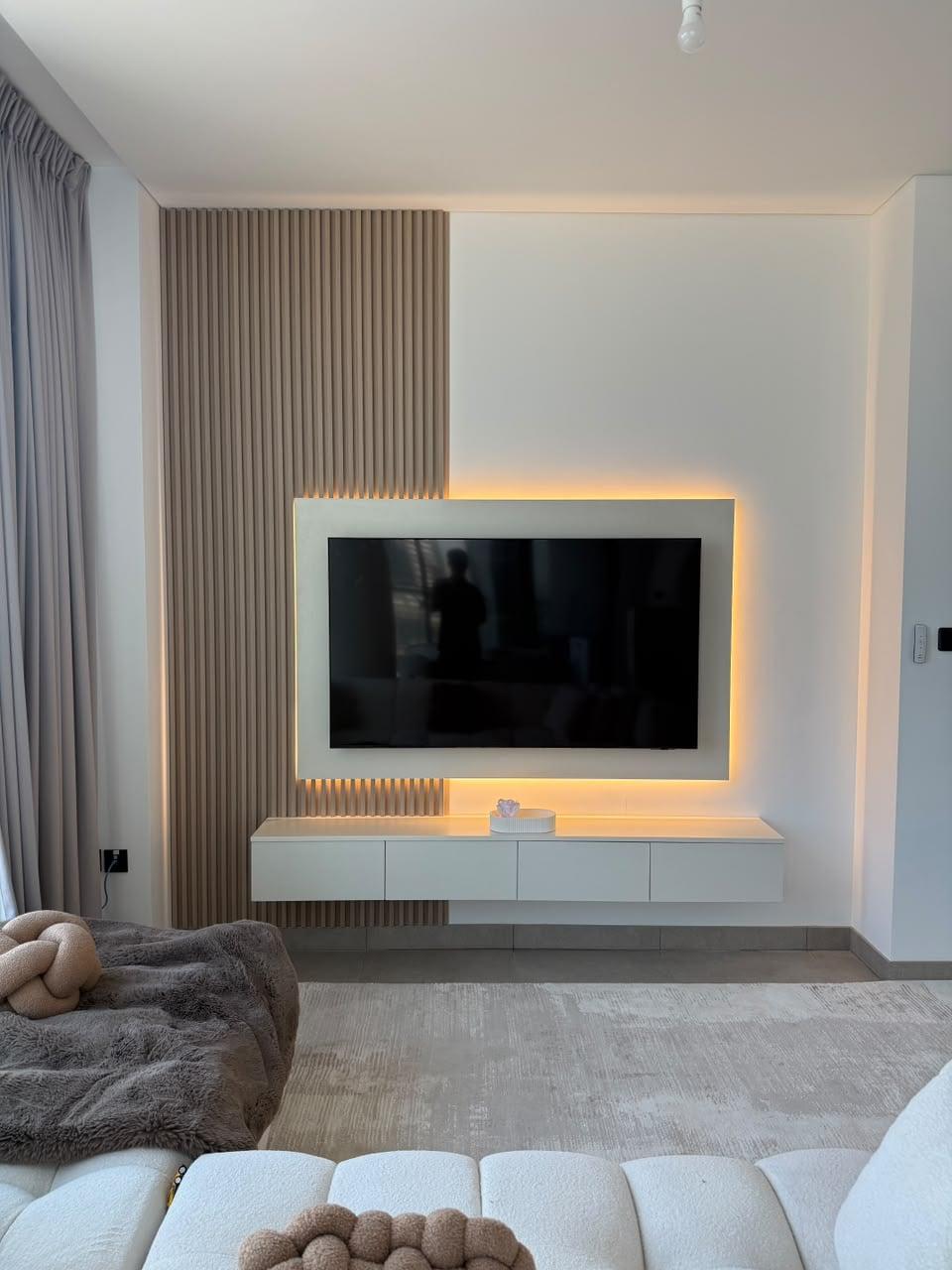
Every load on a media wall ends up in one of two places: the wall or the floor. A TV on its bracket pulls outward on the wall's fixings, because the screen's weight is out in front of the wall. A floating console hangs from the wall too, and its weight, which sits out in front, tries to turn the unit away from the wall. That turning force pulls the top fixings out and presses the bottom ones in. A console that stands on a plinth, or on legs, puts its weight straight down into the floor, and the wall only has to keep it from tipping.
The drawing shows the three cases. The practical rule is simple: the heavier the part, the more it should rest on the floor. A TV is unavoidably hung. A light shelf can hang. A long console loaded with drawers, equipment and books is the part that most often asks too much of a wall, and a plinth or a hidden base under it costs little and takes the load away from the fixings. It still looks floating if the base is set back.
The same logic applies to tall panels and modules. A full-height panel is carried by the floor and held upright by the wall; a hung panel is carried by the wall alone. If the wall is a gypsum partition, ask for the design to be floor-supported wherever it can be. Our guide to block and gypsum walls explains what each wall type is made of, and the TV height guide shows how the bracket position changes the lever arm.
A floating look is a design choice, not a weight rule. We can build a console that looks like it floats and still rests on a hidden plinth, and we would say so in the drawing. If you want a console to hang from the wall alone, tell us what it will hold, and we will tell you what the wall behind must be.
What a fixing can hold depends on the wall
A fixing is only as strong as the material it sits in. One manufacturer's data sheet makes this concrete. For fischer's SX Plus expansion plug in the 8 × 40 size, the table of recommended loads for a single plug gives 0.75 kN in C20/25 concrete, 0.60 kN in solid brick, 0.25 kN in vertically perforated brick and 0.10 kN in aerated concrete, with the required safety factors already included. In plain units, 0.75 kN is roughly 76 kilograms-force and 0.10 kN roughly 10. The same plug holds about seven times less in light aerated block than in concrete.
That is one product's table and it must not be read as a rule for every plug or every wall. A different plug, in a different size, in a different material, gives different numbers. What the table teaches is the order of magnitude and the direction: the wall decides what the plug can hold, and some UAE wall types are much weaker than others. Our guide to block and gypsum walls explains how to find out which you have.
Plasterboard is another case, and the numbers are even smaller. fischer's page for a self-tapping metal plasterboard fixing, again one product, lists a maximum load of 8 kg in 12.5 mm gypsum plasterboard and 7 kg in 9.5 mm. These are the figures for a single fixing in a single board. It is the reason a console is never hung on board alone, and why we plan fixings to reach studs, backing or the structural wall behind.
Mounting instructions make the same point for TVs. One heavy-duty full-motion bracket's manual says not to install it on drywall alone, to use wood studs, and that the user must verify the wall can hold the weight of the TV and the mount. Another mount's instructions say the wall structure must be able to support five times the combined weight of the equipment. Those are specific to those models, and we do not generalise them; they show how a maker thinks about the wall, and why we ask what the wall is before we choose a bracket.
Reading a fixing or bracket page without over-reading it
Recommended load per plug, by material
- What it means
- The wall type changes the rating a lot
- What it does not mean
- That every plug in that wall holds the same
Maximum load in plasterboard, per fixing
- What it means
- Board alone carries very little
- What it does not mean
- That several fixings simply add up
Bracket capacity in kilograms
- What it means
- The mount's own limit
- What it does not mean
- That the wall behind can hold it
Wall must support several times the weight
- What it means
- A safety margin is expected
- What it does not mean
- That the same margin applies to every mount
Do not install on drywall alone
- What it means
- Find studs or backing first
- What it does not mean
- That a stud is always where you want the TV
From the manufacturer pages and manuals opened on 10 Nov 2026; each is one product, not a category.
The load a console carries beyond its own weight
A console is not weighed empty. It carries a games console, a receiver, a router, a stack of discs or books, and often something decorative on top. A drawer full of cables is heavier than it looks, and a shelf of books is heavier than any electronics. When we plan a floating console we ask what it will hold, because a console that is light when we draw it can be heavy when it is lived in.
Think of the console as three weights: its own, its contents and its surprises. Its own weight comes from the board arithmetic above. The contents are what you plan to put in it. The surprises are what you will put in it in three years, when the family has a new device and a shelf has become a storage bay. The right design leaves margin for all three and does not rely on every drawer staying half empty.
The same applies to the shelves beside the TV and to display niches. A glass shelf with a vase and books is a point load, and a row of display cabinets is a line load on the floor. Our guide to shelves in a TV wall explains spans and depths, and the media wall lighting guide shows why heavy shelves and lighting channels have to be planned together.
If you plan a bigger TV later, the bracket and the wall behind matter again. Our guide to changing the TV later explains how to leave room for that, and buying the TV first explains why we ask for its model before the drawing.
Splitting a wall into modules two people can carry
A wall is made in modules so that it can be built in the workshop, carried through a building and fixed on site. The best size of a module is a compromise between the look and the carry. Joints should fall where they are least visible, at the edge of the TV recess, the top of the console or a change of material, and the pieces should be small enough that two people can carry them. A tall single panel looks good, but it is the piece most likely to be a problem in a lift, on a stair or on a landing.
The weight arithmetic helps here. A 3.0 m by 2.6 m wall of 18 mm board is about 94 kg of boards; five modules of about 19 kg are an easy two-person carry, while two modules of 47 kg are not. The modules need not be equal, and the heaviest piece should be one that two people can handle without strain. If you can, ask for the module list with approximate sizes and weights on the drawing; the weights are the workshop's estimate, not a promise.
The delivery side is covered in our guide to lift and delivery access, and the route inside the room in preparing your room. Weight links them: a piece too heavy for the corridor needs a different split, and the split is far cheaper to change on the drawing than at the lift door.
Finish matters across joints. Modules made from the same boards and the same finish fit together visually, which is another reason to settle the division early. The finish sample guide explains why you should see a full-size sample in your own light before the finish is fixed.
Carrying heavy pieces safely
The UK Health and Safety Executive's guide to manual handling states that the regulations do not set specific weight limits, so its guideline figures are not safe limits for lifting and carrying. It also lists handling done by a team among the cases that need a fuller assessment, along with twisting and weights over its filter values. The reading for a media wall is practical. There is no single number that makes a piece safe. The route, the grip, the number of people and the way the piece is carried decide that.
So the rules we use are about method rather than numbers. Look at the piece and the route before you lift. Carry long panels on their edge, close to the body, with two people at the ends. Never drag a console, because dragging breaks corners and the floor. Keep the heavy pieces low in the vehicle and at the bottom of a pile. Do not carry anything you cannot see around. Wrap corners and edges first. Do not try to save a trip by carrying more than the grip allows.
The drawing sets this out as a table of parts: shelves and doors for one person; the console carcass for two; a tall panel or slat module for two, after walking the route; and a marble-effect or porcelain face for two or more, carried on its edge and marked fragile. It is a judgement, not a limit, and a different piece in a different building may need more.
Do not forget the stairs. A piece that two people can carry along a corridor may be too awkward to turn on a landing, and a walk-up building changes the plan entirely. Our moving guide explains wrapping and carrying from the other direction, and the installation day checklist shows how the pieces are brought in order.
Three walls, three weight plans
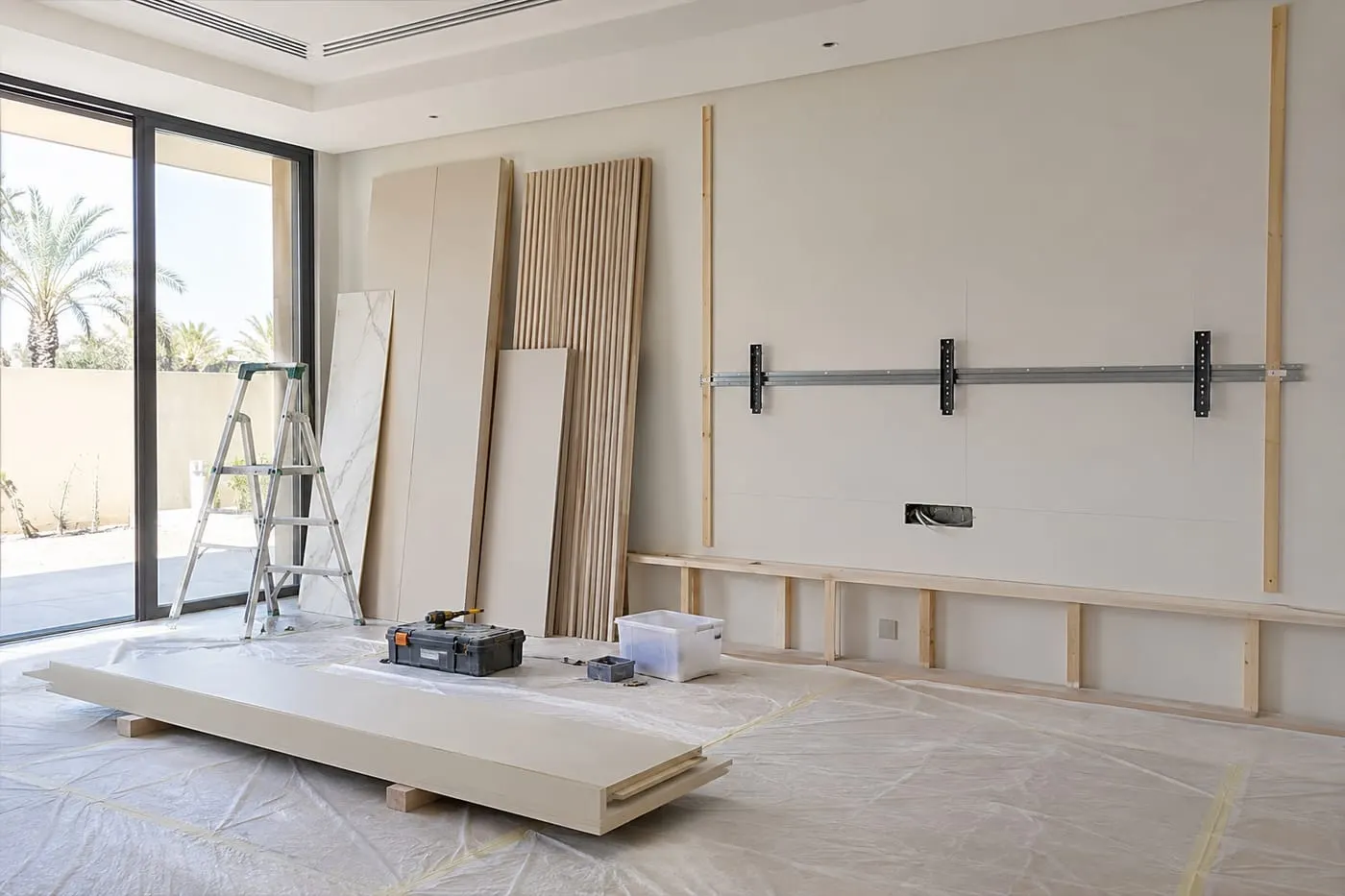
A compact wall on a block wall. A single 1.6 m panel with a floating console of 2.2 m, in a living room whose wall is block. The boards total about 62 kg, the contents add perhaps 15 kg, and the TV is extra. The plan: fix the panel and the console rails into the block with plugs suited to block, keep the console's heavy contents low and in drawers, and check the TV's weight against its bracket. This is the simple case, and the wall can take it with ordinary care.
A full wall on a gypsum partition. A 3.0 m by 2.6 m slatted wall of about 94 kg of boards on a partition between the living room and a bedroom. The plan changes: the wall is not carrying a hung console on its own; the console goes on a hidden plinth, the slat modules are fixed to studs or backing and rest on the floor, and the bracket is mounted on a backing plate behind the board. We would ask for photographs of the partition and, if needed, a look at the free measuring visit. A plan that hangs everything from board alone is not a plan.
A marble-effect wall with a tall tower. A feature panel with a thin stone-effect face, a floating console and a tall lit tower beside the screen. The faces are light for their size but brittle, the tower is tall, and the console is long. The plan: carry faces on edge with corners protected, keep the tower on the floor and tied back at the top, support the console on a plinth, and split the face at the edge of the recess so no piece is awkward. Weight matters here for handling as much as for fixing.
Mistakes that make a heavy wall a problem
The first mistake is hanging a loaded console from board alone. The second is assuming that any plug works in any wall. The third is judging a wall by its look: a block wall and a gypsum partition can be painted the same colour. The fourth is quoting a bracket's capacity as if it were the wall's capacity. The fifth is carrying a long panel flat, so that it flexes and cracks.
The sixth is dragging a console. The seventh is leaving the weight of the contents out of the plan. The eighth is splitting a wall for looks without testing the route. The ninth is relying on a lift's size alone: a lift that takes a panel standing may still not take two people carrying a console. The tenth is not asking us. A WhatsApp message with photographs of the wall, and the TV's model, costs nothing and often saves a surprise.
A weight checklist before the drawing is approved
Use this list when you look at a drawing, and ask for the answers in writing.
- What is the wall behind: block, gypsum, or something else, and who confirmed it?
- Which parts hang from the wall, and which stand on the floor?
- What will the console hold, and is the margin for future devices?
- How is the bracket fixed, and what is behind the board at that spot?
- What are the modules, and what is the heaviest one?
- How will each piece be carried, and by how many people?
- Which faces are brittle, and how are their edges protected?
- What do the fixings suit, and who chose them for this wall?
Choosing designs with weight in mind
Weight is a design input, not only a problem to solve afterwards. A fluted or slatted wall is mostly board and a lot of small parts; our guide to fluted TV wall panels shows the profiles, and the weight follows the thickness of the board behind them. A 3D textured wall adds relief that is often built up from more material, which the 3D feature wall guide explains, and relief usually means more weight to hang.
Stone-look faces are the other extreme: light as a thin sheet and heavy as a bonded panel. The marble TV wall guide and marble TV wall options explain the choices, and the weight question to ask is what the face is bonded to and how the edges are protected. An electric fireplace adds its own unit and its own heat; the fireplace guide explains how it is planned, and its weight and clearances should be on the drawing.
The size of the wall changes everything. A compact panel and a floating console are the light end, and full wall or compact media wall explains the trade-off. If you are still choosing the look, media wall design ideas and the media wall guide show finished walls, and the villa TV wall guide shows how larger rooms take larger, heavier pieces.
Use the pricing guide to see how size and finish move the figure; the final number comes from the quotation, and the weight plan is part of the drawing you approve.
What we do about it, and what to send us
Our media walls start from AED 3,500 per project for a compact panel and floating console in standard laminate; the final figure comes from the quotation and depends on the wall size, the finish (laminate, veneer or lacquer), marble-effect panels, lighting and an electric fireplace. We make them in our Sharjah workshop with our own team, and our team installs them across the UAE. The measuring visit is free, the drawing and itemised price are approved before anything is cut, and once measurements and details are agreed, a 60% advance is paid and production starts when it is received, with up to about 10 days depending on size and design. The founder, Ali Haider Basra, has ten years in the trade, and the 5-year limited warranty covers wood-based boards only; hinges, runners, labour and misuse are excluded.
To check the weight plan for your wall, send a photograph of the wall taken straight on, any information you have on its type, the TV's model or size, what the console will hold, and your building's lift size if you know it. We will tell you what we would look at on a visit. The range is on the media walls page, and what a media wall costs explains how size and finish change the figure.
The simplest next step is a WhatsApp message with the wall photo, the TV size and a photo of the room. Orders are confirmed on WhatsApp, so the thread, the drawing and the quotation stay together. A checklist of what to include is in what to send before a consultation.
Common questions
How heavy is a media wall?
Boards are most of it: 18 mm MDF at the density band of one maker's datasheet is about 12 kg per square metre, so an 8 square metre wall is roughly 94 kg of boards before frame, shelves and TV. Panel materials explains the board types.
Can a gypsum wall hold a media wall?
Only if the weight is carried to the floor or into studs and backing; board alone holds very little per fixing. Block and gypsum walls for a TV explains how to find out which wall you have.
How much weight can a floating console hold?
It depends on the wall behind, the fixings and the design, so tell us what it will hold and we will say what the wall must be. A console on a hidden plinth passes its load to the floor. Shelves in a TV wall explains spans.
Are marble-effect panels heavy?
A thin 3 mm stone-effect sheet is light for its size (one maker states 7 kg per square metre) but brittle, and it is often bonded to a backing board, so the total is the sum. Marble TV wall options explains the choices.
How many people does it take to carry media wall panels?
Shelves and doors one person; a console carcass or tall module two; a brittle face two or more, carried on its edge. The route and the grip decide, not a single weight limit. Lift and delivery access covers the route.
Does a bigger TV need a stronger wall?
It needs a bracket rated for its weight and a wall that can hold the mount, and bracket makers ask you to verify the wall. Changing the TV later explains how to leave room.
Can you check my wall before I order?
Yes: send photos of the wall and the TV size on WhatsApp, and the measuring visit is free. Our media walls page shows what we build.

Sources & specifications
Manufacturer information applies to the named products and systems. Sources reviewed on 10 November 2026.
- Wikipedia: Medium-density fibreboard (density typically 500 to 1,000 kg/m³; mainly indoor use)en.wikipedia.org(opens in a new tab)
- FINSA: Mediland LP EZ technical datasheet (density by thickness band; thickness swelling)files.finsa.com(opens in a new tab)
- Neolith: technical data, 3 mm thin sheet (weight 7 kg/m²)documentacion.generadordeprecios.info(opens in a new tab)
- fischer: SX Plus expansion plug data sheet (recommended loads by base material)docs.rs-online.com(opens in a new tab)
- fischer UK: Plasterboard fixing metal GKM (maximum load in 12.5 mm and 9.5 mm plasterboard)fischer.co.uk(opens in a new tab)
- Monoprice 44486 heavy-duty TV mount manual (not on drywall alone; verify the wall can hold the weight)downloads.monoprice.com(opens in a new tab)
- HSE (UK): Manual handling at work, a brief guide, INDG143 (no set weight limits; team handling)hse.gov.uk(opens in a new tab)
Want this planned for your home?
Consultation and measurement are free. Tell us the rooms, location and what you need; we arrange a sample visit and define the measured quotation.